

From intellect to spirituality
 |
Description
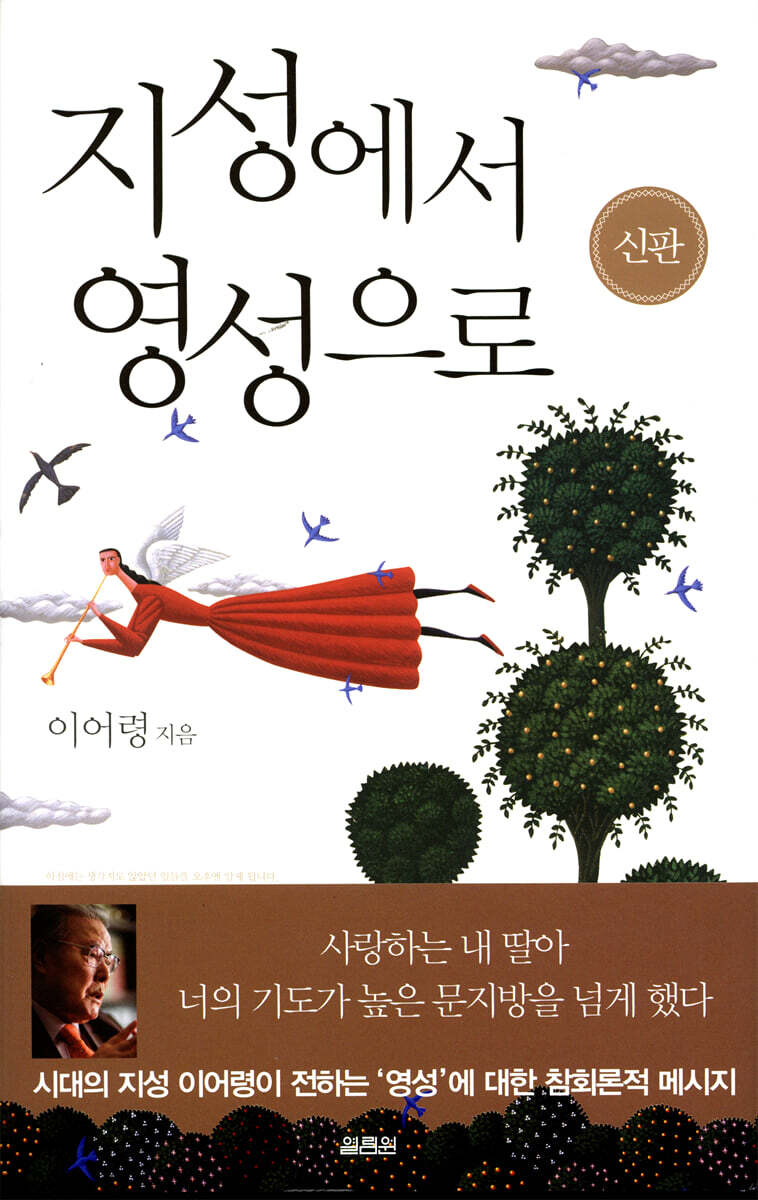
Book Introduction
A diary of a cool-headed intellect, infinitely passionate and innocent
Towards a higher place, towards the light of spirituality
Former Minister of Culture Lee Eo-ryeong is a cool-headed intellectual and atheist who has lived his life rejecting all established authority.
He had never been to church or believed in any religion, but on July 24, 2007, he knelt down to be baptized.
“From today on, I walk the path of a believer.
I have walked this far with many titles.
Now we are embarking on a new path.
This path may be lonely, but as a believer, I want to take it one step at a time.”
"From Intellect to Spirituality" is the infinitely passionate and innocent diary of a cool-headed intellect that no one has ever read.
This is a confession of an atheist's human hesitation before approaching God. The author, Lee Eo-ryeong, records in detail the process of moving from intellect to spirituality as a Christian and his honest thoughts along the way.
At the end of the book, we have included a compilation of interviews conducted by various media outlets.
Ten years have passed since I confessed that I had ascended the threshold of the high sanctuary without any preparation.
They say even mountains and rivers change in ten years. What has happened to him in those years? To commemorate the 10th anniversary of author Lee Eo-ryeong's baptism, Open One has revived and republished the testimony of his daughter, Pastor Lee Min-ah, which was omitted from the latest revised edition.
Although it is not a large amount, its weight is by no means small when considering the message of the entire book.
Pastor Lee Min-ah, who lived like heaven on earth and was called by the Lord in the spring of 2012, describes her unimaginable suffering in sentences that are sometimes so hot it almost burns your throat, but at other times with infinite calmness.
Jesus did not comfort his mother with tears, but soothed her heart with the word of God and spoke of hope that transcended sorrow.
People will stand in silence for a while as they receive this poignant letter, which confesses what human life is like on earth and how God is present in it.
Author Lee Eo-ryeong says that the realm that artificial intelligence cannot reach in the Fourth Industrial Revolution is the "spirituality" of art and religion (lecture at Sarang Church, August 2017).
It is said that religion in the future society exists to fill the void between artificial intelligence and humans with spirituality.
At the threshold of a new era, Lee Eo-ryeong's profound confessions, questions, and messages of faith about spirituality to our society will serve as small beacons that lead readers "toward a higher realm, toward the light of spirituality."
Towards a higher place, towards the light of spirituality
Former Minister of Culture Lee Eo-ryeong is a cool-headed intellectual and atheist who has lived his life rejecting all established authority.
He had never been to church or believed in any religion, but on July 24, 2007, he knelt down to be baptized.
“From today on, I walk the path of a believer.
I have walked this far with many titles.
Now we are embarking on a new path.
This path may be lonely, but as a believer, I want to take it one step at a time.”
"From Intellect to Spirituality" is the infinitely passionate and innocent diary of a cool-headed intellect that no one has ever read.
This is a confession of an atheist's human hesitation before approaching God. The author, Lee Eo-ryeong, records in detail the process of moving from intellect to spirituality as a Christian and his honest thoughts along the way.
At the end of the book, we have included a compilation of interviews conducted by various media outlets.
Ten years have passed since I confessed that I had ascended the threshold of the high sanctuary without any preparation.
They say even mountains and rivers change in ten years. What has happened to him in those years? To commemorate the 10th anniversary of author Lee Eo-ryeong's baptism, Open One has revived and republished the testimony of his daughter, Pastor Lee Min-ah, which was omitted from the latest revised edition.
Although it is not a large amount, its weight is by no means small when considering the message of the entire book.
Pastor Lee Min-ah, who lived like heaven on earth and was called by the Lord in the spring of 2012, describes her unimaginable suffering in sentences that are sometimes so hot it almost burns your throat, but at other times with infinite calmness.
Jesus did not comfort his mother with tears, but soothed her heart with the word of God and spoke of hope that transcended sorrow.
People will stand in silence for a while as they receive this poignant letter, which confesses what human life is like on earth and how God is present in it.
Author Lee Eo-ryeong says that the realm that artificial intelligence cannot reach in the Fourth Industrial Revolution is the "spirituality" of art and religion (lecture at Sarang Church, August 2017).
It is said that religion in the future society exists to fill the void between artificial intelligence and humans with spirituality.
At the threshold of a new era, Lee Eo-ryeong's profound confessions, questions, and messages of faith about spirituality to our society will serve as small beacons that lead readers "toward a higher realm, toward the light of spirituality."
- You can preview some of the book's contents.
Preview
index
Introduction 8
Part 1: Finding in Kyoto
01 The Weight of a Sack of Rice and a Sack of Soul 19
02 Breakfast with Crows 25
03 The Beauty of Withering Flowers 31
04 Gods Who Come Like Guests 37
05 People Who Buy Sleep 43
06 Drawing, Longing, and Scratched Writing 49
07 Mimicking the Power of Creation 57
08 Memento Mori 65
09 In the name of the Father 71
10 It's time to do the dishes 77
11 Cut the string 85
12 People with Nowhere to Go on Holidays 89
13 The Disease of Faith 99
14 A fat bird cannot fly 105
15 The Prodigal Son Returns Without Repentance 115
16 Tears of the Camel 123
17 The Power of Art and the Lion of the Desert 129
18 Shepherd's Leadership 137
19 Falling Snow in Korean 145
Part 2: Meet in Hawaii
20 The World Changed by One Phone Call 151
21 Even if the dawn that day had not been so bright, 159
22 Morning News from Intellect to Spirituality 167
23 A Temple Made of Abandoned Stone 173
24 Baptism is not a washing, but a digging out. 183
25 Hand touching forehead 191
26 Mother's Tangerines 203
27 The Resurrection of the Mother Riding a Rickshaw 213
Part 3: Conducting in Korea
28 How many colors are there in a rainbow? 219
29 Christianity Beyond Culture 229
30 Jesus' Hands, the Rock, and the Cloth 237
31 The Faithful Park Brought to You by a Swallow 243
32 Tears Wetting the Sahara Desert 249
33 Even if there are no fig trees, 255
34 A Fatherless Society 263
35 The Harvest of True Grapes, Unripe Grapes 267
36 Man measures with time; God measures with the heart. 273
Part 4: Father and Daughter Meet
Minah's Letter: The Little Miracle of the Red Mailbox 284
Father's Letter: You Are My Companion 286
37 The Beginning of Faith 289
38 I can no longer live on my own strength. 299
39 Lord, please write me 309
40 Two Fathers, Earthly and Heavenly 317
Part 5: Conversation on the Threshold 331
Part 1: Finding in Kyoto
01 The Weight of a Sack of Rice and a Sack of Soul 19
02 Breakfast with Crows 25
03 The Beauty of Withering Flowers 31
04 Gods Who Come Like Guests 37
05 People Who Buy Sleep 43
06 Drawing, Longing, and Scratched Writing 49
07 Mimicking the Power of Creation 57
08 Memento Mori 65
09 In the name of the Father 71
10 It's time to do the dishes 77
11 Cut the string 85
12 People with Nowhere to Go on Holidays 89
13 The Disease of Faith 99
14 A fat bird cannot fly 105
15 The Prodigal Son Returns Without Repentance 115
16 Tears of the Camel 123
17 The Power of Art and the Lion of the Desert 129
18 Shepherd's Leadership 137
19 Falling Snow in Korean 145
Part 2: Meet in Hawaii
20 The World Changed by One Phone Call 151
21 Even if the dawn that day had not been so bright, 159
22 Morning News from Intellect to Spirituality 167
23 A Temple Made of Abandoned Stone 173
24 Baptism is not a washing, but a digging out. 183
25 Hand touching forehead 191
26 Mother's Tangerines 203
27 The Resurrection of the Mother Riding a Rickshaw 213
Part 3: Conducting in Korea
28 How many colors are there in a rainbow? 219
29 Christianity Beyond Culture 229
30 Jesus' Hands, the Rock, and the Cloth 237
31 The Faithful Park Brought to You by a Swallow 243
32 Tears Wetting the Sahara Desert 249
33 Even if there are no fig trees, 255
34 A Fatherless Society 263
35 The Harvest of True Grapes, Unripe Grapes 267
36 Man measures with time; God measures with the heart. 273
Part 4: Father and Daughter Meet
Minah's Letter: The Little Miracle of the Red Mailbox 284
Father's Letter: You Are My Companion 286
37 The Beginning of Faith 289
38 I can no longer live on my own strength. 299
39 Lord, please write me 309
40 Two Fathers, Earthly and Heavenly 317
Part 5: Conversation on the Threshold 331
Publisher's Review
A diary of a cool-headed intellect, infinitely passionate and innocent
Towards a higher place, towards the light of spirituality
Former Minister of Culture Lee Eo-ryeong is a cool-headed intellectual and atheist who has lived his life rejecting all established authority.
He had never been to church or believed in any religion, but on July 24, 2007, he knelt down to be baptized.
“From today on, I walk the path of a believer.
I have walked this far with many titles.
Now we are embarking on a new path.
This path may be lonely, but as a believer, I want to take it one step at a time.”
"From Intellect to Spirituality" is the infinitely passionate and innocent diary of a cool-headed intellect that no one has ever read.
This is a confession of an atheist's human hesitation before approaching God. The author, Lee Eo-ryeong, records in detail the process of moving from intellect to spirituality as a Christian and his honest thoughts along the way.
At the end of the book, we have included a compilation of interviews conducted by various media outlets.
Ten years have passed since I confessed that I had ascended the threshold of the high sanctuary without any preparation.
They say even mountains and rivers change in ten years. What has happened to him in those years? To commemorate the 10th anniversary of author Lee Eo-ryeong's baptism, Open One has revived and republished the testimony of his daughter, Pastor Lee Min-a, which was omitted from the latest revised edition.
Although it is not a large amount, its weight is by no means small when considering the message of the entire book.
Pastor Lee Min-ah, who lived like heaven on earth and was called by the Lord in the spring of 2012, describes her unimaginable suffering in sentences that are sometimes so hot it almost burns your throat, but at other times with infinite calmness.
Jesus did not comfort his mother with tears, but soothed her heart with the word of God and spoke of hope that transcended sorrow.
People will stand in silence for a while as they receive this poignant letter, which confesses what human life is like on earth and how God is present in it.
Author Lee Eo-ryeong says that the realm that artificial intelligence cannot reach in the Fourth Industrial Revolution is the "spirituality" of art and religion (lecture at Sarang Church, August 2017).
It is said that religion in the future society exists to fill the void between artificial intelligence and humans with spirituality.
At the threshold of a new era, Lee Eo-ryeong's profound confessions, questions, and messages of faith about spirituality to our society will serve as small beacons that lead readers "toward a higher realm, toward the light of spirituality."
Each human being is an island.
As an atheist, this prayer resonates even more deeply and earnestly.
Lee Eo-ryeong said that while living at the Kyoto Research Institute, there were times when he did not have a chance to speak to anyone from morning to night.
What tormented him was his longing for people, his yearning to meet, talk, eat, and have fun.
The author compares himself to Robinson Crusoe, stranded on a deserted island, to describe the pain of being alone.
Yet, I also confess my contradictory feelings of fear of actually meeting someone.
Because being lonely also means being free.
The author says that one of the joys of living in Kyoto is being able to view all the scenery, news, and people of a foreign country without any burden.
The author writes a diary regularly, using the existential loneliness he feels in a foreign land as material.
Writing a diary is an act of filling the blank space of a blank piece of paper with words and meaning.
The author cites someone's comparison of Captain Ahab, chasing the white whale Moby Dick, to a writer struggling with the blankness of the manuscript, and says that he, too, may be drowning in that sea every day because he has been unable to penetrate the heart of that blankness.
Still, I resolve to write until the day I die, until the world ends.
I found languages that raise their heads and stand up like daffodils that bloom even in the cold winter.
The anecdote I will introduce next is one of them.
Lee Eo-ryeong begins the book by recalling a day during her time at a research institute in Kyoto in 2004, before she was baptized.
There was a time when he hated the darkness of empty rooms and kept the lights on. As he was walking home after buying a sack of rice at the supermarket, he suddenly asked himself a question.
How many people in this world live without even the small joy of someone waiting to open the door when they ring the doorbell? Not the star of hope, not the star that guided the Magi, but simply a room in a foreign land, towards the pale fluorescent light, and I feel the weight of a sack of rice weighing down my shoulders.
It was only then that I heard the sound of my own footsteps, as I had been struggling with books, paper, letters, and information my entire life.
Returning home, he begins to pray not to fill the sack of rice, but to empty and let it go, to fill this empty room not with material things, but with the soul.
The poem written in this way is “An Atheist’s Prayer 1,” which begins with the confession that “when I’m so lonely, very occasionally/I kneel before you and pray.”
For the author, it was a piece that could not be converted into a manuscript fee, unlike the piece written under deadline pressure.
Lee Eo-ryeong says:
Even if there is enough food to eat, water to quench your thirst, and solid walls to block out the cold, there must be many atheists like me somewhere who put down their heavy sacks of rice and sit in an empty room, praying secretly.
They say that there are people who pretend to be strong on the outside, but if someone reaches out and says they love you, they will burst into tears.
Anyone born as a human being cannot help but be alone at every moment.
The author seems to be asking if, even when we sit alone at the table, if we can feel the hand of Jesus breaking the bread, saying, “This is my body, this is my blood,” wouldn’t that alone make us feel a little less lonely?
Memento Mori, Remember Death
God, who is always with me in my life, in my breath
The author says that the reason he was baptized may have been because of the Latin phrase 'memento mori', which means 'live with the knowledge that you will die'.
Then I recall when I was six years old, I was rolling a roller along a barley field road alone without any friends, and I burst into tears.
That day, standing in the middle of the white sunlight in the middle of a quiet day that was deafening, tears flowed for no reason.
And even the feeling of my mother's breath when I open my eyes alone at night and place my hand like a fern on her nose as she sleeps as if dead in the pitch-black darkness.
I confess that I realized from that moment on that death and life are not separate, but rather are always together, and that God was watching over us from a place close enough to reach out and touch.
It may be the sad limitation and condition of human beings that they cannot feel life without being conscious of death.
That is why we, ‘like a child who breaks his knee or gets a nosebleed and runs home calling for his mother, only when we are hurt do we run to God and call out’ (p. 98).
Is that why?
Kyoto's diary is filled with stories of illness for almost a month.
The disease makes you feel your whole body.
Talking to my wife, who has a cold in a foreign land, also makes me realize that people are isolated from each other and that each person has to suffer from their own pain.
That is why it is said that humans should not suffer from illness alone.
Because existence is a disease and people associate with others through disease, we need people to care for each other.
Maybe that is the reason for the existence of religion.
As the author puts it, illness is a shortcut to religion.
Our Father on Earth and Our Father in Heaven
Through my daughter, I saw a higher world beyond my intellect.
The author, who returned to Korea after spending a year in Kyoto, which felt like the longest year of his life, the first step from intellect to spirituality, feels like Robinson Crusoe returning to London.
As the prodigal son who returned without repentance, he spent his days forgetting even the prayers of an atheist until he received a call from his daughter, Pastor Lee Min-ah.
That one phone call that makes it impossible to go back to the life before receiving the phone call.
The day I rushed to Hawaii with my wife to see my daughter, she went blind. This cruel world is so dazzling and beautiful.
The coral reef sea was like a transparent glass ball that allowed one to see all the way to the bottom.
But at that moment, there is no light in the sky or on the earth, and everything is dark.
At that moment, without realizing it, the words “Oh, God” burst out of Father Lee Eo-ryeong’s mouth.
If this child never sees my face again, if she never sees her mother's smiling face and her father's smile, isn't that saying that everything in this house, everything with color in the mountains, the sea, and the streets, everything with form, will disappear?
How could you do that to the Lord's daughter?
You are too much, God.
Why do you give so much suffering to your daughter who believes in and follows God the Father so much?
Not only is cancer not enough, but now blindness?
Why are you crying again when you have tears in your eyes from going to school because of a sick child?
Mina said calmly.
“Don’t worry.
Pastor So-and-so lost his sight at a young age, but he sees better than we do.
He said you could see more.
Just think of it as always night.
Even in that dark world, can't you see all the shapes and lights you saw during the day? Your father's face, your mother's hands.
The sound tells you and the smell makes you feel.
“I’m just worried that Mom and Dad will be worried, but I don’t care.” _Pages 153-154
The author confesses that it was not her earthly father but her heavenly Father who protected her daughter from misfortune and despair, comforted her, and guided her to a new life.
He painfully admits that he was only there for her during the happy moments, and that he was not there when his daughter was raising her child alone, when she was having surgery for cancer, when she cried every night because she couldn't attend school properly.
In the face of his daughter's suffering, the author offers a devout prayer to the Lord, whom he had never believed in, for the first time in his life.
'God, if you do not take the light away from my beloved daughter, I will live the rest of my life as your child.'
Don't let go of my hand
You have to hold on tight to someone's hand and walk so that you don't let go when they lose strength.
Why does God so ruthlessly orchestrate and direct the affairs of the world according to His own predetermined order? Pastor Lee Min-ah received a miraculous diagnosis: her retina was healed upon her arrival in Korea.
The time has come to keep the prayers and promises we have made in secret.
One early morning in April, before Pastor Lee Min-ah left for the United States, the author, while seeing his daughter off to church, shouted without realizing it.
“Min-ah, I’m going to get baptized.
“Tell the pastor.”
Yes, that's right.
If the spring light of April dawn had not been so bright, if the dawn air had not been so fresh like the green leaves, I would never have cried out like that.
“I am being baptized.”
Oh my God!
Why would I make such an oath when I have no confidence in myself?
Even from afar, I could clearly feel the morning dew on Minah's eyes.
Oh, thank you, God.
My daughter Minah must have been crying out to God in heaven, not to her father on earth.
Page 164
The author prays quietly before embarking on his intended path to becoming a Christian.
Ask for the faith that can convince you.
Open the door without knocking, and block the way even if I run away without asking, and open the path to spirituality.
And let me wander a little longer.
Please allow me to stay in the old house yard a little longer.
Baptism and After
After deciding to be baptized, the author asks:
Is my life going according to God's will? Why am I only now, well over seventy, here? God uses people well, so surely I will be useful, too? Lee Eo-ryeong ponders.
If I tell you what I realized later after wandering around like a prodigal son my whole life, maybe the hearts of non-believers will change.
Maybe that's what it's for.
In July 2007, I burst into tears while being baptized, tears that I would normally have hidden out of embarrassment.
Why did you cry?
Was it sadness, emotion, repentance, or perhaps gratitude?
The author says:
For him, the world of spirituality was not something that could be understood or explained.
It is said that it is thrown into despair.
For the author, baptism was not a ritual of washing with water, but rather like drawing up a vein of hot spring water buried deep in his heart.
Maybe those were the tears I shed back then.
It is said that if one digs deep into one's heart, there flows the spiritual vein.
Just as a thirsty deer desperately seeks water in a valley, we go to the church and to the Lord to quench our soul's thirst.
It may be the fragile light of love that humans have lit for one another in the darkness, and the light of spirituality that we have desperately sought and waited for throughout our lives.
Pastor Lee Min-ah's daughter's testimony
At that time, in 2004, when my child was twelve years old, I was in despair because my child would not get better no matter how much I prayed, so I cried and prayed all night. When I read the QT book out of habit in the morning, there was a passage from Acts 3, a passage about life.
When Peter said, “Silver and gold I do not have, but what I have I give you: In the name of Jesus Christ of Nazareth, rise up and walk,” the beggar who had been lame since birth believed those words and immediately stood up and walked. As I read that passage, I began to cry out that I could no longer live on my own strength.
So I knelt down before him and prayed.
As I opened the Word, I prayed, “Lord, if it is true that Jesus is the same yesterday, today, and forever, why don’t I have the Jesus that Peter said he has while silver and gold don’t? Why doesn’t my child get better when I pray? Lord, I’ve prayed so hard for the past seven years, I’ve believed in you so diligently, and I’ve served you so diligently, so why isn’t my child getting better? Why don’t I have the power?” These heartbreaking prayers began to flow out along with the sighs the Holy Spirit had been praying for me.
Pages 299-300
“Father God, I believe that you love me.
I believe that there is someone who loves our Eugene more than I love him.
But I don't understand, my way and God's way are so different.
But I will lay down my ways and choose God's ways.
I will put down my thoughts and trust God's thoughts.
I believe that the Lord loves me and my son so much that He gave him the best.
This child going to heaven now is not by dying, but by giving our son the life of resurrection that Jesus said, “Whoever believes in me will never die, and will live even though they die.” I believe that our son is on the throne where Jesus is, as in Revelation 21, my favorite verse.
There are no tears, no death, no mourning or crying there. In front of Jesus, all the tears that Eugene shed during the difficult time after his mom and dad divorced were wiped away, and yet, thank you for raising him to be a good child who loved his mom and dad without becoming twisted, and for filling our child's funeral with only loved ones.
I am so grateful that you gave me a child who was missed by everyone for 25 years, without anyone hating or hurting me.
He made me pray to God, “If you send me to children who do not know God and do not receive the love of their mother and father in place of this child, I will work hard for those children and fulfill the youth ministry vision and intercessory ministry that God has given me.”
Pages 322-323
* This book is a revised edition following the revised edition published on April 15, 2010 (completely correcting errors in the lecture recordings in Part 3), the new revised edition published on August 13, 2010 (more detailed revisions and supplements), and the latest revised edition published on November 13, 2013 (additional content to Part 1 based on the author's diary written in Kyoto).
I have revived the testimony of Pastor Lee Min-ah, which was omitted from the latest revised edition.
Towards a higher place, towards the light of spirituality
Former Minister of Culture Lee Eo-ryeong is a cool-headed intellectual and atheist who has lived his life rejecting all established authority.
He had never been to church or believed in any religion, but on July 24, 2007, he knelt down to be baptized.
“From today on, I walk the path of a believer.
I have walked this far with many titles.
Now we are embarking on a new path.
This path may be lonely, but as a believer, I want to take it one step at a time.”
"From Intellect to Spirituality" is the infinitely passionate and innocent diary of a cool-headed intellect that no one has ever read.
This is a confession of an atheist's human hesitation before approaching God. The author, Lee Eo-ryeong, records in detail the process of moving from intellect to spirituality as a Christian and his honest thoughts along the way.
At the end of the book, we have included a compilation of interviews conducted by various media outlets.
Ten years have passed since I confessed that I had ascended the threshold of the high sanctuary without any preparation.
They say even mountains and rivers change in ten years. What has happened to him in those years? To commemorate the 10th anniversary of author Lee Eo-ryeong's baptism, Open One has revived and republished the testimony of his daughter, Pastor Lee Min-a, which was omitted from the latest revised edition.
Although it is not a large amount, its weight is by no means small when considering the message of the entire book.
Pastor Lee Min-ah, who lived like heaven on earth and was called by the Lord in the spring of 2012, describes her unimaginable suffering in sentences that are sometimes so hot it almost burns your throat, but at other times with infinite calmness.
Jesus did not comfort his mother with tears, but soothed her heart with the word of God and spoke of hope that transcended sorrow.
People will stand in silence for a while as they receive this poignant letter, which confesses what human life is like on earth and how God is present in it.
Author Lee Eo-ryeong says that the realm that artificial intelligence cannot reach in the Fourth Industrial Revolution is the "spirituality" of art and religion (lecture at Sarang Church, August 2017).
It is said that religion in the future society exists to fill the void between artificial intelligence and humans with spirituality.
At the threshold of a new era, Lee Eo-ryeong's profound confessions, questions, and messages of faith about spirituality to our society will serve as small beacons that lead readers "toward a higher realm, toward the light of spirituality."
Each human being is an island.
As an atheist, this prayer resonates even more deeply and earnestly.
Lee Eo-ryeong said that while living at the Kyoto Research Institute, there were times when he did not have a chance to speak to anyone from morning to night.
What tormented him was his longing for people, his yearning to meet, talk, eat, and have fun.
The author compares himself to Robinson Crusoe, stranded on a deserted island, to describe the pain of being alone.
Yet, I also confess my contradictory feelings of fear of actually meeting someone.
Because being lonely also means being free.
The author says that one of the joys of living in Kyoto is being able to view all the scenery, news, and people of a foreign country without any burden.
The author writes a diary regularly, using the existential loneliness he feels in a foreign land as material.
Writing a diary is an act of filling the blank space of a blank piece of paper with words and meaning.
The author cites someone's comparison of Captain Ahab, chasing the white whale Moby Dick, to a writer struggling with the blankness of the manuscript, and says that he, too, may be drowning in that sea every day because he has been unable to penetrate the heart of that blankness.
Still, I resolve to write until the day I die, until the world ends.
I found languages that raise their heads and stand up like daffodils that bloom even in the cold winter.
The anecdote I will introduce next is one of them.
Lee Eo-ryeong begins the book by recalling a day during her time at a research institute in Kyoto in 2004, before she was baptized.
There was a time when he hated the darkness of empty rooms and kept the lights on. As he was walking home after buying a sack of rice at the supermarket, he suddenly asked himself a question.
How many people in this world live without even the small joy of someone waiting to open the door when they ring the doorbell? Not the star of hope, not the star that guided the Magi, but simply a room in a foreign land, towards the pale fluorescent light, and I feel the weight of a sack of rice weighing down my shoulders.
It was only then that I heard the sound of my own footsteps, as I had been struggling with books, paper, letters, and information my entire life.
Returning home, he begins to pray not to fill the sack of rice, but to empty and let it go, to fill this empty room not with material things, but with the soul.
The poem written in this way is “An Atheist’s Prayer 1,” which begins with the confession that “when I’m so lonely, very occasionally/I kneel before you and pray.”
For the author, it was a piece that could not be converted into a manuscript fee, unlike the piece written under deadline pressure.
Lee Eo-ryeong says:
Even if there is enough food to eat, water to quench your thirst, and solid walls to block out the cold, there must be many atheists like me somewhere who put down their heavy sacks of rice and sit in an empty room, praying secretly.
They say that there are people who pretend to be strong on the outside, but if someone reaches out and says they love you, they will burst into tears.
Anyone born as a human being cannot help but be alone at every moment.
The author seems to be asking if, even when we sit alone at the table, if we can feel the hand of Jesus breaking the bread, saying, “This is my body, this is my blood,” wouldn’t that alone make us feel a little less lonely?
Memento Mori, Remember Death
God, who is always with me in my life, in my breath
The author says that the reason he was baptized may have been because of the Latin phrase 'memento mori', which means 'live with the knowledge that you will die'.
Then I recall when I was six years old, I was rolling a roller along a barley field road alone without any friends, and I burst into tears.
That day, standing in the middle of the white sunlight in the middle of a quiet day that was deafening, tears flowed for no reason.
And even the feeling of my mother's breath when I open my eyes alone at night and place my hand like a fern on her nose as she sleeps as if dead in the pitch-black darkness.
I confess that I realized from that moment on that death and life are not separate, but rather are always together, and that God was watching over us from a place close enough to reach out and touch.
It may be the sad limitation and condition of human beings that they cannot feel life without being conscious of death.
That is why we, ‘like a child who breaks his knee or gets a nosebleed and runs home calling for his mother, only when we are hurt do we run to God and call out’ (p. 98).
Is that why?
Kyoto's diary is filled with stories of illness for almost a month.
The disease makes you feel your whole body.
Talking to my wife, who has a cold in a foreign land, also makes me realize that people are isolated from each other and that each person has to suffer from their own pain.
That is why it is said that humans should not suffer from illness alone.
Because existence is a disease and people associate with others through disease, we need people to care for each other.
Maybe that is the reason for the existence of religion.
As the author puts it, illness is a shortcut to religion.
Our Father on Earth and Our Father in Heaven
Through my daughter, I saw a higher world beyond my intellect.
The author, who returned to Korea after spending a year in Kyoto, which felt like the longest year of his life, the first step from intellect to spirituality, feels like Robinson Crusoe returning to London.
As the prodigal son who returned without repentance, he spent his days forgetting even the prayers of an atheist until he received a call from his daughter, Pastor Lee Min-ah.
That one phone call that makes it impossible to go back to the life before receiving the phone call.
The day I rushed to Hawaii with my wife to see my daughter, she went blind. This cruel world is so dazzling and beautiful.
The coral reef sea was like a transparent glass ball that allowed one to see all the way to the bottom.
But at that moment, there is no light in the sky or on the earth, and everything is dark.
At that moment, without realizing it, the words “Oh, God” burst out of Father Lee Eo-ryeong’s mouth.
If this child never sees my face again, if she never sees her mother's smiling face and her father's smile, isn't that saying that everything in this house, everything with color in the mountains, the sea, and the streets, everything with form, will disappear?
How could you do that to the Lord's daughter?
You are too much, God.
Why do you give so much suffering to your daughter who believes in and follows God the Father so much?
Not only is cancer not enough, but now blindness?
Why are you crying again when you have tears in your eyes from going to school because of a sick child?
Mina said calmly.
“Don’t worry.
Pastor So-and-so lost his sight at a young age, but he sees better than we do.
He said you could see more.
Just think of it as always night.
Even in that dark world, can't you see all the shapes and lights you saw during the day? Your father's face, your mother's hands.
The sound tells you and the smell makes you feel.
“I’m just worried that Mom and Dad will be worried, but I don’t care.” _Pages 153-154
The author confesses that it was not her earthly father but her heavenly Father who protected her daughter from misfortune and despair, comforted her, and guided her to a new life.
He painfully admits that he was only there for her during the happy moments, and that he was not there when his daughter was raising her child alone, when she was having surgery for cancer, when she cried every night because she couldn't attend school properly.
In the face of his daughter's suffering, the author offers a devout prayer to the Lord, whom he had never believed in, for the first time in his life.
'God, if you do not take the light away from my beloved daughter, I will live the rest of my life as your child.'
Don't let go of my hand
You have to hold on tight to someone's hand and walk so that you don't let go when they lose strength.
Why does God so ruthlessly orchestrate and direct the affairs of the world according to His own predetermined order? Pastor Lee Min-ah received a miraculous diagnosis: her retina was healed upon her arrival in Korea.
The time has come to keep the prayers and promises we have made in secret.
One early morning in April, before Pastor Lee Min-ah left for the United States, the author, while seeing his daughter off to church, shouted without realizing it.
“Min-ah, I’m going to get baptized.
“Tell the pastor.”
Yes, that's right.
If the spring light of April dawn had not been so bright, if the dawn air had not been so fresh like the green leaves, I would never have cried out like that.
“I am being baptized.”
Oh my God!
Why would I make such an oath when I have no confidence in myself?
Even from afar, I could clearly feel the morning dew on Minah's eyes.
Oh, thank you, God.
My daughter Minah must have been crying out to God in heaven, not to her father on earth.
Page 164
The author prays quietly before embarking on his intended path to becoming a Christian.
Ask for the faith that can convince you.
Open the door without knocking, and block the way even if I run away without asking, and open the path to spirituality.
And let me wander a little longer.
Please allow me to stay in the old house yard a little longer.
Baptism and After
After deciding to be baptized, the author asks:
Is my life going according to God's will? Why am I only now, well over seventy, here? God uses people well, so surely I will be useful, too? Lee Eo-ryeong ponders.
If I tell you what I realized later after wandering around like a prodigal son my whole life, maybe the hearts of non-believers will change.
Maybe that's what it's for.
In July 2007, I burst into tears while being baptized, tears that I would normally have hidden out of embarrassment.
Why did you cry?
Was it sadness, emotion, repentance, or perhaps gratitude?
The author says:
For him, the world of spirituality was not something that could be understood or explained.
It is said that it is thrown into despair.
For the author, baptism was not a ritual of washing with water, but rather like drawing up a vein of hot spring water buried deep in his heart.
Maybe those were the tears I shed back then.
It is said that if one digs deep into one's heart, there flows the spiritual vein.
Just as a thirsty deer desperately seeks water in a valley, we go to the church and to the Lord to quench our soul's thirst.
It may be the fragile light of love that humans have lit for one another in the darkness, and the light of spirituality that we have desperately sought and waited for throughout our lives.
Pastor Lee Min-ah's daughter's testimony
At that time, in 2004, when my child was twelve years old, I was in despair because my child would not get better no matter how much I prayed, so I cried and prayed all night. When I read the QT book out of habit in the morning, there was a passage from Acts 3, a passage about life.
When Peter said, “Silver and gold I do not have, but what I have I give you: In the name of Jesus Christ of Nazareth, rise up and walk,” the beggar who had been lame since birth believed those words and immediately stood up and walked. As I read that passage, I began to cry out that I could no longer live on my own strength.
So I knelt down before him and prayed.
As I opened the Word, I prayed, “Lord, if it is true that Jesus is the same yesterday, today, and forever, why don’t I have the Jesus that Peter said he has while silver and gold don’t? Why doesn’t my child get better when I pray? Lord, I’ve prayed so hard for the past seven years, I’ve believed in you so diligently, and I’ve served you so diligently, so why isn’t my child getting better? Why don’t I have the power?” These heartbreaking prayers began to flow out along with the sighs the Holy Spirit had been praying for me.
Pages 299-300
“Father God, I believe that you love me.
I believe that there is someone who loves our Eugene more than I love him.
But I don't understand, my way and God's way are so different.
But I will lay down my ways and choose God's ways.
I will put down my thoughts and trust God's thoughts.
I believe that the Lord loves me and my son so much that He gave him the best.
This child going to heaven now is not by dying, but by giving our son the life of resurrection that Jesus said, “Whoever believes in me will never die, and will live even though they die.” I believe that our son is on the throne where Jesus is, as in Revelation 21, my favorite verse.
There are no tears, no death, no mourning or crying there. In front of Jesus, all the tears that Eugene shed during the difficult time after his mom and dad divorced were wiped away, and yet, thank you for raising him to be a good child who loved his mom and dad without becoming twisted, and for filling our child's funeral with only loved ones.
I am so grateful that you gave me a child who was missed by everyone for 25 years, without anyone hating or hurting me.
He made me pray to God, “If you send me to children who do not know God and do not receive the love of their mother and father in place of this child, I will work hard for those children and fulfill the youth ministry vision and intercessory ministry that God has given me.”
Pages 322-323
* This book is a revised edition following the revised edition published on April 15, 2010 (completely correcting errors in the lecture recordings in Part 3), the new revised edition published on August 13, 2010 (more detailed revisions and supplements), and the latest revised edition published on November 13, 2013 (additional content to Part 1 based on the author's diary written in Kyoto).
I have revived the testimony of Pastor Lee Min-ah, which was omitted from the latest revised edition.
GOODS SPECIFICS
- Date of issue: September 5, 2017
- Format: Hardcover book binding method guide
- Page count, weight, size: 352 pages | 732g | 153*234*25mm
- ISBN13: 9791188047178
- ISBN10: 1188047175
You may also like
카테고리
korean


korean

![GQ KOREA Mark (Monthly): December [2025]](http://librairie.coreenne.fr/cdn/shop/files/8ef265dbbfbf186523ed75ba7319009d.jpg?v=1765340328&width=3840)


