

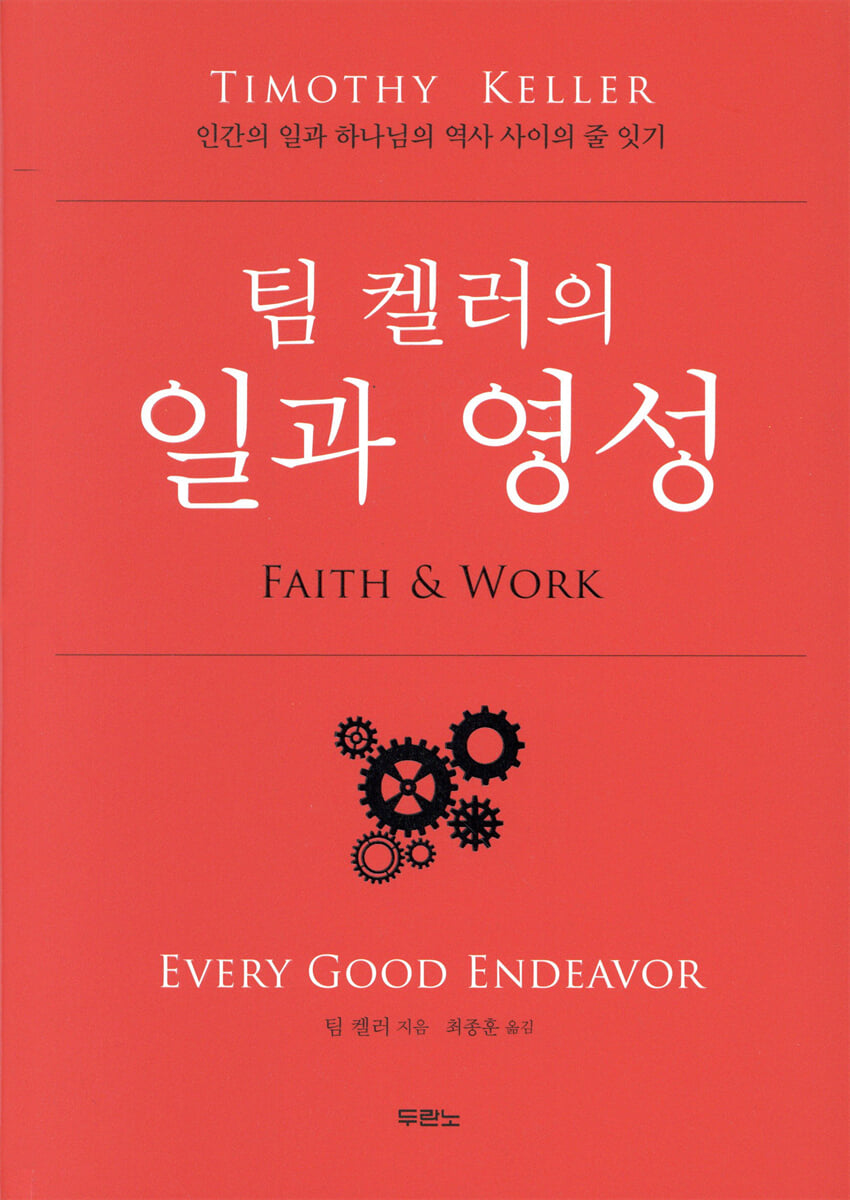
Tim Keller's Work and Spirituality
 |
Description
Book Introduction
Why should I work?
Why is our life so difficult?
Is there any sharp way?
Grab this book for biblical and practical answers to these questions!
New York Times bestselling author Timothy Keller vividly shows how God calls each person to reveal meaning and purpose in their lives through their work and career.
There are questions that linger in the minds of modern people living in a world of work that is becoming increasingly competitive and unstable.
"Why am I doing this? Why is it so hard? Is there no other way?"
Timothy Keller, senior pastor of Redeemer Presbyterian Church in New York City and author of the New York Times bestseller "The Reason for God," has taught and counseled students, professionals, and executive leaders on work and calling issues for over 20 years.
And now, we are compiling these insights into a book and presenting it to readers around the world.
It sheds new light on serious topics from a biblical perspective, such as: what do we work for? How do we find meaning and serve customers in a workplace where cutthroat competition and performance-oriented thinking reign? Is there a way to maintain purpose and find fulfillment by utilizing each of our talents in the professional world? Can we not only live out our own value but also expand it while working? How should we handle situations where we must make difficult choices to achieve success at work?
Through deep insights and anecdotal, surprising advice, the author demonstrates to readers that the wisdom of the Bible offers a powerful solution to all manner of workplace challenges.
In fact, the Christian work ethic of “working for others, not for oneself” is the foundation for an enterprising work life and a balanced personal life.
Keller explains in detail how the outstanding abilities, integrity, discipline, creativity, and passion displayed at work go beyond simply providing for oneself and becoming a way to help others and a form of worship offered through one's body.
Why is our life so difficult?
Is there any sharp way?
Grab this book for biblical and practical answers to these questions!
New York Times bestselling author Timothy Keller vividly shows how God calls each person to reveal meaning and purpose in their lives through their work and career.
There are questions that linger in the minds of modern people living in a world of work that is becoming increasingly competitive and unstable.
"Why am I doing this? Why is it so hard? Is there no other way?"
Timothy Keller, senior pastor of Redeemer Presbyterian Church in New York City and author of the New York Times bestseller "The Reason for God," has taught and counseled students, professionals, and executive leaders on work and calling issues for over 20 years.
And now, we are compiling these insights into a book and presenting it to readers around the world.
It sheds new light on serious topics from a biblical perspective, such as: what do we work for? How do we find meaning and serve customers in a workplace where cutthroat competition and performance-oriented thinking reign? Is there a way to maintain purpose and find fulfillment by utilizing each of our talents in the professional world? Can we not only live out our own value but also expand it while working? How should we handle situations where we must make difficult choices to achieve success at work?
Through deep insights and anecdotal, surprising advice, the author demonstrates to readers that the wisdom of the Bible offers a powerful solution to all manner of workplace challenges.
In fact, the Christian work ethic of “working for others, not for oneself” is the foundation for an enterprising work life and a balanced personal life.
Keller explains in detail how the outstanding abilities, integrity, discipline, creativity, and passion displayed at work go beyond simply providing for oneself and becoming a way to help others and a form of worship offered through one's body.
- You can preview some of the book's contents.
Preview
index
Recommendation
Before entering, I found the answer at Redeemer Church.
Prologue: Work isn't just about making a living, it's a calling.
Part 1: God's Ecstatic Design
A balance between work and rest is necessary.
1 If you want to be happy, work like the Lord and rest like the Lord.
The work itself is worth it.
2 There is nothing insignificant in the world.
Work is a means of becoming more like God.
3. Work ambitiously at your workplace, following the Lord's instructions.
Work is a calling with a purpose.
4. Do not work for yourself alone, but for God and the world.
Part 2 Day 2, Endless Fall
No matter how much I work, there is no result.
5 Even if I work day and night, I can barely make ends meet.
Not realizing the meaning of work
6 Just blindly running along the treadmill of success
Become a means of greed
7 I worked hard to get this far, so I can't give it up!
Work becomes everything in life
8. Your entire life is ruined by being sucked into work.
Part 3: Work and Spirituality, Spreading the Wings of the Gospel
Understanding work from a gospel perspective
Don't be satisfied with just attending the 9th company's new employee meeting.
Rejecting the dualism of work
10 Reject the dichotomy that this is worldly work and that is God's work.
The motivation to work changes
11 Don't work for high pay or praise.
Working with new abilities
12. Work with passion, bearing in mind the assurance of salvation.
Epilogue: Redeemer Church's "How to Unify Work and Faith"
Acknowledgements
Expand main page
Before entering, I found the answer at Redeemer Church.
Prologue: Work isn't just about making a living, it's a calling.
Part 1: God's Ecstatic Design
A balance between work and rest is necessary.
1 If you want to be happy, work like the Lord and rest like the Lord.
The work itself is worth it.
2 There is nothing insignificant in the world.
Work is a means of becoming more like God.
3. Work ambitiously at your workplace, following the Lord's instructions.
Work is a calling with a purpose.
4. Do not work for yourself alone, but for God and the world.
Part 2 Day 2, Endless Fall
No matter how much I work, there is no result.
5 Even if I work day and night, I can barely make ends meet.
Not realizing the meaning of work
6 Just blindly running along the treadmill of success
Become a means of greed
7 I worked hard to get this far, so I can't give it up!
Work becomes everything in life
8. Your entire life is ruined by being sucked into work.
Part 3: Work and Spirituality, Spreading the Wings of the Gospel
Understanding work from a gospel perspective
Don't be satisfied with just attending the 9th company's new employee meeting.
Rejecting the dualism of work
10 Reject the dichotomy that this is worldly work and that is God's work.
The motivation to work changes
11 Don't work for high pay or praise.
Working with new abilities
12. Work with passion, bearing in mind the assurance of salvation.
Epilogue: Redeemer Church's "How to Unify Work and Faith"
Acknowledgements
Expand main page
Into the book
Before entering_
I found the answer at Redeemer Church
In 1989, a coworker begged me to come visit the church he attended.
It was a community that started in Manhattan and was called Redeemer Church.
Personally, when I look at the church I attended as a child, the form always came first, regardless of the substance.
Moreover, whatever lessons I learned there, I felt like I could solve them all if I thought about it rationally.
Nonetheless, this Redeemer Church attracted attention in several ways.
From the pastor onwards, he was not ordinary.
Although he had a brilliant mind, he delivered his message in the way that an ordinary man would speak.
Take the Bible seriously
Not only did I accept it, I never gave up trying to apply it to areas that seemed very important to me, like work and the workplace.
After several years, I decided it was time to make a religious decision and 'give my life' to the truth and promises of the Bible.
To be honest, I was worried.
Since both of my brothers had come to believe in Jesus and were called to be missionaries overseas, I felt like I would lose my dedication, professional ambitions, and material comfort all at once.
One of the two was living in a remote part of Africa without running water or electricity.
If you truly put God first, you must be prepared to open your heart and go wherever He calls you to serve.
That soon became a reality.
A few weeks after I decided on the idea, my boss, who was in the CEO position, suddenly fell ill.
It was a terrifying thing.
The boss asked me to become a manager and lead the company.
It was an unexpected situation, but it seemed like God was telling me to do my part in the business world, not in the Third World.
Over the next ten years, I worked for several technology development companies in New York City, Europe, and Silicon Valley.
Every day, no matter what I did, I wrestled and pondered what it meant to respond to God's calling as a corporate leader.
Each time, Redeemer Church and Pastor Tim Keller provided a strong foundation.
Thanks to this, I was able to realize early on that not only was I transformed by the gospel of Jesus Christ, but I was also to be used by God in relationships with others because of it, and in some cases, I had to run my company in a way that was different from the world.
That's a fantastic idea.
But what should we actually do and how?
There were few models to follow.
Even if it existed, these were stories from the time when most Americans went to church.
A CEO said that he always kept a Bible on his desk, and sometimes people would ask him why.
There were also those who testified that their companies were doing well after they prayed hard.
Nine out of ten people find meaning in running a business by making a lot of money, doing charity work, and helping various organizations.
When I ask pastors and office workers how to best apply their faith in the workplace, the common response (unless they are solo professionals) is, "We need to share the gospel with our coworkers."
However, many were quick to add that evangelism did not seem to be their gift.
These approaches failed to address the challenge of transforming the workplace through faith.
Ironically, in the ever-growing high-tech world, it is not difficult to find examples of such attempts.
This was especially true in the 1990s.
Entrepreneurs and engineers were revered as gods of the age, and cutting-edge technology was seen as the key to solving all the world's problems.
Even among the employees of the company I worked for, their own 'missionary passion' to spread their vision and technology was stronger than that of any other church.
The hope of a new listing was so specific and motivating that it was incomparable to the superficial hopes of Christians for heaven.
The partners I worked with for a long time were also excellent people with mature personalities that made me bow my head in awe.
Even though he did not go to church and did not properly know Jesus as the Bible teaches, he sacrificed himself and worked hard to contribute to the world.
I've had profound insights into the joy, perseverance, hope, teamwork, and willingness to speak the truth in the workplace through colleagues who are non-religious or of different faiths.
The employees who went to meditate on the weekend were much more lively than the believers who gathered at the evangelical church every Sunday for worship.
Then I began to wonder if work was less a dynamic and effective tool for serving God and more a place where He trains me.
I believed in the gospel truth that the Creator created all things in the universe, created humankind in His holy image, and sent His only Son to redeem all things that had been ruined by sin.
I believed that God had a special purpose in calling me to work and making me a leader in a company: to work with others to change the world for the better.
But as someone who manages and leads an organization at the forefront of a competitive society, I had no idea how to put God's plan into practice.
Other than Redeemer Church, it was difficult to find a church that provided the necessary guidance.
Many pastors focused on preparing their members to serve within the church rather than training and equipping them to go out into the world and serve the people.
In the 1990s, when Silicon Valley was at its peak of success, few Christians seemed to be aware of how broken the world and humanity had become.
While there were many who harbored deep compassion for the poor, they failed to grasp the fact that the systems, structures, and mindsets of modern industrial society were in fact decisive factors in the various cracks and collapses that we see today.
The task of living out the principles of faith in the workplace seemed to be reduced to small symbolic gestures, self-righteousness demonstrated through restraint in certain actions, and a unified political stance on the cultural and legal issues prevalent in our time.
.....
This book contains basic concepts about God the Father, God the Son Jesus, and the Holy Spirit.
Reflect on yourself in light of the Trinity and examine how it impacts your ability to carry out the work the Creator has entrusted to you as you create each of us.
The question of how to work within the context of culture, historical period, calling, and organization is a topic that our entire society must consider together.
But the answer must be grounded in core theological knowledge, such as God's attributes, his relationship with humanity, his plan for the world, and the principles by which the gospel of Christ transforms the way we live and work.
Chapter 6 Not Realizing the Meaning of Work
Just following the hamster wheel of success
Just keep running
Therefore I hated life, because the work done under the sun was grievous to me; everything was meaningless and a chasing after the wind (Ecclesiastes 2:17).
In a fallen world, work is often not only fruitless but also often meaningless.
This is also another aspect of the alienation that humans experience in labor.
Some people become frustrated at work due to immature skills and unattainable aspirations, while others, despite pursuing their ambitions and achieving success, fail to feel a sense of satisfaction or accomplishment.
A passage that most poignantly depicts the human condition of not being able to deeply grasp the true meaning of labor can be found in an ancient document called Ecclesiastes in the Old Testament.
The speaker of Ecclesiastes is called 'Qoheleth' in Hebrew, which can be interpreted as 'teacher' or 'philosopher'.
To understand the nature of the work spoken of in Ecclesiastes, we must first examine the literary genre of the book and the narrative style in which its logic is developed.
Most readers of Ecclesiastes are often struck by what they see as conflicting statements from the rest of the Bible.
While other passages generally challenge us to live wisely and righteously, Ecclesiastes advises us to walk the middle path, warning us not to be too righteous or too wicked.
Do not be overly ethical or immoral, nor overly wise or foolish (Ecclesiastes 7:15-17).
How should we interpret these stories?
Old Testament scholar Tremper Longman points out that at the time Ecclesiastes was written, a literary form called "fictional autobiography" existed.
The structure is such that the author introduces another fictional character and describes his or her life journey, concluding with universal realizations and teachings drawn from the case.
In fact, in Ecclesiastes, two speaker voices can be distinguished.
The first author, appearing in the prologue, introduces the fictional Qoheleth, and the second protagonist, who takes over the microphone, recounts to the first character the struggles of his character to find satisfaction and meaning under the sun.
The expression 'under the sun' is a crucial clue to understanding the philosopher's perspective.
This is because it usually refers to a life that considers only this world itself, leaving aside a greater and eternal existence.
Philosophers struggle to live meaningful lives based solely on elements that can be found within the confines of the material world, such as success, pleasure, and knowledge.
In the epilogue, the original author finally finds his voice and delivers his final assessment.
It is a dramatic way to address a theme that was in mind, by presenting a character who, despite being infinitely wise, wealthy, and blessed with more gifts than anyone else, was unable to find satisfaction in life.
Books like James in the New Testament and Proverbs in the Old Testament are like this and that.
Salah feels like he is listening to the pastor's advice.
On the other hand, reading Ecclesiastes feels like sitting in a philosophy lecture hall where the professor is trying to get you to discover the truth for yourself by using Socratic, difficult questions and unfamiliar, bizarre examples to guide the conversation.
The philosopher in Ecclesiastes pushes readers to examine the foundations of life, asking fundamental questions they would rather avoid.
"Have you found meaning in life? Is there anything worth dying for? Why is the world so messed up? How will we overcome it?" The author of Ecclesiastes, using the philosopher as a catalyst, tries to convince readers of the transcendent uniqueness and necessity of God.
Nothing in this world can provide a meaningful life.
If you make work and success, love and pleasure, or wisdom and knowledge the reason for your life, your existence will become unstable and shallow.
It will break easily even with a single impact.
Because the environment constantly threatens the foundations of life, and death inevitably sweeps away the assets that each of us cherishes.
Ecclesiastes loudly proclaims that an attitude of existential dependence on a gracious God, rather than merely abstract belief in Him, is the prerequisite for a life of unwavering purpose and clarity.
Like many people who started attending our church after being successful in their fields, Catherine Alsdorf was also obsessed with three things.
I sought meaning in life through the knowledge I learned in college, later pursuing pleasure and adventure, and in my thirties, I poured everything I had into my work and career, desperately trying to create a satisfying and fulfilling life.
The hard work paid off and I began to reap the rewards, and my life became more comfortable, but as the days went by, my stress increased and I began to suffer from bitter feelings.
When I see people reaping the fruits of their labor and enjoying wonderful lives without putting in any special effort, I can't help but feel a sense of injustice.
No matter how much I achieved, the quantity was not enough.
Even though I earned money and earned more, I wasn't satisfied.
As he said to himself, “I couldn’t help but think that it was all useless.
So I buried my head in my desk and just focused on my work.” Finally, Alsdorf remembered the gospel of Christ.
The world's many philosophies have not helped.
After feeling the emptiness of life, I turned my eyes to the transcendent uniqueness of God.
I found the answer at Redeemer Church
In 1989, a coworker begged me to come visit the church he attended.
It was a community that started in Manhattan and was called Redeemer Church.
Personally, when I look at the church I attended as a child, the form always came first, regardless of the substance.
Moreover, whatever lessons I learned there, I felt like I could solve them all if I thought about it rationally.
Nonetheless, this Redeemer Church attracted attention in several ways.
From the pastor onwards, he was not ordinary.
Although he had a brilliant mind, he delivered his message in the way that an ordinary man would speak.
Take the Bible seriously
Not only did I accept it, I never gave up trying to apply it to areas that seemed very important to me, like work and the workplace.
After several years, I decided it was time to make a religious decision and 'give my life' to the truth and promises of the Bible.
To be honest, I was worried.
Since both of my brothers had come to believe in Jesus and were called to be missionaries overseas, I felt like I would lose my dedication, professional ambitions, and material comfort all at once.
One of the two was living in a remote part of Africa without running water or electricity.
If you truly put God first, you must be prepared to open your heart and go wherever He calls you to serve.
That soon became a reality.
A few weeks after I decided on the idea, my boss, who was in the CEO position, suddenly fell ill.
It was a terrifying thing.
The boss asked me to become a manager and lead the company.
It was an unexpected situation, but it seemed like God was telling me to do my part in the business world, not in the Third World.
Over the next ten years, I worked for several technology development companies in New York City, Europe, and Silicon Valley.
Every day, no matter what I did, I wrestled and pondered what it meant to respond to God's calling as a corporate leader.
Each time, Redeemer Church and Pastor Tim Keller provided a strong foundation.
Thanks to this, I was able to realize early on that not only was I transformed by the gospel of Jesus Christ, but I was also to be used by God in relationships with others because of it, and in some cases, I had to run my company in a way that was different from the world.
That's a fantastic idea.
But what should we actually do and how?
There were few models to follow.
Even if it existed, these were stories from the time when most Americans went to church.
A CEO said that he always kept a Bible on his desk, and sometimes people would ask him why.
There were also those who testified that their companies were doing well after they prayed hard.
Nine out of ten people find meaning in running a business by making a lot of money, doing charity work, and helping various organizations.
When I ask pastors and office workers how to best apply their faith in the workplace, the common response (unless they are solo professionals) is, "We need to share the gospel with our coworkers."
However, many were quick to add that evangelism did not seem to be their gift.
These approaches failed to address the challenge of transforming the workplace through faith.
Ironically, in the ever-growing high-tech world, it is not difficult to find examples of such attempts.
This was especially true in the 1990s.
Entrepreneurs and engineers were revered as gods of the age, and cutting-edge technology was seen as the key to solving all the world's problems.
Even among the employees of the company I worked for, their own 'missionary passion' to spread their vision and technology was stronger than that of any other church.
The hope of a new listing was so specific and motivating that it was incomparable to the superficial hopes of Christians for heaven.
The partners I worked with for a long time were also excellent people with mature personalities that made me bow my head in awe.
Even though he did not go to church and did not properly know Jesus as the Bible teaches, he sacrificed himself and worked hard to contribute to the world.
I've had profound insights into the joy, perseverance, hope, teamwork, and willingness to speak the truth in the workplace through colleagues who are non-religious or of different faiths.
The employees who went to meditate on the weekend were much more lively than the believers who gathered at the evangelical church every Sunday for worship.
Then I began to wonder if work was less a dynamic and effective tool for serving God and more a place where He trains me.
I believed in the gospel truth that the Creator created all things in the universe, created humankind in His holy image, and sent His only Son to redeem all things that had been ruined by sin.
I believed that God had a special purpose in calling me to work and making me a leader in a company: to work with others to change the world for the better.
But as someone who manages and leads an organization at the forefront of a competitive society, I had no idea how to put God's plan into practice.
Other than Redeemer Church, it was difficult to find a church that provided the necessary guidance.
Many pastors focused on preparing their members to serve within the church rather than training and equipping them to go out into the world and serve the people.
In the 1990s, when Silicon Valley was at its peak of success, few Christians seemed to be aware of how broken the world and humanity had become.
While there were many who harbored deep compassion for the poor, they failed to grasp the fact that the systems, structures, and mindsets of modern industrial society were in fact decisive factors in the various cracks and collapses that we see today.
The task of living out the principles of faith in the workplace seemed to be reduced to small symbolic gestures, self-righteousness demonstrated through restraint in certain actions, and a unified political stance on the cultural and legal issues prevalent in our time.
.....
This book contains basic concepts about God the Father, God the Son Jesus, and the Holy Spirit.
Reflect on yourself in light of the Trinity and examine how it impacts your ability to carry out the work the Creator has entrusted to you as you create each of us.
The question of how to work within the context of culture, historical period, calling, and organization is a topic that our entire society must consider together.
But the answer must be grounded in core theological knowledge, such as God's attributes, his relationship with humanity, his plan for the world, and the principles by which the gospel of Christ transforms the way we live and work.
Chapter 6 Not Realizing the Meaning of Work
Just following the hamster wheel of success
Just keep running
Therefore I hated life, because the work done under the sun was grievous to me; everything was meaningless and a chasing after the wind (Ecclesiastes 2:17).
In a fallen world, work is often not only fruitless but also often meaningless.
This is also another aspect of the alienation that humans experience in labor.
Some people become frustrated at work due to immature skills and unattainable aspirations, while others, despite pursuing their ambitions and achieving success, fail to feel a sense of satisfaction or accomplishment.
A passage that most poignantly depicts the human condition of not being able to deeply grasp the true meaning of labor can be found in an ancient document called Ecclesiastes in the Old Testament.
The speaker of Ecclesiastes is called 'Qoheleth' in Hebrew, which can be interpreted as 'teacher' or 'philosopher'.
To understand the nature of the work spoken of in Ecclesiastes, we must first examine the literary genre of the book and the narrative style in which its logic is developed.
Most readers of Ecclesiastes are often struck by what they see as conflicting statements from the rest of the Bible.
While other passages generally challenge us to live wisely and righteously, Ecclesiastes advises us to walk the middle path, warning us not to be too righteous or too wicked.
Do not be overly ethical or immoral, nor overly wise or foolish (Ecclesiastes 7:15-17).
How should we interpret these stories?
Old Testament scholar Tremper Longman points out that at the time Ecclesiastes was written, a literary form called "fictional autobiography" existed.
The structure is such that the author introduces another fictional character and describes his or her life journey, concluding with universal realizations and teachings drawn from the case.
In fact, in Ecclesiastes, two speaker voices can be distinguished.
The first author, appearing in the prologue, introduces the fictional Qoheleth, and the second protagonist, who takes over the microphone, recounts to the first character the struggles of his character to find satisfaction and meaning under the sun.
The expression 'under the sun' is a crucial clue to understanding the philosopher's perspective.
This is because it usually refers to a life that considers only this world itself, leaving aside a greater and eternal existence.
Philosophers struggle to live meaningful lives based solely on elements that can be found within the confines of the material world, such as success, pleasure, and knowledge.
In the epilogue, the original author finally finds his voice and delivers his final assessment.
It is a dramatic way to address a theme that was in mind, by presenting a character who, despite being infinitely wise, wealthy, and blessed with more gifts than anyone else, was unable to find satisfaction in life.
Books like James in the New Testament and Proverbs in the Old Testament are like this and that.
Salah feels like he is listening to the pastor's advice.
On the other hand, reading Ecclesiastes feels like sitting in a philosophy lecture hall where the professor is trying to get you to discover the truth for yourself by using Socratic, difficult questions and unfamiliar, bizarre examples to guide the conversation.
The philosopher in Ecclesiastes pushes readers to examine the foundations of life, asking fundamental questions they would rather avoid.
"Have you found meaning in life? Is there anything worth dying for? Why is the world so messed up? How will we overcome it?" The author of Ecclesiastes, using the philosopher as a catalyst, tries to convince readers of the transcendent uniqueness and necessity of God.
Nothing in this world can provide a meaningful life.
If you make work and success, love and pleasure, or wisdom and knowledge the reason for your life, your existence will become unstable and shallow.
It will break easily even with a single impact.
Because the environment constantly threatens the foundations of life, and death inevitably sweeps away the assets that each of us cherishes.
Ecclesiastes loudly proclaims that an attitude of existential dependence on a gracious God, rather than merely abstract belief in Him, is the prerequisite for a life of unwavering purpose and clarity.
Like many people who started attending our church after being successful in their fields, Catherine Alsdorf was also obsessed with three things.
I sought meaning in life through the knowledge I learned in college, later pursuing pleasure and adventure, and in my thirties, I poured everything I had into my work and career, desperately trying to create a satisfying and fulfilling life.
The hard work paid off and I began to reap the rewards, and my life became more comfortable, but as the days went by, my stress increased and I began to suffer from bitter feelings.
When I see people reaping the fruits of their labor and enjoying wonderful lives without putting in any special effort, I can't help but feel a sense of injustice.
No matter how much I achieved, the quantity was not enough.
Even though I earned money and earned more, I wasn't satisfied.
As he said to himself, “I couldn’t help but think that it was all useless.
So I buried my head in my desk and just focused on my work.” Finally, Alsdorf remembered the gospel of Christ.
The world's many philosophies have not helped.
After feeling the emptiness of life, I turned my eyes to the transcendent uniqueness of God.
---text
Publisher's Review
New York Times bestselling author Timothy Keller vividly shows how God calls each person to reveal meaning and purpose in their lives through their work and career.
There are questions that linger in the minds of modern people living in a world of work that is becoming increasingly competitive and unstable.
"Why am I doing this? Why is it so hard? Is there no solution?"
Timothy Keller, senior pastor of Redeemer Presbyterian Church in New York City and author of the New York Times bestseller "The Reason for God," has taught and counseled students, professionals, and executive leaders on work and calling issues for over 20 years.
And now, we are compiling these insights into a book and presenting it to readers around the world.
It sheds new light on serious topics from a biblical perspective, such as: what do we work for? How do we find meaning and serve customers in a workplace where cutthroat competition and performance-oriented thinking reign? Is there a way to maintain purpose and find fulfillment by utilizing each of our talents in the professional world? Can we not only live out our own value but also expand it while working? How should we handle situations where we must make difficult choices to achieve success at work?
Through deep insights and anecdotal, surprising advice, the author demonstrates to readers that the wisdom of the Bible offers a powerful solution to all manner of workplace challenges.
In fact, the Christian work ethic of “working for others, not for oneself” is the foundation for an enterprising work life and a balanced personal life.
Keller explains in detail how the outstanding abilities, integrity, discipline, creativity, and passion displayed at work go beyond simply providing for oneself and becoming a way to help others and a form of worship offered through one's body.
[Amazon Reader Praise]
I realized that doing good work is the greatest sacrifice a human being can make to the Creator.
_JDA
I wish I had known about this book when I was a newbie at work.
This book will change your life, not just your career.
_Charles Dunn
At a critical crossroads in my career, I was faced with numerous questions about the connection between work and faith.
I am deeply grateful to have read this book.
_Brian Jacobs
A powerful, practical, gospel-centered treatment book on work and calling!_Pierre Delinois
If you feel like you lack expertise in what you do, or if you don't feel like a good disciple of Jesus, you have a lot to gain from this book! _Austin Smith
I always appreciate the author's knowledgeable yet easy-to-read writing style.
This book will also be of great help to office workers without a Christian background.
_C.
Williams
This book will provide an open perspective for those who find no true meaning or joy in their current job but are struggling to find some passion.
_Amy C Harper
This book presents the most well-organized Christian perspective on what we do every day._Alex
It made me see my work again as a dedication to all humanity, rather than a vain attempt to fill my ego.
_Justin J.
Jackson
Most churches are silent on the question of how to live as believers in the workplace.
This book will be of great help to you.
_John Gibbs
'Do you have a job, or are you working out of a calling?' This is the question the author poses.
_William D.
Curnutt
The author connected the gospel with my vocation and helped me see myself and my vocation from the perspective of Jesus Christ, who redeems me.
_S.
Grotzke
Pastor Keller answers a very basic question: "How should our faith influence our work, where we spend most of our time?"
_J.
Taylor
[Recommendation]
This book is about the Christian spirituality that must be pursued in the workplace.
I highly recommend this book, which addresses various issues that can be faced in the workplace from an evangelical perspective.
Kang Jun-min (Senior Pastor, New Life Vision Church, LA)
It is heartbreaking to see believers struggling between their faith and the increasing pressure of the world as time passes.
I recommend this book to all believers who are striving today to shine the light of the gospel in this difficult world.
Kim In-joong (Senior Pastor, Ansan Dongsan Church)
Through the amazing message of Pastor Tim Keller, who has been listening to the vivid concerns of modern people for over 20 years in the heart of New York, I hope that you will realize that your work is not a hardship, but a great 'vocation' that God has entrusted to you.
Kim Hak-jung (Senior Pastor of Dream Church)
Tim Keller's books are a must-read.
This is because the Korean church does not often encounter writings that grapple with the reality of life in this way.
Kim Hyung-guk (Director of Nadulmok Church)
I now have something to say to many young people and a book to recommend.
I recommend this book to the Korean church, which is fighting a fierce spiritual war to live out the gospel.
Noh Jin-jun (Senior Pastor of Hangil Church in LA)
There are questions that linger in the minds of modern people living in a world of work that is becoming increasingly competitive and unstable.
"Why am I doing this? Why is it so hard? Is there no solution?"
Timothy Keller, senior pastor of Redeemer Presbyterian Church in New York City and author of the New York Times bestseller "The Reason for God," has taught and counseled students, professionals, and executive leaders on work and calling issues for over 20 years.
And now, we are compiling these insights into a book and presenting it to readers around the world.
It sheds new light on serious topics from a biblical perspective, such as: what do we work for? How do we find meaning and serve customers in a workplace where cutthroat competition and performance-oriented thinking reign? Is there a way to maintain purpose and find fulfillment by utilizing each of our talents in the professional world? Can we not only live out our own value but also expand it while working? How should we handle situations where we must make difficult choices to achieve success at work?
Through deep insights and anecdotal, surprising advice, the author demonstrates to readers that the wisdom of the Bible offers a powerful solution to all manner of workplace challenges.
In fact, the Christian work ethic of “working for others, not for oneself” is the foundation for an enterprising work life and a balanced personal life.
Keller explains in detail how the outstanding abilities, integrity, discipline, creativity, and passion displayed at work go beyond simply providing for oneself and becoming a way to help others and a form of worship offered through one's body.
[Amazon Reader Praise]
I realized that doing good work is the greatest sacrifice a human being can make to the Creator.
_JDA
I wish I had known about this book when I was a newbie at work.
This book will change your life, not just your career.
_Charles Dunn
At a critical crossroads in my career, I was faced with numerous questions about the connection between work and faith.
I am deeply grateful to have read this book.
_Brian Jacobs
A powerful, practical, gospel-centered treatment book on work and calling!_Pierre Delinois
If you feel like you lack expertise in what you do, or if you don't feel like a good disciple of Jesus, you have a lot to gain from this book! _Austin Smith
I always appreciate the author's knowledgeable yet easy-to-read writing style.
This book will also be of great help to office workers without a Christian background.
_C.
Williams
This book will provide an open perspective for those who find no true meaning or joy in their current job but are struggling to find some passion.
_Amy C Harper
This book presents the most well-organized Christian perspective on what we do every day._Alex
It made me see my work again as a dedication to all humanity, rather than a vain attempt to fill my ego.
_Justin J.
Jackson
Most churches are silent on the question of how to live as believers in the workplace.
This book will be of great help to you.
_John Gibbs
'Do you have a job, or are you working out of a calling?' This is the question the author poses.
_William D.
Curnutt
The author connected the gospel with my vocation and helped me see myself and my vocation from the perspective of Jesus Christ, who redeems me.
_S.
Grotzke
Pastor Keller answers a very basic question: "How should our faith influence our work, where we spend most of our time?"
_J.
Taylor
[Recommendation]
This book is about the Christian spirituality that must be pursued in the workplace.
I highly recommend this book, which addresses various issues that can be faced in the workplace from an evangelical perspective.
Kang Jun-min (Senior Pastor, New Life Vision Church, LA)
It is heartbreaking to see believers struggling between their faith and the increasing pressure of the world as time passes.
I recommend this book to all believers who are striving today to shine the light of the gospel in this difficult world.
Kim In-joong (Senior Pastor, Ansan Dongsan Church)
Through the amazing message of Pastor Tim Keller, who has been listening to the vivid concerns of modern people for over 20 years in the heart of New York, I hope that you will realize that your work is not a hardship, but a great 'vocation' that God has entrusted to you.
Kim Hak-jung (Senior Pastor of Dream Church)
Tim Keller's books are a must-read.
This is because the Korean church does not often encounter writings that grapple with the reality of life in this way.
Kim Hyung-guk (Director of Nadulmok Church)
I now have something to say to many young people and a book to recommend.
I recommend this book to the Korean church, which is fighting a fierce spiritual war to live out the gospel.
Noh Jin-jun (Senior Pastor of Hangil Church in LA)
GOODS SPECIFICS
- Date of publication: November 18, 2013
- Page count, weight, size: 344 pages | 470g | 150*210*30mm
- ISBN13: 9788953119901
- ISBN10: 8953119901
You may also like
카테고리
korean


korean

![GQ KOREA Mark (Monthly): December [2025]](http://librairie.coreenne.fr/cdn/shop/files/8ef265dbbfbf186523ed75ba7319009d.jpg?v=1765340328&width=3840)


