

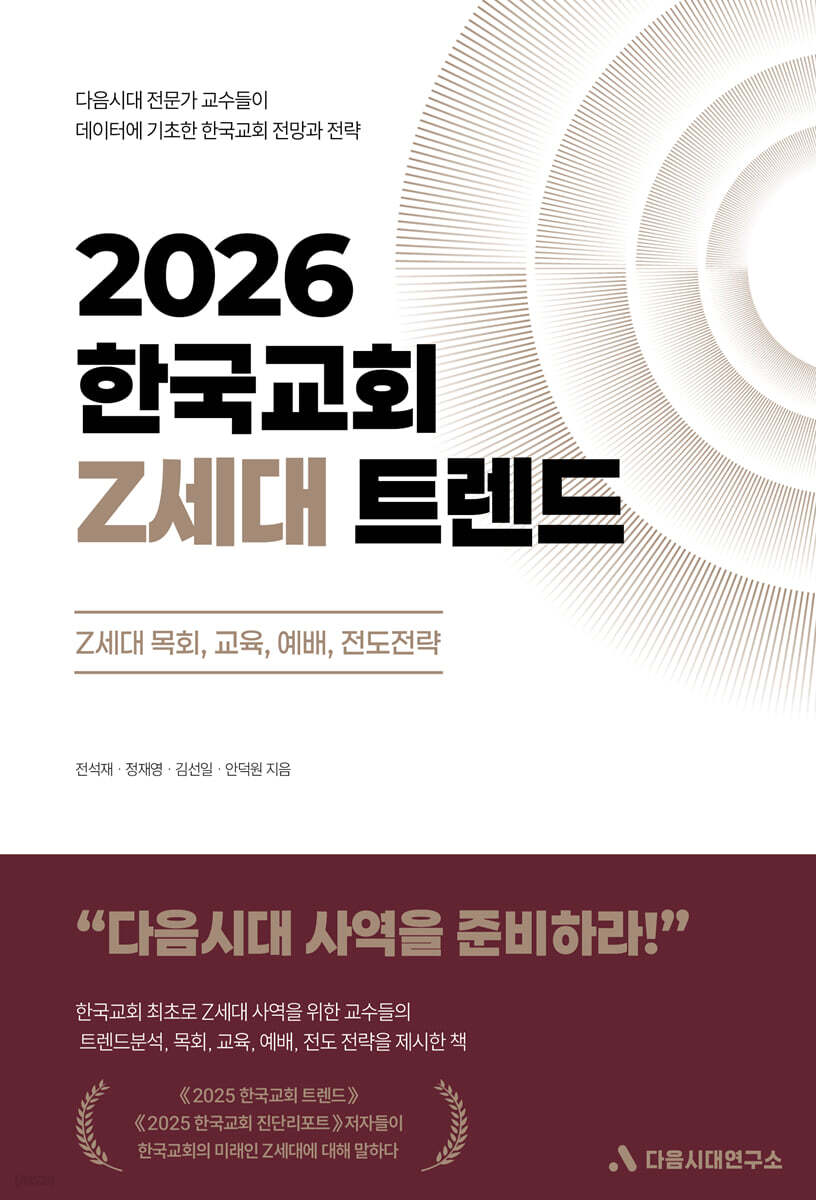
2026 Korean Church Generation Z Trends
 |
Description
Book Introduction
In the era of the 4th Industrial Revolution, everything is changing rapidly.
Generation Z is leading a rapidly changing era as digital natives.
Their lifestyle patterns, values, and worldview are clearly different from those of older generations and even millennials.
And expectations for the church and Christianity are also very low.
I don't like Christianity or trust the church.
Research shows that eight out of ten non-Protestant Generation Z members "do not trust the church," and seven out of ten "have very low favorability toward the church."
Additionally, more than 8 out of 10 Generation Z members have no intention of becoming Christians.
What does this mean? For non-Christian Generation Z, "Christianity and church" simply have no "favorability or appeal."
Even among Generation Z, who attend church, 4 out of 10 say they do not trust the church.
"2026 Korean Church Generation Z Trends: Generation Z Ministry, Education, Worship, and Evangelism Strategies" addresses these concerns and presents alternatives.
We designed the writing together with expert professors from each field and published the book together.
Professor Jeong Jae-young conducted an analysis of Generation Z trends, and Professor Kim Seon-il covered “Generation Z ministry and education.”
Professor Andukwon Ahn focused on “Generation Z worship and sermons” and Professor Seokjae Jeon focused on “Generation Z evangelism and missions.”
Each of the four professors is already proven and recognized for excellence in their respective fields of expertise.
Generation Z is leading a rapidly changing era as digital natives.
Their lifestyle patterns, values, and worldview are clearly different from those of older generations and even millennials.
And expectations for the church and Christianity are also very low.
I don't like Christianity or trust the church.
Research shows that eight out of ten non-Protestant Generation Z members "do not trust the church," and seven out of ten "have very low favorability toward the church."
Additionally, more than 8 out of 10 Generation Z members have no intention of becoming Christians.
What does this mean? For non-Christian Generation Z, "Christianity and church" simply have no "favorability or appeal."
Even among Generation Z, who attend church, 4 out of 10 say they do not trust the church.
"2026 Korean Church Generation Z Trends: Generation Z Ministry, Education, Worship, and Evangelism Strategies" addresses these concerns and presents alternatives.
We designed the writing together with expert professors from each field and published the book together.
Professor Jeong Jae-young conducted an analysis of Generation Z trends, and Professor Kim Seon-il covered “Generation Z ministry and education.”
Professor Andukwon Ahn focused on “Generation Z worship and sermons” and Professor Seokjae Jeon focused on “Generation Z evangelism and missions.”
Each of the four professors is already proven and recognized for excellence in their respective fields of expertise.
index
Table of Contents
Recommendation
prolog
Chapter 1: Generation Z: Who Are They?
What is a generation?
The emergence of Generation Z
Sociological Characteristics of Generation Z
Characteristics of Generation Z based on consumption patterns
The harsh reality hidden behind generational discourse
Generation Z and Religion
Generation Z and the Church
Generation Z's religious views differ from those of older generations.
Generation Z wants to participate
Church governance with youth participation
A church that needs spiritual 'customization'
Chapter 2: Where Should Pastoral Care and Education for Generation Z Go?
The Definition and Current Status of Generation Z
Generation Z classification and historical background
Characteristics of global and Korean societies
Mental health, political orientation, and consumer values
Generation Z's worldview
Digital Environment and Multiple Identities
Sensitivity to diversity, fairness, and practicality
Looser relationships and a new sense of community
Generation Z's Religiosity and Spirituality
Dereligionization in the United States and Korea
Spirituality expressed outside the system
Empathy-centered faith and digital spirituality
longing for emotional security
Pastoral Issues for Generation Z
Discipleship: Recovering Depth in the Digital Age
Restoring Identity in a Self-Centered Age
Restoration of Routine-Based Spiritual Training
Examples of Generation Z's Resurrection
The Asbury Revival: Spontaneous Worship Centered on Authenticity
Britain's Quiet Revival: A Community-Based Restoration of Faith
Examples of digital content and online ministry in Korea
A New Missionary Approach for a Generation Unacquainted with the Church
A Case Study of the Korean Church's Ministry Direction to Generation Z
Designing a Faith Community for the Digital Age
Sermons and ministry that welcome questions and healing
The Church as a Caring Community in the Face of Economic Insecurity
Horizontal participatory structure and youth-centered governance
Chapter 3: Generation Z and Worship: Recovering the Essence and Connecting with the World!
Restoration of the meaning and essence of worship
Are you faithful to the meaning of worship?
The Relationship Between Worship and Daily Life - The Horizontal Nature of Worship
Suggestions for Worship Format and Content for Generation Z
Traditional or modern?
Online and On-site Worship
Democratization of worship
Providing a variety of worship experiences
Sermons on Empathy and Communication
Chapter 4: Generation Z and Evangelism: Try to build bridges to the world!
Generation Z Characteristics and Interests
digital natives
Flex culture
The value of fairness
Anxious Generation
The pursuit of spiritual things
Korean Church's Evangelism Strategy for Generation Z
Evangelism through relationships
Evangelism through cultural content
Media Ministry
Mentoring and Coaching
Missionary community with the local community
Loving hospitality and need-centered evangelism
Recommendation
prolog
Chapter 1: Generation Z: Who Are They?
What is a generation?
The emergence of Generation Z
Sociological Characteristics of Generation Z
Characteristics of Generation Z based on consumption patterns
The harsh reality hidden behind generational discourse
Generation Z and Religion
Generation Z and the Church
Generation Z's religious views differ from those of older generations.
Generation Z wants to participate
Church governance with youth participation
A church that needs spiritual 'customization'
Chapter 2: Where Should Pastoral Care and Education for Generation Z Go?
The Definition and Current Status of Generation Z
Generation Z classification and historical background
Characteristics of global and Korean societies
Mental health, political orientation, and consumer values
Generation Z's worldview
Digital Environment and Multiple Identities
Sensitivity to diversity, fairness, and practicality
Looser relationships and a new sense of community
Generation Z's Religiosity and Spirituality
Dereligionization in the United States and Korea
Spirituality expressed outside the system
Empathy-centered faith and digital spirituality
longing for emotional security
Pastoral Issues for Generation Z
Discipleship: Recovering Depth in the Digital Age
Restoring Identity in a Self-Centered Age
Restoration of Routine-Based Spiritual Training
Examples of Generation Z's Resurrection
The Asbury Revival: Spontaneous Worship Centered on Authenticity
Britain's Quiet Revival: A Community-Based Restoration of Faith
Examples of digital content and online ministry in Korea
A New Missionary Approach for a Generation Unacquainted with the Church
A Case Study of the Korean Church's Ministry Direction to Generation Z
Designing a Faith Community for the Digital Age
Sermons and ministry that welcome questions and healing
The Church as a Caring Community in the Face of Economic Insecurity
Horizontal participatory structure and youth-centered governance
Chapter 3: Generation Z and Worship: Recovering the Essence and Connecting with the World!
Restoration of the meaning and essence of worship
Are you faithful to the meaning of worship?
The Relationship Between Worship and Daily Life - The Horizontal Nature of Worship
Suggestions for Worship Format and Content for Generation Z
Traditional or modern?
Online and On-site Worship
Democratization of worship
Providing a variety of worship experiences
Sermons on Empathy and Communication
Chapter 4: Generation Z and Evangelism: Try to build bridges to the world!
Generation Z Characteristics and Interests
digital natives
Flex culture
The value of fairness
Anxious Generation
The pursuit of spiritual things
Korean Church's Evangelism Strategy for Generation Z
Evangelism through relationships
Evangelism through cultural content
Media Ministry
Mentoring and Coaching
Missionary community with the local community
Loving hospitality and need-centered evangelism
Publisher's Review
"2026 Korean Church Generation Z Trends: Generation Z Ministry, Education, Worship, and Evangelism Strategies" presents a practical and specific direction for "Generation Z ministry" for the church.
Now, I will explain it by dividing it into 4 areas.
Chapter 1: Trends in the Generation Z Phenomenon: Who Are Generation Z? (A Sociological Understanding of Religion and Generation Z)
It is very important to analyze and understand Generation Z.
From here, interpretation and communication towards them begins.
Generation Z refers to the first generation that became adults in the late 1990s and 2000s.
They are familiar with the digital environment.
They are called digital natives.
We pursue the latest trends and unique experiences that set us apart from others.
And I have enjoyed the fruits of democratization and economic development since I was young.
I have rarely experienced poverty.
So there is a big cultural gap between them and the older generation who have experienced poverty.
Generation Z wants to participate in important church decision-making and values church governance and publicness.
In this situation, the church was concerned about what to do and how to do it towards them.
Chapter 2: Pastoral and Education Trends and Challenges for Generation Z - Where Should Pastoral and Education for Generation Z Go?
How should the Korean church minister and educate Generation Z? Amidst the Fourth Industrial Revolution, driven by artificial intelligence and science and technology, we must seriously consider pastoral care for the next era.
At the center of it all is Generation Z.
Let us consider a pastoral alternative for them here.
The focus of Gen Z ministry is on this generation, who value sensory and symbolic restoration of the past.
We must create an important path for experiencing the depth of the gospel with our five senses and body.
Moreover, a participatory church structure is not a passive audience.
It should emphasize the direction of instilling a sense of self-identity as a member of the church. The education of Generation Z goes beyond simple doctrinal education through apologetic upbringing.
It should be led in a teaching style that welcomes meetings and questions.
The gospel must answer their earnest questions and retell biblical truths in today's reality.
What this article emphasizes is spiritual formation, pastoral care, participatory structures, and apologetic nurturing.
Chapter 3: Generation Z Worship and Sermon Trends and Challenges: Generation Z and Worship: Recovering the Essence and Connecting with the World!
Worship for Generation Z is not simply about riding the wave of rapid cultural and historical change brought about by the Fourth Industrial Revolution and digital media.
It is time for compelling research and practical application to the new generation while preserving the essence of Christian worship for Generation Z.
Generation Z is called to live a life of true worship, where worship and life are interconnected.
Worship forms have always changed and problems have always existed.
The format cannot be the same yesterday and today, or there and here, and there is no reason why it should be the same.
It is a serious thought about what values we must ultimately keep in worship.
In this article, we propose a way to restore the essence of Ebae.
It provides an answer to how the Korean church should respond to the restoration of the essence of worship.
Chapter 4: Generation Z Evangelism and Mission Trends and Challenges: Generation Z and Evangelism: Try to Build a Bridge to the World
People living in an age of uncertainty are under severe pressure from employment, career paths, and college entrance exams.
They ponder the problems of life and seek the mystical and spiritual.
This article highlights how to build a bridge toward Generation Z and what the church should do to communicate with them.
We also looked at how the church should reach out to them.
Generation Z, who will lead the next era, is the future of the Korean church.
Going forward, Korean churches must focus on Generation Z.
This book covers Generation Z ministry, education, worship, and evangelism through analysis and interpretation based on research.
In "2026 Korean Church Generation Z Trends," four Generation Z expert professors discuss strategies and alternatives.
We have tried to build a bridge between Generation Z and the world, and to include pastoral strategies, worship strategies, and missionary strategies.
The Korean church is worried about the future.
Every church is crying out that there are no youth, students, or children.
This book presents the challenges that the Korean church must address in solidarity with Generation Z, the next generation of the Korean church, and explains how the church should minister to them as they rapidly change.
Now, I will explain it by dividing it into 4 areas.
Chapter 1: Trends in the Generation Z Phenomenon: Who Are Generation Z? (A Sociological Understanding of Religion and Generation Z)
It is very important to analyze and understand Generation Z.
From here, interpretation and communication towards them begins.
Generation Z refers to the first generation that became adults in the late 1990s and 2000s.
They are familiar with the digital environment.
They are called digital natives.
We pursue the latest trends and unique experiences that set us apart from others.
And I have enjoyed the fruits of democratization and economic development since I was young.
I have rarely experienced poverty.
So there is a big cultural gap between them and the older generation who have experienced poverty.
Generation Z wants to participate in important church decision-making and values church governance and publicness.
In this situation, the church was concerned about what to do and how to do it towards them.
Chapter 2: Pastoral and Education Trends and Challenges for Generation Z - Where Should Pastoral and Education for Generation Z Go?
How should the Korean church minister and educate Generation Z? Amidst the Fourth Industrial Revolution, driven by artificial intelligence and science and technology, we must seriously consider pastoral care for the next era.
At the center of it all is Generation Z.
Let us consider a pastoral alternative for them here.
The focus of Gen Z ministry is on this generation, who value sensory and symbolic restoration of the past.
We must create an important path for experiencing the depth of the gospel with our five senses and body.
Moreover, a participatory church structure is not a passive audience.
It should emphasize the direction of instilling a sense of self-identity as a member of the church. The education of Generation Z goes beyond simple doctrinal education through apologetic upbringing.
It should be led in a teaching style that welcomes meetings and questions.
The gospel must answer their earnest questions and retell biblical truths in today's reality.
What this article emphasizes is spiritual formation, pastoral care, participatory structures, and apologetic nurturing.
Chapter 3: Generation Z Worship and Sermon Trends and Challenges: Generation Z and Worship: Recovering the Essence and Connecting with the World!
Worship for Generation Z is not simply about riding the wave of rapid cultural and historical change brought about by the Fourth Industrial Revolution and digital media.
It is time for compelling research and practical application to the new generation while preserving the essence of Christian worship for Generation Z.
Generation Z is called to live a life of true worship, where worship and life are interconnected.
Worship forms have always changed and problems have always existed.
The format cannot be the same yesterday and today, or there and here, and there is no reason why it should be the same.
It is a serious thought about what values we must ultimately keep in worship.
In this article, we propose a way to restore the essence of Ebae.
It provides an answer to how the Korean church should respond to the restoration of the essence of worship.
Chapter 4: Generation Z Evangelism and Mission Trends and Challenges: Generation Z and Evangelism: Try to Build a Bridge to the World
People living in an age of uncertainty are under severe pressure from employment, career paths, and college entrance exams.
They ponder the problems of life and seek the mystical and spiritual.
This article highlights how to build a bridge toward Generation Z and what the church should do to communicate with them.
We also looked at how the church should reach out to them.
Generation Z, who will lead the next era, is the future of the Korean church.
Going forward, Korean churches must focus on Generation Z.
This book covers Generation Z ministry, education, worship, and evangelism through analysis and interpretation based on research.
In "2026 Korean Church Generation Z Trends," four Generation Z expert professors discuss strategies and alternatives.
We have tried to build a bridge between Generation Z and the world, and to include pastoral strategies, worship strategies, and missionary strategies.
The Korean church is worried about the future.
Every church is crying out that there are no youth, students, or children.
This book presents the challenges that the Korean church must address in solidarity with Generation Z, the next generation of the Korean church, and explains how the church should minister to them as they rapidly change.
GOODS SPECIFICS
- Date of issue: September 25, 2025
- Page count, weight, size: 210 pages | 152*225*20mm
- ISBN13: 9791198949127
- ISBN10: 1198949120
You may also like
카테고리
korean


korean

![GQ KOREA Mark (Monthly): December [2025]](http://librairie.coreenne.fr/cdn/shop/files/8ef265dbbfbf186523ed75ba7319009d.jpg?v=1765340328&width=3840)


