

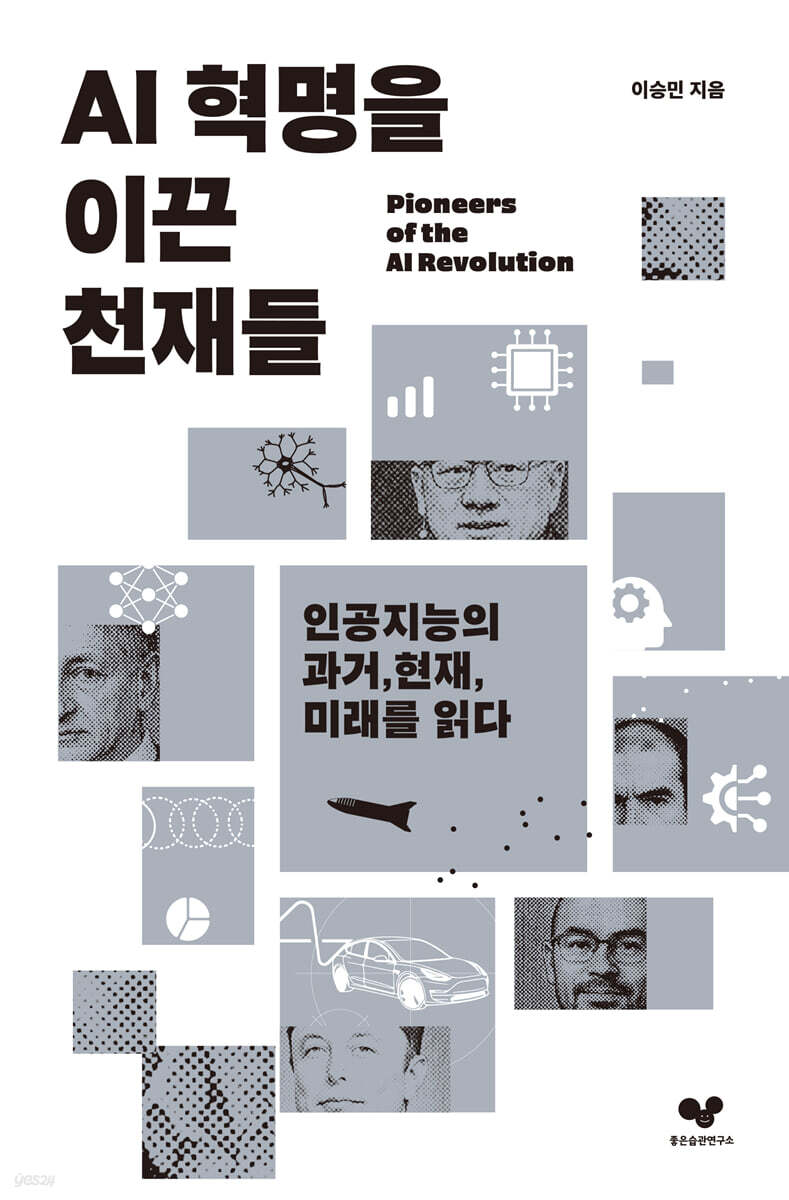
The geniuses who led the AI revolution
 |
Description
Book Introduction
The habit of making AI, which seems difficult, easy is following the thinking of the person who created AI technology.
This book provides an experience of 'seeing technology as you follow people' through the stories of 10 people at the forefront of AI, including Geoffrey Hinton, Jensen Huang, Ilya Sutskever, and Demis Hassabis.
Instead of explaining artificial intelligence in a difficult way, we talk about how the people who created the technology learned and what they thought about.
With its character-driven narrative, engaging interviews, and well-placed quotes and interpretations, this book is a perfect introduction to AI for the general reader.
This book provides an experience of 'seeing technology as you follow people' through the stories of 10 people at the forefront of AI, including Geoffrey Hinton, Jensen Huang, Ilya Sutskever, and Demis Hassabis.
Instead of explaining artificial intelligence in a difficult way, we talk about how the people who created the technology learned and what they thought about.
With its character-driven narrative, engaging interviews, and well-placed quotes and interpretations, this book is a perfect introduction to AI for the general reader.
- You can preview some of the book's contents.
Preview
index
Chapter 1.
Geoffrey Hinton: Opening the Door to AI with Deep Learning
Professor Emeritus, University of Toronto/2024 Nobel Prize in Physics
Curiosity about Intelligence | Backpropagation Algorithm | NVIDIA Graphics Cards | Ilya Sutskever | AlexNet | 10 Years at Google | Warnings of AI Threats | 2024 Nobel Prize in Physics | A Message of Hope
Chapter 2.
Demis Hassabis - Decoding the Structure of Life with AI
_Google DeepMind CEO/2024 Nobel Prize in Chemistry Winner
DeepMind | AlphaGo | Move 37 | AlphaFold | 2024 Nobel Prize in Chemistry | Geoffrey Hinton | Games, Games, Games | General AI
Chapter 3.
Jensen Huang - The semiconductor king who created the engine of the AI revolution
_Nvidia CEO
NV1 | RIVA 128 | Tesla GPU | Harper | Blackwell | TSMC | ARM Acquisition Battle | SoftBank | The Age of Robots | The Age of Inference | 60 Reports | The Future of AI
Chapter 4.
Satya Nadella: Transforming IT Giant Microsoft into an AI Leader
_Microsoft CEO
Sun Microsystems | Microsoft | Becoming CEO | OpenAI | Growth Mindset | The Era of Hyper-Personalization | The Future of Work | The Future of Education | The Future of AI
Chapter 5.
Ilya Sutskever, creator of ChatGPT
_CEO of Safe Superintelligence/Former Chief Scientist of OpenAI
Geoffrey Hinton | OpenAI Five | GPT-2 | ChatGPT | Sam Altman's Firing | Data Depletion | Safe AI |
Chapter 6.
Richard Sutton, AI Philosopher Who Walked the Path of Reinforcement Learning
Professor of Computer Science, University of Alberta
The 2025 Turing Award | The Future of AI | Tool AI and Agent AI | The Great Power of Intelligence | Moore's Law
Chapter 7.
François Cholet - A demanding engineer who questions the limits of AI.
_Keras Founder/Endia CEO
Keras | ARC Prize | The Standard for Intelligence | Endia
Chapter 8.
Andrey Kapash - Pioneer in Autonomous Driving and Vibe Coding
Eureka Labs CEO/Former Tesla AI Director
OpenAI Founder | Joining Tesla | Autopilot | After Tesla | Eureka Labs | The Future of AI
Chapter 9.
Noam Brown, a pioneer in artificial intelligence and inference models
_OpenAI Research Scientist
Dojo Breaking | OpenAI O1 | OpenAI O3 and DeepSec R1 | New Scaling Law | The Future of AI Agents | The Boy Who Loved Games | The Heating Up of the Inference Market
Chapter 10.
Elon Musk - An innovator designing humanity's future
_CEO of Tesla, SpaceX, and xAI
Zip2 | PayPal | SpaceX | Tesla | Demis Hassabis | OpenAI | Tesla Autopilot | The Conflict with Sam Altman | Optimus Robot | xAI | Lifestyle Revolution | On AGI
Geoffrey Hinton: Opening the Door to AI with Deep Learning
Professor Emeritus, University of Toronto/2024 Nobel Prize in Physics
Curiosity about Intelligence | Backpropagation Algorithm | NVIDIA Graphics Cards | Ilya Sutskever | AlexNet | 10 Years at Google | Warnings of AI Threats | 2024 Nobel Prize in Physics | A Message of Hope
Chapter 2.
Demis Hassabis - Decoding the Structure of Life with AI
_Google DeepMind CEO/2024 Nobel Prize in Chemistry Winner
DeepMind | AlphaGo | Move 37 | AlphaFold | 2024 Nobel Prize in Chemistry | Geoffrey Hinton | Games, Games, Games | General AI
Chapter 3.
Jensen Huang - The semiconductor king who created the engine of the AI revolution
_Nvidia CEO
NV1 | RIVA 128 | Tesla GPU | Harper | Blackwell | TSMC | ARM Acquisition Battle | SoftBank | The Age of Robots | The Age of Inference | 60 Reports | The Future of AI
Chapter 4.
Satya Nadella: Transforming IT Giant Microsoft into an AI Leader
_Microsoft CEO
Sun Microsystems | Microsoft | Becoming CEO | OpenAI | Growth Mindset | The Era of Hyper-Personalization | The Future of Work | The Future of Education | The Future of AI
Chapter 5.
Ilya Sutskever, creator of ChatGPT
_CEO of Safe Superintelligence/Former Chief Scientist of OpenAI
Geoffrey Hinton | OpenAI Five | GPT-2 | ChatGPT | Sam Altman's Firing | Data Depletion | Safe AI |
Chapter 6.
Richard Sutton, AI Philosopher Who Walked the Path of Reinforcement Learning
Professor of Computer Science, University of Alberta
The 2025 Turing Award | The Future of AI | Tool AI and Agent AI | The Great Power of Intelligence | Moore's Law
Chapter 7.
François Cholet - A demanding engineer who questions the limits of AI.
_Keras Founder/Endia CEO
Keras | ARC Prize | The Standard for Intelligence | Endia
Chapter 8.
Andrey Kapash - Pioneer in Autonomous Driving and Vibe Coding
Eureka Labs CEO/Former Tesla AI Director
OpenAI Founder | Joining Tesla | Autopilot | After Tesla | Eureka Labs | The Future of AI
Chapter 9.
Noam Brown, a pioneer in artificial intelligence and inference models
_OpenAI Research Scientist
Dojo Breaking | OpenAI O1 | OpenAI O3 and DeepSec R1 | New Scaling Law | The Future of AI Agents | The Boy Who Loved Games | The Heating Up of the Inference Market
Chapter 10.
Elon Musk - An innovator designing humanity's future
_CEO of Tesla, SpaceX, and xAI
Zip2 | PayPal | SpaceX | Tesla | Demis Hassabis | OpenAI | Tesla Autopilot | The Conflict with Sam Altman | Optimus Robot | xAI | Lifestyle Revolution | On AGI
Detailed image

Into the book
“Around 2006, I met a former student of mine named Rick Zielinski at a conference, and he said to me:
“You should consider using a graphics card.
It's great for matrix multiplication.
And basically, what you do is matrix multiplication.” - Geoffrey Hinton, from an interview with the Royal Institution (2024)
--- p.28
Professor Hinton, who was continuing his research on artificial intelligence at the University of Toronto, one day received an interesting proposal from a student.
So far, we have been using CPUs for artificial intelligence learning, but it was suggested that we try using GPUs.
After hearing the suggestion, I immediately bought an NVIDIA GPU and used it, and it completed calculations 30 times faster than the CPU.
It was a moment that found a new use for GPUs, previously only used in high-performance gaming PCs.
It was a discovery that would change the landscape of the artificial intelligence industry, not to mention Nvidia, but it was something no one could have imagined back in 2006.
--- p.29
AlphaGo's 37th move, Move 37, in the second match against Lee Sedol, 9-dan, was a move that was very different from the traditional rules of Go.
Experts estimate the odds of this number occurring to be about 1 in 10,000.
But when we analyze this number later, we see that what seemed inefficient on the surface was actually a creative move that brought long-term strategic advantages.
This number demonstrates that artificial intelligence can go beyond simply mimicking human moves and create new strategies.
It is said that Lee Sedol 9-dan was deeply shocked when he saw this move.
He later remarked in an interview that “no human being would ever do that.”
This move was one that AlphaGo learned on its own while playing Go with each other and reinforcing behaviors that increase scores.
--- p.61
“The next robot to come to us after the automobile will probably be a humanoid robot.
We now have the technology to build general-purpose humanoid robots.
In some ways, humanoid robots might be easier, because they are structured in a very similar way to us,32 and therefore have much more training data to provide.
- Jensen Huang, from his GTC 2024 keynote speech
--- p.103
Typically, a company has one manager who manages and reports to between three and 15 people, but Jensen Huang said in an interview that he receives reports from 60 people.
I think it's a manageable scale, working 14 hours a day, 7 days a week.
Jensen Huang said the reason he works this way is to adhere to the principle of “making sure everyone hears what I’m saying at the same time,” and to ensure that no information is actually known only to individuals.
The argument is that this is more efficient because everyone can work together to solve problems and find solutions while sharing the same background knowledge.
By having everyone in one place hear the problem and the logic behind the solution, everyone in the organization understands the big picture and has room to contribute.
--- p.111
The 10 memos he wrote at that time not only made him the third CEO of Microsoft, but also provided an opportunity to revive Microsoft, which had been faltering.
The content of the memo can be broadly summarized into two concepts: “Ambient Intelligence” and “Ubiquitous Computing.”
He argued that artificial intelligence is needed to be readily accessible and always present to users, like background music, and that computing needs to be accessible from anywhere, i.e., a focus on cloud services.
--- p.126
There needs to be a shift in thinking about education, not as something where everyone learns the same thing at the same time in one place, but as something where each person learns something different according to their aptitude and ability.
The practice of selectively taking only the classes you need through online courses is already quite familiar.
Going forward, these courses will be curated and offered by level, combined with objective and rational evaluation methods, allowing you to enjoy the entire process as if it were a game.
Learning calculus without knowing why you need to learn math is a completely different experience than learning calculus for atmospheric reentry in a manned spacecraft.
In the former, calculus is merely a passing knowledge for passing a test, but in the latter, it is part of a crucial mission that deals with human lives.
If we can fill the learning experiences of future generations with a series of exciting projects like this, we can engage more of these curious and imaginative minds in society.
--- p.143
To briefly explain the learning process of the GPT model, GPT learning is done using the Next Token Prediction method.
For example, let's assume we have a sentence like the one below.
When you see the sentence “I am a ___”, you can probably easily think of words like boy and girl to fill in the blank.
What just happened in our heads is predicting the next word, and this is heavily influenced by the frequency of that combination in the training data.
If you were taught a storybook with a lion as the main character, you might be more likely to say lion than boy.
So, the more you learn, the richer the expressions you can use, and the higher the level of knowledge you can store.
--- p.160
However, if AI can develop internal models like this, could it lead to self-awareness? Perhaps "consciousness" is a different form of human consciousness.
However, the way it manifests itself is perceived by the human eye as being conscious.
If artificial intelligence were to become conscious, whether visible or real, could we completely ignore it? Ilya noted that if artificial intelligence were to become conscious, it could pursue rights.
He then expressed a slightly optimistic view, saying, “If we want AI to coexist with us and have rights, it’s not a bad outcome.”
--- p.175
Professor Sutton is one of the most optimistic people about the future of AI.
He argued that AI should be viewed not as a "hostile outsider," but as "our allies and descendants." Rather than trying to control AI, he argued, we should focus on creating mutually beneficial social structures that allow humans and AI to work together, even if they have different goals.
Just as individual humans may not all have the same goals, but social norms and structures allow them to cooperate despite conflicting personal goals, I believe the relationship between humans and AI will be similar.
--- p.187
“LLMs simply remember a lot of information and then retrieve it, so they can’t be said to have real human-level intelligence.
“True human-level intelligence is the ability to generalize and solve problems in unfamiliar situations with very limited training data.” - François Chollet, founder of Keras, from an interview with Dwakesh Patel (2024)
--- p.206
"They're confusing technology with intelligence. Training an AI to play 100,000 games doesn't make it any more intelligent.
“You just get more skills.” - François Cholet, from an interview with Dwakesh Patel (2025)
--- p.217
“I personally think Tesla is ahead of Waymo.
It may not seem like it, but I'm still very optimistic about Tesla and their self-driving program.
I think Tesla has a software problem and Waymo has a hardware problem.
And I think software problems are much easier to solve.” - Andrey Kapash, from an interview in No Priors (2024)
--- p.232
Andrey also says that the era of “humanoid robots” is coming soon.
In the same interview, he said that Tesla's Optimus robot is essentially no different from a self-driving car, except that it has legs instead of wheels, and that 70-80% of the technology created in Tesla's Autopilot is used in the Optimus robot.
That's why it's predicted that humanoid robots will appear in our daily lives much sooner than people think.
--- p.240
“I had coffee with Ilya in late 2021 and we talked about the AGI timeline.
To be honest, I said it would take a very long time.
(...) to reach superintelligence, we need to figure out how to scale inference computing in a very general way.
I thought this would be an extremely difficult research task, and that it would take at least 10 years.
But in reality, we achieved it in two years.” - Noam Brown of OpenAI, from an interview with the YouTube channel Unsupervised Learning (2024)
--- p.262
If you think about it, usually the richest people are those who have succeeded in changing their lifestyle.
Automobile magnate Henry Ford became very wealthy by changing his lifestyle from riding a horse-drawn carriage to driving a car, and Apple's Steve Jobs became very wealthy by opening the era of home computers with the Macintosh.
And in 2007, the iPhone was created, ushering in the mobile era and changing people's lifestyles twice.
The same goes for Amazon's Jeff Bezos.
He became very wealthy by opening the era of e-commerce, where people could buy things without visiting stores, and through Amazon Web Services, he opened the era of cloud, where people could rent data centers in the corporate computing market, and he accelerated the emergence of many startups.
For Elon Musk, he first ushered in the era of reusable rockets by drastically reducing the cost of launching rockets through SpaceX.
Here, we opened the era of satellite internet by connecting the internet with Starlink satellites.
In addition, Tesla opened the era of electric vehicles.
He didn't stop there, proposing a new lifestyle called autonomous driving, and it seems likely that people's lifestyles will change at least five more times in the future, with things like migration to Mars and humanoid robots.
“You should consider using a graphics card.
It's great for matrix multiplication.
And basically, what you do is matrix multiplication.” - Geoffrey Hinton, from an interview with the Royal Institution (2024)
--- p.28
Professor Hinton, who was continuing his research on artificial intelligence at the University of Toronto, one day received an interesting proposal from a student.
So far, we have been using CPUs for artificial intelligence learning, but it was suggested that we try using GPUs.
After hearing the suggestion, I immediately bought an NVIDIA GPU and used it, and it completed calculations 30 times faster than the CPU.
It was a moment that found a new use for GPUs, previously only used in high-performance gaming PCs.
It was a discovery that would change the landscape of the artificial intelligence industry, not to mention Nvidia, but it was something no one could have imagined back in 2006.
--- p.29
AlphaGo's 37th move, Move 37, in the second match against Lee Sedol, 9-dan, was a move that was very different from the traditional rules of Go.
Experts estimate the odds of this number occurring to be about 1 in 10,000.
But when we analyze this number later, we see that what seemed inefficient on the surface was actually a creative move that brought long-term strategic advantages.
This number demonstrates that artificial intelligence can go beyond simply mimicking human moves and create new strategies.
It is said that Lee Sedol 9-dan was deeply shocked when he saw this move.
He later remarked in an interview that “no human being would ever do that.”
This move was one that AlphaGo learned on its own while playing Go with each other and reinforcing behaviors that increase scores.
--- p.61
“The next robot to come to us after the automobile will probably be a humanoid robot.
We now have the technology to build general-purpose humanoid robots.
In some ways, humanoid robots might be easier, because they are structured in a very similar way to us,32 and therefore have much more training data to provide.
- Jensen Huang, from his GTC 2024 keynote speech
--- p.103
Typically, a company has one manager who manages and reports to between three and 15 people, but Jensen Huang said in an interview that he receives reports from 60 people.
I think it's a manageable scale, working 14 hours a day, 7 days a week.
Jensen Huang said the reason he works this way is to adhere to the principle of “making sure everyone hears what I’m saying at the same time,” and to ensure that no information is actually known only to individuals.
The argument is that this is more efficient because everyone can work together to solve problems and find solutions while sharing the same background knowledge.
By having everyone in one place hear the problem and the logic behind the solution, everyone in the organization understands the big picture and has room to contribute.
--- p.111
The 10 memos he wrote at that time not only made him the third CEO of Microsoft, but also provided an opportunity to revive Microsoft, which had been faltering.
The content of the memo can be broadly summarized into two concepts: “Ambient Intelligence” and “Ubiquitous Computing.”
He argued that artificial intelligence is needed to be readily accessible and always present to users, like background music, and that computing needs to be accessible from anywhere, i.e., a focus on cloud services.
--- p.126
There needs to be a shift in thinking about education, not as something where everyone learns the same thing at the same time in one place, but as something where each person learns something different according to their aptitude and ability.
The practice of selectively taking only the classes you need through online courses is already quite familiar.
Going forward, these courses will be curated and offered by level, combined with objective and rational evaluation methods, allowing you to enjoy the entire process as if it were a game.
Learning calculus without knowing why you need to learn math is a completely different experience than learning calculus for atmospheric reentry in a manned spacecraft.
In the former, calculus is merely a passing knowledge for passing a test, but in the latter, it is part of a crucial mission that deals with human lives.
If we can fill the learning experiences of future generations with a series of exciting projects like this, we can engage more of these curious and imaginative minds in society.
--- p.143
To briefly explain the learning process of the GPT model, GPT learning is done using the Next Token Prediction method.
For example, let's assume we have a sentence like the one below.
When you see the sentence “I am a ___”, you can probably easily think of words like boy and girl to fill in the blank.
What just happened in our heads is predicting the next word, and this is heavily influenced by the frequency of that combination in the training data.
If you were taught a storybook with a lion as the main character, you might be more likely to say lion than boy.
So, the more you learn, the richer the expressions you can use, and the higher the level of knowledge you can store.
--- p.160
However, if AI can develop internal models like this, could it lead to self-awareness? Perhaps "consciousness" is a different form of human consciousness.
However, the way it manifests itself is perceived by the human eye as being conscious.
If artificial intelligence were to become conscious, whether visible or real, could we completely ignore it? Ilya noted that if artificial intelligence were to become conscious, it could pursue rights.
He then expressed a slightly optimistic view, saying, “If we want AI to coexist with us and have rights, it’s not a bad outcome.”
--- p.175
Professor Sutton is one of the most optimistic people about the future of AI.
He argued that AI should be viewed not as a "hostile outsider," but as "our allies and descendants." Rather than trying to control AI, he argued, we should focus on creating mutually beneficial social structures that allow humans and AI to work together, even if they have different goals.
Just as individual humans may not all have the same goals, but social norms and structures allow them to cooperate despite conflicting personal goals, I believe the relationship between humans and AI will be similar.
--- p.187
“LLMs simply remember a lot of information and then retrieve it, so they can’t be said to have real human-level intelligence.
“True human-level intelligence is the ability to generalize and solve problems in unfamiliar situations with very limited training data.” - François Chollet, founder of Keras, from an interview with Dwakesh Patel (2024)
--- p.206
"They're confusing technology with intelligence. Training an AI to play 100,000 games doesn't make it any more intelligent.
“You just get more skills.” - François Cholet, from an interview with Dwakesh Patel (2025)
--- p.217
“I personally think Tesla is ahead of Waymo.
It may not seem like it, but I'm still very optimistic about Tesla and their self-driving program.
I think Tesla has a software problem and Waymo has a hardware problem.
And I think software problems are much easier to solve.” - Andrey Kapash, from an interview in No Priors (2024)
--- p.232
Andrey also says that the era of “humanoid robots” is coming soon.
In the same interview, he said that Tesla's Optimus robot is essentially no different from a self-driving car, except that it has legs instead of wheels, and that 70-80% of the technology created in Tesla's Autopilot is used in the Optimus robot.
That's why it's predicted that humanoid robots will appear in our daily lives much sooner than people think.
--- p.240
“I had coffee with Ilya in late 2021 and we talked about the AGI timeline.
To be honest, I said it would take a very long time.
(...) to reach superintelligence, we need to figure out how to scale inference computing in a very general way.
I thought this would be an extremely difficult research task, and that it would take at least 10 years.
But in reality, we achieved it in two years.” - Noam Brown of OpenAI, from an interview with the YouTube channel Unsupervised Learning (2024)
--- p.262
If you think about it, usually the richest people are those who have succeeded in changing their lifestyle.
Automobile magnate Henry Ford became very wealthy by changing his lifestyle from riding a horse-drawn carriage to driving a car, and Apple's Steve Jobs became very wealthy by opening the era of home computers with the Macintosh.
And in 2007, the iPhone was created, ushering in the mobile era and changing people's lifestyles twice.
The same goes for Amazon's Jeff Bezos.
He became very wealthy by opening the era of e-commerce, where people could buy things without visiting stores, and through Amazon Web Services, he opened the era of cloud, where people could rent data centers in the corporate computing market, and he accelerated the emergence of many startups.
For Elon Musk, he first ushered in the era of reusable rockets by drastically reducing the cost of launching rockets through SpaceX.
Here, we opened the era of satellite internet by connecting the internet with Starlink satellites.
In addition, Tesla opened the era of electric vehicles.
He didn't stop there, proposing a new lifestyle called autonomous driving, and it seems likely that people's lifestyles will change at least five more times in the future, with things like migration to Mars and humanoid robots.
--- p.286
Publisher's Review
The 57th good habit from the Good Habits Institute is “Habits that make AI easy.”
AI technology has now become a part of our daily lives, and at the center of it all are people.
This book follows the journey of ten researchers, founders, and entrepreneurs who created technologies with familiar names like ChatGPT, AlphaGo, reinforcement learning, and AI semiconductors, and illuminates how artificial intelligence has achieved today's innovation.
1.
Geoffrey Hinton: Opening the Door to AI with Deep Learning
2.
Demis Hassabis - Decoding the Structure of Life with AI
3.
Jensen Huang - The semiconductor king who created the engine of the AI revolution.
4.
Satya Nadella: Transforming IT Giant Microsoft into an AI Leader
5.
Ilya Sutskever, creator of ChatGPT
6.
Richard Sutton, AI Philosopher Who Walked the Path of Reinforcement Learning
7.
François Cholet - A demanding engineer who questions the limits of AI.
8.
Andrey Kapash - Pioneer in Autonomous Driving and Vibe Coding
9.
Noam Brown, a pioneer in artificial intelligence and inference models
10 Elon Musk - The Innovator Who Shapes the Future of Humanity
This book also shows the development path and limitations of artificial intelligence, as well as the differences in outlook between academia and industry.
Some scholars believe that AI will become a "collaborator" in solving humanity's problems, while others warn of the economic and social inequality and uncontrollability that AI will bring.
By identifying these differences of opinion, readers can gain a balanced perspective on the future of AI technology, rather than simply being optimistic or pessimistic.
Rather than focusing on technical explanations, the book focuses on the characters, their philosophies, and their attitudes toward life, making it accessible to the general reader. It's recommended for everyone interested in AI, from beginners to experts, from students preparing for the AI era to practitioners and managers—anyone who wants to understand the essence of technology and the human stories embedded within it. It's also an accessible book for readers who find AI challenging.
AI technology has now become a part of our daily lives, and at the center of it all are people.
This book follows the journey of ten researchers, founders, and entrepreneurs who created technologies with familiar names like ChatGPT, AlphaGo, reinforcement learning, and AI semiconductors, and illuminates how artificial intelligence has achieved today's innovation.
1.
Geoffrey Hinton: Opening the Door to AI with Deep Learning
2.
Demis Hassabis - Decoding the Structure of Life with AI
3.
Jensen Huang - The semiconductor king who created the engine of the AI revolution.
4.
Satya Nadella: Transforming IT Giant Microsoft into an AI Leader
5.
Ilya Sutskever, creator of ChatGPT
6.
Richard Sutton, AI Philosopher Who Walked the Path of Reinforcement Learning
7.
François Cholet - A demanding engineer who questions the limits of AI.
8.
Andrey Kapash - Pioneer in Autonomous Driving and Vibe Coding
9.
Noam Brown, a pioneer in artificial intelligence and inference models
10 Elon Musk - The Innovator Who Shapes the Future of Humanity
This book also shows the development path and limitations of artificial intelligence, as well as the differences in outlook between academia and industry.
Some scholars believe that AI will become a "collaborator" in solving humanity's problems, while others warn of the economic and social inequality and uncontrollability that AI will bring.
By identifying these differences of opinion, readers can gain a balanced perspective on the future of AI technology, rather than simply being optimistic or pessimistic.
Rather than focusing on technical explanations, the book focuses on the characters, their philosophies, and their attitudes toward life, making it accessible to the general reader. It's recommended for everyone interested in AI, from beginners to experts, from students preparing for the AI era to practitioners and managers—anyone who wants to understand the essence of technology and the human stories embedded within it. It's also an accessible book for readers who find AI challenging.
GOODS SPECIFICS
- Date of issue: September 1, 2025
- Page count, weight, size: 320 pages | 420g | 138*210*20mm
- ISBN13: 9791193639504
- ISBN10: 1193639506
You may also like
카테고리
korean


korean

![ELLE 엘르 A형 (여성월간) : 1월 [2026]](http://librairie.coreenne.fr/cdn/shop/files/3b70e1cf77cf67d6da56e0eb041901e8.jpg?v=1767265322&width=3840)


