

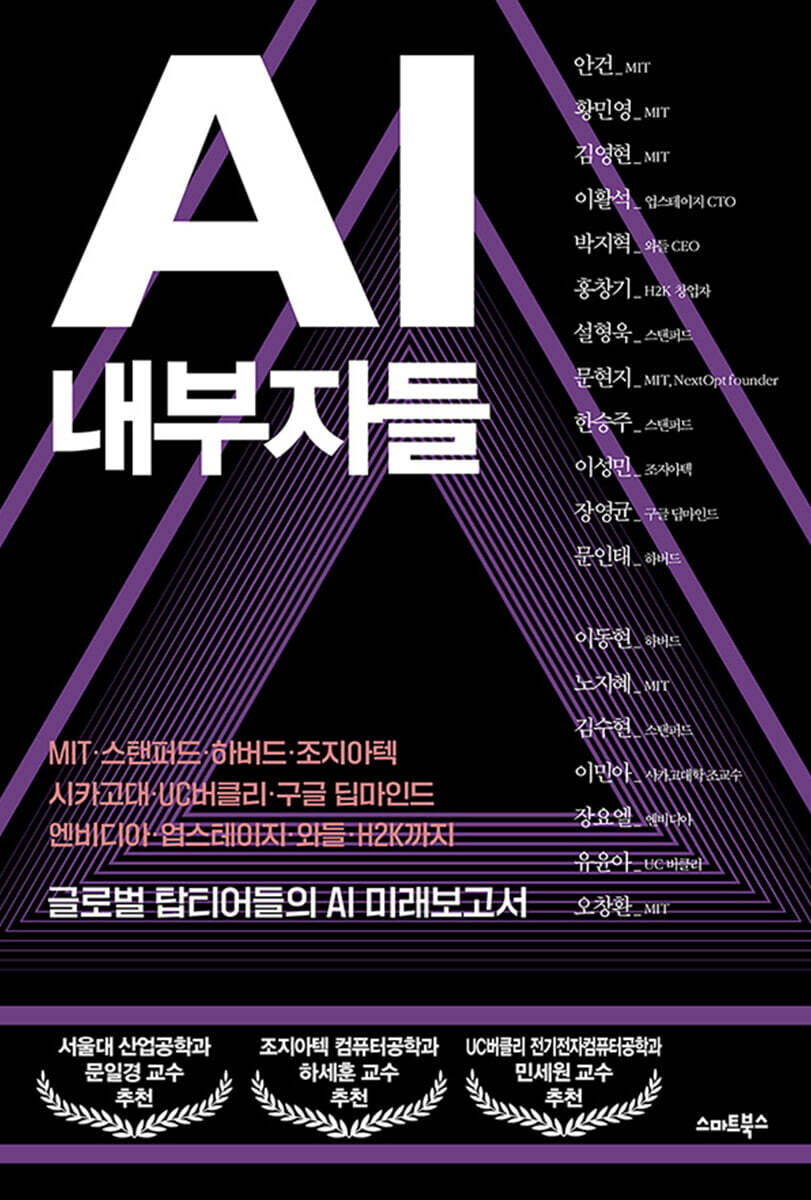
AI Insiders
 |
Description
Book Introduction
How does AI innovation happen?
MIT, Stanford, Harvard, Georgia Tech, University of Chicago, UC Berkeley,
Google DeepMind, NVIDIA, Upstage, Wardle, and H2K
AI Future Reports from Global Top Tiers
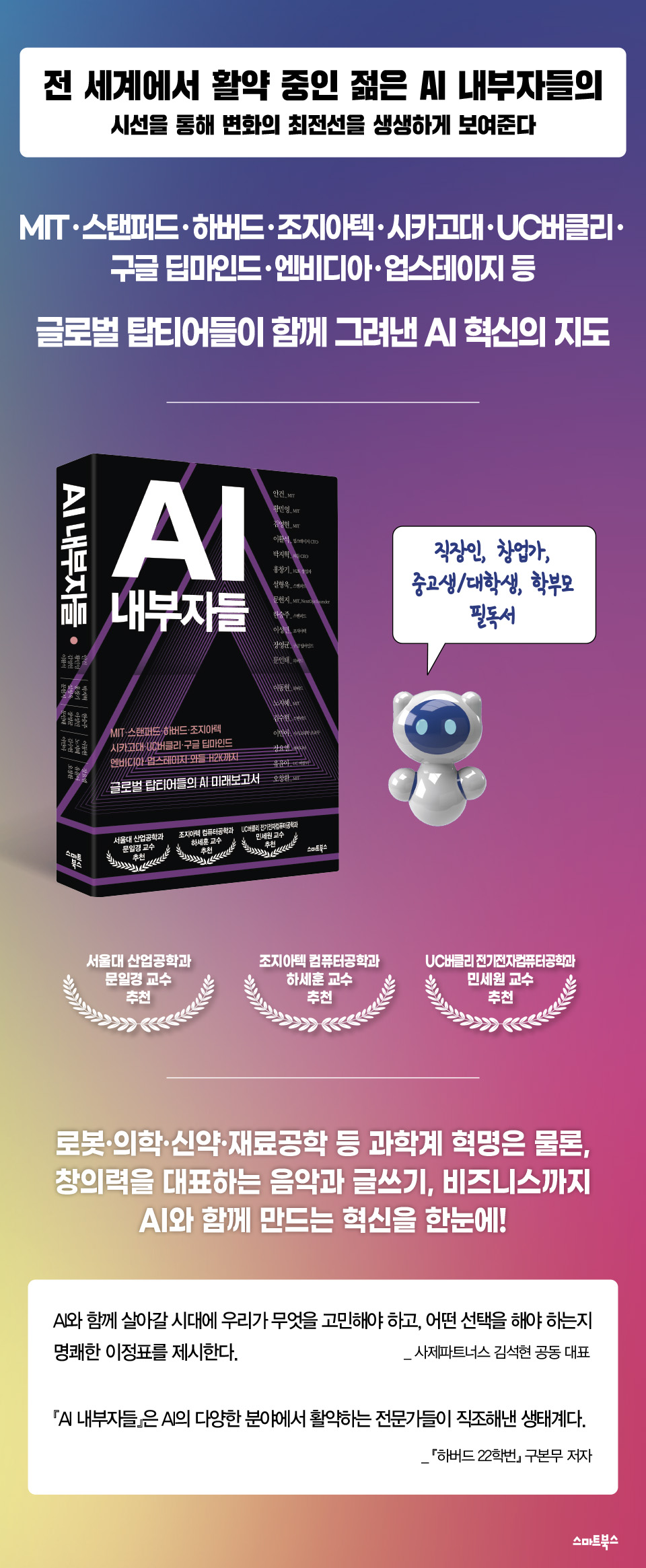
"AI Insiders" is a book written by insiders at the forefront of AI, including MIT, Stanford, Google DeepMind, Nvidia, and Upstage.
It showcases the innovations being created by AI, not only in scientific revolutions like robotics, medicine, new drugs, and materials engineering, but also in music, writing, and even business—representing creativity. It will present a credible and compelling picture of our future, coexisting with AI.
Recommended by leading authorities such as Professor Moon Il-kyung of Seoul National University, Professor Ha Se-hoon of Georgia Tech, and Professor Min Se-won of UC Berkeley, this book vividly conveys the innovations observed by practitioners and researchers at the forefront of AI.
Beyond a simple list of information, we will absorb the authors' vivid experiences and transform them into practical knowledge that can be applied.
"AI Insiders" will be of great help to everyone working with AI, from office workers seeking to understand the future of the AI era, to high school and college students pursuing careers in the AI industry, to professionals seeking perspectives from diverse fields.
MIT, Stanford, Harvard, Georgia Tech, University of Chicago, UC Berkeley,
Google DeepMind, NVIDIA, Upstage, Wardle, and H2K
AI Future Reports from Global Top Tiers
"AI Insiders" is a book written by insiders at the forefront of AI, including MIT, Stanford, Google DeepMind, Nvidia, and Upstage.
It showcases the innovations being created by AI, not only in scientific revolutions like robotics, medicine, new drugs, and materials engineering, but also in music, writing, and even business—representing creativity. It will present a credible and compelling picture of our future, coexisting with AI.
Recommended by leading authorities such as Professor Moon Il-kyung of Seoul National University, Professor Ha Se-hoon of Georgia Tech, and Professor Min Se-won of UC Berkeley, this book vividly conveys the innovations observed by practitioners and researchers at the forefront of AI.
Beyond a simple list of information, we will absorb the authors' vivid experiences and transform them into practical knowledge that can be applied.
"AI Insiders" will be of great help to everyone working with AI, from office workers seeking to understand the future of the AI era, to high school and college students pursuing careers in the AI industry, to professionals seeking perspectives from diverse fields.
- You can preview some of the book's contents.
Preview
index
About this book: How does AI innovation occur?
Preface_ Hoping that we all become masters of AI utilization
Part 1: AI Transforming Business and Industrial Ecosystems
How can companies gain a competitive edge with language models? _Halseok Lee (Upstage CTO)
Large-Scale Language Models: A Magic Box | The Process of Building Language Models | The Advantages and Limitations of Language Models | Strategies for Leveraging Language Models to Gain Product Advantage | Core Elements of AI Business Operations
The Secrets of AI Startups: What's the Key to Success? _ Park Ji-hyuk (CEO of Wardle)
Business models that transcend technological limitations | The shifting focus of AI development | Why AI's costs are rising | The arrival of the 'A2A era' | Time: The essential element for successful business
A New Korean Language Education Using AI _ Hong Chang-ki (Founder of H2K)
Founding H2K | AI in Education | AI in Sojung Hangul: Three Principles of AI Tutoring | Why Data Strategy Matters in AI Services: A Comparison of Industry Cases | Lessons from Data Failures in AI Learning Services | The Role of AI in Entrepreneurship | A Future Vision for AI
Why is Nvidia's stock rising in the AI era? _Seol Hyung-wook (Stanford)
What the heck is a GPU? | Why does AI need a GPU? | Why NVIDIA's GPUs are more powerful | GPUs require effort to work | NVIDIA, the overwhelming leader | The CUDA platform | The future of AI semiconductors | Transformer-specific chips: Etched | A new AI programming platform: Modular
AI that Reads Investors' Minds _ Moon Hyun-ji (MIT)
Decipherable Patterns Hidden in Investor Disagreements | Bayesian Approach: The Engine of AI Investment | Collaborative Decision-Making Systems Using AI | Turning Disagreement into an Engine
Part 2: The Development and Future Prospects of AI
From Sequence Models to ChatGPT and DeepSearch, and the Future _Seungju Han (Stanford)
Google's Sequence-Sequence Model and OpenAI's GPT-1 | The Rise of GPT-2 and Scaling Laws | OpenAI ChatGPT: GPT-3 Understands Speech | OpenAI o1 and DeepSeek-R1: Language Models That Think Like Humans | Large-Scale Language Models Beyond 2025
AI Dominates Humanity?: The Risks of AI and Efforts to Address Them _Lee Seong-min (Georgia Tech)
How does AI learn? | Problems AI can cause | How to mitigate AI risks | What's required for smart AI use?
Big Tech AI Scientist Youngkyun Jang (formerly at Meta, now at Google DeepMind)
What Does an AI Research Scientist Do? | The First Step to Becoming an AI Research Scientist | Become a Big Tech AI Research Scientist! | Life and Future as an AI Research Scientist
Part 3: AI Innovation in Healthcare and Life Sciences
Medicine, AI, and a New Path to Cancer Treatment _ Moon In-tae (Harvard)
The Evolution of Medicine and AI: Steps Toward Better Treatments | How Can AI Aid the Fight Against Cancer? | The Current State of AI-Based Cancer Research | The Future: How AI Will Shape the Future of Cancer Treatment | Challenges and Hopes for the Future of the Fight Against Cancer
Overcoming Aging Using AI _ Lee Dong-hyun (Harvard)
The Benefits of Aging Research | Overcoming Aging Using AI | Identifying Aging Characteristics and Exploring (Therapeutic) Targets | Immunosenescence | Gene Therapy | Cell Reprogramming | Aging Biomarkers | Conclusion
New Drug Development Using AI _ Noh Ji-hye (MIT)
AI-based drug screening | AI-based new drug candidate design | AI-based drug candidate synthesis | The future of AI-based drug development
Using AI in the Diagnosis and Treatment of Depression and Mental Illness (MIT)
Early Diagnosis of Depression Using Digital Phenotyping | AI-Based Depression Treatment Recommendations | Using Survey Data | Using Brain Image Data | AI-Based Mental Illness Treatment
Part 4: AI Expanding Creativity: Potential and Limitations
A New World of AI Music Creation _ Kim Soo-hyun (Stanford)
How should we view AI technology in music creation? | Why tech companies are researching AI music generation technology | How can AI become a truly meaningful music creation tool? | For the innovation of new music.
AI Evolves on Its Own? Truth and Misconceptions _ Minyoung Hwang (MIT)
What AI Can and Can't Do | Why AGI Isn't a Panacea
AI and Writing _ Lee Min-ah (Assistant Professor, University of Chicago)
How Effective Will AI Be in Writing? | The Changes and Prospects AI Brings to the Writing Ecosystem
Part 5: New Horizons in Human-Machine Collaboration
Physical AI: The Next Frontier in Robotics and Generative AI _Yoel Jang (NVIDIA)
The Challenges of Physical AI | Why NVIDIA Focuses on Physical AGI | The Future: The Role of General-Purpose Robotics and Humanoids | The Path to Physical AGI
Human-Robot Interaction _ Minyoung Hwang (MIT)
Robot Learning with Human Feedback | From General-Purpose Systems to Personalized Robots | Learning Personalized Reward Functions | Trustworthy Robots: Safety, Transparency, and Uncertainty
AI-Powered Design Optimization _Yoon-ah Yoo (UC Berkeley)
What is design optimization, and why is it needed? | How can AI be used for design optimization? | Case studies of AI in design optimization | The future of AI and design optimization
AI and Materials Engineering _ Oh Chang-hwan (MIT)
AI and Materials Engineering | Metal-Organic Frameworks for Greenhouse Gas Adsorption | Predicting Material Properties Using AI | Building a Materials Database Using AI | Leveraging AI in Final Material Design | The Role of Engineers in the AI Era
Preface_ Hoping that we all become masters of AI utilization
Part 1: AI Transforming Business and Industrial Ecosystems
How can companies gain a competitive edge with language models? _Halseok Lee (Upstage CTO)
Large-Scale Language Models: A Magic Box | The Process of Building Language Models | The Advantages and Limitations of Language Models | Strategies for Leveraging Language Models to Gain Product Advantage | Core Elements of AI Business Operations
The Secrets of AI Startups: What's the Key to Success? _ Park Ji-hyuk (CEO of Wardle)
Business models that transcend technological limitations | The shifting focus of AI development | Why AI's costs are rising | The arrival of the 'A2A era' | Time: The essential element for successful business
A New Korean Language Education Using AI _ Hong Chang-ki (Founder of H2K)
Founding H2K | AI in Education | AI in Sojung Hangul: Three Principles of AI Tutoring | Why Data Strategy Matters in AI Services: A Comparison of Industry Cases | Lessons from Data Failures in AI Learning Services | The Role of AI in Entrepreneurship | A Future Vision for AI
Why is Nvidia's stock rising in the AI era? _Seol Hyung-wook (Stanford)
What the heck is a GPU? | Why does AI need a GPU? | Why NVIDIA's GPUs are more powerful | GPUs require effort to work | NVIDIA, the overwhelming leader | The CUDA platform | The future of AI semiconductors | Transformer-specific chips: Etched | A new AI programming platform: Modular
AI that Reads Investors' Minds _ Moon Hyun-ji (MIT)
Decipherable Patterns Hidden in Investor Disagreements | Bayesian Approach: The Engine of AI Investment | Collaborative Decision-Making Systems Using AI | Turning Disagreement into an Engine
Part 2: The Development and Future Prospects of AI
From Sequence Models to ChatGPT and DeepSearch, and the Future _Seungju Han (Stanford)
Google's Sequence-Sequence Model and OpenAI's GPT-1 | The Rise of GPT-2 and Scaling Laws | OpenAI ChatGPT: GPT-3 Understands Speech | OpenAI o1 and DeepSeek-R1: Language Models That Think Like Humans | Large-Scale Language Models Beyond 2025
AI Dominates Humanity?: The Risks of AI and Efforts to Address Them _Lee Seong-min (Georgia Tech)
How does AI learn? | Problems AI can cause | How to mitigate AI risks | What's required for smart AI use?
Big Tech AI Scientist Youngkyun Jang (formerly at Meta, now at Google DeepMind)
What Does an AI Research Scientist Do? | The First Step to Becoming an AI Research Scientist | Become a Big Tech AI Research Scientist! | Life and Future as an AI Research Scientist
Part 3: AI Innovation in Healthcare and Life Sciences
Medicine, AI, and a New Path to Cancer Treatment _ Moon In-tae (Harvard)
The Evolution of Medicine and AI: Steps Toward Better Treatments | How Can AI Aid the Fight Against Cancer? | The Current State of AI-Based Cancer Research | The Future: How AI Will Shape the Future of Cancer Treatment | Challenges and Hopes for the Future of the Fight Against Cancer
Overcoming Aging Using AI _ Lee Dong-hyun (Harvard)
The Benefits of Aging Research | Overcoming Aging Using AI | Identifying Aging Characteristics and Exploring (Therapeutic) Targets | Immunosenescence | Gene Therapy | Cell Reprogramming | Aging Biomarkers | Conclusion
New Drug Development Using AI _ Noh Ji-hye (MIT)
AI-based drug screening | AI-based new drug candidate design | AI-based drug candidate synthesis | The future of AI-based drug development
Using AI in the Diagnosis and Treatment of Depression and Mental Illness (MIT)
Early Diagnosis of Depression Using Digital Phenotyping | AI-Based Depression Treatment Recommendations | Using Survey Data | Using Brain Image Data | AI-Based Mental Illness Treatment
Part 4: AI Expanding Creativity: Potential and Limitations
A New World of AI Music Creation _ Kim Soo-hyun (Stanford)
How should we view AI technology in music creation? | Why tech companies are researching AI music generation technology | How can AI become a truly meaningful music creation tool? | For the innovation of new music.
AI Evolves on Its Own? Truth and Misconceptions _ Minyoung Hwang (MIT)
What AI Can and Can't Do | Why AGI Isn't a Panacea
AI and Writing _ Lee Min-ah (Assistant Professor, University of Chicago)
How Effective Will AI Be in Writing? | The Changes and Prospects AI Brings to the Writing Ecosystem
Part 5: New Horizons in Human-Machine Collaboration
Physical AI: The Next Frontier in Robotics and Generative AI _Yoel Jang (NVIDIA)
The Challenges of Physical AI | Why NVIDIA Focuses on Physical AGI | The Future: The Role of General-Purpose Robotics and Humanoids | The Path to Physical AGI
Human-Robot Interaction _ Minyoung Hwang (MIT)
Robot Learning with Human Feedback | From General-Purpose Systems to Personalized Robots | Learning Personalized Reward Functions | Trustworthy Robots: Safety, Transparency, and Uncertainty
AI-Powered Design Optimization _Yoon-ah Yoo (UC Berkeley)
What is design optimization, and why is it needed? | How can AI be used for design optimization? | Case studies of AI in design optimization | The future of AI and design optimization
AI and Materials Engineering _ Oh Chang-hwan (MIT)
AI and Materials Engineering | Metal-Organic Frameworks for Greenhouse Gas Adsorption | Predicting Material Properties Using AI | Building a Materials Database Using AI | Leveraging AI in Final Material Design | The Role of Engineers in the AI Era
Detailed image
Publisher's Review
In the field of AI, Korea lags behind not only the United States and China, but also other countries.
While the United States and China are leading the race for AI supremacy with massive capital and talent, Korea has remained stuck in the global trend, with a shallow research pool and insufficient data and computing infrastructure.
Accordingly, there have even been assessments that while Korea may be a 'country that uses AI' in terms of research results and commercialization speed, it will be difficult for it to establish itself as a 'country that creates AI.'
This isn't simply a technical issue. In an era where AI is shaping the competitiveness of industries across the board, it means that nearly every sector, including manufacturing, finance, services, and defense, could be left behind in global competition.
In this situation, "AI Insiders" is a book like rain in a drought.
A map of AI innovation drawn by experts from various fields.
"AI Insiders" vividly conveys the innovations AI is creating in almost every field imaginable, from the language models we commonly encounter to the scientific revolutions in design processes such as robotics, medicine, new drug development, and materials engineering, to fields such as music and writing, which represent creativity once considered exclusive to humans, and even business.
Anyone who has vaguely felt the power and influence of AI will be surprised by how deeply AI is penetrating each field and even changing the way people at the forefront of each field think and work.
How does AI-driven innovation occur?
In this book, authors from the AI front lines argue that the priority for creating innovation in each field using AI is not AI itself.
It tells us that only when we have a thorough understanding of the history and traditions of each field and an understanding of why certain innovations have occurred can we truly create change.
This will serve as a stimulus to the Korean AI industry, which is catching up late, to realize that we can do it too.
A glance at the AI ecosystem woven by frontline experts!
"AI Insiders" provides a glimpse into the AI ecosystem, woven by experts active in various fields of AI.
From language models to AI startups, AI investment, AI infrastructure, AI risks, Big Tech AI, medicine, biotechnology, new drug development, physical AI and robotics, design optimization, materials engineering, music, writing, business, and more, it showcases the innovations AI is creating in almost every field imaginable.
Part 1: AI Transforming Business and Industrial Ecosystems
With the pace of technological advancement at an unprecedented pace, how can we understand the nature of this change and connect it to real opportunities? Part 1 is designed to answer these questions.
Five experts playing different roles in the AI revolution present new perspectives on topics ranging from the fundamental principles of technology to startups, industrial infrastructure, and investment, including “How can companies gain a competitive edge with language models?”, “The Secret of AI Startups: What is the Key to Success?”, “Why is Nvidia’s stock rising in the AI era?”, and “AI that Reads Investors’ Minds.”
Part 2: The Development and Future Prospects of AI
To answer questions like, "Will AI dominate humanity?" or "Will AI take my job?", we need to understand the history of AI development.
Part 2 traces the development of models such as ChatGPT and DeepSeek to predict what changes will occur in the near future, and delves into the hallucinations and ethical issues that AI can cause, as well as efforts to resolve them.
Part 3: AI Innovation in Healthcare and Life Sciences
Part 3 covers AI innovations in healthcare and life sciences.
We explore how AI is improving accuracy, accelerating speed, and even providing precise care for mental health in areas such as precision cancer diagnosis and treatment, strategies for overcoming aging, new trends in drug development, and mental health care. We distinguish between what's possible today and what will be possible tomorrow, and examine both possibilities and limitations.
Part 4: AI Expanding Creativity: Potential and Limitations
Contrary to our expectations, creative activities such as art, music, and writing are being replaced by AI faster and earlier than other fields since the advent of AI.
Because of this, people in this field feel fear and threat, and they question how to accept AI and how to respond and live with it.
Part 4 will serve as a milestone for human creators to find their own answers amidst such questions and anxieties.
It will also provide valuable hints to those seeking to create AI technologies for these human creators.
Part 5: New Horizons in Human-Machine Collaboration
The true potential of AI is only fully realized when it transcends the digital space and encounters the physical world.
Part 5 examines from various angles how AI is entering the real world, collaborating with humans, and transforming our daily lives and industries.
Through “Physical AI: The Next Frontier in Robotics and Generative AI,” “Human-Robot Interaction,” “Design Optimization Using AI,” and “AI and Materials Engineering,” we introduce AI innovations in various fields and suggest a future collaboration model that humans and AI will create together.
"AI Insiders" will be of great help to everyone who seeks to understand AI as a companion for the new era, from working professionals seeking to understand the future of the AI era, to high school and college students pursuing careers in the AI industry, to professionals seeking to gain perspectives from diverse fields.
While the United States and China are leading the race for AI supremacy with massive capital and talent, Korea has remained stuck in the global trend, with a shallow research pool and insufficient data and computing infrastructure.
Accordingly, there have even been assessments that while Korea may be a 'country that uses AI' in terms of research results and commercialization speed, it will be difficult for it to establish itself as a 'country that creates AI.'
This isn't simply a technical issue. In an era where AI is shaping the competitiveness of industries across the board, it means that nearly every sector, including manufacturing, finance, services, and defense, could be left behind in global competition.
In this situation, "AI Insiders" is a book like rain in a drought.
A map of AI innovation drawn by experts from various fields.
"AI Insiders" vividly conveys the innovations AI is creating in almost every field imaginable, from the language models we commonly encounter to the scientific revolutions in design processes such as robotics, medicine, new drug development, and materials engineering, to fields such as music and writing, which represent creativity once considered exclusive to humans, and even business.
Anyone who has vaguely felt the power and influence of AI will be surprised by how deeply AI is penetrating each field and even changing the way people at the forefront of each field think and work.
How does AI-driven innovation occur?
In this book, authors from the AI front lines argue that the priority for creating innovation in each field using AI is not AI itself.
It tells us that only when we have a thorough understanding of the history and traditions of each field and an understanding of why certain innovations have occurred can we truly create change.
This will serve as a stimulus to the Korean AI industry, which is catching up late, to realize that we can do it too.
A glance at the AI ecosystem woven by frontline experts!
"AI Insiders" provides a glimpse into the AI ecosystem, woven by experts active in various fields of AI.
From language models to AI startups, AI investment, AI infrastructure, AI risks, Big Tech AI, medicine, biotechnology, new drug development, physical AI and robotics, design optimization, materials engineering, music, writing, business, and more, it showcases the innovations AI is creating in almost every field imaginable.
Part 1: AI Transforming Business and Industrial Ecosystems
With the pace of technological advancement at an unprecedented pace, how can we understand the nature of this change and connect it to real opportunities? Part 1 is designed to answer these questions.
Five experts playing different roles in the AI revolution present new perspectives on topics ranging from the fundamental principles of technology to startups, industrial infrastructure, and investment, including “How can companies gain a competitive edge with language models?”, “The Secret of AI Startups: What is the Key to Success?”, “Why is Nvidia’s stock rising in the AI era?”, and “AI that Reads Investors’ Minds.”
Part 2: The Development and Future Prospects of AI
To answer questions like, "Will AI dominate humanity?" or "Will AI take my job?", we need to understand the history of AI development.
Part 2 traces the development of models such as ChatGPT and DeepSeek to predict what changes will occur in the near future, and delves into the hallucinations and ethical issues that AI can cause, as well as efforts to resolve them.
Part 3: AI Innovation in Healthcare and Life Sciences
Part 3 covers AI innovations in healthcare and life sciences.
We explore how AI is improving accuracy, accelerating speed, and even providing precise care for mental health in areas such as precision cancer diagnosis and treatment, strategies for overcoming aging, new trends in drug development, and mental health care. We distinguish between what's possible today and what will be possible tomorrow, and examine both possibilities and limitations.
Part 4: AI Expanding Creativity: Potential and Limitations
Contrary to our expectations, creative activities such as art, music, and writing are being replaced by AI faster and earlier than other fields since the advent of AI.
Because of this, people in this field feel fear and threat, and they question how to accept AI and how to respond and live with it.
Part 4 will serve as a milestone for human creators to find their own answers amidst such questions and anxieties.
It will also provide valuable hints to those seeking to create AI technologies for these human creators.
Part 5: New Horizons in Human-Machine Collaboration
The true potential of AI is only fully realized when it transcends the digital space and encounters the physical world.
Part 5 examines from various angles how AI is entering the real world, collaborating with humans, and transforming our daily lives and industries.
Through “Physical AI: The Next Frontier in Robotics and Generative AI,” “Human-Robot Interaction,” “Design Optimization Using AI,” and “AI and Materials Engineering,” we introduce AI innovations in various fields and suggest a future collaboration model that humans and AI will create together.
"AI Insiders" will be of great help to everyone who seeks to understand AI as a companion for the new era, from working professionals seeking to understand the future of the AI era, to high school and college students pursuing careers in the AI industry, to professionals seeking to gain perspectives from diverse fields.
GOODS SPECIFICS
- Date of issue: September 23, 2025
- Page count, weight, size: 328 pages | 596g | 152*225*21mm
- ISBN13: 9791193674307
- ISBN10: 1193674301
You may also like
카테고리
korean


korean

![ELLE 엘르 A형 (여성월간) : 1월 [2026]](http://librairie.coreenne.fr/cdn/shop/files/3b70e1cf77cf67d6da56e0eb041901e8.jpg?v=1767265322&width=3840)


