

Bible Panorama
 |
Description
Book Introduction
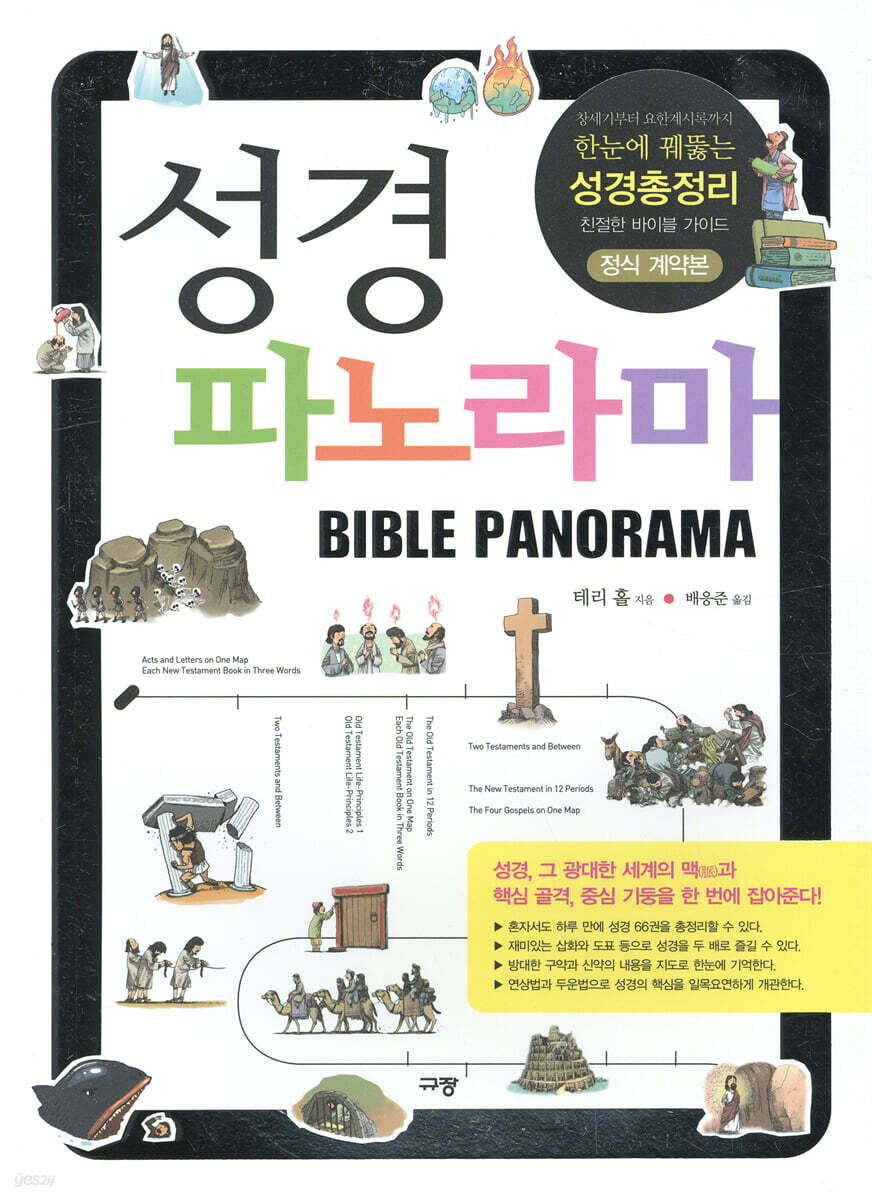
A Bible guide designed to help you understand all 66 books of the Bible at a glance, from Genesis to Revelation.
Author Terry Hall shows the great flow of history, showing how biblical history unfolds, and provides a three-dimensional explanation of where and when it unfolded on the map of the Bible.
Additionally, his Bible study method guides students to remember the important themes and central figures of each book of the Bible in a fun way through associations using interesting illustrations and diagrams.
To accurately grasp the context of the Bible, we need a "spiritual aerial map" that shows how the stream of salvation history flows from Genesis to Revelation.
And we also need detailed photos that show the forest but zoom in on the trees.
Through the 『Bible Panorama』, which is structured to satisfy these two conditions, you will be able to understand the pulse, core framework, and central pillar of the Bible.
Author Terry Hall shows the great flow of history, showing how biblical history unfolds, and provides a three-dimensional explanation of where and when it unfolded on the map of the Bible.
Additionally, his Bible study method guides students to remember the important themes and central figures of each book of the Bible in a fun way through associations using interesting illustrations and diagrams.
To accurately grasp the context of the Bible, we need a "spiritual aerial map" that shows how the stream of salvation history flows from Genesis to Revelation.
And we also need detailed photos that show the forest but zoom in on the trees.
Through the 『Bible Panorama』, which is structured to satisfy these two conditions, you will be able to understand the pulse, core framework, and central pillar of the Bible.
- You can preview some of the book's contents.
Preview
index
Preface for Korean Readers
Korean Edition Editor's Note
PART 1: A Skeletal Panorama of the Bible
CHAPTER 01 See the forest first, then the trees │The three frameworks of the Bible
CHAPTER 02 Understanding the Bible's Flow with the Eight Pillars │The Eight Frameworks of the Bible
PART 2: OLD TESTAMENT PANORAMA
CHAPTER 03 Understanding the Old Testament Era Reveals God's Heart │ The Twelve Eras of the Old Testament
CHAPTER 04 Maps Make the Old Testament More Three-Dimensional │ Maps of the Old Testament
CHAPTER 05 Grasping the Core Plots of Old Testament Dramas │ Core Themes of Each Book of the Old Testament
CHAPTER 06 God's Drama Changes People │Old Testament Life Principles 1
CHAPTER 07 Learning the Best Life Through the Drama of the Old Testament │Old Testament Life Principles 2
PART 3: A Panorama of the Intertestamental Period
CHAPTER 08 Silence Has Meaning │The Old and New Testaments and the Intertestamental Period
PART 4: A Panorama of the New Testament
CHAPTER 09 Understanding the New Testament Era to Enjoy Jesus' Grace │The Twelve Eras of the New Testament
CHAPTER 10: Jesus Seen in More Three-Dimensional Perspectives through Maps │The Four Gospels in Maps
CHAPTER 11: Looking at the Church Age on a Map Shows the Holy Spirit's Work in More Three-Dimensional Ways │ Acts and the Epistles on a Map
CHAPTER 12 The Focus of All the Bible Is Jesus Christ │The Core Theme of Each Book of the New Testament
Meditation Notes on the Cross in Panorama
Korean Edition Editor's Note
PART 1: A Skeletal Panorama of the Bible
CHAPTER 01 See the forest first, then the trees │The three frameworks of the Bible
CHAPTER 02 Understanding the Bible's Flow with the Eight Pillars │The Eight Frameworks of the Bible
PART 2: OLD TESTAMENT PANORAMA
CHAPTER 03 Understanding the Old Testament Era Reveals God's Heart │ The Twelve Eras of the Old Testament
CHAPTER 04 Maps Make the Old Testament More Three-Dimensional │ Maps of the Old Testament
CHAPTER 05 Grasping the Core Plots of Old Testament Dramas │ Core Themes of Each Book of the Old Testament
CHAPTER 06 God's Drama Changes People │Old Testament Life Principles 1
CHAPTER 07 Learning the Best Life Through the Drama of the Old Testament │Old Testament Life Principles 2
PART 3: A Panorama of the Intertestamental Period
CHAPTER 08 Silence Has Meaning │The Old and New Testaments and the Intertestamental Period
PART 4: A Panorama of the New Testament
CHAPTER 09 Understanding the New Testament Era to Enjoy Jesus' Grace │The Twelve Eras of the New Testament
CHAPTER 10: Jesus Seen in More Three-Dimensional Perspectives through Maps │The Four Gospels in Maps
CHAPTER 11: Looking at the Church Age on a Map Shows the Holy Spirit's Work in More Three-Dimensional Ways │ Acts and the Epistles on a Map
CHAPTER 12 The Focus of All the Bible Is Jesus Christ │The Core Theme of Each Book of the New Testament
Meditation Notes on the Cross in Panorama
Into the book
Preface for Korean Readers
A heart-warming panorama of the Bible unfolds before you!
There is one of the most puzzling publications in human history.
This book has no special editor or publisher, but was written by 40 journalists with 20 different professions, living in 10 different countries over 1,600 years, and writing in three languages, mentioning 2,930 people and 1,551 place names.
This book consists of 66 volumes, 1,189 chapters, 31,173 verses, 774,746 words, and 3,567,180 characters.
This vast volume covers every subject that can be expressed in human literature.
The methods of expression are also diverse, including prose, poetry, romance novels, riddles, biographies, science, and history.
What exactly is this book? It is the Bible.
From beginning to end, the Bible consistently speaks of one God, one cause of humanity's problems (sin), and one universal cure for those problems (God's Son and Savior).
The Bible is all one story.
The end of the last book of the Bible feels like the conclusion of a story that began at the beginning of the first book of the Bible.
For many people, the Bible is like a giant puzzle.
They cannot see the Bible as a panoramic picture, but rather see its stories as numerous puzzle pieces.
If you could only see the hundreds of puzzle pieces and not the full picture, imagine how much trouble you would have putting them all together.
Many people study, listen to sermons, and read the Word by picking out a very small part of the Bible.
But we do not see how they make up God's book (the Bible).
Just as it is much more meaningful to look at the whole picture and then examine each puzzle piece, the same is true with the Bible.
As an author, it is a great honor for me to be able to help readers see the big picture of the Bible.
I am especially pleased that this book is being introduced to Korean readers.
Korean Christianity has experienced explosive growth.
Eleven of the 12 largest churches in the world are in Seoul, South Korea.
Additionally, Korea is the second largest missionary-sending country in the world.
Koreans are literally exporting the gospel to the whole world!
One day, two of Jesus' disciples met the resurrected Jesus on their way to Emmaus.
Jesus himself gave a panoramic explanation of how all the Scriptures, from the Pentateuch to Malachi, point to him as the Savior of the world (Luke 24:13-35).
Then they begin to feel holy anguish, saying, “Did not our hearts burn within us while he talked to us on the road and while he opened the Scriptures to us?” (Luke 24:32).
Now we have in our hands the complete revelation of God.
I pray that all Korean readers will learn about the people, places, and principles of the Bible and see the continuity of the Bible from Genesis to Revelation.
I also pray that through this book, all readers in Korea will find renewed motivation to read God's Word every day, apply God's unchanging principles to their lives, and share the stories of the Bible with others.
I pray that those of you who read this book will receive blessings that you could not have even asked for or imagined.
Terry Hall
A heart-warming panorama of the Bible unfolds before you!
There is one of the most puzzling publications in human history.
This book has no special editor or publisher, but was written by 40 journalists with 20 different professions, living in 10 different countries over 1,600 years, and writing in three languages, mentioning 2,930 people and 1,551 place names.
This book consists of 66 volumes, 1,189 chapters, 31,173 verses, 774,746 words, and 3,567,180 characters.
This vast volume covers every subject that can be expressed in human literature.
The methods of expression are also diverse, including prose, poetry, romance novels, riddles, biographies, science, and history.
What exactly is this book? It is the Bible.
From beginning to end, the Bible consistently speaks of one God, one cause of humanity's problems (sin), and one universal cure for those problems (God's Son and Savior).
The Bible is all one story.
The end of the last book of the Bible feels like the conclusion of a story that began at the beginning of the first book of the Bible.
For many people, the Bible is like a giant puzzle.
They cannot see the Bible as a panoramic picture, but rather see its stories as numerous puzzle pieces.
If you could only see the hundreds of puzzle pieces and not the full picture, imagine how much trouble you would have putting them all together.
Many people study, listen to sermons, and read the Word by picking out a very small part of the Bible.
But we do not see how they make up God's book (the Bible).
Just as it is much more meaningful to look at the whole picture and then examine each puzzle piece, the same is true with the Bible.
As an author, it is a great honor for me to be able to help readers see the big picture of the Bible.
I am especially pleased that this book is being introduced to Korean readers.
Korean Christianity has experienced explosive growth.
Eleven of the 12 largest churches in the world are in Seoul, South Korea.
Additionally, Korea is the second largest missionary-sending country in the world.
Koreans are literally exporting the gospel to the whole world!
One day, two of Jesus' disciples met the resurrected Jesus on their way to Emmaus.
Jesus himself gave a panoramic explanation of how all the Scriptures, from the Pentateuch to Malachi, point to him as the Savior of the world (Luke 24:13-35).
Then they begin to feel holy anguish, saying, “Did not our hearts burn within us while he talked to us on the road and while he opened the Scriptures to us?” (Luke 24:32).
Now we have in our hands the complete revelation of God.
I pray that all Korean readers will learn about the people, places, and principles of the Bible and see the continuity of the Bible from Genesis to Revelation.
I also pray that through this book, all readers in Korea will find renewed motivation to read God's Word every day, apply God's unchanging principles to their lives, and share the stories of the Bible with others.
I pray that those of you who read this book will receive blessings that you could not have even asked for or imagined.
Terry Hall
--- From the text
Publisher's Review
How to get 100% out of this book
1. Visual aid! Snap a picture and memorize it!
This book provides a variety of information, including pictures, maps, and diagrams, to help readers understand and study with interest.
If you remember each visual aid that corresponds to the text, it will become an image and you will be able to easily recall the content of the text later.
2 Say goodbye to complicated place names! Meet the Bible on a map.
Key place names that appear in the Bible without fail, such as Galilee, Antioch, and Mount Sinai, although their exact locations are unknown.
Meet these key locations, biblical events, and people on a map! Each time you see a map, try drawing it in the air with your finger or on a blank piece of paper.
The next time you read the Bible, a three-dimensional map will be drawn in your mind.
3. Studying alone? Good! Studying in a group? Very good!
This book is designed so that you can master it on your own in one day.
However, if you study in groups, you can expect greater results.
People who are interested in studying the Bible should gather together and study one chapter a day or one chapter a week.
However, if you have started studying this book, it is best to focus and master it as quickly as possible to grasp the overall flow of the Bible.
4. Share the good things! Remember them again while talking!
You will get the greatest benefit from this book if you teach it to others after you have mastered it.
Teach someone what you have studied within three days.
5 Read this book from beginning to end!
This book is divided into three parts: the Old Testament, the Intertestamental Period, and the New Testament.
But don't start reading about the New Testament just because it seems easy.
You can grasp the overall flow of the Bible only by reading it sequentially from Chapter 1.
Embark on an exciting Bible adventure!
- Pastor Kim Eung-guk, editor-in-chief of Gyu Jang
There was a time when the ability to read and write was power.
Mastering ancient Egyptian hieroglyphs or Sumerian cuneiform script was the path to entry into the power elite at the time.
The reason the Joseon Dynasty's aristocracy opposed King Sejong's creation of Hangul was because they believed that if the common people were able to read and write, the power they had concentrated would collapse.
This is also true in understanding the Bible.
The medieval Catholic Church held onto the Bible only in Latin, allowing a select group of clergy to monopolize the interpretation of the Bible and block common people's access to it, thereby seizing religious power.
The common people were encouraged to receive religious education not through the Bible, but only through sacred paintings and icons.
The hidden and closed Bible was accessible only to a religious elite with specialized training, who regarded it as sacred and used it as a tool of their power.
The person who revolutionarily opened the closed Bible into an open Bible was the religious reformer Martin Luther.
He translated the Latin Bible into German so that workers, farmers, and small businessmen could read and understand the Bible freely.
The clergy's exclusive right to the Bible was destroyed.
A movement was launched to ensure that everyone, regardless of wealth or social standing, could easily access the Bible in their native language, and now “the earth will be filled with the knowledge of the Lord as the waters cover the sea” (Isaiah 11:9).
However, just because the Bible has been translated into one's own language does not mean that it automatically becomes an open Bible.
The Bible becomes open only when it is presented in an easy-to-understand manner so that anyone can easily understand it.
Driving has become more convenient now that navigation has been introduced.
Even if you don't know the road, you can easily reach your destination by following the navigation system's directions.
So, if we can guide us through the complex 66 books of the Bible, like a navigation system, we will be able to explore the Bible without getting lost in its maze.
We need a 'spiritual aerial map' that shows where the main stream, tributary, and side stream of the history of salvation, which flows powerfully from Genesis to Revelation, is.
We also need a detailed photo that shows the forest but zooms in on the trees with an insert screen.
The author of the Bible Guide Navigation that satisfies both of these conditions is Terry Hall.
He divides the Bible into three sections: history, experience, and prophecy, and guides us systematically and very easily.
Terry Hall taught the Bible to new students who did not know much about the Bible for many years at Moody Bible Institute in the United States, and helped them establish a systematic knowledge of the Bible.
He is also famous as a minister who travels to many churches and Christian organizations to teach the Bible through audiovisual means.
The panorama of the Bible he unfolds fits perfectly into my head.
He shows a three-dimensional method of studying the Bible.
It shows the great flow of history and how it unfolds, and it also three-dimensionally explains where and when it unfolds in the Bible.
Here, the key themes and central figures of each book of the Bible are remembered in a fun way through association.
If you follow his guidance and read this book, the main flow of the 66 books of the Bible will be engraved in your heart like a photograph.
Even those who wandered around looking for the books of Zephaniah and Habakkuk in the Old Testament, or who would turn pale if told to look for the books of Philemon and Jude in the New Testament, will be able to grasp the structure and system of the Bible by reading this book.
Even if it is your first time traveling to a foreign country where you don't know anyone, if you find a good guide, you can have a fulfilling trip that broadens your horizons.
If you're embarking on your first journey through the 66 books of the Bible today, Terry Hall will be a skilled Bible guide for you.
Now, join us on our 'Bible Field Trip' guided by the skilled Terry Hall.
An exciting Bible adventure awaits you.
1. Visual aid! Snap a picture and memorize it!
This book provides a variety of information, including pictures, maps, and diagrams, to help readers understand and study with interest.
If you remember each visual aid that corresponds to the text, it will become an image and you will be able to easily recall the content of the text later.
2 Say goodbye to complicated place names! Meet the Bible on a map.
Key place names that appear in the Bible without fail, such as Galilee, Antioch, and Mount Sinai, although their exact locations are unknown.
Meet these key locations, biblical events, and people on a map! Each time you see a map, try drawing it in the air with your finger or on a blank piece of paper.
The next time you read the Bible, a three-dimensional map will be drawn in your mind.
3. Studying alone? Good! Studying in a group? Very good!
This book is designed so that you can master it on your own in one day.
However, if you study in groups, you can expect greater results.
People who are interested in studying the Bible should gather together and study one chapter a day or one chapter a week.
However, if you have started studying this book, it is best to focus and master it as quickly as possible to grasp the overall flow of the Bible.
4. Share the good things! Remember them again while talking!
You will get the greatest benefit from this book if you teach it to others after you have mastered it.
Teach someone what you have studied within three days.
5 Read this book from beginning to end!
This book is divided into three parts: the Old Testament, the Intertestamental Period, and the New Testament.
But don't start reading about the New Testament just because it seems easy.
You can grasp the overall flow of the Bible only by reading it sequentially from Chapter 1.
Embark on an exciting Bible adventure!
- Pastor Kim Eung-guk, editor-in-chief of Gyu Jang
There was a time when the ability to read and write was power.
Mastering ancient Egyptian hieroglyphs or Sumerian cuneiform script was the path to entry into the power elite at the time.
The reason the Joseon Dynasty's aristocracy opposed King Sejong's creation of Hangul was because they believed that if the common people were able to read and write, the power they had concentrated would collapse.
This is also true in understanding the Bible.
The medieval Catholic Church held onto the Bible only in Latin, allowing a select group of clergy to monopolize the interpretation of the Bible and block common people's access to it, thereby seizing religious power.
The common people were encouraged to receive religious education not through the Bible, but only through sacred paintings and icons.
The hidden and closed Bible was accessible only to a religious elite with specialized training, who regarded it as sacred and used it as a tool of their power.
The person who revolutionarily opened the closed Bible into an open Bible was the religious reformer Martin Luther.
He translated the Latin Bible into German so that workers, farmers, and small businessmen could read and understand the Bible freely.
The clergy's exclusive right to the Bible was destroyed.
A movement was launched to ensure that everyone, regardless of wealth or social standing, could easily access the Bible in their native language, and now “the earth will be filled with the knowledge of the Lord as the waters cover the sea” (Isaiah 11:9).
However, just because the Bible has been translated into one's own language does not mean that it automatically becomes an open Bible.
The Bible becomes open only when it is presented in an easy-to-understand manner so that anyone can easily understand it.
Driving has become more convenient now that navigation has been introduced.
Even if you don't know the road, you can easily reach your destination by following the navigation system's directions.
So, if we can guide us through the complex 66 books of the Bible, like a navigation system, we will be able to explore the Bible without getting lost in its maze.
We need a 'spiritual aerial map' that shows where the main stream, tributary, and side stream of the history of salvation, which flows powerfully from Genesis to Revelation, is.
We also need a detailed photo that shows the forest but zooms in on the trees with an insert screen.
The author of the Bible Guide Navigation that satisfies both of these conditions is Terry Hall.
He divides the Bible into three sections: history, experience, and prophecy, and guides us systematically and very easily.
Terry Hall taught the Bible to new students who did not know much about the Bible for many years at Moody Bible Institute in the United States, and helped them establish a systematic knowledge of the Bible.
He is also famous as a minister who travels to many churches and Christian organizations to teach the Bible through audiovisual means.
The panorama of the Bible he unfolds fits perfectly into my head.
He shows a three-dimensional method of studying the Bible.
It shows the great flow of history and how it unfolds, and it also three-dimensionally explains where and when it unfolds in the Bible.
Here, the key themes and central figures of each book of the Bible are remembered in a fun way through association.
If you follow his guidance and read this book, the main flow of the 66 books of the Bible will be engraved in your heart like a photograph.
Even those who wandered around looking for the books of Zephaniah and Habakkuk in the Old Testament, or who would turn pale if told to look for the books of Philemon and Jude in the New Testament, will be able to grasp the structure and system of the Bible by reading this book.
Even if it is your first time traveling to a foreign country where you don't know anyone, if you find a good guide, you can have a fulfilling trip that broadens your horizons.
If you're embarking on your first journey through the 66 books of the Bible today, Terry Hall will be a skilled Bible guide for you.
Now, join us on our 'Bible Field Trip' guided by the skilled Terry Hall.
An exciting Bible adventure awaits you.
GOODS SPECIFICS
- Date of issue: April 7, 2008
- Page count, weight, size: 232 pages | 552g | 176*248*20mm
- ISBN13: 9788960970465
- ISBN10: 8960970468
You may also like
카테고리
korean


korean

![GQ KOREA Mark (Monthly): December [2025]](http://librairie.coreenne.fr/cdn/shop/files/8ef265dbbfbf186523ed75ba7319009d.jpg?v=1765340328&width=3840)


