

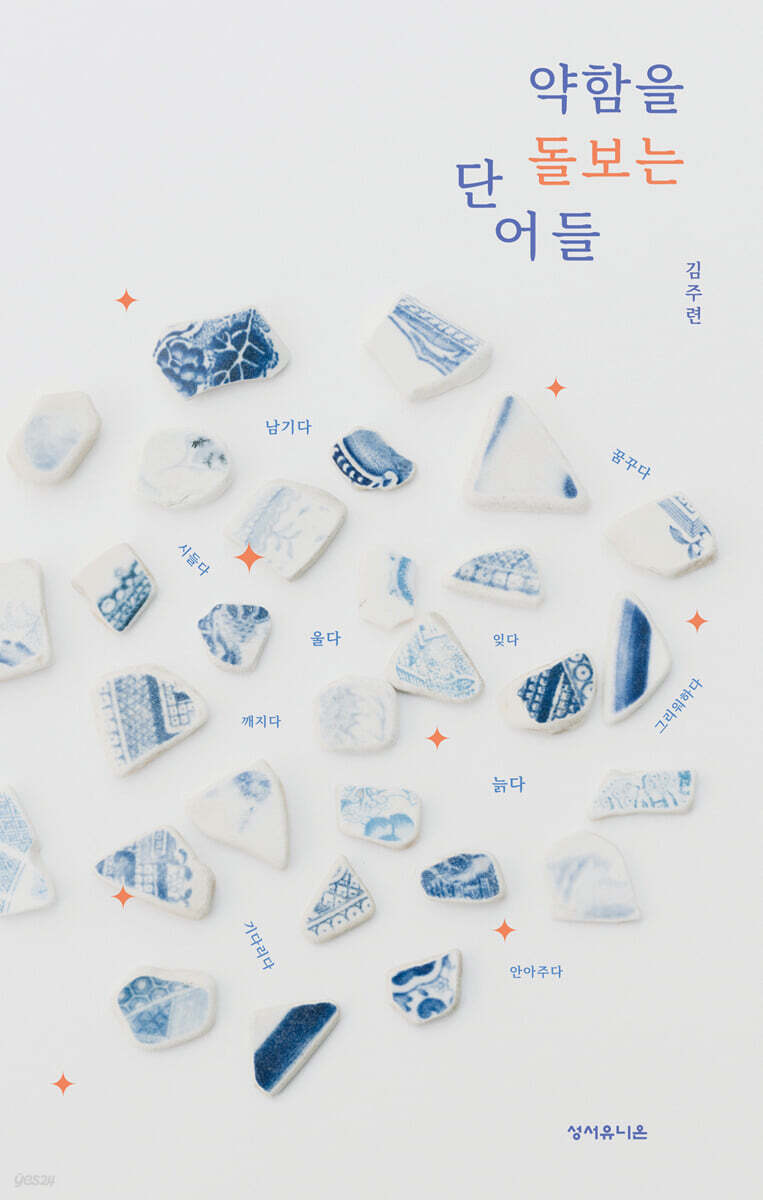
Words that care for weakness
 |
Description
Book Introduction
A letter encouraging the aging of the body and blessing the aging of the soul
A series of articles published for four years in the Senior Daily Bible under the title “Reading the Movement of Faith through Picture Books.”
By reconsidering words like "weaken," "weep," and "wither," as well as "welcome," "leave behind," and "put away," this book encourages us to affirm the physical "aging" in which our body's movements become slower and weaker, while simultaneously blessing the spiritual "aging" in which our faith's movements become more intense.
This shows that even when the movement of the body becomes difficult, the movement of the soul can flow flexibly.
A series of articles published for four years in the Senior Daily Bible under the title “Reading the Movement of Faith through Picture Books.”
By reconsidering words like "weaken," "weep," and "wither," as well as "welcome," "leave behind," and "put away," this book encourages us to affirm the physical "aging" in which our body's movements become slower and weaker, while simultaneously blessing the spiritual "aging" in which our faith's movements become more intense.
This shows that even when the movement of the body becomes difficult, the movement of the soul can flow flexibly.
- You can preview some of the book's contents.
Preview
index
Introduction
become weak
wither
chip
forget
get stained
get old
see
listen
sit
walk
wait
spread
weep
laugh
miss
Be together
hug
welcome
dream
sow
leave
lay
live
there is
Going out words
become weak
wither
chip
forget
get stained
get old
see
listen
sit
walk
wait
spread
weep
laugh
miss
Be together
hug
welcome
dream
sow
leave
lay
live
there is
Going out words
Detailed image

Into the book
All living things decay and grow old and return to the dust.
When I saw the common consonant 'ㄹㄱ' used in the words 'old', 'old', and 'dirt', I felt like the flow was suddenly broken and cut off.
'ㄹ' is open back and forth, so it feels like it is continuously flowing, whereas 'ㄱ', when used attached, seems to break that continuous flow.
Our appearance was once vibrant, as if we were flying, and at times boring, as if time were endlessly stretching out, but now we are gradually becoming worn and old.
Aging will undoubtedly make us feel every day that our appearance is becoming weaker.
But, contrary to our outward appearance, our inner self may not be worn out or old.
--- From "Becoming Weak"
We are all broken vessels.
So it can be a special glass that is different from before, or rather, gives a new resonance.
I hope that the gospel story of God gathering our broken pieces and making colorful glasses will begin anew with our verb, "to break."
I hope that when someone hears the story that even our scars have become patterns of grace, it will encourage them to walk that path with a little more strength.
--- From "Broken"
In the novel "Your Old Age," which depicts the difficult situation of a super-aging society, there is a scene where a student asks a pottery instructor who loves old pottery why old pottery is more expensive than the good dishes that are being produced these days.
The instructor's answer at that time was, "These old, rough ceramics are the parents of the good pottery that is coming out these days."
I thought the same thing happened in life.
I hope that the old and rough people will receive the precious treatment and respect they deserve, as they are the parents who made us who we are today.
I hope that the wind will flow in a way that allows us to see the verb 'to grow old' naturally, rather than looking at it with a sick gaze.
--- From "Getting Old"
In his book, Listening, Lost Wisdom, Professor Seo Jeong-rok, who studied the indigenous languages of Indians, said that in the Indian Tewa language, the word for eye (cheh) means 'to cook' or 'to stamp' and the word for ear (tischu) means 'to give'.
He continued by saying that the saying, "the eyes cook" means that we have a habit of taking only what we want, and that the saying, "giving ears" means that when we listen indifferently, sounds are just noise, but when we listen with our hearts, we can read the mind of the being who made the sound.
To read the mind of another, one must first open one's own heart and receive the sound, so the Indians viewed the 'ear' as a dynamic act of opening one's heart and giving one's own being.
--- From "Listen"
'It was only after I sat quietly that I finally understood.'
I realized what I had worked so hard to get by wandering around here and there.
As I sat still, relationships slowly came to me without my having to beg. The noisy speed of humans, who could not imagine a world where things could stop, brought about discord with the natural world.
If we continue to regard the verb 'to sit' as something that is left behind, no one, no one, will be able to become friends with humans.
It has been said that humans endanger the natural world by existing, and it makes us wonder if our constant movement, which makes it difficult to sit still, might be diminishing the movement of other beings.
--- From "Sit"
“Tourists demand, pilgrims are grateful.” In Eun-sil Yoo’s novel “Pilgrim House,” there is a character named “Pilgrim” who wants to live like a pilgrim and helps people. The above sentence is one of Ms. Pilgrim’s favorite words.
Even though our path today may not be the Camino de Santiago, as pilgrims called to be "walkers," I hope we nod our heads in gratitude at every step.
It would be good to often offer pilgrim greetings to the group of people walking the same path as us.
--- From "Walking"
For the ancient Romans, the word 'humor' comes from 'humus' (earth), and the prerequisite for humor is 'humilitas' (humility).
When life, which began from the earth, acknowledges and accepts its dark and vulnerable side, it finds peace of mind, and that peace can make us smile.
Anselm Grün wrote in “On Being Comforting”, “Humor does not mean that I have to please everyone.
Humor means I can accept myself affectionately and laugh heartily at my human weaknesses.
“I can laugh at my weaknesses because they keep me among people and my feet on the ground,” he said.
I hope that we are not so seriously dominated that we cannot laugh when we should.
--- From "Laugh"
People often say that wisdom lies in moving forward without being tied down by past memories.
But the force that actually pushes us forward and moves us forward is actually stronger when we miss the source from which we came.
This fundamental longing is called 'Sehnsucht' in German, and C.
S. Lewis translated this as 'Joy' and introduced it as human nature to long for heaven.
In other words, it is a longing that lies deep within the human heart, and cannot be filled by anything in the world, but only by the One who created the heart.
--- From "I Miss You"
There is a saying that 'to live is to have a landscape'.
Therefore, if you lose the scenery, you cannot properly enjoy the joy of life even if you are alive.… In the book “Kim Seon-woo’s Things,” there is a poet’s record about a “spoon,” and it vividly expresses how the countless soups and individual grains that a single spoon brought to mind served our bodies.
Let's think about what stories are contained in the landscape surrounding us and the objects that make up that landscape.
People say that as you get older, you live a wiser life by reducing and discarding things one by one.
But I think we need to be careful about telling older people, who are experiencing all kinds of loss and are easily overcome by grief, to throw everything away and live lightly.
Because to them, it may not be a trivial thing, but a memory that they will keep for a lifetime.
--- From "Leave"
In “People Who Are Difficult to Be,” Kaito Dohata says, “We can be our ‘true selves’ when we completely rely on and depend on someone.
If that is not possible, a 'false self' is created.
So when ‘being’ becomes painful, we start ‘doing’.
“In other words, in order for us to ‘be’ somewhere, we must become familiar with that place and be able to trust and entrust ourselves to the people there.”
The story is that if you don't do something, 'being' becomes uncomfortable and you end up creating a lot of fake appearances.
Our true self is revealed not in the achievements and fame we have achieved, but when we shed them all and simply be present, in the relationship we have with ourselves.
So it's okay to just stay like this.
When I saw the common consonant 'ㄹㄱ' used in the words 'old', 'old', and 'dirt', I felt like the flow was suddenly broken and cut off.
'ㄹ' is open back and forth, so it feels like it is continuously flowing, whereas 'ㄱ', when used attached, seems to break that continuous flow.
Our appearance was once vibrant, as if we were flying, and at times boring, as if time were endlessly stretching out, but now we are gradually becoming worn and old.
Aging will undoubtedly make us feel every day that our appearance is becoming weaker.
But, contrary to our outward appearance, our inner self may not be worn out or old.
--- From "Becoming Weak"
We are all broken vessels.
So it can be a special glass that is different from before, or rather, gives a new resonance.
I hope that the gospel story of God gathering our broken pieces and making colorful glasses will begin anew with our verb, "to break."
I hope that when someone hears the story that even our scars have become patterns of grace, it will encourage them to walk that path with a little more strength.
--- From "Broken"
In the novel "Your Old Age," which depicts the difficult situation of a super-aging society, there is a scene where a student asks a pottery instructor who loves old pottery why old pottery is more expensive than the good dishes that are being produced these days.
The instructor's answer at that time was, "These old, rough ceramics are the parents of the good pottery that is coming out these days."
I thought the same thing happened in life.
I hope that the old and rough people will receive the precious treatment and respect they deserve, as they are the parents who made us who we are today.
I hope that the wind will flow in a way that allows us to see the verb 'to grow old' naturally, rather than looking at it with a sick gaze.
--- From "Getting Old"
In his book, Listening, Lost Wisdom, Professor Seo Jeong-rok, who studied the indigenous languages of Indians, said that in the Indian Tewa language, the word for eye (cheh) means 'to cook' or 'to stamp' and the word for ear (tischu) means 'to give'.
He continued by saying that the saying, "the eyes cook" means that we have a habit of taking only what we want, and that the saying, "giving ears" means that when we listen indifferently, sounds are just noise, but when we listen with our hearts, we can read the mind of the being who made the sound.
To read the mind of another, one must first open one's own heart and receive the sound, so the Indians viewed the 'ear' as a dynamic act of opening one's heart and giving one's own being.
--- From "Listen"
'It was only after I sat quietly that I finally understood.'
I realized what I had worked so hard to get by wandering around here and there.
As I sat still, relationships slowly came to me without my having to beg. The noisy speed of humans, who could not imagine a world where things could stop, brought about discord with the natural world.
If we continue to regard the verb 'to sit' as something that is left behind, no one, no one, will be able to become friends with humans.
It has been said that humans endanger the natural world by existing, and it makes us wonder if our constant movement, which makes it difficult to sit still, might be diminishing the movement of other beings.
--- From "Sit"
“Tourists demand, pilgrims are grateful.” In Eun-sil Yoo’s novel “Pilgrim House,” there is a character named “Pilgrim” who wants to live like a pilgrim and helps people. The above sentence is one of Ms. Pilgrim’s favorite words.
Even though our path today may not be the Camino de Santiago, as pilgrims called to be "walkers," I hope we nod our heads in gratitude at every step.
It would be good to often offer pilgrim greetings to the group of people walking the same path as us.
--- From "Walking"
For the ancient Romans, the word 'humor' comes from 'humus' (earth), and the prerequisite for humor is 'humilitas' (humility).
When life, which began from the earth, acknowledges and accepts its dark and vulnerable side, it finds peace of mind, and that peace can make us smile.
Anselm Grün wrote in “On Being Comforting”, “Humor does not mean that I have to please everyone.
Humor means I can accept myself affectionately and laugh heartily at my human weaknesses.
“I can laugh at my weaknesses because they keep me among people and my feet on the ground,” he said.
I hope that we are not so seriously dominated that we cannot laugh when we should.
--- From "Laugh"
People often say that wisdom lies in moving forward without being tied down by past memories.
But the force that actually pushes us forward and moves us forward is actually stronger when we miss the source from which we came.
This fundamental longing is called 'Sehnsucht' in German, and C.
S. Lewis translated this as 'Joy' and introduced it as human nature to long for heaven.
In other words, it is a longing that lies deep within the human heart, and cannot be filled by anything in the world, but only by the One who created the heart.
--- From "I Miss You"
There is a saying that 'to live is to have a landscape'.
Therefore, if you lose the scenery, you cannot properly enjoy the joy of life even if you are alive.… In the book “Kim Seon-woo’s Things,” there is a poet’s record about a “spoon,” and it vividly expresses how the countless soups and individual grains that a single spoon brought to mind served our bodies.
Let's think about what stories are contained in the landscape surrounding us and the objects that make up that landscape.
People say that as you get older, you live a wiser life by reducing and discarding things one by one.
But I think we need to be careful about telling older people, who are experiencing all kinds of loss and are easily overcome by grief, to throw everything away and live lightly.
Because to them, it may not be a trivial thing, but a memory that they will keep for a lifetime.
--- From "Leave"
In “People Who Are Difficult to Be,” Kaito Dohata says, “We can be our ‘true selves’ when we completely rely on and depend on someone.
If that is not possible, a 'false self' is created.
So when ‘being’ becomes painful, we start ‘doing’.
“In other words, in order for us to ‘be’ somewhere, we must become familiar with that place and be able to trust and entrust ourselves to the people there.”
The story is that if you don't do something, 'being' becomes uncomfortable and you end up creating a lot of fake appearances.
Our true self is revealed not in the achievements and fame we have achieved, but when we shed them all and simply be present, in the relationship we have with ourselves.
So it's okay to just stay like this.
--- From "There is"
Publisher's Review
Verbs of Faith Encountered at the Crossroads of Weakness
“Words that Care for Weakness” is a book compiled from the four-year series “Senior Daily Bible” under the title “Reading the Movement of Faith through Picture Books.”
This book is the result of the author's deep reflection on the physical and mental frailty experienced as he grew older, having made us reflect on our religious language through the "Dictionary of Faith Words for Children."
The author, who had been living in a time when his body movements were not as they used to be, to the point where he thought he would have to answer “I’m getting old” to the question “What are you doing these days?”, said that as the movement of sitting down and standing up was accompanied by even the slightest groan, he made his body movements small and slow to avoid straining himself as much as possible.
This situation rather made the author ponder the verbs of faith.
This is because I thought that when physical movement becomes difficult, the movement of faith can flow more flexibly.
The author says that faith is not something that remains in place as a complete noun (Korean word for noun) such as belief, hope, and love, but rather it is a vital force that can live up to its name only when it is followed by the action of verbs (Korean word for verb) such as act, endure, and work.
So, it connects aging and the practice of faith with twenty-four verbs such as weaken, wither, forget, dye, grow old, sit, wait, cry, miss, be together, welcome, dream, leave, put, and exist.
Although various materials such as poetry and novels appear in each piece, it was picture books that helped the author's thinking more than anything else.
The author, convinced that picture books for children can also convey rich stories to adults, used picture books as the main tool to follow the twenty-four movements.
CS
Just as Lewis said that as an adult, he can enjoy fairy tales much better and gain more from them than when he was a child, the author is drawing a picture of a good adult by reading picture books in a new way.
If "The Children's Dictionary of Faith Words" made us rethink our language of faith, this book offers a new perspective on weakness.
The author cites philosopher Han Byung-chul's insight that "only when we become weak, broken, and have holes do we finally open our ears to listen to others," and hopes that new energy will rise in our weakened places.
Citing Moses' staff as an example, he says that just as the staff that supported Moses in his weakness became a tool of power, the tools that support us in our weakness can become the beginning of unexpected stories.
One of the shining points of the author's reflections on weakness and aging is that they make us think about the value of existence itself.
The author emphasizes that even amid the sorrow of loss that comes with aging, our very presence here is a miracle of grace and a reward for our efforts.
The author's message that even if one's life in old age does not involve any further achievements, simply existing is enough resonates with the idea that existence itself is a human value in a social atmosphere where a person's usefulness is considered to be their worth.
This will be a comforting message not only to readers living in their later years, but to all of us.
“Ultimately, it’s all of our story.
As the author says, “The story I want to share is that we are all heading home, and I am glad that you are there on that path, in whatever form you may be.” This book speaks warmly to those who feel the frailty of body and mind as they age, as well as to those who want to understand the slow pace and lost gaze of old age, and even to Christians who want to find the practical meaning of faith.
“Words that Care for Weakness” is a book compiled from the four-year series “Senior Daily Bible” under the title “Reading the Movement of Faith through Picture Books.”
This book is the result of the author's deep reflection on the physical and mental frailty experienced as he grew older, having made us reflect on our religious language through the "Dictionary of Faith Words for Children."
The author, who had been living in a time when his body movements were not as they used to be, to the point where he thought he would have to answer “I’m getting old” to the question “What are you doing these days?”, said that as the movement of sitting down and standing up was accompanied by even the slightest groan, he made his body movements small and slow to avoid straining himself as much as possible.
This situation rather made the author ponder the verbs of faith.
This is because I thought that when physical movement becomes difficult, the movement of faith can flow more flexibly.
The author says that faith is not something that remains in place as a complete noun (Korean word for noun) such as belief, hope, and love, but rather it is a vital force that can live up to its name only when it is followed by the action of verbs (Korean word for verb) such as act, endure, and work.
So, it connects aging and the practice of faith with twenty-four verbs such as weaken, wither, forget, dye, grow old, sit, wait, cry, miss, be together, welcome, dream, leave, put, and exist.
Although various materials such as poetry and novels appear in each piece, it was picture books that helped the author's thinking more than anything else.
The author, convinced that picture books for children can also convey rich stories to adults, used picture books as the main tool to follow the twenty-four movements.
CS
Just as Lewis said that as an adult, he can enjoy fairy tales much better and gain more from them than when he was a child, the author is drawing a picture of a good adult by reading picture books in a new way.
If "The Children's Dictionary of Faith Words" made us rethink our language of faith, this book offers a new perspective on weakness.
The author cites philosopher Han Byung-chul's insight that "only when we become weak, broken, and have holes do we finally open our ears to listen to others," and hopes that new energy will rise in our weakened places.
Citing Moses' staff as an example, he says that just as the staff that supported Moses in his weakness became a tool of power, the tools that support us in our weakness can become the beginning of unexpected stories.
One of the shining points of the author's reflections on weakness and aging is that they make us think about the value of existence itself.
The author emphasizes that even amid the sorrow of loss that comes with aging, our very presence here is a miracle of grace and a reward for our efforts.
The author's message that even if one's life in old age does not involve any further achievements, simply existing is enough resonates with the idea that existence itself is a human value in a social atmosphere where a person's usefulness is considered to be their worth.
This will be a comforting message not only to readers living in their later years, but to all of us.
“Ultimately, it’s all of our story.
As the author says, “The story I want to share is that we are all heading home, and I am glad that you are there on that path, in whatever form you may be.” This book speaks warmly to those who feel the frailty of body and mind as they age, as well as to those who want to understand the slow pace and lost gaze of old age, and even to Christians who want to find the practical meaning of faith.
GOODS SPECIFICS
- Date of issue: September 25, 2025
- Page count, weight, size: 216 pages | 310g | 140*220*14mm
- ISBN13: 9788932550770
- ISBN10: 8932550778
You may also like
카테고리
korean


korean

![GQ KOREA Mark (Monthly): December [2025]](http://librairie.coreenne.fr/cdn/shop/files/8ef265dbbfbf186523ed75ba7319009d.jpg?v=1765340328&width=3840)


