![Comics Now: Issue 27 [2025]](http://librairie.coreenne.fr/cdn/shop/files/bab2796d4c20fe455636cf8f957139c9.jpg?v=1765297793&width=3840)

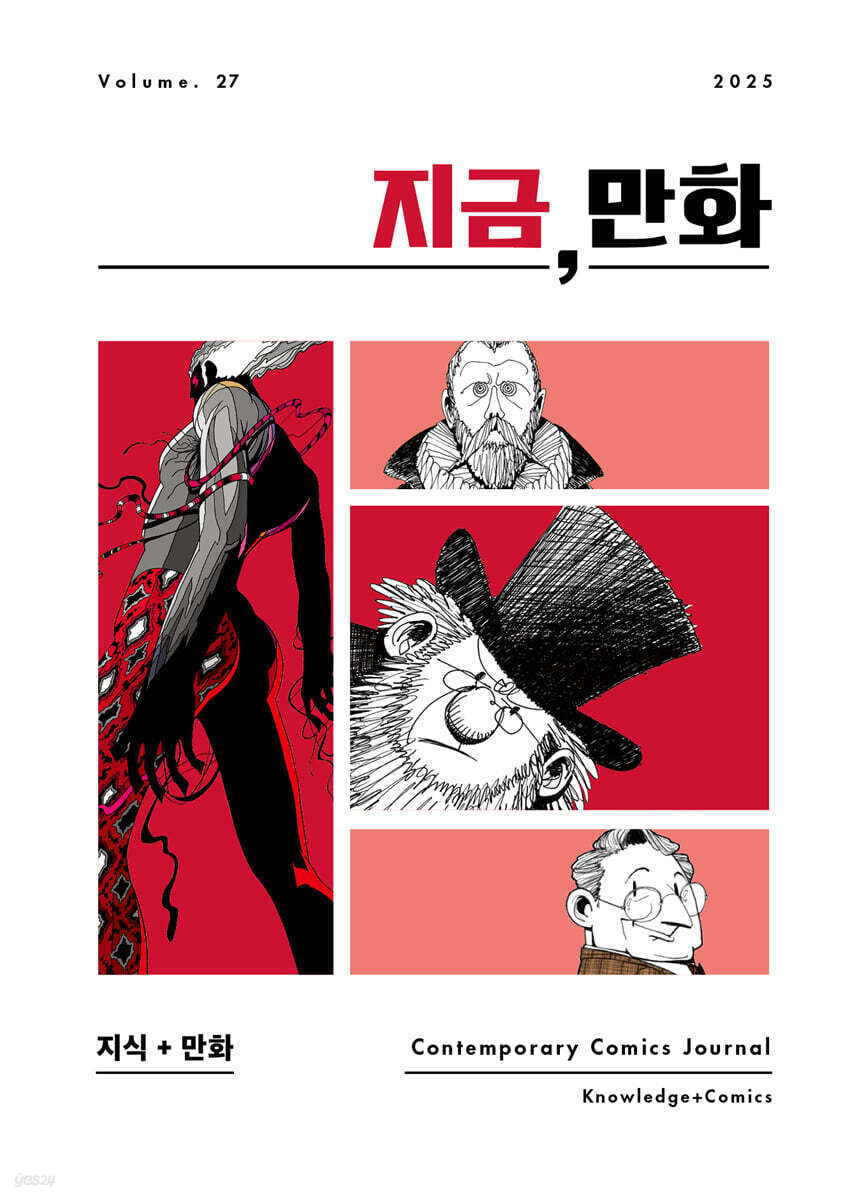
Now, Comics: Issue 27 [2025]
 |
Description
Book Introduction
Unraveling 'Knowledge + Comics' through Comic Criticism!
The only critical journal that interprets the encounter between knowledge and comics through comic criticism!
『Now, Manhwa』 has established itself as Korea's only manhwa critique magazine since its first issue in 2018.
Not only academics and researchers in the webtoon and cartoon department, but also webtoon platform and agency workers, related industry workers, aspiring artists, and students are welcoming the cartoon critique magazine 『Now, Cartoon』.
As there are virtually no media outlets that candidly examine the hottest issues happening in the Korean comics and webtoons world, provide sharp critiques of related works, and even deliver vivid interviews, the number of people who want to read comics and webtoons through "Now, Comics" is steadily increasing.
In the 27th issue of 『Now, Comics』, published in 2025, we explore educational comics that provide not only entertainment but also knowledge and culture.
Knowledge and culture comics are comics that allow readers to absorb information and knowledge from various fields, such as humanities, society, and science, in an interesting way.
Knowledge and culture comics are not just about learning knowledge in a fun way, but are also multi-functional content that aims to cultivate readers' intellectual and cultural abilities.
Knowledge-based comics, which simultaneously satisfy intellectual curiosity and entertainment, have the advantage of making knowledge more accessible.
In other words, it opens the door to knowledge and culture by lowering the barriers to entry into specialized fields that may feel difficult and unfamiliar.
Cute and humorous cartoon characters engage readers and spark interest, reducing the learning burden and aiding comprehension.
Additionally, visual storytelling helps make difficult and abstract concepts concrete, making it easier to intuitively grasp and understand information.
Due to these characteristics, the educational comics genre has gained great popularity in the domestic comics industry.
As "Faraway Neighbors" became a bestseller, selling nearly ten million copies, educational comics for adults and educational comics for children and teenagers began to receive attention.
Due to the influence of the educational cartoon collections of Geumseongsa and Gyemong Publishing, educational cartoons that actively utilized cartoon-like direction and composition appeared in the 2000s, such as “Greek and Roman Mythology in Cartoons,” “Magic Thousand Character Classic,” and “Survival” series.
As parents and students had high expectations for the synergy between textbook learning and comics, the educational comics became a million-seller, and general publishers other than comics publishers also jumped into the competition.
The popularity of children's educational comics led to an interest in adult knowledge and culture comics, and numerous publishers rushed to present works that incorporated knowledge information into comics.
The topics include financial investment, real estate, psychology, and philosophy, all of which are of interest to the general public.
Specialized platforms have also emerged online.
'Ainamu', a specialized children's webtoon platform, and 'Imanbae', a knowledge and culture webtoon platform, clearly show how passionate the desire for acquiring comics and knowledge information is in Korea.
In this way, knowledge-based comics are attracting attention for their future development as a medium that bridges the gap between comics and knowledge.
In particular, the influence of the Fourth Industrial Revolution, such as AI and virtual reality, gives us confidence that we will be able to reach more readers through the integration of science and technology.
In that respect, knowledge-based comics are being rediscovered as content with the vitality to connect knowledge, people, and the world through comics.
The only critical journal that interprets the encounter between knowledge and comics through comic criticism!
『Now, Manhwa』 has established itself as Korea's only manhwa critique magazine since its first issue in 2018.
Not only academics and researchers in the webtoon and cartoon department, but also webtoon platform and agency workers, related industry workers, aspiring artists, and students are welcoming the cartoon critique magazine 『Now, Cartoon』.
As there are virtually no media outlets that candidly examine the hottest issues happening in the Korean comics and webtoons world, provide sharp critiques of related works, and even deliver vivid interviews, the number of people who want to read comics and webtoons through "Now, Comics" is steadily increasing.
In the 27th issue of 『Now, Comics』, published in 2025, we explore educational comics that provide not only entertainment but also knowledge and culture.
Knowledge and culture comics are comics that allow readers to absorb information and knowledge from various fields, such as humanities, society, and science, in an interesting way.
Knowledge and culture comics are not just about learning knowledge in a fun way, but are also multi-functional content that aims to cultivate readers' intellectual and cultural abilities.
Knowledge-based comics, which simultaneously satisfy intellectual curiosity and entertainment, have the advantage of making knowledge more accessible.
In other words, it opens the door to knowledge and culture by lowering the barriers to entry into specialized fields that may feel difficult and unfamiliar.
Cute and humorous cartoon characters engage readers and spark interest, reducing the learning burden and aiding comprehension.
Additionally, visual storytelling helps make difficult and abstract concepts concrete, making it easier to intuitively grasp and understand information.
Due to these characteristics, the educational comics genre has gained great popularity in the domestic comics industry.
As "Faraway Neighbors" became a bestseller, selling nearly ten million copies, educational comics for adults and educational comics for children and teenagers began to receive attention.
Due to the influence of the educational cartoon collections of Geumseongsa and Gyemong Publishing, educational cartoons that actively utilized cartoon-like direction and composition appeared in the 2000s, such as “Greek and Roman Mythology in Cartoons,” “Magic Thousand Character Classic,” and “Survival” series.
As parents and students had high expectations for the synergy between textbook learning and comics, the educational comics became a million-seller, and general publishers other than comics publishers also jumped into the competition.
The popularity of children's educational comics led to an interest in adult knowledge and culture comics, and numerous publishers rushed to present works that incorporated knowledge information into comics.
The topics include financial investment, real estate, psychology, and philosophy, all of which are of interest to the general public.
Specialized platforms have also emerged online.
'Ainamu', a specialized children's webtoon platform, and 'Imanbae', a knowledge and culture webtoon platform, clearly show how passionate the desire for acquiring comics and knowledge information is in Korea.
In this way, knowledge-based comics are attracting attention for their future development as a medium that bridges the gap between comics and knowledge.
In particular, the influence of the Fourth Industrial Revolution, such as AI and virtual reality, gives us confidence that we will be able to reach more readers through the integration of science and technology.
In that respect, knowledge-based comics are being rediscovered as content with the vitality to connect knowledge, people, and the world through comics.
index
■ Cover Story
▷ Comics, drawing knowledge. From knowledge-based comics, published comics to webtoons.
Son Sang-min (Director of the Korea Cartoonists Association)
▷ Categories for learning while enjoying knowledge and comics
Lee Seon-in (game and comic critic)
▷ Things you don't need to know, but it's okay to know. The learning attitude left behind by educational cartoons.
: Suchami (comic critic)
▷ The potential influence of educational comics and their corresponding limitations
: Lee A-reum (comic critic)
■ Interview
▷ It delivers a unique insight with fun and curiosity that goes beyond the threshold of learning.
: Cartoonist Kim Jae-hoon
■ Critic
▷ The path to success with knowledge comics in Korea
Focusing on “Faraway Neighboring Countries,” “Magic Thousand Character Classic,” and “Why?”
Choi Yun-seok (comic critic)
▷ The golden age of educational comics: the depth and breadth of historical comics
Focusing on Park Si-baek's "Annals of the Joseon Dynasty" series and Choi Tae-seong's "Han Neung-geom Korean History" series
Kang Jeong-hwa (Professor of Korean Language Education at Korea University, comic critic)
▷ The will of knowledge comics
: Yoo Un-gi (contemporary visual arts researcher)
▷ Learning revolves around enjoyment.
: Kim Myeong-ho (cartoonist)
■ Interview
▷ Towards the expansion and continuation of K-edutainment beyond history classes on the podium
:History teacher Seol Min-seok
■ Issue
▷ The dreams and hopes of a global webtoon drawn in two scenes and three topics
2025 Chungnam Global Webtoon Research Conference
: Lee Cheol-ho (Editor-in-Chief of Weekly Toon)
▷ A Visit to the Subculture Pop-up Store, a Mecca for Fandom Culture
Son Yu-jin (comic critic)
■ Essay
▷ The way we loved back then
John, Jenna's "Nineteen Twenty-One"
: Kim Shin (Professor of Cartoon and Animation, Joongbu University)
From Quick Consumption to Deep Reading: The Present and Future of Korean Graphic Novels
Kim Min-jae (comic critic)
■ Comics for these times: Good comics for when you don't want to go to school
A comical 'virtual world' of equal possibilities
Ha Min-seok's "Come Play in the Strange Village!"
Park Dong-seong (comic critic)
▷ I don't want to go to school... I should just go, you're the teacher.
Daily "Just a Teacher"
Choi Yun-ju (comic critic)
▷ A comic that deals with disconnection from and recovery from everyday life,
About "Feeling Unwell"
: Kim Yun-jin (comic critic)
▷ About the incident where it turned out to be a dove
Heo Sae-bo's "Seongbuk-gu Pigeon Lee Heon-seo"
Lee Mun-young (novelist)
▷ To us who endure a life without vacation
Inuhiko Doronoda's "To Walk the Universe with You"
Kim Han-young (comic critic)
■ Relay Interview
▷ The restaurant in my neighborhood is Michelin-starred.
: Taste columnist Hwang Kyo-ik
■ I'm going to meet you now
▷ And, if you draw again, something new appears.
: Cartoonist Baek Seong-min (edited by cartoonist Kim Jong-ok)
■ Comics VS Animation
▷ Comic "Look Back" vs. Anime "Look Back"
What art says to the world in the face of loss
Kim Min-seo (comic critic)
■ Webtoon VS Drama
▷ Grotesque horror and suspense of good triumphing over evil
Webtoon "Evil Destiny" vs. Drama "Evil Destiny"
: Yoon Ji-hye (comic critic)
■ Famous lines and scenes from life in comics
▷ A guilty pleasure of loving geniuses
Jeon Gung's "Treatise on Pure Philosophy"
Kim Min-kyung (comic critic)
▷ How to become an adult
In Yu-yu's "Song Yi-yeon, 50, One Month After Divorce"
Choi Jeong-yeon (comic critic)
■ Critics' picks!
▷ Is this really me?
Kim Gyu-ah's "You and My Puzzle"
: Committee member (Strawberry Bookstore representative)
■ Comic News Inside
■ New Release Report
▷ Comics, drawing knowledge. From knowledge-based comics, published comics to webtoons.
Son Sang-min (Director of the Korea Cartoonists Association)
▷ Categories for learning while enjoying knowledge and comics
Lee Seon-in (game and comic critic)
▷ Things you don't need to know, but it's okay to know. The learning attitude left behind by educational cartoons.
: Suchami (comic critic)
▷ The potential influence of educational comics and their corresponding limitations
: Lee A-reum (comic critic)
■ Interview
▷ It delivers a unique insight with fun and curiosity that goes beyond the threshold of learning.
: Cartoonist Kim Jae-hoon
■ Critic
▷ The path to success with knowledge comics in Korea
Focusing on “Faraway Neighboring Countries,” “Magic Thousand Character Classic,” and “Why?”
Choi Yun-seok (comic critic)
▷ The golden age of educational comics: the depth and breadth of historical comics
Focusing on Park Si-baek's "Annals of the Joseon Dynasty" series and Choi Tae-seong's "Han Neung-geom Korean History" series
Kang Jeong-hwa (Professor of Korean Language Education at Korea University, comic critic)
▷ The will of knowledge comics
: Yoo Un-gi (contemporary visual arts researcher)
▷ Learning revolves around enjoyment.
: Kim Myeong-ho (cartoonist)
■ Interview
▷ Towards the expansion and continuation of K-edutainment beyond history classes on the podium
:History teacher Seol Min-seok
■ Issue
▷ The dreams and hopes of a global webtoon drawn in two scenes and three topics
2025 Chungnam Global Webtoon Research Conference
: Lee Cheol-ho (Editor-in-Chief of Weekly Toon)
▷ A Visit to the Subculture Pop-up Store, a Mecca for Fandom Culture
Son Yu-jin (comic critic)
■ Essay
▷ The way we loved back then
John, Jenna's "Nineteen Twenty-One"
: Kim Shin (Professor of Cartoon and Animation, Joongbu University)
From Quick Consumption to Deep Reading: The Present and Future of Korean Graphic Novels
Kim Min-jae (comic critic)
■ Comics for these times: Good comics for when you don't want to go to school
A comical 'virtual world' of equal possibilities
Ha Min-seok's "Come Play in the Strange Village!"
Park Dong-seong (comic critic)
▷ I don't want to go to school... I should just go, you're the teacher.
Daily "Just a Teacher"
Choi Yun-ju (comic critic)
▷ A comic that deals with disconnection from and recovery from everyday life,
About "Feeling Unwell"
: Kim Yun-jin (comic critic)
▷ About the incident where it turned out to be a dove
Heo Sae-bo's "Seongbuk-gu Pigeon Lee Heon-seo"
Lee Mun-young (novelist)
▷ To us who endure a life without vacation
Inuhiko Doronoda's "To Walk the Universe with You"
Kim Han-young (comic critic)
■ Relay Interview
▷ The restaurant in my neighborhood is Michelin-starred.
: Taste columnist Hwang Kyo-ik
■ I'm going to meet you now
▷ And, if you draw again, something new appears.
: Cartoonist Baek Seong-min (edited by cartoonist Kim Jong-ok)
■ Comics VS Animation
▷ Comic "Look Back" vs. Anime "Look Back"
What art says to the world in the face of loss
Kim Min-seo (comic critic)
■ Webtoon VS Drama
▷ Grotesque horror and suspense of good triumphing over evil
Webtoon "Evil Destiny" vs. Drama "Evil Destiny"
: Yoon Ji-hye (comic critic)
■ Famous lines and scenes from life in comics
▷ A guilty pleasure of loving geniuses
Jeon Gung's "Treatise on Pure Philosophy"
Kim Min-kyung (comic critic)
▷ How to become an adult
In Yu-yu's "Song Yi-yeon, 50, One Month After Divorce"
Choi Jeong-yeon (comic critic)
■ Critics' picks!
▷ Is this really me?
Kim Gyu-ah's "You and My Puzzle"
: Committee member (Strawberry Bookstore representative)
■ Comic News Inside
■ New Release Report
Detailed image
Publisher's Review
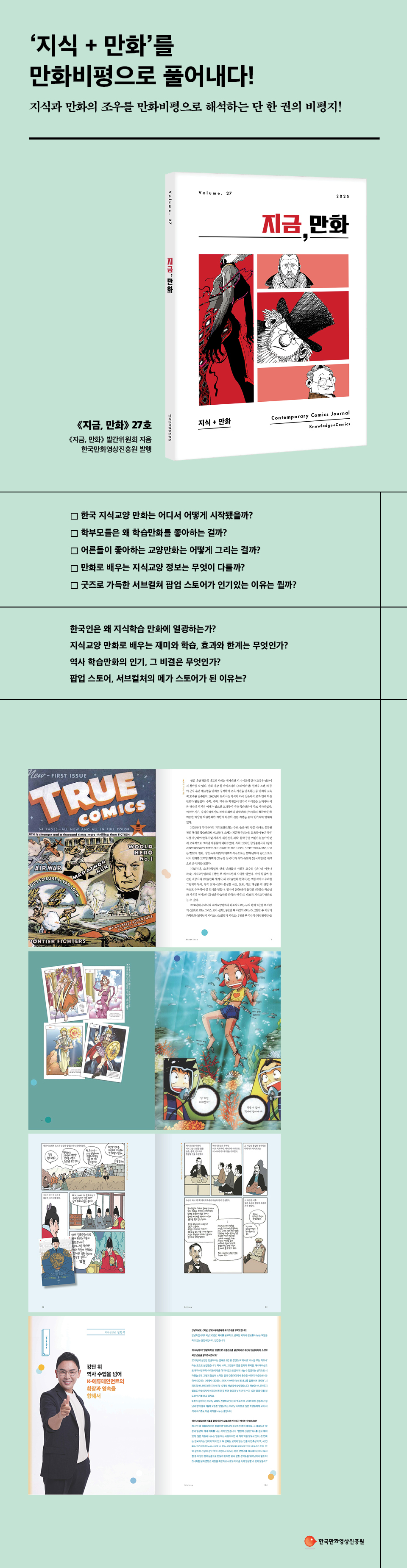
□ Where and how did Korean knowledge and culture comics begin?
□ Why do parents like educational comics?
□ How do adults draw educational cartoons that they like?
□ What is different about the knowledge and general information learned through comics?
□ Why are subculture pop-up stores full of goods so popular?
Why is Korea so enthusiastic about educational comics?
A history-inspiring comic book that teaches you history through storytelling, and a science-inspired comic book that teaches you science through vibrant colors.
One reason why educational comics for knowledge and culture are so popular in Korea is the fervent educational fervor.
One of the reasons is that it is a cost-effective learning method that can double the learning effect while also being fun.
In that respect, history and science are attracting readers' attention as fields of study that are suitable for the comic-style structure that primarily completes narrative direction through storytelling.
Following the huge hit of "Faraway Neighbors," educational comics that have turned interest in world history to Korean history are appearing one after another.
“Park Si-baek’s Annals of the Joseon Dynasty” has been loved by readers as a representative work of Korean history educational comics for about 20 years.
Readers often choose Korean history series such as “Park Si-baek’s Annals of the Joseon Dynasty” and “History of Goryeo” because they cite the fact that they are based on thorough research while also providing content that students can easily understand.
It is a storytelling of the long and winding facts of history, and it contains content that Koreans can easily understand, helping them digest historical comics without any burden.
The field of science cannot be left out either.
In domestic educational comics, somewhat unfamiliar fields such as biology and astronomy can be understood at a glance with easy-to-understand, full-color illustrations.
Science-themed comics such as Abdullah's "Anatomy" series and Pigeon Rice's "Space Like Universe" are gaining popularity.
In addition, foreign educational comics covering a wide range of scientific fields, including physics and mathematics, are being published in Korea.
In this way, academic disciplines that actively utilize the strengths of comics are successfully reaching readers with interest and enjoyment, transcending the threshold of learning.
What are the limitations of learning culture and academics through comics, and what should we read?
The 'Cover Story' of the 27th issue of the webtoon critique magazine "Now, Cartoon" examines the history of knowledge and culture cartoons and their status in Korean cartoons and webtoons in chronological order.
We looked into the classification of knowledge-based comics and the differences between them and educational comics, analyzed the popularity of educational comics in Korea, and also looked at overseas knowledge-based comics.
In 'Critic', we analyzed million-selling educational comics such as "Faraway Neighbors," "Magic Thousand Character Classic," and "Greek and Roman Mythology in Comics," and also looked at recent changes in knowledge and culture specialized webtoons, as well as trends in history educational comics and science knowledge comics.
In 'Interview', we met with Kim Jae-hoon, the creator of 'Amazing Discovery' and '3-Minute Philosophy in Comics', and heard about the reason he has been working on only knowledge-based comics for a long time and his philosophy on knowledge-based comics.
We also met with Mr. Seol Min-seok, who recently successfully transformed from a history teacher to an all-round edutainment expert, and heard about his current status and future plans.
In 'Issue', we visited the 2025 Chungnam Global Webtoon Research Conference held in June and analyzed the recent trend of utilizing pop-up stores as a marketing strategy for subculture goods.
In 'This Kind of Comics for This Time', you can find a curation of comic recommendations from celebrities under the theme of 'Comics to read when you don't want to go to school', and various comics/webtoons are introduced through 'Famous lines/scenes from life in comics', 'Webtoon vs. Drama', and 'Webtoon vs. Webtoon'.
Additionally, in the 'Critics' Picks!' corner, comic critics provide in-depth critiques of works selected by them.
This year's newly established 'Relay Interview' visited Korea's first food columnist Hwang Kyo-ik and veteran cartoonist Baek Seong-min for 'I'm Going to Meet You Now' to hear about how he actively worked across comics and webtoons and gained worldwide attention for his illustrations for 'The Bird That Drinks Tears'.
《Now, Comics》No. 27 = Knowledge + Comics
● Where and how did Korean knowledge and culture comics begin?
In the 1970s, domestic knowledge and culture comics were mainly educational comics in the form of collections distributed through door-to-door sales by publishers.
Most of the educational cartoons were aimed at parents with a high level of educational enthusiasm, and were designed for children's educational purposes, covering Korean and world history, biographies of great people, science, and literature.
Geumseong Publishing's "Color Science Cartoon Learning" was a representative educational cartoon with abundant photographic materials, full-color design, and detailed explanations.
In the 1980s, the educational comics craze began when Professor Lee Won-bok's "Faraway Neighbors," a serialized comic in the Boy's Korea Daily, sold 10 million copies.
The books “Geumseong Edition Learning Comics World History” and “Geumseong Edition Learning Comics Korean History,” published in the 1990s, also gained popularity.
In the 2000s, the popularity of comics and webtoons led to the sales of over 20 million copies of “Greek and Roman Mythology in Comics,” over 80 million copies of “Why?”, over 20 million copies of the “Survival” series, over 20 million copies of the “Treasure Hunt” series, and over 10 million copies of “Magic Thousand Character Classic.”
Meanwhile, “Park Si-baek’s Annals of the Joseon Dynasty” and “Park Si-baek’s History of Goryeo” were published and received much love from readers of all ages.
● What is different about the knowledge and general information learned through comics?
The method of acquiring knowledge through educational comics is, above all, meaningful in its spontaneity.
As we grow older and become adults, we become more aware of ourselves and realize what we lack.
So I continue to learn on my own.
The versatility of educational comics tells us that what we saw and heard as children still forms an axis of our lives as adults, and that it is still valuable and not useless.
Something that is neither child nor adult, right in between these two is educational comics.
If storytelling enhances our understanding of comics, the point here isn't simply to learn something, but to enable us to ask and answer questions about the world ourselves.
● Why are subculture pop-up stores so popular these days?
The biggest advantage of subculture pop-up stores is that they provide an indirect meeting place where fandoms can come together.
For otaku and fandom, confirming that many people share an attachment to a single work or piece of content is one of the greatest driving forces of affection.
Pop-up stores also serve as a focal point for fandoms.
In particular, fans exchange random goods on the spot, which seems like another event at the pop-up store.
In this way, the way pop-up stores interact with content is by mediating between consumers and works of art.
□ Why do parents like educational comics?
□ How do adults draw educational cartoons that they like?
□ What is different about the knowledge and general information learned through comics?
□ Why are subculture pop-up stores full of goods so popular?
Why is Korea so enthusiastic about educational comics?
A history-inspiring comic book that teaches you history through storytelling, and a science-inspired comic book that teaches you science through vibrant colors.
One reason why educational comics for knowledge and culture are so popular in Korea is the fervent educational fervor.
One of the reasons is that it is a cost-effective learning method that can double the learning effect while also being fun.
In that respect, history and science are attracting readers' attention as fields of study that are suitable for the comic-style structure that primarily completes narrative direction through storytelling.
Following the huge hit of "Faraway Neighbors," educational comics that have turned interest in world history to Korean history are appearing one after another.
“Park Si-baek’s Annals of the Joseon Dynasty” has been loved by readers as a representative work of Korean history educational comics for about 20 years.
Readers often choose Korean history series such as “Park Si-baek’s Annals of the Joseon Dynasty” and “History of Goryeo” because they cite the fact that they are based on thorough research while also providing content that students can easily understand.
It is a storytelling of the long and winding facts of history, and it contains content that Koreans can easily understand, helping them digest historical comics without any burden.
The field of science cannot be left out either.
In domestic educational comics, somewhat unfamiliar fields such as biology and astronomy can be understood at a glance with easy-to-understand, full-color illustrations.
Science-themed comics such as Abdullah's "Anatomy" series and Pigeon Rice's "Space Like Universe" are gaining popularity.
In addition, foreign educational comics covering a wide range of scientific fields, including physics and mathematics, are being published in Korea.
In this way, academic disciplines that actively utilize the strengths of comics are successfully reaching readers with interest and enjoyment, transcending the threshold of learning.
What are the limitations of learning culture and academics through comics, and what should we read?
The 'Cover Story' of the 27th issue of the webtoon critique magazine "Now, Cartoon" examines the history of knowledge and culture cartoons and their status in Korean cartoons and webtoons in chronological order.
We looked into the classification of knowledge-based comics and the differences between them and educational comics, analyzed the popularity of educational comics in Korea, and also looked at overseas knowledge-based comics.
In 'Critic', we analyzed million-selling educational comics such as "Faraway Neighbors," "Magic Thousand Character Classic," and "Greek and Roman Mythology in Comics," and also looked at recent changes in knowledge and culture specialized webtoons, as well as trends in history educational comics and science knowledge comics.
In 'Interview', we met with Kim Jae-hoon, the creator of 'Amazing Discovery' and '3-Minute Philosophy in Comics', and heard about the reason he has been working on only knowledge-based comics for a long time and his philosophy on knowledge-based comics.
We also met with Mr. Seol Min-seok, who recently successfully transformed from a history teacher to an all-round edutainment expert, and heard about his current status and future plans.
In 'Issue', we visited the 2025 Chungnam Global Webtoon Research Conference held in June and analyzed the recent trend of utilizing pop-up stores as a marketing strategy for subculture goods.
In 'This Kind of Comics for This Time', you can find a curation of comic recommendations from celebrities under the theme of 'Comics to read when you don't want to go to school', and various comics/webtoons are introduced through 'Famous lines/scenes from life in comics', 'Webtoon vs. Drama', and 'Webtoon vs. Webtoon'.
Additionally, in the 'Critics' Picks!' corner, comic critics provide in-depth critiques of works selected by them.
This year's newly established 'Relay Interview' visited Korea's first food columnist Hwang Kyo-ik and veteran cartoonist Baek Seong-min for 'I'm Going to Meet You Now' to hear about how he actively worked across comics and webtoons and gained worldwide attention for his illustrations for 'The Bird That Drinks Tears'.
《Now, Comics》No. 27 = Knowledge + Comics
● Where and how did Korean knowledge and culture comics begin?
In the 1970s, domestic knowledge and culture comics were mainly educational comics in the form of collections distributed through door-to-door sales by publishers.
Most of the educational cartoons were aimed at parents with a high level of educational enthusiasm, and were designed for children's educational purposes, covering Korean and world history, biographies of great people, science, and literature.
Geumseong Publishing's "Color Science Cartoon Learning" was a representative educational cartoon with abundant photographic materials, full-color design, and detailed explanations.
In the 1980s, the educational comics craze began when Professor Lee Won-bok's "Faraway Neighbors," a serialized comic in the Boy's Korea Daily, sold 10 million copies.
The books “Geumseong Edition Learning Comics World History” and “Geumseong Edition Learning Comics Korean History,” published in the 1990s, also gained popularity.
In the 2000s, the popularity of comics and webtoons led to the sales of over 20 million copies of “Greek and Roman Mythology in Comics,” over 80 million copies of “Why?”, over 20 million copies of the “Survival” series, over 20 million copies of the “Treasure Hunt” series, and over 10 million copies of “Magic Thousand Character Classic.”
Meanwhile, “Park Si-baek’s Annals of the Joseon Dynasty” and “Park Si-baek’s History of Goryeo” were published and received much love from readers of all ages.
● What is different about the knowledge and general information learned through comics?
The method of acquiring knowledge through educational comics is, above all, meaningful in its spontaneity.
As we grow older and become adults, we become more aware of ourselves and realize what we lack.
So I continue to learn on my own.
The versatility of educational comics tells us that what we saw and heard as children still forms an axis of our lives as adults, and that it is still valuable and not useless.
Something that is neither child nor adult, right in between these two is educational comics.
If storytelling enhances our understanding of comics, the point here isn't simply to learn something, but to enable us to ask and answer questions about the world ourselves.
● Why are subculture pop-up stores so popular these days?
The biggest advantage of subculture pop-up stores is that they provide an indirect meeting place where fandoms can come together.
For otaku and fandom, confirming that many people share an attachment to a single work or piece of content is one of the greatest driving forces of affection.
Pop-up stores also serve as a focal point for fandoms.
In particular, fans exchange random goods on the spot, which seems like another event at the pop-up store.
In this way, the way pop-up stores interact with content is by mediating between consumers and works of art.
GOODS SPECIFICS
- Date of issue: September 30, 2025
- Page count, weight, size: 208 pages | 170*240*20mm
- ISBN13: 9788968182976
- ISBN10: 8968182973
You may also like
카테고리
korean


korean

![GQ KOREA Mark (Monthly): December [2025]](http://librairie.coreenne.fr/cdn/shop/files/8ef265dbbfbf186523ed75ba7319009d.jpg?v=1765340328&width=3840)


