

Jeokcheonsu
 |
Description
Book Introduction
In order to convey the meaning of the original text without loss in the fourth book of Master Mu-gong, Myeong-sik borrowed from Cheokcheonsucheonmi, and Master Mu-gong compared and commented on the commentaries of Yu Baek-hon and Im Cheol-jo.
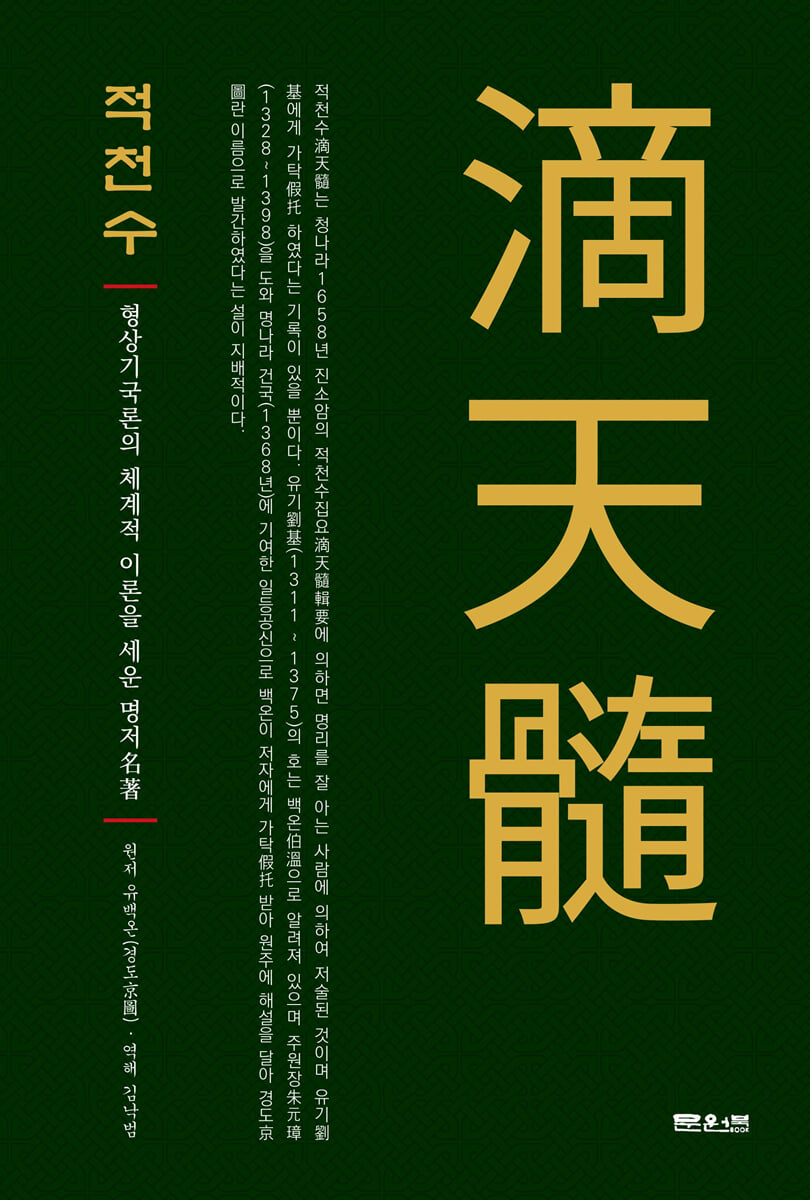
According to the Jeokcheonsujipyo (滴天髓輯要) compiled by Jin So-am in 1658 during the Qing Dynasty, Jeokcheonsu was written by a person who knew the secrets of fate, and there is only a record that it was entrusted to Yu Baek-on.
The commentary on Jeokcheonsu by Wonju Yu Baek-on and Jin So-am on Jeokcheonsu's collection of Jeokcheonsu leaves a somewhat insufficient impression on the theory of Jeokcheonsu's form and origin, and Im Cheol-cho's Jeokcheonsu Cheonmi explains Jeokcheonsu from the perspective of the new and old medicines of the day, which has led to its perception as a theory of oppression.
Seo Rak-o's Jeokcheonsujeongui was added and explained by Seo Rak-o because there were many missing words and typos in the Jeokcheonsucheonmi manuscript he obtained.
According to the Jeokcheonsujipyo (滴天髓輯要) compiled by Jin So-am in 1658 during the Qing Dynasty, Jeokcheonsu was written by a person who knew the secrets of fate, and there is only a record that it was entrusted to Yu Baek-on.
The commentary on Jeokcheonsu by Wonju Yu Baek-on and Jin So-am on Jeokcheonsu's collection of Jeokcheonsu leaves a somewhat insufficient impression on the theory of Jeokcheonsu's form and origin, and Im Cheol-cho's Jeokcheonsu Cheonmi explains Jeokcheonsu from the perspective of the new and old medicines of the day, which has led to its perception as a theory of oppression.
Seo Rak-o's Jeokcheonsujeongui was added and explained by Seo Rak-o because there were many missing words and typos in the Jeokcheonsucheonmi manuscript he obtained.
- You can preview some of the book's contents.
Preview
index
Chapter 1: Theory of Tongcheon
1.
Samwon
2.
nomination
3.
Leegi
4.
combination
Chapter 2: Theory of Ganji
1.
Heavenly Stems Theory
2.
Support theory
3.
Ganji theory
4.
valet
Chapter 3: Formology
1.
shape
2.
Bangguk
3.
A fierce battle
4.
Recruitment
Chapter 4: Momentum
1.
headwaters
2.
Customs clearance
3.
Request
4.
Kang Yu-sun Station
5.
Cold and wet weather
6.
Heavy
7.
Jin Taegamri
8.
Jonghwa
9.
Sunban-guk
10.
Jeonhapguk
11.
war god
12.
hat
Chapter 5: Interpretation and Argumentation
1.
kinship
2.
Rich and poor, nobility and class, good and bad fortune
3.
Jaedeok
4.
Hee-gi
5.
temperament
6.
disease
7.
native
8.
status
9.
Daesaeun
Chapter 6: Jeokcheonsuwonmunsigyeol
1.
Samwon
2.
nomination
3.
Leegi
4.
combination
Chapter 2: Theory of Ganji
1.
Heavenly Stems Theory
2.
Support theory
3.
Ganji theory
4.
valet
Chapter 3: Formology
1.
shape
2.
Bangguk
3.
A fierce battle
4.
Recruitment
Chapter 4: Momentum
1.
headwaters
2.
Customs clearance
3.
Request
4.
Kang Yu-sun Station
5.
Cold and wet weather
6.
Heavy
7.
Jin Taegamri
8.
Jonghwa
9.
Sunban-guk
10.
Jeonhapguk
11.
war god
12.
hat
Chapter 5: Interpretation and Argumentation
1.
kinship
2.
Rich and poor, nobility and class, good and bad fortune
3.
Jaedeok
4.
Hee-gi
5.
temperament
6.
disease
7.
native
8.
status
9.
Daesaeun
Chapter 6: Jeokcheonsuwonmunsigyeol
Publisher's Review
The theory of the shape and energy of Jeokcheonsu is a theory that forms the shape of the country centered on the monthly cycle and emphasizes the harmony of energy. In Jeokcheonsu, it is considered absurd to use letters that are not in the four pillars of destiny and to take them from the air.
The commentary on Jeokcheonsu by Wonju Yu Baek-on and Jin So-am on Jeokcheonsu's collection of Jeokcheonsu leaves a somewhat insufficient impression on the theory of Jeokcheonsu's form and origin, and Im Cheol-cho's Jeokcheonsu Cheonmi explains Jeokcheonsu from the perspective of the new and old medicines of the day, which has led to its perception as a theory of oppression.
Seo Rak-o's Jeokcheonsujeongui was added and explained by Seo Rak-o because there were many missing words and typos in the Jeokcheonsucheonmi manuscript he obtained.
Therefore, this book borrows the formula of Cheokcheonsucheonmi from the perspective of the original text of Jeokcheonsu and concisely explains it.
The commentary on Jeokcheonsu by Wonju Yu Baek-on and Jin So-am on Jeokcheonsu's collection of Jeokcheonsu leaves a somewhat insufficient impression on the theory of Jeokcheonsu's form and origin, and Im Cheol-cho's Jeokcheonsu Cheonmi explains Jeokcheonsu from the perspective of the new and old medicines of the day, which has led to its perception as a theory of oppression.
Seo Rak-o's Jeokcheonsujeongui was added and explained by Seo Rak-o because there were many missing words and typos in the Jeokcheonsucheonmi manuscript he obtained.
Therefore, this book borrows the formula of Cheokcheonsucheonmi from the perspective of the original text of Jeokcheonsu and concisely explains it.
GOODS SPECIFICS
- Date of issue: January 1, 2022
- Page count, weight, size: 468 pages | 682g | 152*225*30mm
- ISBN13: 9788974614874
- ISBN10: 8974614871
You may also like
카테고리
korean


korean

![GQ KOREA Mark (Monthly): December [2025]](http://librairie.coreenne.fr/cdn/shop/files/8ef265dbbfbf186523ed75ba7319009d.jpg?v=1765340328&width=3840)


