

Atlas of Japanese History
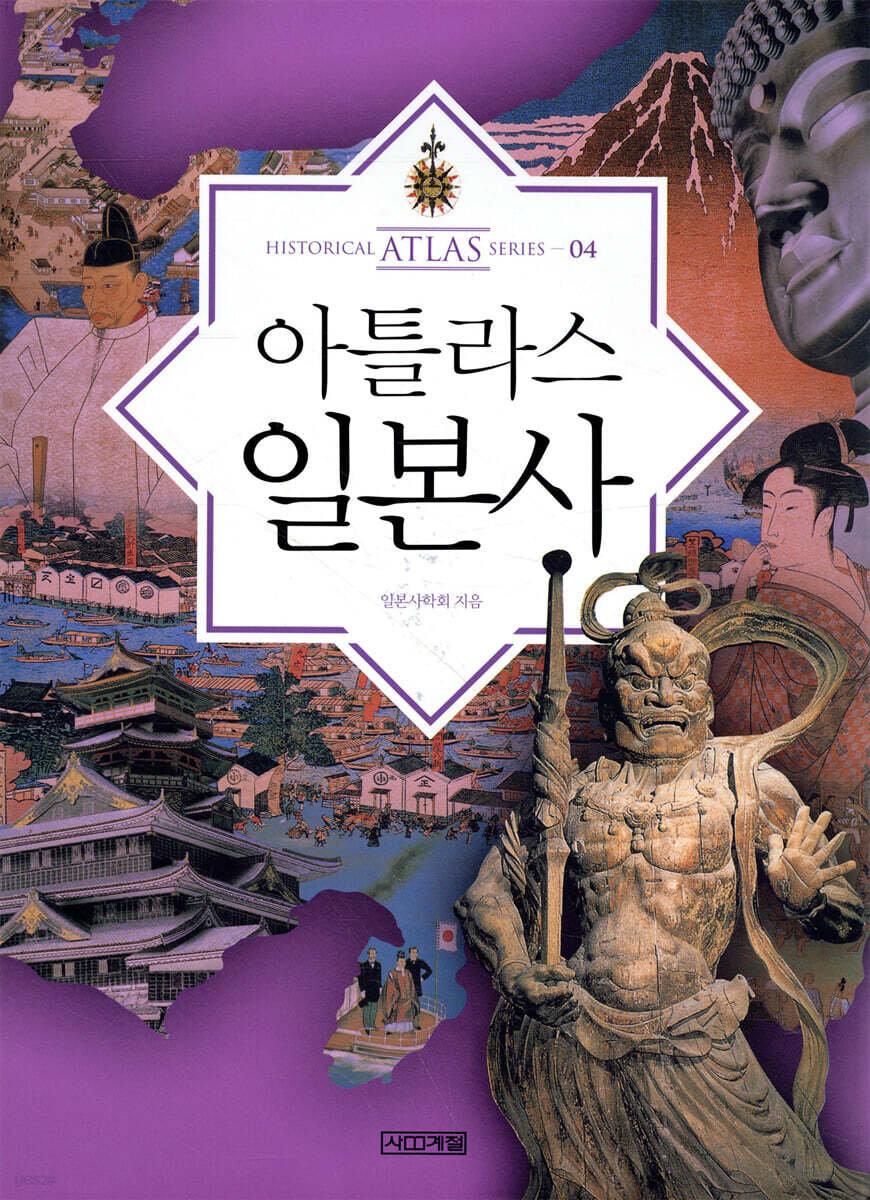 |
Description
Book Introduction
Despite being an introductory history of Japan written in Korea, it focuses on an objective description of Japanese history itself rather than emphasizing a Korean perspective in describing Japanese history.
Therefore, the content related to the history of Korea-Japan relations was also included in the description of the relevant items.
We have strived to reflect diverse interpretations and perspectives on Japanese history in a balanced manner, without compromising the consistency of the narrative, and have set the level of the narrative so that not only university students studying Japanese history but also general readers can understand it without great difficulty.
Additionally, I have tried to explain Japanese historical terms as clearly as possible to help readers understand.
The book is comprised of 89 themes covering the entire history of Japan, from the birth of the Japanese archipelago to the long-term recession period since the 1990s.
Each theme is presented on a double-page spread, with text, maps, diagrams, and illustrations clearly arranged around the topic.
A chronology is provided at the top left, allowing you to easily find the page containing the era or topic you are looking for.
At the end of the text, a "Japanese History Chronology" summarizing major events in Japanese history is included, allowing readers to check at any time which period they are reading about.
Due to the nature of Japanese history, there were numerous emperors, and even the same emperor often had different era names. During the shogunate period, the shogun was the actual ruler.
Also, in modern times, a cabinet system different from ours was established, so the prime minister changed frequently.
Taking these points into account, I have tried to help readers understand by organizing the figures of emperors, eras, shoguns, and prime ministers along with their periods of reign.
Therefore, the content related to the history of Korea-Japan relations was also included in the description of the relevant items.
We have strived to reflect diverse interpretations and perspectives on Japanese history in a balanced manner, without compromising the consistency of the narrative, and have set the level of the narrative so that not only university students studying Japanese history but also general readers can understand it without great difficulty.
Additionally, I have tried to explain Japanese historical terms as clearly as possible to help readers understand.
The book is comprised of 89 themes covering the entire history of Japan, from the birth of the Japanese archipelago to the long-term recession period since the 1990s.
Each theme is presented on a double-page spread, with text, maps, diagrams, and illustrations clearly arranged around the topic.
A chronology is provided at the top left, allowing you to easily find the page containing the era or topic you are looking for.
At the end of the text, a "Japanese History Chronology" summarizing major events in Japanese history is included, allowing readers to check at any time which period they are reading about.
Due to the nature of Japanese history, there were numerous emperors, and even the same emperor often had different era names. During the shogunate period, the shogun was the actual ruler.
Also, in modern times, a cabinet system different from ours was established, so the prime minister changed frequently.
Taking these points into account, I have tried to help readers understand by organizing the figures of emperors, eras, shoguns, and prime ministers along with their periods of reign.
- You can preview some of the book's contents.
Preview
index
1.
youth of the world
2.
Middle Ages
3.
Modern times
4.
Modern and contemporary times
youth of the world
2.
Middle Ages
3.
Modern times
4.
Modern and contemporary times
Detailed image
Into the book
*Japan, which defeated the invasion of the world empire Mongol
The Mongol invasion was the only full-scale invasion of Japan by a foreign force before the modern era.
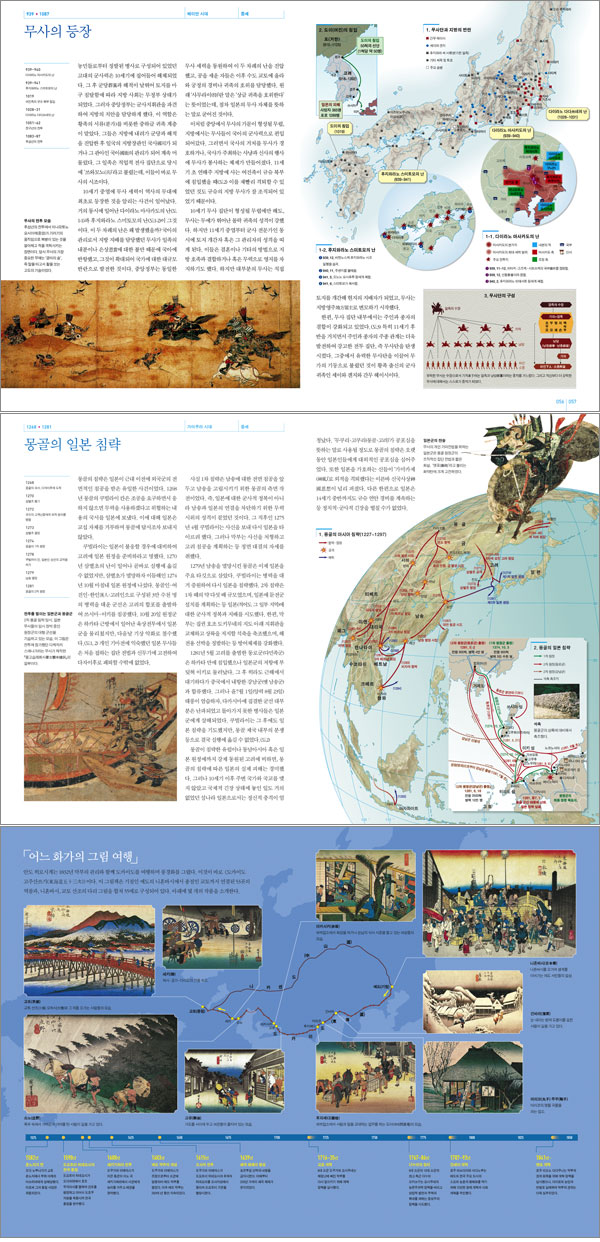
It depicts the expansion route of the Mongol Empire, which ruled all of Asia in the 13th century, and details the Japanese expedition through a detailed map. It also places dynamic icons of Japanese warriors using mounted tactics on the map, thereby realizing the dynamism of East Asia at the time of the Mongol Empire's expansion.
It also included excerpts from the "Mongolian Illustrated Poems" (蒙古襲來繪詞), which depict scenes of battles between the Japanese and Mongolian armies, to convey the vividness of the war. ---pp. 72-73
*Oda Nobunaga's achievements in unifying Japan
Oda Nobunaga attempted to unify Japan, which was divided into various samurai groups.
Through the bloody war of unification, Nobunaga attempted to deny the political, economic, order, and authority of the Middle Ages and create a new ruling order. Nobunaga's economic, religious, urban, and land policies are evaluated as pioneering policies that led Japan into the modern era.
The map on the right depicts Oda Nobunaga's process of unifying the country, from dark to light, depicting the expansion of his power. ---pp. 104-105
*Life in modern Japan as seen through travelogues
Ando Hiroshige's paintings of the Tokaido Fifty-Three Stages of the Tokaido were arranged in the order of his travels, realistically depicting the lifestyle of modern Japan.
This section provides an overview of each era, providing basic materials for a thorough understanding of each era by arranging a chronology for each era and displaying illustrations that capture the characteristics of the era. ---pp. 100-101
*The fantasy of the "Greater East Asia Co-Prosperity Sphere" dreamed of by imperialist Japan
The Pacific War, which began with the attack on Pearl Harbor, demonstrated that Imperial Japan's fantasy of a "Greater East Asia Co-Prosperity Sphere" had reached its peak.
The map on the right details the specific aspects of the Pacific War, allowing a quick understanding of the concept and reality of the "Greater East Asia Co-Prosperity Sphere."
The Mongol invasion was the only full-scale invasion of Japan by a foreign force before the modern era.
It depicts the expansion route of the Mongol Empire, which ruled all of Asia in the 13th century, and details the Japanese expedition through a detailed map. It also places dynamic icons of Japanese warriors using mounted tactics on the map, thereby realizing the dynamism of East Asia at the time of the Mongol Empire's expansion.
It also included excerpts from the "Mongolian Illustrated Poems" (蒙古襲來繪詞), which depict scenes of battles between the Japanese and Mongolian armies, to convey the vividness of the war. ---pp. 72-73
*Oda Nobunaga's achievements in unifying Japan
Oda Nobunaga attempted to unify Japan, which was divided into various samurai groups.
Through the bloody war of unification, Nobunaga attempted to deny the political, economic, order, and authority of the Middle Ages and create a new ruling order. Nobunaga's economic, religious, urban, and land policies are evaluated as pioneering policies that led Japan into the modern era.
The map on the right depicts Oda Nobunaga's process of unifying the country, from dark to light, depicting the expansion of his power. ---pp. 104-105
*Life in modern Japan as seen through travelogues
Ando Hiroshige's paintings of the Tokaido Fifty-Three Stages of the Tokaido were arranged in the order of his travels, realistically depicting the lifestyle of modern Japan.
This section provides an overview of each era, providing basic materials for a thorough understanding of each era by arranging a chronology for each era and displaying illustrations that capture the characteristics of the era. ---pp. 100-101
*The fantasy of the "Greater East Asia Co-Prosperity Sphere" dreamed of by imperialist Japan
The Pacific War, which began with the attack on Pearl Harbor, demonstrated that Imperial Japan's fantasy of a "Greater East Asia Co-Prosperity Sphere" had reached its peak.
The map on the right details the specific aspects of the Pacific War, allowing a quick understanding of the concept and reality of the "Greater East Asia Co-Prosperity Sphere."
---pp.182-183
Publisher's Review
Planning intent
An introductory book on authentic Japanese history written by Korea's best writers.
From ancient times to the present, Japan has maintained a special historical relationship with Korea, but it is true that our interest and efforts to understand Japan have been inadequate.
This point is also clearly revealed in the reality that we lack a full-fledged introductory textbook on Japanese history that we can read and study.
Although several books written by scholars from Japan and the West have been introduced in Korea, they cannot be introductory books for Korean readers.
『Atlas of Japanese History』 was written by the Japanese History Society, a group of Japanese history researchers in Korea, with a syntactic perspective, in an attempt to write a unified history of Japan.
A total of eight authors participated in the writing, rejecting the conventional, simple textbook-style narrative and information listing method, and instead stimulating interest in Japanese history through writing that was both engaging and full of character.
Furthermore, the best experts in each era participated in writing the book, so that not only the introductory content but also the latest research trends are reflected in a balanced way, broadening the scope of understanding of Japanese history.
Through this book, I hope to broaden Korean readers' understanding of Japanese history and, furthermore, their perception of Japan, a country both close and distant.
Japanese history, now read on maps!
When you open a book on Japanese history, you'll find countless place names. Aside from a few major cities that we often encounter through the media or travel, it's often difficult to pinpoint where they are located in Japan.
Moreover, even those who are well-versed in Japanese history cannot grasp the extent of the power of each era and the differences and changes that occurred between them.
Of course, even regular Japanese history books include maps related to Japanese history, but because they are not organically linked to the content of the text, there are many limitations in recognizing Japanese history spatially.
『Atlas of Japanese History』 projects the progression of place names, phenomena, and events appearing in the text onto a map, organically combining the text and map.
Through this book, the breadth of understanding of Japanese history, which has been confined to time, will be broadened through space.
Atlas History Series, the fourth book, "Atlas Japanese History"
The Atlas History series by Sageseul Publishing is an ambitious project and a series of premium history textbooks that seeks to expand the traditional temporally limited historical perception into space through maps.
『Atlas of Japanese History』, which took nearly four years to complete from manuscript writing to map development, illustration selection, and editing, is the fourth book in the Atlas History series, following 『Atlas of Korean History』 (2004), 『Atlas of World History』 (2004), and 『Atlas of Chinese History』 (2007).
Since its publication, the Atlas of History series has created a new trend in historical publishing, and other publishers have followed suit, publishing books that combine text and maps, both domestic and translated.
『Atlas of Japanese History』 is expected to go beyond the level of a mere introductory book to Japanese history and, along with the already published 『Atlas of Korean History』, 『Atlas of World History』, and 『Atlas of Chinese History』, contribute to opening new horizons in the study and understanding of history.
Features of this book
One theme spread across two pages
It consists of a total of 89 themes covering the entire history of Japan, from the birth of the Japanese archipelago to the long-term recession period since the 1990s.
Each theme is presented on a double-page spread, with text, maps, diagrams, and illustrations clearly arranged around the topic.
A chronology is provided at the top left, allowing you to easily find the page containing the era or topic you are looking for.
A total of 179 historical maps and various tables and graphs vividly depicting historical events.
The core of "Atlas of Japanese History" is to compress the content of the text into a map, thereby expanding the scope of historical understanding, which is currently confined to time, into space.
The authors recreated historical events on maps based on thorough historical interpretation and geographical research.
The 101 maps in this book visually reveal various aspects of Japanese history, including the development of political events, the movement of population and goods, the distribution of industry and culture, and the routes of travelers. The 68 tables and graphs concisely summarize information that cannot be explained through text alone.
High-quality 3D map graphics
Breaking away from the monotonous flat maps found in most history books, we mainly used three-dimensional maps that realistically showed mountain ranges, rivers, plateaus, and plains.
By using dots, lines, and surfaces in color, we clearly show the locations of historical events, borders, and spheres of influence. We also used various arrows and icons to create the dynamism of time in a space that appears to be still.
Just by looking at the map from beginning to end, you can get a complete picture of Japanese history.
Illustrated materials that allow you to feel the spirit of the times at a glance
214 illustrations enrich the reading of Japanese history.
Rather than randomly arranging the illustrations related to the period, we carefully selected the illustrations that best captured the characteristics of each era.
For example, the magnificent appearance of Daisen Kofun symbolically shows the powerful royal power of Japan during the Kofun period (page 22), and the activities of the warring states daimyō during the Warring States period, which also fascinates domestic readers, can be understood at a glance by arranging character pictures centered around a map (pages 90-91), and the appearance of a Kabuki theater with a protruding stage allows us to capture the cultural aspects of modern Japan (page 125).
A chronological table and character chart summarizing major events and figures in Japanese history.
At the end of the text, a "Japanese History Chronology" summarizing major events in Japanese history is included, allowing readers to check at any time which period they are reading about.
Due to the nature of Japanese history, there were numerous emperors, and even the same emperor often had different era names. During the shogunate period, the shogun was the actual ruler.
Also, in modern times, a cabinet system different from ours was established, so the prime minister changed frequently.
Taking these points into account, I have tried to help readers understand by organizing the figures of emperors, eras, shoguns, and prime ministers along with their periods of reign.
How to Read Atlas of Japanese History
pp.56-57
Let's look at the text below.
At the top of the right page, there is a large map and three small maps.
The main map shows the samurai forces, a symbol of Japan, appearing throughout medieval Japan, and the power and lineage of each samurai group are shown with symbols of different shapes and colors.
The sub-maps surrounding the main map zoom in on major events on the main map, conveying the era in which warrior groups fought and fought.
The left panel vividly conveys the activities of the warriors at the time, and the diagram on the lower right graphically expresses the composition of the warrior group so that it can be understood at a glance.
In this way, it was organized to enable a comprehensive understanding of the times by utilizing various methods of expression, such as main maps, sub-maps, illustrations, and diagrams for each section.
Show solidarity
- This book serves as a milestone in time when you read it.
I can tell what period of time I am currently reading.
Chronology
- Events related to the period and topic are arranged in chronological order.
Illustration
- We carefully selected and arranged illustrations that best capture the characteristics of the era and subject matter.
Main Map
- The core content of the relevant section was implemented and edited in a format that greatly expands it.
Place names necessary for understanding the map, such as cities, mountains, and rivers, are placed, and various symbols, arrows, and colors are used to help explain the topic and events so that they can be easily understood.
Sub map
- Parts that were difficult to explain in detail in the text due to space limitations or that required more detailed explanation on the main map were implemented as maps.
text
- The text is written to concisely convey the relevant era and topic, and breaks away from the simple textbook-style description and information listing method, and unfolds in a concise and unique way that reflects the author's view of history.
An introductory book on authentic Japanese history written by Korea's best writers.
From ancient times to the present, Japan has maintained a special historical relationship with Korea, but it is true that our interest and efforts to understand Japan have been inadequate.
This point is also clearly revealed in the reality that we lack a full-fledged introductory textbook on Japanese history that we can read and study.
Although several books written by scholars from Japan and the West have been introduced in Korea, they cannot be introductory books for Korean readers.
『Atlas of Japanese History』 was written by the Japanese History Society, a group of Japanese history researchers in Korea, with a syntactic perspective, in an attempt to write a unified history of Japan.
A total of eight authors participated in the writing, rejecting the conventional, simple textbook-style narrative and information listing method, and instead stimulating interest in Japanese history through writing that was both engaging and full of character.
Furthermore, the best experts in each era participated in writing the book, so that not only the introductory content but also the latest research trends are reflected in a balanced way, broadening the scope of understanding of Japanese history.
Through this book, I hope to broaden Korean readers' understanding of Japanese history and, furthermore, their perception of Japan, a country both close and distant.
Japanese history, now read on maps!
When you open a book on Japanese history, you'll find countless place names. Aside from a few major cities that we often encounter through the media or travel, it's often difficult to pinpoint where they are located in Japan.
Moreover, even those who are well-versed in Japanese history cannot grasp the extent of the power of each era and the differences and changes that occurred between them.
Of course, even regular Japanese history books include maps related to Japanese history, but because they are not organically linked to the content of the text, there are many limitations in recognizing Japanese history spatially.
『Atlas of Japanese History』 projects the progression of place names, phenomena, and events appearing in the text onto a map, organically combining the text and map.
Through this book, the breadth of understanding of Japanese history, which has been confined to time, will be broadened through space.
Atlas History Series, the fourth book, "Atlas Japanese History"
The Atlas History series by Sageseul Publishing is an ambitious project and a series of premium history textbooks that seeks to expand the traditional temporally limited historical perception into space through maps.
『Atlas of Japanese History』, which took nearly four years to complete from manuscript writing to map development, illustration selection, and editing, is the fourth book in the Atlas History series, following 『Atlas of Korean History』 (2004), 『Atlas of World History』 (2004), and 『Atlas of Chinese History』 (2007).
Since its publication, the Atlas of History series has created a new trend in historical publishing, and other publishers have followed suit, publishing books that combine text and maps, both domestic and translated.
『Atlas of Japanese History』 is expected to go beyond the level of a mere introductory book to Japanese history and, along with the already published 『Atlas of Korean History』, 『Atlas of World History』, and 『Atlas of Chinese History』, contribute to opening new horizons in the study and understanding of history.
Features of this book
One theme spread across two pages
It consists of a total of 89 themes covering the entire history of Japan, from the birth of the Japanese archipelago to the long-term recession period since the 1990s.
Each theme is presented on a double-page spread, with text, maps, diagrams, and illustrations clearly arranged around the topic.
A chronology is provided at the top left, allowing you to easily find the page containing the era or topic you are looking for.
A total of 179 historical maps and various tables and graphs vividly depicting historical events.
The core of "Atlas of Japanese History" is to compress the content of the text into a map, thereby expanding the scope of historical understanding, which is currently confined to time, into space.
The authors recreated historical events on maps based on thorough historical interpretation and geographical research.
The 101 maps in this book visually reveal various aspects of Japanese history, including the development of political events, the movement of population and goods, the distribution of industry and culture, and the routes of travelers. The 68 tables and graphs concisely summarize information that cannot be explained through text alone.
High-quality 3D map graphics
Breaking away from the monotonous flat maps found in most history books, we mainly used three-dimensional maps that realistically showed mountain ranges, rivers, plateaus, and plains.
By using dots, lines, and surfaces in color, we clearly show the locations of historical events, borders, and spheres of influence. We also used various arrows and icons to create the dynamism of time in a space that appears to be still.
Just by looking at the map from beginning to end, you can get a complete picture of Japanese history.
Illustrated materials that allow you to feel the spirit of the times at a glance
214 illustrations enrich the reading of Japanese history.
Rather than randomly arranging the illustrations related to the period, we carefully selected the illustrations that best captured the characteristics of each era.
For example, the magnificent appearance of Daisen Kofun symbolically shows the powerful royal power of Japan during the Kofun period (page 22), and the activities of the warring states daimyō during the Warring States period, which also fascinates domestic readers, can be understood at a glance by arranging character pictures centered around a map (pages 90-91), and the appearance of a Kabuki theater with a protruding stage allows us to capture the cultural aspects of modern Japan (page 125).
A chronological table and character chart summarizing major events and figures in Japanese history.
At the end of the text, a "Japanese History Chronology" summarizing major events in Japanese history is included, allowing readers to check at any time which period they are reading about.
Due to the nature of Japanese history, there were numerous emperors, and even the same emperor often had different era names. During the shogunate period, the shogun was the actual ruler.
Also, in modern times, a cabinet system different from ours was established, so the prime minister changed frequently.
Taking these points into account, I have tried to help readers understand by organizing the figures of emperors, eras, shoguns, and prime ministers along with their periods of reign.
How to Read Atlas of Japanese History
pp.56-57
Let's look at the text below.
At the top of the right page, there is a large map and three small maps.
The main map shows the samurai forces, a symbol of Japan, appearing throughout medieval Japan, and the power and lineage of each samurai group are shown with symbols of different shapes and colors.
The sub-maps surrounding the main map zoom in on major events on the main map, conveying the era in which warrior groups fought and fought.
The left panel vividly conveys the activities of the warriors at the time, and the diagram on the lower right graphically expresses the composition of the warrior group so that it can be understood at a glance.
In this way, it was organized to enable a comprehensive understanding of the times by utilizing various methods of expression, such as main maps, sub-maps, illustrations, and diagrams for each section.
Show solidarity
- This book serves as a milestone in time when you read it.
I can tell what period of time I am currently reading.
Chronology
- Events related to the period and topic are arranged in chronological order.
Illustration
- We carefully selected and arranged illustrations that best capture the characteristics of the era and subject matter.
Main Map
- The core content of the relevant section was implemented and edited in a format that greatly expands it.
Place names necessary for understanding the map, such as cities, mountains, and rivers, are placed, and various symbols, arrows, and colors are used to help explain the topic and events so that they can be easily understood.
Sub map
- Parts that were difficult to explain in detail in the text due to space limitations or that required more detailed explanation on the main map were implemented as maps.
text
- The text is written to concisely convey the relevant era and topic, and breaks away from the simple textbook-style description and information listing method, and unfolds in a concise and unique way that reflects the author's view of history.
GOODS SPECIFICS
- Date of issue: April 3, 2011
- Format: Hardcover book binding method guide
- Page count, weight, size: 235 pages | 970g | 188*254*20mm
- ISBN13: 9788958285236
- ISBN10: 8958285230
You may also like
카테고리
korean


korean

![GQ KOREA Mark (Monthly): December [2025]](http://librairie.coreenne.fr/cdn/shop/files/8ef265dbbfbf186523ed75ba7319009d.jpg?v=1765340328&width=3840)


