

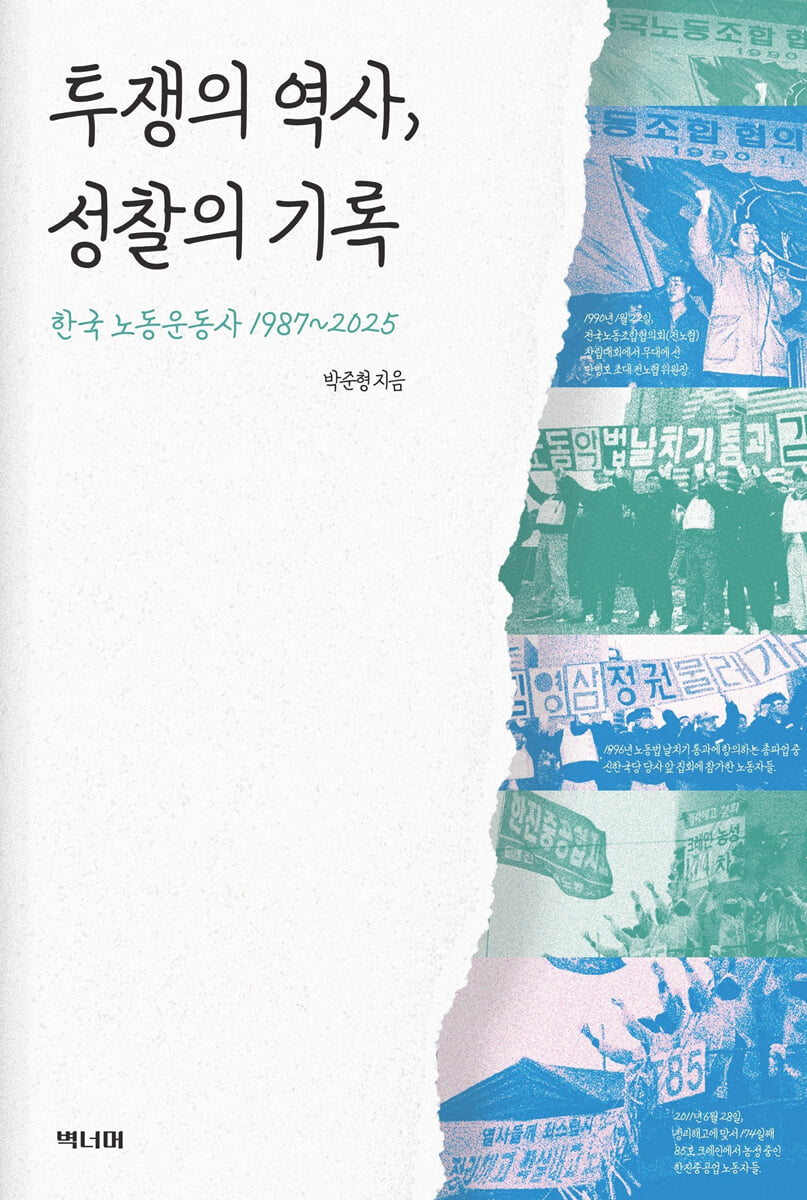
A history of struggle, a record of reflection
 |
Description
Book Introduction
This book examines the direction in which the Korean labor movement has practiced and the political and ideological stances it has developed.
The ideology and practice of the labor movement have directly shaped the form of the labor movement.
However, these ideologies and practices are not merely subjectively formed within ideas.
The labor movement develops within a specific time and space, within the objective nature of the contemporary capitalist economy and society, and within the structure of class relations (foundation).
The labor movement unfolds under specific conditions such as the industrial structure, the resulting labor market situation, and the nature of labor-management relations.
This book also examines the conditions under which the Korean labor movement was formed and how it responded to the development of Korean capitalism (economic history).
Objective factors do not determine all aspects of the labor movement's practice, but if objective factors are ignored, the movement is bound to fail.
This will continue to be the case in the future.
Of course, the labor movement has also changed the reality it faces, and we will examine that as well.
The ideology and practice of the labor movement have directly shaped the form of the labor movement.
However, these ideologies and practices are not merely subjectively formed within ideas.
The labor movement develops within a specific time and space, within the objective nature of the contemporary capitalist economy and society, and within the structure of class relations (foundation).
The labor movement unfolds under specific conditions such as the industrial structure, the resulting labor market situation, and the nature of labor-management relations.
This book also examines the conditions under which the Korean labor movement was formed and how it responded to the development of Korean capitalism (economic history).
Objective factors do not determine all aspects of the labor movement's practice, but if objective factors are ignored, the movement is bound to fail.
This will continue to be the case in the future.
Of course, the labor movement has also changed the reality it faces, and we will examine that as well.
- You can preview some of the book's contents.
Preview
index
introduction
Chronology
Chapter 1.
The birth and growth of the democratic labor union movement
1.
Before 1987, oppressive labor-management relations and the emergence of the democratic labor union movement
2.
The explosion of the great workers' struggle in 1987
3.
Building national unity and the Korean Confederation of Trade Unions
4.
Changes in Korean Capitalism and the Labor Movement in the 1990s
5.
The Labor Movement Crisis Debate: What Was It?
6.
Liquidation of the Korean Confederation of Trade Unions and establishment of the Korean Confederation of Trade Unions
7.
1996-97 general strike
8.
The formation and differentiation of the political labor movement and the founding of the Democratic Labor Party
Chapter 2. The IMF Foreign Exchange Crisis and the Labor Movement
1. The IMF foreign exchange crisis and the full-scale implementation of neoliberal structural adjustments.
2.
1998 labor-management-government agreement and the KCTU general strike
3.
The storm of layoffs and the struggle to stop restructuring in large corporations and the public sector.
4.
Issues in the struggle against layoffs
5.
Struggle to prevent restructuring and privatization in the public and financial sectors
6.
The struggle for shorter working hours and the trap of labor flexibility
7.
Irregular workers' struggle immediately after the foreign exchange crisis
8.
The entrenchment of the dual labor market structure and the limitations of labor movement responses
Chapter 3.
Strategic Exploration of the Labor Movement after the Foreign Exchange Crisis
1.
Transition to a low-growth system and labor market segmentation
2.
Frustration in establishing industrial unions and negotiating with industry
3.
The Roh Moo-hyun administration's attempts at social consensus and the labor movement's conflict
4.
Discussions on KCTU innovation: The paradox of corruption scandals and the introduction of direct elections
5.
The growing organization and struggle of irregular workers
6.
Candlelight vigils against the Korea-US FTA and mad cow disease
7.
Labor movement strategies after the foreign exchange crisis
Chapter 4.
Labor Movement after the Global Financial Crisis
1.
After the global financial crisis, the opportunity for change was lost.
2.
Struggle against layoffs
3.
The struggle to respond to public sector restructuring and the Lee Myung-bak administration's suppression of unions
4.
Industry-wide unions: the limits of industry-wide bargaining and new attempts
5.
The social publicness movement unfolded as a "defensive struggle."
6.
The struggle of irregular workers has expanded into the service industry.
7.
10,000 won minimum wage movement
8.
Legalization of migrant workers' unions and migrant workers' movements
9.
The conservative government's failure to reform labor and the general strike and uprising
10.
The decline of the "anti-conservative front" opposition alliance and the progressive party movement.
Chapter 5.
Labor movement after the Moon Jae-in administration
1.
The Moon Jae-in administration's reform attempts and failures
2.
A turning point in the struggle for regular employment and non-regular workers
3.
The Moon Jae-in administration's North Korea policy and the Korean Confederation of Trade Unions' unification movement
4.
The failure of the Moon Jae-in administration and the failure of the Korean Confederation of Trade Unions
5.
The Yoon Seok-yeol administration's launch and the labor movement's response
Chapter 6.
Can the labor movement change after 1987?
1.
The Trends of the Labor Movement and Historical Path Dependence Since 1987
2.
The result is a fractured labor market.
3.
Failure of existing strategies and new experiments
4.
Is change in the labor movement possible?
[Appendix] Readers' Forum
Chronology
Chapter 1.
The birth and growth of the democratic labor union movement
1.
Before 1987, oppressive labor-management relations and the emergence of the democratic labor union movement
2.
The explosion of the great workers' struggle in 1987
3.
Building national unity and the Korean Confederation of Trade Unions
4.
Changes in Korean Capitalism and the Labor Movement in the 1990s
5.
The Labor Movement Crisis Debate: What Was It?
6.
Liquidation of the Korean Confederation of Trade Unions and establishment of the Korean Confederation of Trade Unions
7.
1996-97 general strike
8.
The formation and differentiation of the political labor movement and the founding of the Democratic Labor Party
Chapter 2. The IMF Foreign Exchange Crisis and the Labor Movement
1. The IMF foreign exchange crisis and the full-scale implementation of neoliberal structural adjustments.
2.
1998 labor-management-government agreement and the KCTU general strike
3.
The storm of layoffs and the struggle to stop restructuring in large corporations and the public sector.
4.
Issues in the struggle against layoffs
5.
Struggle to prevent restructuring and privatization in the public and financial sectors
6.
The struggle for shorter working hours and the trap of labor flexibility
7.
Irregular workers' struggle immediately after the foreign exchange crisis
8.
The entrenchment of the dual labor market structure and the limitations of labor movement responses
Chapter 3.
Strategic Exploration of the Labor Movement after the Foreign Exchange Crisis
1.
Transition to a low-growth system and labor market segmentation
2.
Frustration in establishing industrial unions and negotiating with industry
3.
The Roh Moo-hyun administration's attempts at social consensus and the labor movement's conflict
4.
Discussions on KCTU innovation: The paradox of corruption scandals and the introduction of direct elections
5.
The growing organization and struggle of irregular workers
6.
Candlelight vigils against the Korea-US FTA and mad cow disease
7.
Labor movement strategies after the foreign exchange crisis
Chapter 4.
Labor Movement after the Global Financial Crisis
1.
After the global financial crisis, the opportunity for change was lost.
2.
Struggle against layoffs
3.
The struggle to respond to public sector restructuring and the Lee Myung-bak administration's suppression of unions
4.
Industry-wide unions: the limits of industry-wide bargaining and new attempts
5.
The social publicness movement unfolded as a "defensive struggle."
6.
The struggle of irregular workers has expanded into the service industry.
7.
10,000 won minimum wage movement
8.
Legalization of migrant workers' unions and migrant workers' movements
9.
The conservative government's failure to reform labor and the general strike and uprising
10.
The decline of the "anti-conservative front" opposition alliance and the progressive party movement.
Chapter 5.
Labor movement after the Moon Jae-in administration
1.
The Moon Jae-in administration's reform attempts and failures
2.
A turning point in the struggle for regular employment and non-regular workers
3.
The Moon Jae-in administration's North Korea policy and the Korean Confederation of Trade Unions' unification movement
4.
The failure of the Moon Jae-in administration and the failure of the Korean Confederation of Trade Unions
5.
The Yoon Seok-yeol administration's launch and the labor movement's response
Chapter 6.
Can the labor movement change after 1987?
1.
The Trends of the Labor Movement and Historical Path Dependence Since 1987
2.
The result is a fractured labor market.
3.
Failure of existing strategies and new experiments
4.
Is change in the labor movement possible?
[Appendix] Readers' Forum
Into the book
We will examine not only the "history of victory and progress" that often appears in the official labor movement history of labor unions, but also the history of failure, defeat, and error.
--- From the "Preface"
The 'Great Workers' Struggle' of 1987 was a declaration of humanity by oppressed workers and was a historical event that substantially shaped the current democratic labor union movement.
It was a struggle that combined resistance against the exploitation of developmental capitalism and military dictatorship with the improvement of wages and working conditions and the establishment of democratic labor unions.
Moreover, this was a huge struggle that changed not only the labor movement but also Korea's labor-management relations, as well as the economic and social structure.
It was the starting point of the collapse of the labor-management relations structure of the authoritarian developmental dictatorship that had persisted since the 1960s.
--- From "Chapter 1"
Above all, the biggest problem is that the areas that the KCTU should have focused on, namely, innovation in its movement line and the abolition of the company-based union system, have been delayed.
Among the many proposals for the direction of innovation in the Korean Confederation of Trade Unions, organizational consensus itself was weak in areas other than the introduction of a direct election system.
There were some who expected that direct elections would be a platform for presenting a development strategy for the labor movement, but the actual results did not turn out that way.
--- From Chapter 3
Paradoxically, the failure of the Moon Jae-in administration and the Democratic Party has provided the labor movement with an opportunity to reflect on the path of the "pan-democratic/progressive camp" and "opposition alliance" that it has taken over the past decade.
However, the prevailing notion of a "pan-democratic progressive" camp still lingers within the labor movement, and many veteran activists are connected to the Democratic Party through personal connections with the 586 generation.
--- From Chapter 5
History teaches lessons, but there are no easy answers.
If the labor movement can start anew from its original position for a different future, it may be able to transform the Korean labor movement for a tomorrow different from yesterday.
--- From the "Preface"
The 'Great Workers' Struggle' of 1987 was a declaration of humanity by oppressed workers and was a historical event that substantially shaped the current democratic labor union movement.
It was a struggle that combined resistance against the exploitation of developmental capitalism and military dictatorship with the improvement of wages and working conditions and the establishment of democratic labor unions.
Moreover, this was a huge struggle that changed not only the labor movement but also Korea's labor-management relations, as well as the economic and social structure.
It was the starting point of the collapse of the labor-management relations structure of the authoritarian developmental dictatorship that had persisted since the 1960s.
--- From "Chapter 1"
Above all, the biggest problem is that the areas that the KCTU should have focused on, namely, innovation in its movement line and the abolition of the company-based union system, have been delayed.
Among the many proposals for the direction of innovation in the Korean Confederation of Trade Unions, organizational consensus itself was weak in areas other than the introduction of a direct election system.
There were some who expected that direct elections would be a platform for presenting a development strategy for the labor movement, but the actual results did not turn out that way.
--- From Chapter 3
Paradoxically, the failure of the Moon Jae-in administration and the Democratic Party has provided the labor movement with an opportunity to reflect on the path of the "pan-democratic/progressive camp" and "opposition alliance" that it has taken over the past decade.
However, the prevailing notion of a "pan-democratic progressive" camp still lingers within the labor movement, and many veteran activists are connected to the Democratic Party through personal connections with the 586 generation.
--- From Chapter 5
History teaches lessons, but there are no easy answers.
If the labor movement can start anew from its original position for a different future, it may be able to transform the Korean labor movement for a tomorrow different from yesterday.
--- From Chapter 6
Publisher's Review
Reflecting on 40 Years of the Korean Labor Movement: Not Just Victories, But Also Failures and Mistakes
A history of the labor movement has been published, critically retracing the 40-year trajectory of the Korean democratic labor movement, from the great workers' struggle of 1987 to the resignation of the Yoon Seok-yeol government in 2025.
"History of Struggle, Record of Reflection" is noteworthy in that, unlike existing descriptions of the history of the labor movement, it deals head-on with not only the "history of victory and the history of advancement," but also the history of failure, defeat, and error.
Beyond simply listing events, it closely analyzes how the labor movement was formed and responded to the objective conditions of structural change and political upheaval in contemporary Korean capitalism.
A History of the Labor Movement from a Self-Reflective Perspective This book goes beyond the "history of victory" typically depicted in official labor union histories, and reflects on the history of the movement's failures, defeats, and errors.
It raises fundamental questions about why, despite fierce and dedicated struggles, problems such as the deepening dual structure of the labor market have not been resolved, and why key strategies such as building industrial unions and politicizing them have been frustrated.
This is a different approach from the existing labor movement history narratives that have portrayed the labor movement only as victims or resisters of external oppression and neoliberal offensives.
The book positions the KCTU as a “participant” in Korean society.
It raises head-on the issue that the labor movement is both a part of and responsible for Korea's current achievements in reaching the ranks of advanced nations.
Cross-Analysis of Ideology, Strategy, and Economic Conditions This book organizes by period how the labor movement changed and responded during the 1987 Great Labor Struggle, the establishment of the Korean Confederation of Trade Unions (KCTU) and the Korean Confederation of Trade Unions (KCTU), the 1996-97 general strike, the IMF foreign exchange crisis, and the Roh Moo-hyun, Lee Myung-bak, Park Geun-hye, Moon Jae-in, and Yoon Seok-yeol administrations.
Rather than a simple chronology, it traces the strategic choices and outcomes of the labor movement in each period.
In this, the historical intersection and differentiation of the 'political labor movement', which includes political party and factional activities, as well as the 'socio-economic labor movement' centered on labor unions, are also illuminated, thereby organizing the ideological and practical changes of the labor movement in a three-dimensional manner.
This book analyzes not only the ideology and practice of the labor movement, but also the objective conditions for the development of Korean capitalism.
While the labor movement is a subjective practice, it has always been a consequence of Korea's economic and political turmoil. This book meticulously traces the impact of economic crises like the IMF foreign exchange crisis and the global financial crisis on the labor movement, as well as the changes in industrial structure and labor market segmentation. It also provides a three-dimensional view of the conditions under which the labor movement's strategic choices were made.
Analysis of the Frustration of the Strategy of Industrial Unions and Political Power This six-chapter book provides a detailed analysis of why the core strategies agreed upon by the labor movement in the 2000s—building industrial unions and political power centered on progressive parties—failed to achieve the expected results.
In particular, it addresses the entrenched nature of company-specific unionism, the limitations of irregular workers' struggles, and the failures of the Moon Jae-in administration, with specific examples.
In particular, we focus on the 2010s following the 2008 global financial crisis.
It is diagnosed that even as the industrial union and political force movement failed, the union failed to innovate its strategy toward transforming into a social movement union.
Why this book now? The author emphasizes that "the workers and activists who led the democratic labor movement have already retired or are about to retire," and that "now is not too late" to look back on the past.
At this turning point, with the resignation of the Yoon Seok-yeol administration and the launch of a new government, this is a warning that if we do not reflect on past experiences, we could end up repeating the same mistakes.
This book is a warning to the labor movement to avoid repeating its failures, and a record of self-reflection.
Through a profound reflection on the past, we ask how the Korean labor movement can overcome the limitations of existing strategies and transform itself in the face of the fractured labor market.
Audience: No age restrictions.
Not only for labor activists but also for the general public
Structure: A detailed analysis of the major issues and turning points of the Korean democratic labor movement over the past 40 years across 〈6 chapters〉.
Let's review the overall content through the "Symposium" in the last chapter.
A history of the labor movement has been published, critically retracing the 40-year trajectory of the Korean democratic labor movement, from the great workers' struggle of 1987 to the resignation of the Yoon Seok-yeol government in 2025.
"History of Struggle, Record of Reflection" is noteworthy in that, unlike existing descriptions of the history of the labor movement, it deals head-on with not only the "history of victory and the history of advancement," but also the history of failure, defeat, and error.
Beyond simply listing events, it closely analyzes how the labor movement was formed and responded to the objective conditions of structural change and political upheaval in contemporary Korean capitalism.
A History of the Labor Movement from a Self-Reflective Perspective This book goes beyond the "history of victory" typically depicted in official labor union histories, and reflects on the history of the movement's failures, defeats, and errors.
It raises fundamental questions about why, despite fierce and dedicated struggles, problems such as the deepening dual structure of the labor market have not been resolved, and why key strategies such as building industrial unions and politicizing them have been frustrated.
This is a different approach from the existing labor movement history narratives that have portrayed the labor movement only as victims or resisters of external oppression and neoliberal offensives.
The book positions the KCTU as a “participant” in Korean society.
It raises head-on the issue that the labor movement is both a part of and responsible for Korea's current achievements in reaching the ranks of advanced nations.
Cross-Analysis of Ideology, Strategy, and Economic Conditions This book organizes by period how the labor movement changed and responded during the 1987 Great Labor Struggle, the establishment of the Korean Confederation of Trade Unions (KCTU) and the Korean Confederation of Trade Unions (KCTU), the 1996-97 general strike, the IMF foreign exchange crisis, and the Roh Moo-hyun, Lee Myung-bak, Park Geun-hye, Moon Jae-in, and Yoon Seok-yeol administrations.
Rather than a simple chronology, it traces the strategic choices and outcomes of the labor movement in each period.
In this, the historical intersection and differentiation of the 'political labor movement', which includes political party and factional activities, as well as the 'socio-economic labor movement' centered on labor unions, are also illuminated, thereby organizing the ideological and practical changes of the labor movement in a three-dimensional manner.
This book analyzes not only the ideology and practice of the labor movement, but also the objective conditions for the development of Korean capitalism.
While the labor movement is a subjective practice, it has always been a consequence of Korea's economic and political turmoil. This book meticulously traces the impact of economic crises like the IMF foreign exchange crisis and the global financial crisis on the labor movement, as well as the changes in industrial structure and labor market segmentation. It also provides a three-dimensional view of the conditions under which the labor movement's strategic choices were made.
Analysis of the Frustration of the Strategy of Industrial Unions and Political Power This six-chapter book provides a detailed analysis of why the core strategies agreed upon by the labor movement in the 2000s—building industrial unions and political power centered on progressive parties—failed to achieve the expected results.
In particular, it addresses the entrenched nature of company-specific unionism, the limitations of irregular workers' struggles, and the failures of the Moon Jae-in administration, with specific examples.
In particular, we focus on the 2010s following the 2008 global financial crisis.
It is diagnosed that even as the industrial union and political force movement failed, the union failed to innovate its strategy toward transforming into a social movement union.
Why this book now? The author emphasizes that "the workers and activists who led the democratic labor movement have already retired or are about to retire," and that "now is not too late" to look back on the past.
At this turning point, with the resignation of the Yoon Seok-yeol administration and the launch of a new government, this is a warning that if we do not reflect on past experiences, we could end up repeating the same mistakes.
This book is a warning to the labor movement to avoid repeating its failures, and a record of self-reflection.
Through a profound reflection on the past, we ask how the Korean labor movement can overcome the limitations of existing strategies and transform itself in the face of the fractured labor market.
Audience: No age restrictions.
Not only for labor activists but also for the general public
Structure: A detailed analysis of the major issues and turning points of the Korean democratic labor movement over the past 40 years across 〈6 chapters〉.
Let's review the overall content through the "Symposium" in the last chapter.
GOODS SPECIFICS
- Date of issue: October 30, 2025
- Page count, weight, size: 518 pages | 152*224*27mm
- ISBN13: 9791197629624
- ISBN10: 1197629629
You may also like
카테고리
korean


korean

![GQ KOREA Mark (Monthly): December [2025]](http://librairie.coreenne.fr/cdn/shop/files/8ef265dbbfbf186523ed75ba7319009d.jpg?v=1765340328&width=3840)


