

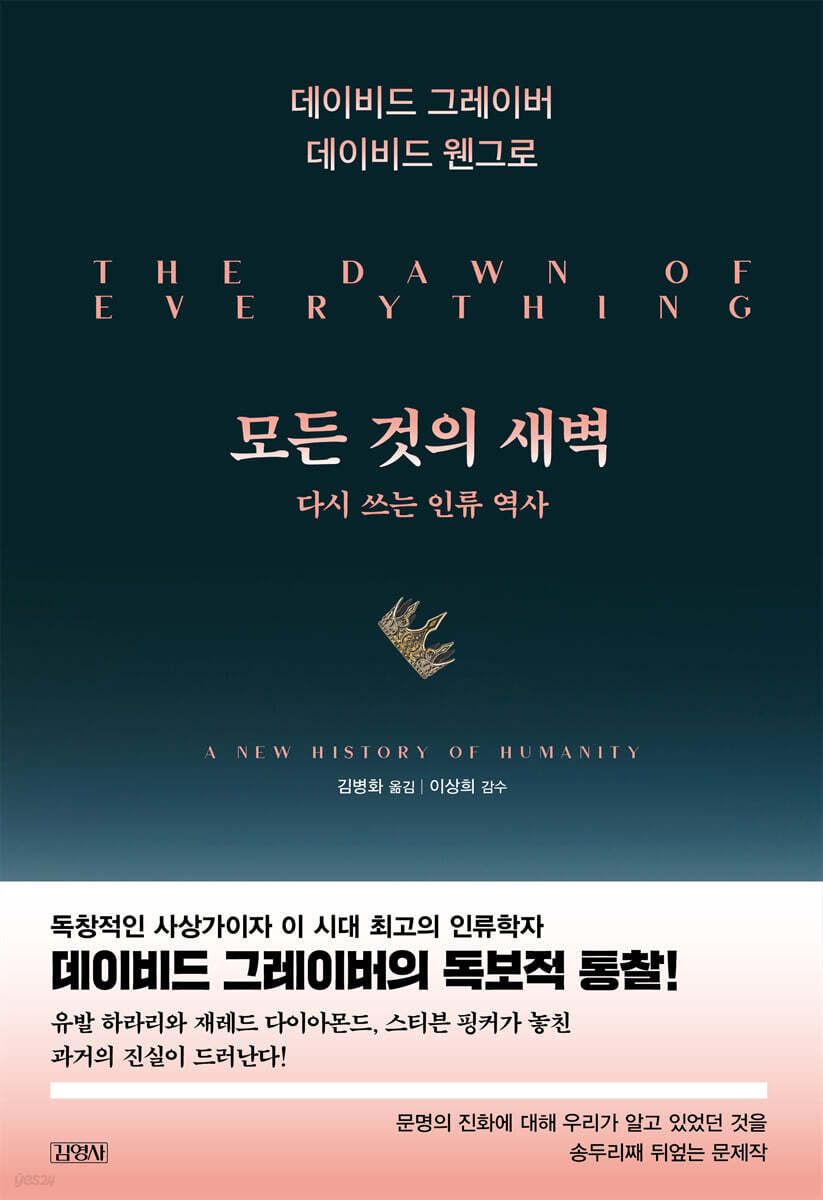
The dawn of everything
 |
Description
Book Introduction
- A word from MD
- A masterpiece by anthropologist David Graeber.
It challenges existing understandings of hunting and gathering and agriculture, cities and states, democracy and inequality, and presents a new history of civilization.
The path that humanity has walked has not been simple.
A fascinating brick book that describes colorful events in an interesting way.
- Son Min-gyu, Humanities PD
★★A book that fundamentally changes everything.
Liberates the way we imagine history and the future.★★
_Rebecca Solnit, author of Orwell's Rose
★★A feast of intellect.
All of this shatters the intellectual beliefs we've been comfortable with.★★
Nassim Nicholas Taleb, author of The Black Swan
★★A journey to restore the real human history erased by the established academic world.
A book full of hope and inspiration.★★
Lee Sang-hee, Professor of Anthropology, University of California, Riverside, Author of "The Origins of Humankind"
A groundbreaking insight that overturns myths and conventional wisdom across civilization.
A monumental work that redefined our understanding of human nature and society in a more scientific and optimistic way.
The legacy of David Graeber, an original thinker and one of the greatest anthropologists of our time.
The final book written by David Graeber, an anthropologist and activist who sadly passed away at an early age in 2020, along with archaeologist David Wengro, is finally available to Korean readers.
Graeber's unique ability to see through social structures that have been formed for thousands of years through anthropological evidence and imagine the possibility of a better life reaches its peak in this book.
Wenger, a renowned scholar leading the latest debate in archaeology on the origins of agriculture and the emergence of the state, said the two authors “have done for human history what Galileo and Darwin did for astronomy and biology” (Jacobin).
The Dawn of Everything (original title) reveals the surprising fact that the history of civilization that has been in the spotlight by historians, geographers, economists, evolutionary psychologists, and political scientists in the Big History field, based on the results of anthropological and archaeological research over the past 30 years, does not match actual history.
It opens up a new horizon for the history of civilization with groundbreaking insights that overturn the myth of linear social evolution across civilizations, including hunting and gathering, agriculture, private property, cities, states, and democracy, and the Eurocentric teleological common sense.
What began as a casual conversation between an anthropologist and an archaeologist on the causes and solutions to deepening social inequality has expanded to encompass the entirety of human history.
This book is the product of a ten-year collaborative effort between two scholars and David Graeber's final masterpiece.
Liberates the way we imagine history and the future.★★
_Rebecca Solnit, author of Orwell's Rose
★★A feast of intellect.
All of this shatters the intellectual beliefs we've been comfortable with.★★
Nassim Nicholas Taleb, author of The Black Swan
★★A journey to restore the real human history erased by the established academic world.
A book full of hope and inspiration.★★
Lee Sang-hee, Professor of Anthropology, University of California, Riverside, Author of "The Origins of Humankind"
A groundbreaking insight that overturns myths and conventional wisdom across civilization.
A monumental work that redefined our understanding of human nature and society in a more scientific and optimistic way.
The legacy of David Graeber, an original thinker and one of the greatest anthropologists of our time.
The final book written by David Graeber, an anthropologist and activist who sadly passed away at an early age in 2020, along with archaeologist David Wengro, is finally available to Korean readers.
Graeber's unique ability to see through social structures that have been formed for thousands of years through anthropological evidence and imagine the possibility of a better life reaches its peak in this book.
Wenger, a renowned scholar leading the latest debate in archaeology on the origins of agriculture and the emergence of the state, said the two authors “have done for human history what Galileo and Darwin did for astronomy and biology” (Jacobin).
The Dawn of Everything (original title) reveals the surprising fact that the history of civilization that has been in the spotlight by historians, geographers, economists, evolutionary psychologists, and political scientists in the Big History field, based on the results of anthropological and archaeological research over the past 30 years, does not match actual history.
It opens up a new horizon for the history of civilization with groundbreaking insights that overturn the myth of linear social evolution across civilizations, including hunting and gathering, agriculture, private property, cities, states, and democracy, and the Eurocentric teleological common sense.
What began as a casual conversation between an anthropologist and an archaeologist on the causes and solutions to deepening social inequality has expanded to encompass the entirety of human history.
This book is the product of a ten-year collaborative effort between two scholars and David Graeber's final masterpiece.
- You can preview some of the book's contents.
Preview
index
Introductory remarks and dedication
1.
A farewell to humanity's childhood
- Or, why this isn't a book about the origins of inequality
2.
evil freedom
- Indigenous Criticism and the Myth of Progress
3.
Melting the Ice Age
Chained and Unchained: The Ever-changing Possibilities of Human Politics
4.
Free Man, the Origins of Culture, and the Emergence of Private Property
- (Appearance order may vary)
5.
A long time ago
- Why did Canadian foragers keep slaves and California foragers did not, or the problem of 'mode of production'?
6.
The Garden of Adonis
The Revolution That Never Happened: How Neolithic People Abandoned Agriculture
7.
Ecology of Freedom
- Farming is first seen jumping, stumbling, and bluffing around the world.
8.
imaginary city
- The first city dwellers of Eurasia in Mesopotamia, the Indus Valley, Ukraine, and China, and how they built cities without kings.
9.
The darkness under the lamp
- Social Housing Issues and the Indigenous Origins of Democracy in America
10.
Why the country has no origin
- The humble beginnings of sovereignty, bureaucracy, and politics
11.
Come back in a circle
- On the historical foundations of indigenous criticism
12.
conclusion
- The dawn of everything
main
List of maps and plates
References
Acknowledgements
Recommendation from the editor
Translator's Note
Search
1.
A farewell to humanity's childhood
- Or, why this isn't a book about the origins of inequality
2.
evil freedom
- Indigenous Criticism and the Myth of Progress
3.
Melting the Ice Age
Chained and Unchained: The Ever-changing Possibilities of Human Politics
4.
Free Man, the Origins of Culture, and the Emergence of Private Property
- (Appearance order may vary)
5.
A long time ago
- Why did Canadian foragers keep slaves and California foragers did not, or the problem of 'mode of production'?
6.
The Garden of Adonis
The Revolution That Never Happened: How Neolithic People Abandoned Agriculture
7.
Ecology of Freedom
- Farming is first seen jumping, stumbling, and bluffing around the world.
8.
imaginary city
- The first city dwellers of Eurasia in Mesopotamia, the Indus Valley, Ukraine, and China, and how they built cities without kings.
9.
The darkness under the lamp
- Social Housing Issues and the Indigenous Origins of Democracy in America
10.
Why the country has no origin
- The humble beginnings of sovereignty, bureaucracy, and politics
11.
Come back in a circle
- On the historical foundations of indigenous criticism
12.
conclusion
- The dawn of everything
main
List of maps and plates
References
Acknowledgements
Recommendation from the editor
Translator's Note
Search
Detailed image

Into the book
Let's get a taste of how different the new drawing is from the old one.
It is now clear that pre-agricultural human societies were not made up solely of small, egalitarian groups.
In contrast, the hunter-gatherer world before the advent of agriculture was a world of bold social experiments.
It was more like a festive procession involving various political forms than a tedious abstraction of evolutionary theory.
Moreover, agriculture did not immediately mean the beginning of private property, nor was it a sign of an irreversible advance toward inequality.
In fact, many of the first farming communities were relatively free from status and hierarchy.
And class differences have not hardened into stone.
A surprisingly large number of the world's first cities were organized along staunchly egalitarian lines and did not require dictatorial rulers or ambitious warrior-politicians.
There was no dominant administration.
---「1.
From "A Farewell to the Childhood of Mankind"
This was a very confusing issue for Europeans in 1703.
Much of the remaining conversation consists of the French trying to convince Candiaronk of the advantages of adopting European civilization, and Candiaronk countering that the French would be much better off adopting the Wendat way of life.
He says.
Do you really think I'd be happy living like a Parisian? Spending two hours a day putting on a shirt, applying makeup, and curtsying and bickering with shameless idiots who happened to inherit money every time I met them on the street? Do you really think I'd have a wallet full of coins and not immediately give them to the hungry? Do you really think I'd have a sword and not draw it the moment I saw a scoundrel dragging the poor into the navy? On the other hand, if Laontan adopted the American way of life, Kandiaronk told him, it would take some time to adjust, but he'd ultimately be much happier.
(As we saw in the previous chapter, Candiaronk was right.
Among the settlers who were accepted into indigenous societies, few wanted to return to their original societies.
---「2.
From "Evil Freedom"
The tribes of the plains were once farmers, but after they tamed horses and adopted a nomadic lifestyle after the Spaniards arrived, most of them abandoned grain farming.
In late summer and early fall, small, mobile Cheyenne and Lakota bands gather in large villages to prepare supplies for buffalo hunting.
During this most sensitive time of the year, they appoint a police force that uses all-out force, including the whipping and fines, to detain any rebels who threaten their progress.
But as Rowe observed, this 'apparent dictatorship' operated only on a strictly seasonal and temporary level.
When the hunting season—and the subsequent collective Sundance rituals—are over, such tyranny gives way to what he calls anarchist forms of organization, and society fragments once again into small, mobile bands.
---「3.
From "Melting the Ice Age"
When viewed in this way, the 'origins of agriculture' begin to look more like a media revolution than an economic transformation.
It is also a social revolution, encompassing everything from gardening to architecture, mathematics to thermodynamics, and from religion to the redefinition of gender roles.
We don't know exactly who was doing what in this new world, but it is clear that women's work and knowledge played a central role in creating it.
The entire process was remarkably leisurely, even playful, and not driven by environmental catastrophe or demographic crisis, with no apparent large-scale violent conflict.
Moreover, they were all carried out in such a way that fundamental inequality could never have arisen.
---「6.
From "The Garden of Adonis"
A village of 100 households has long since surpassed Dunbar's threshold of 150 people.
And Basque towns and cities were much larger than this.
So at least we can see that such an egalitarian system could be scaled up—in a different context—to hundreds, or even thousands, of families.
Returning to Ukraine's mega-relics, we must acknowledge that much remains unknown.
By the mid-3rd millennium BC, most such sites had been essentially abandoned.
We still don't know why that was.
Meanwhile, what they tell us is important.
This is evidence that even city-scale organizations can be very egalitarian.
With this in mind, we can look at better-known examples from other parts of Eurasia in a new light.
Let's start in Mesopotamia.
---「8.
From "Imaginary City"
In fact, there seem to be logical and historical limitations on the various ways in which power can expand its reach.
These constraints form the basis of what we call the 'three principles' of sovereignty, administration, and competitive politics.
But we can also see that something much more interesting is happening—even within these constraints—than we might have guessed by adhering to any conventional definition of 'nation.'
What actually happened inside the Minoan palace? It seems to have served as a theatrical stage, a women's initiation association, and an administrative hub.
Was there ever such a thing as a system of domination?
---「10.
From “Why the Nation Has No Origin”
Does history really take a particular direction? In the case of America, we can actually pose that question as follows.
Was the rise of monarchy as the world's dominant form of government truly inevitable? (…) Judging by the history of pre-Columbian North America, the answer to all these questions is a resounding 'no.'
In fact, although North American archaeologists use terms like "band," "tribe," "chiefdom," and "state," what actually appears to have happened there defies all such assumptions.
(…) It is common among the societies of the Great Plains to appear to have alternated between a herd and some group sharing at least some of the characteristics we now identify with a nation at any given time of year.
In other words, it has been oscillating between what should be opposing ends on the scale of social evolution.
Even more surprising in itself is what happened in the eastern part of the continent.
---「11.
From "Coming Around"
We can now see more clearly what happens when any study, rigorous in all other respects, starts from the unexamined assumption that some 'original' form of human society existed.
These starting points include assumptions that nature is fundamentally good or evil, that there was a time before inequality and political awareness arose, that something happened to change all this, that ‘civilization’ and ‘complexity’ always come at the cost of human freedom, and that participatory democracy works naturally in small groups but cannot scale up to cities or nation-states.
Now we know that what we have before us is a myth.
It is now clear that pre-agricultural human societies were not made up solely of small, egalitarian groups.
In contrast, the hunter-gatherer world before the advent of agriculture was a world of bold social experiments.
It was more like a festive procession involving various political forms than a tedious abstraction of evolutionary theory.
Moreover, agriculture did not immediately mean the beginning of private property, nor was it a sign of an irreversible advance toward inequality.
In fact, many of the first farming communities were relatively free from status and hierarchy.
And class differences have not hardened into stone.
A surprisingly large number of the world's first cities were organized along staunchly egalitarian lines and did not require dictatorial rulers or ambitious warrior-politicians.
There was no dominant administration.
---「1.
From "A Farewell to the Childhood of Mankind"
This was a very confusing issue for Europeans in 1703.
Much of the remaining conversation consists of the French trying to convince Candiaronk of the advantages of adopting European civilization, and Candiaronk countering that the French would be much better off adopting the Wendat way of life.
He says.
Do you really think I'd be happy living like a Parisian? Spending two hours a day putting on a shirt, applying makeup, and curtsying and bickering with shameless idiots who happened to inherit money every time I met them on the street? Do you really think I'd have a wallet full of coins and not immediately give them to the hungry? Do you really think I'd have a sword and not draw it the moment I saw a scoundrel dragging the poor into the navy? On the other hand, if Laontan adopted the American way of life, Kandiaronk told him, it would take some time to adjust, but he'd ultimately be much happier.
(As we saw in the previous chapter, Candiaronk was right.
Among the settlers who were accepted into indigenous societies, few wanted to return to their original societies.
---「2.
From "Evil Freedom"
The tribes of the plains were once farmers, but after they tamed horses and adopted a nomadic lifestyle after the Spaniards arrived, most of them abandoned grain farming.
In late summer and early fall, small, mobile Cheyenne and Lakota bands gather in large villages to prepare supplies for buffalo hunting.
During this most sensitive time of the year, they appoint a police force that uses all-out force, including the whipping and fines, to detain any rebels who threaten their progress.
But as Rowe observed, this 'apparent dictatorship' operated only on a strictly seasonal and temporary level.
When the hunting season—and the subsequent collective Sundance rituals—are over, such tyranny gives way to what he calls anarchist forms of organization, and society fragments once again into small, mobile bands.
---「3.
From "Melting the Ice Age"
When viewed in this way, the 'origins of agriculture' begin to look more like a media revolution than an economic transformation.
It is also a social revolution, encompassing everything from gardening to architecture, mathematics to thermodynamics, and from religion to the redefinition of gender roles.
We don't know exactly who was doing what in this new world, but it is clear that women's work and knowledge played a central role in creating it.
The entire process was remarkably leisurely, even playful, and not driven by environmental catastrophe or demographic crisis, with no apparent large-scale violent conflict.
Moreover, they were all carried out in such a way that fundamental inequality could never have arisen.
---「6.
From "The Garden of Adonis"
A village of 100 households has long since surpassed Dunbar's threshold of 150 people.
And Basque towns and cities were much larger than this.
So at least we can see that such an egalitarian system could be scaled up—in a different context—to hundreds, or even thousands, of families.
Returning to Ukraine's mega-relics, we must acknowledge that much remains unknown.
By the mid-3rd millennium BC, most such sites had been essentially abandoned.
We still don't know why that was.
Meanwhile, what they tell us is important.
This is evidence that even city-scale organizations can be very egalitarian.
With this in mind, we can look at better-known examples from other parts of Eurasia in a new light.
Let's start in Mesopotamia.
---「8.
From "Imaginary City"
In fact, there seem to be logical and historical limitations on the various ways in which power can expand its reach.
These constraints form the basis of what we call the 'three principles' of sovereignty, administration, and competitive politics.
But we can also see that something much more interesting is happening—even within these constraints—than we might have guessed by adhering to any conventional definition of 'nation.'
What actually happened inside the Minoan palace? It seems to have served as a theatrical stage, a women's initiation association, and an administrative hub.
Was there ever such a thing as a system of domination?
---「10.
From “Why the Nation Has No Origin”
Does history really take a particular direction? In the case of America, we can actually pose that question as follows.
Was the rise of monarchy as the world's dominant form of government truly inevitable? (…) Judging by the history of pre-Columbian North America, the answer to all these questions is a resounding 'no.'
In fact, although North American archaeologists use terms like "band," "tribe," "chiefdom," and "state," what actually appears to have happened there defies all such assumptions.
(…) It is common among the societies of the Great Plains to appear to have alternated between a herd and some group sharing at least some of the characteristics we now identify with a nation at any given time of year.
In other words, it has been oscillating between what should be opposing ends on the scale of social evolution.
Even more surprising in itself is what happened in the eastern part of the continent.
---「11.
From "Coming Around"
We can now see more clearly what happens when any study, rigorous in all other respects, starts from the unexamined assumption that some 'original' form of human society existed.
These starting points include assumptions that nature is fundamentally good or evil, that there was a time before inequality and political awareness arose, that something happened to change all this, that ‘civilization’ and ‘complexity’ always come at the cost of human freedom, and that participatory democracy works naturally in small groups but cannot scale up to cities or nation-states.
Now we know that what we have before us is a myth.
---「12.
From the “Conclusion”
From the “Conclusion”
Publisher's Review
The illusion that civilization evolves in steps in a specific direction
Social reality is more complex, colorful, and interesting than that.
The original question that David Graeber and David Wengro sought to answer was the origins of inequality.
Since the 2008 global financial crisis, social and economic inequality has emerged as a hot topic in the social sciences.
Even at the Davos Forum, ‘global inequality’ emerged as a major issue.
If you think about it, in many cases the study of social inequality is a study of the origins of civilization.
This is because the history of civilization up to now has been based on sacrifice.
The story of that fall begins about 12,000 years ago, when humans introduced agriculture.
A pessimistic story about how human groups that lived equally in small groups developed into large-scale societies after the agricultural revolution, becoming stratified, and inequality and lack of freedom naturally became the conditions of human life.
Is today's deepening inequality an inevitable consequence of humanity's gradual evolution? Have we driven ourselves into bondage?
Soon after they began working together, the two authors realized that the question, "What are the origins of social inequality?" was flawed.
There is no origin of inequality.
For a society to become unequal, it must first become equal.
The equation 'equality → inequality' should be established, but this is not true according to the results of archaeological and anthropological research accumulated over the past 30 years.
The myth of social evolution, from ‘innocence, small scale, and savagery to complexity, large scale, and civilization’, also differs from actual history.
Our ancestors, who encountered diverse natural environments around the world, did not write history along such a linear and fixed path.
Social reality is always complex, colorful and interesting.
Therefore, there is no 'original' form of human society, and there is no step-by-step directionality in human history derived from it.
However, from some point in history, we have been trapped in an unequal social system.
So the authors revise the question.
'How did we become globally entrenched in a single social form based on violence and domination?'
The Truth About the Past That Yuval Harari, Jared Diamond, and Steven Pinker Missed
Why inequality and lack of freedom have become inevitable conditions of life.
In the authors' view, even leading authors in the field of human history, such as Jared Diamond and Yuval Harari, are not free from the conventional 'social evolution' diagram.
The diagram is a product of the European Enlightenment.
Rousseau's "Discourse on the Origin of Inequality among Men" and Hobbes's "Leviathan" begin with a "thought experiment" on the state of nature before civilization and explain the emergence of the social contract and the modern state from an evolutionary perspective.
However, their theory is not a judgment based on historical facts, but a history that starts from unfounded conjecture.
Rousseau and Hobbes maintained a teleological way of thinking derived from hypotheses that did not sufficiently observe the truth of the past in order to explain the contemporary reality of 17th and 18th century Europe.
This is the historical narrative style that modern scholars have inherited.
In Sapiens, Harari treats hunter-gatherer groups as apes without political consciousness.
Humanity, having gone through 'cognitive revolution → agricultural revolution → industrial revolution → scientific nomenclature', has no power to escape the system it created.
We are stuck in the current system and it is difficult to see any other possibility of life.
In The World Until Yesterday, Diamond concludes that any meaningful level of social equality for humans is possible only within primitive, small groups.
Francis Fukuyama asserts that the origins of political inequality lie in agriculture (Origins of Political Order).
Both Diamond and Fukuyama believe that complex, large-scale human societies cannot avoid hierarchy and bureaucracy.
Steven Pinker, whom the authors call a modern-day Hobbesian, argues in The Better Angels of Our Nature and Re-Enlightenment that our ancient ancestors lived cruel and short lives in a state of “war of all against all,” while modern life, built on the development of European civilization, is more abundant and peaceful than ever before.
They all advocate a linear theory of social evolution, saying that there is no alternative to changing inequality and unfreedom.
《The Dawn of Everything》 criticizes that there is no historical evidence to support such a conclusion, and further states that it is “a wonderful book full of hope and inspiration” (Lee Sang-hee, Professor of Anthropology, University of California, Riverside) that reconstructs a new history of our ancestors who experimented with various possibilities of life.
Hunting and gathering, agriculture, private property, cities, states, democracy, etc.
A history of civilization based on the truth of history revealed by the latest research results.
Graver and Wengro overturn everything we think we know about the origins and evolution of human society.
New archaeological and anthropological evidence discovered in recent decades but discussed only within specialized academic circles is densely presented across 900 pages.
· Hunter-gatherers were also politically conscious people.
In traditional Western intellectual history, prehistoric hunter-gatherers were either free, equal, and innocent savages or selfish and ruthless barbarians.
But they were human beings, just like modern people, capable of discussing and reflecting on the appropriate way to live.
The Inuit of the Arctic Circle live in small groups in the summer, hunting and gathering, and operating a strong patriarchal system, while in the winter they gather together and live in an egalitarian collective life.
As a result of their political consciousness about what a proper society should be like, they experimented with the possibilities of different societies, and archaeological evidence of this continues to accumulate.
· There was no agricultural revolution.
A revolution is an event that brings about a sharp break with the past and a resulting comprehensive change.
Agriculture was not a revolutionary event.
In the Fertile Crescent region of the Middle East, the cradle of the agricultural revolution, the transition to agriculture took about 3,000 years.
Evidence from the Nambiquara people of Brazil suggests a phase of looser, more flexible farming practices, called "hobby farming" ("in-and-out-of-farming") or "free ecology," that persisted alongside hunting and gathering.
Agriculture was not achieved in a radical and serious way, as Harari puts it, through a "Faustian dramatic contract" between wheat and humans.
Early farmers were the weak who settled in lands beyond the reach of gatherers, fishermen, and hunters.
Neolithic agriculture was a risky experiment, and often failed.
· The origin of private property is the concept of divinity.
Did private property emerge from the process of disposing of surplus agricultural produce? The answer lies in the ceremonial context, rather than the agricultural economy.
Exclusive and monopolistic ownership is based on the concept of divinity.
Both the concept of private property and the concept of sacredness are inherently structures of exclusion.
Sacred objects are preserved in isolation from the world.
The moment something becomes 'mine', it is isolated from the hands of others and placed under my absolute authority.
As the concept of divinity was instilled in certain objects used in rituals, the idea of exclusive ownership, distinct from other everyday tools, emerged.
Even in hunter-gatherer societies, which pursue free and equal relationships, property rights are strictly protected.
After undergoing the rigorous and painful initiation rituals of the Aranda people of Australia, a man is reborn as a sacred guardian of his clan, and a piece of wood or stone engraved with a totem symbol becomes his property as a sacred object.
· Large-scale societies do not necessarily involve domination and hierarchy.
Archaeological discoveries around the world reveal that large cities were populated by large populations, yet lacked administrative hierarchy and authoritarian rule.
For example, in the prehistoric mega-sites north of the Black Sea, civic assemblies were formed that organized autonomous households without centralization.
The Indus Valley Civilization, South Asia's first urban culture, saw the emergence of large-scale human settlements during the Bronze Age even in the absence of a ruling class and administrative elite.
There are also unique examples, such as Teotihuacan in Mexico, which leaned towards monarchy and built pyramids, but then returned to providing multi-family housing for its residents.
We are accustomed to thinking of communities as 'evolving' into nations when they grow beyond the size of a city.
However, according to the authors, the state is not something that evolved from the city, but rather a system in which the three basic principles of rule ('sovereignty', 'bureaucracy', and 'politics') are combined in various ways and under various conditions.
However, the historical origins of these principles are completely different.
So there is no real reason for them to be tied together.
Today's nation may appear strong, but its roots are actually weak.
The ruling system called the state, like all other systems, is malleable.
There is no reason to stop imagining a better life.
· The ideas of democracy, freedom, and equality originated from the ideas of Native Americans.
It is surprising to discover that the origins of the "Western" modern political ideology, known today as the foundation of world order, were not European Enlightenment intellectuals but Native Americans.
The 'native critique' of European civilization by Candiaronk, a Wendat philosopher and politician from the eastern forests of North America, contained the possibility of human liberation.
“A human being who acts according to his own interests cannot be a rational human being.” Kandiaronk criticized the absence of rational reason and individual freedom, which were at the core of the European Enlightenment project that envisioned the progress and improvement of human society.
Also, in the process of forming an alliance with Tlaxcala against the Aztecs, Cortés and the Spaniards were impressed by Tlaxcala's democratic social management system.
Since almost all Europeans at the time were anti-democratic, if anyone learned anything new from that encounter in Central America, it was the Spanish.
The ideas of democracy, freedom and equality have a 'copyleft' to Native Americans.
On a journey to restore the real history obscured by Eurocentrism
A more scientific and optimistic redefinition of human nature and society
So why aren't "orthodox" or "conventional" theories grounded in fact? According to the authors, the history we've learned is a legacy of linear social evolutionary theories, developed by European intellectuals in response to the threat posed by Native American criticism.
AR
J. Turgot and Adam Smith assumed that the pinnacle of social development would be a "commercial civilization," and this became the social model that Europe ultimately pursued, as it had to sacrifice freedom and equality for the complex division of labor, but thanks to this, overall wealth and assets could increase dramatically.
This response preserved the sense of European superiority over Native American ideology, but it also caused vast parts of human history that did not follow the European version to be lost to history.
European Enlightenment thinkers rewrote history as a story of material progress.
By doing so, it was made to appear as if today's global capitalism and market economy were goals that humanity had long sought to achieve.
But this system is merely a temporary fixation, and this book shows that humanity has been constantly seeking diverse and fluid ways to live for tens of thousands of years.
The keyword that runs through the book is freedom.
The authors present a comprehensive and profound account of the profound and profound history of our ancestors, who achieved diverse civilizations without abandoning freedom and its direct consequence, equality.
Graeber and Wengro believe that we too can regain the possibility of living differently without sacrificing our freedom.
The two authors' decade-long collaboration sheds light on a dawn that dispels the darkness cast over human history by myths and conventional wisdom across civilizations, restoring faith in human nature and society.
This is a must-read for anyone who wants to see a more scientific and hopeful horizon for human history, one that evolutionary biology and Big History fail to offer, portraying humans as less thoughtful, less creative, and less free than they actually are.
“In this book, we not only present a new history of humanity, but also invite readers into a new historiography.
“Human history is full of possibilities rather than anything that is firmly established.”
_In the text
Social reality is more complex, colorful, and interesting than that.
The original question that David Graeber and David Wengro sought to answer was the origins of inequality.
Since the 2008 global financial crisis, social and economic inequality has emerged as a hot topic in the social sciences.
Even at the Davos Forum, ‘global inequality’ emerged as a major issue.
If you think about it, in many cases the study of social inequality is a study of the origins of civilization.
This is because the history of civilization up to now has been based on sacrifice.
The story of that fall begins about 12,000 years ago, when humans introduced agriculture.
A pessimistic story about how human groups that lived equally in small groups developed into large-scale societies after the agricultural revolution, becoming stratified, and inequality and lack of freedom naturally became the conditions of human life.
Is today's deepening inequality an inevitable consequence of humanity's gradual evolution? Have we driven ourselves into bondage?
Soon after they began working together, the two authors realized that the question, "What are the origins of social inequality?" was flawed.
There is no origin of inequality.
For a society to become unequal, it must first become equal.
The equation 'equality → inequality' should be established, but this is not true according to the results of archaeological and anthropological research accumulated over the past 30 years.
The myth of social evolution, from ‘innocence, small scale, and savagery to complexity, large scale, and civilization’, also differs from actual history.
Our ancestors, who encountered diverse natural environments around the world, did not write history along such a linear and fixed path.
Social reality is always complex, colorful and interesting.
Therefore, there is no 'original' form of human society, and there is no step-by-step directionality in human history derived from it.
However, from some point in history, we have been trapped in an unequal social system.
So the authors revise the question.
'How did we become globally entrenched in a single social form based on violence and domination?'
The Truth About the Past That Yuval Harari, Jared Diamond, and Steven Pinker Missed
Why inequality and lack of freedom have become inevitable conditions of life.
In the authors' view, even leading authors in the field of human history, such as Jared Diamond and Yuval Harari, are not free from the conventional 'social evolution' diagram.
The diagram is a product of the European Enlightenment.
Rousseau's "Discourse on the Origin of Inequality among Men" and Hobbes's "Leviathan" begin with a "thought experiment" on the state of nature before civilization and explain the emergence of the social contract and the modern state from an evolutionary perspective.
However, their theory is not a judgment based on historical facts, but a history that starts from unfounded conjecture.
Rousseau and Hobbes maintained a teleological way of thinking derived from hypotheses that did not sufficiently observe the truth of the past in order to explain the contemporary reality of 17th and 18th century Europe.
This is the historical narrative style that modern scholars have inherited.
In Sapiens, Harari treats hunter-gatherer groups as apes without political consciousness.
Humanity, having gone through 'cognitive revolution → agricultural revolution → industrial revolution → scientific nomenclature', has no power to escape the system it created.
We are stuck in the current system and it is difficult to see any other possibility of life.
In The World Until Yesterday, Diamond concludes that any meaningful level of social equality for humans is possible only within primitive, small groups.
Francis Fukuyama asserts that the origins of political inequality lie in agriculture (Origins of Political Order).
Both Diamond and Fukuyama believe that complex, large-scale human societies cannot avoid hierarchy and bureaucracy.
Steven Pinker, whom the authors call a modern-day Hobbesian, argues in The Better Angels of Our Nature and Re-Enlightenment that our ancient ancestors lived cruel and short lives in a state of “war of all against all,” while modern life, built on the development of European civilization, is more abundant and peaceful than ever before.
They all advocate a linear theory of social evolution, saying that there is no alternative to changing inequality and unfreedom.
《The Dawn of Everything》 criticizes that there is no historical evidence to support such a conclusion, and further states that it is “a wonderful book full of hope and inspiration” (Lee Sang-hee, Professor of Anthropology, University of California, Riverside) that reconstructs a new history of our ancestors who experimented with various possibilities of life.
Hunting and gathering, agriculture, private property, cities, states, democracy, etc.
A history of civilization based on the truth of history revealed by the latest research results.
Graver and Wengro overturn everything we think we know about the origins and evolution of human society.
New archaeological and anthropological evidence discovered in recent decades but discussed only within specialized academic circles is densely presented across 900 pages.
· Hunter-gatherers were also politically conscious people.
In traditional Western intellectual history, prehistoric hunter-gatherers were either free, equal, and innocent savages or selfish and ruthless barbarians.
But they were human beings, just like modern people, capable of discussing and reflecting on the appropriate way to live.
The Inuit of the Arctic Circle live in small groups in the summer, hunting and gathering, and operating a strong patriarchal system, while in the winter they gather together and live in an egalitarian collective life.
As a result of their political consciousness about what a proper society should be like, they experimented with the possibilities of different societies, and archaeological evidence of this continues to accumulate.
· There was no agricultural revolution.
A revolution is an event that brings about a sharp break with the past and a resulting comprehensive change.
Agriculture was not a revolutionary event.
In the Fertile Crescent region of the Middle East, the cradle of the agricultural revolution, the transition to agriculture took about 3,000 years.
Evidence from the Nambiquara people of Brazil suggests a phase of looser, more flexible farming practices, called "hobby farming" ("in-and-out-of-farming") or "free ecology," that persisted alongside hunting and gathering.
Agriculture was not achieved in a radical and serious way, as Harari puts it, through a "Faustian dramatic contract" between wheat and humans.
Early farmers were the weak who settled in lands beyond the reach of gatherers, fishermen, and hunters.
Neolithic agriculture was a risky experiment, and often failed.
· The origin of private property is the concept of divinity.
Did private property emerge from the process of disposing of surplus agricultural produce? The answer lies in the ceremonial context, rather than the agricultural economy.
Exclusive and monopolistic ownership is based on the concept of divinity.
Both the concept of private property and the concept of sacredness are inherently structures of exclusion.
Sacred objects are preserved in isolation from the world.
The moment something becomes 'mine', it is isolated from the hands of others and placed under my absolute authority.
As the concept of divinity was instilled in certain objects used in rituals, the idea of exclusive ownership, distinct from other everyday tools, emerged.
Even in hunter-gatherer societies, which pursue free and equal relationships, property rights are strictly protected.
After undergoing the rigorous and painful initiation rituals of the Aranda people of Australia, a man is reborn as a sacred guardian of his clan, and a piece of wood or stone engraved with a totem symbol becomes his property as a sacred object.
· Large-scale societies do not necessarily involve domination and hierarchy.
Archaeological discoveries around the world reveal that large cities were populated by large populations, yet lacked administrative hierarchy and authoritarian rule.
For example, in the prehistoric mega-sites north of the Black Sea, civic assemblies were formed that organized autonomous households without centralization.
The Indus Valley Civilization, South Asia's first urban culture, saw the emergence of large-scale human settlements during the Bronze Age even in the absence of a ruling class and administrative elite.
There are also unique examples, such as Teotihuacan in Mexico, which leaned towards monarchy and built pyramids, but then returned to providing multi-family housing for its residents.
We are accustomed to thinking of communities as 'evolving' into nations when they grow beyond the size of a city.
However, according to the authors, the state is not something that evolved from the city, but rather a system in which the three basic principles of rule ('sovereignty', 'bureaucracy', and 'politics') are combined in various ways and under various conditions.
However, the historical origins of these principles are completely different.
So there is no real reason for them to be tied together.
Today's nation may appear strong, but its roots are actually weak.
The ruling system called the state, like all other systems, is malleable.
There is no reason to stop imagining a better life.
· The ideas of democracy, freedom, and equality originated from the ideas of Native Americans.
It is surprising to discover that the origins of the "Western" modern political ideology, known today as the foundation of world order, were not European Enlightenment intellectuals but Native Americans.
The 'native critique' of European civilization by Candiaronk, a Wendat philosopher and politician from the eastern forests of North America, contained the possibility of human liberation.
“A human being who acts according to his own interests cannot be a rational human being.” Kandiaronk criticized the absence of rational reason and individual freedom, which were at the core of the European Enlightenment project that envisioned the progress and improvement of human society.
Also, in the process of forming an alliance with Tlaxcala against the Aztecs, Cortés and the Spaniards were impressed by Tlaxcala's democratic social management system.
Since almost all Europeans at the time were anti-democratic, if anyone learned anything new from that encounter in Central America, it was the Spanish.
The ideas of democracy, freedom and equality have a 'copyleft' to Native Americans.
On a journey to restore the real history obscured by Eurocentrism
A more scientific and optimistic redefinition of human nature and society
So why aren't "orthodox" or "conventional" theories grounded in fact? According to the authors, the history we've learned is a legacy of linear social evolutionary theories, developed by European intellectuals in response to the threat posed by Native American criticism.
AR
J. Turgot and Adam Smith assumed that the pinnacle of social development would be a "commercial civilization," and this became the social model that Europe ultimately pursued, as it had to sacrifice freedom and equality for the complex division of labor, but thanks to this, overall wealth and assets could increase dramatically.
This response preserved the sense of European superiority over Native American ideology, but it also caused vast parts of human history that did not follow the European version to be lost to history.
European Enlightenment thinkers rewrote history as a story of material progress.
By doing so, it was made to appear as if today's global capitalism and market economy were goals that humanity had long sought to achieve.
But this system is merely a temporary fixation, and this book shows that humanity has been constantly seeking diverse and fluid ways to live for tens of thousands of years.
The keyword that runs through the book is freedom.
The authors present a comprehensive and profound account of the profound and profound history of our ancestors, who achieved diverse civilizations without abandoning freedom and its direct consequence, equality.
Graeber and Wengro believe that we too can regain the possibility of living differently without sacrificing our freedom.
The two authors' decade-long collaboration sheds light on a dawn that dispels the darkness cast over human history by myths and conventional wisdom across civilizations, restoring faith in human nature and society.
This is a must-read for anyone who wants to see a more scientific and hopeful horizon for human history, one that evolutionary biology and Big History fail to offer, portraying humans as less thoughtful, less creative, and less free than they actually are.
“In this book, we not only present a new history of humanity, but also invite readers into a new historiography.
“Human history is full of possibilities rather than anything that is firmly established.”
_In the text
GOODS SPECIFICS
- Date of issue: May 2, 2025
- Format: Hardcover book binding method guide
- Page count, weight, size: 912 pages | 147*220*40mm
- ISBN13: 9791173321955
You may also like
카테고리
korean


korean

![GQ KOREA Mark (Monthly): December [2025]](http://librairie.coreenne.fr/cdn/shop/files/8ef265dbbfbf186523ed75ba7319009d.jpg?v=1765340328&width=3840)


