

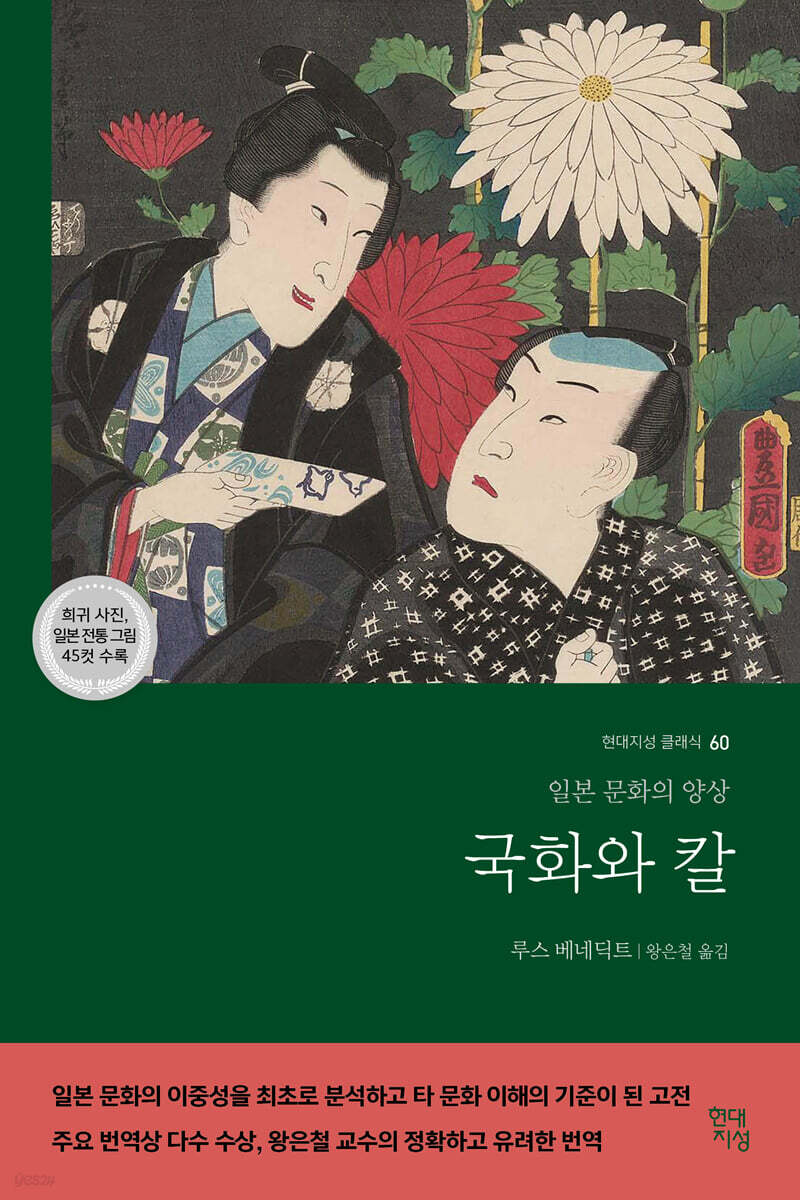
Chrysanthemum and sword
 |
Description
Book Introduction
First to analyze the duality of Japanese culture
Classics that became the standard for understanding other cultures
Professor Wang Eun-cheol, winner of many major translation awards
Accurate and fluent translation with a modern sensibility
* Bestseller in the US, China, and Japan, recommended by the New York Times
* Includes 45 color rare photos and traditional Japanese paintings.
* Essential background knowledge organized by chapter to aid understanding
In 1944, during the height of World War II, the U.S. government asked anthropologist Ruth Benedict to study Japanese culture.
At the time, Japan was the most unfamiliar and unpredictable enemy to the United States, so understanding Japanese behavior patterns was necessary to deal with it effectively.
Although unable to conduct field research due to the war, Benedict developed a remarkable analysis of Japanese culture through extensive research and the assistance of Japanese residents in the United States.
His research, which penetrated core principles with sharp insight, had a decisive influence on the United States' postwar occupation policy in Japan.
The result was published in 1946 as “The Chrysanthemum and the Sword,” which caused a great stir, selling over 2.5 million copies in the United States and Japan.
Benedict presented the 'chrysanthemum' and the 'sword' as symbols that encapsulate the duality inherent in Japanese culture.
At the time, the United States viewed Japan as a confusing and incomprehensible country.
They were polite yet rude, obedient yet difficult to control, loyal yet easily betrayed.
Benedict logically analyzed the principles that establish such dual behavior patterns in the Japanese value system and thoroughly investigated the historical context in which these principles were formed.
Benedict's concepts of 'on', 'kimu', and 'giri' are still the main concepts that form the basis for analyzing Japanese culture.
"The Chrysanthemum and the Sword" presents an exemplary attitude and methodology for studying the culture of others, different from our own.
The intellectual attitude that respects cultural relativity and seeks to objectively understand other cultures without falling into prejudice is the highlight of this book.
In an age where the world is increasingly interconnected and cultural exchanges with others are inevitable, we can still glean brilliant insights and lessons from this book.
The modern intellectual classic 『Chrysanthemum and the Sword』 was translated by Professor Wang Eun-cheol, winner of numerous prestigious translation awards, including the Yu Young Translation Award.
While remaining faithful to the logic and structure of the original text, the author's literary style, as a poet, was also brought to life.
To vividly illustrate the historical background and context, 45 traditional Japanese paintings and rare photographs are included in color, and essential background information is organized by chapter to aid understanding.
Classics that became the standard for understanding other cultures
Professor Wang Eun-cheol, winner of many major translation awards
Accurate and fluent translation with a modern sensibility
* Bestseller in the US, China, and Japan, recommended by the New York Times
* Includes 45 color rare photos and traditional Japanese paintings.
* Essential background knowledge organized by chapter to aid understanding
In 1944, during the height of World War II, the U.S. government asked anthropologist Ruth Benedict to study Japanese culture.
At the time, Japan was the most unfamiliar and unpredictable enemy to the United States, so understanding Japanese behavior patterns was necessary to deal with it effectively.
Although unable to conduct field research due to the war, Benedict developed a remarkable analysis of Japanese culture through extensive research and the assistance of Japanese residents in the United States.
His research, which penetrated core principles with sharp insight, had a decisive influence on the United States' postwar occupation policy in Japan.
The result was published in 1946 as “The Chrysanthemum and the Sword,” which caused a great stir, selling over 2.5 million copies in the United States and Japan.
Benedict presented the 'chrysanthemum' and the 'sword' as symbols that encapsulate the duality inherent in Japanese culture.
At the time, the United States viewed Japan as a confusing and incomprehensible country.
They were polite yet rude, obedient yet difficult to control, loyal yet easily betrayed.
Benedict logically analyzed the principles that establish such dual behavior patterns in the Japanese value system and thoroughly investigated the historical context in which these principles were formed.
Benedict's concepts of 'on', 'kimu', and 'giri' are still the main concepts that form the basis for analyzing Japanese culture.
"The Chrysanthemum and the Sword" presents an exemplary attitude and methodology for studying the culture of others, different from our own.
The intellectual attitude that respects cultural relativity and seeks to objectively understand other cultures without falling into prejudice is the highlight of this book.
In an age where the world is increasingly interconnected and cultural exchanges with others are inevitable, we can still glean brilliant insights and lessons from this book.
The modern intellectual classic 『Chrysanthemum and the Sword』 was translated by Professor Wang Eun-cheol, winner of numerous prestigious translation awards, including the Yu Young Translation Award.
While remaining faithful to the logic and structure of the original text, the author's literary style, as a poet, was also brought to life.
To vividly illustrate the historical background and context, 45 traditional Japanese paintings and rare photographs are included in color, and essential background information is organized by chapter to aid understanding.
- You can preview some of the book's contents.
Preview
index
Acknowledgements
Chapter 1 Research Projects - Japan
Chapter 2 Japanese during the war
Chapter 3: Finding the Right Position
Chapter 4: The Meiji Restoration
Chapter 5: Debtors to the Times and the World
Chapter 6: Paying Back a Ten Thousandth
Chapter 7: The 'Most Difficult' Repayment
Chapter 8: Washing the Stigma
Chapter 9: The Realm of Recognition
Chapter 10: The Dilemma of Virtue
Chapter 11 Self-Discipline
Chapter 12: The Child Learns
Chapter 13: The Japanese After Surrender
Unpacking: The Humanistic Imagination of Anthropologists
annual report
Chapter 1 Research Projects - Japan
Chapter 2 Japanese during the war
Chapter 3: Finding the Right Position
Chapter 4: The Meiji Restoration
Chapter 5: Debtors to the Times and the World
Chapter 6: Paying Back a Ten Thousandth
Chapter 7: The 'Most Difficult' Repayment
Chapter 8: Washing the Stigma
Chapter 9: The Realm of Recognition
Chapter 10: The Dilemma of Virtue
Chapter 11 Self-Discipline
Chapter 12: The Child Learns
Chapter 13: The Japanese After Surrender
Unpacking: The Humanistic Imagination of Anthropologists
annual report
Detailed image

Into the book
In the 75 years since Japan opened its doors to the world, the Japanese have been described nine times out of ten with the outrageous adjective "but also."
It was an expression that had never been used by any citizen of any country in the world.
No serious observer, when writing about the people of a country other than Japan, would describe them as exceptionally polite and then add, “But they are also rude and arrogant.”
If we were to say that the people of a certain country are extremely rigid, we would not add, “But they are also easily amenable to radical reforms.”
---From "Chapter 1: Research Projects - Japan"
To understand the Japanese, we must first understand how they themselves think about the phrase "finding the right place."
Their belief in order and hierarchy is completely at odds with our beliefs in freedom and equality.
It is difficult for us to accept hierarchy as a major social device.
Japan's belief in hierarchy underlies its holistic concept of human relationships and the relationship between individuals and the state.
To understand their outlook on life, we must examine institutions such as family, state, religion, and economic life.
---From "Chapter 3: Finding the Right Place"
In this way, the Japanese have established their own order by taking hierarchy into consideration.
Even within families and in relationships between individuals, behaviors appropriate to age, generation, gender, and class are established.
In government, religion, the military, and industry, territories are carefully divided along class lines, and anyone who transgresses the privileges granted to them is punished, regardless of whether they belong to the upper or lower classes.
When the 'right place' is maintained, Japanese people feel safe and live without complaints.
Of course, it is not 'safe' because the best is protected, but rather because the hierarchy is accepted as legitimate.
This is a characteristic that can be seen in the Japanese outlook on life.
Just as belief in the principles of equality and free enterprise is a hallmark of the American way of life.
---From "Chapter 4: The Meiji Restoration"
'On' means heavy burden, debt, or burden.
Individuals receive warmth from their superiors.
When someone who is not a superior or at least of equal status receives a compliment, one feels an unpleasant sense of inferiority.
If someone says, "I am wearing a hat to him," it should be understood to mean, "I feel a great obligation to him."
They call these creditors, or people who have shown favor, 'onjin' (恩人).
---From "Chapter 5: Debtors to the Times and the World"
The Japanese divide the repayment of money into two areas with different rules.
One is to repay what you have received within the given time limit.
Giving back endless kindness is called 'Kimu' (duty), and the Japanese say about this, "You cannot repay even one ten-thousandth of the kindness you received."
Kimu is a word that refers to both ‘go’ (孝: filial piety) which repays the favor to one’s parents and ‘ju’ (忠: loyalty) which repays the favor to the emperor.
These two are mandatory for everyone.
In fact, Japanese elementary school education is called "Kimu Education," and there is no other word that so aptly expresses the fact that Kimu means "duty."
Although the details of the gimu may change due to the contingencies of life, the gimu is something that everyone automatically carries and transcends all contingencies.
---From "Paying Back a Ten Thousandth of Chapter 6"
There is a proverb in Japan that goes like this:
“There is nothing harder to bear than a debt.” Just as one must do one’s duty, one must also repay debt.
Girim is a duty with a different nature from Gimu.
There is no word for giri in English.
Among the bizarre categories of moral obligations that anthropologists have discovered in various cultures, honoring is one of the most intriguing concepts and a uniquely Japanese creation.
'Ju' (loyalty) and 'go' (filial piety) are virtues shared with China, and although Japan has modified the two concepts, similar moral principles can be found in other Eastern countries.
However, Kiri was not accepted from Chinese Confucianism, nor has it any relation to Eastern Buddhism.
It is a concept unique to Japan.
Their actions cannot be understood without explaining the giri.
Whenever the Japanese talk about motivation, fame, or the dilemmas faced by people in their own country, they always mention giri.
---From Chapter 7, "The Most Difficult to Endure"
She was a scholar with the convictions of a scientist and at the same time the convictions of a humanist.
This can be confirmed in her next words:
“I have the faith of a scientist.
No matter how unfamiliar a behavior may seem to us, if we state the problem accurately, we can obtain answers through research and then study it in a technically sound manner.
I also have the beliefs of a humanist.
“I believe that promoting mutual understanding among people is beneficial.” She was able to achieve almost unparalleled academic achievements in a short life because she was both a scientist and a humanist.
It was an expression that had never been used by any citizen of any country in the world.
No serious observer, when writing about the people of a country other than Japan, would describe them as exceptionally polite and then add, “But they are also rude and arrogant.”
If we were to say that the people of a certain country are extremely rigid, we would not add, “But they are also easily amenable to radical reforms.”
---From "Chapter 1: Research Projects - Japan"
To understand the Japanese, we must first understand how they themselves think about the phrase "finding the right place."
Their belief in order and hierarchy is completely at odds with our beliefs in freedom and equality.
It is difficult for us to accept hierarchy as a major social device.
Japan's belief in hierarchy underlies its holistic concept of human relationships and the relationship between individuals and the state.
To understand their outlook on life, we must examine institutions such as family, state, religion, and economic life.
---From "Chapter 3: Finding the Right Place"
In this way, the Japanese have established their own order by taking hierarchy into consideration.
Even within families and in relationships between individuals, behaviors appropriate to age, generation, gender, and class are established.
In government, religion, the military, and industry, territories are carefully divided along class lines, and anyone who transgresses the privileges granted to them is punished, regardless of whether they belong to the upper or lower classes.
When the 'right place' is maintained, Japanese people feel safe and live without complaints.
Of course, it is not 'safe' because the best is protected, but rather because the hierarchy is accepted as legitimate.
This is a characteristic that can be seen in the Japanese outlook on life.
Just as belief in the principles of equality and free enterprise is a hallmark of the American way of life.
---From "Chapter 4: The Meiji Restoration"
'On' means heavy burden, debt, or burden.
Individuals receive warmth from their superiors.
When someone who is not a superior or at least of equal status receives a compliment, one feels an unpleasant sense of inferiority.
If someone says, "I am wearing a hat to him," it should be understood to mean, "I feel a great obligation to him."
They call these creditors, or people who have shown favor, 'onjin' (恩人).
---From "Chapter 5: Debtors to the Times and the World"
The Japanese divide the repayment of money into two areas with different rules.
One is to repay what you have received within the given time limit.
Giving back endless kindness is called 'Kimu' (duty), and the Japanese say about this, "You cannot repay even one ten-thousandth of the kindness you received."
Kimu is a word that refers to both ‘go’ (孝: filial piety) which repays the favor to one’s parents and ‘ju’ (忠: loyalty) which repays the favor to the emperor.
These two are mandatory for everyone.
In fact, Japanese elementary school education is called "Kimu Education," and there is no other word that so aptly expresses the fact that Kimu means "duty."
Although the details of the gimu may change due to the contingencies of life, the gimu is something that everyone automatically carries and transcends all contingencies.
---From "Paying Back a Ten Thousandth of Chapter 6"
There is a proverb in Japan that goes like this:
“There is nothing harder to bear than a debt.” Just as one must do one’s duty, one must also repay debt.
Girim is a duty with a different nature from Gimu.
There is no word for giri in English.
Among the bizarre categories of moral obligations that anthropologists have discovered in various cultures, honoring is one of the most intriguing concepts and a uniquely Japanese creation.
'Ju' (loyalty) and 'go' (filial piety) are virtues shared with China, and although Japan has modified the two concepts, similar moral principles can be found in other Eastern countries.
However, Kiri was not accepted from Chinese Confucianism, nor has it any relation to Eastern Buddhism.
It is a concept unique to Japan.
Their actions cannot be understood without explaining the giri.
Whenever the Japanese talk about motivation, fame, or the dilemmas faced by people in their own country, they always mention giri.
---From Chapter 7, "The Most Difficult to Endure"
She was a scholar with the convictions of a scientist and at the same time the convictions of a humanist.
This can be confirmed in her next words:
“I have the faith of a scientist.
No matter how unfamiliar a behavior may seem to us, if we state the problem accurately, we can obtain answers through research and then study it in a technically sound manner.
I also have the beliefs of a humanist.
“I believe that promoting mutual understanding among people is beneficial.” She was able to achieve almost unparalleled academic achievements in a short life because she was both a scientist and a humanist.
---From "Anthropologist's Humanistic Imagination"
Publisher's Review
The ultimate answer to the question, "Why Japan?"
A starting point for studying Japanese culture and a timeless must-read.
Japan is geographically close to Korea, and historically, there has been a constant cycle of hostility and cooperation.
Culturally, there are many familiar and similar aspects, but there are also aspects that are so unfamiliar and different that it is impossible to understand.
Korea may be the country that most frequently asks the question, "Why is Japan like that?"
How should we understand Japan, a nation that displays boundless humility and kindness, yet at times reverts to militarism and denounces Korea? "The Chrysanthemum and the Sword" is a book that should serve as a starting point for answering these questions.
"The Chrysanthemum and the Sword" was a research report commissioned by the United States, which was fighting the Pacific War with Japan, to anthropologist Ruth Benedict to efficiently carry out the war and postwar occupation.
However, it has now become a must-read for scholars studying Japan or anyone interested in Japan.
How did research conducted for the national interest of a nation under the unique circumstances of wartime come to be recognized as a classic read worldwide, nearly 80 years later? In this book, Ruth Benedict accurately portrays aspects of Japanese culture and its underlying core principles.
The concepts of on (恩: grace), giri (義理: righteousness), and kimu (義務: duty) that Benedict discovered are still the main concepts that form the basis for interpreting Japanese culture today.
But the value of this book doesn't stop at simply providing a deep understanding of Japanese culture.
This book, which is considered a masterpiece that raised the level of the academic discipline of cultural anthropology to a new level, presents an exemplary standard for studying other cultures.
Especially in modern society, where the entire world is closely connected and constantly interacting, these standards are more important than ever.
In today's world, where encountering cultural strangers has become so commonplace, the intellectual attitude Ruth Benedict demonstrates in this book has become a fundamental skill not only for researchers of Japanese culture but also for modern people.
The greatest virtues of "The Chrysanthemum and the Sword" are its wariness of prejudice, its respect for cultural relativity, and its attitude of seeking deep understanding with good intentions.
The Hidden Meaning of 'Chrysanthemum' and 'Knife'
From contradictory duality to sustainable symbolism
Ruth Benedict delves into the seemingly duplicitous nature of Japanese behavior and the consistent core principles underlying it.
Chapters 2 through 4 analyze the hierarchical order consciousness unique to Japanese culture, presented as the concept of 'finding the right place.'
From the feudal era to the Meiji Restoration and the war-torn empire, we examine how the hierarchical order internalized by the Japanese was formed and applied to the logic of waging war.
It also explains the behavior of the Japanese military, which carried out suicide attacks called 'Kamikaze' and fought without fear of death.
Chapters 5 through 8 use the concepts of 'on', 'kimu', and 'giri' to understand that all relationships surrounding an individual are formed based on a sense of debt. Chapters 9 through 12 then reveal that the shame (haji) that is imposed on an individual as a result of this is one of the core principles that constitute Japanese culture.
At the end of Chapter 12, we can interpret the meaning contained in the symbols of 'chrysanthemum' and 'sword' in a multi-layered way.
For the Japanese, the 'sword' is not simply a symbol of force and aggression.
The Japanese compare their bodies to 'swords' and emphasize the 'responsibility to keep them from rusting', meaning that just as a warrior has the responsibility to keep his sword shiny, a human being must accept responsibility for the consequences of his actions.
In other words, the sword is also a symbol of self-responsibility.
'Chrysanthemum' also expands its meaning by referring to Japan's unique garden management and chrysanthemum cultivation techniques.
The Japanese gardening technique of carefully selecting even the most delicate rocks to place in the garden and camouflaging them with nature, as well as the chrysanthemum cultivation technique of adding wire to shape them, signify the binding force of shame that permeates Japanese culture.
The author, who interpreted these two symbols in this multi-layered way, emphasizes that the 'chrysanthemum' and the 'sword' can continue to be valid symbols for Japan's future after the war.
The chrysanthemum “can be beautiful even without the wire,” and the sword “is a symbol that can be kept even in a freer and more peaceful world.”
This intellectual attitude of respecting the culture of others while also interpreting it deeply with good intentions is what makes "The Chrysanthemum and the Sword" still relevant today.
"The Chrysanthemum and the Sword" in a modern, elegant translation
The definitive edition featuring rare images and essential background knowledge.
The 60th book in the Modern Intellect Classics series, “Chrysanthemum and the Sword,” was translated by Professor Wang Eun-cheol, winner of numerous prestigious translation awards, including the Yu Young Translation Award and the Korean English Language and Literature Association Academic Award.
We have taken great care to preserve the scientific yet literary narrative of Ruth Benedict, who was both an anthropologist and a poet.
The focus was on naturally conveying the unique literary style while remaining faithful to the logic and structure of the original text.
This translation can be said to best highlight the literary side of Ruth Benedict, which has been relatively understudied in previous Korean editions of 『The Chrysanthemum and the Sword』.
The contemporary intellectual classic, "Chrysanthemum and the Sword," is a definitive edition that bridges the gap of nearly 80 years since the original publication and is designed to be most accessible and friendly to Korean readers today.
A total of 45 color images are included, ranging from rare photographic materials depicting modern Japanese society and the Pacific War to traditional Ukiyo-e paintings that capture the essence of Japanese culture.
Additionally, for readers unfamiliar with Japanese culture and history, essential background information is provided at the beginning of each chapter to aid understanding.
It includes key concepts from the text, background historical knowledge, and descriptions of major characters and works.
Subheadings were added to the main text to improve readability and make it easier to understand the flow of the content.
You will be able to encounter the most recent version of 『Chrysanthemum and Sword』 with a translation and editing that reflects a modern sensibility.
A starting point for studying Japanese culture and a timeless must-read.
Japan is geographically close to Korea, and historically, there has been a constant cycle of hostility and cooperation.
Culturally, there are many familiar and similar aspects, but there are also aspects that are so unfamiliar and different that it is impossible to understand.
Korea may be the country that most frequently asks the question, "Why is Japan like that?"
How should we understand Japan, a nation that displays boundless humility and kindness, yet at times reverts to militarism and denounces Korea? "The Chrysanthemum and the Sword" is a book that should serve as a starting point for answering these questions.
"The Chrysanthemum and the Sword" was a research report commissioned by the United States, which was fighting the Pacific War with Japan, to anthropologist Ruth Benedict to efficiently carry out the war and postwar occupation.
However, it has now become a must-read for scholars studying Japan or anyone interested in Japan.
How did research conducted for the national interest of a nation under the unique circumstances of wartime come to be recognized as a classic read worldwide, nearly 80 years later? In this book, Ruth Benedict accurately portrays aspects of Japanese culture and its underlying core principles.
The concepts of on (恩: grace), giri (義理: righteousness), and kimu (義務: duty) that Benedict discovered are still the main concepts that form the basis for interpreting Japanese culture today.
But the value of this book doesn't stop at simply providing a deep understanding of Japanese culture.
This book, which is considered a masterpiece that raised the level of the academic discipline of cultural anthropology to a new level, presents an exemplary standard for studying other cultures.
Especially in modern society, where the entire world is closely connected and constantly interacting, these standards are more important than ever.
In today's world, where encountering cultural strangers has become so commonplace, the intellectual attitude Ruth Benedict demonstrates in this book has become a fundamental skill not only for researchers of Japanese culture but also for modern people.
The greatest virtues of "The Chrysanthemum and the Sword" are its wariness of prejudice, its respect for cultural relativity, and its attitude of seeking deep understanding with good intentions.
The Hidden Meaning of 'Chrysanthemum' and 'Knife'
From contradictory duality to sustainable symbolism
Ruth Benedict delves into the seemingly duplicitous nature of Japanese behavior and the consistent core principles underlying it.
Chapters 2 through 4 analyze the hierarchical order consciousness unique to Japanese culture, presented as the concept of 'finding the right place.'
From the feudal era to the Meiji Restoration and the war-torn empire, we examine how the hierarchical order internalized by the Japanese was formed and applied to the logic of waging war.
It also explains the behavior of the Japanese military, which carried out suicide attacks called 'Kamikaze' and fought without fear of death.
Chapters 5 through 8 use the concepts of 'on', 'kimu', and 'giri' to understand that all relationships surrounding an individual are formed based on a sense of debt. Chapters 9 through 12 then reveal that the shame (haji) that is imposed on an individual as a result of this is one of the core principles that constitute Japanese culture.
At the end of Chapter 12, we can interpret the meaning contained in the symbols of 'chrysanthemum' and 'sword' in a multi-layered way.
For the Japanese, the 'sword' is not simply a symbol of force and aggression.
The Japanese compare their bodies to 'swords' and emphasize the 'responsibility to keep them from rusting', meaning that just as a warrior has the responsibility to keep his sword shiny, a human being must accept responsibility for the consequences of his actions.
In other words, the sword is also a symbol of self-responsibility.
'Chrysanthemum' also expands its meaning by referring to Japan's unique garden management and chrysanthemum cultivation techniques.
The Japanese gardening technique of carefully selecting even the most delicate rocks to place in the garden and camouflaging them with nature, as well as the chrysanthemum cultivation technique of adding wire to shape them, signify the binding force of shame that permeates Japanese culture.
The author, who interpreted these two symbols in this multi-layered way, emphasizes that the 'chrysanthemum' and the 'sword' can continue to be valid symbols for Japan's future after the war.
The chrysanthemum “can be beautiful even without the wire,” and the sword “is a symbol that can be kept even in a freer and more peaceful world.”
This intellectual attitude of respecting the culture of others while also interpreting it deeply with good intentions is what makes "The Chrysanthemum and the Sword" still relevant today.
"The Chrysanthemum and the Sword" in a modern, elegant translation
The definitive edition featuring rare images and essential background knowledge.
The 60th book in the Modern Intellect Classics series, “Chrysanthemum and the Sword,” was translated by Professor Wang Eun-cheol, winner of numerous prestigious translation awards, including the Yu Young Translation Award and the Korean English Language and Literature Association Academic Award.
We have taken great care to preserve the scientific yet literary narrative of Ruth Benedict, who was both an anthropologist and a poet.
The focus was on naturally conveying the unique literary style while remaining faithful to the logic and structure of the original text.
This translation can be said to best highlight the literary side of Ruth Benedict, which has been relatively understudied in previous Korean editions of 『The Chrysanthemum and the Sword』.
The contemporary intellectual classic, "Chrysanthemum and the Sword," is a definitive edition that bridges the gap of nearly 80 years since the original publication and is designed to be most accessible and friendly to Korean readers today.
A total of 45 color images are included, ranging from rare photographic materials depicting modern Japanese society and the Pacific War to traditional Ukiyo-e paintings that capture the essence of Japanese culture.
Additionally, for readers unfamiliar with Japanese culture and history, essential background information is provided at the beginning of each chapter to aid understanding.
It includes key concepts from the text, background historical knowledge, and descriptions of major characters and works.
Subheadings were added to the main text to improve readability and make it easier to understand the flow of the content.
You will be able to encounter the most recent version of 『Chrysanthemum and Sword』 with a translation and editing that reflects a modern sensibility.
GOODS SPECIFICS
- Date of issue: January 6, 2025
- Page count, weight, size: 408 pages | 150*225*30mm
- ISBN13: 9791139718713
- ISBN10: 1139718711
You may also like
카테고리
korean


korean

![GQ KOREA Mark (Monthly): December [2025]](http://librairie.coreenne.fr/cdn/shop/files/8ef265dbbfbf186523ed75ba7319009d.jpg?v=1765340328&width=3840)


