

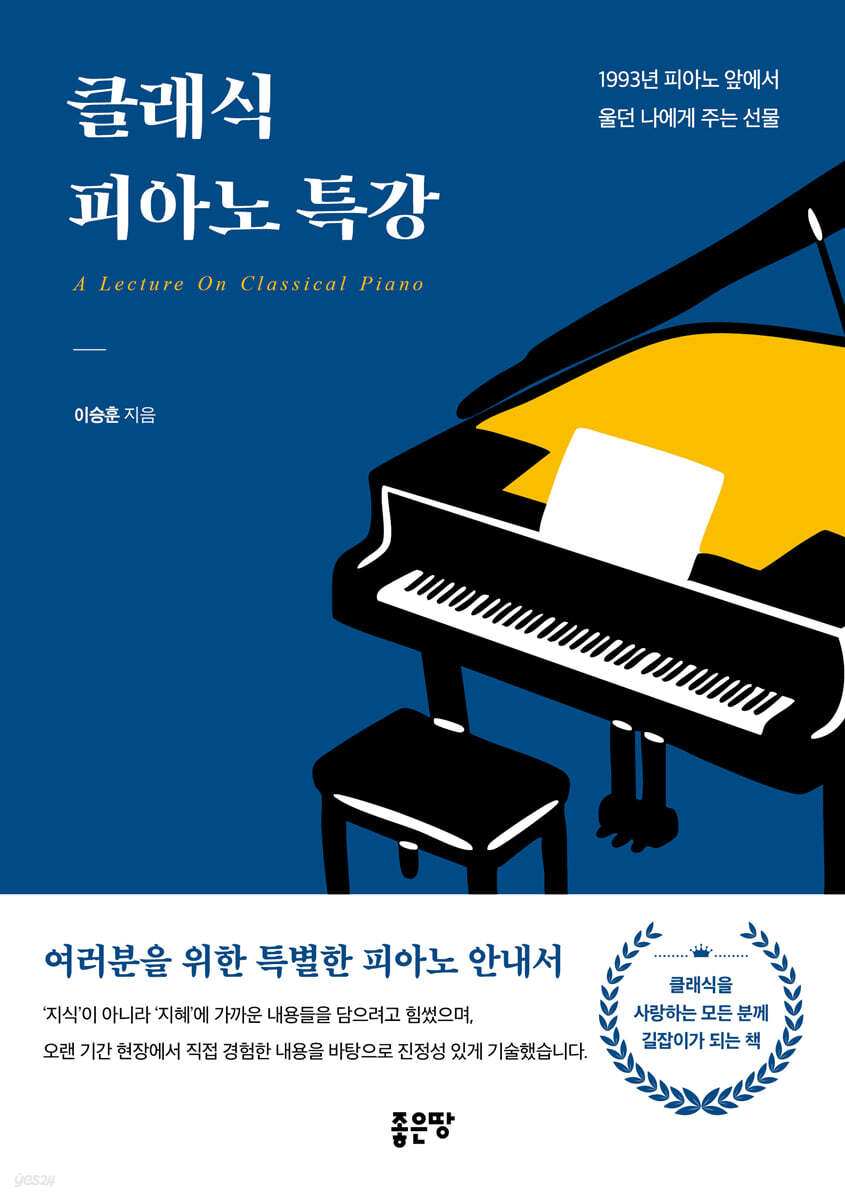
Classical Piano Special Lecture
 |
Description
Book Introduction
This book is an honest account of the author's journey to overcome the difficulties he encountered while practicing piano for over 30 years.
Even though the piano is a popular instrument, many people have difficulty learning it properly because, firstly, unlike other instruments, the only parts that touch the body are the fingertips, and secondly, the balance of the hands is always required while the instrument is moving.
Piano practice involves numerous variables, and delicately manipulating the keys requires a high level of sensitivity and precision.
Therefore, to effectively solve the various problems encountered on the piano, systematic knowledge, including the basic concepts of relaxation and touch, is essential.
As the title suggests, the newly published 'Classical Piano Special Lecture' can be considered a special piano guide for readers.
The author has carefully compiled the knowledge he has gained through long-term contemplation, reflection, and teaching about piano practice into a single book.
Anyone who studies or loves classical piano will deeply sympathize with this and find it a solid guide.
Even though the piano is a popular instrument, many people have difficulty learning it properly because, firstly, unlike other instruments, the only parts that touch the body are the fingertips, and secondly, the balance of the hands is always required while the instrument is moving.
Piano practice involves numerous variables, and delicately manipulating the keys requires a high level of sensitivity and precision.
Therefore, to effectively solve the various problems encountered on the piano, systematic knowledge, including the basic concepts of relaxation and touch, is essential.
As the title suggests, the newly published 'Classical Piano Special Lecture' can be considered a special piano guide for readers.
The author has carefully compiled the knowledge he has gained through long-term contemplation, reflection, and teaching about piano practice into a single book.
Anyone who studies or loves classical piano will deeply sympathize with this and find it a solid guide.
- You can preview some of the book's contents.
Preview
index
Book Introduction 4
Introduction 6
Part 1 Relaxation
About Part 1 Relaxation 18
01 Brain Stress We're Missing 19
02 Piano Masters Who Play Like Meditation 24
03 If you look at your hands for too long, your hands will get twisted. 29
04 All tension is caused by the spine being bent. 33
05 The Ultimate Spine Solution: "One-Line Walking" 40
06 All strength comes from the back 45
07 Zimmerman's posture and Radu Luf's backrest chair 49
08 A good performer's upper body responds to the music 55
09 Body pain is a signal to "slow down your breathing." 58
10 Strongest Breathing Solutions: Teeth Interlocking 63
Part 2 Touch
About Part 2 Touch Edition 70
01 The Beginning of the Piano Touch Mystery: "The Hand of Emil von Sauer" 71
02 The Concept of Proper Touch 83
03 Young Master Shishkin Talks About Piano Touch! 89
04 Touch Masters' Famous Phrases 97
05 Understanding Your Fingers Improves Your Touch 105
06 Q&A for Free Arms 112
Listen to Part 3
About Part 3 Listening 122
01 Hearing and Listening Are Different! 123
02 What is proper listening? 129
03 Do you know about the unilateral aspect? 134
04 Jo Seong-jin risks his life to listen, and Im Yun-chan asks with his heart 140
Part 4 Emotions
About Part 4, Emotions 146
01 Every smile makes movement better 147
02 Understanding Performance Anxiety 151
03 The brain interprets "like" as "important." 156
04 Mental and Thinking Style 160
05 About diet 168
Part 5 Practice Method
About Part 5 Practice Method 174
01 I practiced in my head and got into Seoul National University's piano department! 175
02 Miraculous Practice Method: "Tapping" 186
03 Beat 300% 194
04 Fingering and Ambo 200
05 Clear melody & good tone is metallic 206
06 Two Secrets to Good Sound Q&A 210
Closing remarks 214
Reference 217
Introduction 6
Part 1 Relaxation
About Part 1 Relaxation 18
01 Brain Stress We're Missing 19
02 Piano Masters Who Play Like Meditation 24
03 If you look at your hands for too long, your hands will get twisted. 29
04 All tension is caused by the spine being bent. 33
05 The Ultimate Spine Solution: "One-Line Walking" 40
06 All strength comes from the back 45
07 Zimmerman's posture and Radu Luf's backrest chair 49
08 A good performer's upper body responds to the music 55
09 Body pain is a signal to "slow down your breathing." 58
10 Strongest Breathing Solutions: Teeth Interlocking 63
Part 2 Touch
About Part 2 Touch Edition 70
01 The Beginning of the Piano Touch Mystery: "The Hand of Emil von Sauer" 71
02 The Concept of Proper Touch 83
03 Young Master Shishkin Talks About Piano Touch! 89
04 Touch Masters' Famous Phrases 97
05 Understanding Your Fingers Improves Your Touch 105
06 Q&A for Free Arms 112
Listen to Part 3
About Part 3 Listening 122
01 Hearing and Listening Are Different! 123
02 What is proper listening? 129
03 Do you know about the unilateral aspect? 134
04 Jo Seong-jin risks his life to listen, and Im Yun-chan asks with his heart 140
Part 4 Emotions
About Part 4, Emotions 146
01 Every smile makes movement better 147
02 Understanding Performance Anxiety 151
03 The brain interprets "like" as "important." 156
04 Mental and Thinking Style 160
05 About diet 168
Part 5 Practice Method
About Part 5 Practice Method 174
01 I practiced in my head and got into Seoul National University's piano department! 175
02 Miraculous Practice Method: "Tapping" 186
03 Beat 300% 194
04 Fingering and Ambo 200
05 Clear melody & good tone is metallic 206
06 Two Secrets to Good Sound Q&A 210
Closing remarks 214
Reference 217
Publisher's Review
Many people who have been learning the piano for a long time do not see any improvement in their skills or suffer from pain and tension while practicing.
'Classical Piano Special Lecture' starts from that very point.
Author Seunghoon Lee has taught countless students over the past 30 years and has found the cause of problems that arise during piano practice to be 'tension between the body and brain.'
And to solve this, we systematically organized the five axes of relaxation, touch, listening, emotion, and practice methods into a single guidebook.
This book is not just a simple piano textbook.
From the author's frustration with arm pain during his school days to the insights he gained while guiding thousands of students, this is a "history of trial and error in learning the piano" and a "record of a problem-solving exploration."
He emphasizes that the secret to playing the piano well is not the strength of the fingertips, but the correct posture, comfortable breathing, and balanced emotions.
So, Part 1, 'Relaxation', deals with the spine, breathing, and eye tension, and Part 2, 'Touch', analyzes the hands and senses of the world's greatest piano players.
Next, in 'Listening' and 'Emotions', the influence of listening and state of mind on performance ability is discussed, and finally, in 'Practice Methods', specific practice methods and secrets of memorization are presented.
In particular, ‘brain stress’, ‘spine balance’, and ‘the feeling of playing as if meditating’ are unique contents that are difficult to find in existing piano education books.
It stands out for breaking away from the traditional learning method that focused solely on piano technique and focusing on understanding and tuning the performer himself.
The relaxation principles and touch concepts that the author learned through his own experience can be called 'the world's first physical approach to piano.'
'Classical Piano Special Lecture' is a book for elementary school students, major students, lecturers, parents, and everyone who loves classical piano.
It will help those learning the piano to no longer be stopped by pain and frustration, and readers will realize that piano is not just a technique, but 'the art of restoring balance to life.'
Practice will become a meditation rather than a pain, and it will provide a special experience of understanding yourself in front of the piano.
'Classical Piano Special Lecture' starts from that very point.
Author Seunghoon Lee has taught countless students over the past 30 years and has found the cause of problems that arise during piano practice to be 'tension between the body and brain.'
And to solve this, we systematically organized the five axes of relaxation, touch, listening, emotion, and practice methods into a single guidebook.
This book is not just a simple piano textbook.
From the author's frustration with arm pain during his school days to the insights he gained while guiding thousands of students, this is a "history of trial and error in learning the piano" and a "record of a problem-solving exploration."
He emphasizes that the secret to playing the piano well is not the strength of the fingertips, but the correct posture, comfortable breathing, and balanced emotions.
So, Part 1, 'Relaxation', deals with the spine, breathing, and eye tension, and Part 2, 'Touch', analyzes the hands and senses of the world's greatest piano players.
Next, in 'Listening' and 'Emotions', the influence of listening and state of mind on performance ability is discussed, and finally, in 'Practice Methods', specific practice methods and secrets of memorization are presented.
In particular, ‘brain stress’, ‘spine balance’, and ‘the feeling of playing as if meditating’ are unique contents that are difficult to find in existing piano education books.
It stands out for breaking away from the traditional learning method that focused solely on piano technique and focusing on understanding and tuning the performer himself.
The relaxation principles and touch concepts that the author learned through his own experience can be called 'the world's first physical approach to piano.'
'Classical Piano Special Lecture' is a book for elementary school students, major students, lecturers, parents, and everyone who loves classical piano.
It will help those learning the piano to no longer be stopped by pain and frustration, and readers will realize that piano is not just a technique, but 'the art of restoring balance to life.'
Practice will become a meditation rather than a pain, and it will provide a special experience of understanding yourself in front of the piano.
GOODS SPECIFICS
- Date of issue: October 7, 2025
- Page count, weight, size: 220 pages | 148*210*20mm
- ISBN13: 9791138847940
- ISBN10: 1138847941
You may also like
카테고리
korean


korean

![GQ KOREA Mark (Monthly): December [2025]](http://librairie.coreenne.fr/cdn/shop/files/8ef265dbbfbf186523ed75ba7319009d.jpg?v=1765340328&width=3840)


