

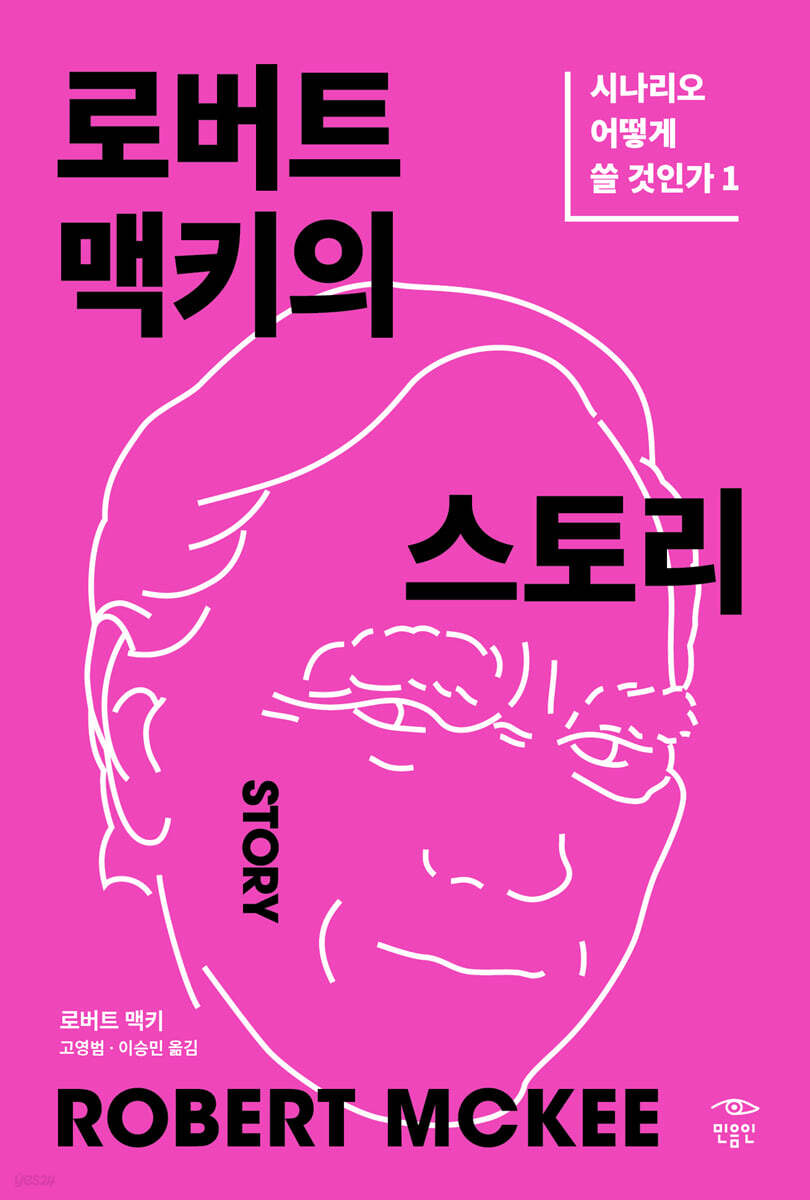
Robert McKee's story
 |
Description
Book Introduction
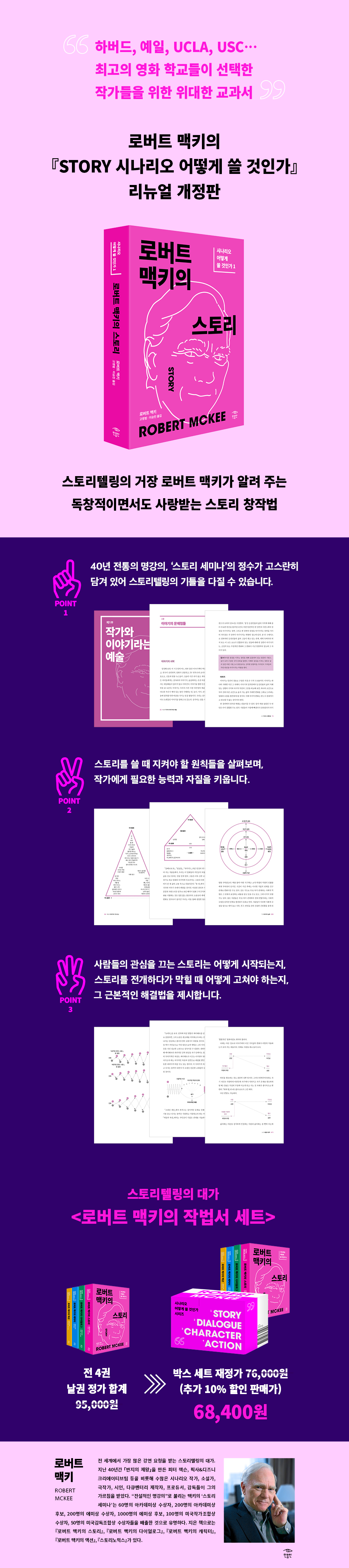
“Harvard, Yale, UCLA, USC…
Chosen by the best film schools
A great textbook for writers!
Robert McKee's "STORY: How to Write a Screenplay"
Renewal Revised Edition
Since its first publication in Korea in 2002, over 100,000 copies have been sold, and 『STORY: How to Write a Screenplay』, which has been recognized as a canon in the field of writing, has been revised and published by Minumsa under the new title 『Robert McKee's Story (original title: STORY)』.
We corrected incorrect translations, refined the text with modern terminology and sentence structure, and redesigned it to meet readers again.
The author of this book, Robert McKee, is a master of storytelling who is most requested to give lectures around the world and has taught numerous screenwriters, novelists, playwrights, producers, and directors, including Peter Jackson of "The Lord of the Rings" and the creative teams at Pixar and Disney.
In particular, his seminars, which are called “legendary lectures,” are famous for having produced 60 Academy Award winners, 200 Academy Award nominees, 200 Emmy Award winners, 1,000 Emmy Award nominees, 100 Writers Guild of America Award winners, and 50 Directors Guild of America Award winners to date.
"Robert McKee's Story" is a book that compiles everything about storytelling that Robert McKee has taught through his "Story Seminar."
Since its publication in the United States in 1997, it has been recognized as a canon on screenwriting, and has been used as a textbook at film schools such as Harvard, Yale, UCLA, and USC, and continues to be a bestseller to this day.
It provides fundamental insight into storytelling and reveals the power of storytelling, while systematically explaining practical guidelines such as principles to follow when creating stories, methods for resolving difficulties encountered during the creative process, and the abilities and qualities required of a writer.
Chosen by the best film schools
A great textbook for writers!
Robert McKee's "STORY: How to Write a Screenplay"
Renewal Revised Edition
Since its first publication in Korea in 2002, over 100,000 copies have been sold, and 『STORY: How to Write a Screenplay』, which has been recognized as a canon in the field of writing, has been revised and published by Minumsa under the new title 『Robert McKee's Story (original title: STORY)』.
We corrected incorrect translations, refined the text with modern terminology and sentence structure, and redesigned it to meet readers again.
The author of this book, Robert McKee, is a master of storytelling who is most requested to give lectures around the world and has taught numerous screenwriters, novelists, playwrights, producers, and directors, including Peter Jackson of "The Lord of the Rings" and the creative teams at Pixar and Disney.
In particular, his seminars, which are called “legendary lectures,” are famous for having produced 60 Academy Award winners, 200 Academy Award nominees, 200 Emmy Award winners, 1,000 Emmy Award nominees, 100 Writers Guild of America Award winners, and 50 Directors Guild of America Award winners to date.
"Robert McKee's Story" is a book that compiles everything about storytelling that Robert McKee has taught through his "Story Seminar."
Since its publication in the United States in 1997, it has been recognized as a canon on screenwriting, and has been used as a textbook at film schools such as Harvard, Yale, UCLA, and USC, and continues to be a bestseller to this day.
It provides fundamental insight into storytelling and reveals the power of storytelling, while systematically explaining practical guidelines such as principles to follow when creating stories, methods for resolving difficulties encountered during the creative process, and the abilities and qualities required of a writer.
- You can preview some of the book's contents.
Preview
index
Part 1: The Art of Storytelling and the Author
Introduction - 9
Chapter 1: Problems with the Story - 22
Part 2: Elements of the Story
Spectrum of Chapter 2 Structure - 57
Chapter 3 Structure and Setting - 111
Chapter 4 Structure and Genre - 130
Chapter 5: Structure and Character Personalities - 162
Chapter 6 Structure and Meaning - 178
Part 3: Principles of Story Composition
Chapter 7: The Real Story - 217
Chapter 8: Provocative Incidents - 273
Chapter 9: Chapter Design - 316
Chapter 10 Scene Design - 350
Chapter 11 Scene Analysis - 378
Chapter 12 - 421
Chapter 13: Crisis, Climax, and Conclusion - 443
Part 4: The Author's Work
Chapter 14: The Principle of Confrontation - 463
Chapter 15 Commentary - 485
Chapter 16 Questions and Answers - 503
Chapter 17 Characters - 544
Chapter 18 Text - 564
Chapter 19: The Writer's Way - 594
Conclusion - 606
Appendix - 609
Translator's Note - 663
Introduction - 9
Chapter 1: Problems with the Story - 22
Part 2: Elements of the Story
Spectrum of Chapter 2 Structure - 57
Chapter 3 Structure and Setting - 111
Chapter 4 Structure and Genre - 130
Chapter 5: Structure and Character Personalities - 162
Chapter 6 Structure and Meaning - 178
Part 3: Principles of Story Composition
Chapter 7: The Real Story - 217
Chapter 8: Provocative Incidents - 273
Chapter 9: Chapter Design - 316
Chapter 10 Scene Design - 350
Chapter 11 Scene Analysis - 378
Chapter 12 - 421
Chapter 13: Crisis, Climax, and Conclusion - 443
Part 4: The Author's Work
Chapter 14: The Principle of Confrontation - 463
Chapter 15 Commentary - 485
Chapter 16 Questions and Answers - 503
Chapter 17 Characters - 544
Chapter 18 Text - 564
Chapter 19: The Writer's Way - 594
Conclusion - 606
Appendix - 609
Translator's Note - 663
Detailed image
Into the book
This book is about principles, not rules.
The rule says, 'You must do it this way.'
The principle says, 'This method works... and has always worked as far back as memory can tell.'
There is a significant difference between these two.
Your work should not be a copy of a well-made work, but should be well-made within the principles that embody our art.
Inexperienced and impatient writers obey the rules.
Rebellious and unschooled writers break the rules.
Artists master form.
--- p.9
This book is about thoroughness, not shortcuts.
It takes about the same amount of time to finish a screenplay from idea to manuscript as it does to write a novel.
Writers who work with images and writers who work with prose deal with worlds, characters, and stories of the same density.
However, simply because there is so much more white space in a screenplay written on paper, screenwriting is often misunderstood as something easier and quicker to complete than writing a novel.
But while third-rate novelists are filling pages as fast as their hands can keep up, screenwriters are mercilessly editing and editing in their heads to express the maximum with the fewest words.
--- p.13
This book is not meant to belittle its audience, but to respect it.
When talented writers write bad work, there are usually one or two reasons.
Either you are blinded by an obsession with expressing certain thoughts, or you are swayed by a certain emotional state that you absolutely must express.
When talented writers produce good work, there are usually reasons for this:
The desire to move the audience is what drives the writer.
--- p.16
I still believe that art changes lives.
But what I also know is that if you can't play all the instruments in the orchestra of your story, you're doomed to just mumble the same old tunes, no matter what music you have in your imagination.
I wrote this book to empower you to use your craft freely, to free you to express your unique perspective on life, and to elevate your talents beyond the conventional to create films of exceptional content, structure, and style.
--- p.20~21
If someone wants to compose a symphony, they will naturally go to music school and study the theory and practice of the symphony genre.
Only after years of hard study will you finally be able to pool your knowledge and creativity and muster the courage to actually take the risk of writing a song.
Too many aspiring screenwriters never even suspect that writing a good screenplay might be as difficult as, or sometimes even more difficult than, composing a symphony.
The reason writing a good screenplay is difficult is that while composers base their compositions on the mathematical purity of notes, screenwriters have to delve into the chaos called human nature.
--- p.30
There must be a love of story, a belief that the writer's vision can only be expressed through story, a belief that characters can be more real than real people, and a belief that the fictional world is more fundamental than the real one.
--- p.39
When an event occurs, it upsets the balance of the protagonist's life, either for good or for bad.
This causes the protagonist to develop a conscious and unconscious desire to restore the broken balance of life, and the protagonist pursues the object of his desire while confronting all the hostile forces (internal, personal, and transpersonal) that stand in his way.
The protagonist may or may not achieve his goal.
This process is simply called 'storytelling'.
--- p.298
Write every day, line by line, page by page, hour by hour.
Always keep this book close at hand.
Use what you learn in this book as a guide until the principles become as natural to you as your natural talents.
Even if you're scared, do it.
More than anything else, what the world demands of writers is courage, more than imagination and skill.
It is the courage to face rejection, ridicule, and failure.
Explore carefully, but write boldly, adventuring in search of meaningful and beautifully written stories.
Then, like the protagonist of that fable, you will dance a dance that will dazzle the world.
The rule says, 'You must do it this way.'
The principle says, 'This method works... and has always worked as far back as memory can tell.'
There is a significant difference between these two.
Your work should not be a copy of a well-made work, but should be well-made within the principles that embody our art.
Inexperienced and impatient writers obey the rules.
Rebellious and unschooled writers break the rules.
Artists master form.
--- p.9
This book is about thoroughness, not shortcuts.
It takes about the same amount of time to finish a screenplay from idea to manuscript as it does to write a novel.
Writers who work with images and writers who work with prose deal with worlds, characters, and stories of the same density.
However, simply because there is so much more white space in a screenplay written on paper, screenwriting is often misunderstood as something easier and quicker to complete than writing a novel.
But while third-rate novelists are filling pages as fast as their hands can keep up, screenwriters are mercilessly editing and editing in their heads to express the maximum with the fewest words.
--- p.13
This book is not meant to belittle its audience, but to respect it.
When talented writers write bad work, there are usually one or two reasons.
Either you are blinded by an obsession with expressing certain thoughts, or you are swayed by a certain emotional state that you absolutely must express.
When talented writers produce good work, there are usually reasons for this:
The desire to move the audience is what drives the writer.
--- p.16
I still believe that art changes lives.
But what I also know is that if you can't play all the instruments in the orchestra of your story, you're doomed to just mumble the same old tunes, no matter what music you have in your imagination.
I wrote this book to empower you to use your craft freely, to free you to express your unique perspective on life, and to elevate your talents beyond the conventional to create films of exceptional content, structure, and style.
--- p.20~21
If someone wants to compose a symphony, they will naturally go to music school and study the theory and practice of the symphony genre.
Only after years of hard study will you finally be able to pool your knowledge and creativity and muster the courage to actually take the risk of writing a song.
Too many aspiring screenwriters never even suspect that writing a good screenplay might be as difficult as, or sometimes even more difficult than, composing a symphony.
The reason writing a good screenplay is difficult is that while composers base their compositions on the mathematical purity of notes, screenwriters have to delve into the chaos called human nature.
--- p.30
There must be a love of story, a belief that the writer's vision can only be expressed through story, a belief that characters can be more real than real people, and a belief that the fictional world is more fundamental than the real one.
--- p.39
When an event occurs, it upsets the balance of the protagonist's life, either for good or for bad.
This causes the protagonist to develop a conscious and unconscious desire to restore the broken balance of life, and the protagonist pursues the object of his desire while confronting all the hostile forces (internal, personal, and transpersonal) that stand in his way.
The protagonist may or may not achieve his goal.
This process is simply called 'storytelling'.
--- p.298
Write every day, line by line, page by page, hour by hour.
Always keep this book close at hand.
Use what you learn in this book as a guide until the principles become as natural to you as your natural talents.
Even if you're scared, do it.
More than anything else, what the world demands of writers is courage, more than imagination and skill.
It is the courage to face rejection, ridicule, and failure.
Explore carefully, but write boldly, adventuring in search of meaningful and beautifully written stories.
Then, like the protagonist of that fable, you will dance a dance that will dazzle the world.
--- p.608
GOODS SPECIFICS
- Date of issue: September 25, 2024
- Page count, weight, size: 668 pages | 848g | 152*225*33mm
- ISBN13: 9791170524533
- ISBN10: 1170524532
You may also like
카테고리
korean


korean

![GQ KOREA Mark (Monthly): December [2025]](http://librairie.coreenne.fr/cdn/shop/files/8ef265dbbfbf186523ed75ba7319009d.jpg?v=1765340328&width=3840)


