

Salon de Gyeongseong 2
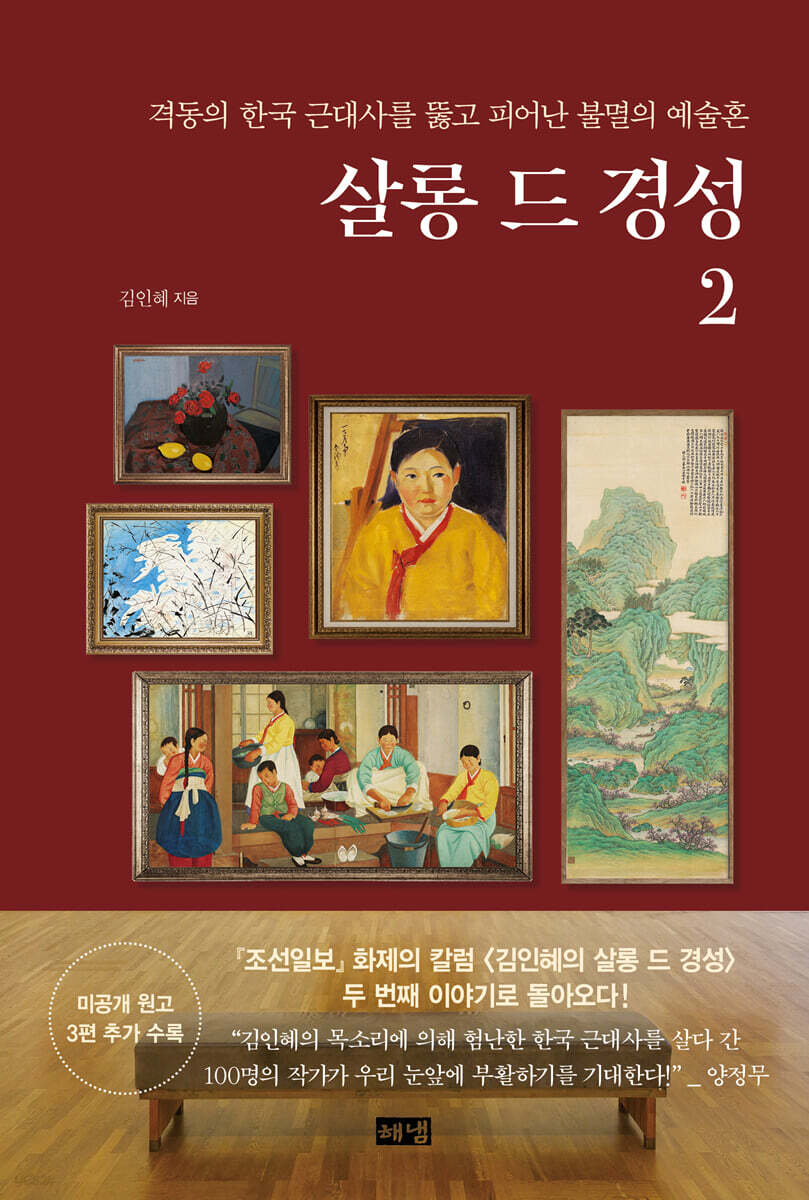 |
Description
Book Introduction
From Lee Sang-beom, who attempted to transform Korean painting, to Cheon Gyeong-ja, who was an icon of the times,
From Nam Kwan, a successful artist in Paris, to the master of abstract art, Yun Hyung-geun
An exhibition of modern Korean painters spanning a century
Korean modern art is emerging as something 'cool' among the younger generation.
Since the opening of the Lee Kun-hee Collection in 2021, exhibitions of modern artists such as Lee Ungno, Jang Wook-jin, and Won Kye-hong have become a popular attraction, and local art museums are also seeing an increase in visitors.
Public interest in modern Korean art has become an important phenomenon, transcending mere cultural consumption.
During this period, Kim In-hye, the curator and art historian at the National Museum of Modern and Contemporary Art, published 『Salon de Gyeongseong 2』, which covers the lives and art of modern Korean painters.
This is the sequel to 『Salon de Gyeongseong』, which is a collection of the popular column in 『Chosun Ilbo』, 『Kim In-hye's Salon de Gyeongseong』, which "even BTS RM reads avidly."
This book, which covers the lives and works of 23 artists, including 20 articles from the latter half of the column and newly written sections on Lee Ungno, Seo Se-ok, and Yun Hyung-geun, covers a wider range of time and space than the previous work.
From painters born in the late 1800s, such as Oh Se-chang, Go Hee-dong, and Byeon Gwan-sik, to painters born in the early 1900s, such as Jeon Hyeok-rim, Won Gye-hong, and Yun Hyeong-geun, from traditional Korean painters to Western painters who pioneered and entered the world, the range is truly wide and diverse.
They had to face the greatest storms of modern Korean history, from the fall of Joseon to colonial rule and the Korean War, but they were not discouraged.
The stories of artists who lived in their own regions, such as Jeon Hyeok-rim of Tongyeong and Jeong Jeom-sik of Daegu, as well as Byeon Gwan-sik, who traveled the country painting the Geumgang River all his life, the "wandering painter" Byeon Jong-ha, the adventurer Kim Dong-seong who went to the United States, and Lee Ungno, who raised the bar of Korean art in Paris, unfold vividly before the readers' eyes.
Author Kim In-hye has presented this vast story in an engaging way, using her signature thoughtful narrative and thorough research, as seen in her previous works.
The stories of genius painters who, even in the darkest of historical times, blossomed with their artistic spirit, those who desperately immersed themselves in the agony of pursuing their own art and united to continue the tradition of art and survive, are deeply moving in themselves.
From Nam Kwan, a successful artist in Paris, to the master of abstract art, Yun Hyung-geun
An exhibition of modern Korean painters spanning a century
Korean modern art is emerging as something 'cool' among the younger generation.
Since the opening of the Lee Kun-hee Collection in 2021, exhibitions of modern artists such as Lee Ungno, Jang Wook-jin, and Won Kye-hong have become a popular attraction, and local art museums are also seeing an increase in visitors.
Public interest in modern Korean art has become an important phenomenon, transcending mere cultural consumption.
During this period, Kim In-hye, the curator and art historian at the National Museum of Modern and Contemporary Art, published 『Salon de Gyeongseong 2』, which covers the lives and art of modern Korean painters.
This is the sequel to 『Salon de Gyeongseong』, which is a collection of the popular column in 『Chosun Ilbo』, 『Kim In-hye's Salon de Gyeongseong』, which "even BTS RM reads avidly."
This book, which covers the lives and works of 23 artists, including 20 articles from the latter half of the column and newly written sections on Lee Ungno, Seo Se-ok, and Yun Hyung-geun, covers a wider range of time and space than the previous work.
From painters born in the late 1800s, such as Oh Se-chang, Go Hee-dong, and Byeon Gwan-sik, to painters born in the early 1900s, such as Jeon Hyeok-rim, Won Gye-hong, and Yun Hyeong-geun, from traditional Korean painters to Western painters who pioneered and entered the world, the range is truly wide and diverse.
They had to face the greatest storms of modern Korean history, from the fall of Joseon to colonial rule and the Korean War, but they were not discouraged.
The stories of artists who lived in their own regions, such as Jeon Hyeok-rim of Tongyeong and Jeong Jeom-sik of Daegu, as well as Byeon Gwan-sik, who traveled the country painting the Geumgang River all his life, the "wandering painter" Byeon Jong-ha, the adventurer Kim Dong-seong who went to the United States, and Lee Ungno, who raised the bar of Korean art in Paris, unfold vividly before the readers' eyes.
Author Kim In-hye has presented this vast story in an engaging way, using her signature thoughtful narrative and thorough research, as seen in her previous works.
The stories of genius painters who, even in the darkest of historical times, blossomed with their artistic spirit, those who desperately immersed themselves in the agony of pursuing their own art and united to continue the tradition of art and survive, are deeply moving in themselves.
- You can preview some of the book's contents.
Preview
index
prolog
Chapter 1: The Path of Art in an Age of Turmoil
01 “Be careful, but when the opportunity arises, you must act quickly.” _Oh Se-chang
02 The Korean Peninsula Became a Tiger at the Tip of His Brush _ Ahn Jung-sik
03 The first Western painting by a Korean was a self-portrait. _Go Hee-dong
04 The "Idiots" Who Shake Up Joseon's Painting World - Kim Dong-seong and Noh Su-hyeon
05 How can a fisherman who sails a boat in troubled times be so peaceful? _Lee Sang-beom
06 A stubborn man like Geumgang, the magnificent Korean mountains he portrays _Byeon Gwan-sik
Chapter 2: A Fervent Prayer for Art
01 The soft light of Baekje Buddha statues opens a passage to another world _ Jeon Hwang
02 A small man weighing 40 kilograms rolled across the canvas and painted a masterpiece. _Park Saeng-gwang
03 The Most Splendid Treasure Painted by the Poorest Painter _ Jeon Hyeok-rim
04 Sunsets Painted Whenever Home Comes to Mind, Brushing the "Age of Loss" _Yoon Jung-sik
05 The Heart of Placing a New Rose in a Vase Every Dawn _ Won Gye-hong
Chapter 3: The Sages on the Road Not Taken
The sound of hammers heard every day in Room 01 was a silent education. _Kim Jong-young
02 70 pieces in the Lee Kun-hee Collection alone, a versatile pioneer of Korean crafts _Yoo Kang-yeol
03 The owner of the artists' love room and a collector with a keen eye for art _Jeong Mu-muk
04 Jin-Hwan, a cow with the wings of a genius who could not fly
05 I threw away my paintbrush three times, but the painting was destined to be like that _Jeong Jeom-sik
06 After a journey through despair, the artist opened his book to page 22. _Cheon Kyung-ja
Chapter 4: Connecting with the World through Korean Art
01 A Korean with a strong will who achieved success in Paris but was terribly lonely _Nam Gwan
02 A life of suffering, never having a good day, and what he drew at the end was coexistence _Lee Ungno
03 “An artist cannot paint if his mental age is over five years old.” _Kwon Ok-yeon
04 Joseon's Don Quixote, who rushed towards art _Byeon Jong-ha
05 Challenging the Impossible: Expressing Shapes Beyond Shapes _Seo Se-ok
06 A space that spreads without a care, a dimensional door that opens there _Hyung-Geun Yoon
Americas
Chapter 1: The Path of Art in an Age of Turmoil
01 “Be careful, but when the opportunity arises, you must act quickly.” _Oh Se-chang
02 The Korean Peninsula Became a Tiger at the Tip of His Brush _ Ahn Jung-sik
03 The first Western painting by a Korean was a self-portrait. _Go Hee-dong
04 The "Idiots" Who Shake Up Joseon's Painting World - Kim Dong-seong and Noh Su-hyeon
05 How can a fisherman who sails a boat in troubled times be so peaceful? _Lee Sang-beom
06 A stubborn man like Geumgang, the magnificent Korean mountains he portrays _Byeon Gwan-sik
Chapter 2: A Fervent Prayer for Art
01 The soft light of Baekje Buddha statues opens a passage to another world _ Jeon Hwang
02 A small man weighing 40 kilograms rolled across the canvas and painted a masterpiece. _Park Saeng-gwang
03 The Most Splendid Treasure Painted by the Poorest Painter _ Jeon Hyeok-rim
04 Sunsets Painted Whenever Home Comes to Mind, Brushing the "Age of Loss" _Yoon Jung-sik
05 The Heart of Placing a New Rose in a Vase Every Dawn _ Won Gye-hong
Chapter 3: The Sages on the Road Not Taken
The sound of hammers heard every day in Room 01 was a silent education. _Kim Jong-young
02 70 pieces in the Lee Kun-hee Collection alone, a versatile pioneer of Korean crafts _Yoo Kang-yeol
03 The owner of the artists' love room and a collector with a keen eye for art _Jeong Mu-muk
04 Jin-Hwan, a cow with the wings of a genius who could not fly
05 I threw away my paintbrush three times, but the painting was destined to be like that _Jeong Jeom-sik
06 After a journey through despair, the artist opened his book to page 22. _Cheon Kyung-ja
Chapter 4: Connecting with the World through Korean Art
01 A Korean with a strong will who achieved success in Paris but was terribly lonely _Nam Gwan
02 A life of suffering, never having a good day, and what he drew at the end was coexistence _Lee Ungno
03 “An artist cannot paint if his mental age is over five years old.” _Kwon Ok-yeon
04 Joseon's Don Quixote, who rushed towards art _Byeon Jong-ha
05 Challenging the Impossible: Expressing Shapes Beyond Shapes _Seo Se-ok
06 A space that spreads without a care, a dimensional door that opens there _Hyung-Geun Yoon
Americas
Detailed image

Into the book
There was a world where I couldn't speak or cry.
So, it was a world that could only be expressed through pictures!
If we combine the 'han' of these people, their power alone would easily be enough to rebuild a new country, but the reality of our country is that we do not have even one proper modern art museum where the works of these many artists are neatly gathered!
However, I am confident that things will get better little by little.
The basis of confidence is none other than ‘love.’
Love as spoken of by sculptor Kim Jong-young.
Didn't he say, "All values in life are based on love, and art is the processing of love?"
The source of our hearts is not hatred, envy, or anger, but fundamentally love.
When people's affection gathers together, it becomes strength, and that strength will move and create something.
I have such a 'well-founded' belief.
And I hope this book will be of some help in creating such a movement.
---From the "Prologue"
“Not being able to draw is like death to me”_Lee Ungno
According to the memoirs of Go Hee-dong, a junior painter who admired Oh Se-chang, Oh Se-chang said the following while under surveillance by the Japanese police immediately after the Gyeongsul National Shame.
“You must be cautious in your words and actions, and when the opportunity arises, you must not miss it and act swiftly.
“Just wait and see.”
In this way, he organized ancient documents and wrote books while being a benefactor, studied epigraphy to restore classics, and collected or personally made calligraphy and seals in large quantities.
He may have seemed like he was just leisurely playing, but he was working hard and waiting for his time.
And in 1919, he suddenly rose up and led the March 1st Movement with Son Byeong-hui, and was imprisoned for 2 years and 8 months as a result.
---「Chapter 1 - 01 “Be careful, but when the opportunity arises, you must act quickly” _ Oh Se-chang」
There was this anecdote when he first entered school.
A Japanese professor pointed to a white plaster statue and asked, “What color is this?”
Go Hee-dong wondered why he was being asked such a simple question, so he answered, “It’s white.”
Then he pointed to the plaster statue again and asked, “What color is this?”
Go Hee-dong suppressed his displeasure, thinking that he was being ignored, and answered, “It’s white.”
Then the professor asked, “This side looks white because it receives light, but the other side does not receive light and is shaded. Does it still look the same color?”
Go Hee-dong felt ashamed of his ignorance.
That's how he first learned the art of shading and how to observe things objectively.
This was a completely different approach from the Oriental painting perspective that had persisted for thousands of years.
---「Chapter 1 - 02 Self-portrait of a Korean by the first Western painter in Joseon _ Go Hee-dong」
In 1977, he held a solo exhibition at Jinhwa Gallery in Seoul and secured a sponsor for the first time in his life.
Park Saeng-gwang asked him first.
“There is a picture I want to paint before I die, so please help me.” (Omitted) He painted historical paintings at the end of his life.
I completed [Empress Myeongseong] in 1983 and drew [Jeon Bong-jun] in 1985.
Next, I was planning to draw Ahn Jung-geun and Yun Bong-gil, but it did not come to fruition.
Park Saeng-gwang was already diagnosed with laryngeal cancer in July 1984.
With little time left, the artist's mind became more anxious, and he worked for more than 10 hours a day.
Sponsor Kim Ihwan lamented that the reason Park Saeng-gwang got laryngeal cancer was probably because of the soft-bowel injections he always sucked in and spit out.
After using cinnabar, which was particularly expensive among paints, Park Saeng-gwang always washed the brush with his mouth.
After gently sucking the paint out of my mouth, I carefully spit it out into the paint dish to use again.
It may have been to save on paint, but it is possible that the mineral component of the light injection was causing the cancer.
Park Saeng-gwang must have had so many paintings to show to future generations, even sparing his paints.
---「Chapter 2 - 02 A man weighing 40 kilograms rolled over the canvas and painted a masterpiece _ Park Saeng-gwang」
So, the exhibition commemorating the 100th anniversary of Won Gye-hong's birth held at the Seonggok Art Museum in 2023 was a dramatic reversal.
In the 1980s, there were two collectors who fell in love at first sight with Won Gye-hong's work that was kept by his family.
They kept the works for over 40 years, and then, to commemorate the 100th anniversary of the artist's birth, they unveiled over 100 of his works to the world for the first time.
What was most surprising was that this exhibition became a huge success thanks to word of mouth among the MZ generation.
Young audiences, led by BTS's RM, continued to flock to the exhibition, and the exhibition period was eventually extended.
It is quite difficult for our generation to understand the spiritual world of Won Gye-hong, who was born over 100 years ago and lived through a time of war and chaos.
But, as the artist claimed, is the "essence of painting" something that transcends time? Perhaps Won Gye-hong dedicated his life to a single path—painting—and created this vast body of work, seeking to prove that truth, even if only now.
---From "Chapter 2 - 05 Only One Path, Devoting One's Life to Finding the Essence of Painting _ Won Gye-hong"
Strangely enough, Cheon Kyung-ja's 1960s works, painted in this state of entanglement of anxiety and happiness, possess a unique beauty that no one can imitate.
Her work at the time was fantastically beautiful yet trembled with a subtle anxiety.
This is an unprecedented work in which the so-called 'feminine sensibility' is expressed so honestly.
Things that were usually considered 'errors' in a strict Confucian society, such as weakness, anxiety, and vain hope, emerged as serious themes in Cheon Gyeong-ja's work.
The sad, innocent, and fragile emotions that seemed like they could break were expressed in a dreamlike, mysterious, and beautiful way.
These are fantastic works that are worthy of Marc Chagall.
---「Chapter 3 - 06 After traveling through despair, the painter opened his '22 pages' _ Cheon Kyung-ja」
In late fall of 1976, when Choi Soon-woo was in Tokyo, he received a phone call from a reporter from the Tokyo branch of Time.
“Mr. Choi, please calm down and listen.
“There is news that a close friend of Mr. Choi, a professor at Hongik University in Seoul, passed away early this morning.” This is how Choi Sun-woo heard the news of Yoo Kang-yeol’s sudden death.
Yoo Kang-yeol passed away at the age of 56 from a heart attack early this morning.
Shin Young-ok, who was Yoo Kang-yeol's last research assistant, said that she met him by chance on the streets of Sinchon the night before he died.
I had the opportunity to chat with Yoo Kang-yeol, who was trying to catch a taxi after a drink.
Yoo Kang-yeol said, “You work hard and become a writer.
He said that he left encouraging words like, “You can do it,” and told himself this.
“I’m going to try to create some work now.”
---「Chapter 3 - 02 Lee Kun-hee Collection alone has over 70 pieces, a multi-talented pioneer of Korean crafts _Yoo Kang-yeol」
He gradually became known in the French art world, starting with his invitation to the Salon de Mai in 1958.
Having somehow managed to enter the Salon de Mai that I had seen in Tokyo in 1952 was a just reward for a 'man of persistence'.
Jacques Busse, a member of the Salon de Mai, highly regarded Nam Gwan, and he was invited to the Salon de Mai almost every year.
And in the 1960s, he held solo exhibitions at leading European galleries, including those in London and Hamburg.
He eventually won the grand prize at the International Biennale held in Menton, France in 1966.
It was a great honor for a Korean to win the top prize in a year when Antoni Tapies, a master of European abstract expressionism, received an honorary award.
This news was also featured prominently in Korean newspapers, and to commemorate the occasion, Nam Kwan held a solo exhibition in Korea.
He packed his bags and returned home in 1968, telling a newspaper interview:
“I came back after doing my work.”
---From "Chapter 4 - 01 A Korean with Obsession Who Captivated Paris but Was Terribly Lonely _Nam Gwan"
And then the Dongbaekrim incident broke out.
It was 1967, when the Vietnam War was in full swing and the Park Chung-hee regime was solidifying its dictatorship.
The Dongbaekrim Incident was a case in which 194 people active in European cultural and artistic circles and academia were arrested on charges that the Korean Central Intelligence Agency had engaged in subversive activities by colluding with North Korea while visiting Dongbaekrim (East Berlin).
Composer Yun Isang and painter Lee Ungno were included in this list.
(Omitted) Lee Ung-no appeared in court several times due to this incident.
Sometimes I cried out, “Aren’t we all the same people?” and when I was sentenced to life imprisonment in the first trial, I was so dumbfounded that I laughed in vain.
All the scenes where he cried and laughed were captured in photographs and left as a record of the times.
So, it was a world that could only be expressed through pictures!
If we combine the 'han' of these people, their power alone would easily be enough to rebuild a new country, but the reality of our country is that we do not have even one proper modern art museum where the works of these many artists are neatly gathered!
However, I am confident that things will get better little by little.
The basis of confidence is none other than ‘love.’
Love as spoken of by sculptor Kim Jong-young.
Didn't he say, "All values in life are based on love, and art is the processing of love?"
The source of our hearts is not hatred, envy, or anger, but fundamentally love.
When people's affection gathers together, it becomes strength, and that strength will move and create something.
I have such a 'well-founded' belief.
And I hope this book will be of some help in creating such a movement.
---From the "Prologue"
“Not being able to draw is like death to me”_Lee Ungno
According to the memoirs of Go Hee-dong, a junior painter who admired Oh Se-chang, Oh Se-chang said the following while under surveillance by the Japanese police immediately after the Gyeongsul National Shame.
“You must be cautious in your words and actions, and when the opportunity arises, you must not miss it and act swiftly.
“Just wait and see.”
In this way, he organized ancient documents and wrote books while being a benefactor, studied epigraphy to restore classics, and collected or personally made calligraphy and seals in large quantities.
He may have seemed like he was just leisurely playing, but he was working hard and waiting for his time.
And in 1919, he suddenly rose up and led the March 1st Movement with Son Byeong-hui, and was imprisoned for 2 years and 8 months as a result.
---「Chapter 1 - 01 “Be careful, but when the opportunity arises, you must act quickly” _ Oh Se-chang」
There was this anecdote when he first entered school.
A Japanese professor pointed to a white plaster statue and asked, “What color is this?”
Go Hee-dong wondered why he was being asked such a simple question, so he answered, “It’s white.”
Then he pointed to the plaster statue again and asked, “What color is this?”
Go Hee-dong suppressed his displeasure, thinking that he was being ignored, and answered, “It’s white.”
Then the professor asked, “This side looks white because it receives light, but the other side does not receive light and is shaded. Does it still look the same color?”
Go Hee-dong felt ashamed of his ignorance.
That's how he first learned the art of shading and how to observe things objectively.
This was a completely different approach from the Oriental painting perspective that had persisted for thousands of years.
---「Chapter 1 - 02 Self-portrait of a Korean by the first Western painter in Joseon _ Go Hee-dong」
In 1977, he held a solo exhibition at Jinhwa Gallery in Seoul and secured a sponsor for the first time in his life.
Park Saeng-gwang asked him first.
“There is a picture I want to paint before I die, so please help me.” (Omitted) He painted historical paintings at the end of his life.
I completed [Empress Myeongseong] in 1983 and drew [Jeon Bong-jun] in 1985.
Next, I was planning to draw Ahn Jung-geun and Yun Bong-gil, but it did not come to fruition.
Park Saeng-gwang was already diagnosed with laryngeal cancer in July 1984.
With little time left, the artist's mind became more anxious, and he worked for more than 10 hours a day.
Sponsor Kim Ihwan lamented that the reason Park Saeng-gwang got laryngeal cancer was probably because of the soft-bowel injections he always sucked in and spit out.
After using cinnabar, which was particularly expensive among paints, Park Saeng-gwang always washed the brush with his mouth.
After gently sucking the paint out of my mouth, I carefully spit it out into the paint dish to use again.
It may have been to save on paint, but it is possible that the mineral component of the light injection was causing the cancer.
Park Saeng-gwang must have had so many paintings to show to future generations, even sparing his paints.
---「Chapter 2 - 02 A man weighing 40 kilograms rolled over the canvas and painted a masterpiece _ Park Saeng-gwang」
So, the exhibition commemorating the 100th anniversary of Won Gye-hong's birth held at the Seonggok Art Museum in 2023 was a dramatic reversal.
In the 1980s, there were two collectors who fell in love at first sight with Won Gye-hong's work that was kept by his family.
They kept the works for over 40 years, and then, to commemorate the 100th anniversary of the artist's birth, they unveiled over 100 of his works to the world for the first time.
What was most surprising was that this exhibition became a huge success thanks to word of mouth among the MZ generation.
Young audiences, led by BTS's RM, continued to flock to the exhibition, and the exhibition period was eventually extended.
It is quite difficult for our generation to understand the spiritual world of Won Gye-hong, who was born over 100 years ago and lived through a time of war and chaos.
But, as the artist claimed, is the "essence of painting" something that transcends time? Perhaps Won Gye-hong dedicated his life to a single path—painting—and created this vast body of work, seeking to prove that truth, even if only now.
---From "Chapter 2 - 05 Only One Path, Devoting One's Life to Finding the Essence of Painting _ Won Gye-hong"
Strangely enough, Cheon Kyung-ja's 1960s works, painted in this state of entanglement of anxiety and happiness, possess a unique beauty that no one can imitate.
Her work at the time was fantastically beautiful yet trembled with a subtle anxiety.
This is an unprecedented work in which the so-called 'feminine sensibility' is expressed so honestly.
Things that were usually considered 'errors' in a strict Confucian society, such as weakness, anxiety, and vain hope, emerged as serious themes in Cheon Gyeong-ja's work.
The sad, innocent, and fragile emotions that seemed like they could break were expressed in a dreamlike, mysterious, and beautiful way.
These are fantastic works that are worthy of Marc Chagall.
---「Chapter 3 - 06 After traveling through despair, the painter opened his '22 pages' _ Cheon Kyung-ja」
In late fall of 1976, when Choi Soon-woo was in Tokyo, he received a phone call from a reporter from the Tokyo branch of Time.
“Mr. Choi, please calm down and listen.
“There is news that a close friend of Mr. Choi, a professor at Hongik University in Seoul, passed away early this morning.” This is how Choi Sun-woo heard the news of Yoo Kang-yeol’s sudden death.
Yoo Kang-yeol passed away at the age of 56 from a heart attack early this morning.
Shin Young-ok, who was Yoo Kang-yeol's last research assistant, said that she met him by chance on the streets of Sinchon the night before he died.
I had the opportunity to chat with Yoo Kang-yeol, who was trying to catch a taxi after a drink.
Yoo Kang-yeol said, “You work hard and become a writer.
He said that he left encouraging words like, “You can do it,” and told himself this.
“I’m going to try to create some work now.”
---「Chapter 3 - 02 Lee Kun-hee Collection alone has over 70 pieces, a multi-talented pioneer of Korean crafts _Yoo Kang-yeol」
He gradually became known in the French art world, starting with his invitation to the Salon de Mai in 1958.
Having somehow managed to enter the Salon de Mai that I had seen in Tokyo in 1952 was a just reward for a 'man of persistence'.
Jacques Busse, a member of the Salon de Mai, highly regarded Nam Gwan, and he was invited to the Salon de Mai almost every year.
And in the 1960s, he held solo exhibitions at leading European galleries, including those in London and Hamburg.
He eventually won the grand prize at the International Biennale held in Menton, France in 1966.
It was a great honor for a Korean to win the top prize in a year when Antoni Tapies, a master of European abstract expressionism, received an honorary award.
This news was also featured prominently in Korean newspapers, and to commemorate the occasion, Nam Kwan held a solo exhibition in Korea.
He packed his bags and returned home in 1968, telling a newspaper interview:
“I came back after doing my work.”
---From "Chapter 4 - 01 A Korean with Obsession Who Captivated Paris but Was Terribly Lonely _Nam Gwan"
And then the Dongbaekrim incident broke out.
It was 1967, when the Vietnam War was in full swing and the Park Chung-hee regime was solidifying its dictatorship.
The Dongbaekrim Incident was a case in which 194 people active in European cultural and artistic circles and academia were arrested on charges that the Korean Central Intelligence Agency had engaged in subversive activities by colluding with North Korea while visiting Dongbaekrim (East Berlin).
Composer Yun Isang and painter Lee Ungno were included in this list.
(Omitted) Lee Ung-no appeared in court several times due to this incident.
Sometimes I cried out, “Aren’t we all the same people?” and when I was sentenced to life imprisonment in the first trial, I was so dumbfounded that I laughed in vain.
All the scenes where he cried and laughed were captured in photographs and left as a record of the times.
---From "Chapter 4 - 02 A life of suffering that never had a good day, and what was depicted at the end was coexistence _ Lee Ungno"
Publisher's Review
A great lineage and spectrum created by a passion for art
The amazing achievements of genius painters revived before our eyes
This book shows the flow of modern Korean art in four major categories.
Chapter 1 features Korean painting masters born in the late 1800s.
During this period, when the tradition of Korean painting was on the verge of extinction, painters taught and helped each other, innovated traditions, and persevered.
Oh Se-chang, who led the cultural movement during the Japanese colonial period, was the teacher of Go Hee-dong, the first Western-style painter in Joseon, and Ahn Jung-sik was particularly fond of his students No Su-hyeon and Lee Sang-beom, who were leaders in the Korean art world.
Chapter 2 is the story of painters who overcame the misfortunes of their times and personal lives with a single yearning for art.
We can get a glimpse of their tenacity and struggle through examples like Jeon Hwa-hwang, who lived a difficult life as a Zainichi Korean and even lost his two older brothers unjustly, but painted Buddhist statues that glowed softly in the darkness, and Park Saeng-gwang, who painted while rinsing paint with his mouth even in poverty because he had so many paintings he wanted to paint before he died.
Chapter 3 is the story of those who pioneered a new path in art.
This fascinating collection includes stories from Kim Jong-young, a pioneer of modern abstract sculpture, to Yoo Kang-yeol, a pioneer of Korean crafts who left behind many excellent works, over 70 of which were in the Lee Kun-hee Collection alone, to Chun Kyung-ja, a legendary artist who shocked the art world with her squirming snake paintings.
Chapter 4 is about painters who have spread out across the world.
There are Nam Gwan, who established a firm foothold in the Parisian art world by entering the Salon de Mai, and Lee Ungno, who left for Paris with a solemn determination to nurture numerous blue-eyed painters and ultimately spread the Korean spirit to the world.
Encompassing the artist, his work, and the context of his era, we enrich our understanding of modern art.
Appreciating art can be done with just one piece, but it can be enjoyed in a much more three-dimensional and richer way when you know the context of the work, the artist, and the era.
If we understand the turbulent life of artist Lee Ungno, who was unjustly sentenced to life imprisonment for the Dongbaekrim Incident and later exiled to Paris, we can understand why he so often depicted crowds gathered like ants.
How was the summit?
Born the eldest son of a Confucian family in the 1920s, a time of extreme Japanese oppression, he was known for his quiet demeanor. If you hear about his life, you will no longer feel vague about his abstract paintings, which he gritted his teeth and sought to overcome reality.
To this end, artist Kim In-hye, who has worked at the National Museum of Modern and Contemporary Art, personally collected materials on modern artists, interviewed their families, and planned exhibitions, tells the jewel-like stories of our modern art that are not easily accessible to the general public.
We aimed to convey a deep and accurate story about the artists through living materials, and to vividly portray the world of each artist's work with 173 plates.
Author Kim In-hye laments the current reality of not having a single modern art museum that exhibits the works of artists who have fallen through the turmoil of the times, and says she wrote this book in the hope that it will make a small contribution to improving this situation.
As if he had noticed this, Professor Yang Jeong-mu of the Korea National University of Arts recommended this book, saying, “Just as Giorgio Vasari made over 100 Renaissance artists immortal, I hope that through Kim In-hye’s voice, 100 writers who lived through Korea’s difficult modern history will be resurrected before our eyes.”
This book will offer a unique perspective not only to beginners interested in art, but also to art enthusiasts seeking a deeper understanding of modern Korean art, and even to professionals working in the art world.
The passing of modern Korean artists, who left behind dazzling achievements during a turbulent era, will convey a sense of pride and profound resonance in our art.
The amazing achievements of genius painters revived before our eyes
This book shows the flow of modern Korean art in four major categories.
Chapter 1 features Korean painting masters born in the late 1800s.
During this period, when the tradition of Korean painting was on the verge of extinction, painters taught and helped each other, innovated traditions, and persevered.
Oh Se-chang, who led the cultural movement during the Japanese colonial period, was the teacher of Go Hee-dong, the first Western-style painter in Joseon, and Ahn Jung-sik was particularly fond of his students No Su-hyeon and Lee Sang-beom, who were leaders in the Korean art world.
Chapter 2 is the story of painters who overcame the misfortunes of their times and personal lives with a single yearning for art.
We can get a glimpse of their tenacity and struggle through examples like Jeon Hwa-hwang, who lived a difficult life as a Zainichi Korean and even lost his two older brothers unjustly, but painted Buddhist statues that glowed softly in the darkness, and Park Saeng-gwang, who painted while rinsing paint with his mouth even in poverty because he had so many paintings he wanted to paint before he died.
Chapter 3 is the story of those who pioneered a new path in art.
This fascinating collection includes stories from Kim Jong-young, a pioneer of modern abstract sculpture, to Yoo Kang-yeol, a pioneer of Korean crafts who left behind many excellent works, over 70 of which were in the Lee Kun-hee Collection alone, to Chun Kyung-ja, a legendary artist who shocked the art world with her squirming snake paintings.
Chapter 4 is about painters who have spread out across the world.
There are Nam Gwan, who established a firm foothold in the Parisian art world by entering the Salon de Mai, and Lee Ungno, who left for Paris with a solemn determination to nurture numerous blue-eyed painters and ultimately spread the Korean spirit to the world.
Encompassing the artist, his work, and the context of his era, we enrich our understanding of modern art.
Appreciating art can be done with just one piece, but it can be enjoyed in a much more three-dimensional and richer way when you know the context of the work, the artist, and the era.
If we understand the turbulent life of artist Lee Ungno, who was unjustly sentenced to life imprisonment for the Dongbaekrim Incident and later exiled to Paris, we can understand why he so often depicted crowds gathered like ants.
How was the summit?
Born the eldest son of a Confucian family in the 1920s, a time of extreme Japanese oppression, he was known for his quiet demeanor. If you hear about his life, you will no longer feel vague about his abstract paintings, which he gritted his teeth and sought to overcome reality.
To this end, artist Kim In-hye, who has worked at the National Museum of Modern and Contemporary Art, personally collected materials on modern artists, interviewed their families, and planned exhibitions, tells the jewel-like stories of our modern art that are not easily accessible to the general public.
We aimed to convey a deep and accurate story about the artists through living materials, and to vividly portray the world of each artist's work with 173 plates.
Author Kim In-hye laments the current reality of not having a single modern art museum that exhibits the works of artists who have fallen through the turmoil of the times, and says she wrote this book in the hope that it will make a small contribution to improving this situation.
As if he had noticed this, Professor Yang Jeong-mu of the Korea National University of Arts recommended this book, saying, “Just as Giorgio Vasari made over 100 Renaissance artists immortal, I hope that through Kim In-hye’s voice, 100 writers who lived through Korea’s difficult modern history will be resurrected before our eyes.”
This book will offer a unique perspective not only to beginners interested in art, but also to art enthusiasts seeking a deeper understanding of modern Korean art, and even to professionals working in the art world.
The passing of modern Korean artists, who left behind dazzling achievements during a turbulent era, will convey a sense of pride and profound resonance in our art.
GOODS SPECIFICS
- Date of issue: May 26, 2025
- Page count, weight, size: 336 pages | 566g | 145*215*30mm
- ISBN13: 9791167141149
- ISBN10: 1167141148
You may also like
카테고리
korean


korean

![GQ KOREA Mark (Monthly): December [2025]](http://librairie.coreenne.fr/cdn/shop/files/8ef265dbbfbf186523ed75ba7319009d.jpg?v=1765340328&width=3840)


