

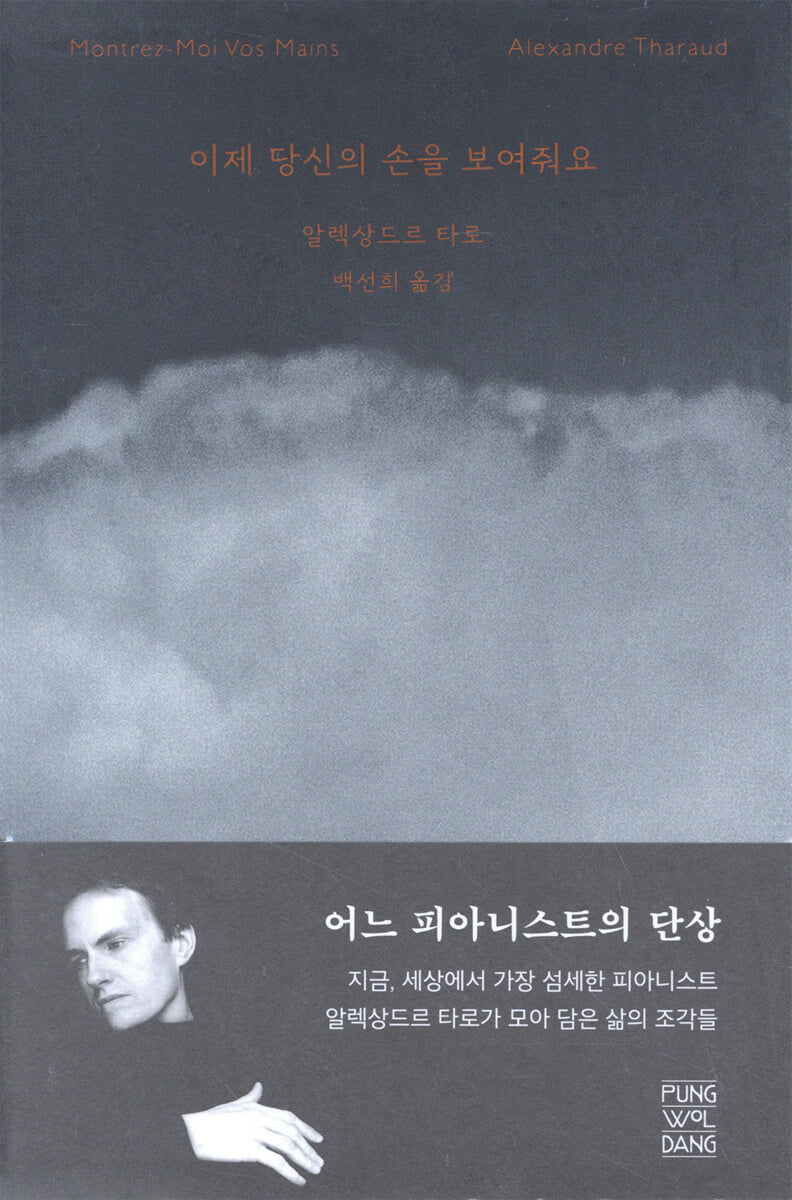
Now show me your hands
 |
Description
Book Introduction
The inner workings of pianists are still largely unknown.
Because writers cannot enter into it, and pianists do not write with enough passion to describe its inner world.
There are many pianists who are good at writing, but none of them have used that skill to observe themselves.
Or it wasn't successful enough.
Alexandre Tharaud was probably the first pianist to successfully accomplish this difficult task.
His essay, "Now Show Me Your Hands," which begins with him recognizing himself as an "other" in the mirror in the waiting room just before a performance, is a story he wrote directly about his own existence.
This book, which combines the journey of one individual, the history of piano music, various places around the world, and quirky hotel rooms, continues as a single story with a firm sense of theme.
The subject is the life of a concert pianist.
Tarot is not simply a story of his life's journey, but rather creates an essay that contains much richer thoughts by freely connecting various materials.
This is almost a model for essays.
Who am I, what do I do, and how do I see the world through it?
Tarot puts all of this into a bundle of short stories.
Beginning with an image in a mirror and ending with a story in a dream, this short and colorful essay will long remain one of the richest records of the pianist's inner life.
Because writers cannot enter into it, and pianists do not write with enough passion to describe its inner world.
There are many pianists who are good at writing, but none of them have used that skill to observe themselves.
Or it wasn't successful enough.
Alexandre Tharaud was probably the first pianist to successfully accomplish this difficult task.
His essay, "Now Show Me Your Hands," which begins with him recognizing himself as an "other" in the mirror in the waiting room just before a performance, is a story he wrote directly about his own existence.
This book, which combines the journey of one individual, the history of piano music, various places around the world, and quirky hotel rooms, continues as a single story with a firm sense of theme.
The subject is the life of a concert pianist.
Tarot is not simply a story of his life's journey, but rather creates an essay that contains much richer thoughts by freely connecting various materials.
This is almost a model for essays.
Who am I, what do I do, and how do I see the world through it?
Tarot puts all of this into a bundle of short stories.
Beginning with an image in a mirror and ending with a story in a dream, this short and colorful essay will long remain one of the richest records of the pianist's inner life.
- You can preview some of the book's contents.
Preview
index
start
craving
fire
craving
fire
Detailed image

Into the book
Argentum Nitricum gives time to time, Nux vomica protects from summer, and Bryonia protects from winter.
Epar Sulphuricum keeps you away from storms, and Stramonium keeps you away from the evil spirits of the night.
Arum triphyllum gives substance to the horse, and Iris versicolor lightens the horse's weight.
--- pp.20~21
Take a seat.
Adapt to the stage and unpack there.
The stage is mine until night.
I try lying down on the floor for a long time.
Beneath the floor is a resonance chamber that is very important to the acoustics of the concert hall.
A large space is filled with dry, half-full or empty resonance chambers.
The audience has no idea that there are hundreds of cubic meters of hidden void beneath the floor.
The cave amplifies the sound significantly more than the piano's resonating chamber, the soundboard.
There is a void under the stage.
The pianist floats.
He is seen rowing on the floor and settling down in front of the overwhelming instrument.
We believe he is anchored deep in the sea.
no.
There is emptiness around the pianist.
All over the place.
--- p.36
Labelle's music is performed like a meticulous surgeon.
Every detail matters.
They have been meticulously examined and measured over the years, broken down to the millimeter.
But tonight, only the lines matter.
If you play the label analytically and deliberately in concert, it quickly becomes unbearable.
(...) In his work, which is built like a giant ark, even the smallest pebble is as important as the entire structure.
It's like a small sailboat sailing in the middle of a vast ocean.
You have to find the perfect balance between detail work and deciding what direction to take.
You must aim for the last note from the moment you press the first note.
All the elements in the song support each other.
I practiced Ravel more than any other composer.
But the moment I go on stage, all that matters to me is phrases, long breaths, and perspective.
--- pp.177~178
Victor, who lives in Quebec, enjoys cultural life while driving a truck.
Every time he had lunch at the terminal, he played recorded Baroque music for his fellow drivers.
His colleagues don't react much, but he continues steadfastly.
He sits in his massive Columbia Freightliner truck, tunes the radio to 95.3 FM's "Ici Musique" and sings at the top of his lungs.
The music is louder than the motor noise.
Scarlatti, with his halo of smoke, is beautiful.
Victor's physique may be that of a lumberjack, but his heart is sensitive.
When he was young, his mother listened to classical music and his father listened to French songs.
Victor doesn't cry much.
But when his mother's favorite label, Ravel, or his father's favorite, Georges Moustaki, comes on 95.3 FM, tears well up in his eyes.
(...) Victor has two loves.
Driving a truck with a load and being carried along by the music.
--- pp.182~183
I play for one man, one woman.
My piano sound is directed towards a special person, and my solo concert is secretly dedicated to him.
The character is decided in the afternoon, or a few minutes before entering the stage.
The very fact that I think of someone gives me a sense of warmth.
A certain acquaintance, a certain face, a certain smile, a man or woman that comes to mind unconsciously.
I speak to that person first.
Sometimes the person notices it, but usually he doesn't.
That person may not be there.
Or it could be a dead person.
I gladly play for my dead.
Many people died.
I can't accept their deaths.
Rather, they exist clearly under my fingers.
Their obituaries fill Bucephalus's stomach.
They sing for me, and I motivate them to work.
When I play solo, there are many people on stage.
There are many people who are absent.
I am many.
--- p.193
The waves rolling over the pebbles, I receive them on stage.
Near the beach of Trestrinel in Perros-Guirec, there is a place where the sea behind the castle's spires makes a sound similar to applause.
The inner harbour hidden between the rocks is covered with small pebbles.
Round, oval, or triangular pebbles about 4 centimeters in diameter.
When the sea water gently rolls the pebbles, the stones collide with each other and regain their vitality.
You have to stay there long enough to perceive the richness of the sound.
The sound was bright, thumping, and had a rare vitality.
Pebbles, each with its own unique resonance, constantly change their sound as they come into contact with other pebbles.
The sea that spreads out behind the sound of rolling waves is silent.
Applause is exactly that.
I hear the sound of each and every pebble-like hand on stage.
Each and every substance communicates with the substance next to it.
After the solo concert, a more extensive chamber music performance begins.
Waves crash onto the stage, thousands of pebbles and clear water rush onto my black stage.
Epar Sulphuricum keeps you away from storms, and Stramonium keeps you away from the evil spirits of the night.
Arum triphyllum gives substance to the horse, and Iris versicolor lightens the horse's weight.
--- pp.20~21
Take a seat.
Adapt to the stage and unpack there.
The stage is mine until night.
I try lying down on the floor for a long time.
Beneath the floor is a resonance chamber that is very important to the acoustics of the concert hall.
A large space is filled with dry, half-full or empty resonance chambers.
The audience has no idea that there are hundreds of cubic meters of hidden void beneath the floor.
The cave amplifies the sound significantly more than the piano's resonating chamber, the soundboard.
There is a void under the stage.
The pianist floats.
He is seen rowing on the floor and settling down in front of the overwhelming instrument.
We believe he is anchored deep in the sea.
no.
There is emptiness around the pianist.
All over the place.
--- p.36
Labelle's music is performed like a meticulous surgeon.
Every detail matters.
They have been meticulously examined and measured over the years, broken down to the millimeter.
But tonight, only the lines matter.
If you play the label analytically and deliberately in concert, it quickly becomes unbearable.
(...) In his work, which is built like a giant ark, even the smallest pebble is as important as the entire structure.
It's like a small sailboat sailing in the middle of a vast ocean.
You have to find the perfect balance between detail work and deciding what direction to take.
You must aim for the last note from the moment you press the first note.
All the elements in the song support each other.
I practiced Ravel more than any other composer.
But the moment I go on stage, all that matters to me is phrases, long breaths, and perspective.
--- pp.177~178
Victor, who lives in Quebec, enjoys cultural life while driving a truck.
Every time he had lunch at the terminal, he played recorded Baroque music for his fellow drivers.
His colleagues don't react much, but he continues steadfastly.
He sits in his massive Columbia Freightliner truck, tunes the radio to 95.3 FM's "Ici Musique" and sings at the top of his lungs.
The music is louder than the motor noise.
Scarlatti, with his halo of smoke, is beautiful.
Victor's physique may be that of a lumberjack, but his heart is sensitive.
When he was young, his mother listened to classical music and his father listened to French songs.
Victor doesn't cry much.
But when his mother's favorite label, Ravel, or his father's favorite, Georges Moustaki, comes on 95.3 FM, tears well up in his eyes.
(...) Victor has two loves.
Driving a truck with a load and being carried along by the music.
--- pp.182~183
I play for one man, one woman.
My piano sound is directed towards a special person, and my solo concert is secretly dedicated to him.
The character is decided in the afternoon, or a few minutes before entering the stage.
The very fact that I think of someone gives me a sense of warmth.
A certain acquaintance, a certain face, a certain smile, a man or woman that comes to mind unconsciously.
I speak to that person first.
Sometimes the person notices it, but usually he doesn't.
That person may not be there.
Or it could be a dead person.
I gladly play for my dead.
Many people died.
I can't accept their deaths.
Rather, they exist clearly under my fingers.
Their obituaries fill Bucephalus's stomach.
They sing for me, and I motivate them to work.
When I play solo, there are many people on stage.
There are many people who are absent.
I am many.
--- p.193
The waves rolling over the pebbles, I receive them on stage.
Near the beach of Trestrinel in Perros-Guirec, there is a place where the sea behind the castle's spires makes a sound similar to applause.
The inner harbour hidden between the rocks is covered with small pebbles.
Round, oval, or triangular pebbles about 4 centimeters in diameter.
When the sea water gently rolls the pebbles, the stones collide with each other and regain their vitality.
You have to stay there long enough to perceive the richness of the sound.
The sound was bright, thumping, and had a rare vitality.
Pebbles, each with its own unique resonance, constantly change their sound as they come into contact with other pebbles.
The sea that spreads out behind the sound of rolling waves is silent.
Applause is exactly that.
I hear the sound of each and every pebble-like hand on stage.
Each and every substance communicates with the substance next to it.
After the solo concert, a more extensive chamber music performance begins.
Waves crash onto the stage, thousands of pebbles and clear water rush onto my black stage.
--- p.205
Publisher's Review
Only the pianist,
Among them, a story that only Alexandre Taro can tell
Michelle Schneider's book about pianist Glenn Gould, "Glenn Gould: Piano Solo," begins with a description of the hotel room where Glenn Gould performed his last live concert.
In that quiet room, Gould is lost in his thoughts about music.
But this beautiful introduction is a product of the author's imagination.
Gould wrote extensively and even gave audio interviews about why he decided to stop performing and focus solely on recording, but he did not record what was going through his mind the night of that final performance.
Because he said very little about himself.
In "Glenn Gould, Piano Solo," Gould does not give a monologue.
Because no one has ever heard of it, and it is not recorded.
Gould's most intimate spaces remained secret, and later writers had no choice but to 'create' them.
The inner workings of pianists are still largely unknown.
Because writers cannot enter into it, and pianists do not write with enough passion to describe its inner world.
There are many pianists who are good at writing, but none of them have used that skill to observe themselves.
Or it wasn't successful enough.
Alexandre Tharaud was probably the first pianist to successfully accomplish this difficult task.
His essay, "Now Show Me Your Hands," which begins with him recognizing himself as an "other" in the mirror in the waiting room just before a performance, is a story he wrote directly about his own existence.
So before he talks about the piano or being a pianist, he mentions his dreams and his body.
The traces of insomnia that he has suffered from since childhood are described, and the names of the pills he has taken to overcome it are listed like a poem.
Argentum Nitricum gives time to time, Nux vomica protects from summer, and Bryonia protects from winter.
Epar Sulphuricum keeps you away from storms, and Stramonium keeps you away from the evil spirits of the night.
Arum triphyllum gives substance to the horse, and Iris versicolor lightens the horse's weight.
(Pages 20-21)
These poetic descriptions shine beautifully throughout “Now Show Me Your Hands.”
The episode where Taro, during his unknown days, accompanied silent films in the basement of the Musée d'Orsay feels like a fantastic short story, and the eulogy he read at the funeral of his late piano teacher is inserted into the book like a small poem.
The opera aria sung by the father, who gave up his career as a baritone singer to become an auto mechanic for his family, in his room alone is conveyed through short, sorrowful sentences, and the story of seeing a white whale in the distance when he came out of the dressing room after an outdoor performance feels like a dream.
There's even humor.
Tarot, when analyzing and categorizing coughing sounds heard during a performance, truly demonstrates what 'elegant humor' is.
These poetic moments eventually expand into descriptions of the world Taro inhabits, his experiences and observations as a concert pianist.
It is full of scenes that only a first-class concert pianist can see.
Tarot introduces real-life spaces, such as unique and beautiful performance halls scattered around the world or small beaches with pebbles that make a sound similar to the applause after a performance.
At the same time, he goes into the past.
He mentions the history of the piano as an instrument and the history of the pianist profession as if he were searching for his own ancestors, and through this, he traces where the pianist was born.
This reflection is brief and to the point.
Tarot examines the pianist's birthplace and extracts a kind of origin, an essence, from it.
According to him, a solo pianist is a being born in solitude and song.
Fingers from the 19th century who sang alone on stage, imitating singers.
Tarot extracts its life motto from this origin.
On one side there is solitude and isolation, on the other side there is excitement and exploration.
This book, which combines the journey of one individual, the history of piano music, various places around the world, and quaint hotel rooms, continues as a single story with a firm sense of theme.
The subject is the life of a concert pianist.
Tarot is not simply a story of his life's journey, but rather creates an essay that contains much richer thoughts by freely connecting various materials.
This is almost a model for essays.
Who am I, what do I do, and how do I see the world through it?
Tarot puts all of this into a bundle of short stories.
Beginning with an image in a mirror and ending with a story in a dream, this short and colorful essay will long remain one of the richest records of the pianist's inner life.
Among them, a story that only Alexandre Taro can tell
Michelle Schneider's book about pianist Glenn Gould, "Glenn Gould: Piano Solo," begins with a description of the hotel room where Glenn Gould performed his last live concert.
In that quiet room, Gould is lost in his thoughts about music.
But this beautiful introduction is a product of the author's imagination.
Gould wrote extensively and even gave audio interviews about why he decided to stop performing and focus solely on recording, but he did not record what was going through his mind the night of that final performance.
Because he said very little about himself.
In "Glenn Gould, Piano Solo," Gould does not give a monologue.
Because no one has ever heard of it, and it is not recorded.
Gould's most intimate spaces remained secret, and later writers had no choice but to 'create' them.
The inner workings of pianists are still largely unknown.
Because writers cannot enter into it, and pianists do not write with enough passion to describe its inner world.
There are many pianists who are good at writing, but none of them have used that skill to observe themselves.
Or it wasn't successful enough.
Alexandre Tharaud was probably the first pianist to successfully accomplish this difficult task.
His essay, "Now Show Me Your Hands," which begins with him recognizing himself as an "other" in the mirror in the waiting room just before a performance, is a story he wrote directly about his own existence.
So before he talks about the piano or being a pianist, he mentions his dreams and his body.
The traces of insomnia that he has suffered from since childhood are described, and the names of the pills he has taken to overcome it are listed like a poem.
Argentum Nitricum gives time to time, Nux vomica protects from summer, and Bryonia protects from winter.
Epar Sulphuricum keeps you away from storms, and Stramonium keeps you away from the evil spirits of the night.
Arum triphyllum gives substance to the horse, and Iris versicolor lightens the horse's weight.
(Pages 20-21)
These poetic descriptions shine beautifully throughout “Now Show Me Your Hands.”
The episode where Taro, during his unknown days, accompanied silent films in the basement of the Musée d'Orsay feels like a fantastic short story, and the eulogy he read at the funeral of his late piano teacher is inserted into the book like a small poem.
The opera aria sung by the father, who gave up his career as a baritone singer to become an auto mechanic for his family, in his room alone is conveyed through short, sorrowful sentences, and the story of seeing a white whale in the distance when he came out of the dressing room after an outdoor performance feels like a dream.
There's even humor.
Tarot, when analyzing and categorizing coughing sounds heard during a performance, truly demonstrates what 'elegant humor' is.
These poetic moments eventually expand into descriptions of the world Taro inhabits, his experiences and observations as a concert pianist.
It is full of scenes that only a first-class concert pianist can see.
Tarot introduces real-life spaces, such as unique and beautiful performance halls scattered around the world or small beaches with pebbles that make a sound similar to the applause after a performance.
At the same time, he goes into the past.
He mentions the history of the piano as an instrument and the history of the pianist profession as if he were searching for his own ancestors, and through this, he traces where the pianist was born.
This reflection is brief and to the point.
Tarot examines the pianist's birthplace and extracts a kind of origin, an essence, from it.
According to him, a solo pianist is a being born in solitude and song.
Fingers from the 19th century who sang alone on stage, imitating singers.
Tarot extracts its life motto from this origin.
On one side there is solitude and isolation, on the other side there is excitement and exploration.
This book, which combines the journey of one individual, the history of piano music, various places around the world, and quaint hotel rooms, continues as a single story with a firm sense of theme.
The subject is the life of a concert pianist.
Tarot is not simply a story of his life's journey, but rather creates an essay that contains much richer thoughts by freely connecting various materials.
This is almost a model for essays.
Who am I, what do I do, and how do I see the world through it?
Tarot puts all of this into a bundle of short stories.
Beginning with an image in a mirror and ending with a story in a dream, this short and colorful essay will long remain one of the richest records of the pianist's inner life.
GOODS SPECIFICS
- Date of issue: July 5, 2019
- Page count, weight, size: 232 pages | 213g | 122*186*14mm
- ISBN13: 9791189346065
- ISBN10: 1189346060
You may also like
카테고리
korean


korean

![GQ KOREA Mark (Monthly): December [2025]](http://librairie.coreenne.fr/cdn/shop/files/8ef265dbbfbf186523ed75ba7319009d.jpg?v=1765340328&width=3840)


