

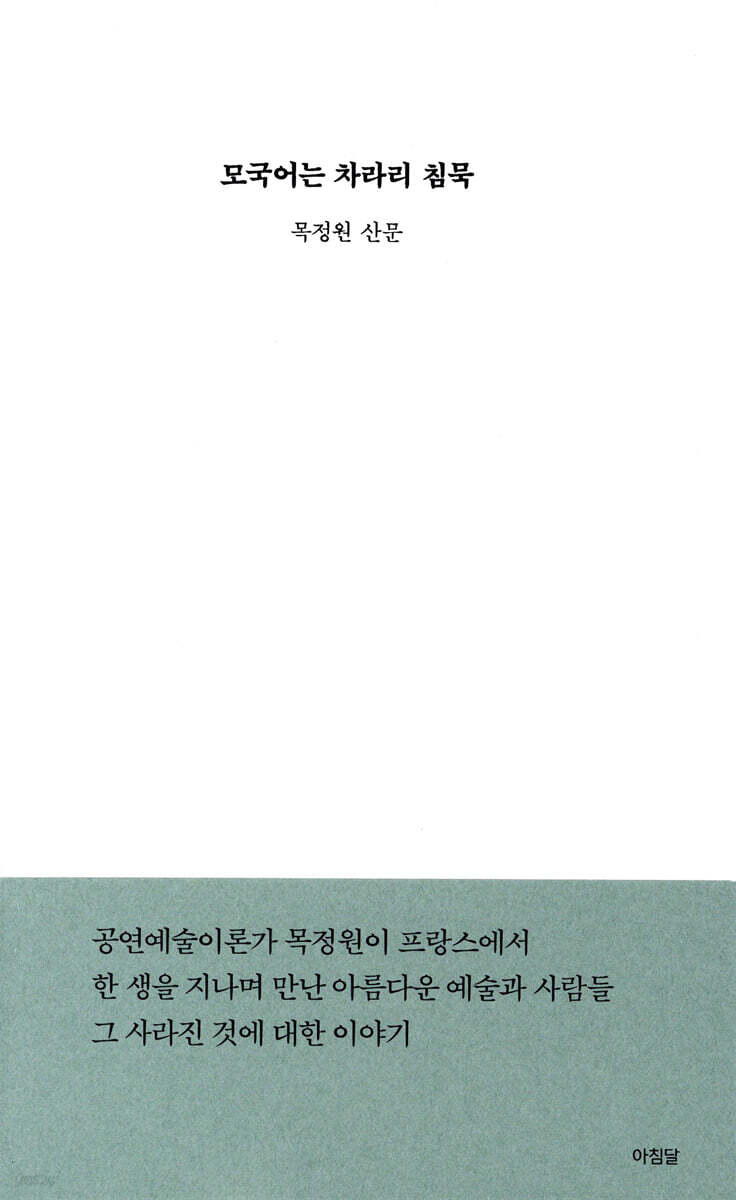
Mother tongue is better silence
 |
Description
Book Introduction
“Because there is nothing more valuable than the beauty that knows sorrow.” A voice tracing the traces left behind by things that have disappeared Critical essays by performance art theorist Mok Jeong-won The prose collection 『My Mother Tongue Would Rather Be Silent』 by performing arts theorist Mok Jeong-won has been published by Achimdal. This book is about art, people, and disappearing things that Mok Jeong-won encountered during his six years in France and two years in Korea, starting in 2013. Writing and talking about performing arts can be a difficult task to avoid feeling empty. Because it is a temporal art that occurs and disappears at the same time. The work appears briefly before the audience's eyes and then disappears, leaving only a fading memory behind. Nevertheless, Mokjeongwon wants to talk about disappearance, and rather write about it when the work has become sufficiently faint even to himself. To pass on the traces that still remain in our memories and the things that cannot be put into words even after an era has passed. This book is a critique and a letter to such sad and beautiful things. |
- You can preview some of the book's contents.
Preview
index
Late-Written Criticism 05
11 in space
Spring Festival 21
Solen 35
Audience School 45
64 to Mr. Kim Dong-hyun
The Origins of Tragedy 69
83 in Contigne
Terror and Theater 95
116 to watch the play till the end
Uncle Jean-Claude 127
Sharing the dance 153
Mother tongue is better silence 175
11 in space
Spring Festival 21
Solen 35
Audience School 45
64 to Mr. Kim Dong-hyun
The Origins of Tragedy 69
83 in Contigne
Terror and Theater 95
116 to watch the play till the end
Uncle Jean-Claude 127
Sharing the dance 153
Mother tongue is better silence 175
Detailed image
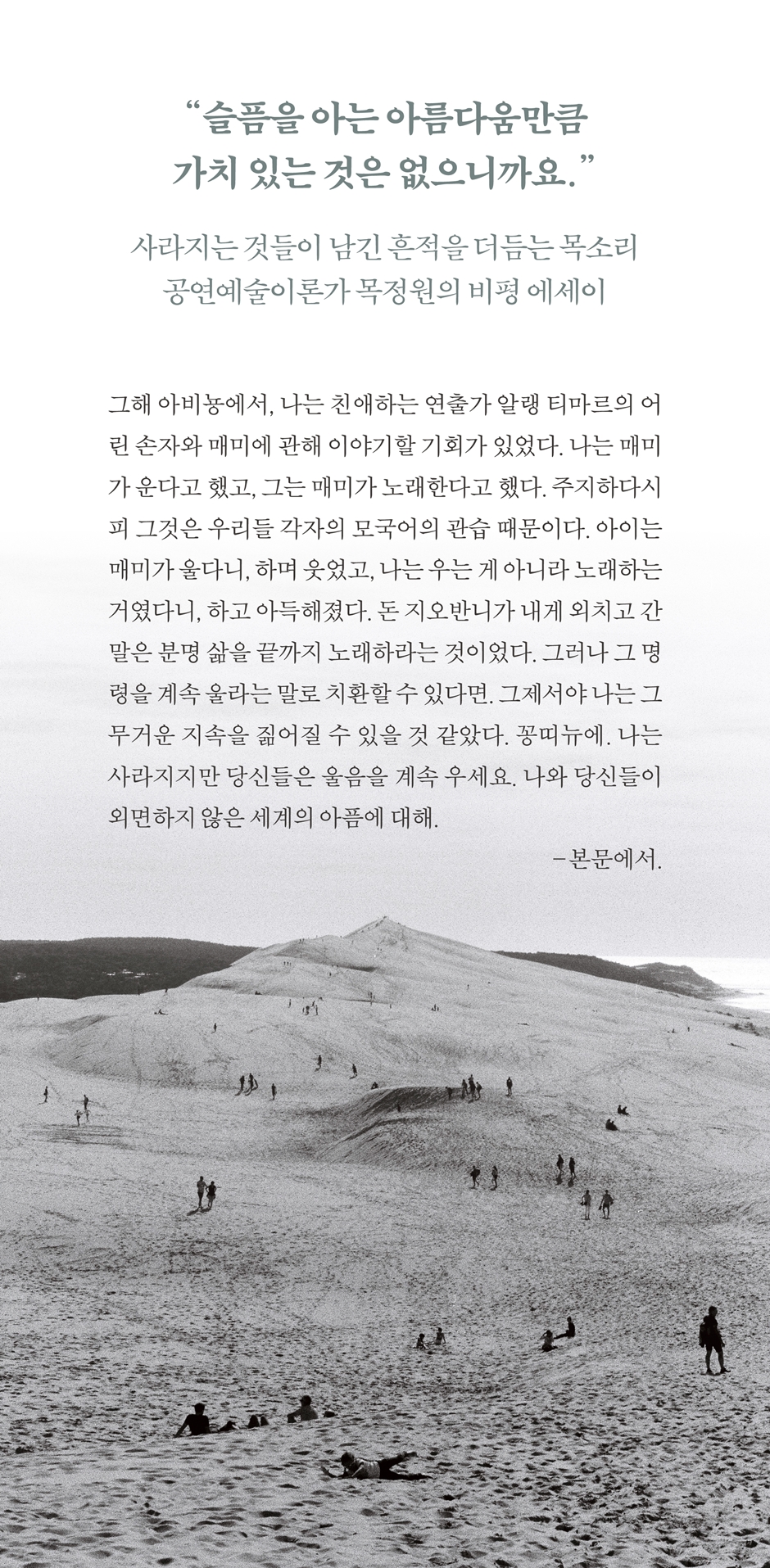
Into the book
The day I left Paris, a friend came to the airport to see me off.
Before I left, I cried, not because of my departure, but because of his being left behind.
As I walked away, I looked back at her a lot.
It was written in the text I received before boarding the plane that he was like a wonderful Orpheus who looked back over and over again as if he was not afraid of anything.
If someone asks me what I did in Paris, I would say I just existed.
Standing, sitting, or lying in space, I have finally developed a body that can travel anywhere, having sensed the entire world.
Still, I wanted to see the face that remained there just one more time.
--- p.18, from “In Space”
If he had only danced, if he had only been a prince or a clown, the world would have loved him.
But as he stopped flying and rolled on the ground, the world also stopped loving him.
Of course, love and loneliness are not compatible, so even if he had only danced and been loved, he would have been deeply lonely.
So instead of remaining a genius dancer, he became a choreographer who was neglected.
--- p.24, from “The Rite of Spring”
I once thought that the most appropriate definition of the word 'contemporary' is 'people who have witnessed death together'.
We are people who have endured the times and witnessed the deaths of those who could not endure the times.
So, there are people who share their memories of certain deaths without explanation.
Rather than people who laugh together, there are people who cannot laugh together.
People who find something rarely funny.
--- p.47, from “Audience School”
In French, the word for ghost is revenant, which literally means 'one who returns'.
The person who left cannot leave forever and returns again.
The absent one becomes present.
Coming in and out, appearing and wandering.
Maybe because I still have something to say.
Because there is an undisclosed truth.
Because that death cannot be a pleasant goodbye.
Because I can't convince myself and give up.
Because I'm sick.
Because the pain is indescribable.
Because only the living can say that.
--- p.80, from “The Origin of Tragedy”
And that day, she couldn't kill anyone because she was doing a play.
Angelica Riedel.
A person who creates screaming works from the scars of the world's swamps.
One who mocks the gross hypocrisy of humanity, pities those who have not yet cried enough, and despairs endlessly over not being loved by anyone.
She digs through a pile of dirt on stage, lies down on it and masturbates, carries dozens of sofas, cuts up a lemon and rubs it on her legs, waves her arms in the air, pours alcohol over her head, makes eye contact with a stuffed animal, and draws her own blood.
--- p.96, from “Terror and Theater”
The ticket cost 6 euros and it said this in one corner:
“No visibility.” It was funny how such an extreme expression of what would have been something like “limited visibility seat” in Korean was used.
That seat, while honesty was good, I also wondered why it was being sold.
That balcony seat.
A multi-level room facing the orchestra pit, right next to the stage.
Two-thirds of the stage was covered, encouraging resignation and imagination.
There were more things you could see there than you couldn't see.
--- p.129, from “Uncle Jean-Claude”
If you dance, I will follow you even if I am sitting still.
That's love.
How heavily the leaping body on the stage must tense its muscles to appear so light, how dizzyingly the endless spinning avoids the dizziness, how the knees that crawl on the floor flatten with a tingling sensation.
Only through our bodies can we see, know, and sense dance as much as we can imagine.
Before I left, I cried, not because of my departure, but because of his being left behind.
As I walked away, I looked back at her a lot.
It was written in the text I received before boarding the plane that he was like a wonderful Orpheus who looked back over and over again as if he was not afraid of anything.
If someone asks me what I did in Paris, I would say I just existed.
Standing, sitting, or lying in space, I have finally developed a body that can travel anywhere, having sensed the entire world.
Still, I wanted to see the face that remained there just one more time.
--- p.18, from “In Space”
If he had only danced, if he had only been a prince or a clown, the world would have loved him.
But as he stopped flying and rolled on the ground, the world also stopped loving him.
Of course, love and loneliness are not compatible, so even if he had only danced and been loved, he would have been deeply lonely.
So instead of remaining a genius dancer, he became a choreographer who was neglected.
--- p.24, from “The Rite of Spring”
I once thought that the most appropriate definition of the word 'contemporary' is 'people who have witnessed death together'.
We are people who have endured the times and witnessed the deaths of those who could not endure the times.
So, there are people who share their memories of certain deaths without explanation.
Rather than people who laugh together, there are people who cannot laugh together.
People who find something rarely funny.
--- p.47, from “Audience School”
In French, the word for ghost is revenant, which literally means 'one who returns'.
The person who left cannot leave forever and returns again.
The absent one becomes present.
Coming in and out, appearing and wandering.
Maybe because I still have something to say.
Because there is an undisclosed truth.
Because that death cannot be a pleasant goodbye.
Because I can't convince myself and give up.
Because I'm sick.
Because the pain is indescribable.
Because only the living can say that.
--- p.80, from “The Origin of Tragedy”
And that day, she couldn't kill anyone because she was doing a play.
Angelica Riedel.
A person who creates screaming works from the scars of the world's swamps.
One who mocks the gross hypocrisy of humanity, pities those who have not yet cried enough, and despairs endlessly over not being loved by anyone.
She digs through a pile of dirt on stage, lies down on it and masturbates, carries dozens of sofas, cuts up a lemon and rubs it on her legs, waves her arms in the air, pours alcohol over her head, makes eye contact with a stuffed animal, and draws her own blood.
--- p.96, from “Terror and Theater”
The ticket cost 6 euros and it said this in one corner:
“No visibility.” It was funny how such an extreme expression of what would have been something like “limited visibility seat” in Korean was used.
That seat, while honesty was good, I also wondered why it was being sold.
That balcony seat.
A multi-level room facing the orchestra pit, right next to the stage.
Two-thirds of the stage was covered, encouraging resignation and imagination.
There were more things you could see there than you couldn't see.
--- p.129, from “Uncle Jean-Claude”
If you dance, I will follow you even if I am sitting still.
That's love.
How heavily the leaping body on the stage must tense its muscles to appear so light, how dizzyingly the endless spinning avoids the dizziness, how the knees that crawl on the floor flatten with a tingling sensation.
Only through our bodies can we see, know, and sense dance as much as we can imagine.
--- p.155, from “Sharing the Dance”
Publisher's Review
The power to remember sorrow
Do we only love things that are tangible?
Could it be possible to love a face you've never seen before even more?
If you still have to lean on something, what more traces do you need to keep loving?
─ Page 28.
The characteristic of temporal art lies in disappearance.
Unlike spatial art, such as painting, which exists in space continuously once completed and is not destroyed, temporal art, such as theater, appears in space and time for a while and then disappears.
If it is something that appears and disappears, it is not only temporal art.
Human life, like a performance, remains in the world and flows into time.
They all fade away in human memory, but they leave behind some traces.
Of course, leaving traces and leaving existence are different things, so there is fundamental sadness in all of this.
Mokjeongwon speaks about the traces of sadness that we encounter in art and life.
Through The Rite of Spring, audiences a hundred years later recall the life of choreographer Nijinsky and his dances they have never seen before.
What would it be like to restore or recreate a work whose original text was lost without the dance being recorded?
It is to love the face of someone you have never seen before, and to recreate that face by collecting the traces he left behind.
Looking back on his time with costume designer Solen, the author talks about the special nature of stage costumes.
Stage costumes are made for one performance only.
Those clothes are worn for a short time on stage and then become useless and are stored in storage or become collections of enthusiasts.
Therefore, the work of making clothes is a work of uniqueness that arises and then disappears, and in this case, the stage costume itself becomes a metaphor for life.
This reminds Mokjeongwon of choreographer Alain Platel's Tauberbach, which features Bach sung by deaf people who cannot hear their own voices, along with hundreds of clothes piled up like a tomb on stage.
The dancers dance to a song that defies the music, disappear into a tomb of clothes, and emerge from the tomb dressed in clothes.
Next, recalling another work by Alain Platel, “Out of Context – For Pina Bausch,” Mok Jeong-won thinks about seeing a dance that some cannot see and hearing a song that others cannot hear.
About the sadness that comes with an experience that is forbidden to some, something that is as good as gone.
I feel like there's still so much we don't know about becoming proper contemporaries.
There is so much we don't know, and it's all about the pain of others.
So, without us knowing, some people have gone far away.
To a place where the letters left behind will not be deciphered.
To a place where unforgettable things are forgotten.
─ Page 47.
Mok Jeong-won reads the deaths that have become the history of our bodies, which we know because we witnessed them as contemporaries, from writer Bae Sam-sik's "Woman Coming from afar," and writes a letter to the deceased after watching a performance commemorating director Kim Dong-hyun.
It focuses on women who died in reality and in works, and on Antigone, who mourns her brother's death even in defiance of the king's orders.
In the wake of the 2015 terrorist attacks in France, when the sadness and fear of death weigh heavily on theaters, the play of Angelica Riedel, which confronts the world's suffering in a disturbing way, and Romeo Castellucci, which unintentionally recreates the tragedy, reflect on what it means to be alive and present in the face of the many dead.
For the author, burying memories of various losses for a long time and then finally putting them into words seems to be a way of resolving grief and also a way of mourning through things that remain after they disappear.
Such mourning may be similar to the act of gathering the traces of the departed and re-drawing their face, as in the Rite of Spring, or it may be like the face of Eurydice that Orpheus sees for the last time.
If the act of recalling the face of someone you long to see leads to the act of remembering, then that task inevitably involves love.
Love is the power that enables us to remember something beyond its own memory, and to be engraved on the bodies of others beyond our own.
Through anecdotes about the artist Jean Villar who loved his audience, the story of his friendship with Uncle Jean-Claude who loved opera, and lyrics sent to the author's maternal grandfather whom he loved, Mokjeongwon also tells us that love is something that conveys many things to others, and that people can continue to live by making traces of such love their legacy.
I share a song with you.
You will go to another place and share some of the song.
Inscribe the sorrow you have witnessed on your body.
Dancing to your breath.
In love again.
In this way, we become ourselves, and then finally disperse into what we are not.
After death, does only the soul remain?
Will we still be able to love each other then?
Even if we don't have bodies to reflect each other.
Could every season begin with a dance?
─ Page 172.
Do we only love things that are tangible?
Could it be possible to love a face you've never seen before even more?
If you still have to lean on something, what more traces do you need to keep loving?
─ Page 28.
The characteristic of temporal art lies in disappearance.
Unlike spatial art, such as painting, which exists in space continuously once completed and is not destroyed, temporal art, such as theater, appears in space and time for a while and then disappears.
If it is something that appears and disappears, it is not only temporal art.
Human life, like a performance, remains in the world and flows into time.
They all fade away in human memory, but they leave behind some traces.
Of course, leaving traces and leaving existence are different things, so there is fundamental sadness in all of this.
Mokjeongwon speaks about the traces of sadness that we encounter in art and life.
Through The Rite of Spring, audiences a hundred years later recall the life of choreographer Nijinsky and his dances they have never seen before.
What would it be like to restore or recreate a work whose original text was lost without the dance being recorded?
It is to love the face of someone you have never seen before, and to recreate that face by collecting the traces he left behind.
Looking back on his time with costume designer Solen, the author talks about the special nature of stage costumes.
Stage costumes are made for one performance only.
Those clothes are worn for a short time on stage and then become useless and are stored in storage or become collections of enthusiasts.
Therefore, the work of making clothes is a work of uniqueness that arises and then disappears, and in this case, the stage costume itself becomes a metaphor for life.
This reminds Mokjeongwon of choreographer Alain Platel's Tauberbach, which features Bach sung by deaf people who cannot hear their own voices, along with hundreds of clothes piled up like a tomb on stage.
The dancers dance to a song that defies the music, disappear into a tomb of clothes, and emerge from the tomb dressed in clothes.
Next, recalling another work by Alain Platel, “Out of Context – For Pina Bausch,” Mok Jeong-won thinks about seeing a dance that some cannot see and hearing a song that others cannot hear.
About the sadness that comes with an experience that is forbidden to some, something that is as good as gone.
I feel like there's still so much we don't know about becoming proper contemporaries.
There is so much we don't know, and it's all about the pain of others.
So, without us knowing, some people have gone far away.
To a place where the letters left behind will not be deciphered.
To a place where unforgettable things are forgotten.
─ Page 47.
Mok Jeong-won reads the deaths that have become the history of our bodies, which we know because we witnessed them as contemporaries, from writer Bae Sam-sik's "Woman Coming from afar," and writes a letter to the deceased after watching a performance commemorating director Kim Dong-hyun.
It focuses on women who died in reality and in works, and on Antigone, who mourns her brother's death even in defiance of the king's orders.
In the wake of the 2015 terrorist attacks in France, when the sadness and fear of death weigh heavily on theaters, the play of Angelica Riedel, which confronts the world's suffering in a disturbing way, and Romeo Castellucci, which unintentionally recreates the tragedy, reflect on what it means to be alive and present in the face of the many dead.
For the author, burying memories of various losses for a long time and then finally putting them into words seems to be a way of resolving grief and also a way of mourning through things that remain after they disappear.
Such mourning may be similar to the act of gathering the traces of the departed and re-drawing their face, as in the Rite of Spring, or it may be like the face of Eurydice that Orpheus sees for the last time.
If the act of recalling the face of someone you long to see leads to the act of remembering, then that task inevitably involves love.
Love is the power that enables us to remember something beyond its own memory, and to be engraved on the bodies of others beyond our own.
Through anecdotes about the artist Jean Villar who loved his audience, the story of his friendship with Uncle Jean-Claude who loved opera, and lyrics sent to the author's maternal grandfather whom he loved, Mokjeongwon also tells us that love is something that conveys many things to others, and that people can continue to live by making traces of such love their legacy.
I share a song with you.
You will go to another place and share some of the song.
Inscribe the sorrow you have witnessed on your body.
Dancing to your breath.
In love again.
In this way, we become ourselves, and then finally disperse into what we are not.
After death, does only the soul remain?
Will we still be able to love each other then?
Even if we don't have bodies to reflect each other.
Could every season begin with a dance?
─ Page 172.
GOODS SPECIFICS
- Publication date: October 15, 2021
- Format: Hardcover book binding method guide
- Page count, weight, size: 188 pages | 312g | 127*200*15mm
- ISBN13: 9791189467302
- ISBN10: 1189467305
You may also like
카테고리
korean


korean

![GQ KOREA Mark (Monthly): December [2025]](http://librairie.coreenne.fr/cdn/shop/files/8ef265dbbfbf186523ed75ba7319009d.jpg?v=1765340328&width=3840)


