

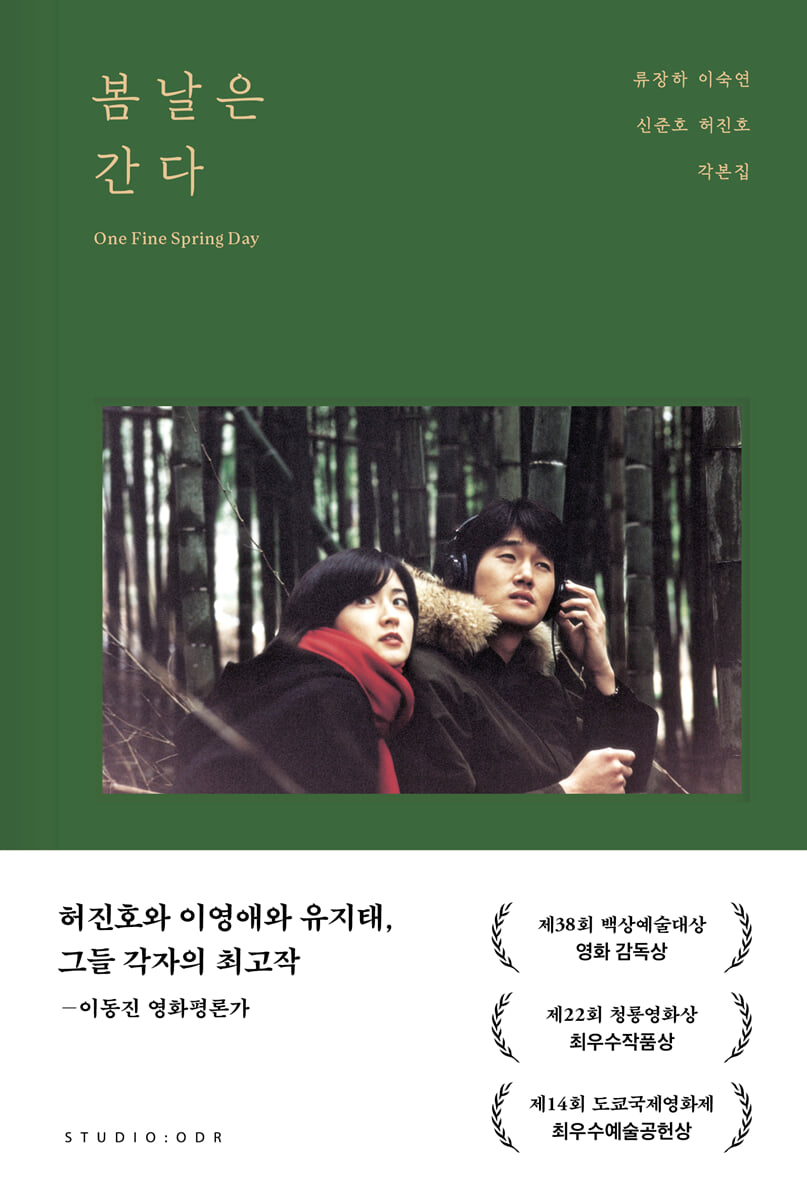
Spring Days Are Gone script collection
 |
Description
Book Introduction
- A word from MD
-
The Age of Romanticism, Love in FilmA collection of scripts for two films that came like a spring day in a time full of romance.
The flow of emotions contained in the film blends with the sentences in the script, adding a gentle resonance.
October 24, 2025. Art PD Ahn Hyun-jae
“Heo Jin-ho, Lee Young-ae, and Yoo Ji-tae, their respective best works.”
_Lee Dong-jin, film critic
When talking about Korean melodramatic films and romance genres
A work that will be mentioned forever!
★ 38th Baeksang Arts Awards Best Director ★
★ 22nd Blue Dragon Film Awards Best Picture Award ★
★ 6th Busan International Film Festival International Film Critics Association Award ★
★ 21st Korean Association of Film Critics Awards Best Picture and Best Cinematography ★
★ 14th Tokyo International Film Festival Best Artistic Contribution Award ★
Director Jin-ho Heo, who opened a new horizon for Korean melodramatic films with “Christmas in August,” has released his second film, “One Fine Spring Day,” in three years, and is now publishing the original script for the first time in 24 years since the film’s release.
"One Fine Spring Day" is a work that contains the meeting and love between sound engineer Sang-woo (Yoo Ji-tae) and radio PD Eun-soo (Lee Young-ae), and their gradually changing emotions.
The short but intense seasonal journey that began in Gangwon-do left behind famous scenes such as lines like “Would you like to eat ramen?” and “How does love change?” and is still considered one of the most talked-about masterpieces in the history of Korean melodramatic films.
If “Christmas in August” captured the beginning of a love that is quietly changing, “Spring Days Are Gone” delicately observes the inevitable process of love changing.
Director Jin-ho Heo records the time when love blooms and fades through everyday details, sounds of nature, and moments of emptiness, without exaggerating the characters' emotions.
Upon its release in 2001, the film won the Best Director Award at the 38th Baeksang Arts Awards, Best Picture Award at the 22nd Blue Dragon Film Awards, Best Film Award at the 6th Busan International Film Festival FIPRESCI Awards, Best Picture and Best Cinematography Award at the 21st Korean Association of Film Critics Awards, and Best Artistic Contribution Award at the 14th Tokyo International Film Festival, receiving recognition for both its artistic quality and directing ability.
_Lee Dong-jin, film critic
When talking about Korean melodramatic films and romance genres
A work that will be mentioned forever!
★ 38th Baeksang Arts Awards Best Director ★
★ 22nd Blue Dragon Film Awards Best Picture Award ★
★ 6th Busan International Film Festival International Film Critics Association Award ★
★ 21st Korean Association of Film Critics Awards Best Picture and Best Cinematography ★
★ 14th Tokyo International Film Festival Best Artistic Contribution Award ★
Director Jin-ho Heo, who opened a new horizon for Korean melodramatic films with “Christmas in August,” has released his second film, “One Fine Spring Day,” in three years, and is now publishing the original script for the first time in 24 years since the film’s release.
"One Fine Spring Day" is a work that contains the meeting and love between sound engineer Sang-woo (Yoo Ji-tae) and radio PD Eun-soo (Lee Young-ae), and their gradually changing emotions.
The short but intense seasonal journey that began in Gangwon-do left behind famous scenes such as lines like “Would you like to eat ramen?” and “How does love change?” and is still considered one of the most talked-about masterpieces in the history of Korean melodramatic films.
If “Christmas in August” captured the beginning of a love that is quietly changing, “Spring Days Are Gone” delicately observes the inevitable process of love changing.
Director Jin-ho Heo records the time when love blooms and fades through everyday details, sounds of nature, and moments of emptiness, without exaggerating the characters' emotions.
Upon its release in 2001, the film won the Best Director Award at the 38th Baeksang Arts Awards, Best Picture Award at the 22nd Blue Dragon Film Awards, Best Film Award at the 6th Busan International Film Festival FIPRESCI Awards, Best Picture and Best Cinematography Award at the 21st Korean Association of Film Critics Awards, and Best Artistic Contribution Award at the 14th Tokyo International Film Festival, receiving recognition for both its artistic quality and directing ability.
- You can preview some of the book's contents.
Preview
index
Synopsis
Characters
original script
Interview: The Poetics of That Moment Between the Script and Film of "One Fine Spring Day" ─ Joo Sung-chul and Heo Jin-ho's Special Interview
Memories of Spring: Behind-the-Scenes Stills
Creators
Characters
original script
Interview: The Poetics of That Moment Between the Script and Film of "One Fine Spring Day" ─ Joo Sung-chul and Heo Jin-ho's Special Interview
Memories of Spring: Behind-the-Scenes Stills
Creators
Detailed image

Publisher's Review
The moment you feel that love has come this far,
Spring days are passing by.
From the terminal waiting room scene where Eun-soo and Sang-woo first meet, to the moments of meeting and parting represented by lines like “Would you like to eat ramen?” and “How does love change?”, and the countless scenes that the actors created together with the director according to their emotions at that time, we have created a place to understand and interpret “One Fine Spring Day” in a completely different way than we have known it until now.
In other words, just by comparing the script and the finished film, you gain a completely new perspective.
_Joo Seong-cheol, editor-in-chief of Cineplay, from an interview included in the script collection
The most interesting aspect of the script for "One Fine Spring Day" is the gap between the original script and the finished film.
The experience of reading and comparing the changes and differences that actors and directors create on set allows us to look at films we thought we already knew from a new perspective.
From the terminal scene where Eun-su and Sang-woo first meet, to the moment they become closer while collecting the sounds of nature, to the lines that foreshadow their separation, the gap between the text and the film itself allows for another interpretation of One Fine Spring Day.
Beyond simple text appreciation, it offers a special reading experience that traces director Jin-ho Heo's directing intentions and creative process.
Additionally, the film's key scenes are included in high-definition still cuts so that they can be viewed together with the script.
From the two people's greening journey against the backdrop of the Gangneung sea and Samcheok bamboo forest to the process of how their gazes towards each other change in daily life, the film's depiction of seasonal changes and the flow of emotions blends with the script's sentences to add a gentle resonance.
The script collection also includes an in-depth conversation between director Jin-ho Heo and Cineplay editor-in-chief Sung-chul Joo.
From the background of the creation of the famous scene to the impromptu choices made on set and the in-depth stories about the moments created together with the actors, this will be a special record for fans as it contains a creative context never heard before.
As critic Lee Dong-jin said, “This is the best work of each of Heo Jin-ho, Lee Young-ae, and Yoo Ji-tae,” “One Fine Spring Day” remains a monumental work in the history of Korean melodramatic films.
If “Christmas in August” was about the power of unspoken love, “Spring Days Are Gone” shows the maturity of love that accepts its end.
Director Jin-ho Heo's unique 'contemplative gaze' that runs through both works has elevated the quality of Korean melodramatic films to a new level.
This script collection will be a valuable record that allows us to fully glimpse into the secrets of its creation.
Spring days are passing by.
From the terminal waiting room scene where Eun-soo and Sang-woo first meet, to the moments of meeting and parting represented by lines like “Would you like to eat ramen?” and “How does love change?”, and the countless scenes that the actors created together with the director according to their emotions at that time, we have created a place to understand and interpret “One Fine Spring Day” in a completely different way than we have known it until now.
In other words, just by comparing the script and the finished film, you gain a completely new perspective.
_Joo Seong-cheol, editor-in-chief of Cineplay, from an interview included in the script collection
The most interesting aspect of the script for "One Fine Spring Day" is the gap between the original script and the finished film.
The experience of reading and comparing the changes and differences that actors and directors create on set allows us to look at films we thought we already knew from a new perspective.
From the terminal scene where Eun-su and Sang-woo first meet, to the moment they become closer while collecting the sounds of nature, to the lines that foreshadow their separation, the gap between the text and the film itself allows for another interpretation of One Fine Spring Day.
Beyond simple text appreciation, it offers a special reading experience that traces director Jin-ho Heo's directing intentions and creative process.
Additionally, the film's key scenes are included in high-definition still cuts so that they can be viewed together with the script.
From the two people's greening journey against the backdrop of the Gangneung sea and Samcheok bamboo forest to the process of how their gazes towards each other change in daily life, the film's depiction of seasonal changes and the flow of emotions blends with the script's sentences to add a gentle resonance.
The script collection also includes an in-depth conversation between director Jin-ho Heo and Cineplay editor-in-chief Sung-chul Joo.
From the background of the creation of the famous scene to the impromptu choices made on set and the in-depth stories about the moments created together with the actors, this will be a special record for fans as it contains a creative context never heard before.
As critic Lee Dong-jin said, “This is the best work of each of Heo Jin-ho, Lee Young-ae, and Yoo Ji-tae,” “One Fine Spring Day” remains a monumental work in the history of Korean melodramatic films.
If “Christmas in August” was about the power of unspoken love, “Spring Days Are Gone” shows the maturity of love that accepts its end.
Director Jin-ho Heo's unique 'contemplative gaze' that runs through both works has elevated the quality of Korean melodramatic films to a new level.
This script collection will be a valuable record that allows us to fully glimpse into the secrets of its creation.
GOODS SPECIFICS
- Date of issue: October 24, 2025
- Format: Hardcover book binding method guide
- Page count, weight, size: 224 pages | 376g | 130*195*20mm
- ISBN13: 9791194979463
- ISBN10: 1194979467
You may also like
카테고리
korean


korean

![GQ KOREA Mark (Monthly): December [2025]](http://librairie.coreenne.fr/cdn/shop/files/8ef265dbbfbf186523ed75ba7319009d.jpg?v=1765340328&width=3840)


