

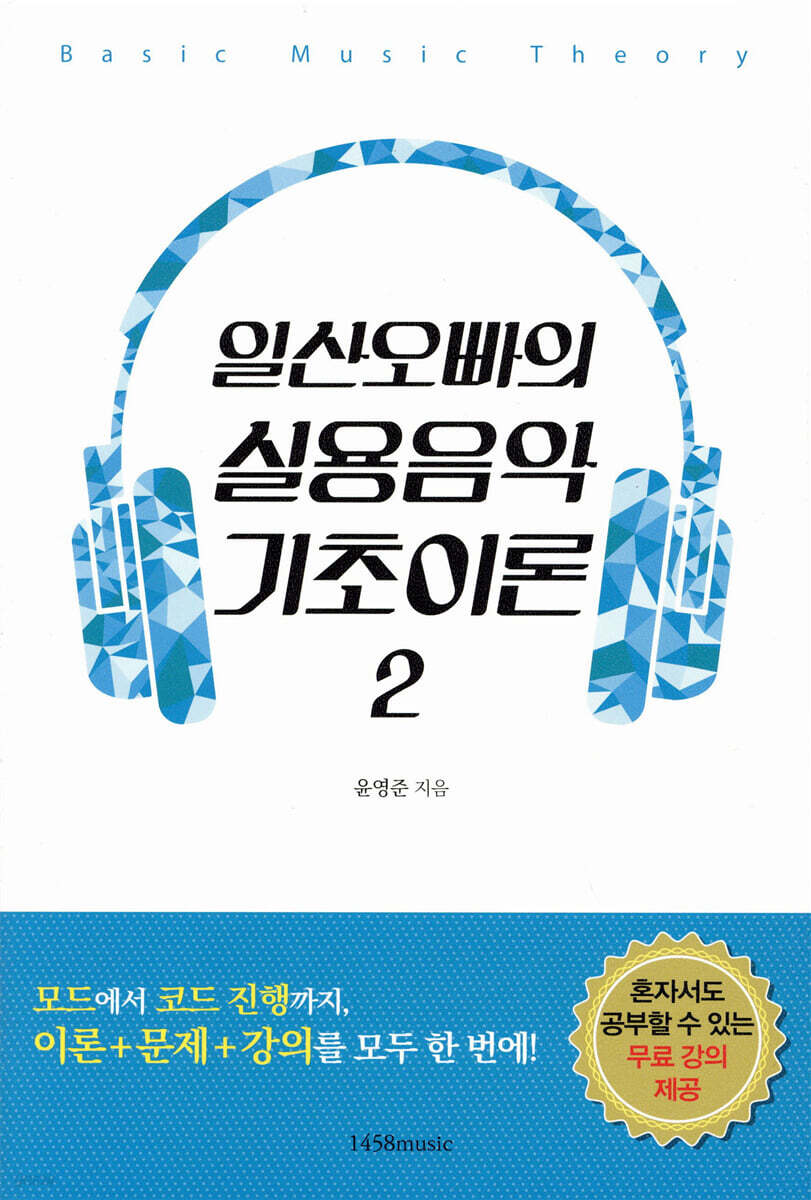
Ilsan Oppa's Practical Music Basics 2
 |
Description
Book Introduction
Theory + Problems + Lectures all in one!
Ilsan Oppa's Practical Music Basics 2
Ilsan Oppa's Practical Music Basics Theory 2 introduces music theory in a bit more depth than Volume 1, from modes to chord progression.
If you studied the basic concepts of music theory in Volume 1, Volume 2 covers the more practical application of that content, and is composed primarily of content that is essential for both students preparing for entrance exams and those who enjoy music as a hobby.
The characteristic of Ilsan Oppa's basic theory of practical music is that it divides the theory into units and explains them.
It helps with planned learning because the content to be studied is organized into small units and arranged in accordance with the thought process that completes the theory.
If you study in order, you can see the overall framework of music theory, and after each theory explanation, check problems, practice problems, and comprehensive problems are given to confirm your understanding.
The presented problems are tailored to practical music and entrance exam types, so they will be of great help to students preparing for the entrance exam.
In Volume 2, review problems were added.
You can check whether you remember the contents you studied in Volume 1 well through the questions.
The biggest advantage of Ilsan Oppa's Practical Music Fundamentals is that it offers free lectures.
The podcast lectures conducted by the author himself provide the same effect as taking lessons from a teacher at any time, as long as you have the textbook.
As you listen to the lectures and look at the textbook, you will soon find yourself shedding the preconceived notion that Mars is difficult.
http://www.podbbang.com/ch/9086
Ilsan Oppa's Practical Music Basics 2
Ilsan Oppa's Practical Music Basics Theory 2 introduces music theory in a bit more depth than Volume 1, from modes to chord progression.
If you studied the basic concepts of music theory in Volume 1, Volume 2 covers the more practical application of that content, and is composed primarily of content that is essential for both students preparing for entrance exams and those who enjoy music as a hobby.
The characteristic of Ilsan Oppa's basic theory of practical music is that it divides the theory into units and explains them.
It helps with planned learning because the content to be studied is organized into small units and arranged in accordance with the thought process that completes the theory.
If you study in order, you can see the overall framework of music theory, and after each theory explanation, check problems, practice problems, and comprehensive problems are given to confirm your understanding.
The presented problems are tailored to practical music and entrance exam types, so they will be of great help to students preparing for the entrance exam.
In Volume 2, review problems were added.
You can check whether you remember the contents you studied in Volume 1 well through the questions.
The biggest advantage of Ilsan Oppa's Practical Music Fundamentals is that it offers free lectures.
The podcast lectures conducted by the author himself provide the same effect as taking lessons from a teacher at any time, as long as you have the textbook.
As you listen to the lectures and look at the textbook, you will soon find yourself shedding the preconceived notion that Mars is difficult.
http://www.podbbang.com/ch/9086
- You can preview some of the book's contents.
Preview
index
Part 9.
Basics of Mods (Lessons 21-23)
51.
What is a mode?
52.
Evolution of the mod
53.
Modes derived from the Major scale
54.
Draw the score by looking at the mode name
55.
Find the name by looking at the mod score
Part 10.
Other scales (24-26)
56.
Modes derived from the jazz minor scale
57.
Finding modes derived from the jazz minor scale
58.
Relationship between code and mode
59.
Other scales
Part 11.
Diatonic 7th Chords and Tension Chords (Lessons 27-29)
60.
Diatonic 7th Chords
61.
Degrees of Diatonic 7th Chords
62.
The principle of tension note composition of diatonic 7th chords
63.
The atmosphere created by the 7th chord
Part 12.
Chord Progression 1 - Diatonic Chords (Lessons 30-33)
64.
Code progression
65.
How to express chord progression
66.
Ascending progression of diatonic chords
67.
Descending progression of diatonic chords
68.
Chord Progression Practice ① Diatonic Triad
69.
Chord Progression Practice ② Diatonic Triads that Match the Melody
70.
Chord Progression Practice ③ Application of 7th Chord
71.
Code Progression Practice ④ Applying Tension Codes
Part 13.
Chord Progression 2 - Non-diatonic Chords (Lessons 34-37)
72.
Are you diatonic?
73.
Secondary dominant
74.
Chord Progression Practice ① Secondary Dominant
75.
Extended Secondary Dominant
76.
Chord Progression Practice ② Extended Secondary Dominant
77.
Secondary Diminished
78.
Chord Progression Practice ③ Secondary Diminished
79.
2-5-1 progression
80.
Code Progression Practice ④ 2-5-1
81.
Modal Interchange
82.
Code Progression Exercise ⑤ Modal Interchange
Part 14.
Chord Progression 3 - Fraction Chords (Lessons 38-40)
83.
Fractional code progression
84.
Chord Progression Exercise ① Bass Progression
85.
Chord progression practice ② Continuous progression of bass
86.
Tone changes made with fractional codes
87.
Changes to V7 (Dominant 7)
Part 15.
Non-harmonic sounds (Lessons 41-44)
88.
Non-harmonic sounds (sounds outside the chord)
89.
passing note
90.
Auxiliary sounds
91.
Pre-stroke
92.
mooring sound
93.
preceding sound
94.
Deviating sounds
95.
Use of non-harmonic sounds
Part 16.
Theoretical terms and principles that are good to know
96.
proxy code
97.
Voice reading
98.
Dense location, Gary location
99.
Basic ending (the end of the song)
100.
Reharmonization
Basics of Mods (Lessons 21-23)
51.
What is a mode?
52.
Evolution of the mod
53.
Modes derived from the Major scale
54.
Draw the score by looking at the mode name
55.
Find the name by looking at the mod score
Part 10.
Other scales (24-26)
56.
Modes derived from the jazz minor scale
57.
Finding modes derived from the jazz minor scale
58.
Relationship between code and mode
59.
Other scales
Part 11.
Diatonic 7th Chords and Tension Chords (Lessons 27-29)
60.
Diatonic 7th Chords
61.
Degrees of Diatonic 7th Chords
62.
The principle of tension note composition of diatonic 7th chords
63.
The atmosphere created by the 7th chord
Part 12.
Chord Progression 1 - Diatonic Chords (Lessons 30-33)
64.
Code progression
65.
How to express chord progression
66.
Ascending progression of diatonic chords
67.
Descending progression of diatonic chords
68.
Chord Progression Practice ① Diatonic Triad
69.
Chord Progression Practice ② Diatonic Triads that Match the Melody
70.
Chord Progression Practice ③ Application of 7th Chord
71.
Code Progression Practice ④ Applying Tension Codes
Part 13.
Chord Progression 2 - Non-diatonic Chords (Lessons 34-37)
72.
Are you diatonic?
73.
Secondary dominant
74.
Chord Progression Practice ① Secondary Dominant
75.
Extended Secondary Dominant
76.
Chord Progression Practice ② Extended Secondary Dominant
77.
Secondary Diminished
78.
Chord Progression Practice ③ Secondary Diminished
79.
2-5-1 progression
80.
Code Progression Practice ④ 2-5-1
81.
Modal Interchange
82.
Code Progression Exercise ⑤ Modal Interchange
Part 14.
Chord Progression 3 - Fraction Chords (Lessons 38-40)
83.
Fractional code progression
84.
Chord Progression Exercise ① Bass Progression
85.
Chord progression practice ② Continuous progression of bass
86.
Tone changes made with fractional codes
87.
Changes to V7 (Dominant 7)
Part 15.
Non-harmonic sounds (Lessons 41-44)
88.
Non-harmonic sounds (sounds outside the chord)
89.
passing note
90.
Auxiliary sounds
91.
Pre-stroke
92.
mooring sound
93.
preceding sound
94.
Deviating sounds
95.
Use of non-harmonic sounds
Part 16.
Theoretical terms and principles that are good to know
96.
proxy code
97.
Voice reading
98.
Dense location, Gary location
99.
Basic ending (the end of the song)
100.
Reharmonization
Publisher's Review
This book explains the basic theories that anyone studying practical music must know.
The best part about the book is that it offers free lectures.
The theories that were difficult to understand by just reading the explanations were accurately and repeatedly learned through lectures.
Additionally, we provide a variety of problems that match the theoretical explanations, allowing you to get a feel for how the theory is applied in practice.
Anyone can master the basic theories of practical music in a short period of time by studying 1-2 lectures per day according to the order guided in the book.
* Free lecture link address
http://www.podbbang.com/ch/9086
Recommendation
1.
Professor Jang Gi-ho (Head of the Department of Practical Music, Seoul Institute of the Arts)
It goes without saying that the basics are important in any field.
This book emphasizes the importance of basic theory in another way.
Friendly explanations and easy-to-understand examples will guide readers comfortably into the world of fundamental music theory.
2.
Composer Kim Do-hoon, CEO of RBW, composer of "Some"
It firmly establishes the foundation of music that was like a floating cloud.
It will be a good guide for those who are starting out in music.
The best part about the book is that it offers free lectures.
The theories that were difficult to understand by just reading the explanations were accurately and repeatedly learned through lectures.
Additionally, we provide a variety of problems that match the theoretical explanations, allowing you to get a feel for how the theory is applied in practice.
Anyone can master the basic theories of practical music in a short period of time by studying 1-2 lectures per day according to the order guided in the book.
* Free lecture link address
http://www.podbbang.com/ch/9086
Recommendation
1.
Professor Jang Gi-ho (Head of the Department of Practical Music, Seoul Institute of the Arts)
It goes without saying that the basics are important in any field.
This book emphasizes the importance of basic theory in another way.
Friendly explanations and easy-to-understand examples will guide readers comfortably into the world of fundamental music theory.
2.
Composer Kim Do-hoon, CEO of RBW, composer of "Some"
It firmly establishes the foundation of music that was like a floating cloud.
It will be a good guide for those who are starting out in music.
GOODS SPECIFICS
- Date of publication: September 18, 2015
- Page count, weight, size: 260 pages | 475g | 152*225*15mm
- ISBN13: 9791195356232
- ISBN10: 1195356234
You may also like
카테고리
korean


korean

![GQ KOREA Mark (Monthly): December [2025]](http://librairie.coreenne.fr/cdn/shop/files/8ef265dbbfbf186523ed75ba7319009d.jpg?v=1765340328&width=3840)


