

Awkward Art Story 8
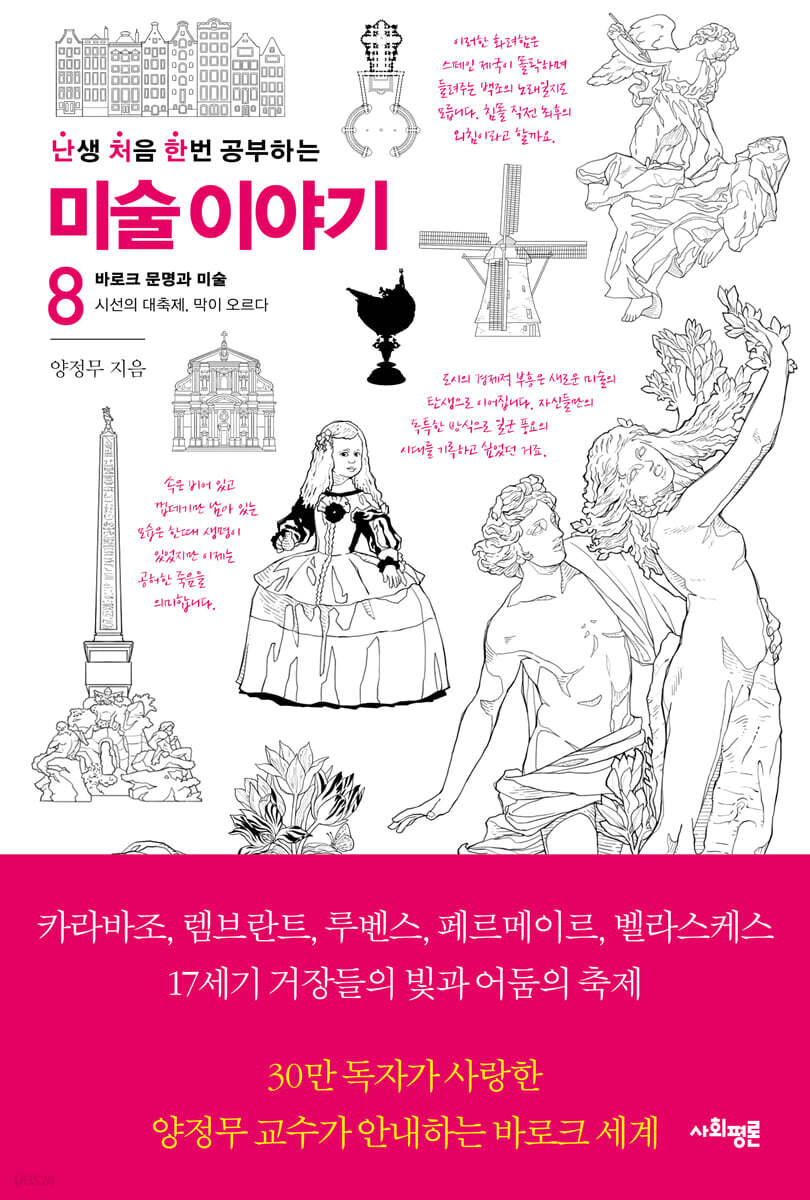 |
Description
Book Introduction
“A parade where new stories unfold continuously no matter how you look at it.
『Embarrassing Art Stories』 Volume 8,
“The ‘Grand Festival of Sight’ leads you to Baroque art.”
The series, "Art Stories I'm Learning for the First Time in My Life," is a book that explains the history of art, which was once perceived as difficult, from beginning to end in an easy-to-understand manner.
After a two-year wait since the publication of Volume 7, the new volume 8, which contains all of the teaching skills of Professor Yang Jeong-mu, an authority in the field of art history, has been published.
Volume 8 contains the triumphant praise of those who have overcome hardships and the art of the Baroque era.
The journey of Baroque art begins in Rome and spreads across Northern Europe and Spain, then across the world.
We examine the efforts of Rome, which fell to the tail of the world, to restore its authority, why commercial art developed so particularly in Northern Europe, and where Baroque art, which reached its peak in Spain, ended.
Another great thing about this book is that it examines the masters of art history (Caravaggio, Rubens, Rembrandt, Vermeer, Velazquez, etc.) who fill the eight volumes side by side.
From these people, whose unique perspectives changed the course of art, the art of Van Gogh, Picasso, and Monet was born.
Professor Yang Jeong-mu, the author of the “Embarrassing Art” series, who brought the joy of “reading” art to 300,000 readers, said, “The eight volumes of “Embarrassing Art Stories” are books that I grew fond of the more I wrote them.”
As he boasts, this book will be established as “the most Baroque textbook,” emphasizing that ceiling paintings (paintings), staircases (architecture), and fountains (sculpture) are the three major characteristics of Baroque art.
『Embarrassing Art Stories』 Volume 8,
“The ‘Grand Festival of Sight’ leads you to Baroque art.”
The series, "Art Stories I'm Learning for the First Time in My Life," is a book that explains the history of art, which was once perceived as difficult, from beginning to end in an easy-to-understand manner.
After a two-year wait since the publication of Volume 7, the new volume 8, which contains all of the teaching skills of Professor Yang Jeong-mu, an authority in the field of art history, has been published.
Volume 8 contains the triumphant praise of those who have overcome hardships and the art of the Baroque era.
The journey of Baroque art begins in Rome and spreads across Northern Europe and Spain, then across the world.
We examine the efforts of Rome, which fell to the tail of the world, to restore its authority, why commercial art developed so particularly in Northern Europe, and where Baroque art, which reached its peak in Spain, ended.
Another great thing about this book is that it examines the masters of art history (Caravaggio, Rubens, Rembrandt, Vermeer, Velazquez, etc.) who fill the eight volumes side by side.
From these people, whose unique perspectives changed the course of art, the art of Van Gogh, Picasso, and Monet was born.
Professor Yang Jeong-mu, the author of the “Embarrassing Art” series, who brought the joy of “reading” art to 300,000 readers, said, “The eight volumes of “Embarrassing Art Stories” are books that I grew fond of the more I wrote them.”
As he boasts, this book will be established as “the most Baroque textbook,” emphasizing that ceiling paintings (paintings), staircases (architecture), and fountains (sculpture) are the three major characteristics of Baroque art.
- You can preview some of the book's contents.
Preview
index
I Roman Baroque - A New Art Blossomed in Chaos
01 The Vatican, the center of the intense and passionate Baroque world
02 The Glory and Frustration of Rome
03 Caravaggio, who aimed at reality with light and darkness
04 Karachi, the city that opened up a world of fantasy
05 The Battle of Geniuses: Bernini and Borromini
II Nordic Baroque - Engraving the Peace Finally Won
01 Rubens, who led the Northern European Baroque
02 The golden sun rising over Amsterdam
03 A new daily life and landscape created by abundance
04 The 'Renaissance' of 17th-century Dutch art
III Spanish Baroque - Consoling a Fallen Empire with the Height of Splendor
01 The Beginning of Spanish Art, El Greco
02 The Essence of Spanish Baroque, Velazquez
03 Baroque Art that Colored the World - Ultra Baroque and Asian Baroque
01 The Vatican, the center of the intense and passionate Baroque world
02 The Glory and Frustration of Rome
03 Caravaggio, who aimed at reality with light and darkness
04 Karachi, the city that opened up a world of fantasy
05 The Battle of Geniuses: Bernini and Borromini
II Nordic Baroque - Engraving the Peace Finally Won
01 Rubens, who led the Northern European Baroque
02 The golden sun rising over Amsterdam
03 A new daily life and landscape created by abundance
04 The 'Renaissance' of 17th-century Dutch art
III Spanish Baroque - Consoling a Fallen Empire with the Height of Splendor
01 The Beginning of Spanish Art, El Greco
02 The Essence of Spanish Baroque, Velazquez
03 Baroque Art that Colored the World - Ultra Baroque and Asian Baroque
Detailed image
.jpg)
Into the book
The Bridge of Angels was an active visual device welcoming pilgrims and tourists who made the arduous journey to the Vatican.
Bernini created this fantastic angel sculpture to bless those who had just entered the Vatican, telling them that they had now entered the world of heaven.
---From "Part 1, Chapter 1: The Vatican, the Center of the Intense and Fiery Baroque World"
Later critics derided Baroque art as a disorderly and distorted style.
But when we recall the crisis the Catholic world went through in the 16th century, it becomes understandable why 17th-century Baroque art was so fixated on exaggerated expression.
Where there is light, there is also darkness, and behind the splendor there were times of crisis and challenge.
The result of overcoming that crisis is the beautiful world created by Baroque art.
---From "Part 1, Chapter 1: The Vatican, the Center of the Intense and Fiery Baroque World"
Through the painting, Caravaggio is saying that it was not the rich and the high-ranking, but ordinary people like us who accompanied Jesus to his final moments.
The people in the painting do not look ordinary, but rather impoverished to the point of difficulty in living.
It is certainly a revolutionary expression in the context of Catholic religious art, as it portrays the socially disadvantaged as adults and saints.
---From "Caravaggio, who aimed at reality with light and darkness in Chapter 3 of Part 1"
In fact, it seems contradictory that a cardinal, a member of the Vatican, would commission a ceiling painting depicting non-Christian gods and their carnal love.
However, the Farnese Gallery was a festive space where parties and banquets were held.
Could this be a blind spot where strict religious standards are relatively relaxed?
---From "Chapter 4, Part 1: Karachi, the World of Fantasy"
In this way, Baroque ceiling paintings turned the ceiling into a window that opened high into the sky.
He tried to vividly show us the heavenly world beyond the window.
It can be said that these confident visual effects opened up artistic possibilities that were distinctly different from the static world of previous Renaissance art.
---From "Chapter 4, Part 1: Karachi, the World of Fantasy"
In fact, Baroque is called theatrical art, and the work that fits this description very well is The Ecstasy of Saint Teresa.
Bernini used the altar in the center of the chapel as a stage and created a scene where Saint Teresa experiences a spiritual experience.
On both walls, the Cornaro family members are depicted astonished at the mysterious scene, as if they were audience members in an opera house.
What's amazing is that all of this is just pieces.
---From "Part 1, Chapter 5: The Battle of Geniuses, Bernini and Borromini"
Rubens depicted every element in meticulous detail, from the shining hair to the texture of the clothing.
The Descent from the Cross is a work of art that combines a sensual yet idealized representation of the human body, magnificent sculptural composition, and delicate detail.
Rubens's unique world was completed by blending the strengths of ancient art, Italian Baroque art, and Flemish art.
---From "Rubens, the Leader of Northern European Baroque, Part 2, Chapter 1"
The subject of the painting gradually changes from everyday materials to luxury items.
In this way, while most still life paintings in the 16th century depicted the simple lives of the common people, in the 17th century, still life paintings began to elegantly depict the luxurious lives of the wealthy.
At that time, still life paintings were also called 'vanitas' in the Netherlands.
Vanitas is a Latin word meaning the transience of life, and in the Bible, it is expressed in the book of Ecclesiastes as 'Vanity of vanities.
It also appears in the phrase 'all is vanity'.
---From "The Golden Sun Rising Over Amsterdam", Part 2, Chapter 2
At that time, the Netherlands was a civil society supported by the strength and wisdom of its citizens.
Successful citizens played their own roles as members of the militia, operating committees of nursing homes, hospitals, etc.
I couldn't help but love the group portrait of myself serving alongside my colleagues, taking pride in carrying out my public duties.
---From "Part 2, Chapter 4, The 'Renaissance' of 17th-Century Dutch Art"
Above all, the building that represents Toledo is the Toledo Cathedral shown above.
With a history spanning over 500 years, it is a place that represents the authority of Spanish Catholicism since the Middle Ages in terms of its scale and splendor.
However, El Greco's process of settling in Toledo was not easy.
Should I say that I experienced discrimination?
But he doesn't give up and learns the so-called 'Spanish spirit'.
El Greco's first work in Toledo has a deep connection with the Toledo Cathedral.
---From "Part 3, Chapter 1: The Beginning of Spanish Art, El Greco"
In 1628, Rubens, a master of his time, returned to Madrid as a diplomat.
At this time, Rubens met Velázquez, who was 22 years younger than him, and gave him advice.
Velázquez initially painted mainly the daily lives of the lower classes.
Rubens left a short comment on his work, calling it 'rustic'.
Rubens was a cool-headed adviser.
He encouraged Velázquez to further his painting studies in Rome, the center of art.
After heeding his loving advice, Velázquez headed to Rome in 1629.
---From "Part 3, Chapter 2: The Essence of Spanish Baroque, Velazquez"
The problem of poverty has become a major social problem.
Interestingly, from this time on, Murillo began to draw poor people.
It captures the miserable lives of poor children and beggars who scavenge for food on the streets with a warm gaze.
His paintings, which give a gentle feeling as if they were caressed by a brush, must have been a comforting hand to the people of Seville who were going through difficult times.
---From "Baroque Art that Colored the World, Part 3, Chapter 3"
The extreme beauty and the collapsing empire create a strong contrast.
This splendor may be the swan song of the Spanish Empire as it falls.
Could this be called the final cry before sinking?
---From "Baroque Art that Colored the World, Part 3, Chapter 3"
It seems that the Joseon people who were sent as envoys to China at the time were amazed by the Western civilization that had entered China.
On the way back home, we each bought a Western painting and hung it up at home.
I hung a realistic Western painting on the wooden floor of a Hanok and shared a novel experience with guests who visited my house.
You must have been impressed by the perspective, the brilliant colors, and the vividness that makes you feel like you are looking at the real thing, which cannot be seen in oriental paintings.
It's really interesting to look at old records of Western paintings.
There is probably no one who has depicted Baroque ceiling paintings as well as Park Ji-won, the protagonist of 『Yeolha Diary』.
Bernini created this fantastic angel sculpture to bless those who had just entered the Vatican, telling them that they had now entered the world of heaven.
---From "Part 1, Chapter 1: The Vatican, the Center of the Intense and Fiery Baroque World"
Later critics derided Baroque art as a disorderly and distorted style.
But when we recall the crisis the Catholic world went through in the 16th century, it becomes understandable why 17th-century Baroque art was so fixated on exaggerated expression.
Where there is light, there is also darkness, and behind the splendor there were times of crisis and challenge.
The result of overcoming that crisis is the beautiful world created by Baroque art.
---From "Part 1, Chapter 1: The Vatican, the Center of the Intense and Fiery Baroque World"
Through the painting, Caravaggio is saying that it was not the rich and the high-ranking, but ordinary people like us who accompanied Jesus to his final moments.
The people in the painting do not look ordinary, but rather impoverished to the point of difficulty in living.
It is certainly a revolutionary expression in the context of Catholic religious art, as it portrays the socially disadvantaged as adults and saints.
---From "Caravaggio, who aimed at reality with light and darkness in Chapter 3 of Part 1"
In fact, it seems contradictory that a cardinal, a member of the Vatican, would commission a ceiling painting depicting non-Christian gods and their carnal love.
However, the Farnese Gallery was a festive space where parties and banquets were held.
Could this be a blind spot where strict religious standards are relatively relaxed?
---From "Chapter 4, Part 1: Karachi, the World of Fantasy"
In this way, Baroque ceiling paintings turned the ceiling into a window that opened high into the sky.
He tried to vividly show us the heavenly world beyond the window.
It can be said that these confident visual effects opened up artistic possibilities that were distinctly different from the static world of previous Renaissance art.
---From "Chapter 4, Part 1: Karachi, the World of Fantasy"
In fact, Baroque is called theatrical art, and the work that fits this description very well is The Ecstasy of Saint Teresa.
Bernini used the altar in the center of the chapel as a stage and created a scene where Saint Teresa experiences a spiritual experience.
On both walls, the Cornaro family members are depicted astonished at the mysterious scene, as if they were audience members in an opera house.
What's amazing is that all of this is just pieces.
---From "Part 1, Chapter 5: The Battle of Geniuses, Bernini and Borromini"
Rubens depicted every element in meticulous detail, from the shining hair to the texture of the clothing.
The Descent from the Cross is a work of art that combines a sensual yet idealized representation of the human body, magnificent sculptural composition, and delicate detail.
Rubens's unique world was completed by blending the strengths of ancient art, Italian Baroque art, and Flemish art.
---From "Rubens, the Leader of Northern European Baroque, Part 2, Chapter 1"
The subject of the painting gradually changes from everyday materials to luxury items.
In this way, while most still life paintings in the 16th century depicted the simple lives of the common people, in the 17th century, still life paintings began to elegantly depict the luxurious lives of the wealthy.
At that time, still life paintings were also called 'vanitas' in the Netherlands.
Vanitas is a Latin word meaning the transience of life, and in the Bible, it is expressed in the book of Ecclesiastes as 'Vanity of vanities.
It also appears in the phrase 'all is vanity'.
---From "The Golden Sun Rising Over Amsterdam", Part 2, Chapter 2
At that time, the Netherlands was a civil society supported by the strength and wisdom of its citizens.
Successful citizens played their own roles as members of the militia, operating committees of nursing homes, hospitals, etc.
I couldn't help but love the group portrait of myself serving alongside my colleagues, taking pride in carrying out my public duties.
---From "Part 2, Chapter 4, The 'Renaissance' of 17th-Century Dutch Art"
Above all, the building that represents Toledo is the Toledo Cathedral shown above.
With a history spanning over 500 years, it is a place that represents the authority of Spanish Catholicism since the Middle Ages in terms of its scale and splendor.
However, El Greco's process of settling in Toledo was not easy.
Should I say that I experienced discrimination?
But he doesn't give up and learns the so-called 'Spanish spirit'.
El Greco's first work in Toledo has a deep connection with the Toledo Cathedral.
---From "Part 3, Chapter 1: The Beginning of Spanish Art, El Greco"
In 1628, Rubens, a master of his time, returned to Madrid as a diplomat.
At this time, Rubens met Velázquez, who was 22 years younger than him, and gave him advice.
Velázquez initially painted mainly the daily lives of the lower classes.
Rubens left a short comment on his work, calling it 'rustic'.
Rubens was a cool-headed adviser.
He encouraged Velázquez to further his painting studies in Rome, the center of art.
After heeding his loving advice, Velázquez headed to Rome in 1629.
---From "Part 3, Chapter 2: The Essence of Spanish Baroque, Velazquez"
The problem of poverty has become a major social problem.
Interestingly, from this time on, Murillo began to draw poor people.
It captures the miserable lives of poor children and beggars who scavenge for food on the streets with a warm gaze.
His paintings, which give a gentle feeling as if they were caressed by a brush, must have been a comforting hand to the people of Seville who were going through difficult times.
---From "Baroque Art that Colored the World, Part 3, Chapter 3"
The extreme beauty and the collapsing empire create a strong contrast.
This splendor may be the swan song of the Spanish Empire as it falls.
Could this be called the final cry before sinking?
---From "Baroque Art that Colored the World, Part 3, Chapter 3"
It seems that the Joseon people who were sent as envoys to China at the time were amazed by the Western civilization that had entered China.
On the way back home, we each bought a Western painting and hung it up at home.
I hung a realistic Western painting on the wooden floor of a Hanok and shared a novel experience with guests who visited my house.
You must have been impressed by the perspective, the brilliant colors, and the vividness that makes you feel like you are looking at the real thing, which cannot be seen in oriental paintings.
It's really interesting to look at old records of Western paintings.
There is probably no one who has depicted Baroque ceiling paintings as well as Park Ji-won, the protagonist of 『Yeolha Diary』.
---From "Baroque Art that Colored the World, Part 3, Chapter 3"
Publisher's Review
* After the Renaissance trilogy, a new Baroque era emerged! Baroque art, confronting deepening hardships, raced toward the pinnacle of splendor!
* The most dazzling and dazzling journey in the "Embarrassing Art Stories" series! Beginning in Europe and reaching Asia!
* From Caravaggio with his devilish talent, Rembrandt who swallowed light and darkness, to Velazquez who breathed life into paintings, we can encounter the works of masters we are familiar with in just one volume!
A grand festival of sight, a brilliant era of art
Magnificent cathedrals, delicate sculptures, and splendid paintings… The grand and fantastical images that come to mind when thinking of art today are largely influenced by Baroque art, which developed in Catholic European countries, including Italy, from the early 17th century to the early 18th century.
Like all artistic movements, Baroque is inseparable from reality.
The Counter-Reformation movement that swept through Europe at the time and the growth of the bourgeoisie based on handicrafts and commerce were the lifeblood of the Baroque, symbolized by its intense contrasts of light and shade and a tendency toward abundance.
Baroque was the 'age of writers'.
Caravaggio of Italy in the early 17th century is called the founder of Baroque painting.
His paintings, with their unstable diagonal compositions and their degrading of saints to the level of mediocrity, completely overturned the Renaissance art grammar that pursued stable compositions and ideal expressions.
His influence spread to Spain and northern Europe, spawning a following known as the Caravagisti.
Flanders and the Netherlands, which gave birth to Rubens and Rembrandt, were also centers of Baroque.
Rembrandt, a representative of Northern European Baroque, captured on canvas the militiamen protecting the peace of the Netherlands.
In a time when the art world was limited to monotonous character compositions, Rembrandt's group portraits, which captured the dynamism of each and every person alive and moving on canvas, were the pinnacle of aesthetics of the time.
In this way, the Baroque era had distinct characteristics of art in each country.
Italian Baroque has a theatrical character with its bold use of composition, movement, and light and shade.
The Netherlands had different artistic developments in the south, which was unable to escape Spanish rule, and in the north, which achieved independence.
While Southern Netherlands Baroque emphasized religious art due to Catholic influence, Northern Netherlands Baroque aimed for de-religion and de-ideology and spread a secular message.
Spanish Baroque, symbolized by Velazquez and Zurbarán, developed strict and restrained art based on strong Catholic ideology.
At the same time, it opened new horizons for Baroque art by revealing strong decorativeness under the influence of Islamic and medieval art.
The danger behind the brilliance
Baroque comes from the Portuguese word Barroco, meaning 'distorted pearl'.
When the word was first used, it carried a contemptuous connotation for architecture and sculpture that were considered overly exaggerated compared to the neat and elegant classical style of the Renaissance.
However, from an art historical perspective, the emergence of Baroque art was inevitable.
As the power of the Catholic Church faltered due to the Reformation, religious art came under strict censorship.
In a situation where the content of art was limited, the only breakthrough was a dramatic change in form.
Artists overcame the crisis by pursuing imbalance instead of balance, mediocrity instead of elegance, emotion instead of reason, and reality instead of fantasy.
Baroque art was an active movement of artists who sought to continue their artistic activities by finding new paths.
As a result, Baroque is considered a key trend that reflected the zeitgeist of 17th-century Europe.
Baroque artists often used theatrical elements to emphasize the authority and faith of the Church.
At its center is Bernini's sculpture [The Ecstasy of Saint Teresa].
Bernini created the moment of Saint Teresa's spiritual experience in the center of the chapel, and placed figures on either side to watch her, using the chapel as a theatrical stage.
Additionally, lighting effects were added by creating a window above the statue of St. Teresa and recreating rays of light.
It was a culmination of Baroque art that held the gaze with an intense visual experience.
The grand festival of gazes has finally begun
The keyword of Baroque art is ‘gaze.’
Considering the composition of the gaze looking at the work, we created an optical illusion effect, used exaggerated expressions that overwhelmed the gaze, and created a new perspective imbued with novelty.
Annibale Carracci, who led the 17th-century Roman art scene along with Caravaggio, enjoyed using optical illusions.
The ceiling painting he left behind in the mansion of the Farnese family, a prestigious Italian family, is considered a masterpiece representing the Baroque era.
Large and small paintings are surrounded by gold frames and marble sculptures.
But there are no frames or sculptures here.
Annibale Carracci meticulously calculated the angles from below to create a ceiling painting that made it seem as if all these elements were actually present.
Bernini used 'exaggeration' as a keyword.
Curly hair and wrinkled clothes, as if she just came out of the hair salon.
His dynamic and exaggerated expressions are characteristic of the Baroque.
Velazquez's masterpiece, [Las Meninas], adds to the pleasure of seeing by expanding the 'gaze' with a mirror.
To the left of the princess, who appears to be the main character in the painting, a man is holding a brush.
It's Velazquez himself.
He draws while looking at the object opposite him.
Who is he painting? Is he depicting the "viewer" looking at him? Is the royal couple reflected in the mirror hanging behind the princess? The viewer, that is, we, are standing in the same position as the royal couple in the painting.
In this way, Velázquez transcends the boundaries between reality and fantasy, illuminating both the audience and the royal couple simultaneously.
[The Maids] contains a lot of room for interpretation with various visual devices.
This is why people flock to the Prado Museum in Spain, which houses this work.
Turning crisis into opportunity
Part 1 Roman Baroque
St. Peter's Basilica is the center of Roman Catholicism and is still a popular tourist destination today.
What was this place like in the 17th century? Catholic pilgrims on their way to St. Peter's Basilica had to walk barefoot for days.
Those who overcame moments when they felt like they were about to collapse from exhaustion and finally arrived at the Vatican were greeted by angels above the clouds.
An angel statue with an ecstatic appearance, as if it had reached heaven.
Baroque art was a triumphant tribute to those who had overcome hardship.
Moreover, it is no exaggeration to say that the story of the two rivalries between Caravaggio and Annibale, and Bernini and Borromini, is a highlight of Roman Baroque.
Peace and prosperity enjoyed by all
Part 2: Nordic Baroque
The land of tulips and windmills.
The Dutch Republic, free from the religious oppression of Spain, valued freedom and tolerance.
After 80 years of war, this place welcomed an era of peace, where citizens enjoyed a prosperous life and art.
A life of abundance and freedom led to the birth of still life paintings.
The pride in the land they protected was expressed in group portraits, genre paintings, and landscapes.
The daily life and landscapes of 17th-century Netherlands, seen through the works of Rubens, Rembrandt, and Vermeer, representative of Northern European art, are a celebration of freedom and peace achieved through one's own efforts.
A swan's song as it watches the setting sun
Part 3 Spanish Baroque
Because Spain was an empire with vast territories, it is difficult to estimate the scope of art at a national level.
Nevertheless, El Greco, who represents the Spanish spirit, guides us with deep spiritual inspiration.
Velazquez is a painter who stands at the pinnacle of Spanish art.
Spanish art, which had not produced any significant artistic achievements since Velázquez's death, rose again in Seville.
Ironically, art flourished in the back alleys of the empire amidst severe economic hardship.
A story of art that overcame the most difficult and painful times in the most brilliant way.
I invite you to those dazzling times.
* The most dazzling and dazzling journey in the "Embarrassing Art Stories" series! Beginning in Europe and reaching Asia!
* From Caravaggio with his devilish talent, Rembrandt who swallowed light and darkness, to Velazquez who breathed life into paintings, we can encounter the works of masters we are familiar with in just one volume!
A grand festival of sight, a brilliant era of art
Magnificent cathedrals, delicate sculptures, and splendid paintings… The grand and fantastical images that come to mind when thinking of art today are largely influenced by Baroque art, which developed in Catholic European countries, including Italy, from the early 17th century to the early 18th century.
Like all artistic movements, Baroque is inseparable from reality.
The Counter-Reformation movement that swept through Europe at the time and the growth of the bourgeoisie based on handicrafts and commerce were the lifeblood of the Baroque, symbolized by its intense contrasts of light and shade and a tendency toward abundance.
Baroque was the 'age of writers'.
Caravaggio of Italy in the early 17th century is called the founder of Baroque painting.
His paintings, with their unstable diagonal compositions and their degrading of saints to the level of mediocrity, completely overturned the Renaissance art grammar that pursued stable compositions and ideal expressions.
His influence spread to Spain and northern Europe, spawning a following known as the Caravagisti.
Flanders and the Netherlands, which gave birth to Rubens and Rembrandt, were also centers of Baroque.
Rembrandt, a representative of Northern European Baroque, captured on canvas the militiamen protecting the peace of the Netherlands.
In a time when the art world was limited to monotonous character compositions, Rembrandt's group portraits, which captured the dynamism of each and every person alive and moving on canvas, were the pinnacle of aesthetics of the time.
In this way, the Baroque era had distinct characteristics of art in each country.
Italian Baroque has a theatrical character with its bold use of composition, movement, and light and shade.
The Netherlands had different artistic developments in the south, which was unable to escape Spanish rule, and in the north, which achieved independence.
While Southern Netherlands Baroque emphasized religious art due to Catholic influence, Northern Netherlands Baroque aimed for de-religion and de-ideology and spread a secular message.
Spanish Baroque, symbolized by Velazquez and Zurbarán, developed strict and restrained art based on strong Catholic ideology.
At the same time, it opened new horizons for Baroque art by revealing strong decorativeness under the influence of Islamic and medieval art.
The danger behind the brilliance
Baroque comes from the Portuguese word Barroco, meaning 'distorted pearl'.
When the word was first used, it carried a contemptuous connotation for architecture and sculpture that were considered overly exaggerated compared to the neat and elegant classical style of the Renaissance.
However, from an art historical perspective, the emergence of Baroque art was inevitable.
As the power of the Catholic Church faltered due to the Reformation, religious art came under strict censorship.
In a situation where the content of art was limited, the only breakthrough was a dramatic change in form.
Artists overcame the crisis by pursuing imbalance instead of balance, mediocrity instead of elegance, emotion instead of reason, and reality instead of fantasy.
Baroque art was an active movement of artists who sought to continue their artistic activities by finding new paths.
As a result, Baroque is considered a key trend that reflected the zeitgeist of 17th-century Europe.
Baroque artists often used theatrical elements to emphasize the authority and faith of the Church.
At its center is Bernini's sculpture [The Ecstasy of Saint Teresa].
Bernini created the moment of Saint Teresa's spiritual experience in the center of the chapel, and placed figures on either side to watch her, using the chapel as a theatrical stage.
Additionally, lighting effects were added by creating a window above the statue of St. Teresa and recreating rays of light.
It was a culmination of Baroque art that held the gaze with an intense visual experience.
The grand festival of gazes has finally begun
The keyword of Baroque art is ‘gaze.’
Considering the composition of the gaze looking at the work, we created an optical illusion effect, used exaggerated expressions that overwhelmed the gaze, and created a new perspective imbued with novelty.
Annibale Carracci, who led the 17th-century Roman art scene along with Caravaggio, enjoyed using optical illusions.
The ceiling painting he left behind in the mansion of the Farnese family, a prestigious Italian family, is considered a masterpiece representing the Baroque era.
Large and small paintings are surrounded by gold frames and marble sculptures.
But there are no frames or sculptures here.
Annibale Carracci meticulously calculated the angles from below to create a ceiling painting that made it seem as if all these elements were actually present.
Bernini used 'exaggeration' as a keyword.
Curly hair and wrinkled clothes, as if she just came out of the hair salon.
His dynamic and exaggerated expressions are characteristic of the Baroque.
Velazquez's masterpiece, [Las Meninas], adds to the pleasure of seeing by expanding the 'gaze' with a mirror.
To the left of the princess, who appears to be the main character in the painting, a man is holding a brush.
It's Velazquez himself.
He draws while looking at the object opposite him.
Who is he painting? Is he depicting the "viewer" looking at him? Is the royal couple reflected in the mirror hanging behind the princess? The viewer, that is, we, are standing in the same position as the royal couple in the painting.
In this way, Velázquez transcends the boundaries between reality and fantasy, illuminating both the audience and the royal couple simultaneously.
[The Maids] contains a lot of room for interpretation with various visual devices.
This is why people flock to the Prado Museum in Spain, which houses this work.
Turning crisis into opportunity
Part 1 Roman Baroque
St. Peter's Basilica is the center of Roman Catholicism and is still a popular tourist destination today.
What was this place like in the 17th century? Catholic pilgrims on their way to St. Peter's Basilica had to walk barefoot for days.
Those who overcame moments when they felt like they were about to collapse from exhaustion and finally arrived at the Vatican were greeted by angels above the clouds.
An angel statue with an ecstatic appearance, as if it had reached heaven.
Baroque art was a triumphant tribute to those who had overcome hardship.
Moreover, it is no exaggeration to say that the story of the two rivalries between Caravaggio and Annibale, and Bernini and Borromini, is a highlight of Roman Baroque.
Peace and prosperity enjoyed by all
Part 2: Nordic Baroque
The land of tulips and windmills.
The Dutch Republic, free from the religious oppression of Spain, valued freedom and tolerance.
After 80 years of war, this place welcomed an era of peace, where citizens enjoyed a prosperous life and art.
A life of abundance and freedom led to the birth of still life paintings.
The pride in the land they protected was expressed in group portraits, genre paintings, and landscapes.
The daily life and landscapes of 17th-century Netherlands, seen through the works of Rubens, Rembrandt, and Vermeer, representative of Northern European art, are a celebration of freedom and peace achieved through one's own efforts.
A swan's song as it watches the setting sun
Part 3 Spanish Baroque
Because Spain was an empire with vast territories, it is difficult to estimate the scope of art at a national level.
Nevertheless, El Greco, who represents the Spanish spirit, guides us with deep spiritual inspiration.
Velazquez is a painter who stands at the pinnacle of Spanish art.
Spanish art, which had not produced any significant artistic achievements since Velázquez's death, rose again in Seville.
Ironically, art flourished in the back alleys of the empire amidst severe economic hardship.
A story of art that overcame the most difficult and painful times in the most brilliant way.
I invite you to those dazzling times.
GOODS SPECIFICS
- Date of issue: October 4, 2024
- Page count, weight, size: 616 pages | 934g | 152*225*39mm
- ISBN13: 9791162733349
- ISBN10: 1162733349
You may also like
카테고리
korean


korean

![GQ KOREA Mark (Monthly): December [2025]](http://librairie.coreenne.fr/cdn/shop/files/8ef265dbbfbf186523ed75ba7319009d.jpg?v=1765340328&width=3840)


