

Again, the plan is in two forms.
 |
Description
Book Introduction
★ The latest revised and expanded edition of the best-selling book that has been reprinted 25 times since its publication in 2014!
★ The origin of 'problem solving is planning' and 'simple planning', the 'planning bible'
★ An easy-to-understand planning book that you can understand if you know only "The Tortoise and the Hare"
★ Constant praise and recommendations from Korea's top planners
“When talking about planning, there is no better book than ‘Planning is a Two-Format Plan.’”
“My work life is divided into before and after reading ‘Planning is in Two Forms.’”
“If you ask me how to solve a problem properly, I would recommend this book without hesitation.”
“I recommend this book to those who work in creative fields and are constantly at a crossroads in planning, as well as to those who want to learn how to plan their lives.”
- Jang In-seong, CEO of Stayfolio / Author of "Marketer's Work" / Former CBO of Baedal Minjok
Yoon Du-seok, Head of the Shopping Live Team at Hyundai Home Shopping / E-commerce Content Planner
Kim Bong-gi, CEO of NRISE / Planner of Wi-Fi and Quat services
- Relay praise from Won Ah-ran, GFFG Creative Director / Former Disney APAC Retail Creative Manager, and others!
★ The origin of 'problem solving is planning' and 'simple planning', the 'planning bible'
★ An easy-to-understand planning book that you can understand if you know only "The Tortoise and the Hare"
★ Constant praise and recommendations from Korea's top planners
“When talking about planning, there is no better book than ‘Planning is a Two-Format Plan.’”
“My work life is divided into before and after reading ‘Planning is in Two Forms.’”
“If you ask me how to solve a problem properly, I would recommend this book without hesitation.”
“I recommend this book to those who work in creative fields and are constantly at a crossroads in planning, as well as to those who want to learn how to plan their lives.”
- Jang In-seong, CEO of Stayfolio / Author of "Marketer's Work" / Former CBO of Baedal Minjok
Yoon Du-seok, Head of the Shopping Live Team at Hyundai Home Shopping / E-commerce Content Planner
Kim Bong-gi, CEO of NRISE / Planner of Wi-Fi and Quat services
- Relay praise from Won Ah-ran, GFFG Creative Director / Former Disney APAC Retail Creative Manager, and others!
- You can preview some of the book's contents.
Preview
index
Recommendation 006
Acknowledgements 010
Publishing the 10th Anniversary Special Edition - Again, it's the essence.
Planning again 012
Prologue - Funky Jazz, Awakening the Creative Giant Within You 018
Epilogue - The Beatles Sing Planning Code 430
The story of the birth of O Planning Code
Planning's A 30 | Planning is Value 31 | Salieri Syndrome: Planning, Anyone Can Do It, But Not Everyone Can Do It Well 34 | Bad Jar 38 | The Taste of Planning 40 | The Aesthetics of Kiss 41 | The Temple of Process 44 | The Cupertino Project 50 | SAW 53 | Montage of Planning 55 | A's Insight 59 | I am a boy.
You are a girl 69 | Code Play 73 | Strange Picture 80 | 7525 84 | Lincoln's Descendants 86 | Common Sense and Courage 91 | Map 93
The first form of P planning, the P code story
Problems of Problems 98 | Stranger 99 | Where's Wally 102 | Basic Wally 104 | Applied Wally 168 | A Beautiful Mind 226 | Zoo Story 228 | Plan with Purpose 232 | North Star Planners 238 | Art of P 250
The second form of the S plan, the S code story
Answer 258 | Please Be Honest 259 | Eun-gyo 262 | Jumping 265 | Monkey's Butthole 269 | The King of Metaphors 277 | Steal 285 | The Art of Stealing Without Being Noticed 292 | The Secret of Creativity Revealed by Einstein 293 | Jumping to Space 321 | Let's Do It 336 | Never Forget 'P' 345 | What Kind of Planner Does This Era Want? 354 | The Planner Who Writes Moleskine Monthly 356 | The Art of S 372
The Story of PS Planning's Integrated Code
The Beginning of the End 381 | Alone 382 | Drawing, Not Writing 385 | Proposal Code 388 | Drawing Planning Code in the Audience's Head 395 | Discarding Planning Code 422
Acknowledgements 010
Publishing the 10th Anniversary Special Edition - Again, it's the essence.
Planning again 012
Prologue - Funky Jazz, Awakening the Creative Giant Within You 018
Epilogue - The Beatles Sing Planning Code 430
The story of the birth of O Planning Code
Planning's A 30 | Planning is Value 31 | Salieri Syndrome: Planning, Anyone Can Do It, But Not Everyone Can Do It Well 34 | Bad Jar 38 | The Taste of Planning 40 | The Aesthetics of Kiss 41 | The Temple of Process 44 | The Cupertino Project 50 | SAW 53 | Montage of Planning 55 | A's Insight 59 | I am a boy.
You are a girl 69 | Code Play 73 | Strange Picture 80 | 7525 84 | Lincoln's Descendants 86 | Common Sense and Courage 91 | Map 93
The first form of P planning, the P code story
Problems of Problems 98 | Stranger 99 | Where's Wally 102 | Basic Wally 104 | Applied Wally 168 | A Beautiful Mind 226 | Zoo Story 228 | Plan with Purpose 232 | North Star Planners 238 | Art of P 250
The second form of the S plan, the S code story
Answer 258 | Please Be Honest 259 | Eun-gyo 262 | Jumping 265 | Monkey's Butthole 269 | The King of Metaphors 277 | Steal 285 | The Art of Stealing Without Being Noticed 292 | The Secret of Creativity Revealed by Einstein 293 | Jumping to Space 321 | Let's Do It 336 | Never Forget 'P' 345 | What Kind of Planner Does This Era Want? 354 | The Planner Who Writes Moleskine Monthly 356 | The Art of S 372
The Story of PS Planning's Integrated Code
The Beginning of the End 381 | Alone 382 | Drawing, Not Writing 385 | Proposal Code 388 | Drawing Planning Code in the Audience's Head 395 | Discarding Planning Code 422
Detailed image

Into the book
No matter how technology advances and how the world changes, humans' value-driven instinct and creative desire to solve problems will never disappear.
And AI will not be able to replace or destroy that essence.
This is the role of the planner.
--- p.15, “Publishing the 10th Anniversary Special Edition, it is the essence again.
From "Planning Again"
Because planning is the work of creating ‘new value.’
Because good planning, good planning, changes the world.
Because it can make my family, my friends, and my loved ones happier.
--- p.31, from “Planning is value. Good planning creates a good world and a happy me.”
I saw the 'Moleskine Diary'.
I saw 'Fried Food'.
I saw the 'UNICEF booth'.
I just saw it and said saw.
And then, “Monthly Yoon Jong-shin” was born.
Instant Ramen was born.
〈TOSS〉 was born.
…insight is fundamentally the ‘ability to see,’ but it is the ‘ability to see what others cannot see.’
Moleskine, Fried Food, and UNICEF booths are also visible to our eyes.
Was it really a Moleskine they saw? Was it fried food? Was it a UNICEF booth? What did they see?
--- p.53, from “The Unbelievable Testimonies of SAW Creative Planners”
Planning is not something to be thought of as a 'complex process'.
Planning is about thinking 'simply in two forms'.
Problem 1 Solution 2 Think about the problem first, then think about the solution.
When thoughts become simple in two forms, speech and writing also become simple in two forms.
Do you believe it? The simplest sentence format for meetings, presentations, and proposals is none other than "Form 2."
--- p.69, 「I am a boy.
You are a girl.
Define the problem and solution in two-form sentences.
The secret to success wasn't the planner's genius creativity.
It was the planner's tenacity to dig into the essence of the problem by asking the question, 'Why?'
It was the power of a simple yet powerful 'why'.
--- p.120, from “2_ Why 1↓: One letter that goes to the essence of the problem”
Nestlé conducted a survey.
Housewives answered that it was because it was 'tasteless' compared to coffee beans.
It was a bit weird.
This is because in a blind test conducted before the coffee was launched, the majority of people could not tell the difference between the taste of whole bean coffee and instant coffee.
In 1950, Professor Mason Haire, commissioned by Nestlé, conducted a 'projection method' to discover the hidden P-code of housewives.
… In other words, Nestlé was able to use projection techniques to reveal that the real reason people don't buy instant coffee is not because it "doesn't taste good," but because they feel guilty about being seen as lazy and indiscriminate housewives. They were able to completely revise their marketing strategy based on that P-code, ushering in the golden age of instant coffee.
--- p.127, from “3_ Tools: How to Handle Research and Data”
“My problem awareness radar isn’t very good yet.
Even if I look hard, I can't see the problem.
“How can I do this?” There is a way.
If you can't see it clearly, try splitting it up and looking at it.
Try to artificially fragment the phenomenon you see.
By turning on your 'problem awareness radar' on each piece, you can uncover previously unseen issues.
--- p.182, 「1-3.
From "If you can't see it, break it down and look: Finding a planning topic using the problem division method"
Which of the three problem statements is the correct one? Of course, there's no right answer.
However, as mentioned, the individual issues identified should be structured around one core issue, the kingpin.
Each problem must be organically connected rather than fragmented to become a single 'perspective'.
Maturation from the paradigm of 'problems' that point out problems to the paradigm of 'perspectives' that look at problems will make your plan appear as a more valuable vision.
--- p.217, from “2-4 Mature the Problem from a Perspective”
Surprisingly, planning experts are not very interested in 'Strange Code'.
Focus on 'Sympathy Code'.
Why is that? Because the experts' "problem definitions," or P-codes, are already new and unfamiliar.
This is because the specified problem already has an 'unfamiliar code' built in.
--- p.261, from “Please Be Honest: The Big Idea is Balancing the Code of Strangeness and the Code of Empathy”
Good planning has a metaphor.
A good metaphor is also of the two-form 'Not A, but B'.
The 'Not A, But B' format multiplies the power of metaphor.
〈NOT A BUT B〉 ?Starbucks is not a 'coffee shop'.
It is an 'oasis in the city'.
…metaphors are not just metaphors.
Metaphors can also be 'concepts' in planning.
--- p.283, from “The King of Metaphors: A Good Concept Has a Hidden Metaphor Code”
The line between creativity and plagiarism is a fine line.
This is the essence of the secret message Einstein gave us.
“Steal, but steal the form, not the content.” In other words, if you steal the “inner idea” such as the “principle, structure, pattern” of a product, service, or design, rather than the “outer idea” that is easily visible, it will not be noticeable and you will not be able to tell that you stole it.
And instead of borrowing ideas from the same or similar industries, it is the creative wisdom of stealing several from distant industries and mixing them together so that the original forms of the stolen ideas are completely hidden.
--- p.294-295, from “The Secret of Creativity Leaked by Einstein: Steal the Form, Not the Content”
Now, Yoon Jong-shin needed an idea of 25% S-code that would realize the 'marketing lightweight project for music release' (that would jump up to Baekdu Mountain).
… “Let’s make it light and release it often!” This is Yoon Jong-shin’s unique ‘light music release system.’
… It exquisitely combines the dilemma of ‘regular or single’ with the answer of ‘releasing singles regularly.’
… Planner Yoon Jong-shin stole again.
Where? He confessed(?) to stealing it from his own 'Moleskine Monthly Diary'.
While he was pondering the appropriate publication cycle, one day he suddenly looked at the Moleskine Monthly he always carried around and thought, 'Yes, Monthly, one month would be perfect.'
--- p.362-364, from “The ultimate planning ability of a planner who writes Moleskine Monthly is execution ability”
Planning Code is a planning wally that shines and becomes more powerful the more complex and tangled and difficult the task becomes.
Now we plan with planning code.
Now, when we have planning meetings, we don't start with, "Let's have some ideas."
It starts with, “What is the real problem we need to solve?”
We spend 75% of our time and energy on P-code.
I know that the idea of S-code is not 'invention' but 'association'.
Sometimes we use metaphors, steal ideas from other areas, mix them up, and come up with something better out of them.
--- p.434, from "Epilogue: The Beatles Sing the Planning Code"
I am a planner who lacks talent and ability.
So, I am a planner who knows the ‘power of togetherness’ better than anyone else.
I value three skilled planners more than one brilliant planner, and I believe that planning is not about talent, but about attitude.
I told you in planning that there is no 'right answer'.
There is only the ‘answer’ that we find together.
A world without answers.
So, I hope we can work together to create a better plan that will bring more value to the world.
…is that all? Our life plans are no different.
And AI will not be able to replace or destroy that essence.
This is the role of the planner.
--- p.15, “Publishing the 10th Anniversary Special Edition, it is the essence again.
From "Planning Again"
Because planning is the work of creating ‘new value.’
Because good planning, good planning, changes the world.
Because it can make my family, my friends, and my loved ones happier.
--- p.31, from “Planning is value. Good planning creates a good world and a happy me.”
I saw the 'Moleskine Diary'.
I saw 'Fried Food'.
I saw the 'UNICEF booth'.
I just saw it and said saw.
And then, “Monthly Yoon Jong-shin” was born.
Instant Ramen was born.
〈TOSS〉 was born.
…insight is fundamentally the ‘ability to see,’ but it is the ‘ability to see what others cannot see.’
Moleskine, Fried Food, and UNICEF booths are also visible to our eyes.
Was it really a Moleskine they saw? Was it fried food? Was it a UNICEF booth? What did they see?
--- p.53, from “The Unbelievable Testimonies of SAW Creative Planners”
Planning is not something to be thought of as a 'complex process'.
Planning is about thinking 'simply in two forms'.
Problem 1 Solution 2 Think about the problem first, then think about the solution.
When thoughts become simple in two forms, speech and writing also become simple in two forms.
Do you believe it? The simplest sentence format for meetings, presentations, and proposals is none other than "Form 2."
--- p.69, 「I am a boy.
You are a girl.
Define the problem and solution in two-form sentences.
The secret to success wasn't the planner's genius creativity.
It was the planner's tenacity to dig into the essence of the problem by asking the question, 'Why?'
It was the power of a simple yet powerful 'why'.
--- p.120, from “2_ Why 1↓: One letter that goes to the essence of the problem”
Nestlé conducted a survey.
Housewives answered that it was because it was 'tasteless' compared to coffee beans.
It was a bit weird.
This is because in a blind test conducted before the coffee was launched, the majority of people could not tell the difference between the taste of whole bean coffee and instant coffee.
In 1950, Professor Mason Haire, commissioned by Nestlé, conducted a 'projection method' to discover the hidden P-code of housewives.
… In other words, Nestlé was able to use projection techniques to reveal that the real reason people don't buy instant coffee is not because it "doesn't taste good," but because they feel guilty about being seen as lazy and indiscriminate housewives. They were able to completely revise their marketing strategy based on that P-code, ushering in the golden age of instant coffee.
--- p.127, from “3_ Tools: How to Handle Research and Data”
“My problem awareness radar isn’t very good yet.
Even if I look hard, I can't see the problem.
“How can I do this?” There is a way.
If you can't see it clearly, try splitting it up and looking at it.
Try to artificially fragment the phenomenon you see.
By turning on your 'problem awareness radar' on each piece, you can uncover previously unseen issues.
--- p.182, 「1-3.
From "If you can't see it, break it down and look: Finding a planning topic using the problem division method"
Which of the three problem statements is the correct one? Of course, there's no right answer.
However, as mentioned, the individual issues identified should be structured around one core issue, the kingpin.
Each problem must be organically connected rather than fragmented to become a single 'perspective'.
Maturation from the paradigm of 'problems' that point out problems to the paradigm of 'perspectives' that look at problems will make your plan appear as a more valuable vision.
--- p.217, from “2-4 Mature the Problem from a Perspective”
Surprisingly, planning experts are not very interested in 'Strange Code'.
Focus on 'Sympathy Code'.
Why is that? Because the experts' "problem definitions," or P-codes, are already new and unfamiliar.
This is because the specified problem already has an 'unfamiliar code' built in.
--- p.261, from “Please Be Honest: The Big Idea is Balancing the Code of Strangeness and the Code of Empathy”
Good planning has a metaphor.
A good metaphor is also of the two-form 'Not A, but B'.
The 'Not A, But B' format multiplies the power of metaphor.
〈NOT A BUT B〉 ?Starbucks is not a 'coffee shop'.
It is an 'oasis in the city'.
…metaphors are not just metaphors.
Metaphors can also be 'concepts' in planning.
--- p.283, from “The King of Metaphors: A Good Concept Has a Hidden Metaphor Code”
The line between creativity and plagiarism is a fine line.
This is the essence of the secret message Einstein gave us.
“Steal, but steal the form, not the content.” In other words, if you steal the “inner idea” such as the “principle, structure, pattern” of a product, service, or design, rather than the “outer idea” that is easily visible, it will not be noticeable and you will not be able to tell that you stole it.
And instead of borrowing ideas from the same or similar industries, it is the creative wisdom of stealing several from distant industries and mixing them together so that the original forms of the stolen ideas are completely hidden.
--- p.294-295, from “The Secret of Creativity Leaked by Einstein: Steal the Form, Not the Content”
Now, Yoon Jong-shin needed an idea of 25% S-code that would realize the 'marketing lightweight project for music release' (that would jump up to Baekdu Mountain).
… “Let’s make it light and release it often!” This is Yoon Jong-shin’s unique ‘light music release system.’
… It exquisitely combines the dilemma of ‘regular or single’ with the answer of ‘releasing singles regularly.’
… Planner Yoon Jong-shin stole again.
Where? He confessed(?) to stealing it from his own 'Moleskine Monthly Diary'.
While he was pondering the appropriate publication cycle, one day he suddenly looked at the Moleskine Monthly he always carried around and thought, 'Yes, Monthly, one month would be perfect.'
--- p.362-364, from “The ultimate planning ability of a planner who writes Moleskine Monthly is execution ability”
Planning Code is a planning wally that shines and becomes more powerful the more complex and tangled and difficult the task becomes.
Now we plan with planning code.
Now, when we have planning meetings, we don't start with, "Let's have some ideas."
It starts with, “What is the real problem we need to solve?”
We spend 75% of our time and energy on P-code.
I know that the idea of S-code is not 'invention' but 'association'.
Sometimes we use metaphors, steal ideas from other areas, mix them up, and come up with something better out of them.
--- p.434, from "Epilogue: The Beatles Sing the Planning Code"
I am a planner who lacks talent and ability.
So, I am a planner who knows the ‘power of togetherness’ better than anyone else.
I value three skilled planners more than one brilliant planner, and I believe that planning is not about talent, but about attitude.
I told you in planning that there is no 'right answer'.
There is only the ‘answer’ that we find together.
A world without answers.
So, I hope we can work together to create a better plan that will bring more value to the world.
…is that all? Our life plans are no different.
--- p.435-436, from "Epilogue: The Beatles Sing the Planning Code"
Publisher's Review
In the AI era, planning is the key to becoming unique.
Published in 2014, 『Planning is a Two-Format』, which contained the know-how and insight of Nam Chung-sik, the industry's top veteran planner, caught the attention of readers with its unique picture of glasses on the bright yellow cover, and captured the hearts of readers who are planners in the field, aspiring planners, and everyday planners with its unique and novel content such as 'The essence is problem solving', 'two-form planning', and 'planning code'.
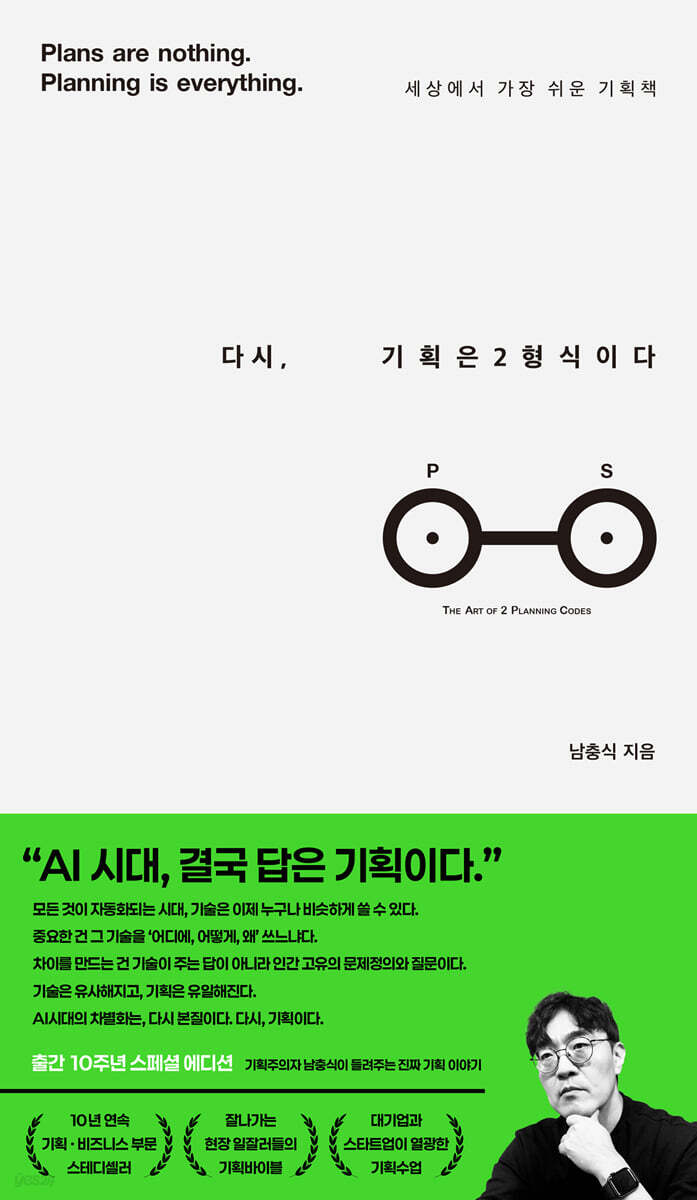
And again, the author and Human Cube published the 10th anniversary special edition, “Again, Planning is in 2 forms.”
The cover is clear in white, and the elongated format and exposed four-page binding make it easy to read and sturdy.
But the essence of the content, ‘human’, remains the same.
As concerns grow louder that AI, which aims to be human itself, is diminishing the human role, ironically, what is demanded of humans is to become more 'humane.'
Technology may provide the answers, but defining problems, asking questions, and creating meaning are uniquely human domains.
So, we must focus on 'planning' to make people happy by exploring and defining human problems and creating new values.
Even after 10 years, even after 20 years, it is still a plan, and the plan is still in two forms.
Good planning creates a happy 'me'
“This YouTube channel has great planning.”, “This product planning has made a difference in sales.”
The words ‘planning’ and ‘planning ability’ are used everywhere.
It's a world where 'planning' is necessary not only for work but also for anniversary events for lovers, birthday parties for friends, marriage, childbirth, children's education, and even my own life story.
Everyone knows how important planning is.
But why is planning important? Why do we even talk about planning? Nam Chung-sik, author of "Planning is a Two-Format Again," explains.
“Planning is value.
“Good planning creates a better world and makes me happy.”
Well-planned idols and dramas promote a country and elevate its cultural status.
Make friends and loved ones happy by planning special events.
One financial app project made payments and remittances easier and even improved financial life.
Planning is about creating a world where planning is easy, a pleasant daily life, and a happy me.
So, it is important to plan well and see.
How can I do this well? "Planning Code" is the answer.
Problem (P):Solution (S), 75:25 planning code
The essence of planning is ‘solving problems.’
Finding a solution by understanding the essence of a given problem.
To this end, the author proposes a 'planning code' of P-code and S-code.
What we need to pay more attention to is the P code, not the S code, as we might expect.
75% for P code definition, 25% for S code.
When finding this crucial P-code, you need to keep asking "why?" until you get to the essence of the problem, not just the symptoms.
Once you find the root of the problem, the S code will naturally follow.
Let's think about it in terms of planning code.
An elementary school student who returned home in the rain without an umbrella caught a cold.
Why did you catch a cold? Because you got caught in the rain.
Why did it rain? Because Mom was busy and didn't come to pick me up.
The problem of mom being busy is not solvable and is not the root of the problem.
We need to go into more.
“Why” did I get caught in the rain? Because I didn’t bring an umbrella.
If you define the P code in three lines, one line of S code will automatically appear.
It's about preparing an umbrella in advance.
Let's express it in two formats.
“P did not bring an umbrella in advance.”, “The solution is to bring an umbrella in advance.” The author presents the ‘why’ of P as well as the ‘stealing and mixing’ of the S code.
To avoid being plagiarized, it is about stealing 'what is invisible to the eye from as far away as possible, and stealing the form, not the content', and 'mixing' the stolen items so that they are not noticeable.
King Sejong the Great 'stole' the shape of the vocal organs to create Hangul, Monthly Yoon Jong-shin 'stole' Moleskine Monthly, and the iPhone 'stole' and 'mixed' the telephone, MP3, and the Internet.
It's not difficult.
Anyone can make a good plan in two simple formats with P code and S code.
Planning is an attitude, not a skill.
Following 『Planning is a Two-Format』 from 10 years ago, there is something the author emphasizes most in the 10th anniversary edition of 『Planning is a Two-Format Again』.
The point is, “Planning is not a talent, it’s an attitude.”
The most important thing in each stage of planning is the 'attitude': asking "Why?" repeatedly until you find the essence of the problem; the 'attitude' of always carefully looking around to find a solution and thinking of something to steal (an idea); the 'attitude' of creatively defining the problem, thinking of a common-sense solution, and courageously putting it into practice; the 'attitude' of repeatedly practicing presentations to persuade people with my plan.
Planning Code is not a technique, but an attitude. It requires sincerity, love, and passion to make people more comfortable and happy—in other words, a sense of purpose and ownership.
Also, that is why there is no ‘one correct answer to find alone’, and only ‘answers to find together’ are planned.
The author's perspective has been recognized for its utility and value through "Planning is a Two-Format", which has been a steady seller in the planning world for the past ten years.
Adding 10 years to that, and 『Planning is a Two-Format Again』 has become even simpler and more perfect. This will be the ultimate planning guide and manual for readers who must plan and do it well.
Published in 2014, 『Planning is a Two-Format』, which contained the know-how and insight of Nam Chung-sik, the industry's top veteran planner, caught the attention of readers with its unique picture of glasses on the bright yellow cover, and captured the hearts of readers who are planners in the field, aspiring planners, and everyday planners with its unique and novel content such as 'The essence is problem solving', 'two-form planning', and 'planning code'.
And again, the author and Human Cube published the 10th anniversary special edition, “Again, Planning is in 2 forms.”
The cover is clear in white, and the elongated format and exposed four-page binding make it easy to read and sturdy.
But the essence of the content, ‘human’, remains the same.
As concerns grow louder that AI, which aims to be human itself, is diminishing the human role, ironically, what is demanded of humans is to become more 'humane.'
Technology may provide the answers, but defining problems, asking questions, and creating meaning are uniquely human domains.
So, we must focus on 'planning' to make people happy by exploring and defining human problems and creating new values.
Even after 10 years, even after 20 years, it is still a plan, and the plan is still in two forms.
Good planning creates a happy 'me'
“This YouTube channel has great planning.”, “This product planning has made a difference in sales.”
The words ‘planning’ and ‘planning ability’ are used everywhere.
It's a world where 'planning' is necessary not only for work but also for anniversary events for lovers, birthday parties for friends, marriage, childbirth, children's education, and even my own life story.
Everyone knows how important planning is.
But why is planning important? Why do we even talk about planning? Nam Chung-sik, author of "Planning is a Two-Format Again," explains.
“Planning is value.
“Good planning creates a better world and makes me happy.”
Well-planned idols and dramas promote a country and elevate its cultural status.
Make friends and loved ones happy by planning special events.
One financial app project made payments and remittances easier and even improved financial life.
Planning is about creating a world where planning is easy, a pleasant daily life, and a happy me.
So, it is important to plan well and see.
How can I do this well? "Planning Code" is the answer.
Problem (P):Solution (S), 75:25 planning code
The essence of planning is ‘solving problems.’
Finding a solution by understanding the essence of a given problem.
To this end, the author proposes a 'planning code' of P-code and S-code.
What we need to pay more attention to is the P code, not the S code, as we might expect.
75% for P code definition, 25% for S code.
When finding this crucial P-code, you need to keep asking "why?" until you get to the essence of the problem, not just the symptoms.
Once you find the root of the problem, the S code will naturally follow.
Let's think about it in terms of planning code.
An elementary school student who returned home in the rain without an umbrella caught a cold.
Why did you catch a cold? Because you got caught in the rain.
Why did it rain? Because Mom was busy and didn't come to pick me up.
The problem of mom being busy is not solvable and is not the root of the problem.
We need to go into more.
“Why” did I get caught in the rain? Because I didn’t bring an umbrella.
If you define the P code in three lines, one line of S code will automatically appear.
It's about preparing an umbrella in advance.
Let's express it in two formats.
“P did not bring an umbrella in advance.”, “The solution is to bring an umbrella in advance.” The author presents the ‘why’ of P as well as the ‘stealing and mixing’ of the S code.
To avoid being plagiarized, it is about stealing 'what is invisible to the eye from as far away as possible, and stealing the form, not the content', and 'mixing' the stolen items so that they are not noticeable.
King Sejong the Great 'stole' the shape of the vocal organs to create Hangul, Monthly Yoon Jong-shin 'stole' Moleskine Monthly, and the iPhone 'stole' and 'mixed' the telephone, MP3, and the Internet.
It's not difficult.
Anyone can make a good plan in two simple formats with P code and S code.
Planning is an attitude, not a skill.
Following 『Planning is a Two-Format』 from 10 years ago, there is something the author emphasizes most in the 10th anniversary edition of 『Planning is a Two-Format Again』.
The point is, “Planning is not a talent, it’s an attitude.”
The most important thing in each stage of planning is the 'attitude': asking "Why?" repeatedly until you find the essence of the problem; the 'attitude' of always carefully looking around to find a solution and thinking of something to steal (an idea); the 'attitude' of creatively defining the problem, thinking of a common-sense solution, and courageously putting it into practice; the 'attitude' of repeatedly practicing presentations to persuade people with my plan.
Planning Code is not a technique, but an attitude. It requires sincerity, love, and passion to make people more comfortable and happy—in other words, a sense of purpose and ownership.
Also, that is why there is no ‘one correct answer to find alone’, and only ‘answers to find together’ are planned.
The author's perspective has been recognized for its utility and value through "Planning is a Two-Format", which has been a steady seller in the planning world for the past ten years.
Adding 10 years to that, and 『Planning is a Two-Format Again』 has become even simpler and more perfect. This will be the ultimate planning guide and manual for readers who must plan and do it well.
GOODS SPECIFICS
- Date of issue: August 29, 2025
- Format: Hardcover book binding method guide
- Page count, weight, size: 440 pages | 768g | 130*225*30mm
- ISBN13: 9791165384623
- ISBN10: 1165384620
You may also like
카테고리
korean


korean

![GQ KOREA Mark (Monthly): December [2025]](http://librairie.coreenne.fr/cdn/shop/files/8ef265dbbfbf186523ed75ba7319009d.jpg?v=1765340328&width=3840)


