

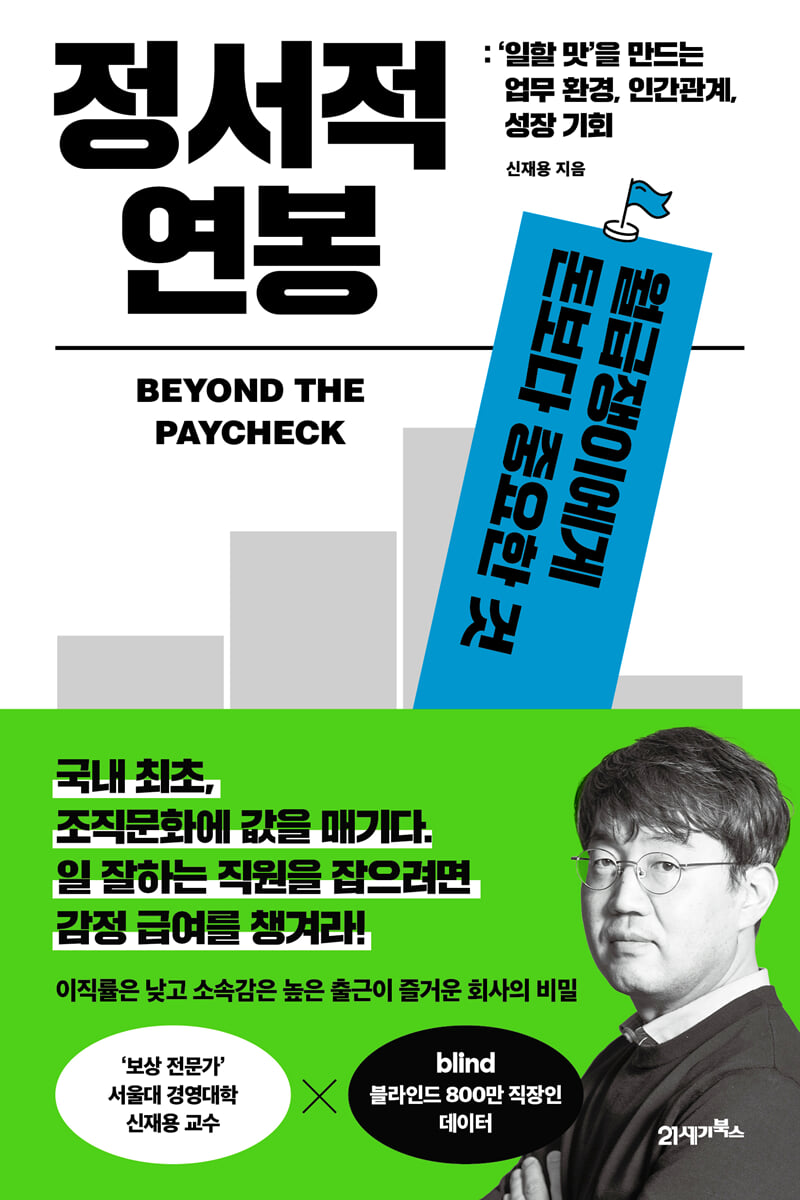
emotional salary
 |
Description
Book Introduction
Korea's first to value organizational culture
If you want to attract good employees, pay them emotionally!
The secret to a company that's fun to work at, with a low turnover rate and a high sense of belonging.
★ Strongly recommended by Song Gil-young, author of "Sidae Yebo," Professor Kang Sung-chun of Seoul National University's School of Business, and Moon Sung-wook, CEO of Blind.
★ Compensation expert Professor Shin Jae-yong of Seoul National University's Department of Business Administration X Blind's data on 8 million office workers
People join the company because of the salary.
In the end, I quit because of my emotions.
Is your company a place you'd want to work?
Last August, Job Korea announced the results of a survey that found that 43.1% of workers in their 20s would immediately quit their jobs if offered a salary increase.
To capture the hearts of these reed-like workers, countless companies spend hundreds of billions of won every year designing recruitment, training, and personnel systems.
They don't hesitate to offer hundreds of millions of won in base salaries and performance-based bonuses to secure key talent who will be responsible for the company's future.
But key talent leaves the company within a few years.
The words they leave behind as they leave are always the same.
‘Because I wasn’t respected’, ‘Because my growth opportunities were blocked’, ‘Because my work lost its meaning’, etc.
The era of retaining talent based solely on salary is over.
Young and talented people want a workplace that offers a work environment that gives them a "joy for work," growth opportunities, and good interpersonal relationships, rather than just monetary compensation.
This is what is called an 'emotional salary'.
Professor Shin Jae-yong, a professor at Seoul National University's School of Business and an expert in corporate compensation systems, calculated emotional annual salaries based on data from 8 million workers on Blind, Korea's largest workplace community.
Intangible values such as autonomy, psychological safety, bonds with superiors and colleagues, growth opportunities, recognition and respect, and work-life balance were converted into monetary value and given an emotional annual salary, like a monthly salary.
Let's take a look at how the ranking of the top 30 companies by domestic currency salaries, based on the latest data, differs from the ranking of the top 30 companies by emotional salaries, and how the ranking of the top 30 companies by total salary, which combines monetary and emotional salaries, is different.
You'll discover why employees change companies, or why they should change companies now.
Furthermore, through real-world examples of companies such as LG Energy Solution's spatial innovation, POSCO International's autonomy and responsibility, and Korea South-East Power's family-like culture, it presents concrete models that executives can immediately implement to become a "company people want to stay at."
This shows that the real strategy for retaining talent is not simply increasing welfare, but rather creating an emotional system that creates a "taste for work."
This book provides data-driven evidence for HR departments and executives on how to create a company where people enjoy coming to work, and offers practical solutions for any company struggling to attract and retain talent.
Even if it's inevitable that key talent will move to Google or Apple, shouldn't they be protected from being poached by domestic competitors? In the future, only companies that earn emotional salaries will survive!
If you want to attract good employees, pay them emotionally!
The secret to a company that's fun to work at, with a low turnover rate and a high sense of belonging.
★ Strongly recommended by Song Gil-young, author of "Sidae Yebo," Professor Kang Sung-chun of Seoul National University's School of Business, and Moon Sung-wook, CEO of Blind.
★ Compensation expert Professor Shin Jae-yong of Seoul National University's Department of Business Administration X Blind's data on 8 million office workers
People join the company because of the salary.
In the end, I quit because of my emotions.
Is your company a place you'd want to work?
Last August, Job Korea announced the results of a survey that found that 43.1% of workers in their 20s would immediately quit their jobs if offered a salary increase.
To capture the hearts of these reed-like workers, countless companies spend hundreds of billions of won every year designing recruitment, training, and personnel systems.
They don't hesitate to offer hundreds of millions of won in base salaries and performance-based bonuses to secure key talent who will be responsible for the company's future.
But key talent leaves the company within a few years.
The words they leave behind as they leave are always the same.
‘Because I wasn’t respected’, ‘Because my growth opportunities were blocked’, ‘Because my work lost its meaning’, etc.
The era of retaining talent based solely on salary is over.
Young and talented people want a workplace that offers a work environment that gives them a "joy for work," growth opportunities, and good interpersonal relationships, rather than just monetary compensation.
This is what is called an 'emotional salary'.
Professor Shin Jae-yong, a professor at Seoul National University's School of Business and an expert in corporate compensation systems, calculated emotional annual salaries based on data from 8 million workers on Blind, Korea's largest workplace community.
Intangible values such as autonomy, psychological safety, bonds with superiors and colleagues, growth opportunities, recognition and respect, and work-life balance were converted into monetary value and given an emotional annual salary, like a monthly salary.
Let's take a look at how the ranking of the top 30 companies by domestic currency salaries, based on the latest data, differs from the ranking of the top 30 companies by emotional salaries, and how the ranking of the top 30 companies by total salary, which combines monetary and emotional salaries, is different.
You'll discover why employees change companies, or why they should change companies now.
Furthermore, through real-world examples of companies such as LG Energy Solution's spatial innovation, POSCO International's autonomy and responsibility, and Korea South-East Power's family-like culture, it presents concrete models that executives can immediately implement to become a "company people want to stay at."
This shows that the real strategy for retaining talent is not simply increasing welfare, but rather creating an emotional system that creates a "taste for work."
This book provides data-driven evidence for HR departments and executives on how to create a company where people enjoy coming to work, and offers practical solutions for any company struggling to attract and retain talent.
Even if it's inevitable that key talent will move to Google or Apple, shouldn't they be protected from being poached by domestic competitors? In the future, only companies that earn emotional salaries will survive!
- You can preview some of the book's contents.
Preview
index
Introduction│Why Talk About Emotional Salary Now
CHAPTER 1 The Era of People Choosing Companies Has Arrived
An era where even professors are chosen by students
The era of the 'Great Residue' is over.
Young R&D talent is becoming increasingly scarce, and corporate attitudes need to change.
You have to fill your heart to hold on
CHAPTER 2 What is emotional salary?
You'd cut ties with your family for 1 billion won?
Real motivation for office workers
Fair compensation is needed for every effort made.
Which is more powerful, the carrot or the stick?
Do people live by money alone?
Can something that cannot be bought with money be converted into money?
What is emotional salary?
When autonomy and a flexible work environment meet
Finding the value of existence in work
The Meaning of Work: When Work Becomes Important to My Life
Growth and Development: Rising Values Equate to Growth
Recognition and Respect: How the Organization Views What I Do
The best colleagues are the best welfare.
CHAPTER 3: Blind: Data Revealing Employees' True Feelings
What if we could hear what our employees think?
Bamboo forest for office workers
If employees are satisfied, the stock price will rise.
How are blinds made?
The 'real' way employees view their organizations
What is the Blind Index?
What are the effects of a high blind index?
Can you really trust company reviews on anonymous platforms for office workers?
CHAPTER 4 Why do office workers decide to change jobs?
Why People Leave Their Dream Jobs
The impact of job changes on the company
Escape is a matter of intelligence?
What is the turnover rate in Korean companies?
A worker's decision to break up
Employees always evaluate the company's financial situation.
Factors that lead to job changes
Would changing the compensation structure lead to less job turnover?
How do emotional factors affect turnover rates?
If you like your company and your job, you won't run away.
The 'Emotional Dial' that Helps Employees Cope with Anxiety
CHAPTER 5 Emotional Salary: Speaking in Numbers
Why should we calculate emotional salary?
How to quantify emotional salary
Emotional Salary Calculation Criteria
Companies with high, invisible salaries, listed companies
Emotional value is more important than size, for external audit companies
Psychological Compensation Beyond Welfare: Public Enterprises and Public Institutions
Numerical evidence that creates a 'will to stay' mindset
CHAPTER 6 The Secret of Companies You Want to Stay At
LG Energy Solution: A Company You Look Forward to Going to Work For
Entral Park: A Space Innovation for Employee Happiness
Entalk: Employees are our most important customers.
The power to work and grow on your own
Why Global Talent Gathers
Efforts to keep pace with the changing environment
A fun, employee-focused workplace where people look forward to going to work.
POSCO International, the company that helped me grow
Immersion created by autonomy and responsibility
POSCO-style entrepreneurship
Diverse perspectives create collaboration.
A company where its members move on their own
Korea South-East Power, a company that communicates horizontally
We are the 'Namdong Family'
When companies think about work-life balance first
I know my job best.
Improving location, welfare, and quality of work
The evolution of the way we work
A company you want to stay at is emerging.
Going Out│For an Era Where Emotional Salary Becomes Real Salary
Appendix│What is the best company to work for in Korea?
Top 30 Emotional Salaries at Listed Companies in 2023
Top 30 Total Salaries at Listed Companies in 2023
Top 30 Average Total Salaries at Listed Companies 2021-2023
Top 30 Emotional Salaries at Unlisted External Audit Companies in 2023
annotation
CHAPTER 1 The Era of People Choosing Companies Has Arrived
An era where even professors are chosen by students
The era of the 'Great Residue' is over.
Young R&D talent is becoming increasingly scarce, and corporate attitudes need to change.
You have to fill your heart to hold on
CHAPTER 2 What is emotional salary?
You'd cut ties with your family for 1 billion won?
Real motivation for office workers
Fair compensation is needed for every effort made.
Which is more powerful, the carrot or the stick?
Do people live by money alone?
Can something that cannot be bought with money be converted into money?
What is emotional salary?
When autonomy and a flexible work environment meet
Finding the value of existence in work
The Meaning of Work: When Work Becomes Important to My Life
Growth and Development: Rising Values Equate to Growth
Recognition and Respect: How the Organization Views What I Do
The best colleagues are the best welfare.
CHAPTER 3: Blind: Data Revealing Employees' True Feelings
What if we could hear what our employees think?
Bamboo forest for office workers
If employees are satisfied, the stock price will rise.
How are blinds made?
The 'real' way employees view their organizations
What is the Blind Index?
What are the effects of a high blind index?
Can you really trust company reviews on anonymous platforms for office workers?
CHAPTER 4 Why do office workers decide to change jobs?
Why People Leave Their Dream Jobs
The impact of job changes on the company
Escape is a matter of intelligence?
What is the turnover rate in Korean companies?
A worker's decision to break up
Employees always evaluate the company's financial situation.
Factors that lead to job changes
Would changing the compensation structure lead to less job turnover?
How do emotional factors affect turnover rates?
If you like your company and your job, you won't run away.
The 'Emotional Dial' that Helps Employees Cope with Anxiety
CHAPTER 5 Emotional Salary: Speaking in Numbers
Why should we calculate emotional salary?
How to quantify emotional salary
Emotional Salary Calculation Criteria
Companies with high, invisible salaries, listed companies
Emotional value is more important than size, for external audit companies
Psychological Compensation Beyond Welfare: Public Enterprises and Public Institutions
Numerical evidence that creates a 'will to stay' mindset
CHAPTER 6 The Secret of Companies You Want to Stay At
LG Energy Solution: A Company You Look Forward to Going to Work For
Entral Park: A Space Innovation for Employee Happiness
Entalk: Employees are our most important customers.
The power to work and grow on your own
Why Global Talent Gathers
Efforts to keep pace with the changing environment
A fun, employee-focused workplace where people look forward to going to work.
POSCO International, the company that helped me grow
Immersion created by autonomy and responsibility
POSCO-style entrepreneurship
Diverse perspectives create collaboration.
A company where its members move on their own
Korea South-East Power, a company that communicates horizontally
We are the 'Namdong Family'
When companies think about work-life balance first
I know my job best.
Improving location, welfare, and quality of work
The evolution of the way we work
A company you want to stay at is emerging.
Going Out│For an Era Where Emotional Salary Becomes Real Salary
Appendix│What is the best company to work for in Korea?
Top 30 Emotional Salaries at Listed Companies in 2023
Top 30 Total Salaries at Listed Companies in 2023
Top 30 Average Total Salaries at Listed Companies 2021-2023
Top 30 Emotional Salaries at Unlisted External Audit Companies in 2023
annotation
Detailed image

Into the book
For young people these days, a workplace is a place where they work for a certain number of hours and receive wages and benefits in return. It is nothing more or less than that, but a workplace is more than just a place to work for money.
Although there is a difference in the workplace view of the older generation, who realize their dreams and self through work, everyone, regardless of generation, has a basic desire for the workplace, which is the place where they spend the most time after home.
It is the desire to grow by being recognized by superiors and colleagues, being personally respected as a member of the organization, contributing to society through valuable work, and increasing one's value by developing expertise.
--- p.33, from “The era in which people choose companies is coming”
Just as it's easy to compare salaries expressed in monetary terms, it would also be easier to compare the "feel good about working" at a new or transferring company if it could be converted into monetary value.
There's a lot of talk about a company's work style, organizational culture, work-life balance, and growth potential, but there's no information on how much that translates to in monetary terms.
Only when information on price criteria is available can a thorough comparison be made.
This book uses Blind's extensive employee review data to attempt to assign a monetary value to the "joy of work," something money can't buy.
--- p.64, from “What is emotional salary?”
Which companies were selected as the Best Companies in 2023? Interestingly, there weren't many affiliates or large corporations of the four major conglomerates—Samsung, SK, Hyundai Motor, and LG.
It also includes public institutions and public corporations such as the Korea Institute of Nuclear Safety and Korea Midland Power, as well as a significant number of Korean subsidiaries of global companies such as Google Korea, SAP Korea, Synopsys Korea, and Qualcomm Korea.
There are also IT and game companies such as Naver Webtoon, Carrot, and Nexon Games.
At first glance, it seems that there is no significant relationship between the size of the company and the level of salary.
--- p.139, from "Data that reveals the true feelings of employees, Blind"
We found that increasing employees' psychological claims, or emotional salaries, not only reduces turnover but also suppresses the increase in turnover caused by a decrease in expected future monetary salaries.
Here's why companies need to increase emotional pay.
This is a surefire way to reduce the ever-increasing turnover rate amidst the limitations of paying labor costs, a concern for mid-sized and small business managers mentioned earlier.
--- p.219, from “Why do office workers decide to change jobs?”
If you measure it, convert it into money, and make it public, more people will become interested and find better ways to measure it.
If the problems in a company's organizational culture are quantified in the form of low emotional salaries, both the company and employees will seek out the cause, seek solutions, and strive for improvement.
If companies can demonstrate and prove that they are a good workplace not only through salary but also through a quantifiable organizational culture, they will gain a strong competitive advantage in the labor market of the imminent "era of people choosing companies."
--- p.265, from “Emotional Salary, Spoken in Numbers”
The key is for each company to dial in the emotional pay that best suits its business, talent, and growth model.
If you want to reduce employee turnover, you need to start by accurately understanding your organization and its people before asking for the "right" answer.
There must be a thorough analysis and philosophical reflection on what kind of people we wanted and what kind of people we elected.
Strategies to reduce turnover rates and intentions to turnover follow.
Although there is a difference in the workplace view of the older generation, who realize their dreams and self through work, everyone, regardless of generation, has a basic desire for the workplace, which is the place where they spend the most time after home.
It is the desire to grow by being recognized by superiors and colleagues, being personally respected as a member of the organization, contributing to society through valuable work, and increasing one's value by developing expertise.
--- p.33, from “The era in which people choose companies is coming”
Just as it's easy to compare salaries expressed in monetary terms, it would also be easier to compare the "feel good about working" at a new or transferring company if it could be converted into monetary value.
There's a lot of talk about a company's work style, organizational culture, work-life balance, and growth potential, but there's no information on how much that translates to in monetary terms.
Only when information on price criteria is available can a thorough comparison be made.
This book uses Blind's extensive employee review data to attempt to assign a monetary value to the "joy of work," something money can't buy.
--- p.64, from “What is emotional salary?”
Which companies were selected as the Best Companies in 2023? Interestingly, there weren't many affiliates or large corporations of the four major conglomerates—Samsung, SK, Hyundai Motor, and LG.
It also includes public institutions and public corporations such as the Korea Institute of Nuclear Safety and Korea Midland Power, as well as a significant number of Korean subsidiaries of global companies such as Google Korea, SAP Korea, Synopsys Korea, and Qualcomm Korea.
There are also IT and game companies such as Naver Webtoon, Carrot, and Nexon Games.
At first glance, it seems that there is no significant relationship between the size of the company and the level of salary.
--- p.139, from "Data that reveals the true feelings of employees, Blind"
We found that increasing employees' psychological claims, or emotional salaries, not only reduces turnover but also suppresses the increase in turnover caused by a decrease in expected future monetary salaries.
Here's why companies need to increase emotional pay.
This is a surefire way to reduce the ever-increasing turnover rate amidst the limitations of paying labor costs, a concern for mid-sized and small business managers mentioned earlier.
--- p.219, from “Why do office workers decide to change jobs?”
If you measure it, convert it into money, and make it public, more people will become interested and find better ways to measure it.
If the problems in a company's organizational culture are quantified in the form of low emotional salaries, both the company and employees will seek out the cause, seek solutions, and strive for improvement.
If companies can demonstrate and prove that they are a good workplace not only through salary but also through a quantifiable organizational culture, they will gain a strong competitive advantage in the labor market of the imminent "era of people choosing companies."
--- p.265, from “Emotional Salary, Spoken in Numbers”
The key is for each company to dial in the emotional pay that best suits its business, talent, and growth model.
If you want to reduce employee turnover, you need to start by accurately understanding your organization and its people before asking for the "right" answer.
There must be a thorough analysis and philosophical reflection on what kind of people we wanted and what kind of people we elected.
Strategies to reduce turnover rates and intentions to turnover follow.
--- p.298, from “The Secret of a Company You Want to Stay At”
Publisher's Review
Even if we can't stop talented people from going to Google or Apple,
Shouldn't we not lose to our domestic competitors?
In the past, 'lifetime employment', where employees worked at one company for decades, was a common culture.
But now it's different.
The average length of employment is getting shorter every year, and companies are becoming little more than a 'subscription site' for a certain period of time.
In particular, young R&D talent and key personnel in the digital and advanced industries are no longer just individuals that companies "select," but rather "valuable individuals that companies must attract."
So, is the solution to raising salaries? No.
No matter how high a salary a company offers, today's talent isn't motivated by money alone.
Now, 'emotional salary' is the core of a new personnel strategy suitable for this era.
Only when a company evolves from being a place that pays well to a place that is worth working for does it become competitive.
So, what makes a company worth working for? Professor Shin Jae-yong of Seoul National University's School of Business Administration uses data from 8 million employees on the workplace community "Blind" to quantify the value of a company's work experience.
This emotional salary, which serves as a motivation for workers just as much as their monetary salary, such as autonomy, psychological safety, bonds with superiors and colleagues, growth opportunities, recognition, respect, and work-life balance, was given the name "emotional salary" to enable objective comparison.
So far, [40 million won starting salary with a reputation for a good company atmosphere vs.
If you chose a company based on vague criteria such as [the worst work environment but starting salary of 60 million won], now you can choose [a monetary salary of 40 million won + an emotional salary of 30 million won vs.
You will choose a company based on objective comparison criteria such as [annual salary of 60 million won + emotional annual salary of -20 million won].
A salary in the hundreds of millions and benefits at a large corporation aren't everything!
Employees stay only when they feel like they're working.
A high salary is the biggest deciding factor when choosing a job, but surprisingly, it doesn't have much influence in keeping a company for a long time.
Numerous studies have shown that providing employees with valuable work and meaning in their work keeps them employed.
Not knowing this fact and playing a game of salary increase chicken with competitors or trying to win over employees with bonuses is like pouring water into a bottomless pit.
Employee turnover directly leads to losses for the company.
Not only are there the immediate, visible costs of education and management fees, but if an atmosphere like "escape is based on intelligence" is created, it can lead to an irreversible decline in morale.
In this way, emotional compensation becomes a hidden safety device to protect the company.
Employees at companies with stable emotional salaries keep their jobs even in recessions and with flashy offers.
Meanwhile, for employers who sigh at the ever-growing wage gap between large corporations and small and medium-sized enterprises, emotional salaries offer a breakthrough.
The author, an expert in corporate compensation systems, says that when he lectures on how to satisfy the 2030 core workforce that will lead companies in the future, numerous mid-sized and small business managers share their concerns.
Unlike the 1% of large corporations that can offer competitive compensation and fair monetary compensation, 99% of small and medium-sized businesses literally have no money.
By offering proven emotional rewards tailored to each industry and employee's personality, you can increase loyalty among key personnel and reduce turnover intentions at minimal cost.
If you're an employer who's been helplessly poaching talented employees from large corporations due to overwhelming wage differences, consider equipping your company with an emotional salary as its unique weapon.
Which company should I transfer to so that I don't fail?
The most objective selection criteria for job seekers
If you're preparing for a job change and a company catches your eye, you'll probably check out the company's Blind Index and reviews at least once.
Blind, Korea's largest anonymous platform for office workers, with over 90% of workers at listed companies registered, contains on-site evaluations by actual employees.
There's no better resource for examining Korea's labor market today than Blind's big data, built on honest reviews from 8 million office workers.
Using this data, the author re-ranked the top 30 companies in terms of total annual salary in Korea.
You can still find the top 30 companies in Korea that offer the highest annual salaries.
However, we cannot say that this ranking is a good ranking of companies that are worth working for.
On the other hand, the top companies in total annual salary, which include emotional and monetary salaries, presented by the author, are clearly, to borrow the book's expression, "companies I would recommend to my children."
If you don't want to lose your humanity by joining a company solely based on salary, and if you want to stop the tiresome job-hopping and find a company where you can settle down, this book's list of companies with the highest total salaries will be of great help.
Necessary for both corporate executives and job seekers
A survival strategy manual for the era of thigh surgery
As of 2025, the job market is experiencing a period of great stagnation, but the author predicts that this trend will not last long.
The job seeker advantage market will be created within the next five years, so rather than holding on to employees who are hastily leaving, prepare to win their hearts and minds now.
The book demonstrates through empirical analysis that companies with higher emotional pay have lower turnover rates and higher engagement and performance.
This will soon lead to a company's competitiveness and stock price.
The positive waves created by employees who are highly satisfied with their company increase the value of the company and the organization.
Real-life examples also support this.
The cases of LG Energy Solution, POSCO International, and Korea South-East Power prove that the higher the emotional salary, the more likely it is that going to work is expected, not an obligation, by providing a space for employee happiness, a culture that does not spare growth opportunities, an environment that encourages autonomy and responsibility, horizontal communication and trust, and an attitude that respects work-life balance.
What specific steps should companies take to increase their emotional pay? This book goes beyond simply introducing concepts; it's a practical strategy manual companies can implement immediately.
Through six chapters, it presents key factors for increasing emotional salaries and explains implementation methods through industry-specific data comparisons and success stories.
Emotional salary is not an abstract emotion; it is an 'invisible salary' that can be sufficiently managed numerically.
However, unlike monetary salaries, they do not automatically increase over time, and once they are high, they do not remain high forever.
Therefore, companies must continuously manage and increase emotional salaries without being overly excited or depressed.
This book will serve as a strategy guide for executives seeking to recruit and retain talented individuals, and a compass for employees seeking a new job to find the job they truly desire.
Emotional salary is no longer an option.
It is a corporate survival strategy in the era of talent war.
Shouldn't we not lose to our domestic competitors?
In the past, 'lifetime employment', where employees worked at one company for decades, was a common culture.
But now it's different.
The average length of employment is getting shorter every year, and companies are becoming little more than a 'subscription site' for a certain period of time.
In particular, young R&D talent and key personnel in the digital and advanced industries are no longer just individuals that companies "select," but rather "valuable individuals that companies must attract."
So, is the solution to raising salaries? No.
No matter how high a salary a company offers, today's talent isn't motivated by money alone.
Now, 'emotional salary' is the core of a new personnel strategy suitable for this era.
Only when a company evolves from being a place that pays well to a place that is worth working for does it become competitive.
So, what makes a company worth working for? Professor Shin Jae-yong of Seoul National University's School of Business Administration uses data from 8 million employees on the workplace community "Blind" to quantify the value of a company's work experience.
This emotional salary, which serves as a motivation for workers just as much as their monetary salary, such as autonomy, psychological safety, bonds with superiors and colleagues, growth opportunities, recognition, respect, and work-life balance, was given the name "emotional salary" to enable objective comparison.
So far, [40 million won starting salary with a reputation for a good company atmosphere vs.
If you chose a company based on vague criteria such as [the worst work environment but starting salary of 60 million won], now you can choose [a monetary salary of 40 million won + an emotional salary of 30 million won vs.
You will choose a company based on objective comparison criteria such as [annual salary of 60 million won + emotional annual salary of -20 million won].
A salary in the hundreds of millions and benefits at a large corporation aren't everything!
Employees stay only when they feel like they're working.
A high salary is the biggest deciding factor when choosing a job, but surprisingly, it doesn't have much influence in keeping a company for a long time.
Numerous studies have shown that providing employees with valuable work and meaning in their work keeps them employed.
Not knowing this fact and playing a game of salary increase chicken with competitors or trying to win over employees with bonuses is like pouring water into a bottomless pit.
Employee turnover directly leads to losses for the company.
Not only are there the immediate, visible costs of education and management fees, but if an atmosphere like "escape is based on intelligence" is created, it can lead to an irreversible decline in morale.
In this way, emotional compensation becomes a hidden safety device to protect the company.
Employees at companies with stable emotional salaries keep their jobs even in recessions and with flashy offers.
Meanwhile, for employers who sigh at the ever-growing wage gap between large corporations and small and medium-sized enterprises, emotional salaries offer a breakthrough.
The author, an expert in corporate compensation systems, says that when he lectures on how to satisfy the 2030 core workforce that will lead companies in the future, numerous mid-sized and small business managers share their concerns.
Unlike the 1% of large corporations that can offer competitive compensation and fair monetary compensation, 99% of small and medium-sized businesses literally have no money.
By offering proven emotional rewards tailored to each industry and employee's personality, you can increase loyalty among key personnel and reduce turnover intentions at minimal cost.
If you're an employer who's been helplessly poaching talented employees from large corporations due to overwhelming wage differences, consider equipping your company with an emotional salary as its unique weapon.
Which company should I transfer to so that I don't fail?
The most objective selection criteria for job seekers
If you're preparing for a job change and a company catches your eye, you'll probably check out the company's Blind Index and reviews at least once.
Blind, Korea's largest anonymous platform for office workers, with over 90% of workers at listed companies registered, contains on-site evaluations by actual employees.
There's no better resource for examining Korea's labor market today than Blind's big data, built on honest reviews from 8 million office workers.
Using this data, the author re-ranked the top 30 companies in terms of total annual salary in Korea.
You can still find the top 30 companies in Korea that offer the highest annual salaries.
However, we cannot say that this ranking is a good ranking of companies that are worth working for.
On the other hand, the top companies in total annual salary, which include emotional and monetary salaries, presented by the author, are clearly, to borrow the book's expression, "companies I would recommend to my children."
If you don't want to lose your humanity by joining a company solely based on salary, and if you want to stop the tiresome job-hopping and find a company where you can settle down, this book's list of companies with the highest total salaries will be of great help.
Necessary for both corporate executives and job seekers
A survival strategy manual for the era of thigh surgery
As of 2025, the job market is experiencing a period of great stagnation, but the author predicts that this trend will not last long.
The job seeker advantage market will be created within the next five years, so rather than holding on to employees who are hastily leaving, prepare to win their hearts and minds now.
The book demonstrates through empirical analysis that companies with higher emotional pay have lower turnover rates and higher engagement and performance.
This will soon lead to a company's competitiveness and stock price.
The positive waves created by employees who are highly satisfied with their company increase the value of the company and the organization.
Real-life examples also support this.
The cases of LG Energy Solution, POSCO International, and Korea South-East Power prove that the higher the emotional salary, the more likely it is that going to work is expected, not an obligation, by providing a space for employee happiness, a culture that does not spare growth opportunities, an environment that encourages autonomy and responsibility, horizontal communication and trust, and an attitude that respects work-life balance.
What specific steps should companies take to increase their emotional pay? This book goes beyond simply introducing concepts; it's a practical strategy manual companies can implement immediately.
Through six chapters, it presents key factors for increasing emotional salaries and explains implementation methods through industry-specific data comparisons and success stories.
Emotional salary is not an abstract emotion; it is an 'invisible salary' that can be sufficiently managed numerically.
However, unlike monetary salaries, they do not automatically increase over time, and once they are high, they do not remain high forever.
Therefore, companies must continuously manage and increase emotional salaries without being overly excited or depressed.
This book will serve as a strategy guide for executives seeking to recruit and retain talented individuals, and a compass for employees seeking a new job to find the job they truly desire.
Emotional salary is no longer an option.
It is a corporate survival strategy in the era of talent war.
GOODS SPECIFICS
- Date of issue: October 15, 2025
- Page count, weight, size: 324 pages | 438g | 140*210*20mm
- ISBN13: 9791173574719
- ISBN10: 1173574719
You may also like
카테고리
korean


korean

![GQ KOREA Mark (Monthly): December [2025]](http://librairie.coreenne.fr/cdn/shop/files/8ef265dbbfbf186523ed75ba7319009d.jpg?v=1765340328&width=3840)


