

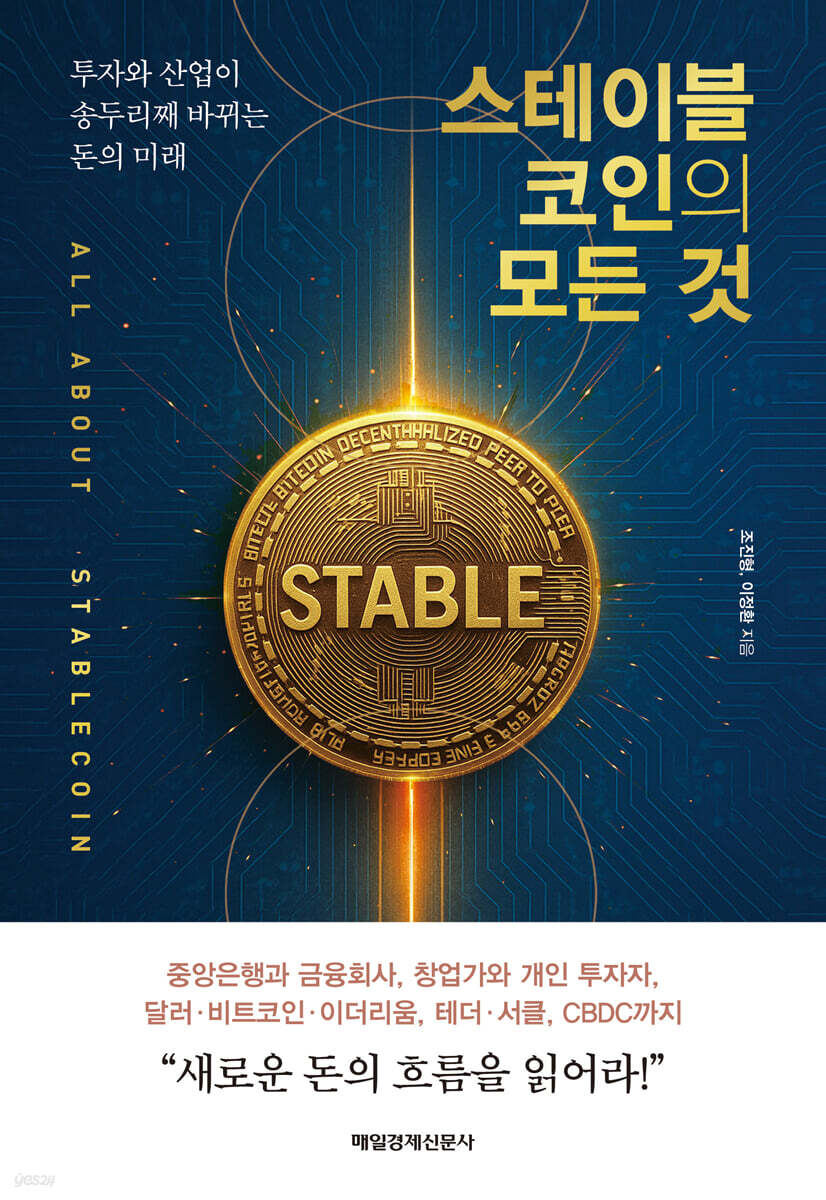
All About Stablecoins
 |
Description
Book Introduction
Beyond Bitcoin, it's now the era of stablecoins!
Digital currency innovation attracting attention from central banks and global corporations.
A must-read for anyone who wants to seize the future of money.
“Read the new money flow!”
It has been 10 years since the era of virtual assets began.
Bitcoin and Ethereum have been touted as "digital gold," but no currency has yet emerged that is widely used in everyday life.
Now there is someone who is quickly filling that void.
It is called ‘stablecoin’.
Stablecoins are not a replacement for Bitcoin.
It is a new digital currency model that organically connects virtual assets, legal tender, blockchain technology, and financial policy.
By linking its value to real assets such as the dollar, gold, and government bonds, it reduces volatility and creates a foundation for everyday payments and financial transactions.
This book begins with the question, "What is a stablecoin?"
And we examine why governments, corporations, and financial institutions around the world are paying attention.
“Stablecoins are not just new coins; they are an innovation that fundamentally changes the concept of money and the financial system,” the authors say.
We view stablecoins not simply as a technology, but as a game-changer for the global economy.
In particular, the introduction of legislation by US politicians and the issuance of their own coins by global tech companies have made it impossible to dismiss stablecoins as a passing fad.
"Everything About Stablecoins" provides investors, policymakers, economists, technologists, and general readers with the insights they need to understand the "digital currency transition."
As the traditional financial system becomes digitized and monetary policy and asset management methods rapidly change, this book is a must-read for those who question the "future of money" beyond mere "investment."
Digital currency innovation attracting attention from central banks and global corporations.
A must-read for anyone who wants to seize the future of money.
“Read the new money flow!”
It has been 10 years since the era of virtual assets began.
Bitcoin and Ethereum have been touted as "digital gold," but no currency has yet emerged that is widely used in everyday life.
Now there is someone who is quickly filling that void.
It is called ‘stablecoin’.
Stablecoins are not a replacement for Bitcoin.
It is a new digital currency model that organically connects virtual assets, legal tender, blockchain technology, and financial policy.
By linking its value to real assets such as the dollar, gold, and government bonds, it reduces volatility and creates a foundation for everyday payments and financial transactions.
This book begins with the question, "What is a stablecoin?"
And we examine why governments, corporations, and financial institutions around the world are paying attention.
“Stablecoins are not just new coins; they are an innovation that fundamentally changes the concept of money and the financial system,” the authors say.
We view stablecoins not simply as a technology, but as a game-changer for the global economy.
In particular, the introduction of legislation by US politicians and the issuance of their own coins by global tech companies have made it impossible to dismiss stablecoins as a passing fad.
"Everything About Stablecoins" provides investors, policymakers, economists, technologists, and general readers with the insights they need to understand the "digital currency transition."
As the traditional financial system becomes digitized and monetary policy and asset management methods rapidly change, this book is a must-read for those who question the "future of money" beyond mere "investment."
- You can preview some of the book's contents.
Preview
index
Introduction: Why We Need to Know About Stablecoins
PART 1.
What is a stablecoin?
The Global Financial Crisis: Calling for Bitcoin
Stablecoins: Beyond Virtual Assets, They're Becoming Currencies
Stablecoins vs. CBDCs: The Two Faces of Digital Currency
Stablecoins that swallowed up US Treasuries
How do stablecoins maintain their price?
Comparison of Stablecoins and Existing Payment Systems
Can CBDCs and Stablecoins Coexist?
Major Stablecoins at a Glance
PART 2.
How Stablecoins Are Changing the Economic Structure
The power of interest rates is weakening, and the authority of central banks is shaking.
Stablecoins fostered by the low-interest-rate era
The Rise of Stablecoins Threatening Monetary Sovereignty
The War of Trust to Protect the Dollar
The Economic Psychology of Stablecoins
Four Forces Driving the Stablecoin Market
The Dark Side of Stablecoins: Premiums and Discounts
Arbitrage and profit structure: how is it possible?
Why is stablecoin liquidity important?
Are stablecoins a financial innovation or just gaming money?
Why Are US FAANGs Jumping into the Stablecoin Market?
PART 3.
Investing in Stablecoins and Their Future
Can stablecoins integrate with traditional finance?
Why are stablecoin issuances and the Ethereum market so excited?
ESG investing reimagined with stablecoins
Where has Korea's virtual asset regulation come from?
Why do we need a won stablecoin now?
PART 4.
Questions About Stablecoins
Are Stablecoins Really "Stable"?
Stablecoins and Financial Market Crime
An international organization warns that without regulation, it is dangerous.
The Future of Stablecoins and Bank Deposits
Conclusion: Stablecoins: The Opportunity is Big, but the Answer Must Be Careful
References and Sources
Photo and schematic sources
PART 1.
What is a stablecoin?
The Global Financial Crisis: Calling for Bitcoin
Stablecoins: Beyond Virtual Assets, They're Becoming Currencies
Stablecoins vs. CBDCs: The Two Faces of Digital Currency
Stablecoins that swallowed up US Treasuries
How do stablecoins maintain their price?
Comparison of Stablecoins and Existing Payment Systems
Can CBDCs and Stablecoins Coexist?
Major Stablecoins at a Glance
PART 2.
How Stablecoins Are Changing the Economic Structure
The power of interest rates is weakening, and the authority of central banks is shaking.
Stablecoins fostered by the low-interest-rate era
The Rise of Stablecoins Threatening Monetary Sovereignty
The War of Trust to Protect the Dollar
The Economic Psychology of Stablecoins
Four Forces Driving the Stablecoin Market
The Dark Side of Stablecoins: Premiums and Discounts
Arbitrage and profit structure: how is it possible?
Why is stablecoin liquidity important?
Are stablecoins a financial innovation or just gaming money?
Why Are US FAANGs Jumping into the Stablecoin Market?
PART 3.
Investing in Stablecoins and Their Future
Can stablecoins integrate with traditional finance?
Why are stablecoin issuances and the Ethereum market so excited?
ESG investing reimagined with stablecoins
Where has Korea's virtual asset regulation come from?
Why do we need a won stablecoin now?
PART 4.
Questions About Stablecoins
Are Stablecoins Really "Stable"?
Stablecoins and Financial Market Crime
An international organization warns that without regulation, it is dangerous.
The Future of Stablecoins and Bank Deposits
Conclusion: Stablecoins: The Opportunity is Big, but the Answer Must Be Careful
References and Sources
Photo and schematic sources
Into the book
The 2008 global financial crisis had a huge impact on the global economy.
The crisis, which began with the collapse of the U.S. housing bubble, spread into a global recession, leading to massive financial regulatory reforms and political unrest.
In the process, as the vulnerabilities of the existing financial and monetary systems were revealed, voices grew louder calling for questions about the traditional monetary system managed by central banks and the search for new alternatives.
The 2008 financial crisis was the backdrop for the emergence of Bitcoin, virtual assets, and stablecoins.
--- p.13, from “Global Financial Crisis, Calling for Bitcoin”
Who issues stablecoins? Some believe that only the private sector can answer this question.
However, central banks around the world already have the ability to issue digital currencies.
This raises the question of whether stablecoins will be replaced when central banks issue digital currencies.
What comes to mind at this time is central bank digital currency, or CBDC.
CBDC is an official currency issued directly by the central bank.
As the name suggests, it is a digital currency managed by the central bank, so it has the status of a country's legal tender, like the Korean won or dollar that we use.
While they differ in form from traditional currencies like cash or deposits, they essentially have the same effect. While CBDCs and private stablecoins may appear to be "digital forms of money," the two concepts differ from their very origins.
--- p.31, from "Private Stablecoins vs. CBDC, the Two Faces of Digital Currency"
Stablecoins are digital assets designed to peg their value to a fiat currency, such as the dollar.
Therefore, a stabilizer is needed.
Stablecoin issuers must hold reserve assets that can back the value of the currency on a 1:1 basis.
Here, reserve assets are literally 'prepared' assets, so they must be highly liquid and safe.
The most representative safe assets include government bonds, especially short-term government bonds.
In other words, issuing a dollar-pegged stablecoin requires purchasing US Treasury bonds.
Because of this structure, stablecoin issuers are emerging as new investors in US Treasury bonds.
In fact, as of March 2025, the total reserve assets of major stablecoins exceeded $200 billion, and their holdings of short-term U.S. Treasury securities surpassed the short-term government bond holdings of major countries around the world.
--- p.36, from "Stablecoins That Swallowed U.S. Treasury Bonds"
The most important feature of stablecoins is that they are designed to maintain a constant value.
It is linked to the value of fiat currency such as the US dollar.
Simply put, it is designed to maintain the price of one coin = $1.
Most stablecoins currently in circulation are pegged to the US dollar and are exchangeable 1:1 with the dollar.
USDT is the largest stablecoin by market capitalization, aiming for a 1 USDT = 1 US dollar exchange rate. USDC is the next largest dollar-pegged stablecoin.
Because they use the value of existing currencies as a benchmark, stablecoins can serve as a bridge between the virtual asset market and traditional finance.
The crisis, which began with the collapse of the U.S. housing bubble, spread into a global recession, leading to massive financial regulatory reforms and political unrest.
In the process, as the vulnerabilities of the existing financial and monetary systems were revealed, voices grew louder calling for questions about the traditional monetary system managed by central banks and the search for new alternatives.
The 2008 financial crisis was the backdrop for the emergence of Bitcoin, virtual assets, and stablecoins.
--- p.13, from “Global Financial Crisis, Calling for Bitcoin”
Who issues stablecoins? Some believe that only the private sector can answer this question.
However, central banks around the world already have the ability to issue digital currencies.
This raises the question of whether stablecoins will be replaced when central banks issue digital currencies.
What comes to mind at this time is central bank digital currency, or CBDC.
CBDC is an official currency issued directly by the central bank.
As the name suggests, it is a digital currency managed by the central bank, so it has the status of a country's legal tender, like the Korean won or dollar that we use.
While they differ in form from traditional currencies like cash or deposits, they essentially have the same effect. While CBDCs and private stablecoins may appear to be "digital forms of money," the two concepts differ from their very origins.
--- p.31, from "Private Stablecoins vs. CBDC, the Two Faces of Digital Currency"
Stablecoins are digital assets designed to peg their value to a fiat currency, such as the dollar.
Therefore, a stabilizer is needed.
Stablecoin issuers must hold reserve assets that can back the value of the currency on a 1:1 basis.
Here, reserve assets are literally 'prepared' assets, so they must be highly liquid and safe.
The most representative safe assets include government bonds, especially short-term government bonds.
In other words, issuing a dollar-pegged stablecoin requires purchasing US Treasury bonds.
Because of this structure, stablecoin issuers are emerging as new investors in US Treasury bonds.
In fact, as of March 2025, the total reserve assets of major stablecoins exceeded $200 billion, and their holdings of short-term U.S. Treasury securities surpassed the short-term government bond holdings of major countries around the world.
--- p.36, from "Stablecoins That Swallowed U.S. Treasury Bonds"
The most important feature of stablecoins is that they are designed to maintain a constant value.
It is linked to the value of fiat currency such as the US dollar.
Simply put, it is designed to maintain the price of one coin = $1.
Most stablecoins currently in circulation are pegged to the US dollar and are exchangeable 1:1 with the dollar.
USDT is the largest stablecoin by market capitalization, aiming for a 1 USDT = 1 US dollar exchange rate. USDC is the next largest dollar-pegged stablecoin.
Because they use the value of existing currencies as a benchmark, stablecoins can serve as a bridge between the virtual asset market and traditional finance.
--- p.43, from “How do stablecoins maintain their prices?”
Publisher's Review
Why is everyone paying attention to stablecoins now?
Covering virtual assets, legal tender, and CBDC
A new monetary revolution shaking up the global financial landscape
Stablecoins: The Real Heroes of the Digital Financial Revolution
When Bitcoin was introduced to the world in 2009, people were excited, saying, "Finally, a new currency without a central bank has been born."
But over the past decade or so, we've clearly seen its limitations.
Prices fluctuated by tens of percent a day, making it unsuitable for everyday payments, let alone as a stable investment.
Ultimately, Bitcoin remained a means of storing asset value, dubbed "digital gold," but failed to take its place as the currency we use every day.
So, what's the new currency candidate now? It's a stablecoin, embracing both stability and innovation.
A digital currency that minimizes price fluctuations by linking its value to stable assets such as the dollar, gold, and government bonds.
A new model has emerged that maintains the speed and openness of blockchain while allowing it to be used as reliably as real money.
Digital currency permeates everyday life
The strength of stablecoins isn't limited to price stability.
For example, consider international remittances.
In the past, you had to go to a bank branch, wait for several days, and pay expensive fees.
Now you can send money across borders in minutes.
In Latin America and Africa, dollar-pegged stablecoins are already being used in everyday life.
It became a means of paying salary, savings, and living expenses.
In Argentina, where inflation exceeds 40%, a growing number of people are opting to receive their salaries in stablecoins.
In investment and financial services, stablecoins also function as "reserve currencies."
It serves as a standard for Bitcoin and altcoin trading in virtual asset exchanges, and is used as collateral and a means of deposit in decentralized finance (DeFi).
In traditional finance, it serves as a 'safe asset substitute', like money market funds.
Stablecoins are now more than just coins; they have established themselves as a new financial infrastructure.
Stablecoins shaking up the global economic order
The influence of stablecoins extends beyond individuals and corporations to encompass nations and the international order.
Issuing a stablecoin requires securing large amounts of dollar assets, particularly U.S. Treasury bonds.
The scale exceeds the foreign exchange reserves of some countries.
This has a real impact on the US short-term interest rate market, and the Bank for International Settlements (BIS) and the IMF warn that it could weaken the effectiveness of monetary policy.
Big tech and global financial firms are also rushing to join this war.
Following Facebook's (now Meta) 'Libra Project', Apple, Amazon, and Google are considering stablecoins as a core 'lock-in strategy' to secure their ecosystems.
Stablecoins are no longer just a buzzword in the virtual asset market, but have emerged as a disruptive force in global finance.
A Friendly Guide to Stablecoins for Investors, Policymakers, and General Readers
"All About Stablecoins" is the most comprehensive book covering the flow of stablecoins.
Part 1 explains the background of the global financial crisis and the emergence of Bitcoin, the issuance structure of stablecoins, and their differences from CBDCs.
Part 2 examines interest rates and monetary policy, trust mechanisms, liquidity structures, arbitrage systems, and why US politicians and Big Tech are paying attention to this market.
Part 3 covers the potential for integration with traditional finance, Ethereum-based scalability, ESG connections, and the need for a Korean won stablecoin.
Part 4 analyzes potential risks, including the stability conditions for stablecoins, the potential financial crimes caused by regulatory gaps, and their relationship with bank deposits.
This book is not just a simple guide to stablecoins.
It provides investors with strategies to mitigate price volatility and capture profit opportunities, and provides policymakers with criteria for institutional design.
For the general reader, it explains in detail how the concept of 'money' is changing.
Covering virtual assets, legal tender, and CBDC
A new monetary revolution shaking up the global financial landscape
Stablecoins: The Real Heroes of the Digital Financial Revolution
When Bitcoin was introduced to the world in 2009, people were excited, saying, "Finally, a new currency without a central bank has been born."
But over the past decade or so, we've clearly seen its limitations.
Prices fluctuated by tens of percent a day, making it unsuitable for everyday payments, let alone as a stable investment.
Ultimately, Bitcoin remained a means of storing asset value, dubbed "digital gold," but failed to take its place as the currency we use every day.
So, what's the new currency candidate now? It's a stablecoin, embracing both stability and innovation.
A digital currency that minimizes price fluctuations by linking its value to stable assets such as the dollar, gold, and government bonds.
A new model has emerged that maintains the speed and openness of blockchain while allowing it to be used as reliably as real money.
Digital currency permeates everyday life
The strength of stablecoins isn't limited to price stability.
For example, consider international remittances.
In the past, you had to go to a bank branch, wait for several days, and pay expensive fees.
Now you can send money across borders in minutes.
In Latin America and Africa, dollar-pegged stablecoins are already being used in everyday life.
It became a means of paying salary, savings, and living expenses.
In Argentina, where inflation exceeds 40%, a growing number of people are opting to receive their salaries in stablecoins.
In investment and financial services, stablecoins also function as "reserve currencies."
It serves as a standard for Bitcoin and altcoin trading in virtual asset exchanges, and is used as collateral and a means of deposit in decentralized finance (DeFi).
In traditional finance, it serves as a 'safe asset substitute', like money market funds.
Stablecoins are now more than just coins; they have established themselves as a new financial infrastructure.
Stablecoins shaking up the global economic order
The influence of stablecoins extends beyond individuals and corporations to encompass nations and the international order.
Issuing a stablecoin requires securing large amounts of dollar assets, particularly U.S. Treasury bonds.
The scale exceeds the foreign exchange reserves of some countries.
This has a real impact on the US short-term interest rate market, and the Bank for International Settlements (BIS) and the IMF warn that it could weaken the effectiveness of monetary policy.
Big tech and global financial firms are also rushing to join this war.
Following Facebook's (now Meta) 'Libra Project', Apple, Amazon, and Google are considering stablecoins as a core 'lock-in strategy' to secure their ecosystems.
Stablecoins are no longer just a buzzword in the virtual asset market, but have emerged as a disruptive force in global finance.
A Friendly Guide to Stablecoins for Investors, Policymakers, and General Readers
"All About Stablecoins" is the most comprehensive book covering the flow of stablecoins.
Part 1 explains the background of the global financial crisis and the emergence of Bitcoin, the issuance structure of stablecoins, and their differences from CBDCs.
Part 2 examines interest rates and monetary policy, trust mechanisms, liquidity structures, arbitrage systems, and why US politicians and Big Tech are paying attention to this market.
Part 3 covers the potential for integration with traditional finance, Ethereum-based scalability, ESG connections, and the need for a Korean won stablecoin.
Part 4 analyzes potential risks, including the stability conditions for stablecoins, the potential financial crimes caused by regulatory gaps, and their relationship with bank deposits.
This book is not just a simple guide to stablecoins.
It provides investors with strategies to mitigate price volatility and capture profit opportunities, and provides policymakers with criteria for institutional design.
For the general reader, it explains in detail how the concept of 'money' is changing.
GOODS SPECIFICS
- Date of issue: October 15, 2025
- Page count, weight, size: 248 pages | 428g | 148*215*15mm
- ISBN13: 9791164848157
- ISBN10: 1164848151
You may also like
카테고리
korean


korean

![GQ KOREA Mark (Monthly): December [2025]](http://librairie.coreenne.fr/cdn/shop/files/8ef265dbbfbf186523ed75ba7319009d.jpg?v=1765340328&width=3840)


