

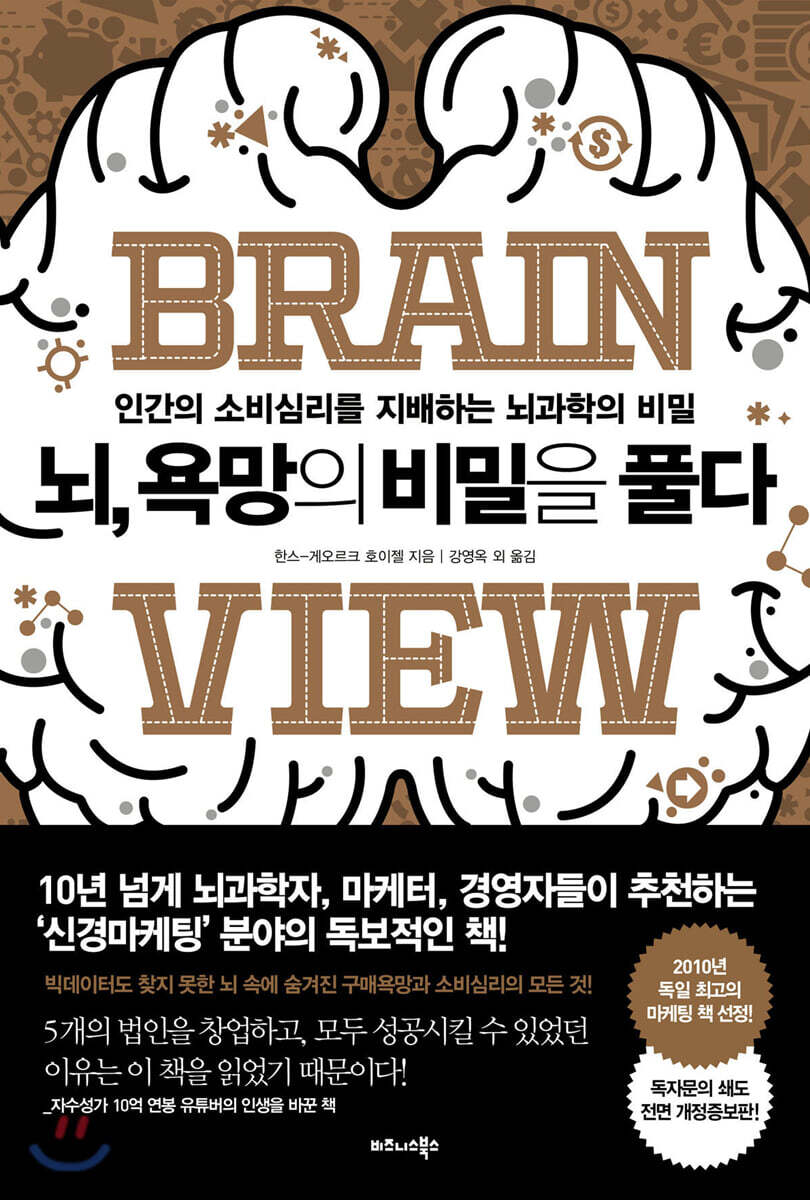
The Brain Unlocks the Secrets of Desire
 |
Description
Book Introduction
How does the unconscious mind control your customers' wallets? The secret of brain science that governs human consumer psychology! "The Brain, Unlocking the Secrets of Desire" is a hot topic by Dr. Hans-Georg Heusel, a leading authority in the field of neuromarketing and a marketing and branding advisor to global companies. The core concept advocated by the author is the Limbic® Map, the world's leading neuromarketing model for understanding consumer emotions and motivations. The Limbic® Map, a motivation modeling tool developed by the author through 15 years of brain research and market research, provides a clear answer to the question, "How does the unconscious mind control human economic activity?" This book presents an effective way to dramatically improve sales by using a new method to look inside the human brain. The key is the three scientifically proven emotional systems known as the "Big 3." The Big 3 include the balance system (need for safety), the stimulation system (need for novelty and experience), and the dominance system (need for power). These three needs conflict, compromise, and combine with each other depending on various environments and situations to control or stimulate economic activity. By following the Big 3 map of emotions and motivations, you can decipher the complexly intertwined human psychology that deceives reason, creates conflict, and ultimately leads to purchase. And you can get valuable insights into why your customers and consumers buy what products. This book analyzes consumer personality by following the Limbic® Map and divides them into seven types (Traditionalists, Harmonizers, Open-mindedness, Hedonists, Adventurers, Implementers, and Disciplinarians) based on their emotional center of gravity. By categorizing by type, we provide practical tips on marketing and sales increase strategies discovered through tracking consumer tendencies and characteristics, internal and external factors that move consumers' minds and brains, the process and reasons for making purchasing decisions, effective methods to induce purchases based on gender and age, the brand formation process, and everything from cue management that stimulates the five senses to store layout and product display. This book, which suggests ways to understand customer tendencies, patterns, and motivations and further increase sales, recently became a hot topic after being introduced by a YouTuber with an annual salary of 1 billion won, and it became so popular that it was sold for 100,000 won on the used market. |
- You can preview some of the book's contents.
Preview
index
Preface to the Revised Edition: The Key to Decoding the Hidden Purchasing Desire in the Human Brain
Getting Started_ It's Time to Say Goodbye to Marketing Myths
Part 1: Why Customers Buy Products
Chapter 01 Brain Research: Finding the Hidden Tempter
Chapter 02 The Real Purchasing Motivation Hidden in Customers' Brains
Chapter 03 The Unconscious Logic of Products and Markets
Chapter 04 The process of making a purchase decision in your head
◆ Key points
Part 2: Swaying Customers' Minds in Purchasing Decisions
Chapter 05 How to Target Your Mind According to Your Brain Type
Chapter 06 The Female Brain, the Male Brain
Chapter 07 Does the brain change with age?
◆ Key points
Part 3 Effective Ways to Induce Purchases
Chapter 08 Brand Reserved Seats in the Brain
Chapter 09 Advanced Seduction Skills: Queue Management
Chapter 10 POS & POP, Where Decisions Are Made
Chapter 11: The Digital Brain: The Encounter of New Technology and the Old Brain
Chapter 12 B2B Transactions Are Also Governed by Emotions
Chapter 13 Can a Brain Scanner Read Your Customers' Minds?
◆ Key points
In conclusion: Neuromarketing: The most powerful weapon to seduce consumers.
Infobox
References
Getting Started_ It's Time to Say Goodbye to Marketing Myths
Part 1: Why Customers Buy Products
Chapter 01 Brain Research: Finding the Hidden Tempter
Chapter 02 The Real Purchasing Motivation Hidden in Customers' Brains
Chapter 03 The Unconscious Logic of Products and Markets
Chapter 04 The process of making a purchase decision in your head
◆ Key points
Part 2: Swaying Customers' Minds in Purchasing Decisions
Chapter 05 How to Target Your Mind According to Your Brain Type
Chapter 06 The Female Brain, the Male Brain
Chapter 07 Does the brain change with age?
◆ Key points
Part 3 Effective Ways to Induce Purchases
Chapter 08 Brand Reserved Seats in the Brain
Chapter 09 Advanced Seduction Skills: Queue Management
Chapter 10 POS & POP, Where Decisions Are Made
Chapter 11: The Digital Brain: The Encounter of New Technology and the Old Brain
Chapter 12 B2B Transactions Are Also Governed by Emotions
Chapter 13 Can a Brain Scanner Read Your Customers' Minds?
◆ Key points
In conclusion: Neuromarketing: The most powerful weapon to seduce consumers.
Infobox
References
Detailed image

Publisher's Review
For over 10 years, neuroscientists, marketers, and managers have been
A unique book in the field of 'neuromarketing' that I highly recommend!
Why does this book sell for 100,000 won on the used market?
Everything about consumer psychology and purchasing desires hidden in the brain that even big data can't find!
★Highly recommended by neuroscientist Professor Jaeseung Jeong!
★The life book of a YouTuber with a salary of 1 billion won!
★Selected as Germany's best marketing book!
★Completely revised and expanded edition!
Deciphering the hidden purchasing desires in the brain that even big data can't find!
Named Germany's best marketing book of 2010, this book shows how far brain research and marketing have come.
For several years now, many companies have been using big data for marketing.
However, there is skepticism about how much valuable information companies and practitioners are analyzing and scientifically utilizing through big data.
In other words, no matter how advanced big data analysis technology becomes, if it cannot grasp the essence of the purchasing motivations and consumer desires hidden in the human brain, it will be difficult for any product, no matter how excellent, to succeed in the market.
The Galaxy Fold recently sold out within a day of its release.
According to the industry, the gender ratio of buyers was overwhelmingly male at 90% and female at 10%, and by age, it was in the order of 20s and 30s (60%), 40s (22%), and 50s (5%).
This means that men in their 20s and 30s, who tend to be early adopters, responded enthusiastically.
Why are men in their 20s and 30s so attracted to this product, and what are their purchasing patterns and motivations? The answer lies in the purchasing desires hidden within the human brain.
In that respect, Professor Jeong Jae-seung strongly recommends this book.
"Why do customers buy our products? Which potential customers should we market to in order to increase our sales?" This book provides precise answers to these questions.
Dissect your customers' brains and read their desires.
“For anyone who needs to sell something and win someone’s heart, this book will be an invaluable guide.”
How does the unconscious mind control your customers' wallets?
The secret of brain science that governs human consumer psychology!
"The Brain, Unlocking the Secrets of Desire" is a hot topic by Dr. Hans-Georg Heusel, a leading authority in the field of neuromarketing and a marketing and branding advisor to global companies.
The core concept advocated by the author is the Limbic® Map, the world's leading neuromarketing model for understanding consumer emotions and motivations.
The Limbic® Map, a motivation modeling tool developed by the author through 15 years of brain research and market research, provides a clear answer to the question, "How does the unconscious mind control human economic activity?"
This book presents an effective way to dramatically improve sales by using a new method to look inside the human brain.
The key is the three scientifically proven emotional systems known as the "Big 3."
The Big 3 include the balance system (need for safety), the stimulation system (need for novelty and experience), and the dominance system (need for power). These three needs conflict, compromise, and combine with each other depending on various environments and situations to control or stimulate economic activity.
By following the Big 3 map of emotions and motivations, you can decipher the complexly intertwined human psychology that deceives reason, creates conflict, and ultimately leads to purchase.
And you can get valuable insights into why your customers and consumers buy what products.
This book analyzes consumer personality by following the Limbic® Map and divides them into seven types (Traditionalists, Harmonizers, Open-mindedness, Hedonists, Adventurers, Implementers, and Disciplinarians) based on their emotional center of gravity.
By categorizing by type, we provide practical tips on marketing and sales increase strategies discovered through tracking consumer tendencies and characteristics, internal and external factors that move consumers' minds and brains, the process and reasons for making purchasing decisions, effective methods to induce purchases based on gender and age, the brand formation process, and everything from cue management that stimulates the five senses to store layout and product display.
This book, which suggests ways to understand customer tendencies, patterns, and motivations and further increase sales, recently became a hot topic after being introduced by a YouTuber with an annual salary of 1 billion won, and it became so popular that it was sold for 100,000 won on the used market.
A tool that can be applied directly to marketing sites!
Knowing the Limbic® map allows you to apply the emotional language of design to your furniture or home style.
A leading German furniture company increased its sales by using Limbic® maps.
The design and form language suitable for customers with a strong balance system is warm colors, natural wood, and small accessory decoration.
For customers who are heavily influenced by the stimulation system, design colors and shapes become more eccentric and the materials used become more unique.
In other words, success was achieved by changing the morphological language strategy according to the target group.
In addition, it vividly shows how brands such as Google, Kellogg, Krombacher beer, Nivea, Porsche and Volkswagen, Camel cigarettes, and IKEA have dealt with the consumer's brain and experienced success and failure through the marketing strategies of brands such as Foesslauer, which led the market by designing the shape of its bottle to match the activated areas of the female brain, and the Q management strategy that turned ordinary UHT milk into a premium product.
This book presents the results of brain research in three parts and explores how to effectively apply them to marketing and sales practices.
Part 1 focuses on the question, "Why do customers buy products?"
Discover the hidden temptations that influence customers to buy your products.
Part 2 focuses on the question, "What differences do customers exhibit when purchasing products?"
After segmenting the customer's personality, we identify the psychological/neurobiological characteristics of the target group.
Provides direction for effective target setting and strategy setting.
We also talk about marketing and sales by gender and age.
In Part 3, we select a product and follow its journey from the moment the brand is born until it is displayed in stores.
Through this, we explore the intriguing question: "What can we do to get customers to buy more of our products, more often?"
This comprehensively revised and expanded edition includes additional insights into how the brain reacts to digital media and shopping channels, strategies for successful online commerce, and offers numerous practical hints for marketing by explaining effective brand image building, maximizing sales through signal and message management, the laws of the human unconscious applied to POS, emotional B2B, and the impact of brain scans on market research.
Neuromarketing, a field that may seem difficult at first glance, can be easily understood and utilized by anyone through various examples and diagrams, making it an excellent tool for marketing lectures and research.
A unique book in the field of 'neuromarketing' that I highly recommend!
Why does this book sell for 100,000 won on the used market?
Everything about consumer psychology and purchasing desires hidden in the brain that even big data can't find!
★Highly recommended by neuroscientist Professor Jaeseung Jeong!
★The life book of a YouTuber with a salary of 1 billion won!
★Selected as Germany's best marketing book!
★Completely revised and expanded edition!
Deciphering the hidden purchasing desires in the brain that even big data can't find!
Named Germany's best marketing book of 2010, this book shows how far brain research and marketing have come.
For several years now, many companies have been using big data for marketing.
However, there is skepticism about how much valuable information companies and practitioners are analyzing and scientifically utilizing through big data.
In other words, no matter how advanced big data analysis technology becomes, if it cannot grasp the essence of the purchasing motivations and consumer desires hidden in the human brain, it will be difficult for any product, no matter how excellent, to succeed in the market.
The Galaxy Fold recently sold out within a day of its release.
According to the industry, the gender ratio of buyers was overwhelmingly male at 90% and female at 10%, and by age, it was in the order of 20s and 30s (60%), 40s (22%), and 50s (5%).
This means that men in their 20s and 30s, who tend to be early adopters, responded enthusiastically.
Why are men in their 20s and 30s so attracted to this product, and what are their purchasing patterns and motivations? The answer lies in the purchasing desires hidden within the human brain.
In that respect, Professor Jeong Jae-seung strongly recommends this book.
"Why do customers buy our products? Which potential customers should we market to in order to increase our sales?" This book provides precise answers to these questions.
Dissect your customers' brains and read their desires.
“For anyone who needs to sell something and win someone’s heart, this book will be an invaluable guide.”
How does the unconscious mind control your customers' wallets?
The secret of brain science that governs human consumer psychology!
"The Brain, Unlocking the Secrets of Desire" is a hot topic by Dr. Hans-Georg Heusel, a leading authority in the field of neuromarketing and a marketing and branding advisor to global companies.
The core concept advocated by the author is the Limbic® Map, the world's leading neuromarketing model for understanding consumer emotions and motivations.
The Limbic® Map, a motivation modeling tool developed by the author through 15 years of brain research and market research, provides a clear answer to the question, "How does the unconscious mind control human economic activity?"
This book presents an effective way to dramatically improve sales by using a new method to look inside the human brain.
The key is the three scientifically proven emotional systems known as the "Big 3."
The Big 3 include the balance system (need for safety), the stimulation system (need for novelty and experience), and the dominance system (need for power). These three needs conflict, compromise, and combine with each other depending on various environments and situations to control or stimulate economic activity.
By following the Big 3 map of emotions and motivations, you can decipher the complexly intertwined human psychology that deceives reason, creates conflict, and ultimately leads to purchase.
And you can get valuable insights into why your customers and consumers buy what products.
This book analyzes consumer personality by following the Limbic® Map and divides them into seven types (Traditionalists, Harmonizers, Open-mindedness, Hedonists, Adventurers, Implementers, and Disciplinarians) based on their emotional center of gravity.
By categorizing by type, we provide practical tips on marketing and sales increase strategies discovered through tracking consumer tendencies and characteristics, internal and external factors that move consumers' minds and brains, the process and reasons for making purchasing decisions, effective methods to induce purchases based on gender and age, the brand formation process, and everything from cue management that stimulates the five senses to store layout and product display.
This book, which suggests ways to understand customer tendencies, patterns, and motivations and further increase sales, recently became a hot topic after being introduced by a YouTuber with an annual salary of 1 billion won, and it became so popular that it was sold for 100,000 won on the used market.
A tool that can be applied directly to marketing sites!
Knowing the Limbic® map allows you to apply the emotional language of design to your furniture or home style.
A leading German furniture company increased its sales by using Limbic® maps.
The design and form language suitable for customers with a strong balance system is warm colors, natural wood, and small accessory decoration.
For customers who are heavily influenced by the stimulation system, design colors and shapes become more eccentric and the materials used become more unique.
In other words, success was achieved by changing the morphological language strategy according to the target group.
In addition, it vividly shows how brands such as Google, Kellogg, Krombacher beer, Nivea, Porsche and Volkswagen, Camel cigarettes, and IKEA have dealt with the consumer's brain and experienced success and failure through the marketing strategies of brands such as Foesslauer, which led the market by designing the shape of its bottle to match the activated areas of the female brain, and the Q management strategy that turned ordinary UHT milk into a premium product.
This book presents the results of brain research in three parts and explores how to effectively apply them to marketing and sales practices.
Part 1 focuses on the question, "Why do customers buy products?"
Discover the hidden temptations that influence customers to buy your products.
Part 2 focuses on the question, "What differences do customers exhibit when purchasing products?"
After segmenting the customer's personality, we identify the psychological/neurobiological characteristics of the target group.
Provides direction for effective target setting and strategy setting.
We also talk about marketing and sales by gender and age.
In Part 3, we select a product and follow its journey from the moment the brand is born until it is displayed in stores.
Through this, we explore the intriguing question: "What can we do to get customers to buy more of our products, more often?"
This comprehensively revised and expanded edition includes additional insights into how the brain reacts to digital media and shopping channels, strategies for successful online commerce, and offers numerous practical hints for marketing by explaining effective brand image building, maximizing sales through signal and message management, the laws of the human unconscious applied to POS, emotional B2B, and the impact of brain scans on market research.
Neuromarketing, a field that may seem difficult at first glance, can be easily understood and utilized by anyone through various examples and diagrams, making it an excellent tool for marketing lectures and research.
GOODS SPECIFICS
- Date of issue: October 4, 2019
- Page count, weight, size: 420 pages | 626g | 153*224*20mm
- ISBN13: 9791162541029
- ISBN10: 1162541024
You may also like
카테고리
korean


korean

![ELLE 엘르 스페셜 에디션 A형 : 12월 [2025]](http://librairie.coreenne.fr/cdn/shop/files/b8e27a3de6c9538896439686c6b0e8fb.jpg?v=1766436872&width=3840)


