

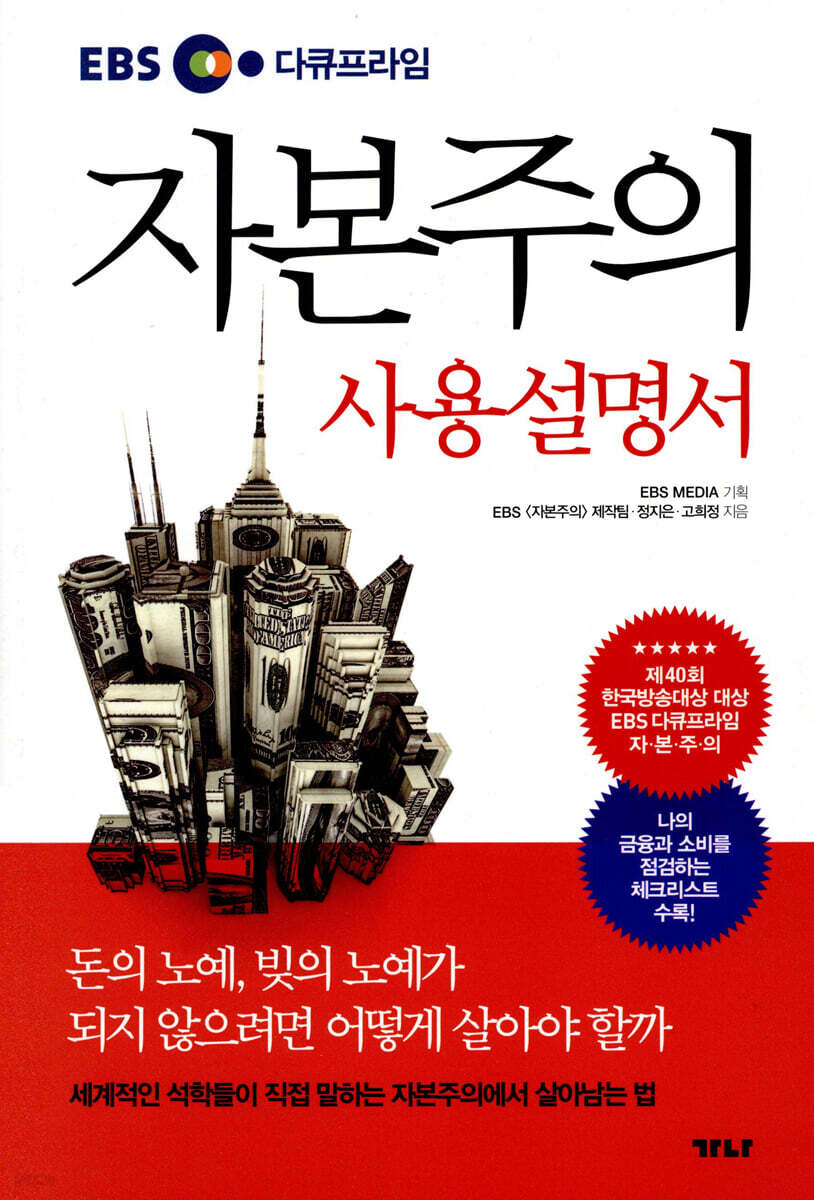
Capitalism User Manual
 |
Description
Book Introduction
“He who knows in advance and prepares will never be defeated!”
Everything You Need to Know to Protect Yourself and Your Family in a Capitalist Society
Capitalism is reaching its limits and various problems are emerging, but there is virtually no alternative to capitalism, and we live in a world where, like it or not, we are returning to the capitalist system.
Consumer marketing will increasingly penetrate our subconscious, and this vague financial world will become an increasingly important part of our lives.
And our children will live in similar or worse conditions than we did.
From the beginning, 'EBS Documentary Prime 〈Capitalism〉' was a program planned with the viewpoint of being a story to teach my child.
There were stories that were not even revealed in 『EBS Documentary Prime Capitalism』, which was a book that explained the broadcast.
I wanted to share with you the advice I heard from world-renowned scholars I met during my broadcast reporting, on why the concerns that arise in our daily lives arise and how we should live.
This book contains stories that the production team, who uncovered the hidden aspects of capitalism that we did not know about through the EBS documentary prime program “Capitalism,” was unable to reveal on the show.
Capitalism manipulates our daily lives in more ingenious ways than we can imagine.
So how should we live so that we don't fall into the trap set by capitalism and become slaves to debt and money?
In the EBS Documentary Prime Capitalism User Manual, each chapter on finance, consumption, money, and financial education features characters who are living as ordinary citizens of this era.
Through these characters, we can experience the temptations and threats of capitalism that have deeply penetrated our daily lives in a concrete and realistic way.
As for what on earth is happening to us.
And through interviews with scholars the production team met in person, it shows us how we can live wisely amidst those temptations and threats.
Everything You Need to Know to Protect Yourself and Your Family in a Capitalist Society
Capitalism is reaching its limits and various problems are emerging, but there is virtually no alternative to capitalism, and we live in a world where, like it or not, we are returning to the capitalist system.
Consumer marketing will increasingly penetrate our subconscious, and this vague financial world will become an increasingly important part of our lives.
And our children will live in similar or worse conditions than we did.
From the beginning, 'EBS Documentary Prime 〈Capitalism〉' was a program planned with the viewpoint of being a story to teach my child.
There were stories that were not even revealed in 『EBS Documentary Prime Capitalism』, which was a book that explained the broadcast.
I wanted to share with you the advice I heard from world-renowned scholars I met during my broadcast reporting, on why the concerns that arise in our daily lives arise and how we should live.
This book contains stories that the production team, who uncovered the hidden aspects of capitalism that we did not know about through the EBS documentary prime program “Capitalism,” was unable to reveal on the show.
Capitalism manipulates our daily lives in more ingenious ways than we can imagine.
So how should we live so that we don't fall into the trap set by capitalism and become slaves to debt and money?
In the EBS Documentary Prime Capitalism User Manual, each chapter on finance, consumption, money, and financial education features characters who are living as ordinary citizens of this era.
Through these characters, we can experience the temptations and threats of capitalism that have deeply penetrated our daily lives in a concrete and realistic way.
As for what on earth is happening to us.
And through interviews with scholars the production team met in person, it shows us how we can live wisely amidst those temptations and threats.
- You can preview some of the book's contents.
Preview
index
Prologue: No One Can Be Free from Finance and Consumption
PART 1: Common Misconceptions in a Financial Capitalist Society
Check! How is your financial life?
1.
Investing is not a way to make a lot of money | 2.
Even if you suffer financial damage, you are responsible|3.
When I buy stocks, the price falls | 4.
Insurance companies thrive on anxiety | 5.
The state is not responsible for the uncertainty of my life | 6.
Should you make owning your own home your lifelong goal?
PART 2: How Consumers Survive the Marketing War
Check! What is your spending style?
1.
Your credit card statement will bring you an unexpected list of charges. | 2.
The discount itself becomes a reason to shop | 3.
Is buying one plus one products a reasonable consumption? | 4.
The behavior of people around you leads to overconsumption | 5.
Living under the illusion of images even when we don't need them | 6.
The illusion that luxury goods increase my worth | 7.
Can you control your emotions? | 8.
In a society where you can't save even if you want to,
Check! Impulse Buying Self-Diagnosis Chart, Shopping Addiction Checklist
PART 3 How Friendly Are You With Money?
Check! What are your thoughts on money?
1.
Why Money Doesn't Save Me | 2.
If you don't carry money, you'll spend more | 3.
If you want to live well, you need to understand the economy.
4.
The Impact of National Income on My Wallet | 5.
Manage your expenses or manage your income
PART 4 Financial Education to Protect You and Your Family
check! What kind of parent are you?
1.
We must learn to look at money | 2.
You're never too young to learn the value of money | 3.
What to leave to your children | 4.
Lack of preparation for retirement due to children | 5.
Children also have the right to know their parents' income | 6.
Financial education teaches happy consumption | 7.
Children should also have opportunities to earn money themselves. | 8.
Growing into an adult who can look at society as a whole
Appendix _ Elementary School Financial Literacy Test
PART 1: Common Misconceptions in a Financial Capitalist Society
Check! How is your financial life?
1.
Investing is not a way to make a lot of money | 2.
Even if you suffer financial damage, you are responsible|3.
When I buy stocks, the price falls | 4.
Insurance companies thrive on anxiety | 5.
The state is not responsible for the uncertainty of my life | 6.
Should you make owning your own home your lifelong goal?
PART 2: How Consumers Survive the Marketing War
Check! What is your spending style?
1.
Your credit card statement will bring you an unexpected list of charges. | 2.
The discount itself becomes a reason to shop | 3.
Is buying one plus one products a reasonable consumption? | 4.
The behavior of people around you leads to overconsumption | 5.
Living under the illusion of images even when we don't need them | 6.
The illusion that luxury goods increase my worth | 7.
Can you control your emotions? | 8.
In a society where you can't save even if you want to,
Check! Impulse Buying Self-Diagnosis Chart, Shopping Addiction Checklist
PART 3 How Friendly Are You With Money?
Check! What are your thoughts on money?
1.
Why Money Doesn't Save Me | 2.
If you don't carry money, you'll spend more | 3.
If you want to live well, you need to understand the economy.
4.
The Impact of National Income on My Wallet | 5.
Manage your expenses or manage your income
PART 4 Financial Education to Protect You and Your Family
check! What kind of parent are you?
1.
We must learn to look at money | 2.
You're never too young to learn the value of money | 3.
What to leave to your children | 4.
Lack of preparation for retirement due to children | 5.
Children also have the right to know their parents' income | 6.
Financial education teaches happy consumption | 7.
Children should also have opportunities to earn money themselves. | 8.
Growing into an adult who can look at society as a whole
Appendix _ Elementary School Financial Literacy Test
Publisher's Review
How to Protect Yourself and Your Family from the Cracks of Financial and Consumer Wars
As long as we live in a capitalist society, no one can be free from finance and consumption.
We like to believe that we are making rational choices in our finances and consumer lives, but that's not true.
The choice is not ours.
Consumer marketing penetrates our subconscious and constantly prompts us to buy things without us even realizing it.
Financial professionals are overwhelmed by the sheer number of financial products available, each boasting that their product is the best, but obscuring the information we truly need.
To protect myself and my children in this capitalist society we live in,
What do we need to know and what can we do?
“He who knows in advance and prepares will never be defeated!”
Everything You Need to Know to Protect Yourself and Your Family in a Capitalist Society
This book contains stories that the production team, who uncovered the hidden aspects of capitalism that we did not know about through the EBS documentary prime program “Capitalism,” was unable to reveal on the show.
Capitalism manipulates our daily lives in more ingenious ways than we can imagine.
So how should we live to avoid falling into the trap set by capitalism, becoming slaves to debt and money? In "EBS Documentary Prime: A Guide to Capitalism," each chapter on finance, consumption, money, and financial education features characters living as ordinary citizens of this era.
Through these characters, we can experience the temptations and threats of capitalism that have deeply penetrated our daily lives in a concrete and realistic way.
As for what on earth is happening to us.
And through interviews with scholars the production team met in person, it shows us how we can live wisely amidst those temptations and threats.
This book will help you examine your own attitudes toward finance, consumption, and money, and determine what you should teach your children as they grow up in a capitalist society.
Stories about everyday life… Are happy consumption and a rational economic life possible?
Capitalism is reaching its limits and various problems are emerging, but there is virtually no alternative to capitalism, and we live in a world where, like it or not, we are returning to the capitalist system.
Consumer marketing will increasingly penetrate our subconscious, and this vague financial world will become an increasingly important part of our lives.
And our children will live in similar or worse conditions than we did.
From the beginning, 'EBS Documentary Prime 〈Capitalism〉' was a program planned with the viewpoint of being a story to teach my child.
There were stories that were not even revealed in 『EBS Documentary Prime Capitalism』, which was a book that explained the broadcast.
I wanted to share with you the advice I heard from world-renowned scholars I met during my broadcast reporting, on why the concerns that arise in our daily lives arise and how we should live.
Why do we have to work two jobs to pay our bills? Why do we become shopaholics and cannot give up fleeting pleasures for deeper satisfaction? Why shouldn't we jump into the financial frenzy without understanding the components of financial markets? Why do we buy things when we're sad or depressed?
The book that came out that way is 『EBS Documentary Prime Capitalism User Manual』.
After reading this book, 'warm capitalism' comes to mind.
It reminds us of the hidden truth and horrors of capitalism, but it also provides us with the wisdom and hope to live wisely in the capitalist era.
What should I do to avoid struggling with loan interest and worrying about my retirement?
“We are fish that have fallen to the bottom.
Someone comes and puts us in the bathtub.
And we give money as if we were giving water and nutrients.
I feel like I'm alive now.
We grow by feeding on the debt poured in by financial capital.
But when the time comes, financial capital drains the water in an instant.
There is nothing that can be done about the body that has already grown large.
“I try to survive somehow, but my life is already dead.”
Song Hongming, a former consultant for Freddie Mac, a U.S. government-sponsored financial institution, offers this analogy for the U.S. financial derivatives industry. This scene, which caused a sensation when the first episode of the EBS documentary series "Capitalism," "Money is Debt," aired, is precisely this.
If you think, 'Who would know I'm studying funds, insurance, and finance?', you'll end up living a difficult life, blaming the recession every time a financial crisis comes.
And it will be passed down to the children.
I'm earning more than I did five or ten years ago, but why is life getting harder and harder? You need to know the answer.
He who knows will never be defeated, and he who knows will be prepared.
Happy financial education that protects me and my family
What is the most essential thing we need to prepare for the future in a capitalist society? It would be economic activities surrounding money.
Among these, ‘financial education for children’ and ‘creating good consumption habits’ should be the most controversial issues.
To help children develop good spending habits and understand money, parents must first understand it.
We can't allow our children to live a life where they work tirelessly and it becomes increasingly difficult to make a living.
Can't we make it so that we are forced to step on each other because of competition?
Change comes from small movements.
After the 2007 financial crisis, the Obama administration in the United States began to focus on financial education for children.
Chicago's Westridge Elementary School is running a money saving program.
Children can learn by coloring a book with the same concept and talking to their parents about it, using piggy banks divided into spending, saving, investing, and donating.
It's about learning about the choices you can make with your money.
Stephanie Neely, a Chicago financial officer who runs this financial education program, says:
“America is now steeped in a culture of constant consumption, buying what you want now, and using credit cards.
We don't teach our children fundamental lessons about money.
That if you postpone your desires for a little while, you can save money.
We need financial education about the choices we can make with money.
Before the current severe recession, the savings rate in the United States was very low.
I was spending a lot of money on credit cards and spending beyond my means.
I think we need to teach kids the value of saving up and waiting, even if they want new sneakers now.
I think it's okay to teach them when they're very young.
American parents, especially those in urban areas, are afraid to teach their children about money choices.
We need to teach children how to control their desires, save, and live within their means.”
The same goes for this book, “Capitalism User Manual.”
Rather than waiting until you're an adult to start saving, spending, and donating, I encourage you to learn how to manage your money from a young age.
The reason children are immature about money is because their parents are like that.
Therefore, the first thing we must do to protect ourselves and our families from the temptations and attacks of capitalism is to look back on our daily lives and introspect ourselves.
And financial education should teach children to establish a proper relationship with money.
A User's Manual for Capitalism from World-Class Scholars… Excerpts from Interviews
“Capitalism is when someone wants my money, attention, and time right now.
Not later.
We live surrounded by temptations to consume and spend money right now.
Companies are using all kinds of strategies here.”
Dan Ariely, Professor of Economics, Duke University.
Author of "Economics Beyond Common Sense"
“The 21st century consumer needs to consume better and consume less.
“It’s about buying better things in smaller quantities and using them much more consistently.”
Paco Underhill, CEO of Envirocell, a shopping consulting firm, and author of "The Science of Shopping"
“Many people today believe that ethics in finance do not exist.
“People who work at banks and hedge funds have no moral compass and are solely focused on making money by any means necessary.”
Niall Ferguson, Professor of History at Harvard University, author of "The Dominance of Cash" and "The Dominance of Finance"
“Even if you have more money, if you don’t have a balanced relationship, the imbalance will only get worse.
I believe that establishing a balanced relationship with money is the starting point for achieving balance.
“That way, you can become someone who can manage, control, and protect your money well.”
Olivia Melan, Clinical Psychologist, Money Coach
“Financial education should begin at a young age and continue to raise awareness about financial choices.
“By the time they are around 8 years old, they are absorbing a lot of information, and the financial education they receive at this time has a huge impact on their lives.”
Stephanie Neely, Treasurer, Chicago, USA
“We need to teach kids what a brand is.
Kids these days know what a brand is, but they don't know why they are so addicted to it.
Parents should talk to their children at home.”
Martin Lindstrom _ World-renowned brand consultant.
Author of 『Shopping Science』 and 『Five Senses Branding』
As long as we live in a capitalist society, no one can be free from finance and consumption.
We like to believe that we are making rational choices in our finances and consumer lives, but that's not true.
The choice is not ours.
Consumer marketing penetrates our subconscious and constantly prompts us to buy things without us even realizing it.
Financial professionals are overwhelmed by the sheer number of financial products available, each boasting that their product is the best, but obscuring the information we truly need.
To protect myself and my children in this capitalist society we live in,
What do we need to know and what can we do?
“He who knows in advance and prepares will never be defeated!”
Everything You Need to Know to Protect Yourself and Your Family in a Capitalist Society
This book contains stories that the production team, who uncovered the hidden aspects of capitalism that we did not know about through the EBS documentary prime program “Capitalism,” was unable to reveal on the show.
Capitalism manipulates our daily lives in more ingenious ways than we can imagine.
So how should we live to avoid falling into the trap set by capitalism, becoming slaves to debt and money? In "EBS Documentary Prime: A Guide to Capitalism," each chapter on finance, consumption, money, and financial education features characters living as ordinary citizens of this era.
Through these characters, we can experience the temptations and threats of capitalism that have deeply penetrated our daily lives in a concrete and realistic way.
As for what on earth is happening to us.
And through interviews with scholars the production team met in person, it shows us how we can live wisely amidst those temptations and threats.
This book will help you examine your own attitudes toward finance, consumption, and money, and determine what you should teach your children as they grow up in a capitalist society.
Stories about everyday life… Are happy consumption and a rational economic life possible?
Capitalism is reaching its limits and various problems are emerging, but there is virtually no alternative to capitalism, and we live in a world where, like it or not, we are returning to the capitalist system.
Consumer marketing will increasingly penetrate our subconscious, and this vague financial world will become an increasingly important part of our lives.
And our children will live in similar or worse conditions than we did.
From the beginning, 'EBS Documentary Prime 〈Capitalism〉' was a program planned with the viewpoint of being a story to teach my child.
There were stories that were not even revealed in 『EBS Documentary Prime Capitalism』, which was a book that explained the broadcast.
I wanted to share with you the advice I heard from world-renowned scholars I met during my broadcast reporting, on why the concerns that arise in our daily lives arise and how we should live.
Why do we have to work two jobs to pay our bills? Why do we become shopaholics and cannot give up fleeting pleasures for deeper satisfaction? Why shouldn't we jump into the financial frenzy without understanding the components of financial markets? Why do we buy things when we're sad or depressed?
The book that came out that way is 『EBS Documentary Prime Capitalism User Manual』.
After reading this book, 'warm capitalism' comes to mind.
It reminds us of the hidden truth and horrors of capitalism, but it also provides us with the wisdom and hope to live wisely in the capitalist era.
What should I do to avoid struggling with loan interest and worrying about my retirement?
“We are fish that have fallen to the bottom.
Someone comes and puts us in the bathtub.
And we give money as if we were giving water and nutrients.
I feel like I'm alive now.
We grow by feeding on the debt poured in by financial capital.
But when the time comes, financial capital drains the water in an instant.
There is nothing that can be done about the body that has already grown large.
“I try to survive somehow, but my life is already dead.”
Song Hongming, a former consultant for Freddie Mac, a U.S. government-sponsored financial institution, offers this analogy for the U.S. financial derivatives industry. This scene, which caused a sensation when the first episode of the EBS documentary series "Capitalism," "Money is Debt," aired, is precisely this.
If you think, 'Who would know I'm studying funds, insurance, and finance?', you'll end up living a difficult life, blaming the recession every time a financial crisis comes.
And it will be passed down to the children.
I'm earning more than I did five or ten years ago, but why is life getting harder and harder? You need to know the answer.
He who knows will never be defeated, and he who knows will be prepared.
Happy financial education that protects me and my family
What is the most essential thing we need to prepare for the future in a capitalist society? It would be economic activities surrounding money.
Among these, ‘financial education for children’ and ‘creating good consumption habits’ should be the most controversial issues.
To help children develop good spending habits and understand money, parents must first understand it.
We can't allow our children to live a life where they work tirelessly and it becomes increasingly difficult to make a living.
Can't we make it so that we are forced to step on each other because of competition?
Change comes from small movements.
After the 2007 financial crisis, the Obama administration in the United States began to focus on financial education for children.
Chicago's Westridge Elementary School is running a money saving program.
Children can learn by coloring a book with the same concept and talking to their parents about it, using piggy banks divided into spending, saving, investing, and donating.
It's about learning about the choices you can make with your money.
Stephanie Neely, a Chicago financial officer who runs this financial education program, says:
“America is now steeped in a culture of constant consumption, buying what you want now, and using credit cards.
We don't teach our children fundamental lessons about money.
That if you postpone your desires for a little while, you can save money.
We need financial education about the choices we can make with money.
Before the current severe recession, the savings rate in the United States was very low.
I was spending a lot of money on credit cards and spending beyond my means.
I think we need to teach kids the value of saving up and waiting, even if they want new sneakers now.
I think it's okay to teach them when they're very young.
American parents, especially those in urban areas, are afraid to teach their children about money choices.
We need to teach children how to control their desires, save, and live within their means.”
The same goes for this book, “Capitalism User Manual.”
Rather than waiting until you're an adult to start saving, spending, and donating, I encourage you to learn how to manage your money from a young age.
The reason children are immature about money is because their parents are like that.
Therefore, the first thing we must do to protect ourselves and our families from the temptations and attacks of capitalism is to look back on our daily lives and introspect ourselves.
And financial education should teach children to establish a proper relationship with money.
A User's Manual for Capitalism from World-Class Scholars… Excerpts from Interviews
“Capitalism is when someone wants my money, attention, and time right now.
Not later.
We live surrounded by temptations to consume and spend money right now.
Companies are using all kinds of strategies here.”
Dan Ariely, Professor of Economics, Duke University.
Author of "Economics Beyond Common Sense"
“The 21st century consumer needs to consume better and consume less.
“It’s about buying better things in smaller quantities and using them much more consistently.”
Paco Underhill, CEO of Envirocell, a shopping consulting firm, and author of "The Science of Shopping"
“Many people today believe that ethics in finance do not exist.
“People who work at banks and hedge funds have no moral compass and are solely focused on making money by any means necessary.”
Niall Ferguson, Professor of History at Harvard University, author of "The Dominance of Cash" and "The Dominance of Finance"
“Even if you have more money, if you don’t have a balanced relationship, the imbalance will only get worse.
I believe that establishing a balanced relationship with money is the starting point for achieving balance.
“That way, you can become someone who can manage, control, and protect your money well.”
Olivia Melan, Clinical Psychologist, Money Coach
“Financial education should begin at a young age and continue to raise awareness about financial choices.
“By the time they are around 8 years old, they are absorbing a lot of information, and the financial education they receive at this time has a huge impact on their lives.”
Stephanie Neely, Treasurer, Chicago, USA
“We need to teach kids what a brand is.
Kids these days know what a brand is, but they don't know why they are so addicted to it.
Parents should talk to their children at home.”
Martin Lindstrom _ World-renowned brand consultant.
Author of 『Shopping Science』 and 『Five Senses Branding』
GOODS SPECIFICS
- Date of issue: July 7, 2014
- Page count, weight, size: 356 pages | 652g | 153*224*21mm
- ISBN13: 9788957366745
- ISBN10: 8957366741
You may also like
카테고리
korean


korean

![ELLE 엘르 스페셜 에디션 A형 : 12월 [2025]](http://librairie.coreenne.fr/cdn/shop/files/b8e27a3de6c9538896439686c6b0e8fb.jpg?v=1766436872&width=3840)


