

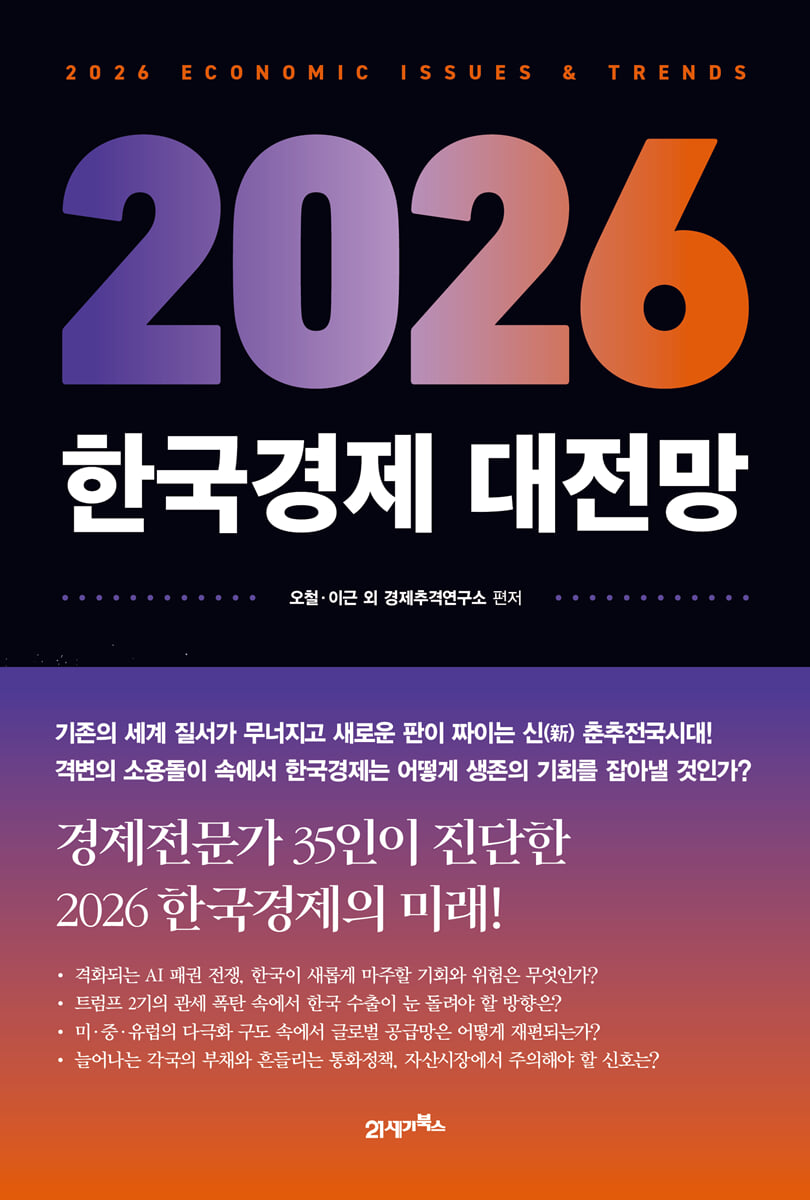
2026 Korean Economic Outlook
 |
Description
Book Introduction
★★ Highly recommended by Kim Yu-won, CEO of Naver Cloud, and Park Jong-hoon, an economic expert!★★
The AI hegemony war, deglobalization, and global supply chain restructuring...
The new Spring and Autumn Period and Warring States Period, where the existing order collapses and a new game is created!
How will the Korean economy seize the opportunity to survive amidst the whirlwind of change?
35 economic experts analyze the Korean economy's outlook for 2026!
The world is now engulfed in a great turmoil that could be called the 'New Spring and Autumn Period and Warring States Period.'
The United States continues to impose and expand tariffs, disrupting the global trade order. Furthermore, with India and China, previously in conflict within the BRICS, now engaging in new cooperation, the bipolar US-China system is shifting to a tripolar or multipolar structure with the US, Europe, and BRICS competing against each other.
Above all, the massive variable called AI is shaking up security, industry, and society as a whole, completely changing the global economy.
The book "2026 Korean Economic Outlook" is a diagnosis of 2026, a year that will be plunged into a whirlwind of upheaval, by 35 of Korea's top economic experts.
The authors list 'turmoil in the clouds' and 'collapse in the sky' as keywords to describe this era.
As the saying goes, "Even in a chaotic situation where waves surge and clouds tumble, there is always a way out even if the sky falls," crisis and opportunity always coexist.
This book comprehensively analyzes the structural challenges facing the Korean economy, including AI, geopolitics, industry, and asset markets, and shows us the path we must take to survive in a turbulent world.
For readers who dream of the revival of the Korean economy and ponder the future of food even amidst extreme chaos, this book will serve as a friendly economic guide and a survival manual to navigate uncertainty.
The AI hegemony war, deglobalization, and global supply chain restructuring...
The new Spring and Autumn Period and Warring States Period, where the existing order collapses and a new game is created!
How will the Korean economy seize the opportunity to survive amidst the whirlwind of change?
35 economic experts analyze the Korean economy's outlook for 2026!
The world is now engulfed in a great turmoil that could be called the 'New Spring and Autumn Period and Warring States Period.'
The United States continues to impose and expand tariffs, disrupting the global trade order. Furthermore, with India and China, previously in conflict within the BRICS, now engaging in new cooperation, the bipolar US-China system is shifting to a tripolar or multipolar structure with the US, Europe, and BRICS competing against each other.
Above all, the massive variable called AI is shaking up security, industry, and society as a whole, completely changing the global economy.
The book "2026 Korean Economic Outlook" is a diagnosis of 2026, a year that will be plunged into a whirlwind of upheaval, by 35 of Korea's top economic experts.
The authors list 'turmoil in the clouds' and 'collapse in the sky' as keywords to describe this era.
As the saying goes, "Even in a chaotic situation where waves surge and clouds tumble, there is always a way out even if the sky falls," crisis and opportunity always coexist.
This book comprehensively analyzes the structural challenges facing the Korean economy, including AI, geopolitics, industry, and asset markets, and shows us the path we must take to survive in a turbulent world.
For readers who dream of the revival of the Korean economy and ponder the future of food even amidst extreme chaos, this book will serve as a friendly economic guide and a survival manual to navigate uncertainty.
- You can preview some of the book's contents.
Preview
index
Recommendation
Prologue: The economic climate is turbulent and clouded, but opportunities exist.
Chapter 1: The World AI Will Change
INTRO: AI, the Emergence of the World and Its Impact
01 Sovereign AI and South Korea: Technology, Organization, and Industrial Strategy
02 The US-China AI Competition and Korea: Openness and Closeness Reversed
03 AI and Power Systems: Korea's Energy Paradigm Shift by 2026
04 Current Status and Prospects of Artificial Intelligence Utilization in the Industrial Sector
05 Beyond Language Model-Based AI to the Era of Physical AI
06 The Socio-Economic Impact and Prospects of Artificial Intelligence
Chapter 2: Each Country at a Geopolitical Inflection Point: Each Country's Self-Reliance
INTRO: Each country's response strategies in the era of each person for himself
01 Trump's Second Term: Protectionism and a New Order
02 Three Paths for China to Dominate Manufacturing
03 The European economy attempts a soft landing amid dramatic changes.
04 The Reality of the Japanese Economy Revealed by Rising Rice Prices
05 Southeast Asian Economy: Opportunities and Challenges Amidst an 'Unstable Balance'
06 Trump's Second-Term Tariff Policy and the Outlook for Korean Exports
Chapter 3: Key Economic Variables in 2026
INTRO: Five Key Variables That Will Bring a Turning Point to the Korean Economy in 2026
01 The uncertain global economy and the turning point of protectionism
02 Dollar Hegemony and Stablecoins
03 Data-Based Outlook for Korea-China Tourism Industry and People-to-People Exchange
04 Regional Economic Outlook: A Second National Balanced Development Policy Is Needed
05 Korea's SMEs: Beyond the 'Survival Formula' to a 'Growth Strategy'
Chapter 4: K-Industry Outlook and Strategies
INTRO: K-Industry: Time for Strategies to Turn Weakness into Opportunity and Maintain Strength
01 The film industry needs to redefine values and transform its structure.
02 K-Semiconductors Take Another Leap Forward with Artificial Intelligence in 2026
03 K-Electric Vehicles and Batteries in 2026: Finding a Breakthrough in a Time of Turbulence
04 A New Opportunity for K-Shipbuilding through Full-scale Cooperation between Korea and the U.S.
05 K-Nuclear Power's leap forward through exports: A year of revival in the large-scale nuclear power plant market and opportunities for SMRs.
06 K-Defense Industry at the Crossroads of Localization and the Test of Transition to Unmanned and Anti-Aircraft Systems
Chapter 5: Interest Rate Outlook and Asset Markets
INTRO: The Link Between Global Oversupply of Funds and Increased Asset Price Volatility
01 Will monetary policy expand beyond the base interest rate?
02 2026 Stock Market Outlook: A Bull Market Driven by Improved Governance and a Weak Dollar
03 Despite the Fed's rate cut, the risk of a trend upward trend in U.S. long-term interest rates will remain.
04 What Will Drive Exchange Rates in 2026? Key Factors in Exchange Rate Fluctuations
05 Why are house prices rising even though the economy is bad?
Epilogue: The Global Economy and the Korean Economy as Seen Through the Economic Catch-up Index: Korea's Per Capita Income Stalls, China's Catch-up with the US Slows Significantly, and India Overtakes Japan
About the Author
Prologue: The economic climate is turbulent and clouded, but opportunities exist.
Chapter 1: The World AI Will Change
INTRO: AI, the Emergence of the World and Its Impact
01 Sovereign AI and South Korea: Technology, Organization, and Industrial Strategy
02 The US-China AI Competition and Korea: Openness and Closeness Reversed
03 AI and Power Systems: Korea's Energy Paradigm Shift by 2026
04 Current Status and Prospects of Artificial Intelligence Utilization in the Industrial Sector
05 Beyond Language Model-Based AI to the Era of Physical AI
06 The Socio-Economic Impact and Prospects of Artificial Intelligence
Chapter 2: Each Country at a Geopolitical Inflection Point: Each Country's Self-Reliance
INTRO: Each country's response strategies in the era of each person for himself
01 Trump's Second Term: Protectionism and a New Order
02 Three Paths for China to Dominate Manufacturing
03 The European economy attempts a soft landing amid dramatic changes.
04 The Reality of the Japanese Economy Revealed by Rising Rice Prices
05 Southeast Asian Economy: Opportunities and Challenges Amidst an 'Unstable Balance'
06 Trump's Second-Term Tariff Policy and the Outlook for Korean Exports
Chapter 3: Key Economic Variables in 2026
INTRO: Five Key Variables That Will Bring a Turning Point to the Korean Economy in 2026
01 The uncertain global economy and the turning point of protectionism
02 Dollar Hegemony and Stablecoins
03 Data-Based Outlook for Korea-China Tourism Industry and People-to-People Exchange
04 Regional Economic Outlook: A Second National Balanced Development Policy Is Needed
05 Korea's SMEs: Beyond the 'Survival Formula' to a 'Growth Strategy'
Chapter 4: K-Industry Outlook and Strategies
INTRO: K-Industry: Time for Strategies to Turn Weakness into Opportunity and Maintain Strength
01 The film industry needs to redefine values and transform its structure.
02 K-Semiconductors Take Another Leap Forward with Artificial Intelligence in 2026
03 K-Electric Vehicles and Batteries in 2026: Finding a Breakthrough in a Time of Turbulence
04 A New Opportunity for K-Shipbuilding through Full-scale Cooperation between Korea and the U.S.
05 K-Nuclear Power's leap forward through exports: A year of revival in the large-scale nuclear power plant market and opportunities for SMRs.
06 K-Defense Industry at the Crossroads of Localization and the Test of Transition to Unmanned and Anti-Aircraft Systems
Chapter 5: Interest Rate Outlook and Asset Markets
INTRO: The Link Between Global Oversupply of Funds and Increased Asset Price Volatility
01 Will monetary policy expand beyond the base interest rate?
02 2026 Stock Market Outlook: A Bull Market Driven by Improved Governance and a Weak Dollar
03 Despite the Fed's rate cut, the risk of a trend upward trend in U.S. long-term interest rates will remain.
04 What Will Drive Exchange Rates in 2026? Key Factors in Exchange Rate Fluctuations
05 Why are house prices rising even though the economy is bad?
Epilogue: The Global Economy and the Korean Economy as Seen Through the Economic Catch-up Index: Korea's Per Capita Income Stalls, China's Catch-up with the US Slows Significantly, and India Overtakes Japan
About the Author
Detailed image
Into the book
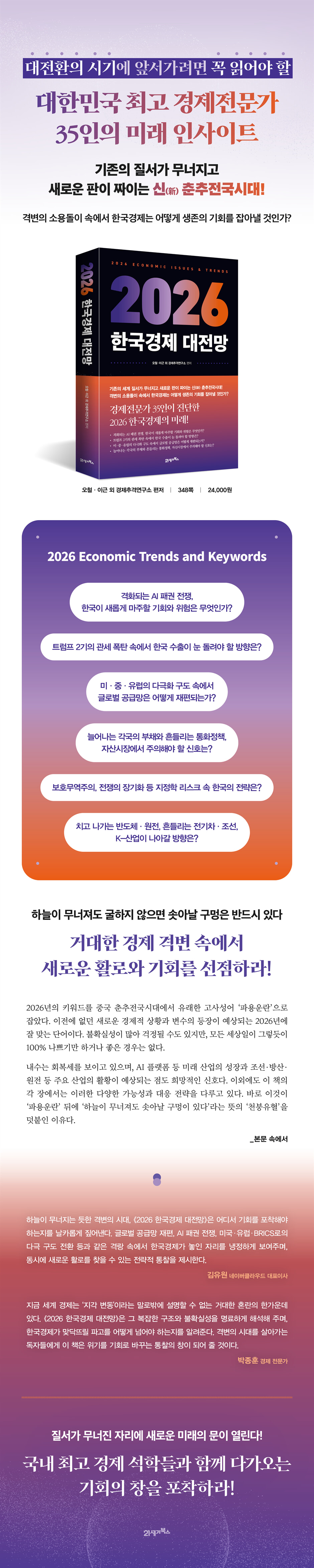
Even in an uncertain 2026 economy, there are positive factors.
First, domestic demand is recovering, and positive factors include the growth of future industries such as AI platforms and the expected boom in industries such as shipbuilding, defense, and nuclear power.
While exports to the U.S. market have become more difficult, market diversification is taking place, with exports to Europe and the Middle East increasing.
I am also confident that the end of the Russo-Ukrainian war will present many positive opportunities for Korea.
The Ukrainian reconstruction project cannot be solely the responsibility of Western Europe, and Russia has no other choice but to choose South Korea as its economic cooperation partner.
In addition, various possibilities are covered in each section of this book.
This is precisely why the saying, “Even if the sky falls, there is a hole to emerge from” was included after the Pa Yong Unran.
--- From "The economic situation is turbulent and the clouds are turbulent, but there is opportunity"
The US-China competition for AI hegemony is becoming increasingly intense, unfolding in a complex intertwining of technology, industry, and security.
Recent advancements in DeepSec's model weight reduction and efficiency, Unitree's commercialization of low-cost robots, China's large-scale AI talent development, and its strategy of integrating manufacturing, healthcare, and military sectors are all testament to China's rise, and as a result, the US's AI leadership is facing challenges.
In response, the United States is strengthening its containment of China through measures such as GPU control, investment restrictions, and cloud blocking, while solidifying a monopoly structure centered on its own platforms, effectively transitioning to a closed system.
In contrast, China emphasizes an open ecosystem, championing open source and global governance.
The author suggests that within this framework, rather than unilaterally aligning with either the United States or China, Korea should maintain a balanced strategy and find a way forward through a convergence strategy that combines AI with its own industrial strengths in manufacturing, healthcare, defense, shipbuilding, and content.
--- From "AI, the Center of the World, and Its Waves"
There are also predictions that if high tariffs lead to a slowdown in economic growth and widening income inequality, the policy could be reversed due to political backlash.
In fact, some point out that the Trump administration's large-scale tax cuts for the wealthy, coupled with tariff increases, will inevitably worsen income distribution.
However, tariff revenues are expected to reach approximately $300 billion in 2025, four times the level in 2024, and are projected to reach a cumulative $2.5 trillion over the next decade.
This has the effect of significantly compensating for the tax revenue shortfall resulting from the tax cut, making tariff reductions unlikely at least during the Trump administration's term.
Moreover, given the ongoing corporate lobbying against tariff reductions and the ongoing US-China hegemony competition, the US's high tariffs and protectionist policies are likely to continue for a considerable period of time.
--- From "The Uncertain Global Economy: A Turning Point of Protectionism"
As of 2025, stablecoins have become a core pillar of digital finance, but they still face significant uncertainties.
Defegging incidents, such as the collapse of Silicon Valley Bank (SVB) in 2023, which sent the USDC price to $0.88, or the collapse of Terra and Luna in 2022, have exposed the structural vulnerabilities of stablecoins as "pseudo-banks."
Potential risks include the G20 and FATF's strengthened blockchain fund tracking, distrust in reserve transparency, and the risk of bank runs due to large-scale redemption demands.
In Korea, if won-based stablecoins and CBDCs address privacy concerns, they could secure a foothold in the domestic payments market.
In particular, the introduction of next-generation privacy protection technologies such as zero-knowledge proofs (ZKPs) is likely to increase user trust and significantly expand digital financial acceptance, especially among the younger generation.
--- From "Dollar Hegemony and Stablecoins"
The central bank's traditional monetary policy aimed to achieve both price stability and economic growth by adjusting the short-term interest rate known as the base rate.
However, as chronic oversupply of funds continues worldwide, and the possibility of inflation rising even in an economic downturn arises, the policy centered on the base interest rate is gradually reaching its limits.
Although the situation is not identical for the US dollar, the key currency, and the Korean won, a non-reserve currency, if long-term interest rates show a structural upward trend globally, both Korea and the United States could see a greater decline in currency value over time and an increase in the overall inflation rate, including for necessities.
Accordingly, investors will have a stronger incentive to prefer non-monetary assets to reduce inflation risk.
Compared to other advanced countries, Korea's average consumer prices are relatively stable (as of August 2025, the consumer price inflation rate was 1.7% year-on-year), but food prices are high in absolute terms and are rising rapidly due to global warming.
Additionally, the phenomenon of Seoul apartment prices jumping sharply whenever market interest rates fall is still a burden.
First, domestic demand is recovering, and positive factors include the growth of future industries such as AI platforms and the expected boom in industries such as shipbuilding, defense, and nuclear power.
While exports to the U.S. market have become more difficult, market diversification is taking place, with exports to Europe and the Middle East increasing.
I am also confident that the end of the Russo-Ukrainian war will present many positive opportunities for Korea.
The Ukrainian reconstruction project cannot be solely the responsibility of Western Europe, and Russia has no other choice but to choose South Korea as its economic cooperation partner.
In addition, various possibilities are covered in each section of this book.
This is precisely why the saying, “Even if the sky falls, there is a hole to emerge from” was included after the Pa Yong Unran.
--- From "The economic situation is turbulent and the clouds are turbulent, but there is opportunity"
The US-China competition for AI hegemony is becoming increasingly intense, unfolding in a complex intertwining of technology, industry, and security.
Recent advancements in DeepSec's model weight reduction and efficiency, Unitree's commercialization of low-cost robots, China's large-scale AI talent development, and its strategy of integrating manufacturing, healthcare, and military sectors are all testament to China's rise, and as a result, the US's AI leadership is facing challenges.
In response, the United States is strengthening its containment of China through measures such as GPU control, investment restrictions, and cloud blocking, while solidifying a monopoly structure centered on its own platforms, effectively transitioning to a closed system.
In contrast, China emphasizes an open ecosystem, championing open source and global governance.
The author suggests that within this framework, rather than unilaterally aligning with either the United States or China, Korea should maintain a balanced strategy and find a way forward through a convergence strategy that combines AI with its own industrial strengths in manufacturing, healthcare, defense, shipbuilding, and content.
--- From "AI, the Center of the World, and Its Waves"
There are also predictions that if high tariffs lead to a slowdown in economic growth and widening income inequality, the policy could be reversed due to political backlash.
In fact, some point out that the Trump administration's large-scale tax cuts for the wealthy, coupled with tariff increases, will inevitably worsen income distribution.
However, tariff revenues are expected to reach approximately $300 billion in 2025, four times the level in 2024, and are projected to reach a cumulative $2.5 trillion over the next decade.
This has the effect of significantly compensating for the tax revenue shortfall resulting from the tax cut, making tariff reductions unlikely at least during the Trump administration's term.
Moreover, given the ongoing corporate lobbying against tariff reductions and the ongoing US-China hegemony competition, the US's high tariffs and protectionist policies are likely to continue for a considerable period of time.
--- From "The Uncertain Global Economy: A Turning Point of Protectionism"
As of 2025, stablecoins have become a core pillar of digital finance, but they still face significant uncertainties.
Defegging incidents, such as the collapse of Silicon Valley Bank (SVB) in 2023, which sent the USDC price to $0.88, or the collapse of Terra and Luna in 2022, have exposed the structural vulnerabilities of stablecoins as "pseudo-banks."
Potential risks include the G20 and FATF's strengthened blockchain fund tracking, distrust in reserve transparency, and the risk of bank runs due to large-scale redemption demands.
In Korea, if won-based stablecoins and CBDCs address privacy concerns, they could secure a foothold in the domestic payments market.
In particular, the introduction of next-generation privacy protection technologies such as zero-knowledge proofs (ZKPs) is likely to increase user trust and significantly expand digital financial acceptance, especially among the younger generation.
--- From "Dollar Hegemony and Stablecoins"
The central bank's traditional monetary policy aimed to achieve both price stability and economic growth by adjusting the short-term interest rate known as the base rate.
However, as chronic oversupply of funds continues worldwide, and the possibility of inflation rising even in an economic downturn arises, the policy centered on the base interest rate is gradually reaching its limits.
Although the situation is not identical for the US dollar, the key currency, and the Korean won, a non-reserve currency, if long-term interest rates show a structural upward trend globally, both Korea and the United States could see a greater decline in currency value over time and an increase in the overall inflation rate, including for necessities.
Accordingly, investors will have a stronger incentive to prefer non-monetary assets to reduce inflation risk.
Compared to other advanced countries, Korea's average consumer prices are relatively stable (as of August 2025, the consumer price inflation rate was 1.7% year-on-year), but food prices are high in absolute terms and are rising rapidly due to global warming.
Additionally, the phenomenon of Seoul apartment prices jumping sharply whenever market interest rates fall is still a burden.
--- From "The Link Between Global Excessive Fund Demand and Increased Asset Price Volatility"
Publisher's Review
Even if the sky falls, if you don't give in, there will definitely be a hole to emerge from!
Seize new paths and opportunities amidst the massive economic upheaval!
In 2026, the world economy is caught in a huge whirlpool.
The ultra-high tariffs being pushed by the Trump administration in its second term are shaking the global trade order and directly putting pressure on Korean exports.
Here, the AI revolution is breaking down boundaries across industry, security, and society, nullifying existing rules, while geopolitical conflicts are further increasing uncertainty.
The Korean economy, highly dependent on trade, stands at the center of this upheaval, requiring strategic decisions rather than mere defensive measures.
Just as the wisdom says that even in times of turbulent waves and turbulent clouds, there is a hole to emerge from even if the sky falls, 2026 is a year of both crisis and opportunity.
"2026 Korea Economic Outlook" features 35 of Korea's top economic experts, providing a multi-faceted analysis of AI, geopolitics, industry, asset markets, and the structural challenges facing Korea, offering a path forward for overcoming the waves of change.
This book comprehensively addresses the key issues facing the Korean economy amidst the turbulent global economy. It comprehensively analyzes the impact of the AI revolution, the US-China hegemony competition, the restructuring of the global order, key variables that will shape the Korean economy in 2026, the opportunities and challenges of key K-industries, and the future direction of asset markets.
Finally, the "Economic Catch-up Index" provides a long-term view of the Korean and global economies, offering readers a benchmark for preparing for the coming era.
In these chaotic times, this book will serve as a compass for survival, essential for policymakers, businesses, and individuals alike.
AI has emerged as the center of the world, transforming industry and society.
This book first examines the AI revolution, the biggest topic in the global economy today and its impact on industry and society as a whole.
Beyond simple technological advancement, AI has become a pivotal force for a massive transformation that will transform national security, industrial competitiveness, and even social structure.
It provides concrete insights into the choices the Korean economy should make in this current.
"Sovereign AI," which secures data and infrastructure sovereignty, is now at the center of national strategy, and the establishment of an integrated ecosystem encompassing semiconductors, power grids, data centers, and even the legal system is urgently needed.
At the same time, the US-China hegemony competition is expanding into a complex front involving technology, industry, and security.
The United States is strengthening GPU control and cloud blocking to build a closed system, while China is expanding an open ecosystem by promoting open source and global governance.
In this polarized landscape, Korea must find a breakthrough by combining the strengths of its domestic industry with AI.
Korea's Choice in an Era of Each-For-All and a Shaking World Order
As the boundaries between allies and enemies blur, the world has entered an era of each for itself.
Global supply chains are fragmenting along geopolitical divides, and nationalism is intensifying.
Southeast Asia struggles to maintain a precarious balance at the forefront of the US-China hegemony competition, while the Middle East and Eastern Europe are fueling global economic uncertainty with war and conflict.
Amidst this whirlwind of change, Korea must move beyond a simple export-dependent model, reorganize its industrial structure, and secure strategic autonomy.
Five Variables That Will Shape the Korean Economy in 2026
The Trump administration's ultra-high tariffs are putting significant pressure on Korean exports and making a restructuring of the trade structure inevitable.
As the dollar's hegemony expands to include stablecoins, the financial order will be reshaped, putting Korea's monetary and financial policy autonomy to the test.
The expansion of tourism between Korea and China is a key variable that will revitalize the stagnant domestic demand and service industry.
The number of Chinese tourists is expected to exceed 7 million in 2026, and if visa-free measures and improved relations continue, this could even reach an all-time high.
The widening gap between the metropolitan and non-metropolitan areas remains a structural challenge, but if balanced development strategies such as strategic industry superclusters and the relocation of large corporations' R&D are implemented, local areas can emerge as growth hubs.
Furthermore, the key question is whether small and medium-sized enterprises (SMEs), which support the Korean economy and its jobs, can move beyond survival to growth.
If export conversion, smart factories, and AI-based innovations bear fruit, 2026 could become the first year of growth for small and medium-sized enterprises (SMEs).
The K-industry outlook is becoming more complex amidst growing pains and China's penetration of the domestic market.
In 2026, K-industry stands at a crossroads where opportunity and crisis intersect.
Semiconductors are preparing for a major transformation as the memory market enters a recovery phase driven by AI demand, while nuclear power is facing new growth potential with the revival of large-scale nuclear power plants and entry into the SMR market.
Despite the slowdown in global orders, the shipbuilding industry can expect profitability based on the Korea-U.S. shipbuilding cooperation program, MASGA.
However, electric vehicles and batteries face the dual challenges of slowing demand and China's price offensive.
The film industry faces the challenge of overcoming the sharp decline in audiences and investment crisis following the COVID-19 pandemic and rediscovering the "reasons for watching movies in theaters."
In 2026, the future landscape of the Korean economy will change depending on which industries overcome decline and revive.
The Link Between Global Financial Excess Demand and Increased Asset Price Volatility
In 2026, asset markets are facing increasing volatility amidst the surge in government debt and chronic oversupply of funds following the pandemic and financial crisis.
Governments around the world are investing massive amounts of money in industrial restructuring, energy transition, and welfare expansion, but as the supply of funds fails to keep pace, long-term interest rates are under upward pressure regardless of the economic cycle.
Meanwhile, the Korean asset market is showing a different pattern.
The stock market is undergoing structural changes as its governance structure improves due to revisions to the Commercial Act, increasing the likelihood that stock prices, which have been stuck around PBR 1, will rebound.
Despite the economic downturn and sluggish construction, the real estate market is expected to continue its gradual upward trend due to a shortage of apartments in the metropolitan area, falling short-term interest rates, and a sense of stability in ownership.
The changes in the asset market, which will intertwine interest rates, stocks, and real estate, will be a critical watershed that will determine the direction of the Korean economy in 2026.
Strategic wisdom is needed to navigate the rough waves.
In 2026, the Korean economy faces more uncertainty and turbulence than ever before.
However, Korea's experience of finding breakthroughs and achieving recovery and growth in times of crisis, such as the IMF foreign exchange crisis, the global financial crisis, and the impact of the pandemic, demonstrates that it can successfully navigate the path ahead.
Through "2026 Korean Economic Outlook," which contains the insights of 35 domestic and international economic experts from diverse backgrounds, including academia, research institutes, government, and business, we hope that readers will systematically interpret the rapidly changing global economic trends and gain insight into the future that the Korean economy and businesses will face.
It is time for individuals, businesses, and nations to develop practical response strategies and to demonstrate the courage and wisdom to ride the wave of change rather than fear it.
What we need now is not hesitation but determination, and not inaction but proactive action.
I hope this book will be a strong companion as you explore that path together.
Seize new paths and opportunities amidst the massive economic upheaval!
In 2026, the world economy is caught in a huge whirlpool.
The ultra-high tariffs being pushed by the Trump administration in its second term are shaking the global trade order and directly putting pressure on Korean exports.
Here, the AI revolution is breaking down boundaries across industry, security, and society, nullifying existing rules, while geopolitical conflicts are further increasing uncertainty.
The Korean economy, highly dependent on trade, stands at the center of this upheaval, requiring strategic decisions rather than mere defensive measures.
Just as the wisdom says that even in times of turbulent waves and turbulent clouds, there is a hole to emerge from even if the sky falls, 2026 is a year of both crisis and opportunity.
"2026 Korea Economic Outlook" features 35 of Korea's top economic experts, providing a multi-faceted analysis of AI, geopolitics, industry, asset markets, and the structural challenges facing Korea, offering a path forward for overcoming the waves of change.
This book comprehensively addresses the key issues facing the Korean economy amidst the turbulent global economy. It comprehensively analyzes the impact of the AI revolution, the US-China hegemony competition, the restructuring of the global order, key variables that will shape the Korean economy in 2026, the opportunities and challenges of key K-industries, and the future direction of asset markets.
Finally, the "Economic Catch-up Index" provides a long-term view of the Korean and global economies, offering readers a benchmark for preparing for the coming era.
In these chaotic times, this book will serve as a compass for survival, essential for policymakers, businesses, and individuals alike.
AI has emerged as the center of the world, transforming industry and society.
This book first examines the AI revolution, the biggest topic in the global economy today and its impact on industry and society as a whole.
Beyond simple technological advancement, AI has become a pivotal force for a massive transformation that will transform national security, industrial competitiveness, and even social structure.
It provides concrete insights into the choices the Korean economy should make in this current.
"Sovereign AI," which secures data and infrastructure sovereignty, is now at the center of national strategy, and the establishment of an integrated ecosystem encompassing semiconductors, power grids, data centers, and even the legal system is urgently needed.
At the same time, the US-China hegemony competition is expanding into a complex front involving technology, industry, and security.
The United States is strengthening GPU control and cloud blocking to build a closed system, while China is expanding an open ecosystem by promoting open source and global governance.
In this polarized landscape, Korea must find a breakthrough by combining the strengths of its domestic industry with AI.
Korea's Choice in an Era of Each-For-All and a Shaking World Order
As the boundaries between allies and enemies blur, the world has entered an era of each for itself.
Global supply chains are fragmenting along geopolitical divides, and nationalism is intensifying.
Southeast Asia struggles to maintain a precarious balance at the forefront of the US-China hegemony competition, while the Middle East and Eastern Europe are fueling global economic uncertainty with war and conflict.
Amidst this whirlwind of change, Korea must move beyond a simple export-dependent model, reorganize its industrial structure, and secure strategic autonomy.
Five Variables That Will Shape the Korean Economy in 2026
The Trump administration's ultra-high tariffs are putting significant pressure on Korean exports and making a restructuring of the trade structure inevitable.
As the dollar's hegemony expands to include stablecoins, the financial order will be reshaped, putting Korea's monetary and financial policy autonomy to the test.
The expansion of tourism between Korea and China is a key variable that will revitalize the stagnant domestic demand and service industry.
The number of Chinese tourists is expected to exceed 7 million in 2026, and if visa-free measures and improved relations continue, this could even reach an all-time high.
The widening gap between the metropolitan and non-metropolitan areas remains a structural challenge, but if balanced development strategies such as strategic industry superclusters and the relocation of large corporations' R&D are implemented, local areas can emerge as growth hubs.
Furthermore, the key question is whether small and medium-sized enterprises (SMEs), which support the Korean economy and its jobs, can move beyond survival to growth.
If export conversion, smart factories, and AI-based innovations bear fruit, 2026 could become the first year of growth for small and medium-sized enterprises (SMEs).
The K-industry outlook is becoming more complex amidst growing pains and China's penetration of the domestic market.
In 2026, K-industry stands at a crossroads where opportunity and crisis intersect.
Semiconductors are preparing for a major transformation as the memory market enters a recovery phase driven by AI demand, while nuclear power is facing new growth potential with the revival of large-scale nuclear power plants and entry into the SMR market.
Despite the slowdown in global orders, the shipbuilding industry can expect profitability based on the Korea-U.S. shipbuilding cooperation program, MASGA.
However, electric vehicles and batteries face the dual challenges of slowing demand and China's price offensive.
The film industry faces the challenge of overcoming the sharp decline in audiences and investment crisis following the COVID-19 pandemic and rediscovering the "reasons for watching movies in theaters."
In 2026, the future landscape of the Korean economy will change depending on which industries overcome decline and revive.
The Link Between Global Financial Excess Demand and Increased Asset Price Volatility
In 2026, asset markets are facing increasing volatility amidst the surge in government debt and chronic oversupply of funds following the pandemic and financial crisis.
Governments around the world are investing massive amounts of money in industrial restructuring, energy transition, and welfare expansion, but as the supply of funds fails to keep pace, long-term interest rates are under upward pressure regardless of the economic cycle.
Meanwhile, the Korean asset market is showing a different pattern.
The stock market is undergoing structural changes as its governance structure improves due to revisions to the Commercial Act, increasing the likelihood that stock prices, which have been stuck around PBR 1, will rebound.
Despite the economic downturn and sluggish construction, the real estate market is expected to continue its gradual upward trend due to a shortage of apartments in the metropolitan area, falling short-term interest rates, and a sense of stability in ownership.
The changes in the asset market, which will intertwine interest rates, stocks, and real estate, will be a critical watershed that will determine the direction of the Korean economy in 2026.
Strategic wisdom is needed to navigate the rough waves.
In 2026, the Korean economy faces more uncertainty and turbulence than ever before.
However, Korea's experience of finding breakthroughs and achieving recovery and growth in times of crisis, such as the IMF foreign exchange crisis, the global financial crisis, and the impact of the pandemic, demonstrates that it can successfully navigate the path ahead.
Through "2026 Korean Economic Outlook," which contains the insights of 35 domestic and international economic experts from diverse backgrounds, including academia, research institutes, government, and business, we hope that readers will systematically interpret the rapidly changing global economic trends and gain insight into the future that the Korean economy and businesses will face.
It is time for individuals, businesses, and nations to develop practical response strategies and to demonstrate the courage and wisdom to ride the wave of change rather than fear it.
What we need now is not hesitation but determination, and not inaction but proactive action.
I hope this book will be a strong companion as you explore that path together.
GOODS SPECIFICS
- Date of issue: October 31, 2025
- Page count, weight, size: 348 pages | 152*225*30mm
- ISBN13: 9791173575457
- ISBN10: 1173575456
You may also like
카테고리
korean


korean

![GQ KOREA Mark (Monthly): December [2025]](http://librairie.coreenne.fr/cdn/shop/files/8ef265dbbfbf186523ed75ba7319009d.jpg?v=1765340328&width=3840)


