

2025 Listed Company Industry Map
 |
Description
Book Introduction
See over 2,400 listed companies at a glance!
Investment points for energy, bio, beauty, and defense companies
- A separate volume, "Supply Chain Map," woven into the supply chain.
The fourth volume of the "Listed Company Industry Map," published every two years and a must-have for individual investors.
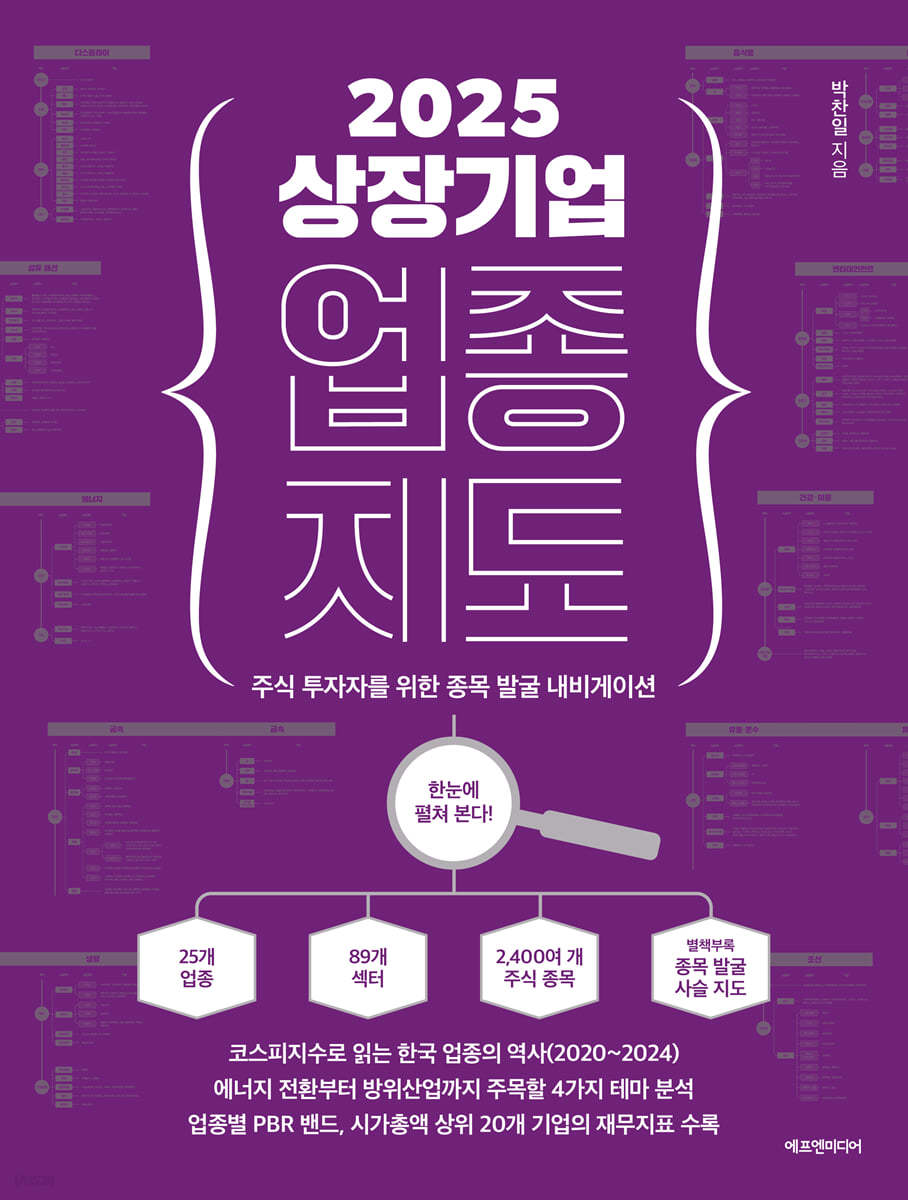
It serves as a "stock discovery guide" by categorizing approximately 2,400 domestic listed companies into 25 industries and 89 sectors, and then organizing them by supply chain and business area.
By systematically organizing what each industry does, which companies are involved and which companies are involved forward and backward, what value chains affect each company's performance, and which companies it competes with, it helps develop an eye for seeing both the "forest and the trees" in the stock market.
Part 1 looks at the history of the Korean stock market through stock indices.
We examined industries that gained attention during the period of rising KOSPI index from 2000 to 2024, and also analyzed interest rates, oil prices, and economic growth rates.
Part 2 selects four themes to watch: energy, bio, beauty, and defense, and introduces related companies, highlighting investment points.
Part 3 classifies listed companies into 25 industries and explains the characteristics, issues, and major companies of each industry.
For each industry, the top 20 stocks by market capitalization include key financial data such as market capitalization, total equity, sales, net profit, and debt ratio.
We also added the PBR band, an indicator that will be of practical help to investors.
We also provide a special appendix titled “Stock Discovery Chain Map,” which compiles industry maps for 25 industries and holding companies.
It is a flow diagram format that enhances visibility and readability, making it easy to understand the supply chain from industry to company.
This book will be a useful reference for investors who lack specialized knowledge but are uncomfortable relying on fragmented information, as well as those who seek to understand industries and companies and identify investment opportunities on their own.
Investment points for energy, bio, beauty, and defense companies
- A separate volume, "Supply Chain Map," woven into the supply chain.
The fourth volume of the "Listed Company Industry Map," published every two years and a must-have for individual investors.
It serves as a "stock discovery guide" by categorizing approximately 2,400 domestic listed companies into 25 industries and 89 sectors, and then organizing them by supply chain and business area.
By systematically organizing what each industry does, which companies are involved and which companies are involved forward and backward, what value chains affect each company's performance, and which companies it competes with, it helps develop an eye for seeing both the "forest and the trees" in the stock market.
Part 1 looks at the history of the Korean stock market through stock indices.
We examined industries that gained attention during the period of rising KOSPI index from 2000 to 2024, and also analyzed interest rates, oil prices, and economic growth rates.
Part 2 selects four themes to watch: energy, bio, beauty, and defense, and introduces related companies, highlighting investment points.
Part 3 classifies listed companies into 25 industries and explains the characteristics, issues, and major companies of each industry.
For each industry, the top 20 stocks by market capitalization include key financial data such as market capitalization, total equity, sales, net profit, and debt ratio.
We also added the PBR band, an indicator that will be of practical help to investors.
We also provide a special appendix titled “Stock Discovery Chain Map,” which compiles industry maps for 25 industries and holding companies.
It is a flow diagram format that enhances visibility and readability, making it easy to understand the supply chain from industry to company.
This book will be a useful reference for investors who lack specialized knowledge but are uncomfortable relying on fragmented information, as well as those who seek to understand industries and companies and identify investment opportunities on their own.
- You can preview some of the book's contents.
Preview
index
Introduction: Knowing your industry increases your chances of investment success.
PART 1.
Industry History as Seen Through Stock Indices
PART 2.
Notable Themes for 2025
Energy, Finding Opportunity in Chaos
Opportunities Created by Bio, Technology, and the Environment
The Power of K-Beauty: From Cosmetics to Medical Devices
K-Defense Industry Takes a Leap Forward to the Global Market
PART 3.
25 industries and holding companies that make up the stock market
IT industry
Health and Beauty Industry
construction industry
construction materials industry
metal industry
machinery industry
Display industry
leisure industry
bio industry
semiconductor industry
Living industry
Textile and fashion industry
Smartphone industry
Energy industry
entertainment industry
Distribution and transportation industry
Food and beverage industry
Medical device industry
automotive industry
electronics industry
pharmaceutical industry
shipbuilding industry
Telecommunications industry
chemical industry
Landlord
Search
PART 1.
Industry History as Seen Through Stock Indices
PART 2.
Notable Themes for 2025
Energy, Finding Opportunity in Chaos
Opportunities Created by Bio, Technology, and the Environment
The Power of K-Beauty: From Cosmetics to Medical Devices
K-Defense Industry Takes a Leap Forward to the Global Market
PART 3.
25 industries and holding companies that make up the stock market
IT industry
Health and Beauty Industry
construction industry
construction materials industry
metal industry
machinery industry
Display industry
leisure industry
bio industry
semiconductor industry
Living industry
Textile and fashion industry
Smartphone industry
Energy industry
entertainment industry
Distribution and transportation industry
Food and beverage industry
Medical device industry
automotive industry
electronics industry
pharmaceutical industry
shipbuilding industry
Telecommunications industry
chemical industry
Landlord
Search
Detailed image

Publisher's Review
Navigator that guides you through the industries and stocks of the Korean stock market.
Reflecting changing industry conditions and updating key issues
To invest in stocks, you need to understand the business model of a company and how it makes money, and analyze its financial data to see exactly how much money it has made.
However, this task is not only difficult and tedious for amateur investors who have other jobs, but also for professionals whose main job is investing.
It costs a lot of money to get help.
Therefore, the most realistic and efficient way is to select a good book, read it, and utilize it.
The "2025 Listed Company Industry Map" provides simple yet concrete, key data.
We created 25 industry baskets, and installed partitions in each basket according to the characteristics of the company.
It revealed invisible companies and brought together companies with similar characteristics for comparison.
It's hard to find a practical book that's as helpful for real-world investing as this one.
Industry History as Seen Through Stock Indices
Energy transition and aging populations will become increasingly important in the future.
Part 1 looked at the history of the Korean stock market through stock indices.
The Korean stock market began with 12 companies in 1956 and grew to approximately 2,400 companies by 2024.
The book examines the ups and downs of industries from 2000 to 2024, analyzing interest rates, oil prices, economic growth rates, politics, and leading industries that influence the KOSPI index.
For example, when the global financial crisis broke out in 2008, the KOSPI index plummeted from 1,700 points to 1,100 points, but liquidity was supplied thereafter, and a liquidity boom unfolded from 2009 to 2011, leading to a craze for 'cha·hwa·jeong (automobiles, chemicals, and oil refining).
The period after 2023 will be the era of artificial intelligence, symbolized by ChatGPT.
The author presented ‘energy transition’ and ‘aging’ as paradigms that will have a major impact in the future.
Four themes to watch, from energy to defense
Seize the opportunity to enjoy growth together
The four themes to watch in 2025 were selected as 'energy, bio, beauty, and defense industry.'
What they have in common is that they are recording differential changes and rapid growth.
Since the 2000s, the transition to 'decarbonized and eco-friendly' energy has been implemented, but the brakes have been applied due to unstable power generation and power grid shortages.
Therefore, there are opportunities for companies involved in power grid expansion and nuclear power generation.
Biotech companies have strengths in the bioplatform sector, which enables accurate and rapid drug delivery, and the opportunity has grown further with the US decision to sanction Chinese biotech companies under the Biosecurity Act.
K-beauty is gaining popularity in North America and Japan as a result of collaborations between indie brands, ODMs, and distribution platforms, and cosmetic medical devices such as botox, fillers, lifting, and home beauty devices are expanding their base to the global market thanks to social media.
Defense industry companies are experiencing a surge in export orders amid the "new Cold War-deglobalization" atmosphere, fueled by the Russia-Ukraine war and the Israeli conflict.
By focusing on companies that are leading the way in these fields, you can create opportunities to share in their growth.
Analysis of 25 industries and holding companies
Added PBR band, a useful indicator for investment.
In Part 3, all stocks of approximately 2,400 listed companies are classified into 25 industries, and the companies within each industry are linked by "business field" and "supply chain," and the characteristics and trends of the industries are briefly explained.
It includes PBR bands that show past and present stock price levels for each industry, and selects the top 20 stocks by market capitalization to provide data on 'stock price, market capitalization, total capital, sales, net profit, debt ratio, PER, PBR, ROE, and dividend yield.'
Finally, the landlord was added.
In this book, we have condensed the sectors from 91 to 89 to more clearly organize the companies within them.
The stock market is constantly changing due to frequent corporate mergers and acquisitions, delistings, and new listings.
A company's business model may change, and its industry may change.
The book reflects the changing landscape of the industry and updates key issues.
It's good to just group together the industry maps for reference
Special Appendix: "Stock Discovery Chain Map"
The mind maps included up to the 2021 edition were well-received for their advantage of showing the overall flow.
However, some pointed out that it was difficult to decipher due to the complex branch shapes, irregular lines, and small letters.
So, starting with the 2023 edition, we are producing industry maps in a flow diagram format that is as simple as possible to improve visibility and readability.
Just by looking at the industry map, categorized by industry-sector-subcategory, you can grasp the big picture of the manufacturing process and ecosystem and identify companies that are competing while conducting equal business.
It is not easy for individual investors who lack professional knowledge to classify industries and analyze companies based on their own criteria.
It is even more difficult to grasp the stock market at a glance, predict the future, and find good stocks.
Some people suffer huge losses by investing solely based on popular YouTube channels, blogs, stock reading rooms, and stock news.
However, if you use this book, which comprehensively examines all stock market sectors, as a stock-discovery navigator, it will establish a standard for viewing the market and help improve your investment performance.
Reflecting changing industry conditions and updating key issues
To invest in stocks, you need to understand the business model of a company and how it makes money, and analyze its financial data to see exactly how much money it has made.
However, this task is not only difficult and tedious for amateur investors who have other jobs, but also for professionals whose main job is investing.
It costs a lot of money to get help.
Therefore, the most realistic and efficient way is to select a good book, read it, and utilize it.
The "2025 Listed Company Industry Map" provides simple yet concrete, key data.
We created 25 industry baskets, and installed partitions in each basket according to the characteristics of the company.
It revealed invisible companies and brought together companies with similar characteristics for comparison.
It's hard to find a practical book that's as helpful for real-world investing as this one.
Industry History as Seen Through Stock Indices
Energy transition and aging populations will become increasingly important in the future.
Part 1 looked at the history of the Korean stock market through stock indices.
The Korean stock market began with 12 companies in 1956 and grew to approximately 2,400 companies by 2024.
The book examines the ups and downs of industries from 2000 to 2024, analyzing interest rates, oil prices, economic growth rates, politics, and leading industries that influence the KOSPI index.
For example, when the global financial crisis broke out in 2008, the KOSPI index plummeted from 1,700 points to 1,100 points, but liquidity was supplied thereafter, and a liquidity boom unfolded from 2009 to 2011, leading to a craze for 'cha·hwa·jeong (automobiles, chemicals, and oil refining).
The period after 2023 will be the era of artificial intelligence, symbolized by ChatGPT.
The author presented ‘energy transition’ and ‘aging’ as paradigms that will have a major impact in the future.
Four themes to watch, from energy to defense
Seize the opportunity to enjoy growth together
The four themes to watch in 2025 were selected as 'energy, bio, beauty, and defense industry.'
What they have in common is that they are recording differential changes and rapid growth.
Since the 2000s, the transition to 'decarbonized and eco-friendly' energy has been implemented, but the brakes have been applied due to unstable power generation and power grid shortages.
Therefore, there are opportunities for companies involved in power grid expansion and nuclear power generation.
Biotech companies have strengths in the bioplatform sector, which enables accurate and rapid drug delivery, and the opportunity has grown further with the US decision to sanction Chinese biotech companies under the Biosecurity Act.
K-beauty is gaining popularity in North America and Japan as a result of collaborations between indie brands, ODMs, and distribution platforms, and cosmetic medical devices such as botox, fillers, lifting, and home beauty devices are expanding their base to the global market thanks to social media.
Defense industry companies are experiencing a surge in export orders amid the "new Cold War-deglobalization" atmosphere, fueled by the Russia-Ukraine war and the Israeli conflict.
By focusing on companies that are leading the way in these fields, you can create opportunities to share in their growth.
Analysis of 25 industries and holding companies
Added PBR band, a useful indicator for investment.
In Part 3, all stocks of approximately 2,400 listed companies are classified into 25 industries, and the companies within each industry are linked by "business field" and "supply chain," and the characteristics and trends of the industries are briefly explained.
It includes PBR bands that show past and present stock price levels for each industry, and selects the top 20 stocks by market capitalization to provide data on 'stock price, market capitalization, total capital, sales, net profit, debt ratio, PER, PBR, ROE, and dividend yield.'
Finally, the landlord was added.
In this book, we have condensed the sectors from 91 to 89 to more clearly organize the companies within them.
The stock market is constantly changing due to frequent corporate mergers and acquisitions, delistings, and new listings.
A company's business model may change, and its industry may change.
The book reflects the changing landscape of the industry and updates key issues.
It's good to just group together the industry maps for reference
Special Appendix: "Stock Discovery Chain Map"
The mind maps included up to the 2021 edition were well-received for their advantage of showing the overall flow.
However, some pointed out that it was difficult to decipher due to the complex branch shapes, irregular lines, and small letters.
So, starting with the 2023 edition, we are producing industry maps in a flow diagram format that is as simple as possible to improve visibility and readability.
Just by looking at the industry map, categorized by industry-sector-subcategory, you can grasp the big picture of the manufacturing process and ecosystem and identify companies that are competing while conducting equal business.
It is not easy for individual investors who lack professional knowledge to classify industries and analyze companies based on their own criteria.
It is even more difficult to grasp the stock market at a glance, predict the future, and find good stocks.
Some people suffer huge losses by investing solely based on popular YouTube channels, blogs, stock reading rooms, and stock news.
However, if you use this book, which comprehensively examines all stock market sectors, as a stock-discovery navigator, it will establish a standard for viewing the market and help improve your investment performance.
GOODS SPECIFICS
- Date of issue: January 1, 2025
- Page count, weight, size: 432 pages | 1,154g | 190*251*30mm
- ISBN13: 9791194322047
- ISBN10: 1194322042
You may also like
카테고리
korean


korean

![GQ KOREA Mark (Monthly): December [2025]](http://librairie.coreenne.fr/cdn/shop/files/8ef265dbbfbf186523ed75ba7319009d.jpg?v=1765340328&width=3840)


