

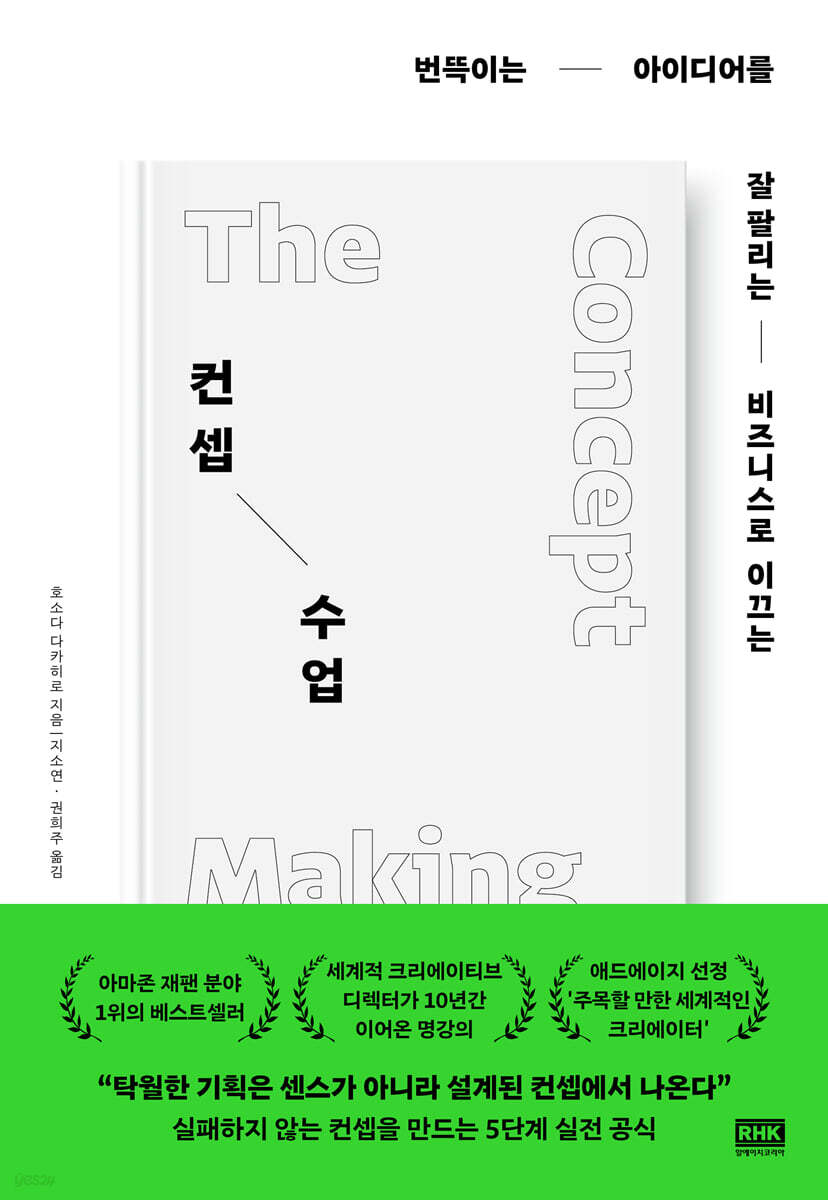
Concept class
 |
Description
Book Introduction
- A word from MD
-
In the end, it's a concept!In an era overflowing with products, services, and content.
The ability to give meaning to a concept has become essential for creators.
This book breaks down the process of creating clear definitions of concepts we often use but are vague into five steps.
Let's make the secrets of high-quality experts our own.
February 16, 2024. Economics and Management PD Kim Sang-geun
Reprinted immediately after publication! Amazon Japan Marketing & Sales Division,
The #1 bestseller in business management!
A world-renowned creative director, praised by thousands
Takahiro Hosoda's "Concept Class" now available as a book.
The era of competing for 'usefulness' is over.
There is an abundance of products, services, and content that meet consumer needs.
An era where the ‘meaning’ contained within it has become important.
Creators are required to have the ability to manipulate concepts, that is, the ability to give new meaning to them.
A well-designed concept is the key to instantly opening the consumer's heart.
When all components are related and harmonized under the concept, a single message is imprinted on the consumer and their hearts are won.
Takahiro Hosoda, Senior Creative Director of global advertising agency TBWA Hakuhodo, has been giving 'concept' lectures to businesspeople, entrepreneurs, and planners for 10 years.
He has led numerous projects with numerous global brands and won numerous awards at prestigious international advertising festivals, including Cannes Lions. Based on this expertise, he teaches practical and systematic instructions on how to proceed from concept ideation to deriving a single sentence.
His lectures, which have received rave reviews from thousands of people, are a compilation of his know-how and have been compiled into a book.
This book begins by correcting the definition of 'concept' that we have vaguely understood and used.
The author defines a concept in business as a process of infusing new meaning into something, that is, a new perspective that permeates the whole.
This process is divided into five steps: 'Understanding the concept', 'Creating good questions', 'Designing a story', 'Writing in one sentence', and 'Applying to work', and is guided in a friendly manner.
The entire process emphasizes that it should be 'designed' rather than relying on intuition and sense, and provides a 'framework' that anyone, even beginners, can immediately apply.
This book, which guides you through concept creation in an easy and practical way, with carefully selected case studies and example problems based on recognition and reliability, will give you a sense of accomplishment as your ideas become vivid businesses.
The #1 bestseller in business management!
A world-renowned creative director, praised by thousands
Takahiro Hosoda's "Concept Class" now available as a book.
The era of competing for 'usefulness' is over.
There is an abundance of products, services, and content that meet consumer needs.
An era where the ‘meaning’ contained within it has become important.
Creators are required to have the ability to manipulate concepts, that is, the ability to give new meaning to them.
A well-designed concept is the key to instantly opening the consumer's heart.
When all components are related and harmonized under the concept, a single message is imprinted on the consumer and their hearts are won.
Takahiro Hosoda, Senior Creative Director of global advertising agency TBWA Hakuhodo, has been giving 'concept' lectures to businesspeople, entrepreneurs, and planners for 10 years.
He has led numerous projects with numerous global brands and won numerous awards at prestigious international advertising festivals, including Cannes Lions. Based on this expertise, he teaches practical and systematic instructions on how to proceed from concept ideation to deriving a single sentence.
His lectures, which have received rave reviews from thousands of people, are a compilation of his know-how and have been compiled into a book.
This book begins by correcting the definition of 'concept' that we have vaguely understood and used.
The author defines a concept in business as a process of infusing new meaning into something, that is, a new perspective that permeates the whole.
This process is divided into five steps: 'Understanding the concept', 'Creating good questions', 'Designing a story', 'Writing in one sentence', and 'Applying to work', and is guided in a friendly manner.
The entire process emphasizes that it should be 'designed' rather than relying on intuition and sense, and provides a 'framework' that anyone, even beginners, can immediately apply.
This book, which guides you through concept creation in an easy and practical way, with carefully selected case studies and example problems based on recognition and reliability, will give you a sense of accomplishment as your ideas become vivid businesses.
- You can preview some of the book's contents.
Preview
index
Entering
Curriculum
Note - About the concepts introduced in this book
Chapter 1 What is a Concept?
1-1 Definition of the concept
Designing value with 1-2 concepts
1-3 Conditions for an effective concept
1-4 This is not a concept
Chapter 1 Summary
Chapter 2.
Creating 'Questions' that Drive Concepts
2-1 Why are questions important?
2-2 Questions We Must Face
8 Ways to Reconstruct 2-3
2-4 [Practical] Reconstruction
Chapter 2 Summary
Chapter 3: Seeing from the Customer's Perspective | Designing Insight-Based Stories
3-1 The framework of an insight-type story
3-2 Customers | How to Find Customer Insights
3-3 Competitors | How to Find Your True Competitors
3-4 Our Company | Benefits Only We Can Provide
3-5 [Practical] Insight-Based Story Design
Chapter 3 Summary
Chapter 4.
Looking to the Future | Designing "Atypical" Stories
4-1 The skeleton of an atypical story
Mission 4-2 | Looking Back
4-3 Vision | Looking to the Future
4-4 [Practical] Designing a Non-Typical Story
4-5 Insight and Vision in One
Chapter 4 Summary
Chapter 5: Writing the Concept in One Sentence
5-1 How to make it into one sentence
5-2 [Practical] Creating a Sentence
5-3 10 Patterns for Creating a Sentence
5-4 [Practical] Applying Concept Syntax
Chapter 5 Summary
Chapter 6: Applying the Concepts Learned
6-1 Product/Service Concept Development
6-2 Marketing Communication Development
6-3 Values | Principles of Conduct That Guide the Organization
Chapter 6 Summary
Q&A for deeper understanding
In conclusion
References
Reference site
Curriculum
Note - About the concepts introduced in this book
Chapter 1 What is a Concept?
1-1 Definition of the concept
Designing value with 1-2 concepts
1-3 Conditions for an effective concept
1-4 This is not a concept
Chapter 1 Summary
Chapter 2.
Creating 'Questions' that Drive Concepts
2-1 Why are questions important?
2-2 Questions We Must Face
8 Ways to Reconstruct 2-3
2-4 [Practical] Reconstruction
Chapter 2 Summary
Chapter 3: Seeing from the Customer's Perspective | Designing Insight-Based Stories
3-1 The framework of an insight-type story
3-2 Customers | How to Find Customer Insights
3-3 Competitors | How to Find Your True Competitors
3-4 Our Company | Benefits Only We Can Provide
3-5 [Practical] Insight-Based Story Design
Chapter 3 Summary
Chapter 4.
Looking to the Future | Designing "Atypical" Stories
4-1 The skeleton of an atypical story
Mission 4-2 | Looking Back
4-3 Vision | Looking to the Future
4-4 [Practical] Designing a Non-Typical Story
4-5 Insight and Vision in One
Chapter 4 Summary
Chapter 5: Writing the Concept in One Sentence
5-1 How to make it into one sentence
5-2 [Practical] Creating a Sentence
5-3 10 Patterns for Creating a Sentence
5-4 [Practical] Applying Concept Syntax
Chapter 5 Summary
Chapter 6: Applying the Concepts Learned
6-1 Product/Service Concept Development
6-2 Marketing Communication Development
6-3 Values | Principles of Conduct That Guide the Organization
Chapter 6 Summary
Q&A for deeper understanding
In conclusion
References
Reference site
Detailed image

Into the book
The idea that thinking about concepts is something special and limited to a select few is now a thing of the past.
The ability to verbalize imagination is essential for businesspeople, developers, creators, and even office workers.
In an age where creativity is required of everyone, it is no exaggeration to say that concepts are an essential basic subject.
(…) No matter what technology comes next, the fundamental challenges of business will not change.
Ultimately, it comes down to one question: 'What will we create and for whom?'
--- p.6
Is it a product or a service, hardware or software, private enterprise or government?
The process of creating something varies greatly depending on the product or subject.
But great creators have one thing in common: they use concepts well.
Create new words from nothing, present them to colleagues and clients, discuss them, break them down without hesitation, and then create them again.
A concept acts like a prototype, a prototype that costs nothing.
--- p.9
We used to think of candles as being used only to prepare for power outages.
However, candle sales have continued to increase in many developed countries since the 2000s.
Why? Because modern people have found meaning in candles beyond just "lighting."
In the age of electricity, the candle was renamed as a 'candle' and survived as an 'object that creates a warm atmosphere' or an 'object for enjoying fragrance'.
There are candles that are much more expensive than the most advanced LED bulbs.
This reversal of values can never be understood with the mindset that only technological advancement is considered innovation.
--- p.9~10
For team building, negotiations, presentations, and marketing.
The concept is to work hard, running around from site to site, all by yourself.
Therefore, it is beneficial for people who are too busy to devote time to new ideas to learn the concept.
Just as investors make money work for them, planners must make words work for them.
--- p.10~11
When I first started teaching, I was amazed at how many people believed that a concept was something that "you can't create without feeling or talent."
This is a huge misunderstanding.
If you feel like you're not good at creating concepts, it's not because you lack a sense or talent.
You just don't know the 'frame'.
In fact, I have witnessed many instances where people who had never used it before created concepts that surprised everyone around them and made them say, “Oh, so that’s how it’s done!”
--- p.14
The concept serves as a criterion for decision-making, provides consistency to the whole, and provides a reason for the price.
It serves as a basis, like a blueprint drawn before constructing a building.
For a creator, a concept can be said to be a 'blueprint of value'.
--- p.39
AI, IoT, DX, big data, metaverse, NFT, DAO.
These concepts, which sound clever just by writing them down, are ultimately only convenient words for those who make things like '5GB MP3 players'.
Does it end in self-satisfaction, or can it be changed by the customer's words?
This is where the skill of the concept creator comes into play.
--- p.53~54
From a family's 'first aid kit' to a young man's 'sunscreen'.
And back to the high school girl's 'sweat care'.
Seabreeze, a brand with over 120 years of history, has evolved its concept to suit each target audience.
The concept should not be a poem that you read alone and are satisfied with.
A good concept can only be considered good if it is constantly tested against the business goals.
--- p.59
Howard Schultz wanted to bring Italian café culture to America.
These ideas are called ideas.
But if you leave a brilliant idea like this alone, it won't become a concept.
There's a distance between the idea of "bringing Italian café culture to America" and the concept of a "third place."
These two are divided depending on whether or not the customer's eye level is taken into consideration.
In business, an idea is the reason you start a business.
But this doesn't necessarily mean that customers pay money.
Howard Schultz's idea of "bringing Italian cafe culture to America" lacks the customer's perspective.
What does Italian café culture mean to customers?
The concept of this expressed in words is the 'third place'.
--- p.65~66
When faced with a good question, a variety of answers naturally arise.
And every answer leads to a meaningful outcome.
Creative questions encourage those who are engrossed in finding answers.
Starting with a ‘good question’ like this is a shortcut to creating a good concept.
If the question in front of you is a 'bad question' that requires determination or a 'quiz' that is only fun, you should boldly consider 'changing' the question.
--- p.85~86
Bill Moggridge, one of the co-founders of global design firm IDEO, said that we should design “verbs, not nouns.”
Focusing on action means breaking free from existing paradigms.
In fact, the Ideo design team observes behavior to generate new ideas.
For example, while observing people eating breakfast, you notice a seemingly insignificant action of 'laying out toast' before eating it, and so you create a toaster lid that can hold the bread upright.
--- p.104
Casper, a D2C mattress brand that started in New York and became a huge hit for a while, applied a Nintendo-like technique to the mattress industry.
In an era when only cushioning and other features were the issue, the true purpose of the mattress was to 'provide the best sleep'.
And they defined themselves as 'The Sleep Company', not a mattress company.
The promotional slogan is 'Love your tomorrow'.
It was an appeal that the best tomorrow begins with the best sleep.
--- p.111
In business, the term "customer insight" can be defined in one word: "hidden needs that have not yet been met."
Even though the dissatisfaction and pain already exist there, you don't even realize it.
A great insight is one that makes you want to slap your knee and say, “I see!” the moment you hear it.
This 'knee-slapping' feeling is created through the multiplication of 'empathy' and 'discovery'.
--- p.139
Insight exists in the midst of conflict that creates conflicting emotions.
If so, then the words that express this would naturally also be a way of speaking that expresses contradiction.
(…) If we use the example of Oysix (a meal kit company), Psychology A becomes “I don’t want to put a lot of effort into preparing meals,” and Psychology B becomes “I don’t want to eat poorly.”
Connecting the opposing A and B, we get “I don’t want to put a lot of effort into preparing meals.
The sentence “(But) I don’t want to eat poorly” is completed.
This 'A but B' is the basic phrase that captures insight.
--- p.144
Before Chanel came along in the early 20th century, women's clothing was very different from what it is today.
The women's bodies were tightly bound by flashy and stuffy clothes.
(…) So Chanel began to harbor the vision of ‘liberating women’s bodies.’
The ideal future he envisioned was a world where women were free from bondage and could work freely as they pleased.
Chanel designed clothes for this new era of women.
(…) The flexible and easy-to-move-in ‘jersey dress’ was a product that truly reflected Chanel’s vision.
After freeing the body, the 'shoulder bag' was invented to be worn on the shoulder, freeing up both hands of women.
(…) And Chanel herself realized her vision by becoming a pioneering female entrepreneur.
It can be said that the vision showed not only a concept but also a way of life.
The ability to verbalize imagination is essential for businesspeople, developers, creators, and even office workers.
In an age where creativity is required of everyone, it is no exaggeration to say that concepts are an essential basic subject.
(…) No matter what technology comes next, the fundamental challenges of business will not change.
Ultimately, it comes down to one question: 'What will we create and for whom?'
--- p.6
Is it a product or a service, hardware or software, private enterprise or government?
The process of creating something varies greatly depending on the product or subject.
But great creators have one thing in common: they use concepts well.
Create new words from nothing, present them to colleagues and clients, discuss them, break them down without hesitation, and then create them again.
A concept acts like a prototype, a prototype that costs nothing.
--- p.9
We used to think of candles as being used only to prepare for power outages.
However, candle sales have continued to increase in many developed countries since the 2000s.
Why? Because modern people have found meaning in candles beyond just "lighting."
In the age of electricity, the candle was renamed as a 'candle' and survived as an 'object that creates a warm atmosphere' or an 'object for enjoying fragrance'.
There are candles that are much more expensive than the most advanced LED bulbs.
This reversal of values can never be understood with the mindset that only technological advancement is considered innovation.
--- p.9~10
For team building, negotiations, presentations, and marketing.
The concept is to work hard, running around from site to site, all by yourself.
Therefore, it is beneficial for people who are too busy to devote time to new ideas to learn the concept.
Just as investors make money work for them, planners must make words work for them.
--- p.10~11
When I first started teaching, I was amazed at how many people believed that a concept was something that "you can't create without feeling or talent."
This is a huge misunderstanding.
If you feel like you're not good at creating concepts, it's not because you lack a sense or talent.
You just don't know the 'frame'.
In fact, I have witnessed many instances where people who had never used it before created concepts that surprised everyone around them and made them say, “Oh, so that’s how it’s done!”
--- p.14
The concept serves as a criterion for decision-making, provides consistency to the whole, and provides a reason for the price.
It serves as a basis, like a blueprint drawn before constructing a building.
For a creator, a concept can be said to be a 'blueprint of value'.
--- p.39
AI, IoT, DX, big data, metaverse, NFT, DAO.
These concepts, which sound clever just by writing them down, are ultimately only convenient words for those who make things like '5GB MP3 players'.
Does it end in self-satisfaction, or can it be changed by the customer's words?
This is where the skill of the concept creator comes into play.
--- p.53~54
From a family's 'first aid kit' to a young man's 'sunscreen'.
And back to the high school girl's 'sweat care'.
Seabreeze, a brand with over 120 years of history, has evolved its concept to suit each target audience.
The concept should not be a poem that you read alone and are satisfied with.
A good concept can only be considered good if it is constantly tested against the business goals.
--- p.59
Howard Schultz wanted to bring Italian café culture to America.
These ideas are called ideas.
But if you leave a brilliant idea like this alone, it won't become a concept.
There's a distance between the idea of "bringing Italian café culture to America" and the concept of a "third place."
These two are divided depending on whether or not the customer's eye level is taken into consideration.
In business, an idea is the reason you start a business.
But this doesn't necessarily mean that customers pay money.
Howard Schultz's idea of "bringing Italian cafe culture to America" lacks the customer's perspective.
What does Italian café culture mean to customers?
The concept of this expressed in words is the 'third place'.
--- p.65~66
When faced with a good question, a variety of answers naturally arise.
And every answer leads to a meaningful outcome.
Creative questions encourage those who are engrossed in finding answers.
Starting with a ‘good question’ like this is a shortcut to creating a good concept.
If the question in front of you is a 'bad question' that requires determination or a 'quiz' that is only fun, you should boldly consider 'changing' the question.
--- p.85~86
Bill Moggridge, one of the co-founders of global design firm IDEO, said that we should design “verbs, not nouns.”
Focusing on action means breaking free from existing paradigms.
In fact, the Ideo design team observes behavior to generate new ideas.
For example, while observing people eating breakfast, you notice a seemingly insignificant action of 'laying out toast' before eating it, and so you create a toaster lid that can hold the bread upright.
--- p.104
Casper, a D2C mattress brand that started in New York and became a huge hit for a while, applied a Nintendo-like technique to the mattress industry.
In an era when only cushioning and other features were the issue, the true purpose of the mattress was to 'provide the best sleep'.
And they defined themselves as 'The Sleep Company', not a mattress company.
The promotional slogan is 'Love your tomorrow'.
It was an appeal that the best tomorrow begins with the best sleep.
--- p.111
In business, the term "customer insight" can be defined in one word: "hidden needs that have not yet been met."
Even though the dissatisfaction and pain already exist there, you don't even realize it.
A great insight is one that makes you want to slap your knee and say, “I see!” the moment you hear it.
This 'knee-slapping' feeling is created through the multiplication of 'empathy' and 'discovery'.
--- p.139
Insight exists in the midst of conflict that creates conflicting emotions.
If so, then the words that express this would naturally also be a way of speaking that expresses contradiction.
(…) If we use the example of Oysix (a meal kit company), Psychology A becomes “I don’t want to put a lot of effort into preparing meals,” and Psychology B becomes “I don’t want to eat poorly.”
Connecting the opposing A and B, we get “I don’t want to put a lot of effort into preparing meals.
The sentence “(But) I don’t want to eat poorly” is completed.
This 'A but B' is the basic phrase that captures insight.
--- p.144
Before Chanel came along in the early 20th century, women's clothing was very different from what it is today.
The women's bodies were tightly bound by flashy and stuffy clothes.
(…) So Chanel began to harbor the vision of ‘liberating women’s bodies.’
The ideal future he envisioned was a world where women were free from bondage and could work freely as they pleased.
Chanel designed clothes for this new era of women.
(…) The flexible and easy-to-move-in ‘jersey dress’ was a product that truly reflected Chanel’s vision.
After freeing the body, the 'shoulder bag' was invented to be worn on the shoulder, freeing up both hands of women.
(…) And Chanel herself realized her vision by becoming a pioneering female entrepreneur.
It can be said that the vision showed not only a concept but also a way of life.
--- p.216~217
Publisher's Review
“Excellent planning comes from a designed concept, not from sense!”
How to Create a Concept That Doesn't Fail
“So what’s the concept?” If you can’t quite respond to that piercing question, it’s likely that you relied on intuition and intuition to plan.
That alone is not enough to guarantee a high level of perfection, and even if you happen to get lucky and achieve good results, you will become anxious about vulnerabilities that will eventually be revealed.
Meanwhile, excellent planners not only maintain a high and consistent level of completion, but also have high confidence in their work.
So what's the secret? Author Takahiro Hosoda, a "concept expert," says the secret lies in the "framework."
In this book, the author presents a 'framework' that makes it easy to create concepts.
It helps you produce results by immediately applying 10 ways to reframe questions from various angles to create questions that lead to concepts, sheets that can be divided into insight-type and vision-type to organize concepts into stories, and 8 expression methods to compress the completed story into one impactful sentence.
The example problems and sample answers included in each chapter allow readers to check for themselves whether they have properly understood each step and can properly utilize the 'framework'.
The appendix contains a Q&A with answers to frequently asked questions the author hears in lectures and on-site, which also serves as a kind of 'framework'.
This thoughtful composition leaves the reader with no choice but to trust the contents of this book.
By reading the easy-to-understand and user-friendly 『Concept Class』, those familiar with 'concepts' will be able to derive concepts that are 200% more effective than before, and those new to the subject will find the process enjoyable as they can also derive good concepts.
How to Create a Concept That Doesn't Fail
“So what’s the concept?” If you can’t quite respond to that piercing question, it’s likely that you relied on intuition and intuition to plan.
That alone is not enough to guarantee a high level of perfection, and even if you happen to get lucky and achieve good results, you will become anxious about vulnerabilities that will eventually be revealed.
Meanwhile, excellent planners not only maintain a high and consistent level of completion, but also have high confidence in their work.
So what's the secret? Author Takahiro Hosoda, a "concept expert," says the secret lies in the "framework."
In this book, the author presents a 'framework' that makes it easy to create concepts.
It helps you produce results by immediately applying 10 ways to reframe questions from various angles to create questions that lead to concepts, sheets that can be divided into insight-type and vision-type to organize concepts into stories, and 8 expression methods to compress the completed story into one impactful sentence.
The example problems and sample answers included in each chapter allow readers to check for themselves whether they have properly understood each step and can properly utilize the 'framework'.
The appendix contains a Q&A with answers to frequently asked questions the author hears in lectures and on-site, which also serves as a kind of 'framework'.
This thoughtful composition leaves the reader with no choice but to trust the contents of this book.
By reading the easy-to-understand and user-friendly 『Concept Class』, those familiar with 'concepts' will be able to derive concepts that are 200% more effective than before, and those new to the subject will find the process enjoyable as they can also derive good concepts.
GOODS SPECIFICS
- Date of issue: January 24, 2024
- Page count, weight, size: 384 pages | 608g | 145*210*26mm
- ISBN13: 9788925575438
- ISBN10: 8925575434
You may also like
카테고리
korean


korean

![ELLE 엘르 스페셜 에디션 A형 : 12월 [2025]](http://librairie.coreenne.fr/cdn/shop/files/b8e27a3de6c9538896439686c6b0e8fb.jpg?v=1766436872&width=3840)


