

Why trend following strategy?
 |
Description
Book Introduction
Everything you need to know about trend-following strategies for maximum returns!
Michael Covel, author of the international bestsellers "Trend Following" and "Turtle Trading" and founder of TurtleTrade.com, humorously unravels the truth about trend following and the problems with traditional investment methods through interviews with leading trend-following traders over the past 15 years.
This book is a must-read for investment professionals as it provides the simplest and most clear explanation of trend following techniques.
This book is for anyone who wants to make as much money as possible while avoiding big risks, and for anyone who wants to know what a trend-following strategy is.
This book is also for those who are fascinated by the mindset and outstanding profits of trend-following traders.
This book is for all investors and traders, regardless of investment size, age, or gender.
Want more confidence and new ideas for investing? Follow market trends now!
Michael Covel, author of the international bestsellers "Trend Following" and "Turtle Trading" and founder of TurtleTrade.com, humorously unravels the truth about trend following and the problems with traditional investment methods through interviews with leading trend-following traders over the past 15 years.
This book is a must-read for investment professionals as it provides the simplest and most clear explanation of trend following techniques.
This book is for anyone who wants to make as much money as possible while avoiding big risks, and for anyone who wants to know what a trend-following strategy is.
This book is also for those who are fascinated by the mindset and outstanding profits of trend-following traders.
This book is for all investors and traders, regardless of investment size, age, or gender.
Want more confidence and new ideas for investing? Follow market trends now!
- You can preview some of the book's contents.
Preview
index
Acknowledgements
ignition
expectation
Terminology
How much money do trend-following traders make?
The bubble bursts
Speculari
Fundamentals are just a false belief
Everything flows with the trend.
Trend following techniques using the system
change
Predictions are forbidden!
Let's trade the price
The Art of Betting
Trading System
Investment diversification
One step back
How to enter
Liquidation method
Water riding is a shortcut to failure
Hit a home run
A robust trend-following technique is needed.
Press the computer button
Wash, rinse, wash, rinse again
zero-sum game
Market crash and its damage
inefficient market
Benchmark
hatred
The root of evil
A flock of terrified sheep
IQ vs. EQ
will
Make the decision now!
science
statistical thinking
aha!
hero worship
Buy first and hope the price goes up
Conversion
Warren Buffett, the Sage of Omaha
A TV sitcom-like moment
sugar coating
Send me a tweet
Gold Line
poisoning
Alcoholics, perverts, and politicians with failed lives
A house crowded with people
black box
Is it because I was lucky?
Honesty
The Story Behind Turtle Traders
spirit
People's game
Bloodhound
Epilogue
It's not surprising anymore
The origins of trend following techniques
cheat sheet
Trend-following techniques that you can learn at a glance
Trend Following and Michael Covel
ignition
expectation
Terminology
How much money do trend-following traders make?
The bubble bursts
Speculari
Fundamentals are just a false belief
Everything flows with the trend.
Trend following techniques using the system
change
Predictions are forbidden!
Let's trade the price
The Art of Betting
Trading System
Investment diversification
One step back
How to enter
Liquidation method
Water riding is a shortcut to failure
Hit a home run
A robust trend-following technique is needed.
Press the computer button
Wash, rinse, wash, rinse again
zero-sum game
Market crash and its damage
inefficient market
Benchmark
hatred
The root of evil
A flock of terrified sheep
IQ vs. EQ
will
Make the decision now!
science
statistical thinking
aha!
hero worship
Buy first and hope the price goes up
Conversion
Warren Buffett, the Sage of Omaha
A TV sitcom-like moment
sugar coating
Send me a tweet
Gold Line
poisoning
Alcoholics, perverts, and politicians with failed lives
A house crowded with people
black box
Is it because I was lucky?
Honesty
The Story Behind Turtle Traders
spirit
People's game
Bloodhound
Epilogue
It's not surprising anymore
The origins of trend following techniques
cheat sheet
Trend-following techniques that you can learn at a glance
Trend Following and Michael Covel
Into the book
Let's talk about something that happened in the 20th century.
A famous trend-following trader was invited to a stock investment seminar.
The attendees fired off a barrage of questions.
“What about gold?” “What about the value of the Canadian dollar?” “When will the market reach a ceiling?” His answer was:
“I like gold.
“It’s shiny, pretty, and makes a great accessory.” “Well, I don’t know what will happen to the Canadian dollar.” The attendees were disappointed when they heard his answer.
Some people thought they had just wasted money.
But I can't give you a more accurate answer than that.
The problem was in the people's questions.
Instead of asking, “How do I know the trend is up?” we should have asked, “What do I need to look for to know that the current trend is up?”
Instead of asking, “How is gold?” you should have asked, “Am I trading gold correctly?”
The trend-following trader gave his answer in a way that left the questioner to reflect on himself.
But most people did not understand his intentions.
- 80p.
[Predictions are forbidden!]
Let's take real estate investing as an example.
In the spring of 2003, I purchased a property worth $900,000.
By January 2008, it was estimated to be worth approximately $1.2 million and was being sold for $1.3 million.
However, as the real estate market began to decline in 2008, the desired purchase price fell to $900,000 at best.
Ultimately, the final sale price was set at $1.01 million.
After deducting the purchase cost, it was really a meager profit.
One lesson learned here.
It doesn't matter at all how much I paid for it.
What matters is how much the buyer is willing to pay.
In other words, it is the market price.
Let go of the thought, 'I should at least get this much.'
The same applies when investing in financial assets.
Let's say you entered the market at $50 and the current price is $100.
It wouldn't make much of a difference if it entered at $52 or $60.
Even if you entered at $70, you would have made a significant profit if the market price were $100.
Most investors think, "$52! It's too expensive! I can never get into it."
However, it is much better to buy at $70 and take the opportunity to sell at $100 than to wait for the price to drop again.
In other words, if you enter while riding the trend, the timing of your entry is not that important.
- 107p.
[How to enter]
It is no exaggeration to say that this book was written to explain various obstacles that hinder learning trend following techniques.
Why do investors spend all day listening to the predictions of so-called market luminaries? Do they think, "If I just listen to the experts, I could make millions"? Do they think, "Their predictions about Google seem right, but is now a good time to invest?" Or do they believe, "The experts on TV are always right!"?
A famous person advised me to buy gold.
So, isn't the advice "now is the time to buy gold" a worldwide sensation? And let's assume you actually bought gold.
So, when it comes to selling gold, do you wait for an expert to give you a signal? Or do you buy, believing that gold prices will never fall and therefore there's no reason to sell?
- 191p.
[Hero Worship]
To define it, I will explain two characteristics of trend following techniques.
The first is the psychological aspect of human beings.
Keynesians described this as an 'animal spirit' that is deeply rooted in the human mind.
This type of trend following is short-term, inductive, realistic, and constantly changing.
It is also a way to quickly accept environmental changes.
Human psychology tends to follow trends not only in finance but also in many other fields, including music, art, clothing, and worldview.
The second characteristic is completely different from the first.
Meta-level, that is, the external aspect of human beings, objectively observing the market while leaving aside the practical and psychological causes and effects.
This is to plan in advance how to respond wisely to changes in the market.
If you are a trend-following trader, this is something you must do and always do.
- 284p.
[The Origin of Trend Following Techniques]
A famous trend-following trader was invited to a stock investment seminar.
The attendees fired off a barrage of questions.
“What about gold?” “What about the value of the Canadian dollar?” “When will the market reach a ceiling?” His answer was:
“I like gold.
“It’s shiny, pretty, and makes a great accessory.” “Well, I don’t know what will happen to the Canadian dollar.” The attendees were disappointed when they heard his answer.
Some people thought they had just wasted money.
But I can't give you a more accurate answer than that.
The problem was in the people's questions.
Instead of asking, “How do I know the trend is up?” we should have asked, “What do I need to look for to know that the current trend is up?”
Instead of asking, “How is gold?” you should have asked, “Am I trading gold correctly?”
The trend-following trader gave his answer in a way that left the questioner to reflect on himself.
But most people did not understand his intentions.
- 80p.
[Predictions are forbidden!]
Let's take real estate investing as an example.
In the spring of 2003, I purchased a property worth $900,000.
By January 2008, it was estimated to be worth approximately $1.2 million and was being sold for $1.3 million.
However, as the real estate market began to decline in 2008, the desired purchase price fell to $900,000 at best.
Ultimately, the final sale price was set at $1.01 million.
After deducting the purchase cost, it was really a meager profit.
One lesson learned here.
It doesn't matter at all how much I paid for it.
What matters is how much the buyer is willing to pay.
In other words, it is the market price.
Let go of the thought, 'I should at least get this much.'
The same applies when investing in financial assets.
Let's say you entered the market at $50 and the current price is $100.
It wouldn't make much of a difference if it entered at $52 or $60.
Even if you entered at $70, you would have made a significant profit if the market price were $100.
Most investors think, "$52! It's too expensive! I can never get into it."
However, it is much better to buy at $70 and take the opportunity to sell at $100 than to wait for the price to drop again.
In other words, if you enter while riding the trend, the timing of your entry is not that important.
- 107p.
[How to enter]
It is no exaggeration to say that this book was written to explain various obstacles that hinder learning trend following techniques.
Why do investors spend all day listening to the predictions of so-called market luminaries? Do they think, "If I just listen to the experts, I could make millions"? Do they think, "Their predictions about Google seem right, but is now a good time to invest?" Or do they believe, "The experts on TV are always right!"?
A famous person advised me to buy gold.
So, isn't the advice "now is the time to buy gold" a worldwide sensation? And let's assume you actually bought gold.
So, when it comes to selling gold, do you wait for an expert to give you a signal? Or do you buy, believing that gold prices will never fall and therefore there's no reason to sell?
- 191p.
[Hero Worship]
To define it, I will explain two characteristics of trend following techniques.
The first is the psychological aspect of human beings.
Keynesians described this as an 'animal spirit' that is deeply rooted in the human mind.
This type of trend following is short-term, inductive, realistic, and constantly changing.
It is also a way to quickly accept environmental changes.
Human psychology tends to follow trends not only in finance but also in many other fields, including music, art, clothing, and worldview.
The second characteristic is completely different from the first.
Meta-level, that is, the external aspect of human beings, objectively observing the market while leaving aside the practical and psychological causes and effects.
This is to plan in advance how to respond wisely to changes in the market.
If you are a trend-following trader, this is something you must do and always do.
- 284p.
[The Origin of Trend Following Techniques]
--- From the text
Publisher's Review
Everything you need to know about trend-following strategies for maximum returns!
Michael Covel, author of the international bestsellers "Trend Following" and "Turtle Trading" and founder of TurtleTrade.com, humorously unravels the truth about trend following and the problems with traditional investment methods through interviews with leading trend-following traders over the past 15 years.
This book is a must-read for investment professionals as it provides the simplest and most clear explanation of trend following techniques.
This book is for anyone who wants to make as much money as possible while avoiding big risks, and for anyone who wants to know what a trend-following strategy is.
This book is also for those who are fascinated by the mindset and outstanding profits of trend-following traders.
This book is for all investors and traders, regardless of investment size, age, or gender.
Want more confidence and new ideas for investing? Follow market trends now!
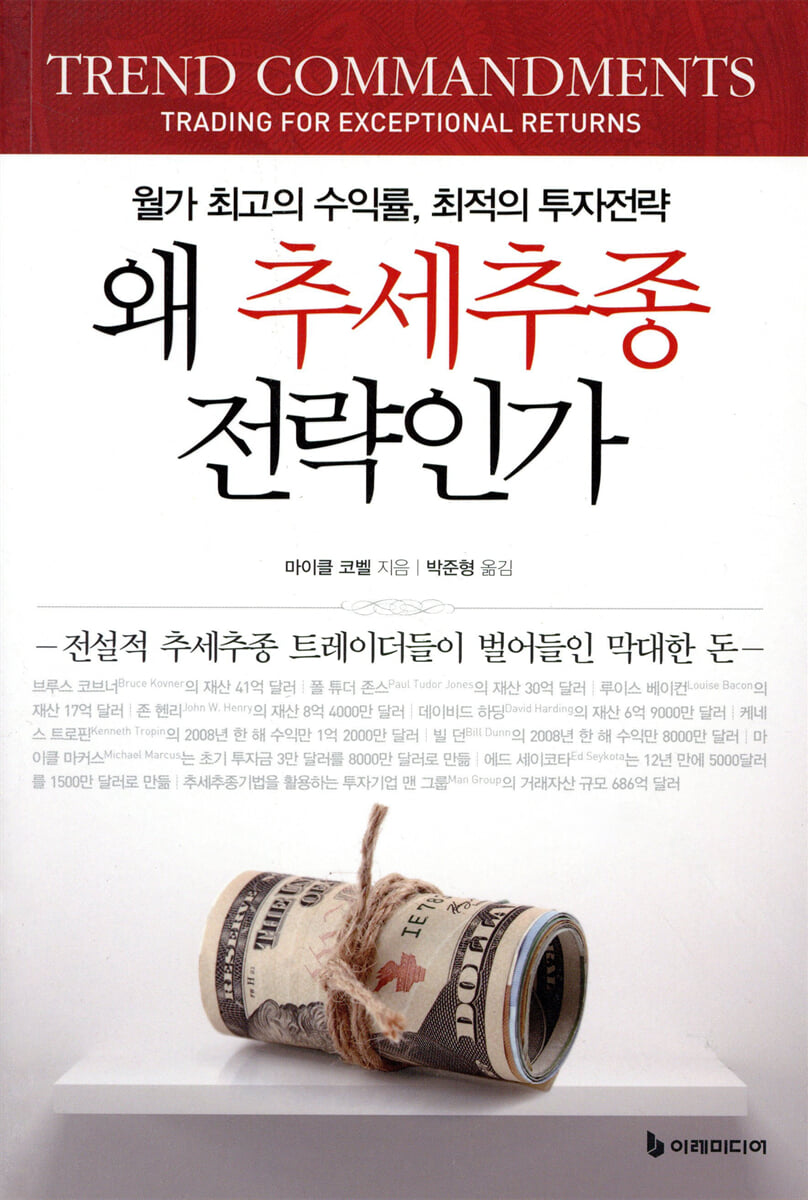
The huge amounts of money made by legendary trend-following traders!
Some people say, 'There is absolutely nothing romantic about trend following.'
But it's not always like that.
Because profits are romantic! The ultimate goal of investing is, after all, money.
Who have been the highest-earning trend-following traders over the past 30 years? Here are the earnings of some of the most famous trend-following traders.
* Bruce Kovner's net worth is over $4.1 billion.
* John W. Henry
Henry's fortune is $840 million.
* Bill Dunn earned $80 million in 2008 alone.
* Michael Marcus turned an initial investment of $30,000 into $80 million.
* David Harding's fortune is estimated at over $690 million.
* Ed Seykota turned $5,000 into $15 million in 12 years.
* Kenneth Tropin earned $120 million in 2008 alone.
* Larry Hite made millions of dollars over 30 years, and then millions more.
* Louise Bacon's fortune is $1.7 billion.
* Paul Tudor Jones's fortune is $3 billion.
* Transtrend is a fund that uses trend-following techniques and has generated profits in the hundreds of millions, if not billions, of dollars.
* The size of assets traded by Man Group, an investment firm that utilizes trend-following techniques, amounts to $68.6 billion.
Is trend following really the optimal investment strategy?
To make a lot of money through investing, you have to ride the market's waves.
The people who make a lot of money in the market are those who ride the market trend.
In other words, anyone can make money by just following the trend.
Therefore, there is no doubt that trend following is the optimal investment strategy.
However, we must focus on when and how trends are formed.
Predicting future trends is never easy.
The only thing that is certain is that if you ride the great wave of the trend, you can arrive at a beach that is completely different from the one you have been to so far.
Here it is worth referencing Michael Covell's words:
Investors often mistake non-trends for trends, but this is a dangerous assumption in a manipulated market environment, where they should not assume that the market will move according to their own wishes or expectations.
Everything flows with the trend!
Trend-following traders are those who wait for the market to move and then follow that trend.
The purpose of this book is to explain trend following techniques in a more accessible way, focusing more on principles than on specifics.
It doesn't matter whether you invest in stocks or soybeans.
Investment is just investment.
The purpose of investing is to make money, not to become adept at reading financial statements.
Fundamental analysis and trend following techniques can also be used in parallel.
Likewise, you can also invest in horoscopes, lucky four-leaf clovers, lucky chicken bones, lucky crickets, and folk remedies.
This is such a useless thing.
Ignore anything that pretends to be some special seasoning that improves the taste of trend following techniques.
This book will help you take the first step toward becoming rich.
Michael Covel, author of the international bestsellers "Trend Following" and "Turtle Trading" and founder of TurtleTrade.com, humorously unravels the truth about trend following and the problems with traditional investment methods through interviews with leading trend-following traders over the past 15 years.
This book is a must-read for investment professionals as it provides the simplest and most clear explanation of trend following techniques.
This book is for anyone who wants to make as much money as possible while avoiding big risks, and for anyone who wants to know what a trend-following strategy is.
This book is also for those who are fascinated by the mindset and outstanding profits of trend-following traders.
This book is for all investors and traders, regardless of investment size, age, or gender.
Want more confidence and new ideas for investing? Follow market trends now!
The huge amounts of money made by legendary trend-following traders!
Some people say, 'There is absolutely nothing romantic about trend following.'
But it's not always like that.
Because profits are romantic! The ultimate goal of investing is, after all, money.
Who have been the highest-earning trend-following traders over the past 30 years? Here are the earnings of some of the most famous trend-following traders.
* Bruce Kovner's net worth is over $4.1 billion.
* John W. Henry
Henry's fortune is $840 million.
* Bill Dunn earned $80 million in 2008 alone.
* Michael Marcus turned an initial investment of $30,000 into $80 million.
* David Harding's fortune is estimated at over $690 million.
* Ed Seykota turned $5,000 into $15 million in 12 years.
* Kenneth Tropin earned $120 million in 2008 alone.
* Larry Hite made millions of dollars over 30 years, and then millions more.
* Louise Bacon's fortune is $1.7 billion.
* Paul Tudor Jones's fortune is $3 billion.
* Transtrend is a fund that uses trend-following techniques and has generated profits in the hundreds of millions, if not billions, of dollars.
* The size of assets traded by Man Group, an investment firm that utilizes trend-following techniques, amounts to $68.6 billion.
Is trend following really the optimal investment strategy?
To make a lot of money through investing, you have to ride the market's waves.
The people who make a lot of money in the market are those who ride the market trend.
In other words, anyone can make money by just following the trend.
Therefore, there is no doubt that trend following is the optimal investment strategy.
However, we must focus on when and how trends are formed.
Predicting future trends is never easy.
The only thing that is certain is that if you ride the great wave of the trend, you can arrive at a beach that is completely different from the one you have been to so far.
Here it is worth referencing Michael Covell's words:
Investors often mistake non-trends for trends, but this is a dangerous assumption in a manipulated market environment, where they should not assume that the market will move according to their own wishes or expectations.
Everything flows with the trend!
Trend-following traders are those who wait for the market to move and then follow that trend.
The purpose of this book is to explain trend following techniques in a more accessible way, focusing more on principles than on specifics.
It doesn't matter whether you invest in stocks or soybeans.
Investment is just investment.
The purpose of investing is to make money, not to become adept at reading financial statements.
Fundamental analysis and trend following techniques can also be used in parallel.
Likewise, you can also invest in horoscopes, lucky four-leaf clovers, lucky chicken bones, lucky crickets, and folk remedies.
This is such a useless thing.
Ignore anything that pretends to be some special seasoning that improves the taste of trend following techniques.
This book will help you take the first step toward becoming rich.
GOODS SPECIFICS
- Date of issue: May 15, 2014
- Page count, weight, size: 320 pages | 536g | 153*224*30mm
- ISBN13: 9788991998896
- ISBN10: 8991998895
You may also like
카테고리
korean


korean

![ELLE 엘르 스페셜 에디션 A형 : 12월 [2025]](http://librairie.coreenne.fr/cdn/shop/files/b8e27a3de6c9538896439686c6b0e8fb.jpg?v=1766436872&width=3840)


