

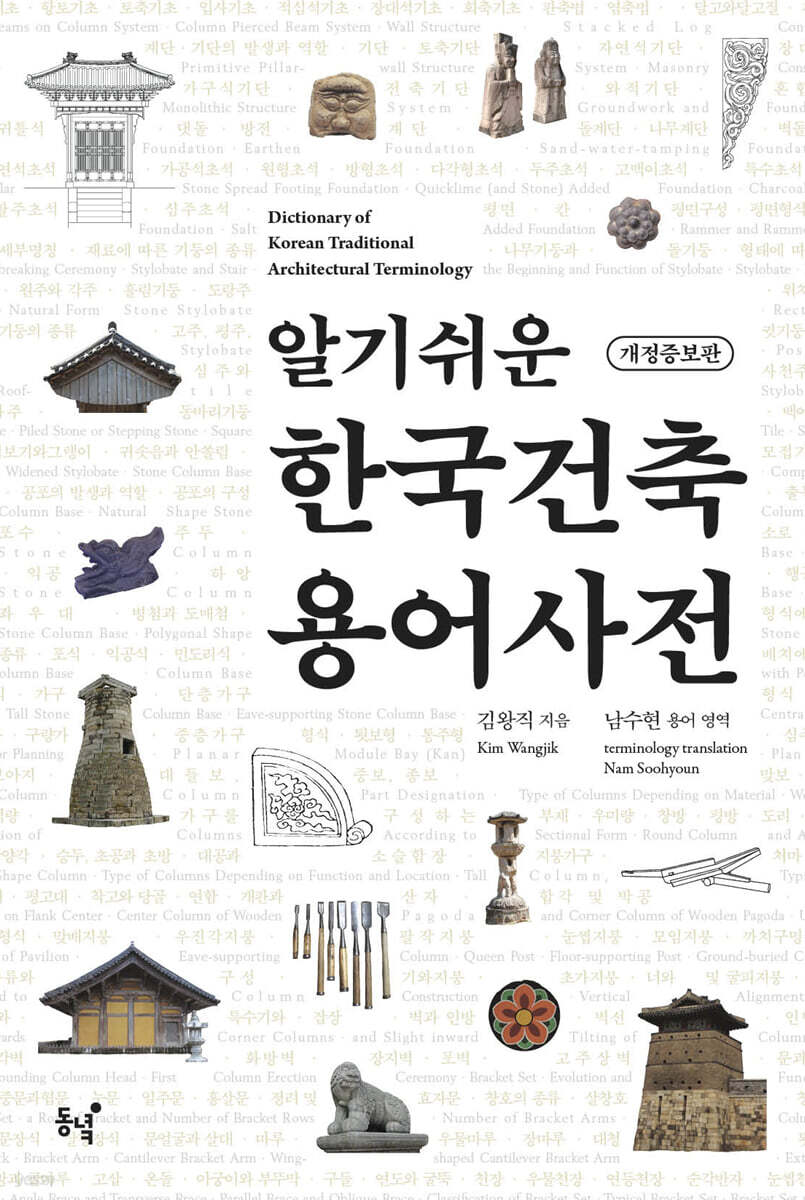
Easy-to-understand Dictionary of Korean Architectural Terms
 |
Description
Book Introduction
An unrivaled guide to Korean architecture, now revised and presented after 18 years!
A must-read for both beginners and experts on Korean architecture!
A must-read for understanding Korean architecture.
Revised and expanded edition of the Easy-to-understand Dictionary of Korean Architectural Terminology published!
The revised and expanded edition of the "Easy-to-Understand Dictionary of Korean Architectural Terminology," which was published in 2007 and has since become an essential introductory text for those studying Korean architecture, has finally been published.
《Easy-to-Understand Dictionary of Korean Architectural Terminology》 is a must-have for those preparing to become cultural heritage experts and those working in the cultural heritage field, and is also widely loved by general readers interested in Korean architecture and Korean cultural heritage, and has been evaluated as an unrivaled must-read on Korean architecture for beginners and experts alike.
This revised and expanded edition also places the reader's convenience and understanding at the forefront.
Because terminology is something that is often forgotten, it is important to keep it close at hand and refer to it often.
This book excludes overly technical terms to ensure efficient study, but does not omit essential terms. It also provides a well-organized summary of key terms frequently used in Korean architecture, with ample photographs and drawings to aid understanding.
In this revised and expanded edition, we have supplemented the terms for materials necessary to complete a building, even though they were not included in the previous edition due to their low frequency of use, to ensure that none are left out. We have also provided illustrations that correspond to all terms, even if they overlap with photographs, so that parts that cannot be understood through photographs alone can be sufficiently supplemented through illustrations.
It consists of a total of about 500 items, and if you include the detailed terms attached to each term, about 1,000 items are introduced.
From the foundation work of compacting the ground to the stonework that decorates the building, we have classified key terms for each component of the building.
In addition to the location and form of the object to which the term refers, the term has been attempted to explain, as much as possible, its usage, historical changes, function and role, examples, origin, and aliases.
Additionally, because the terms are categorized according to the actual order in which the house was built, rather than alphabetically, it can be helpful for systematically understanding the construction process.
The sections that cover more specialized and in-depth content are separated into sections, so you can select and read them.
A must-read for both beginners and experts on Korean architecture!
A must-read for understanding Korean architecture.
Revised and expanded edition of the Easy-to-understand Dictionary of Korean Architectural Terminology published!
The revised and expanded edition of the "Easy-to-Understand Dictionary of Korean Architectural Terminology," which was published in 2007 and has since become an essential introductory text for those studying Korean architecture, has finally been published.
《Easy-to-Understand Dictionary of Korean Architectural Terminology》 is a must-have for those preparing to become cultural heritage experts and those working in the cultural heritage field, and is also widely loved by general readers interested in Korean architecture and Korean cultural heritage, and has been evaluated as an unrivaled must-read on Korean architecture for beginners and experts alike.
This revised and expanded edition also places the reader's convenience and understanding at the forefront.
Because terminology is something that is often forgotten, it is important to keep it close at hand and refer to it often.
This book excludes overly technical terms to ensure efficient study, but does not omit essential terms. It also provides a well-organized summary of key terms frequently used in Korean architecture, with ample photographs and drawings to aid understanding.
In this revised and expanded edition, we have supplemented the terms for materials necessary to complete a building, even though they were not included in the previous edition due to their low frequency of use, to ensure that none are left out. We have also provided illustrations that correspond to all terms, even if they overlap with photographs, so that parts that cannot be understood through photographs alone can be sufficiently supplemented through illustrations.
It consists of a total of about 500 items, and if you include the detailed terms attached to each term, about 1,000 items are introduced.
From the foundation work of compacting the ground to the stonework that decorates the building, we have classified key terms for each component of the building.
In addition to the location and form of the object to which the term refers, the term has been attempted to explain, as much as possible, its usage, historical changes, function and role, examples, origin, and aliases.
Additionally, because the terms are categorized according to the actual order in which the house was built, rather than alphabetically, it can be helpful for systematically understanding the construction process.
The sections that cover more specialized and in-depth content are separated into sections, so you can select and read them.
- You can preview some of the book's contents.
Preview
index
In publishing the revised and expanded edition
While publishing the “Easy-to-understand Dictionary of Korean Architectural Terms”
Preface to "Korean Architectural Terminology in Pictures"
wood
Growth characteristics of trees Cross-sectional characteristics of trees | Wood drying | Wood use | Tree ring age
architectural structure
Furniture structure
Beam type|Sewn type
wall structure
Frame type|Wall type|Masonry type|Integrated type
Designation and Foundation
Soil foundation|Earthen foundation|Sand foundation|Round stone foundation|Long stone foundation|Rotary foundation|Carbon foundation method|Salt foundation method|Dalgo and Dalgojil|Opening ceremony
pedestal and stairs
base
Earthen foundation|Natural stone foundation|Long stone foundation|Furniture foundation|Window foundation|Tile foundation|Mixed-use foundation|Tilestone|Blast stone
stairs
Stone stairs | Wooden stairs | Brick stairs
Woldae
cornerstone
Composition of the cornerstone
Natural stone foundation
processed stone cornerstone
Circular cornerstone | Square cornerstone | Polygonal cornerstone | Two-pillar cornerstone | High-maeked cornerstone
Special cornerstone
Jangju Cornerstone|Hwalju Cornerstone|Heart Cornerstone
plane
Khan | Plane composition | Plane format
pillar
Detailed names of pillars
Types of columns according to material
Wooden pillar | Stone pillar
Types of columns by shape
Columns and cornerstones | Pillars | Ditch columns
Types of columns according to location and function
High pillar, flat pillar, ear pillar|Mother pillar|Sim pillar and Sacheon pillar|Nusang pillar and Nuha pillar|Hwalju|Dongja pillar|Dongbari pillar|Baekgi pillar
Techniques and decorations used on the columns
Darimbogi and Greungi|Ear-raising and Ansollim|Mopapgi and Gamjagi|
Knitting machine
Move-in ceremony
horror
The Composition of Fear
The ridgepole and the ridgepole's number|the number of shooters|the head|the small road|the tip|the salmi|the ikgong|the haang|the haenggong|the noble and the left and right poles|the tip and the wholesale tip
Types of fear by format
Predation|Eye formula|Mindori formula
Types of fear according to placement
Main meal|Multi-meal meal
furniture
Single-story furniture format
Samryangga|Pyeongsaryangga|Oryangga|Chilryangga|Guryangga
Multi-level furniture format
beam type|round beam type|deep beam type|mixed type|laminated type
paper
Bow and boaji|Main beam, middle beam, and longitudinal beam|Main beam|Front beam|Reinforcement beam|Ear beam and ear catcher beam|Gokryang and Deokryang
The parts that make up furniture
Umiryang|Changbang|Pyeongbang|Dori|Janghyeo and Danhyeo|Hwaban|Anchogong|Seungdu, Chogong and Chobang|Choyeop and Nakyangak|Daegong and Soseulhapjang
Roof furniture
Eaves | Eaves and ridge beams | Rafters | Core beams and ridge beams | Flat beams | Roof beams and ridge beams | Roof beams and ridge beams | Roof beams and ridge beams | Roof beams
Seonjayeon
roof
Roof type
Gable roof|Hip roof|Hip-and-gable roof|Eyebrow roof|Gable roof|Magpie hole house|Roof porch
Types and compositions of roofs according to material
Tiled roof | Thatched roof | Gable roof and gable roof
Types of roof tiles
Flat roof tiles | Roof tiles | Decorative roof tiles | Special roof tiles
miscellaneous items
Walls and lintels
Wall line|lintel|earthen wall|board wall|core wall|pre-stressed wall|gable wall|fireproof wall|paper wall|wall|columnar wall
Doors and windows
Opening and closing method
Inquiry type
Main Gate | Middle Gate and Side Gate | Tower Gate | Iljumun Gate | Hongsalmun Gate | Jeongnyeong and Hyojamun Gate
Types of windows
Salchangho | Barred Window | Panchangho
Door and window decoration
Headlamp|Panmun decoration|Lattice decoration
Moon face and saddle
Maru
Well-shaped wooden floor | Jangmaru | Daecheong | Hyeonmaru | Jjokmaru | Numaru | Deulmaru | Marubang and Golmaru | Gosapmaru
Ondol
Hearth and stove | Fireplace | Chimney and flue
ceiling
Well ceiling|Lantern ceiling|Single-cornered ceiling|Eyebrow ceiling|Comb ceiling|Paper ceiling|Small-ceilinged ceiling|Gormi ceiling|Bag ceiling|Ear-folded ceiling
railing
Step railing | Flat railing | Stone railing
Dancheong
Types of Dancheong
Gachil Dancheong|Geutgi Dancheong|Moro Dancheong|Geum Dancheong
Composition of the pattern
Hair grass|Geummun|Byeolhwa|Buri grass|Gungchang grass|Banja grass
Dancheong construction
Draft drawing|Source|Cheoncho|Jochae|Aggyo paste|Gachil|Tabun|Dochae|Eat painting|Perilla oil painting
grand decoration
Closed house | Tower | Lion | Dragon | Haetae and the Four Guardian Gods | Deumu | Landscape | Juyeon | Plaque | Swastika | Mask | Taegeuk | Twelve Zodiac Signs | Objects
Joints and Fits
joint
Butt joint|mortise and tenon joint|Mutual joint and staggered joint|Half-tuck joint and rake joint|Comb joint
Custom
Four-legged alignment|Tension alignment|Tuck alignment|Top-knot alignment|Mitered alignment
sideboard
Extension of construction
Yundopan|ja|muktong|daepae|saw|adze|chisel|chisel|awl
wall
Sagoseokdam|Kkotdam|Wapyondam|Stonedam|Earthendam|Bamboodam|Saengul|Sariul|Bazaul|Panjang|Chwibyeong|Naeowaedam|Innerdam and Saetdam|Gokdam|Yu
castle walls
Types of castles
Capital city | Town castle | Wooden fence | Earthen castle | Stone castle | Stone wall | Mountain castle | Flatland castle | Flatland castle
The composition of the castle walls
Castle gate | Secret gate | Water gate | Ongseong | Cheseong | Jeokdae | Current issue | Purpose | Yeojang | Chi | Gaktur | Jangdae | Beacon tower | Moat
stonework
Stone pagoda | Stone lantern | Stone pagoda | Flagpole | Top monument | Hamabi | Stone structure | Nojo | Noduldol | Pumgyeseok | Jeongryodae | Mangryowi | Gwansewi | Bongbaldae | Stairs
leg
Stepping Stones | Wooden Bridge | Flat Stone Bridge | Hongye Bridge | Nugyo Bridge | Boat Bridge
tomb
Stone Arrangement|Hoseok|Munseok and Museokin|Jangmyeongdeung|Sunset and Seokho|Shindobi and Tombstone|Honyuseok|Sangseok|Gyecheseok|Mangjuseok|Jeongjagak
supplement
Terminology|Names of temple buildings|Meanings of temple buildings|Statues of Buddha|Statues of Bodhisattva|Mud seals|Measures related to ancient architecture|Comparative chronology of the East|Examples of era names and sexagenary cycles|Korean, Chinese, and Japanese era names|Dynasty table|Sexagenary cycle table|Compass
Search
References
*English Table of Contents
Contents
Preface to the Revised and Enlarged Edition 4
Preface to the Revised Edition 6
Preface 8
Wood 22
Growth Characteristics of Trees 24 | Cross-sectional Characteristics of Trees 25 | Description of Wood 28 | Wood Application 30 | Dendrochronology (Tree-ring Dating) 32
Structure 34
Post-and-lintel Structure 36
Beams on Column System 36 | Column Pierced Beam System 37
Wall Structure 40
Stacked Log Construction System 40 | Primitive Pillar-wall Structure System 41 | Masonry Construction System 42 | Monolithic Structure System 43
Groundwork and Foundation
Groundwork Surface Foundation 47 | Earthen Foundation 48 | Sand-water-tamping Foundation 50 | Gravel-tamping Foundation 51 |Rectangular Stone Spread Footing Foundation 52 |Quicklime Added Foundation 53 | Charcoal Powder Added Foundation 54 |Salt Added Foundation 55 | Rammer and Rammering 56
Groundbreaking Ceremony 59
Stylobate and Stairs
Stylobate Stylobate 62
Earthen Style 63 | Natural Form Stone Stylobate 64 |Rectangular Stone Stylobate 65 | Post and Lintel Stylobate 66 | Brick Stylobate 67 |Roof-tile Stylobate 68 | Hybrid Stylobate 69 | L-shape Cornerstone 70 |Piled Stone or Stepping Stone 70 | Square Tile 72
Stairs 75
Stone Stairs 75 | Wooden Stairs 80 | Brick Stairs 82
Widened Stylobate 83
Stone Column Base
Composition of Stone Column Base 86
Natural Form Stone Column Base 88
Refined Stone Column Base 89
Round Shape Stone Column Base 89 | Square Shape Stone Column Base 90 |
Polygonal Shape Stone Column Base 91 |Plain Square Shape Stone Column Base 93 | Column Base with Perimeter Stone 94
Unique Stone Column Base 95
Tall Stone Column Base 95 | Eave-supporting Column Stone Base 96 |
Central Column Stone Base for Wooden Pagoda 97
Floor Planning 98
Planar Module Bay (Kan) 100 | Plan Composition 101 |
Type of Plan Composition 104
Column 108
Column Part Designation 110
Type of Columns Depending on Material 111
Wooden Column 111 | Stone Column 112
Classification of Columns Depending on Sectional Form 113
Round Column and Angular Column 113 | Tapered Column 115 |Natural Shape Column 117
Type of Columns Depending on Function and Location 118
Tall Column, Typical Column and Corner Column 118 |Tall Column on Flank Center 119 | Center Column of Wooden Pagoda and Corner
Column of Wooden Pagoda 120 | Upper and Lower Column of a Pavilion 122 |
Eave-supporting Column 123 | Queen Post 124 |
Floor-supporting Post 125 | Ground-buried Column 126
Technics and Ornamentation Related to Column Construction 127
Vertical Alignment and Notching 127 | Gradual Increase of Height towards Corner
Columns and Slight inward Tilting of Columns 129 |Chamfering and Line Insert on Surface 130 | Rounding Column Head 132
First Column Erection Ceremony 133
Bracket Set
Composition of Bracket Set 137
Bracket Row and Number of Bracket Rows 137 | Number of Bracket Arms 139 |
Column Top (Bracket) Support 140 | Bracket Bearing Block 142 | Bracket Arm 144 |
Cantilever Bracket Arm 147 | Wing-shaped Cantilever Bracket 150 |
Extended Cantilever Bracket Arm 151 | Purlin Brace Tie 153 |
Angle Brace and Transverse Brace 155 | Parallel Brace and Oblique Brace 157
Classification of Bracket Set 158
Typical Bracket Set 158 | Bracket Set with Wing-shaped Cantilever Bracket 159 |
Type without Bracket Set 162
Type of Bracket Set Depending on Location 164
Type with Bracket Set Only on Columns 164 |
Type with Multiple Bracket Set on Columns and In-between 166
Frame Structure
Single-roof Frame Structure
3 Purlin Structure 170 | 4 Purlin Structure 171 | 5 Purlin Structure 172 |7 Purlin Structure 175 | 9 Purlin Structure 176
Layered-roof Frame Structure 177
Upper Column on Beam Type 177 | One Column through Multi-layer Type 178 |Center Column Type 179 | Hybrid Type 180 | Stacked Column Type 181
Beam Types 182
Beam and Beam Supports 182 | Main Crossbeam, Collar Crossbeam and Ridge
Crossbeam 185 | Center-column Beam 186 | External Crossbeam 187 | Transverse Beam 189 | Angle Beam and Angle Tie 191 |Curved Beam and Beam Resting on Purlin 192
Elements Composing Frame Structure 193
Oxtail-shaped Beam 193 | Column Head Connecting Beam 194 | Bracket Set
Supporting Beam 196 | Purlin 198 | Purlin Support and Short Purlin Support 200 |Flower-shape Board Struts 202 | Bracket-set Base Wing 204 |Purlin Tie, Decorated Purlin Tie and Small Purlin Tie 205 |Lintel-column Bracket and Elongated Lintel-column Bracket 206 |Ridge Post and Slanted Purlin Tie 208
Roof Frame 212
Eaves 214 | Diagonal Corner Rafter and Corner Rafter Extension 216 |
Frame 212 Rafter 220 | Ridge-purlin Stabilizer and Eaves Purlin 225 | Laths on Rafters 226 |Block Board between Additional Rafters and Gap between Rafters 228 | Pan Tile
Supporting Laths 230 | Roof Board and Lattice Sticks Across Roof Rafters 231 |Triangle Element of Hip-and Gable Roof and Gable Wooden Plank 233 |Gable Board 235 | Projected Mid-purlin 237
Fan-shaped Rafter 239
Roof 242
Roof Types 244
Gabled Roof 244 | Hipped Roof 245 | Hipped-and-gabled Roof 246 |Eyebrow Roof (Small Roof) 247 | Hip Roof without Ridge 248 |Small Gable Hybrid Roof 249 | Roof Ridge 250
Roof Type Depending on Material 253
Tiled Roof 253 | Thatched Roof 256 | Slate Roof and Bark Shingled Roof 259
Roof Tile Type 261
Flat Roof Tile 262 | Antefix 264 | Decorative Tiles 266 | Unique Tiles 269
Decorative Figures at Eave Ridge 272
Wall and Lintel 274
Wall Stud 276 | Lintel 276 | Earthen Wall 279 | Wooden Panel Wall 280 |Compacted Earth Wall 282 | Brick Wall 285 | Gable Wall 286 | Fire-proof Wall 287 |Wooden-rib Paper Finish Wall (for Insulation) 289 | Board between Bracket-set 290 |Board between Purlin and Purlin Support 291
Openings 292
Type of Operation 295
Door Type 300
Front Gate 301 | Middle Gate and Postern Gate 304 | Gate under Pavilion 306 |One Pillar Gate 307 | Red Colored Gate with Arrow Shape Decoration 308 |Monument Gate and Monument Gate to the Filial Piety 309
Door and Window Types 311
Lattice Door and Window 311 | Lattice Patterns of Openings 316 |Board Doors 322
Decorations of Doors and Windows 324
High Window Sill 324 | Door Fixtures 326 | Window Fixtures 330
Sectional Shape of Door Frame and Lattice Sectional Shape 334
Wooden Floor 336
Well-pattern Maru 338 | Strip Wooden Floor 340 | Roofed Main Hall Maru 341 |
Half Bay Maru 342 | Added Maru 344 | Elevated Maru 345 | Portable Maru 346 |
Wooden Floor Room and Partial Wooden Floor Room 347 |
Triangle Corner Maru 347
Floor Heating System 348
Firewood Intake Opening and Cooking Furnace 350 |
Floor Heating System 352 | Horizontal Smoke Channel and Chimney 356
Ceiling 360
Coffered Ceiling 362 | Exposed Ceiling 363 | Ceiling between Bracket Set 364 |Eyebrow Ceiling 365 | Slanted Ceiling 366 | Paper Finish Ceiling 368 |Exposed Ceiling with Paper-finish 369 | Earth Insulated Ceiling on Wooden
Structure 370 | Coffered Ceiling for Holiness 371 | Triangular Recess Ceiling 372
Balustrade 374
Protruding Balustrade 376 | Flat Balustrade 378 | Stone Balustrade 380
Decorative Polychrome
Types of Polychrome 384
Monochrome 385 | Line Polychrome 386 |Polychrome with Patterns at the End of Member 387 | Full Pattern Polychrome 388
Composition of Patterns 389
Flower Decoration at the End of Member 389 | Pattern Decoration at the Middle
of Member 391 | Independent Pattern 391 | Pattern at the Tip of Member 392 |Pattern at the Lower Part of Door 392 | Pattern at Coffered Ceiling 393
Polychrome Process 394
Preliminary Drawing 394 | Drawing onto Thick Paper 394 | Puncturing of the Paper with Needle for Transfer 395 | Pigment Preparation 395 |Glue and Alum Application 395 | Base Pigment Application 396 |Transfer of Drawing to Member 396 | Pigment Application 397 | Highlighting Outline 397 | Perilla Oil Coating 397
Decorations and Ornaments
Roof-shape Interior Canopy (Baldachin) 400 |Elevated Platform for Throne 402 | Lion Sculpture 403 | Dragon 404 |Mythical Unicorn Lion and Four Guardians 406 | Symbolic Firewater Bowl 409 |Wind Chime 410 | Pillar Tablet 411 | Framed Plaque 412 | Svastika 415 | The Mask of a Devil 416 | Yin-yang Symbol 418 | Twelve Zodiac Animals 419 | Buddhist Objects 421
Joinery 424
Lengthening Extension Types 426
Butt Extension 426 | Mortise-and-tenon Extension 428 |Stop Bladed Scarf Extension and Tenoned Scarf Extension 430 | Half-lap Scarf
Extension and Dovetailed Scarf Extension 432 | Splayed Extension 434
Joint Types 435
Four-way Dovetail Joint 435 | Mortise-and-tenon Joint 436 | Shoulder Joint 442 |Post and Beam Joint with Tenon 445 | Miter Joint 446
Board Joint 448
Tools 450
FengShui Compass 452 | Ruler 452 | Inkwell 455 | Plane 456 | Saw 458 | Adze 459 |
Flat Chisel (Slot Chiesel) 460 | Point Chisel 461 | Gimlet 462
Outer Walls 464
Cube Stone Wall 466 | Floral Pattern Brick Wall 467 | Roof Tile Wall 468 |Stone Wall 469 | Earthen Wall 470 | Earth-bond Stone Wall 471 |Plant Screen 472 | Bush Clover Screen 473 | Weaved Screen 473 |Wooden Board Fence 474 | Plant Screen with Frame 475 |Privacy Wall 476 | Inner Wall and Wall in-between Space 477 |Tomb Surrounding Wall 478 | State Deities Altar Surrounding Wall 479
Fortress Walls 480
Fortress Wall Types 482
Capital City Fortress Wall 482 | City Fortress Wall 484 | Wooden Fortress Wall 485 |Earthen Fortress Wall 486 | Stone Fortress Wall 487 | Brick Fortress Wall 488 | Fortress Wall on a Mountain 489 | Flatland Fortress Wall 490 | Hill Fortress Wall 491
Elements of Fortress Wall 492
Fortress Gate 492 | Hidden Gate 496 | Flood Gate 497 | Drum Tower 498 |
Rampart 499 | Gate House 501 | Machicolation 502 |
Wall-walk (Chemin de Ronde) 503 | Battlement 504 | Flanking Tower 506 |
Corner Sentry Tower 508 | Control Tower 510 | Beacon Tower 511 | Moat 512
Stone Works 514
Stone Pagoda 516 | Stone Lantern 519 | Stone Stupa 521 | Flagpole 524 |Stone Stele Accompanying Stupa 526 | Dismount Sign Stone 528 |Stone Basin 529 | Water Spout 530 | Dismounting Stone Steps 532 |Rank Sign Stone 533 | Stone Pedestal for Illuminating Device 534 |Brick Housing for Burning Used Ceremonial Items 535 |Stone Cleansing Bowl 536 | Stone Offering Bowl to Maitreya 536 |Stone Platform for Buddhist Initiation Ritual 537
Bridges
Stepping-stone Bridge 540 | Wooden Bridge 541 | Stone Slab Bridge 542 |Arch Bridge 546 | Pavilion Bridge 549 | Pontoon Bridge 550
Tomb 552 Stone Work Placement 554 | Stone Slabs around a Tumulus 556 |Stone Statue of Civil Official and Stone Statue of Military Official 557 |Stone Lantern for a Tomb 558 | Stone Sheep to Ward off Evil Spirits and Stone Tiger to Guard the Tomb 559 | Tombstone with Epitaph and Tomb Stele 560 |Spirit Stone Seat 562 | Ritual Stone Table 563 |Ritual Area Marking Platform Stone 564 | Pair of Stone Posts 565 |T-shape Plan Shrine 566
Appendix
Terminology Notation Principle | Names of Building Types |Meaning of Each Building in a Temple | Statue of Buddha |Statue of Bodhisattva | Hand Gestures (Mudras) |Measurements Related to Ancient Architecture |Comparative Chronological Table of the East |Examples of Era Names and Zodiac Cycle Usage |Era Names of Korea, China, and Japan | Table of Dynasties |Zodiac Cycle Table | Compass
Index
Bibliography
While publishing the “Easy-to-understand Dictionary of Korean Architectural Terms”
Preface to "Korean Architectural Terminology in Pictures"
wood
Growth characteristics of trees Cross-sectional characteristics of trees | Wood drying | Wood use | Tree ring age
architectural structure
Furniture structure
Beam type|Sewn type
wall structure
Frame type|Wall type|Masonry type|Integrated type
Designation and Foundation
Soil foundation|Earthen foundation|Sand foundation|Round stone foundation|Long stone foundation|Rotary foundation|Carbon foundation method|Salt foundation method|Dalgo and Dalgojil|Opening ceremony
pedestal and stairs
base
Earthen foundation|Natural stone foundation|Long stone foundation|Furniture foundation|Window foundation|Tile foundation|Mixed-use foundation|Tilestone|Blast stone
stairs
Stone stairs | Wooden stairs | Brick stairs
Woldae
cornerstone
Composition of the cornerstone
Natural stone foundation
processed stone cornerstone
Circular cornerstone | Square cornerstone | Polygonal cornerstone | Two-pillar cornerstone | High-maeked cornerstone
Special cornerstone
Jangju Cornerstone|Hwalju Cornerstone|Heart Cornerstone
plane
Khan | Plane composition | Plane format
pillar
Detailed names of pillars
Types of columns according to material
Wooden pillar | Stone pillar
Types of columns by shape
Columns and cornerstones | Pillars | Ditch columns
Types of columns according to location and function
High pillar, flat pillar, ear pillar|Mother pillar|Sim pillar and Sacheon pillar|Nusang pillar and Nuha pillar|Hwalju|Dongja pillar|Dongbari pillar|Baekgi pillar
Techniques and decorations used on the columns
Darimbogi and Greungi|Ear-raising and Ansollim|Mopapgi and Gamjagi|
Knitting machine
Move-in ceremony
horror
The Composition of Fear
The ridgepole and the ridgepole's number|the number of shooters|the head|the small road|the tip|the salmi|the ikgong|the haang|the haenggong|the noble and the left and right poles|the tip and the wholesale tip
Types of fear by format
Predation|Eye formula|Mindori formula
Types of fear according to placement
Main meal|Multi-meal meal
furniture
Single-story furniture format
Samryangga|Pyeongsaryangga|Oryangga|Chilryangga|Guryangga
Multi-level furniture format
beam type|round beam type|deep beam type|mixed type|laminated type
paper
Bow and boaji|Main beam, middle beam, and longitudinal beam|Main beam|Front beam|Reinforcement beam|Ear beam and ear catcher beam|Gokryang and Deokryang
The parts that make up furniture
Umiryang|Changbang|Pyeongbang|Dori|Janghyeo and Danhyeo|Hwaban|Anchogong|Seungdu, Chogong and Chobang|Choyeop and Nakyangak|Daegong and Soseulhapjang
Roof furniture
Eaves | Eaves and ridge beams | Rafters | Core beams and ridge beams | Flat beams | Roof beams and ridge beams | Roof beams and ridge beams | Roof beams and ridge beams | Roof beams
Seonjayeon
roof
Roof type
Gable roof|Hip roof|Hip-and-gable roof|Eyebrow roof|Gable roof|Magpie hole house|Roof porch
Types and compositions of roofs according to material
Tiled roof | Thatched roof | Gable roof and gable roof
Types of roof tiles
Flat roof tiles | Roof tiles | Decorative roof tiles | Special roof tiles
miscellaneous items
Walls and lintels
Wall line|lintel|earthen wall|board wall|core wall|pre-stressed wall|gable wall|fireproof wall|paper wall|wall|columnar wall
Doors and windows
Opening and closing method
Inquiry type
Main Gate | Middle Gate and Side Gate | Tower Gate | Iljumun Gate | Hongsalmun Gate | Jeongnyeong and Hyojamun Gate
Types of windows
Salchangho | Barred Window | Panchangho
Door and window decoration
Headlamp|Panmun decoration|Lattice decoration
Moon face and saddle
Maru
Well-shaped wooden floor | Jangmaru | Daecheong | Hyeonmaru | Jjokmaru | Numaru | Deulmaru | Marubang and Golmaru | Gosapmaru
Ondol
Hearth and stove | Fireplace | Chimney and flue
ceiling
Well ceiling|Lantern ceiling|Single-cornered ceiling|Eyebrow ceiling|Comb ceiling|Paper ceiling|Small-ceilinged ceiling|Gormi ceiling|Bag ceiling|Ear-folded ceiling
railing
Step railing | Flat railing | Stone railing
Dancheong
Types of Dancheong
Gachil Dancheong|Geutgi Dancheong|Moro Dancheong|Geum Dancheong
Composition of the pattern
Hair grass|Geummun|Byeolhwa|Buri grass|Gungchang grass|Banja grass
Dancheong construction
Draft drawing|Source|Cheoncho|Jochae|Aggyo paste|Gachil|Tabun|Dochae|Eat painting|Perilla oil painting
grand decoration
Closed house | Tower | Lion | Dragon | Haetae and the Four Guardian Gods | Deumu | Landscape | Juyeon | Plaque | Swastika | Mask | Taegeuk | Twelve Zodiac Signs | Objects
Joints and Fits
joint
Butt joint|mortise and tenon joint|Mutual joint and staggered joint|Half-tuck joint and rake joint|Comb joint
Custom
Four-legged alignment|Tension alignment|Tuck alignment|Top-knot alignment|Mitered alignment
sideboard
Extension of construction
Yundopan|ja|muktong|daepae|saw|adze|chisel|chisel|awl
wall
Sagoseokdam|Kkotdam|Wapyondam|Stonedam|Earthendam|Bamboodam|Saengul|Sariul|Bazaul|Panjang|Chwibyeong|Naeowaedam|Innerdam and Saetdam|Gokdam|Yu
castle walls
Types of castles
Capital city | Town castle | Wooden fence | Earthen castle | Stone castle | Stone wall | Mountain castle | Flatland castle | Flatland castle
The composition of the castle walls
Castle gate | Secret gate | Water gate | Ongseong | Cheseong | Jeokdae | Current issue | Purpose | Yeojang | Chi | Gaktur | Jangdae | Beacon tower | Moat
stonework
Stone pagoda | Stone lantern | Stone pagoda | Flagpole | Top monument | Hamabi | Stone structure | Nojo | Noduldol | Pumgyeseok | Jeongryodae | Mangryowi | Gwansewi | Bongbaldae | Stairs
leg
Stepping Stones | Wooden Bridge | Flat Stone Bridge | Hongye Bridge | Nugyo Bridge | Boat Bridge
tomb
Stone Arrangement|Hoseok|Munseok and Museokin|Jangmyeongdeung|Sunset and Seokho|Shindobi and Tombstone|Honyuseok|Sangseok|Gyecheseok|Mangjuseok|Jeongjagak
supplement
Terminology|Names of temple buildings|Meanings of temple buildings|Statues of Buddha|Statues of Bodhisattva|Mud seals|Measures related to ancient architecture|Comparative chronology of the East|Examples of era names and sexagenary cycles|Korean, Chinese, and Japanese era names|Dynasty table|Sexagenary cycle table|Compass
Search
References
*English Table of Contents
Contents
Preface to the Revised and Enlarged Edition 4
Preface to the Revised Edition 6
Preface 8
Wood 22
Growth Characteristics of Trees 24 | Cross-sectional Characteristics of Trees 25 | Description of Wood 28 | Wood Application 30 | Dendrochronology (Tree-ring Dating) 32
Structure 34
Post-and-lintel Structure 36
Beams on Column System 36 | Column Pierced Beam System 37
Wall Structure 40
Stacked Log Construction System 40 | Primitive Pillar-wall Structure System 41 | Masonry Construction System 42 | Monolithic Structure System 43
Groundwork and Foundation
Groundwork Surface Foundation 47 | Earthen Foundation 48 | Sand-water-tamping Foundation 50 | Gravel-tamping Foundation 51 |Rectangular Stone Spread Footing Foundation 52 |Quicklime Added Foundation 53 | Charcoal Powder Added Foundation 54 |Salt Added Foundation 55 | Rammer and Rammering 56
Groundbreaking Ceremony 59
Stylobate and Stairs
Stylobate Stylobate 62
Earthen Style 63 | Natural Form Stone Stylobate 64 |Rectangular Stone Stylobate 65 | Post and Lintel Stylobate 66 | Brick Stylobate 67 |Roof-tile Stylobate 68 | Hybrid Stylobate 69 | L-shape Cornerstone 70 |Piled Stone or Stepping Stone 70 | Square Tile 72
Stairs 75
Stone Stairs 75 | Wooden Stairs 80 | Brick Stairs 82
Widened Stylobate 83
Stone Column Base
Composition of Stone Column Base 86
Natural Form Stone Column Base 88
Refined Stone Column Base 89
Round Shape Stone Column Base 89 | Square Shape Stone Column Base 90 |
Polygonal Shape Stone Column Base 91 |Plain Square Shape Stone Column Base 93 | Column Base with Perimeter Stone 94
Unique Stone Column Base 95
Tall Stone Column Base 95 | Eave-supporting Column Stone Base 96 |
Central Column Stone Base for Wooden Pagoda 97
Floor Planning 98
Planar Module Bay (Kan) 100 | Plan Composition 101 |
Type of Plan Composition 104
Column 108
Column Part Designation 110
Type of Columns Depending on Material 111
Wooden Column 111 | Stone Column 112
Classification of Columns Depending on Sectional Form 113
Round Column and Angular Column 113 | Tapered Column 115 |Natural Shape Column 117
Type of Columns Depending on Function and Location 118
Tall Column, Typical Column and Corner Column 118 |Tall Column on Flank Center 119 | Center Column of Wooden Pagoda and Corner
Column of Wooden Pagoda 120 | Upper and Lower Column of a Pavilion 122 |
Eave-supporting Column 123 | Queen Post 124 |
Floor-supporting Post 125 | Ground-buried Column 126
Technics and Ornamentation Related to Column Construction 127
Vertical Alignment and Notching 127 | Gradual Increase of Height towards Corner
Columns and Slight inward Tilting of Columns 129 |Chamfering and Line Insert on Surface 130 | Rounding Column Head 132
First Column Erection Ceremony 133
Bracket Set
Composition of Bracket Set 137
Bracket Row and Number of Bracket Rows 137 | Number of Bracket Arms 139 |
Column Top (Bracket) Support 140 | Bracket Bearing Block 142 | Bracket Arm 144 |
Cantilever Bracket Arm 147 | Wing-shaped Cantilever Bracket 150 |
Extended Cantilever Bracket Arm 151 | Purlin Brace Tie 153 |
Angle Brace and Transverse Brace 155 | Parallel Brace and Oblique Brace 157
Classification of Bracket Set 158
Typical Bracket Set 158 | Bracket Set with Wing-shaped Cantilever Bracket 159 |
Type without Bracket Set 162
Type of Bracket Set Depending on Location 164
Type with Bracket Set Only on Columns 164 |
Type with Multiple Bracket Set on Columns and In-between 166
Frame Structure
Single-roof Frame Structure
3 Purlin Structure 170 | 4 Purlin Structure 171 | 5 Purlin Structure 172 |7 Purlin Structure 175 | 9 Purlin Structure 176
Layered-roof Frame Structure 177
Upper Column on Beam Type 177 | One Column through Multi-layer Type 178 |Center Column Type 179 | Hybrid Type 180 | Stacked Column Type 181
Beam Types 182
Beam and Beam Supports 182 | Main Crossbeam, Collar Crossbeam and Ridge
Crossbeam 185 | Center-column Beam 186 | External Crossbeam 187 | Transverse Beam 189 | Angle Beam and Angle Tie 191 |Curved Beam and Beam Resting on Purlin 192
Elements Composing Frame Structure 193
Oxtail-shaped Beam 193 | Column Head Connecting Beam 194 | Bracket Set
Supporting Beam 196 | Purlin 198 | Purlin Support and Short Purlin Support 200 |Flower-shape Board Struts 202 | Bracket-set Base Wing 204 |Purlin Tie, Decorated Purlin Tie and Small Purlin Tie 205 |Lintel-column Bracket and Elongated Lintel-column Bracket 206 |Ridge Post and Slanted Purlin Tie 208
Roof Frame 212
Eaves 214 | Diagonal Corner Rafter and Corner Rafter Extension 216 |
Frame 212 Rafter 220 | Ridge-purlin Stabilizer and Eaves Purlin 225 | Laths on Rafters 226 |Block Board between Additional Rafters and Gap between Rafters 228 | Pan Tile
Supporting Laths 230 | Roof Board and Lattice Sticks Across Roof Rafters 231 |Triangle Element of Hip-and Gable Roof and Gable Wooden Plank 233 |Gable Board 235 | Projected Mid-purlin 237
Fan-shaped Rafter 239
Roof 242
Roof Types 244
Gabled Roof 244 | Hipped Roof 245 | Hipped-and-gabled Roof 246 |Eyebrow Roof (Small Roof) 247 | Hip Roof without Ridge 248 |Small Gable Hybrid Roof 249 | Roof Ridge 250
Roof Type Depending on Material 253
Tiled Roof 253 | Thatched Roof 256 | Slate Roof and Bark Shingled Roof 259
Roof Tile Type 261
Flat Roof Tile 262 | Antefix 264 | Decorative Tiles 266 | Unique Tiles 269
Decorative Figures at Eave Ridge 272
Wall and Lintel 274
Wall Stud 276 | Lintel 276 | Earthen Wall 279 | Wooden Panel Wall 280 |Compacted Earth Wall 282 | Brick Wall 285 | Gable Wall 286 | Fire-proof Wall 287 |Wooden-rib Paper Finish Wall (for Insulation) 289 | Board between Bracket-set 290 |Board between Purlin and Purlin Support 291
Openings 292
Type of Operation 295
Door Type 300
Front Gate 301 | Middle Gate and Postern Gate 304 | Gate under Pavilion 306 |One Pillar Gate 307 | Red Colored Gate with Arrow Shape Decoration 308 |Monument Gate and Monument Gate to the Filial Piety 309
Door and Window Types 311
Lattice Door and Window 311 | Lattice Patterns of Openings 316 |Board Doors 322
Decorations of Doors and Windows 324
High Window Sill 324 | Door Fixtures 326 | Window Fixtures 330
Sectional Shape of Door Frame and Lattice Sectional Shape 334
Wooden Floor 336
Well-pattern Maru 338 | Strip Wooden Floor 340 | Roofed Main Hall Maru 341 |
Half Bay Maru 342 | Added Maru 344 | Elevated Maru 345 | Portable Maru 346 |
Wooden Floor Room and Partial Wooden Floor Room 347 |
Triangle Corner Maru 347
Floor Heating System 348
Firewood Intake Opening and Cooking Furnace 350 |
Floor Heating System 352 | Horizontal Smoke Channel and Chimney 356
Ceiling 360
Coffered Ceiling 362 | Exposed Ceiling 363 | Ceiling between Bracket Set 364 |Eyebrow Ceiling 365 | Slanted Ceiling 366 | Paper Finish Ceiling 368 |Exposed Ceiling with Paper-finish 369 | Earth Insulated Ceiling on Wooden
Structure 370 | Coffered Ceiling for Holiness 371 | Triangular Recess Ceiling 372
Balustrade 374
Protruding Balustrade 376 | Flat Balustrade 378 | Stone Balustrade 380
Decorative Polychrome
Types of Polychrome 384
Monochrome 385 | Line Polychrome 386 |Polychrome with Patterns at the End of Member 387 | Full Pattern Polychrome 388
Composition of Patterns 389
Flower Decoration at the End of Member 389 | Pattern Decoration at the Middle
of Member 391 | Independent Pattern 391 | Pattern at the Tip of Member 392 |Pattern at the Lower Part of Door 392 | Pattern at Coffered Ceiling 393
Polychrome Process 394
Preliminary Drawing 394 | Drawing onto Thick Paper 394 | Puncturing of the Paper with Needle for Transfer 395 | Pigment Preparation 395 |Glue and Alum Application 395 | Base Pigment Application 396 |Transfer of Drawing to Member 396 | Pigment Application 397 | Highlighting Outline 397 | Perilla Oil Coating 397
Decorations and Ornaments
Roof-shape Interior Canopy (Baldachin) 400 |Elevated Platform for Throne 402 | Lion Sculpture 403 | Dragon 404 |Mythical Unicorn Lion and Four Guardians 406 | Symbolic Firewater Bowl 409 |Wind Chime 410 | Pillar Tablet 411 | Framed Plaque 412 | Svastika 415 | The Mask of a Devil 416 | Yin-yang Symbol 418 | Twelve Zodiac Animals 419 | Buddhist Objects 421
Joinery 424
Lengthening Extension Types 426
Butt Extension 426 | Mortise-and-tenon Extension 428 |Stop Bladed Scarf Extension and Tenoned Scarf Extension 430 | Half-lap Scarf
Extension and Dovetailed Scarf Extension 432 | Splayed Extension 434
Joint Types 435
Four-way Dovetail Joint 435 | Mortise-and-tenon Joint 436 | Shoulder Joint 442 |Post and Beam Joint with Tenon 445 | Miter Joint 446
Board Joint 448
Tools 450
FengShui Compass 452 | Ruler 452 | Inkwell 455 | Plane 456 | Saw 458 | Adze 459 |
Flat Chisel (Slot Chiesel) 460 | Point Chisel 461 | Gimlet 462
Outer Walls 464
Cube Stone Wall 466 | Floral Pattern Brick Wall 467 | Roof Tile Wall 468 |Stone Wall 469 | Earthen Wall 470 | Earth-bond Stone Wall 471 |Plant Screen 472 | Bush Clover Screen 473 | Weaved Screen 473 |Wooden Board Fence 474 | Plant Screen with Frame 475 |Privacy Wall 476 | Inner Wall and Wall in-between Space 477 |Tomb Surrounding Wall 478 | State Deities Altar Surrounding Wall 479
Fortress Walls 480
Fortress Wall Types 482
Capital City Fortress Wall 482 | City Fortress Wall 484 | Wooden Fortress Wall 485 |Earthen Fortress Wall 486 | Stone Fortress Wall 487 | Brick Fortress Wall 488 | Fortress Wall on a Mountain 489 | Flatland Fortress Wall 490 | Hill Fortress Wall 491
Elements of Fortress Wall 492
Fortress Gate 492 | Hidden Gate 496 | Flood Gate 497 | Drum Tower 498 |
Rampart 499 | Gate House 501 | Machicolation 502 |
Wall-walk (Chemin de Ronde) 503 | Battlement 504 | Flanking Tower 506 |
Corner Sentry Tower 508 | Control Tower 510 | Beacon Tower 511 | Moat 512
Stone Works 514
Stone Pagoda 516 | Stone Lantern 519 | Stone Stupa 521 | Flagpole 524 |Stone Stele Accompanying Stupa 526 | Dismount Sign Stone 528 |Stone Basin 529 | Water Spout 530 | Dismounting Stone Steps 532 |Rank Sign Stone 533 | Stone Pedestal for Illuminating Device 534 |Brick Housing for Burning Used Ceremonial Items 535 |Stone Cleansing Bowl 536 | Stone Offering Bowl to Maitreya 536 |Stone Platform for Buddhist Initiation Ritual 537
Bridges
Stepping-stone Bridge 540 | Wooden Bridge 541 | Stone Slab Bridge 542 |Arch Bridge 546 | Pavilion Bridge 549 | Pontoon Bridge 550
Tomb 552 Stone Work Placement 554 | Stone Slabs around a Tumulus 556 |Stone Statue of Civil Official and Stone Statue of Military Official 557 |Stone Lantern for a Tomb 558 | Stone Sheep to Ward off Evil Spirits and Stone Tiger to Guard the Tomb 559 | Tombstone with Epitaph and Tomb Stele 560 |Spirit Stone Seat 562 | Ritual Stone Table 563 |Ritual Area Marking Platform Stone 564 | Pair of Stone Posts 565 |T-shape Plan Shrine 566
Appendix
Terminology Notation Principle | Names of Building Types |Meaning of Each Building in a Temple | Statue of Buddha |Statue of Bodhisattva | Hand Gestures (Mudras) |Measurements Related to Ancient Architecture |Comparative Chronological Table of the East |Examples of Era Names and Zodiac Cycle Usage |Era Names of Korea, China, and Japan | Table of Dynasties |Zodiac Cycle Table | Compass
Index
Bibliography
Detailed image

Into the book
I would like to express my deepest gratitude to all of our readers for their love and affection.
It has been 15 years since the first edition of “Easy-to-Understand Dictionary of Korean Architectural Terms” was published.
Although the terminology has not changed significantly, there were terms that caused confusion in the concepts, terms that were necessary but could not be introduced due to the length, and terms that were not explained sufficiently. Therefore, I have published a revised and expanded edition in response to requests for terms in the terminology section.
The biggest difference is that 'the English transliteration and English expression of all terms are included.'
--- p.4
When you study terminology for a long time, you come to think of terminology as a living, moving organism.
It goes through a process of being created, growing, and disappearing, and while it is alive, it becomes a source of vitality and energy for the advancement of academic knowledge in that field.
A diverse vocabulary means a diverse culture and a rich history.
So I think that terminology doesn't necessarily have to be unified and that diversity should be recognized.
However, in order to communicate in the same field at the same time, it is necessary to share the concept of terminology.
If this book contributes even a little to these areas, I, as the author, could not ask for more.
It has been 15 years since the first edition of “Easy-to-Understand Dictionary of Korean Architectural Terms” was published.
Although the terminology has not changed significantly, there were terms that caused confusion in the concepts, terms that were necessary but could not be introduced due to the length, and terms that were not explained sufficiently. Therefore, I have published a revised and expanded edition in response to requests for terms in the terminology section.
The biggest difference is that 'the English transliteration and English expression of all terms are included.'
--- p.4
When you study terminology for a long time, you come to think of terminology as a living, moving organism.
It goes through a process of being created, growing, and disappearing, and while it is alive, it becomes a source of vitality and energy for the advancement of academic knowledge in that field.
A diverse vocabulary means a diverse culture and a rich history.
So I think that terminology doesn't necessarily have to be unified and that diversity should be recognized.
However, in order to communicate in the same field at the same time, it is necessary to share the concept of terminology.
If this book contributes even a little to these areas, I, as the author, could not ask for more.
--- p.5
Publisher's Review
The realm of all terms
Above all, the biggest change in this revised and expanded edition is that all terms have been given a domain notation.
The field of Korean architectural terminology has been in demand for a long time, but it has been difficult to start due to the burden of finding the right person for the job and the cost.
First of all, for this field, not only English language skills to communicate, but also a thorough knowledge of English architectural terminology and a complete understanding of Korean architectural concepts are essential.
Because of this, the domain worker had to be able to communicate constantly with the author.
Nam Su-hyeon, a fellow professor at the same architecture school as the author, Professor Kim Wang-jik of Myongji University, jumped into this task.
Nam Su-hyeon is a professor of architecture and a practicing architect who is able to communicate with authors without formality, has a keen interest in Korean architecture, and is also fluent in English.
Professor Nam Su-hyeon's significant contribution, coupled with the publisher's strong will and support, made it possible to complete this significant undertaking in the field of Korean architectural terminology.
As for the English notation, all pronunciations were displayed so that foreigners could read Korean architectural terms.
When translating into English terms, if there was a suitable term for translation, I used that term, and if there was no suitable term, I translated the concept of the term by explaining it in English.
At first, I only planned to work on about 300 essential terms, but I gradually became more ambitious and ended up working on a larger task of translating all 1,000 terms.
Additionally, English terms were matched to photos and illustrations whenever possible, so that foreigners could understand them just by looking at the illustrations.
By citing this term, any writing about Korean architecture will be able to be translated into English, and I hope that this will greatly contribute to the advancement of Korean architecture overseas through writing.
A basic guide to understanding complex and seemingly difficult Korean architecture.
“This house has a hipped roof with double eaves.
The doorpost part of the veranda attached to the Sarangchae is something that is not commonly seen.
… … The highlight of this house is the ditch liquor on top of the dumplings… … “Everyone has probably seen this kind of description written in front of our traditional buildings at least once.
It is written in Korean, but it is not easy to understand.
《Easy-to-Understand Dictionary of Korean Architectural Terms》 is a book that contains approximately 1,000 Korean architectural terms, focusing on those that are frequently used, to help readers easily and accurately understand Korean architecture, which is difficult to understand even when written in Korean. It explains the basic terms of Korean architecture step by step using abundant photos and drawings.
By using photos that only capture the part you want to explain and drawings that crop out parts, you can sometimes understand what is being said just with the photos or drawings even if the explanation is not understandable.
Furthermore, by arranging terms based on the order in which houses were built rather than alphabetically, we aimed to create a “glossary to read” rather than a simple “glossary to look up,” which could help in understanding the structure of the building.
Until this book was created
This book was originally intended to make studying Korean architecture easier.
Existing glossaries expressed regret over the use of Japanese terms in the field and theory of our traditional architecture, and aimed to discover Korean architectural terms to replace them.
Because of this, we focused on collecting terminology, so different terms were used in each region, the same term was sometimes used with different meanings, and general architectural terms were mixed in.
Those studying Korean architecture were bound to have a very difficult time due to the terminology, and the first book the author published to make studying Korean architecture easier was “Korean Architectural Terminology in Pictures” (Balyeon, 2000).
In his first book, the author organized around 300 high-frequency terms based on drawings, and this book, which was greatly supplemented, was published as “Easy-to-Understand Dictionary of Korean Architectural Terms” (2007, Dongnyok).
At this time, the basic principle of organizing Korean architecture in an easy-to-understand manner by focusing on drawings and photographs and selecting terms with high frequency of use was maintained, but the number of terms was significantly increased to around 700 to 800.
In this revised and expanded edition, the terminology has been expanded to approximately 1,000 terms, and all terms have been matched with drawings and photographs. Since photos from various angles may be used to explain the same term, more photographs have been added to enrich the explanations.
The goal of the book remains to help students study Korean architecture more easily and accurately.
In particular, the author used the "Uigwe," which can be considered the Joseon Dynasty's architectural completion report, as a reference point to select Korean architectural terms and organize their concepts. By looking at various "Uigwe" from the 17th to 20th centuries, the author was able to derive common concepts and changes in terms, organize the concepts of terms used differently, and also discover new, unknown terms.
The study of the "Uigwe" is also the author's field of expertise.
Author Kim Wang-jik was introduced to Korean architecture through his undergraduate teacher, Professor Kim Hong-sik.
While the teacher, who values the field, traveled around the country to survey folk houses, he worked as an assistant, researching materials and working on drawings, and thus gained a deeper understanding of Korean architecture.
During my graduate school years, I was able to work at a desk in the lab of Professor Shin Young-hoon, who was the president of the Minhakhoe at the time, and receive guidance while exploring various Korean architecture around the country with various experts.
He studied Korean architecture through fieldwork rather than books, and it is said that the study of the Uigwe, which is the basis of this book, also began at the recommendation of Professor Shin Young-hoon.
By studying the 《Uigwe》, which contains countless architectural terms, I began to discover terms, organize concepts, and research notation methods.
Above all, the biggest change in this revised and expanded edition is that all terms have been given a domain notation.
The field of Korean architectural terminology has been in demand for a long time, but it has been difficult to start due to the burden of finding the right person for the job and the cost.
First of all, for this field, not only English language skills to communicate, but also a thorough knowledge of English architectural terminology and a complete understanding of Korean architectural concepts are essential.
Because of this, the domain worker had to be able to communicate constantly with the author.
Nam Su-hyeon, a fellow professor at the same architecture school as the author, Professor Kim Wang-jik of Myongji University, jumped into this task.
Nam Su-hyeon is a professor of architecture and a practicing architect who is able to communicate with authors without formality, has a keen interest in Korean architecture, and is also fluent in English.
Professor Nam Su-hyeon's significant contribution, coupled with the publisher's strong will and support, made it possible to complete this significant undertaking in the field of Korean architectural terminology.
As for the English notation, all pronunciations were displayed so that foreigners could read Korean architectural terms.
When translating into English terms, if there was a suitable term for translation, I used that term, and if there was no suitable term, I translated the concept of the term by explaining it in English.
At first, I only planned to work on about 300 essential terms, but I gradually became more ambitious and ended up working on a larger task of translating all 1,000 terms.
Additionally, English terms were matched to photos and illustrations whenever possible, so that foreigners could understand them just by looking at the illustrations.
By citing this term, any writing about Korean architecture will be able to be translated into English, and I hope that this will greatly contribute to the advancement of Korean architecture overseas through writing.
A basic guide to understanding complex and seemingly difficult Korean architecture.
“This house has a hipped roof with double eaves.
The doorpost part of the veranda attached to the Sarangchae is something that is not commonly seen.
… … The highlight of this house is the ditch liquor on top of the dumplings… … “Everyone has probably seen this kind of description written in front of our traditional buildings at least once.
It is written in Korean, but it is not easy to understand.
《Easy-to-Understand Dictionary of Korean Architectural Terms》 is a book that contains approximately 1,000 Korean architectural terms, focusing on those that are frequently used, to help readers easily and accurately understand Korean architecture, which is difficult to understand even when written in Korean. It explains the basic terms of Korean architecture step by step using abundant photos and drawings.
By using photos that only capture the part you want to explain and drawings that crop out parts, you can sometimes understand what is being said just with the photos or drawings even if the explanation is not understandable.
Furthermore, by arranging terms based on the order in which houses were built rather than alphabetically, we aimed to create a “glossary to read” rather than a simple “glossary to look up,” which could help in understanding the structure of the building.
Until this book was created
This book was originally intended to make studying Korean architecture easier.
Existing glossaries expressed regret over the use of Japanese terms in the field and theory of our traditional architecture, and aimed to discover Korean architectural terms to replace them.
Because of this, we focused on collecting terminology, so different terms were used in each region, the same term was sometimes used with different meanings, and general architectural terms were mixed in.
Those studying Korean architecture were bound to have a very difficult time due to the terminology, and the first book the author published to make studying Korean architecture easier was “Korean Architectural Terminology in Pictures” (Balyeon, 2000).
In his first book, the author organized around 300 high-frequency terms based on drawings, and this book, which was greatly supplemented, was published as “Easy-to-Understand Dictionary of Korean Architectural Terms” (2007, Dongnyok).
At this time, the basic principle of organizing Korean architecture in an easy-to-understand manner by focusing on drawings and photographs and selecting terms with high frequency of use was maintained, but the number of terms was significantly increased to around 700 to 800.
In this revised and expanded edition, the terminology has been expanded to approximately 1,000 terms, and all terms have been matched with drawings and photographs. Since photos from various angles may be used to explain the same term, more photographs have been added to enrich the explanations.
The goal of the book remains to help students study Korean architecture more easily and accurately.
In particular, the author used the "Uigwe," which can be considered the Joseon Dynasty's architectural completion report, as a reference point to select Korean architectural terms and organize their concepts. By looking at various "Uigwe" from the 17th to 20th centuries, the author was able to derive common concepts and changes in terms, organize the concepts of terms used differently, and also discover new, unknown terms.
The study of the "Uigwe" is also the author's field of expertise.
Author Kim Wang-jik was introduced to Korean architecture through his undergraduate teacher, Professor Kim Hong-sik.
While the teacher, who values the field, traveled around the country to survey folk houses, he worked as an assistant, researching materials and working on drawings, and thus gained a deeper understanding of Korean architecture.
During my graduate school years, I was able to work at a desk in the lab of Professor Shin Young-hoon, who was the president of the Minhakhoe at the time, and receive guidance while exploring various Korean architecture around the country with various experts.
He studied Korean architecture through fieldwork rather than books, and it is said that the study of the Uigwe, which is the basis of this book, also began at the recommendation of Professor Shin Young-hoon.
By studying the 《Uigwe》, which contains countless architectural terms, I began to discover terms, organize concepts, and research notation methods.
GOODS SPECIFICS
- Date of issue: February 12, 2025
- Page count, weight, size: 664 pages | 836g | 143*210*33mm
- ISBN13: 9788972971528
- ISBN10: 8972971529
You may also like
카테고리
korean


korean

![GQ KOREA Mark (Monthly): December [2025]](http://librairie.coreenne.fr/cdn/shop/files/8ef265dbbfbf186523ed75ba7319009d.jpg?v=1765340328&width=3840)


