

The Power to Change Classrooms: IB Concept-Based Inquiry
 |
Description
Book Introduction
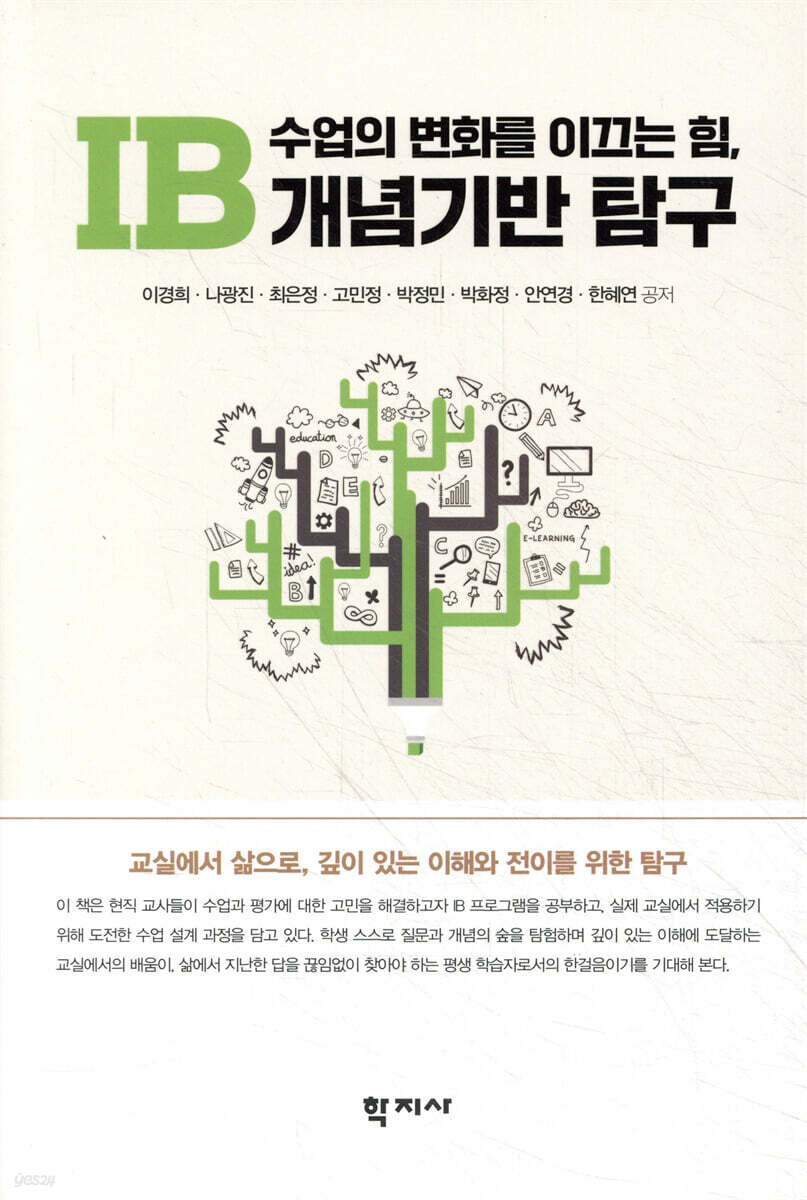
"The Power to Change Classrooms: IB Concept-Based Exploration" is a book written by eight current teachers who have studied the IB program in depth and put it into practice in actual classrooms.
The authors are education experts who have systematically completed the IB program at Inha University's Graduate School of Education and obtained IBEC (IB Educator Certificate) teacher qualifications.
Those who have applied IB unit design in various subject classes, such as Korean, English, mathematics, science, and specialized subjects, are sincerely answering the question, as both teachers and researchers, "How can we understand and implement each element of IB unit design in our public education classrooms?"
The authors are education experts who have systematically completed the IB program at Inha University's Graduate School of Education and obtained IBEC (IB Educator Certificate) teacher qualifications.
Those who have applied IB unit design in various subject classes, such as Korean, English, mathematics, science, and specialized subjects, are sincerely answering the question, as both teachers and researchers, "How can we understand and implement each element of IB unit design in our public education classrooms?"
index
Recommendation ①
Recommendation ②
Opening remarks
Part 1: Comparing the 2022 Revised Curriculum with the IB
Chapter 1: A Deeper Understanding of the 2022 Revised Curriculum and the IB's Direction
1.
What should we do to achieve a deeper understanding?
2.
The 2022 Revised Curriculum and the IB: What's the Same and What's Different?
3.
How can we achieve deep understanding?
Part 2: Implementing Concept-Based Inquiry Classes with the IB
Chapter 2: Transfer Goals as a Guideline for Classes
1.
Where is the class headed?
2.
What are the objectives of the class?
3.
What is needed to present lesson objectives?
4.
How should I present the objectives of the class?
Chapter 3: Stepping Stones of Classrooms: Evaluation
1.
Evaluation, how should it be done?
2.
The Framework of Evaluation: What's Different?
3.
How to design assessments in class
4.
How to apply assessment to class
Chapter 4: Lesson Design and the Beginning of Inquiry Learning: Inquiry Questions
1.
How to ask, how to make people ask
2.
What questions will become exploratory questions?
3.
Why Questions Can Lead to Deeper Inquiry
4.
How to formulate questions for deep inquiry
Chapter 5: Teaching and Learning Approaches that Make 1+1 Greater Than 2
1.
Where did all those 1s we gave you in class go?
2.
What is the class that makes 1+1 greater than 2?
3.
What is the formula for greater learning in classes and learning?
4.
Let's design a class that can provide more learning than 2.
Chapter 6: Exploratory and Transferable Learning Experiences and Activities
1.
How are exploration and transfer experienced?
2.
How to Apply Concept-Based Unit Activities
Chapter 7: Creative Experiential Activities: The Core of the Curriculum
1.
What is a truly creative experiential activity?
2.
How to integrate curriculum with creative experiential activities
3.
Creative experiential activities within the curriculum, and curriculum within creative experiential activities
4.
How to Design Classrooms to Connect Curriculum and Creative Experiential Activities
Chapter 8: Taking a Step Toward Growth, Reflection
1.
Reflection, isn't that what we're doing too?
2.
How is this different from the reflection we thought of?
3.
How to Practice Reflection
4.
Reflection, should I try it too?
Part 3: Unit Design Examples by Subject
Chapter 9: High School Curriculum Unit Design Case
1.
Language and Literature
2.
Language acquisition (English)
3.
Application and Interpretation
4.
Food Science and Technology
Chapter 10: Middle School Curriculum Unit Design Case
1.
Integrated curriculum (science + individual and society)
2.
Language acquisition (English)
Closing Remarks: Reflections on the IBEC Course
References
Search
Recommendation ②
Opening remarks
Part 1: Comparing the 2022 Revised Curriculum with the IB
Chapter 1: A Deeper Understanding of the 2022 Revised Curriculum and the IB's Direction
1.
What should we do to achieve a deeper understanding?
2.
The 2022 Revised Curriculum and the IB: What's the Same and What's Different?
3.
How can we achieve deep understanding?
Part 2: Implementing Concept-Based Inquiry Classes with the IB
Chapter 2: Transfer Goals as a Guideline for Classes
1.
Where is the class headed?
2.
What are the objectives of the class?
3.
What is needed to present lesson objectives?
4.
How should I present the objectives of the class?
Chapter 3: Stepping Stones of Classrooms: Evaluation
1.
Evaluation, how should it be done?
2.
The Framework of Evaluation: What's Different?
3.
How to design assessments in class
4.
How to apply assessment to class
Chapter 4: Lesson Design and the Beginning of Inquiry Learning: Inquiry Questions
1.
How to ask, how to make people ask
2.
What questions will become exploratory questions?
3.
Why Questions Can Lead to Deeper Inquiry
4.
How to formulate questions for deep inquiry
Chapter 5: Teaching and Learning Approaches that Make 1+1 Greater Than 2
1.
Where did all those 1s we gave you in class go?
2.
What is the class that makes 1+1 greater than 2?
3.
What is the formula for greater learning in classes and learning?
4.
Let's design a class that can provide more learning than 2.
Chapter 6: Exploratory and Transferable Learning Experiences and Activities
1.
How are exploration and transfer experienced?
2.
How to Apply Concept-Based Unit Activities
Chapter 7: Creative Experiential Activities: The Core of the Curriculum
1.
What is a truly creative experiential activity?
2.
How to integrate curriculum with creative experiential activities
3.
Creative experiential activities within the curriculum, and curriculum within creative experiential activities
4.
How to Design Classrooms to Connect Curriculum and Creative Experiential Activities
Chapter 8: Taking a Step Toward Growth, Reflection
1.
Reflection, isn't that what we're doing too?
2.
How is this different from the reflection we thought of?
3.
How to Practice Reflection
4.
Reflection, should I try it too?
Part 3: Unit Design Examples by Subject
Chapter 9: High School Curriculum Unit Design Case
1.
Language and Literature
2.
Language acquisition (English)
3.
Application and Interpretation
4.
Food Science and Technology
Chapter 10: Middle School Curriculum Unit Design Case
1.
Integrated curriculum (science + individual and society)
2.
Language acquisition (English)
Closing Remarks: Reflections on the IBEC Course
References
Search
Publisher's Review
Bringing the focus of the classroom back to the students!
IB Concept-Based Inquiry Classes: Their Practice and Potential
There is a growing demand in Korean education for a shift from classes focused on spoon-fed knowledge to one where students ask questions and explore concepts on their own.
Accordingly, interest in the International Baccalaureate (IB), a globally recognized educational program, is growing, and many schools and teachers are attempting to introduce IB classes.
However, applying a completely new class structure and philosophy to the field remains a daunting challenge.
"The Power to Change Classrooms: IB Concept-Based Exploration" is a book written by eight current teachers who have studied the IB program in depth and put it into practice in actual classrooms.
The authors are education experts who have systematically completed the IB program at Inha University's Graduate School of Education and obtained IBEC (IB Educator Certificate) teacher qualifications.
Those who have applied IB unit design in various subject classes, such as Korean, English, mathematics, science, and specialized subjects, are sincerely answering the question, as both teachers and researchers, "How can we understand and implement each element of IB unit design in our public education classrooms?"
This book provides a theoretical framework that compares and analyzes the direction of the 2022 revised curriculum and the IB program, provides detailed explanations of the core components for IB lesson design (framework, inquiry statements, ATL, assessment plans, etc.), and even provides practical unit design examples for each subject, presenting a practical model of IB education applicable to domestic classrooms.
This book, written in the language of field teachers, is particularly credible because it is not a simple theoretical book, but a "usable guide" rooted in the realities of education.
This book will serve as a useful guide for those who reflect on the essence of student-centered instruction and consider classes that transfer learning into everyday life.
This book provides teachers with practical tools to redesign their classes and assessments, and educators and parents with in-depth insight and direction for IB education. It is a must-read for our current educational transition.
IB Concept-Based Inquiry Classes: Their Practice and Potential
There is a growing demand in Korean education for a shift from classes focused on spoon-fed knowledge to one where students ask questions and explore concepts on their own.
Accordingly, interest in the International Baccalaureate (IB), a globally recognized educational program, is growing, and many schools and teachers are attempting to introduce IB classes.
However, applying a completely new class structure and philosophy to the field remains a daunting challenge.
"The Power to Change Classrooms: IB Concept-Based Exploration" is a book written by eight current teachers who have studied the IB program in depth and put it into practice in actual classrooms.
The authors are education experts who have systematically completed the IB program at Inha University's Graduate School of Education and obtained IBEC (IB Educator Certificate) teacher qualifications.
Those who have applied IB unit design in various subject classes, such as Korean, English, mathematics, science, and specialized subjects, are sincerely answering the question, as both teachers and researchers, "How can we understand and implement each element of IB unit design in our public education classrooms?"
This book provides a theoretical framework that compares and analyzes the direction of the 2022 revised curriculum and the IB program, provides detailed explanations of the core components for IB lesson design (framework, inquiry statements, ATL, assessment plans, etc.), and even provides practical unit design examples for each subject, presenting a practical model of IB education applicable to domestic classrooms.
This book, written in the language of field teachers, is particularly credible because it is not a simple theoretical book, but a "usable guide" rooted in the realities of education.
This book will serve as a useful guide for those who reflect on the essence of student-centered instruction and consider classes that transfer learning into everyday life.
This book provides teachers with practical tools to redesign their classes and assessments, and educators and parents with in-depth insight and direction for IB education. It is a must-read for our current educational transition.
GOODS SPECIFICS
- Date of issue: February 15, 2025
- Format: Paperback book binding method guide
- Page count, weight, size: 344 pages | 153*225*16mm
- ISBN13: 9788999732645
You may also like
카테고리
korean


korean

![GQ KOREA Mark (Monthly): December [2025]](http://librairie.coreenne.fr/cdn/shop/files/8ef265dbbfbf186523ed75ba7319009d.jpg?v=1765340328&width=3840)


