

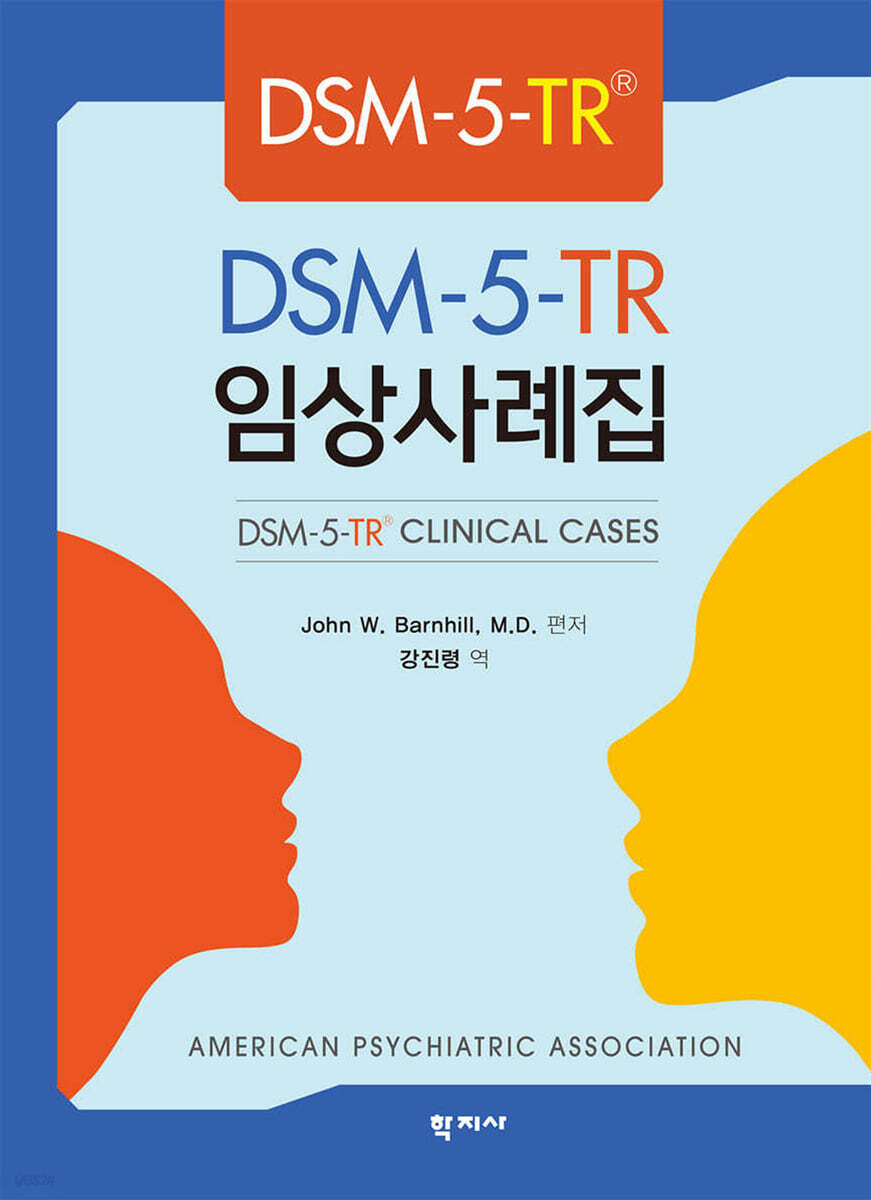
DSM-5-TR® Clinical Case Book
 |
Description
Book Introduction
This book is based on the diagnostic categories included in Part III of the DSM-5-TR and is organized in the following order: ① cases, ② discussion of the diagnostic process, ③ diagnosis of cases, and ④ reading material.
Each diagnostic category contains from one case (Chapter 11/Excretory Disorders) to twelve cases (Chapter 4/Depressive Disorders), depending on the proportion of people seeking mental health care.
The highlight of this book is that experts in each field, carefully selected by APA, introduce and analyze actual clinical cases by diagnostic category based on their extensive experience and expertise, and then discuss the diagnostic process in detail.
Accordingly, the translator sought to put into practice his usual belief that it is the translator's original mission and responsibility to accurately and delicately translate the author's intended meaning into Korean during the translation process of this book.
To this end, we consistently translated the key terms used in the DSM-5-TR into Korean, while distinguishing similar terms used in the context of the text as much as possible and translating them into different Korean terms, in an effort to accurately convey the authors' intentions to readers.
As a result, it was sometimes impossible to avoid situations where the terminology did not match the Korean version of the DSM-5-TR.
For example, in the Korean version, 'disorder' is translated as 'disease' or 'disability', and 'illness' is translated as 'disease' or 'disease', depending on the context of the text.
However, in this book, we have tried to use the terminology presented in the Korean version of the DSM-5-TR as much as possible, but have translated some terms that are judged to be linguistically inconsistent or inconsistent with the authors' intentions into other Korean words, thereby conveying the authors' intentions for using different terms and the nuances of the terms in a differentiated and consistent manner.
In addition, by consistently translating '~mania' as '~광' and compound words such as '~disorder' as '~장애', we aimed to minimize readers' confusion caused by the use of different terms depending on the context, while maintaining linguistic order.
This series of choices was a desperate measure based on the translator's usual belief that a good translation should not differ significantly from the original work even when the translated content is translated back into the original language and back into Korean.
Additionally, efforts to maximize the readability of this book have led to the following measures:
First, the patient's age, gender, race, and/or marital status are presented in parentheses so that the case can be read with the patient's basic personal information in mind.
Second, to improve readability, we enclosed diagnoses, key terms, and specific vocabulary or expressions used by the patient in single quotation marks, and to enhance clinical realism, we enclosed patient statements presented in sentences in double quotation marks and directly quoted them.
Third, when necessary, technical terms, including names of drugs or substances, were included with the original names in a ‘translator’s note’ to help readers understand.
Fourth, key terms are indicated with superscripts in their original language, allowing for reference not only to Korean terms but also to terms used by the authors.
Fifth, when translating the English text directly, terms and sentences that may be difficult to understand or cause confusion due to idiomatic meanings and cultural differences were explained to improve readability.
Each diagnostic category contains from one case (Chapter 11/Excretory Disorders) to twelve cases (Chapter 4/Depressive Disorders), depending on the proportion of people seeking mental health care.
The highlight of this book is that experts in each field, carefully selected by APA, introduce and analyze actual clinical cases by diagnostic category based on their extensive experience and expertise, and then discuss the diagnostic process in detail.
Accordingly, the translator sought to put into practice his usual belief that it is the translator's original mission and responsibility to accurately and delicately translate the author's intended meaning into Korean during the translation process of this book.
To this end, we consistently translated the key terms used in the DSM-5-TR into Korean, while distinguishing similar terms used in the context of the text as much as possible and translating them into different Korean terms, in an effort to accurately convey the authors' intentions to readers.
As a result, it was sometimes impossible to avoid situations where the terminology did not match the Korean version of the DSM-5-TR.
For example, in the Korean version, 'disorder' is translated as 'disease' or 'disability', and 'illness' is translated as 'disease' or 'disease', depending on the context of the text.
However, in this book, we have tried to use the terminology presented in the Korean version of the DSM-5-TR as much as possible, but have translated some terms that are judged to be linguistically inconsistent or inconsistent with the authors' intentions into other Korean words, thereby conveying the authors' intentions for using different terms and the nuances of the terms in a differentiated and consistent manner.
In addition, by consistently translating '~mania' as '~광' and compound words such as '~disorder' as '~장애', we aimed to minimize readers' confusion caused by the use of different terms depending on the context, while maintaining linguistic order.
This series of choices was a desperate measure based on the translator's usual belief that a good translation should not differ significantly from the original work even when the translated content is translated back into the original language and back into Korean.
Additionally, efforts to maximize the readability of this book have led to the following measures:
First, the patient's age, gender, race, and/or marital status are presented in parentheses so that the case can be read with the patient's basic personal information in mind.
Second, to improve readability, we enclosed diagnoses, key terms, and specific vocabulary or expressions used by the patient in single quotation marks, and to enhance clinical realism, we enclosed patient statements presented in sentences in double quotation marks and directly quoted them.
Third, when necessary, technical terms, including names of drugs or substances, were included with the original names in a ‘translator’s note’ to help readers understand.
Fourth, key terms are indicated with superscripts in their original language, allowing for reference not only to Korean terms but also to terms used by the authors.
Fifth, when translating the English text directly, terms and sentences that may be difficult to understand or cause confusion due to idiomatic meanings and cultural differences were explained to improve readability.
index
Translator's Preface
Contributors
introduction
CHAPTER 1 Neurodevelopmental Disorders
introduction
Case 1.1 Other findings on autism
Case 1.2 Anger Outburst
Case 1.3 Academic difficulties
Case 1.4 School Problems
Case 1.5 Restlessness and distraction
CHAPTER 2 Schizophrenia Spectrum and Other Psychotic Disorders
introduction
Case 2.1 Emotional Disorder
Case 2.2 Progressive singularity
Case 2.3 Spiritual Hallucinations
Case 2.4 Mind Control
Case 2.5: Grief and Psychosis
Case 2.6 Mental illness and cannabis
Case 2.7 Flea penetration
CHAPTER 3 BIPOLAR AND RELATED DISORDERS
introduction
Case 3.1 Emotional Disorder
Case 3.2 Depressive cycle
Case 3.3 Suicidal obsession
Case 3.4 Episodic depression
Case 3.5 Irritability and Sadness
Case 3.6 God Healed Me
Case 3.7 A Strange Silence
Case 3.8 Postpartum Changes
Case 3.9 Depression and anxiety
CHAPTER 4 Depressive Disorder
introduction
Case 4.1 Melancholy and Irritability
Case 4.2 Postpartum Grief
Case 4.3 Grief and Depression
Case 4.4 Loss of interest in life
Case 4.5 Despair
Case 4.6 Years of low mood
Case 4.7 Mood swings
Case 4.8 Stress, Drugs, and Unhappiness
Case 4.9 Anhedonia and restless sleep
Case 4.10 Mixed pattern, non-polar
Case 4.11 Struggle
Case 4.12 Insomnia and Physical Discomfort
CHAPTER 5 Anxiety Disorders
introduction
Case 5.1 Fear and Anxiety
Case 5.2 Panic
Case 5.3 Adolescent shyness
Case 5.4 Aviation Fear
Case 5.5 Habitual hypersensitivity
Case 5.6 Anxiety and Cirrhosis
CHAPTER 6 Obsessive-Compulsive and Related Disorders
introduction
Case 6.1 Depression
Case 6.2 Bacteria
Case 6.3: Obsession with Appearance
Case 6.4 Depression and Anxiety
Case 6.5 Alopecia
CHAPTER 7 TRAUMA AND STRESS-RELATED DISORDERS
introduction
Case 7.1 Risky Behavior
Case 7.2 Two Responses to Trauma
Case 7.3 Car Accident
Case 7.4 Easily irritable
Case 7.5 Accumulated stress
Case 7.6 Lung cancer
Case 7.7 Overdose
Case 7.8 Exhaustion
CHAPTER 8 Dissociative Disorder
introduction
Case 8.1 Sadness and Loneliness
Case 8.2 Unrealism
Case 8.3 Harry
CHAPTER 9 Physical Symptoms and Related Disorders
introduction
Case 9.1 Pain and Depression
Case 9.2 Physical discomfort
Case 9.3 Chronic Lyme disease
Case 9.4 Seizure
Case 9.5 Abdominal pain
Case 9.6 Dyspnea
CHAPTER 10 FEEDING AND EATING DISORDERS
introduction
Case 10.1 Stomach pain
Case 10.2: Drifting to the Bottom of the Growth Curve
Case 10.3 Headache and fatigue
Case 10.4 Out of Control
Case 10.5 Weight gain
CHAPTER 11 EXCRETIONAL DISORDERS
introduction
Case 11.1 Anger Outbursts and Physical Discomfort
CHAPTER 12 Sleep-Wake Disorders
introduction
Case 12.1 Difficulty maintaining sleep
Case 12.2 Anxiety and drowsiness
Case 12.3 Drowsiness
Case 12.4 Itchy, creepy, and ticklish feeling
CHAPTER 13 Erectile Dysfunction
introduction
Case 13.1 Erectile dysfunction
Case 13.2 Sexual Problems
CHAPTER 14 Gender Dysphoria
introduction
Case 14.1 Gender Reassignment
CHAPTER 15 Disruptive, Impulse-Control, and Conduct Disorders
introduction
Case 15.1 A child who does not know the rules
Case 15.2 People Who Cannot Live Together
CHAPTER 16 Substance-Related and Addictive Disorders
introduction
Case 16.1 Alcohol
Case 16.2 Alcohol withdrawal
Case 16.3 Addiction
Case 16.4 Knee Pain
Case 16.5: Plummet
Case 16.6 Stress and Substance Abuse
Case 16.7 Gambling
CHAPTER 17 Neurocognitive Disorders
introduction
Case 17.1 Discomfort
Case 17.2 Anxiety and confusion
Case 17.3 Depression and Withdrawal
Case 17.4 Tangled and exhausted
Case 17.5 Rigidity and Amnesia
Case 17.6 Paranoia and Hallucinations
Case 17.7 Sudden Rebellion
CHAPTER 18 PERSONALITY DISORDERS
introduction
Case 18.1 Personality Conflict
Case 18.2 Unusual Isolation
Case 18.3 Worries and Unusual Obsessions
Case 18.4 Unfairness
Case 18.5 Vulnerable and Angry
Case 18.6 Painful suicidal tendencies
Case 18.7 Dissatisfaction
Case 18.8 Shyness
Case 18.9 Lack of Confidence
Case 18.10 Relationship Control
CHAPTER 19 Sexual Dysphoria
introduction
Case 19.1 Sadomasochism
Case 19.2 Relationship Problems
Case 19.3 Sexual violence
Case 19.4 Some Perverted Sexual Behaviors
Search
Contributors
introduction
CHAPTER 1 Neurodevelopmental Disorders
introduction
Case 1.1 Other findings on autism
Case 1.2 Anger Outburst
Case 1.3 Academic difficulties
Case 1.4 School Problems
Case 1.5 Restlessness and distraction
CHAPTER 2 Schizophrenia Spectrum and Other Psychotic Disorders
introduction
Case 2.1 Emotional Disorder
Case 2.2 Progressive singularity
Case 2.3 Spiritual Hallucinations
Case 2.4 Mind Control
Case 2.5: Grief and Psychosis
Case 2.6 Mental illness and cannabis
Case 2.7 Flea penetration
CHAPTER 3 BIPOLAR AND RELATED DISORDERS
introduction
Case 3.1 Emotional Disorder
Case 3.2 Depressive cycle
Case 3.3 Suicidal obsession
Case 3.4 Episodic depression
Case 3.5 Irritability and Sadness
Case 3.6 God Healed Me
Case 3.7 A Strange Silence
Case 3.8 Postpartum Changes
Case 3.9 Depression and anxiety
CHAPTER 4 Depressive Disorder
introduction
Case 4.1 Melancholy and Irritability
Case 4.2 Postpartum Grief
Case 4.3 Grief and Depression
Case 4.4 Loss of interest in life
Case 4.5 Despair
Case 4.6 Years of low mood
Case 4.7 Mood swings
Case 4.8 Stress, Drugs, and Unhappiness
Case 4.9 Anhedonia and restless sleep
Case 4.10 Mixed pattern, non-polar
Case 4.11 Struggle
Case 4.12 Insomnia and Physical Discomfort
CHAPTER 5 Anxiety Disorders
introduction
Case 5.1 Fear and Anxiety
Case 5.2 Panic
Case 5.3 Adolescent shyness
Case 5.4 Aviation Fear
Case 5.5 Habitual hypersensitivity
Case 5.6 Anxiety and Cirrhosis
CHAPTER 6 Obsessive-Compulsive and Related Disorders
introduction
Case 6.1 Depression
Case 6.2 Bacteria
Case 6.3: Obsession with Appearance
Case 6.4 Depression and Anxiety
Case 6.5 Alopecia
CHAPTER 7 TRAUMA AND STRESS-RELATED DISORDERS
introduction
Case 7.1 Risky Behavior
Case 7.2 Two Responses to Trauma
Case 7.3 Car Accident
Case 7.4 Easily irritable
Case 7.5 Accumulated stress
Case 7.6 Lung cancer
Case 7.7 Overdose
Case 7.8 Exhaustion
CHAPTER 8 Dissociative Disorder
introduction
Case 8.1 Sadness and Loneliness
Case 8.2 Unrealism
Case 8.3 Harry
CHAPTER 9 Physical Symptoms and Related Disorders
introduction
Case 9.1 Pain and Depression
Case 9.2 Physical discomfort
Case 9.3 Chronic Lyme disease
Case 9.4 Seizure
Case 9.5 Abdominal pain
Case 9.6 Dyspnea
CHAPTER 10 FEEDING AND EATING DISORDERS
introduction
Case 10.1 Stomach pain
Case 10.2: Drifting to the Bottom of the Growth Curve
Case 10.3 Headache and fatigue
Case 10.4 Out of Control
Case 10.5 Weight gain
CHAPTER 11 EXCRETIONAL DISORDERS
introduction
Case 11.1 Anger Outbursts and Physical Discomfort
CHAPTER 12 Sleep-Wake Disorders
introduction
Case 12.1 Difficulty maintaining sleep
Case 12.2 Anxiety and drowsiness
Case 12.3 Drowsiness
Case 12.4 Itchy, creepy, and ticklish feeling
CHAPTER 13 Erectile Dysfunction
introduction
Case 13.1 Erectile dysfunction
Case 13.2 Sexual Problems
CHAPTER 14 Gender Dysphoria
introduction
Case 14.1 Gender Reassignment
CHAPTER 15 Disruptive, Impulse-Control, and Conduct Disorders
introduction
Case 15.1 A child who does not know the rules
Case 15.2 People Who Cannot Live Together
CHAPTER 16 Substance-Related and Addictive Disorders
introduction
Case 16.1 Alcohol
Case 16.2 Alcohol withdrawal
Case 16.3 Addiction
Case 16.4 Knee Pain
Case 16.5: Plummet
Case 16.6 Stress and Substance Abuse
Case 16.7 Gambling
CHAPTER 17 Neurocognitive Disorders
introduction
Case 17.1 Discomfort
Case 17.2 Anxiety and confusion
Case 17.3 Depression and Withdrawal
Case 17.4 Tangled and exhausted
Case 17.5 Rigidity and Amnesia
Case 17.6 Paranoia and Hallucinations
Case 17.7 Sudden Rebellion
CHAPTER 18 PERSONALITY DISORDERS
introduction
Case 18.1 Personality Conflict
Case 18.2 Unusual Isolation
Case 18.3 Worries and Unusual Obsessions
Case 18.4 Unfairness
Case 18.5 Vulnerable and Angry
Case 18.6 Painful suicidal tendencies
Case 18.7 Dissatisfaction
Case 18.8 Shyness
Case 18.9 Lack of Confidence
Case 18.10 Relationship Control
CHAPTER 19 Sexual Dysphoria
introduction
Case 19.1 Sadomasochism
Case 19.2 Relationship Problems
Case 19.3 Sexual violence
Case 19.4 Some Perverted Sexual Behaviors
Search
GOODS SPECIFICS
- Date of issue: February 25, 2024
- Page count, weight, size: 600 pages | 188*255*32mm
- ISBN13: 9788999730559
You may also like
카테고리
korean


korean

![ELLE 엘르 스페셜 에디션 A형 : 12월 [2025]](http://librairie.coreenne.fr/cdn/shop/files/b8e27a3de6c9538896439686c6b0e8fb.jpg?v=1766436872&width=3840)


