

Understanding Korean Language Education
 |
Description
Book Introduction
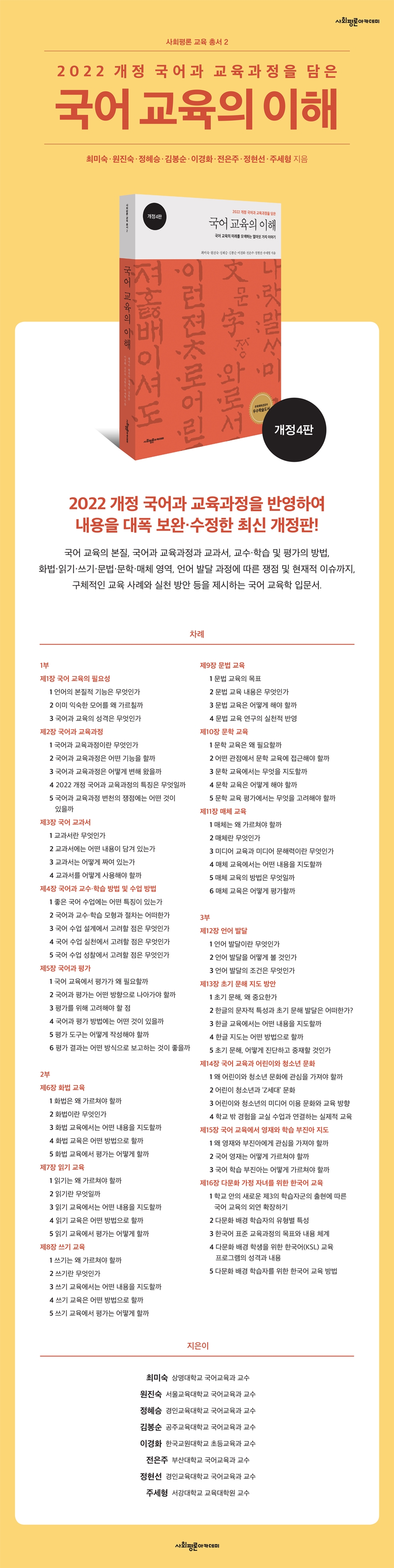
This introductory book on Korean language education is systematically organized and accessible for those new to the field, covering the essence of Korean language education, the Korean language curriculum and textbooks, teaching, learning, and assessment methods, the areas of speaking, reading, writing, grammar, literature, and media, and even issues related to language development and current issues.
The content has been significantly supplemented and revised to reflect the 2022 revised Korean language curriculum, and the format and text design have also been revised to make it easier to access anytime, anywhere.
The content has been significantly supplemented and revised to reflect the 2022 revised Korean language curriculum, and the format and text design have also been revised to make it easier to access anytime, anywhere.
- You can preview some of the book's contents.
Preview
index
Preface to the 4th Revised Edition
Preface to the first edition
Part 1
Chapter 1: The Necessity of Korean Language Education
1 What is the essential function of language?
2 Why teach a mother tongue that is already familiar?
3. What is the nature of Korean language education?
Chapter 2 Korean Language Curriculum
1 What is the Korean Language Curriculum?
2 What function does the Korean language curriculum serve?
3 How has the Korean language curriculum changed?
4 What are the characteristics of the revised 2022 Korean language curriculum?
5. What are the issues facing the Korean language curriculum?
Chapter 3 Korean Language Textbook
1 What is a textbook?
2 What is included in the textbook?
3 How are textbooks structured?
4 How to Use Textbooks
Chapter 4: Teaching and Learning Methods and Class Methods in Korean Language
1. What are the characteristics of a good Korean language class?
2. What are the teaching and learning models and procedures for the Korean language department?
3. What should you consider when designing a Korean language class?
4. What should you consider when practicing Korean language classes?
5. What should you consider when reflecting on your Korean language classes?
Chapter 5 Korean Language Assessment
1 Why is evaluation necessary in Korean language education?
2. In what direction should Korean language assessments proceed?
3 Things to Consider for Evaluation
4. What are the evaluation methods for Korean language subjects?
5 How to Create an Assessment Tool
6 How should the evaluation results be reported?
Part 2
Chapter 6: Speaking Skills Education
1 Why should we teach speaking skills?
2 What is a speech technique?
3. What will be taught in speaking education?
4. How should speaking skills be taught?
5 How to evaluate speaking skills training
Chapter 7 Reading Education
1 Why should we teach reading?
2 What is reading?
3. What content will be taught in reading education?
4 How should reading education be conducted?
5 How to assess reading education
Chapter 8 Writing Education
1 Why should we teach writing?
2 What is writing?
3. What will be taught in writing education?
4. How should writing be taught?
5 How to evaluate writing education
Chapter 9 Grammar Education
1. Goals of Grammar Education
2 What is the content of grammar education?
3 How should grammar be taught?
4. Practical Reflection of Grammar Education Research
Chapter 10 Literary Education
1 Why is literature education necessary?
2 From what perspective should we approach literature education?
3. What should be taught in literature education?
4. How should literature education be conducted?
5. What Should Be Considered in Literature Education Evaluation?
Chapter 11 Media Education
1 Why should media teach?
2 What is media?
3 What is Media Education and Media Literacy?
4. What content will be taught in media education?
5 What are the methods of media education?
6 How to evaluate media education
Part 3
Chapter 12 Language Development
1 What is language development?
2 How should we view language development?
3 What are the conditions for language development?
Chapter 13: Early Literacy Instruction
1 Early Literacy: Why It Matters
2 What are the character characteristics of Hangul and its early literacy development?
3. What content will be taught in Korean language education?
4 How to make a Korean map
5 Early Literacy: How to Diagnose and Intervene
Chapter 14: Korean Language Education and Children and Youth Culture
1 Why Should We Care About Children and Youth Culture?
2 Children, Youth, and Generation Z Culture
3 Media Use Culture and Education Directions for Children and Adolescents
4. Practical education that connects out-of-school experiences with classroom lessons.
Chapter 15: Guidance of Gifted and Underachieving Students in Korean Language Education
1 Why should we care about gifted and underachieving children?
2 How should we teach gifted Korean students?
3 How to Teach Korean to Children Who Have Difficulty Learning It
Chapter 16: Korean Language Education for Children from Multicultural Families
1. Expanding the scope of Korean language education in response to the emergence of a new third group of learners within schools.
2. Characteristics of multicultural learners by type
3. Goals and Content System of the Korean Standard Curriculum
4. The nature and content of the Korean Language (KSL) education program for students from multicultural backgrounds.
5 Methods of Teaching Korean to Multicultural Learners
References
Search
Preface to the first edition
Part 1
Chapter 1: The Necessity of Korean Language Education
1 What is the essential function of language?
2 Why teach a mother tongue that is already familiar?
3. What is the nature of Korean language education?
Chapter 2 Korean Language Curriculum
1 What is the Korean Language Curriculum?
2 What function does the Korean language curriculum serve?
3 How has the Korean language curriculum changed?
4 What are the characteristics of the revised 2022 Korean language curriculum?
5. What are the issues facing the Korean language curriculum?
Chapter 3 Korean Language Textbook
1 What is a textbook?
2 What is included in the textbook?
3 How are textbooks structured?
4 How to Use Textbooks
Chapter 4: Teaching and Learning Methods and Class Methods in Korean Language
1. What are the characteristics of a good Korean language class?
2. What are the teaching and learning models and procedures for the Korean language department?
3. What should you consider when designing a Korean language class?
4. What should you consider when practicing Korean language classes?
5. What should you consider when reflecting on your Korean language classes?
Chapter 5 Korean Language Assessment
1 Why is evaluation necessary in Korean language education?
2. In what direction should Korean language assessments proceed?
3 Things to Consider for Evaluation
4. What are the evaluation methods for Korean language subjects?
5 How to Create an Assessment Tool
6 How should the evaluation results be reported?
Part 2
Chapter 6: Speaking Skills Education
1 Why should we teach speaking skills?
2 What is a speech technique?
3. What will be taught in speaking education?
4. How should speaking skills be taught?
5 How to evaluate speaking skills training
Chapter 7 Reading Education
1 Why should we teach reading?
2 What is reading?
3. What content will be taught in reading education?
4 How should reading education be conducted?
5 How to assess reading education
Chapter 8 Writing Education
1 Why should we teach writing?
2 What is writing?
3. What will be taught in writing education?
4. How should writing be taught?
5 How to evaluate writing education
Chapter 9 Grammar Education
1. Goals of Grammar Education
2 What is the content of grammar education?
3 How should grammar be taught?
4. Practical Reflection of Grammar Education Research
Chapter 10 Literary Education
1 Why is literature education necessary?
2 From what perspective should we approach literature education?
3. What should be taught in literature education?
4. How should literature education be conducted?
5. What Should Be Considered in Literature Education Evaluation?
Chapter 11 Media Education
1 Why should media teach?
2 What is media?
3 What is Media Education and Media Literacy?
4. What content will be taught in media education?
5 What are the methods of media education?
6 How to evaluate media education
Part 3
Chapter 12 Language Development
1 What is language development?
2 How should we view language development?
3 What are the conditions for language development?
Chapter 13: Early Literacy Instruction
1 Early Literacy: Why It Matters
2 What are the character characteristics of Hangul and its early literacy development?
3. What content will be taught in Korean language education?
4 How to make a Korean map
5 Early Literacy: How to Diagnose and Intervene
Chapter 14: Korean Language Education and Children and Youth Culture
1 Why Should We Care About Children and Youth Culture?
2 Children, Youth, and Generation Z Culture
3 Media Use Culture and Education Directions for Children and Adolescents
4. Practical education that connects out-of-school experiences with classroom lessons.
Chapter 15: Guidance of Gifted and Underachieving Students in Korean Language Education
1 Why should we care about gifted and underachieving children?
2 How should we teach gifted Korean students?
3 How to Teach Korean to Children Who Have Difficulty Learning It
Chapter 16: Korean Language Education for Children from Multicultural Families
1. Expanding the scope of Korean language education in response to the emergence of a new third group of learners within schools.
2. Characteristics of multicultural learners by type
3. Goals and Content System of the Korean Standard Curriculum
4. The nature and content of the Korean Language (KSL) education program for students from multicultural backgrounds.
5 Methods of Teaching Korean to Multicultural Learners
References
Search
Detailed image
Into the book
All subjects have the basis for their existence as subjects by simultaneously securing educational universality and subject specificity.
Korean language education also possesses educational universality, which means that it can contribute to the personal and social growth of individuals.
Korean language education has always been planned and implemented with the following goals in mind, thereby solidifying its status as a subject for members of the community.
First, the purpose of Korean language education is personal growth.
Second, Korean language education aims to acquire cross-curricular skills.
Third, it aims for practicality after growth.
Fourth, the goal is to inherit and promote culture.
Fifth, we aim to improve cultural analysis capabilities.
--- p.24
In the 2022 revised Korean language curriculum, the content areas of the Korean language subject have been divided into six major areas: ‘Listening and Speaking,’ ‘Reading,’ ‘Writing,’ ‘Grammar,’ ‘Literature,’ and ‘Media,’ with the new inclusion of ‘Media,’ rather than the five major areas that were divided in the 2009 revised Korean language curriculum.
--- p.42
Korean language class design refers to designing an overall plan to ensure effective teaching and learning of Korean language.
By designing Korean language lessons, you can organize the elements of units and lessons in a consistent and well-organized manner so that each activity works harmoniously both individually and as a whole.
Teachers must consider the variables of Korean language teaching and learning and plan each learning activity so that it can be organically linked to achieving the learning objectives. They must also carefully and flexibly structure the activity, taking into account the learners, the time and space environment, and the situation.
--- p.107
A 'reading' human thinks quietly, reflects, explores deeply, solves problems, and creates.
Reading cultivates the human mind and strengthens its strength.
Now, let's raise a human who 'reads'.
Let's teach them what, how, and why to read so they can become readers themselves.
Let us step forward to help them fully experience the possibilities of reading and develop the strength to live in the world.
--- p.195
Let's count the numbers from 1 to 10.
Let's count as fast as possible.
It could be done very quickly.
Then let's count backwards.
If it's a young child, it might stutter, but if it's an adult, it might be easy.
Then, let's count backwards from 20 to 10.
Let's try counting backwards in English too.
It will probably be slow and require a lot of concentration to do.
Why is this so? I already know Arabic numerals and probably English numbers, so why is it so hard? I already have the knowledge, but why can't I express it fluently? The answer lies in "skills."
Function is the driving force behind what is done, and although its identity is difficult to reveal, it is a core element of ability.
Sometimes, this function alone, excluding knowledge or attitude, is referred to as ability, because the function is the core that contains the essence of ability and is an important part of reading comprehension instruction.
Korean language education also possesses educational universality, which means that it can contribute to the personal and social growth of individuals.
Korean language education has always been planned and implemented with the following goals in mind, thereby solidifying its status as a subject for members of the community.
First, the purpose of Korean language education is personal growth.
Second, Korean language education aims to acquire cross-curricular skills.
Third, it aims for practicality after growth.
Fourth, the goal is to inherit and promote culture.
Fifth, we aim to improve cultural analysis capabilities.
--- p.24
In the 2022 revised Korean language curriculum, the content areas of the Korean language subject have been divided into six major areas: ‘Listening and Speaking,’ ‘Reading,’ ‘Writing,’ ‘Grammar,’ ‘Literature,’ and ‘Media,’ with the new inclusion of ‘Media,’ rather than the five major areas that were divided in the 2009 revised Korean language curriculum.
--- p.42
Korean language class design refers to designing an overall plan to ensure effective teaching and learning of Korean language.
By designing Korean language lessons, you can organize the elements of units and lessons in a consistent and well-organized manner so that each activity works harmoniously both individually and as a whole.
Teachers must consider the variables of Korean language teaching and learning and plan each learning activity so that it can be organically linked to achieving the learning objectives. They must also carefully and flexibly structure the activity, taking into account the learners, the time and space environment, and the situation.
--- p.107
A 'reading' human thinks quietly, reflects, explores deeply, solves problems, and creates.
Reading cultivates the human mind and strengthens its strength.
Now, let's raise a human who 'reads'.
Let's teach them what, how, and why to read so they can become readers themselves.
Let us step forward to help them fully experience the possibilities of reading and develop the strength to live in the world.
--- p.195
Let's count the numbers from 1 to 10.
Let's count as fast as possible.
It could be done very quickly.
Then let's count backwards.
If it's a young child, it might stutter, but if it's an adult, it might be easy.
Then, let's count backwards from 20 to 10.
Let's try counting backwards in English too.
It will probably be slow and require a lot of concentration to do.
Why is this so? I already know Arabic numerals and probably English numbers, so why is it so hard? I already have the knowledge, but why can't I express it fluently? The answer lies in "skills."
Function is the driving force behind what is done, and although its identity is difficult to reveal, it is a core element of ability.
Sometimes, this function alone, excluding knowledge or attitude, is referred to as ability, because the function is the core that contains the essence of ability and is an important part of reading comprehension instruction.
--- p.222
Publisher's Review
The unexpected introduction of remote learning methods due to the COVID-19 pandemic has forced us to fundamentally rethink the very concept of school education, which used to be confined to classrooms.
The full-scale emergence of artificial intelligence, represented by chatGPT, demands serious reflection on the role of school education.
The rapid decline in student numbers also poses the challenge of restructuring the curriculum, teaching and learning methods, and evaluation methods.
Education has always been in line with social change.
Even in the face of crisis, people have the right to a happy life, and education must do its best to foster individual growth and development while addressing the needs of society.
This book reflects a changing society, contemplates the future of Korean language education, and presents a starting point for its development.
Part 1 begins with the necessity of Korean language education and covers general topics related to Korean language education, including the Korean language curriculum, textbooks, teaching, learning, and evaluation.
Part 2 covers the core content of six major areas: speaking education, reading education, writing education, grammar education, and literature education, including the newly added 'media' area in the 2022 revised curriculum.
Part 3 addresses issues in Korean language education that arise from the human growth process, such as language development, early literacy, and youth culture, as well as social issues such as differences among students in the classroom and Korean language education in multicultural families.
This book systematically covers the 'present state of Korean language education' built up through past efforts, and presents the 'future of Korean language education' that must be continuously explored. It will serve as a friendly guide for those who wish to study Korean language education.
The full-scale emergence of artificial intelligence, represented by chatGPT, demands serious reflection on the role of school education.
The rapid decline in student numbers also poses the challenge of restructuring the curriculum, teaching and learning methods, and evaluation methods.
Education has always been in line with social change.
Even in the face of crisis, people have the right to a happy life, and education must do its best to foster individual growth and development while addressing the needs of society.
This book reflects a changing society, contemplates the future of Korean language education, and presents a starting point for its development.
Part 1 begins with the necessity of Korean language education and covers general topics related to Korean language education, including the Korean language curriculum, textbooks, teaching, learning, and evaluation.
Part 2 covers the core content of six major areas: speaking education, reading education, writing education, grammar education, and literature education, including the newly added 'media' area in the 2022 revised curriculum.
Part 3 addresses issues in Korean language education that arise from the human growth process, such as language development, early literacy, and youth culture, as well as social issues such as differences among students in the classroom and Korean language education in multicultural families.
This book systematically covers the 'present state of Korean language education' built up through past efforts, and presents the 'future of Korean language education' that must be continuously explored. It will serve as a friendly guide for those who wish to study Korean language education.
GOODS SPECIFICS
- Date of issue: August 25, 2023
- Page count, weight, size: 535 pages | 188*257*35mm
- ISBN13: 9791167071170
- ISBN10: 1167071174
You may also like
카테고리
korean


korean

![ELLE 엘르 스페셜 에디션 A형 : 12월 [2025]](http://librairie.coreenne.fr/cdn/shop/files/b8e27a3de6c9538896439686c6b0e8fb.jpg?v=1766436872&width=3840)


