

thermodynamics
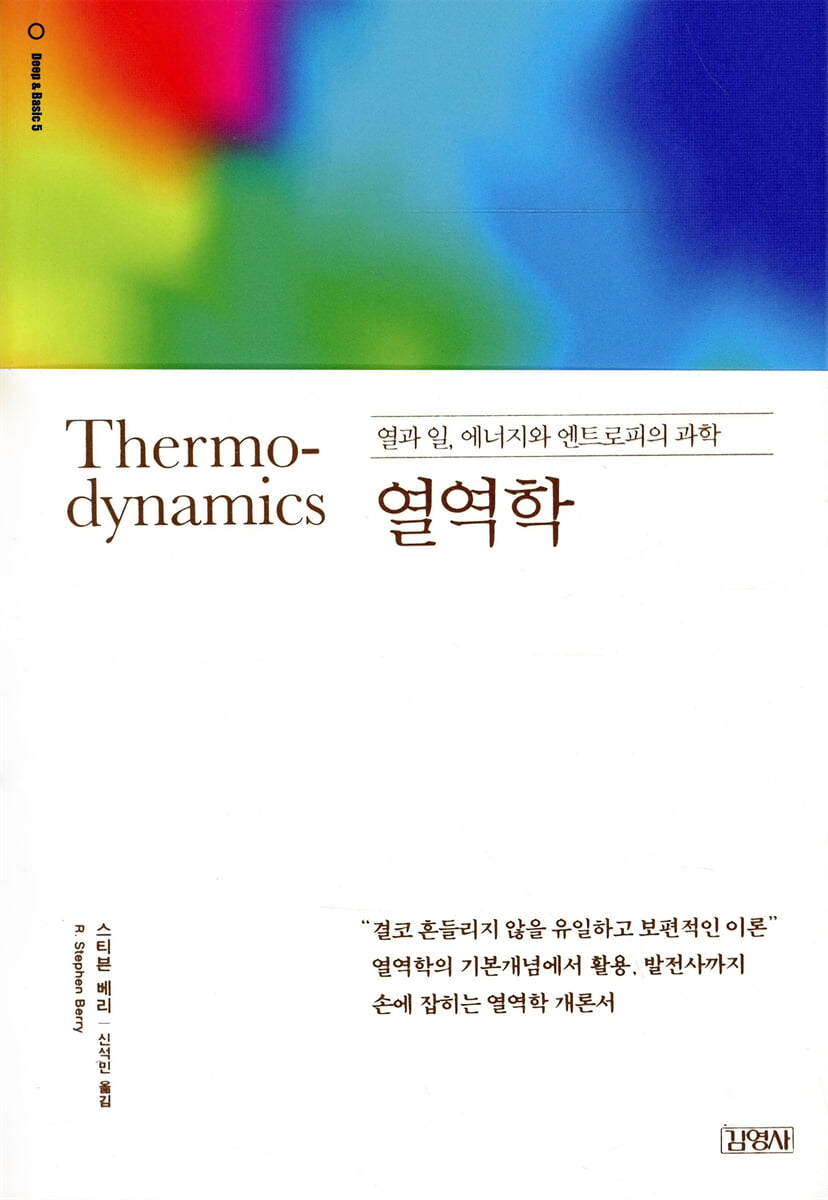 |
Description
Book Introduction
“The only universal theory that will never be shaken.”
From the basic concepts of thermodynamics to its application and development history,
An Introduction to Thermodynamics at Your Fingertips
An introductory book on thermodynamics written for the general public by world-renowned physical chemist Stephen Berry.
Thermodynamics is the science that deals with heat, work, energy, and entropy. As Einstein said, it is “the only universal theory that will never be shaken.” It is very fundamental, and as seen in refrigerators and air conditioners, it is deeply embedded in our daily lives. As can be seen in the fact that the Industrial Revolution, which was a major turning point in human history, began with the steam engine, it is a field with a long history.
As a result, the terms 'thermodynamics' and 'entropy' can be easily encountered in various fields such as science textbooks, sociology, and economics, but science books that deal solely with these topics are almost exclusively specialized or youth books, making it difficult to find introductory books for general readers who are interested.
The author, who has been teaching thermodynamics to undergraduates and adults for a long time, explains in this book what thermodynamics is, why we cannot go back in time, where and how thermodynamics is used, how thermodynamics has developed and what challenges remain, and whether the laws of thermodynamics are sometimes violated, in a way that is easy and clear for even those without much scientific knowledge to understand.
From the basic concepts of thermodynamics to its application and development history, this book provides essential knowledge about thermodynamics as well as insight into the science itself.
From the basic concepts of thermodynamics to its application and development history,
An Introduction to Thermodynamics at Your Fingertips
An introductory book on thermodynamics written for the general public by world-renowned physical chemist Stephen Berry.
Thermodynamics is the science that deals with heat, work, energy, and entropy. As Einstein said, it is “the only universal theory that will never be shaken.” It is very fundamental, and as seen in refrigerators and air conditioners, it is deeply embedded in our daily lives. As can be seen in the fact that the Industrial Revolution, which was a major turning point in human history, began with the steam engine, it is a field with a long history.
As a result, the terms 'thermodynamics' and 'entropy' can be easily encountered in various fields such as science textbooks, sociology, and economics, but science books that deal solely with these topics are almost exclusively specialized or youth books, making it difficult to find introductory books for general readers who are interested.
The author, who has been teaching thermodynamics to undergraduates and adults for a long time, explains in this book what thermodynamics is, why we cannot go back in time, where and how thermodynamics is used, how thermodynamics has developed and what challenges remain, and whether the laws of thermodynamics are sometimes violated, in a way that is easy and clear for even those without much scientific knowledge to understand.
From the basic concepts of thermodynamics to its application and development history, this book provides essential knowledge about thermodynamics as well as insight into the science itself.
- You can preview some of the book's contents.
Preview
index
preface
Chapter 1: What is Thermodynamics? (First Law)
Chapter 2: Why Can't We Go Back in Time? (The Second and Third Laws)
Chapter 3 How did classical thermodynamics arise?
Chapter 4 How do we use, or can we use, thermodynamics?
Chapter 5 How Has Thermodynamics Evolved?
Chapter 6 How can we go beyond the traditional scope of thermodynamics?
Chapter 7 What Can Thermodynamics Teach Us About Science?
Translator's Note
Search
Chapter 1: What is Thermodynamics? (First Law)
Chapter 2: Why Can't We Go Back in Time? (The Second and Third Laws)
Chapter 3 How did classical thermodynamics arise?
Chapter 4 How do we use, or can we use, thermodynamics?
Chapter 5 How Has Thermodynamics Evolved?
Chapter 6 How can we go beyond the traditional scope of thermodynamics?
Chapter 7 What Can Thermodynamics Teach Us About Science?
Translator's Note
Search
Into the book
The purpose of this book is very specific.
Using thermodynamics as a paradigm, I will show what science is, what it does, how we use it, how science came into being, and how science evolves as humans approach and attempt to solve increasingly challenging questions about nature.
--- p.5
Thermodynamics holds a special place in science.
Thermodynamics deals with everything, but in another sense it does not deal with anything real, at least not anything that can be practically touched.
As far as we know, thermodynamics applies to everything observed in the universe, from the smallest subatomic particles to entire galaxies.
--- p.12
Light, sound, electricity and magnetism, gravity, all motion, whether constant or changing, the 'glue' that holds atomic nuclei together, and even mass itself are all examples of energy.
Additionally, there are forms of energy we do not yet understand, called 'dark matter' and 'dark energy'.
If you think about it, it is surprising and wonderful that the human mind has recognized such a universal phenomenon in the natural world.
--- p.33
Roughly speaking, entropy is a measure of how many ways all the constituent atoms can exist, even though they appear the same to us.
--- p.51
In contrast to the 'basics to applications' model, the origins of thermodynamics were historically very practical problems.
For example, let's say I own a mine, and to keep it running, I need a pump to remove water that seeps into the ground.
Because if you don't drain the water, it will overflow.
I'm trying to fuel the pump with coal.
What is the minimum amount of coal needed to drain enough water to operate a mine? This is the question that inspired the thinking that led to the science of thermodynamics.
--- p.60
One important property to know about Carnot's ideal engine is that it must run very slowly, infinitely slowly to be precise, so that no heat loss occurs due to friction.
The engine must run so slowly that at any given moment you cannot tell whether it is moving forward or backward.
An engine like this is called a reversible engine.
The idea of using an ideal, reversible engine to perform a real process is unrealistic, but even if it is unattainable, the concept itself serves as a limitation of the real process.
--- p.86
The fundamental question of what fever actually is has been a matter of debate for many years.
There were two opposing views.
One view, which began in the 18th century, said that heat was the motion of the particles that make up matter, while another held that heat was a fluid called 'caloric' that could not be compressed or destroyed.
Although the former view of relating kinetic energy to heat has become accepted, some of the language of the fluid model is still used, such as when we say that “heat flows from hot to cold.”
--- p.90~91
It would be impossible to observe a situation where all air molecules would move to one side of the room for even a moment, leaving nothing on the other side.
However, if we consider only 10 air molecules in a 1 cubic centimeter box, sometimes we can find all 10 on one side of the box.
The more elementary entities that make up a system, the less likely it is that we will observe deviations from the most probable macroscopic state of that system, until we reach near zero.
--- p.158
The 'laws' of science and science itself should not be regarded as permanent and inviolable statements about nature.
--- p.167
As far as we know, one common property that runs through the many forms energy can take is that it is conserved.
It is truly remarkable, and perhaps one of the few facts about nature that, at least in this age, is readily accepted as a true and unbreakable property of nature.
This raises an interesting question for the reader to consider.
Was energy discovered, or was it invented by the human mind?
Using thermodynamics as a paradigm, I will show what science is, what it does, how we use it, how science came into being, and how science evolves as humans approach and attempt to solve increasingly challenging questions about nature.
--- p.5
Thermodynamics holds a special place in science.
Thermodynamics deals with everything, but in another sense it does not deal with anything real, at least not anything that can be practically touched.
As far as we know, thermodynamics applies to everything observed in the universe, from the smallest subatomic particles to entire galaxies.
--- p.12
Light, sound, electricity and magnetism, gravity, all motion, whether constant or changing, the 'glue' that holds atomic nuclei together, and even mass itself are all examples of energy.
Additionally, there are forms of energy we do not yet understand, called 'dark matter' and 'dark energy'.
If you think about it, it is surprising and wonderful that the human mind has recognized such a universal phenomenon in the natural world.
--- p.33
Roughly speaking, entropy is a measure of how many ways all the constituent atoms can exist, even though they appear the same to us.
--- p.51
In contrast to the 'basics to applications' model, the origins of thermodynamics were historically very practical problems.
For example, let's say I own a mine, and to keep it running, I need a pump to remove water that seeps into the ground.
Because if you don't drain the water, it will overflow.
I'm trying to fuel the pump with coal.
What is the minimum amount of coal needed to drain enough water to operate a mine? This is the question that inspired the thinking that led to the science of thermodynamics.
--- p.60
One important property to know about Carnot's ideal engine is that it must run very slowly, infinitely slowly to be precise, so that no heat loss occurs due to friction.
The engine must run so slowly that at any given moment you cannot tell whether it is moving forward or backward.
An engine like this is called a reversible engine.
The idea of using an ideal, reversible engine to perform a real process is unrealistic, but even if it is unattainable, the concept itself serves as a limitation of the real process.
--- p.86
The fundamental question of what fever actually is has been a matter of debate for many years.
There were two opposing views.
One view, which began in the 18th century, said that heat was the motion of the particles that make up matter, while another held that heat was a fluid called 'caloric' that could not be compressed or destroyed.
Although the former view of relating kinetic energy to heat has become accepted, some of the language of the fluid model is still used, such as when we say that “heat flows from hot to cold.”
--- p.90~91
It would be impossible to observe a situation where all air molecules would move to one side of the room for even a moment, leaving nothing on the other side.
However, if we consider only 10 air molecules in a 1 cubic centimeter box, sometimes we can find all 10 on one side of the box.
The more elementary entities that make up a system, the less likely it is that we will observe deviations from the most probable macroscopic state of that system, until we reach near zero.
--- p.158
The 'laws' of science and science itself should not be regarded as permanent and inviolable statements about nature.
--- p.167
As far as we know, one common property that runs through the many forms energy can take is that it is conserved.
It is truly remarkable, and perhaps one of the few facts about nature that, at least in this age, is readily accepted as a true and unbreakable property of nature.
This raises an interesting question for the reader to consider.
Was energy discovered, or was it invented by the human mind?
--- p.169
Publisher's Review
“Thermodynamics is the only physical theory that can deal with everything in the universe within its framework.
“It will never be shaken.” _Albert Einstein
From microscopic particles to entire galaxies
A theory that applies to everything observed in the universe
A book that explains the core of thermodynamics
Even if you aren't particularly interested in science, there are probably few people who haven't heard of the terms 'thermodynamics' or 'entropy'.
Thermodynamics is literally the study of the relationship between 'heat' and 'work', and is a science that applies to everything observed in the universe, from ultra-small particles to entire galaxies.
As Einstein said, “It is the only universal theory that will never be shaken,” thermodynamics is very fundamental, and it is deeply embedded in our daily lives, as seen in refrigerators and air conditioners. It is also a field with a long history, as can be seen from the fact that the Industrial Revolution, which was a major turning point in human history, began with the steam engine.
Despite its long history, deep penetration into daily life, and fundamental nature, thermodynamics-related books are limited to specialized or youth-oriented texts, making it difficult to find introductory texts for general readers interested in thermodynamics.
Even a book that is difficult to consider a science book has been on the science shelves of bookstores for a long time because of its title, 'Entropy.'
This small book, written by world-renowned physical chemist Stephen Berry, contains the teaching know-how of a veteran scholar who has been teaching thermodynamics to undergraduates and adults for many years.
In order to scientifically clarify the concept of thermodynamics and continue the discussion, the author explains the three laws of thermodynamics directly rather than the history of thermodynamics.
In this book, the author clearly and concisely explains what thermodynamics is, how we use it, how it came into existence, and how it has developed.
However, since 'thermodynamics' is also another name for 'science', readers will be able to learn about questions about science itself, such as what science is, what science does, how we use it, and how science develops, in addition to the essential knowledge about thermodynamics.
“Can you explain the second law of thermodynamics?”
It originated from the 'two cultures' debate sparked by Percy Snow.
A clear and accessible guide to thermodynamics from a world-renowned scientist.
The decisive factor that led author Stephen Barry to write this book was related to the famous 'two cultures' debate by British physical chemist and novelist Charles Percy Snow.
In his book, The Two Cultures and Scientific Revolutions, published in 1959 based on lectures given at Cambridge University, Snow cited the gap, misunderstanding, and lack of communication between the culture of scientists and the culture of humanists, citing the 'second law of thermodynamics' as an example.
According to Snow, the question “Can you explain the second law of thermodynamics?” is the literary equivalent of “Have you ever read Shakespeare?”
Snow's lecture and book on "Two Cultures" had a huge impact worldwide.
The term 'two cultures' became an idiom, and a constant and intense debate ensued.
However, separate from the debate about the 'two cultures' themselves, the author notes that in the revised and expanded edition of The Two Cultures: Subsequent Reflections, published in 1964, 'the second law of thermodynamics' was replaced with 'modern biology'.
“Even at the time, I did not agree with this revision, but as biology has advanced, it has now become clear that his original idea was correct.
Because to understand biology today, you have to learn a lot, a lot of facts, but to understand thermodynamics, you only need to know a few facts.
“Thermodynamics is a discipline rooted in a few concepts rather than in systematic reasoning based on a vast amount of information, like modern biology.” (p. 6) Based on the intuitive feeling about heat and temperature that everyone has, the author clearly and kindly explains the basic concepts of thermodynamics step by step.
We will also briefly examine remaining questions in thermodynamics.
In the publication interview of the author, who passed away in the summer of 2020 after writing his last book, we get a glimpse into his love of science.
"When I was in graduate school, nobody wanted to study thermodynamics.
Because I thought that all questions about thermodynamics had already been asked and explored, and that there were no questions left.
But my research on 'finite-time thermodynamics' shows how wrong and foolish that idea is.
Science is not closed.
That's what makes science fun." (Chicago News, 2019.
4. 26.)
From the basic concepts of thermodynamics to its application and development history
An Introduction to Thermodynamics at Your Fingertips
This book consists of a total of 7 chapters.
Here's a brief overview of what's covered in each chapter:
Chapter 1, "What is Thermodynamics?" introduces the basic concepts of thermodynamics, including temperature, pressure, volume, heat, work, energy, equilibrium, and entropy, as well as the first law of thermodynamics.
“Energy can never be created or destroyed; it can only change form and location.
“The change in energy of a system from its initial state to its final state depends only on the difference in energy between the two states, and not on the path taken between them.” This may seem obvious and trivial, but “when we consider all the forms that energy can take—heat, work, electromagnetic waves, gravity, mass—we realize what a remarkable and wonderful statement this law is.”
Chapter 2, "Why Can't We Go Back in Time?" explores the Second and Third Laws.
The second law tells us the direction of time by distinguishing between what can happen and what cannot happen.
The most important variable in the second law is ‘entropy’.
Since its introduction, 'entropy' has been widely applied to various fields such as sociology, biology, and political science. It is a core concept representing thermodynamics. Simply put, it is "a measure of how many ways all the constituent atoms can exist, even though they appear the same to us."
The third law states that there is an absolute lower limit to temperature called 'absolute zero', and that absolute zero cannot be reached in a finite number of steps.
Chapter 3, "How Did Classical Thermodynamics Arise?", looks back at the history of thermodynamics.
Thermodynamics is a science that arose from the problem of how to operate pumps that pump water out of mines more efficiently.
In this regard, it covers the principles and development history of the early steam engine, as well as the scientists who were active in the process, such as Joseph Black, Benjamin Thompson, John Dalton, Joseph Gay-Lussac, Sadi Carnot, André-Marie Ampere, James Prescott Joule, William Thomson, Victor Regnault, and Willard Gibbs.
The process by which the concepts of energy and conservation of energy developed through the debate over the identity of heat is also presented.
Chapter 4, "How is Thermodynamics Used or Can It Be Used?" explores how and in what fields thermodynamics is actually used.
Representative examples include fields related to the cooling process, such as refrigeration and air conditioning; power generation, which converts various forms of energy into a specific form called electricity; and lighting, which converts electrical energy into visible light, such as incandescent lamps, fluorescent lamps, and LEDs.
Thermodynamics is so deeply ingrained in our daily lives that it provides a guide to how to maximize the benefits of energy conversion.
Chapter 5, "How Has Thermodynamics Evolved?", covers how thermodynamics has developed since its pioneers established its fundamentals.
The emergence of statistics and statistical mechanics made it possible to bridge the gap between the macroscopic approach of traditional thermodynamics and the microscopic description based on the basic constituent elements, the atoms.
We will understand the 'Otto cycle', which is the basis of actual gasoline engines, step by step, and also learn about the relationship between thermodynamics and quantum mechanics.
Chapter 6, "How Can We Go Beyond the Traditional Scope of Thermodynamics?", addresses remaining questions in thermodynamics, a field that was once thought to have answered all the questions worth exploring.
Thermodynamics fundamentally deals with equilibrium, but strictly speaking nothing is in equilibrium.
As the 20th century progressed, the subject of thermodynamics expanded to include systems that are not in equilibrium, and this chapter outlines the content and applications of that extension.
This is also the author's major achievement.
Chapter 7, "What Can Thermodynamics Teach Us About Science?" is a kind of overview. It uses the specific science of thermodynamics to explore what science is and what it does, how scientific knowledge is verified or falsified, and how tools and methods for exploring new concepts are developed.
Contrary to our preconceptions about 'science', science has historically evolved by developing concepts that, while not necessarily correct, are useful and consistent with all observed facts.
In this chapter, the author emphasizes that scientific knowledge is never a fixed, absolute truth.
“It will never be shaken.” _Albert Einstein
From microscopic particles to entire galaxies
A theory that applies to everything observed in the universe
A book that explains the core of thermodynamics
Even if you aren't particularly interested in science, there are probably few people who haven't heard of the terms 'thermodynamics' or 'entropy'.
Thermodynamics is literally the study of the relationship between 'heat' and 'work', and is a science that applies to everything observed in the universe, from ultra-small particles to entire galaxies.
As Einstein said, “It is the only universal theory that will never be shaken,” thermodynamics is very fundamental, and it is deeply embedded in our daily lives, as seen in refrigerators and air conditioners. It is also a field with a long history, as can be seen from the fact that the Industrial Revolution, which was a major turning point in human history, began with the steam engine.
Despite its long history, deep penetration into daily life, and fundamental nature, thermodynamics-related books are limited to specialized or youth-oriented texts, making it difficult to find introductory texts for general readers interested in thermodynamics.
Even a book that is difficult to consider a science book has been on the science shelves of bookstores for a long time because of its title, 'Entropy.'
This small book, written by world-renowned physical chemist Stephen Berry, contains the teaching know-how of a veteran scholar who has been teaching thermodynamics to undergraduates and adults for many years.
In order to scientifically clarify the concept of thermodynamics and continue the discussion, the author explains the three laws of thermodynamics directly rather than the history of thermodynamics.
In this book, the author clearly and concisely explains what thermodynamics is, how we use it, how it came into existence, and how it has developed.
However, since 'thermodynamics' is also another name for 'science', readers will be able to learn about questions about science itself, such as what science is, what science does, how we use it, and how science develops, in addition to the essential knowledge about thermodynamics.
“Can you explain the second law of thermodynamics?”
It originated from the 'two cultures' debate sparked by Percy Snow.
A clear and accessible guide to thermodynamics from a world-renowned scientist.
The decisive factor that led author Stephen Barry to write this book was related to the famous 'two cultures' debate by British physical chemist and novelist Charles Percy Snow.
In his book, The Two Cultures and Scientific Revolutions, published in 1959 based on lectures given at Cambridge University, Snow cited the gap, misunderstanding, and lack of communication between the culture of scientists and the culture of humanists, citing the 'second law of thermodynamics' as an example.
According to Snow, the question “Can you explain the second law of thermodynamics?” is the literary equivalent of “Have you ever read Shakespeare?”
Snow's lecture and book on "Two Cultures" had a huge impact worldwide.
The term 'two cultures' became an idiom, and a constant and intense debate ensued.
However, separate from the debate about the 'two cultures' themselves, the author notes that in the revised and expanded edition of The Two Cultures: Subsequent Reflections, published in 1964, 'the second law of thermodynamics' was replaced with 'modern biology'.
“Even at the time, I did not agree with this revision, but as biology has advanced, it has now become clear that his original idea was correct.
Because to understand biology today, you have to learn a lot, a lot of facts, but to understand thermodynamics, you only need to know a few facts.
“Thermodynamics is a discipline rooted in a few concepts rather than in systematic reasoning based on a vast amount of information, like modern biology.” (p. 6) Based on the intuitive feeling about heat and temperature that everyone has, the author clearly and kindly explains the basic concepts of thermodynamics step by step.
We will also briefly examine remaining questions in thermodynamics.
In the publication interview of the author, who passed away in the summer of 2020 after writing his last book, we get a glimpse into his love of science.
"When I was in graduate school, nobody wanted to study thermodynamics.
Because I thought that all questions about thermodynamics had already been asked and explored, and that there were no questions left.
But my research on 'finite-time thermodynamics' shows how wrong and foolish that idea is.
Science is not closed.
That's what makes science fun." (Chicago News, 2019.
4. 26.)
From the basic concepts of thermodynamics to its application and development history
An Introduction to Thermodynamics at Your Fingertips
This book consists of a total of 7 chapters.
Here's a brief overview of what's covered in each chapter:
Chapter 1, "What is Thermodynamics?" introduces the basic concepts of thermodynamics, including temperature, pressure, volume, heat, work, energy, equilibrium, and entropy, as well as the first law of thermodynamics.
“Energy can never be created or destroyed; it can only change form and location.
“The change in energy of a system from its initial state to its final state depends only on the difference in energy between the two states, and not on the path taken between them.” This may seem obvious and trivial, but “when we consider all the forms that energy can take—heat, work, electromagnetic waves, gravity, mass—we realize what a remarkable and wonderful statement this law is.”
Chapter 2, "Why Can't We Go Back in Time?" explores the Second and Third Laws.
The second law tells us the direction of time by distinguishing between what can happen and what cannot happen.
The most important variable in the second law is ‘entropy’.
Since its introduction, 'entropy' has been widely applied to various fields such as sociology, biology, and political science. It is a core concept representing thermodynamics. Simply put, it is "a measure of how many ways all the constituent atoms can exist, even though they appear the same to us."
The third law states that there is an absolute lower limit to temperature called 'absolute zero', and that absolute zero cannot be reached in a finite number of steps.
Chapter 3, "How Did Classical Thermodynamics Arise?", looks back at the history of thermodynamics.
Thermodynamics is a science that arose from the problem of how to operate pumps that pump water out of mines more efficiently.
In this regard, it covers the principles and development history of the early steam engine, as well as the scientists who were active in the process, such as Joseph Black, Benjamin Thompson, John Dalton, Joseph Gay-Lussac, Sadi Carnot, André-Marie Ampere, James Prescott Joule, William Thomson, Victor Regnault, and Willard Gibbs.
The process by which the concepts of energy and conservation of energy developed through the debate over the identity of heat is also presented.
Chapter 4, "How is Thermodynamics Used or Can It Be Used?" explores how and in what fields thermodynamics is actually used.
Representative examples include fields related to the cooling process, such as refrigeration and air conditioning; power generation, which converts various forms of energy into a specific form called electricity; and lighting, which converts electrical energy into visible light, such as incandescent lamps, fluorescent lamps, and LEDs.
Thermodynamics is so deeply ingrained in our daily lives that it provides a guide to how to maximize the benefits of energy conversion.
Chapter 5, "How Has Thermodynamics Evolved?", covers how thermodynamics has developed since its pioneers established its fundamentals.
The emergence of statistics and statistical mechanics made it possible to bridge the gap between the macroscopic approach of traditional thermodynamics and the microscopic description based on the basic constituent elements, the atoms.
We will understand the 'Otto cycle', which is the basis of actual gasoline engines, step by step, and also learn about the relationship between thermodynamics and quantum mechanics.
Chapter 6, "How Can We Go Beyond the Traditional Scope of Thermodynamics?", addresses remaining questions in thermodynamics, a field that was once thought to have answered all the questions worth exploring.
Thermodynamics fundamentally deals with equilibrium, but strictly speaking nothing is in equilibrium.
As the 20th century progressed, the subject of thermodynamics expanded to include systems that are not in equilibrium, and this chapter outlines the content and applications of that extension.
This is also the author's major achievement.
Chapter 7, "What Can Thermodynamics Teach Us About Science?" is a kind of overview. It uses the specific science of thermodynamics to explore what science is and what it does, how scientific knowledge is verified or falsified, and how tools and methods for exploring new concepts are developed.
Contrary to our preconceptions about 'science', science has historically evolved by developing concepts that, while not necessarily correct, are useful and consistent with all observed facts.
In this chapter, the author emphasizes that scientific knowledge is never a fixed, absolute truth.
GOODS SPECIFICS
- Publication date: March 29, 2021
- Page count, weight, size: 184 pages | 288g | 142*205*10mm
- ISBN13: 9788934989868
- ISBN10: 8934989866
You may also like
카테고리
korean


korean

![GQ KOREA Mark (Monthly): December [2025]](http://librairie.coreenne.fr/cdn/shop/files/8ef265dbbfbf186523ed75ba7319009d.jpg?v=1765340328&width=3840)


