

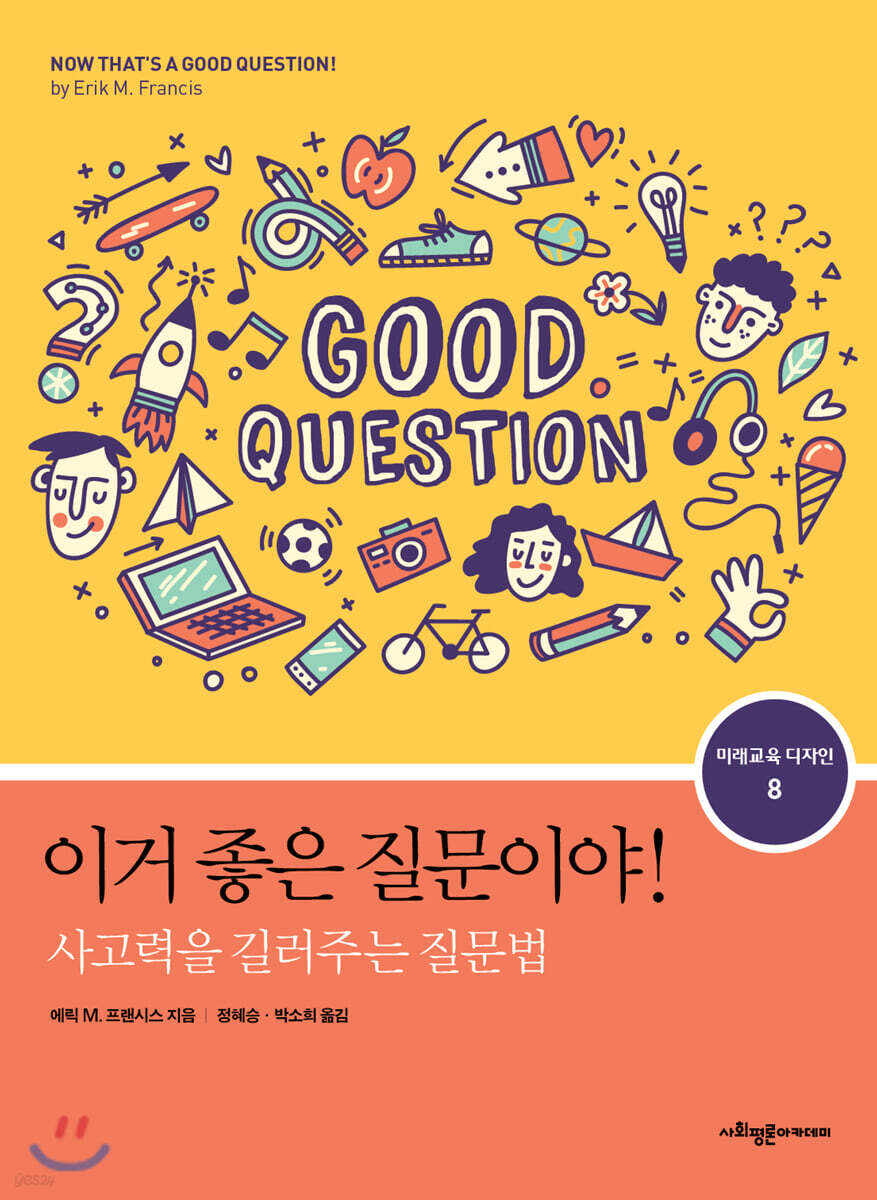
This is a good question!
 |
Description
Book Introduction
Teachers ask countless questions during class, yet they are not sure whether their questions are good enough to help students.
The reason why questions have been emphasized in education and learning is because when students ask questions, they develop the ability to think for themselves.
However, in actual classrooms, questions are asked simply to check whether students have memorized and understood the material.
This book tells you what makes a good question and how to create a good question.
The reason why questions have been emphasized in education and learning is because when students ask questions, they develop the ability to think for themselves.
However, in actual classrooms, questions are asked simply to check whether students have memorized and understood the material.
This book tells you what makes a good question and how to create a good question.
- You can preview some of the book's contents.
Preview
index
Translator's Preface 5
Acknowledgements 8
Introduction: What role do good questions play? 14
01 What are questions for developing critical thinking? 21
What is Rigor of Thought 25
How Asking Good Questions Can Promote Rigor in Thinking 35
How to Teach Using Questions to Promote Rigor in Thinking 38
Conclusion 39
Teacher Professional Development│Let's Create Good Questions from Learning Objectives 40
02 What Makes a Good Core Question? 42
What role does a good core question play? 44
How to Teach Using Good Key Questions 59
Conclusion 60
Teacher Professional Development│Let's Create Good Core Questions 61
03 How Good Factual Questions Lay the Foundation for Deeper Learning 63
What role do good factual questions play? 65
How to Teach Using Good Factual Questions 71
Conclusion 76
Teacher Professional Development│Let's Create Good Factual Questions 78
04 How Good Analytical Questions Deepen Knowledge and Thinking 80
What role does a good analytical question play? 82
How to Teach Using Good Analytical Questions 91
Conclusion 95
Teacher Professional Development│Let's Create Good Analytical Questions 97
05 How Good Reflective Questions Expand Knowledge and Thinking 100
What Role Do Good Reflective Questions Play? 102
How to Teach Using Good Reflective Questions 109
Conclusion 116
Teacher Professional Development│Let's Create Good Reflective Questions 117
06 How Good Hypothetical Questions Spark Curiosity and Creativity 118
What role does a good hypothetical question play? 120
How to Teach Using Good Hypothetical Questions 128
Conclusion 135
Teacher Professional Development│Let's Create Good Hypothetical Questions 136
07 How Good Argumentative Questions Handle Choices, Claims, and Controversies 138
What role does a good argumentative question play? 140
How to Teach Using Good Argumentative Questions 146
Conclusion 157
Teacher Professional Development│Let's Create Good Argumentative Questions 158
08 How Good Emotional Questions Support Differentiation and Personality 160
What role do good emotional questions play? 162
How to Teach Using Good Emotional Questions 171
Conclusion 179
Teacher Professional Development│Let's Create Good Emotional Questions 180
09 How Good Personal Questions Motivate Learning 182
What role do good personal questions play? 183
How to Teach Using Good Personal Questions 184
Conclusion 185
Teacher Professional Development│Let's Create Good Personal Questions 187
10 How Should Students Handle and Answer Good Questions? 188
How to Evaluate Student Response 188
How to Elicit Deep Responses from Students 191
Appendix A: Rigor of Thinking Questionnaire 196
Appendix B: Examples of Universal Core Questions 200
Appendix C: Example of a General Key Question 203
Appendix D: Argumentative Questions for Dealing with Difficult or Impossible Projects 211
Reference 213
Search 217
About the Author 224
Acknowledgements 8
Introduction: What role do good questions play? 14
01 What are questions for developing critical thinking? 21
What is Rigor of Thought 25
How Asking Good Questions Can Promote Rigor in Thinking 35
How to Teach Using Questions to Promote Rigor in Thinking 38
Conclusion 39
Teacher Professional Development│Let's Create Good Questions from Learning Objectives 40
02 What Makes a Good Core Question? 42
What role does a good core question play? 44
How to Teach Using Good Key Questions 59
Conclusion 60
Teacher Professional Development│Let's Create Good Core Questions 61
03 How Good Factual Questions Lay the Foundation for Deeper Learning 63
What role do good factual questions play? 65
How to Teach Using Good Factual Questions 71
Conclusion 76
Teacher Professional Development│Let's Create Good Factual Questions 78
04 How Good Analytical Questions Deepen Knowledge and Thinking 80
What role does a good analytical question play? 82
How to Teach Using Good Analytical Questions 91
Conclusion 95
Teacher Professional Development│Let's Create Good Analytical Questions 97
05 How Good Reflective Questions Expand Knowledge and Thinking 100
What Role Do Good Reflective Questions Play? 102
How to Teach Using Good Reflective Questions 109
Conclusion 116
Teacher Professional Development│Let's Create Good Reflective Questions 117
06 How Good Hypothetical Questions Spark Curiosity and Creativity 118
What role does a good hypothetical question play? 120
How to Teach Using Good Hypothetical Questions 128
Conclusion 135
Teacher Professional Development│Let's Create Good Hypothetical Questions 136
07 How Good Argumentative Questions Handle Choices, Claims, and Controversies 138
What role does a good argumentative question play? 140
How to Teach Using Good Argumentative Questions 146
Conclusion 157
Teacher Professional Development│Let's Create Good Argumentative Questions 158
08 How Good Emotional Questions Support Differentiation and Personality 160
What role do good emotional questions play? 162
How to Teach Using Good Emotional Questions 171
Conclusion 179
Teacher Professional Development│Let's Create Good Emotional Questions 180
09 How Good Personal Questions Motivate Learning 182
What role do good personal questions play? 183
How to Teach Using Good Personal Questions 184
Conclusion 185
Teacher Professional Development│Let's Create Good Personal Questions 187
10 How Should Students Handle and Answer Good Questions? 188
How to Evaluate Student Response 188
How to Elicit Deep Responses from Students 191
Appendix A: Rigor of Thinking Questionnaire 196
Appendix B: Examples of Universal Core Questions 200
Appendix C: Example of a General Key Question 203
Appendix D: Argumentative Questions for Dealing with Difficult or Impossible Projects 211
Reference 213
Search 217
About the Author 224
Publisher's Review
Questions that encourage students to explore and think for themselves.
That's a good question!
Questions that check a student's understanding and memorization are not necessarily "bad questions."
However, this book says that the questions should not stop here.
There is a hierarchy of educational goals and depth of thought.
Students must explore more than just accurately recognizing the concepts and knowledge they learn in class.
You should be able to apply your knowledge in a variety of contexts, explain why you used it, and broadly extend it to other situations or fields.
In this way, the questions that teachers ask students and the questions that students create must combine deep knowledge and high-level thinking.
Such questions are truly 'good questions' that develop students' thinking skills.
Good questions encourage students to move beyond binary yes/no thinking and explore their own answers.
It also encourages deeper thinking by requiring students to apply their knowledge to various problem situations encountered in real life.
Students become the subjects of their own learning as they embody new knowledge by finding answers to good questions and sharing it with their peers in their own unique way.
Develops deep thinking skills
8 Good Questions
The author, who has over 20 years of experience in the field of education, presents eight types of good questions based on educational theory and the achievement standards of actual curriculum: 'core questions, factual questions, analytical questions, reflective questions, hypothetical questions, argumentative questions, emotional questions, and personal questions.'
ㆍKey questions are useful for identifying and understanding key concepts, subject knowledge, and class topics.
ㆍFactual questions are questions that check whether you remember specific information and facts.
Factual questions allow students to accurately perceive detailed information about 'who, what, when, where'.
ㆍAnalytical questions require direct investigation of the intention, principles, and categories of an event or phenomenon.
As students answer analytical questions, they think beyond the specific knowledge itself and delve deeper into how and why that knowledge can be used.
ㆍReflective questions ask students about the meaning, relationships, and impact of the knowledge they have learned.
This question particularly emphasizes real-life context, encouraging students to explore how knowledge relates to their own lives.
ㆍHypothetical questions are questions that assume a 'what if' situation and are good for developing students' creativity.
Students must gather information to develop hypotheses and then test the validity of their thinking processes.
ㆍArgumentative questions address questions that allow for multiple perspectives, such as “Should Pluto be reclassified as a planet, or should it continue to be designated as an outer planet?”
Students will consider multiple perspectives on a particular issue and develop their own valid arguments.
ㆍEmotional questions ask about students' personal beliefs or values about a topic.
Students answering emotional questions must share their opinions clearly and coherently with their classmates.
ㆍPersonal questions ask students about what they have learned and what they would like to learn more about.
This question stimulates curiosity, an inherent curiosity that leads us to delve deeper into topics that interest us personally.
Good questions like these, which stimulate higher-order thinking and expand learning, motivate students and provide a new experience of self-directed learning.
Reflecting the achievement standards of the curriculum
Creating good, practical questions
This book covers eight types of good questions in depth, organized into individual chapters.
It is characterized by providing actual class scenarios rather than simply describing the definition of each type of good question, how to create it, and the changes in students.
It shows specific class scenes for various subjects such as Korean, social studies, math, science, and art, and provides a list of good questions for each as examples.
By following this scenario, you will be able to understand the concept and meaning of a good question more easily.
Another great strength of this book is that it shows the process of transforming the curriculum's achievement standards into good questions that fit the subject matter and materials of the unit the teacher wants to teach.
Although this book is based on the American curriculum, it is not difficult to create questions that can be applied to the domestic curriculum.
It will also be a practical guide for teachers who want to teach inquiry-based classes but feel burdened by the need to keep up with the curriculum and unit learning objectives.
That's a good question!
Questions that check a student's understanding and memorization are not necessarily "bad questions."
However, this book says that the questions should not stop here.
There is a hierarchy of educational goals and depth of thought.
Students must explore more than just accurately recognizing the concepts and knowledge they learn in class.
You should be able to apply your knowledge in a variety of contexts, explain why you used it, and broadly extend it to other situations or fields.
In this way, the questions that teachers ask students and the questions that students create must combine deep knowledge and high-level thinking.
Such questions are truly 'good questions' that develop students' thinking skills.
Good questions encourage students to move beyond binary yes/no thinking and explore their own answers.
It also encourages deeper thinking by requiring students to apply their knowledge to various problem situations encountered in real life.
Students become the subjects of their own learning as they embody new knowledge by finding answers to good questions and sharing it with their peers in their own unique way.
Develops deep thinking skills
8 Good Questions
The author, who has over 20 years of experience in the field of education, presents eight types of good questions based on educational theory and the achievement standards of actual curriculum: 'core questions, factual questions, analytical questions, reflective questions, hypothetical questions, argumentative questions, emotional questions, and personal questions.'
ㆍKey questions are useful for identifying and understanding key concepts, subject knowledge, and class topics.
ㆍFactual questions are questions that check whether you remember specific information and facts.
Factual questions allow students to accurately perceive detailed information about 'who, what, when, where'.
ㆍAnalytical questions require direct investigation of the intention, principles, and categories of an event or phenomenon.
As students answer analytical questions, they think beyond the specific knowledge itself and delve deeper into how and why that knowledge can be used.
ㆍReflective questions ask students about the meaning, relationships, and impact of the knowledge they have learned.
This question particularly emphasizes real-life context, encouraging students to explore how knowledge relates to their own lives.
ㆍHypothetical questions are questions that assume a 'what if' situation and are good for developing students' creativity.
Students must gather information to develop hypotheses and then test the validity of their thinking processes.
ㆍArgumentative questions address questions that allow for multiple perspectives, such as “Should Pluto be reclassified as a planet, or should it continue to be designated as an outer planet?”
Students will consider multiple perspectives on a particular issue and develop their own valid arguments.
ㆍEmotional questions ask about students' personal beliefs or values about a topic.
Students answering emotional questions must share their opinions clearly and coherently with their classmates.
ㆍPersonal questions ask students about what they have learned and what they would like to learn more about.
This question stimulates curiosity, an inherent curiosity that leads us to delve deeper into topics that interest us personally.
Good questions like these, which stimulate higher-order thinking and expand learning, motivate students and provide a new experience of self-directed learning.
Reflecting the achievement standards of the curriculum
Creating good, practical questions
This book covers eight types of good questions in depth, organized into individual chapters.
It is characterized by providing actual class scenarios rather than simply describing the definition of each type of good question, how to create it, and the changes in students.
It shows specific class scenes for various subjects such as Korean, social studies, math, science, and art, and provides a list of good questions for each as examples.
By following this scenario, you will be able to understand the concept and meaning of a good question more easily.
Another great strength of this book is that it shows the process of transforming the curriculum's achievement standards into good questions that fit the subject matter and materials of the unit the teacher wants to teach.
Although this book is based on the American curriculum, it is not difficult to create questions that can be applied to the domestic curriculum.
It will also be a practical guide for teachers who want to teach inquiry-based classes but feel burdened by the need to keep up with the curriculum and unit learning objectives.
GOODS SPECIFICS
- Publication date: November 9, 2020
- Page count, weight, size: 224 pages | 572g | 188*257*12mm
- ISBN13: 9791189946784
- ISBN10: 1189946785
You may also like
카테고리
korean


korean

![ELLE 엘르 스페셜 에디션 A형 : 12월 [2025]](http://librairie.coreenne.fr/cdn/shop/files/b8e27a3de6c9538896439686c6b0e8fb.jpg?v=1766436872&width=3840)


