

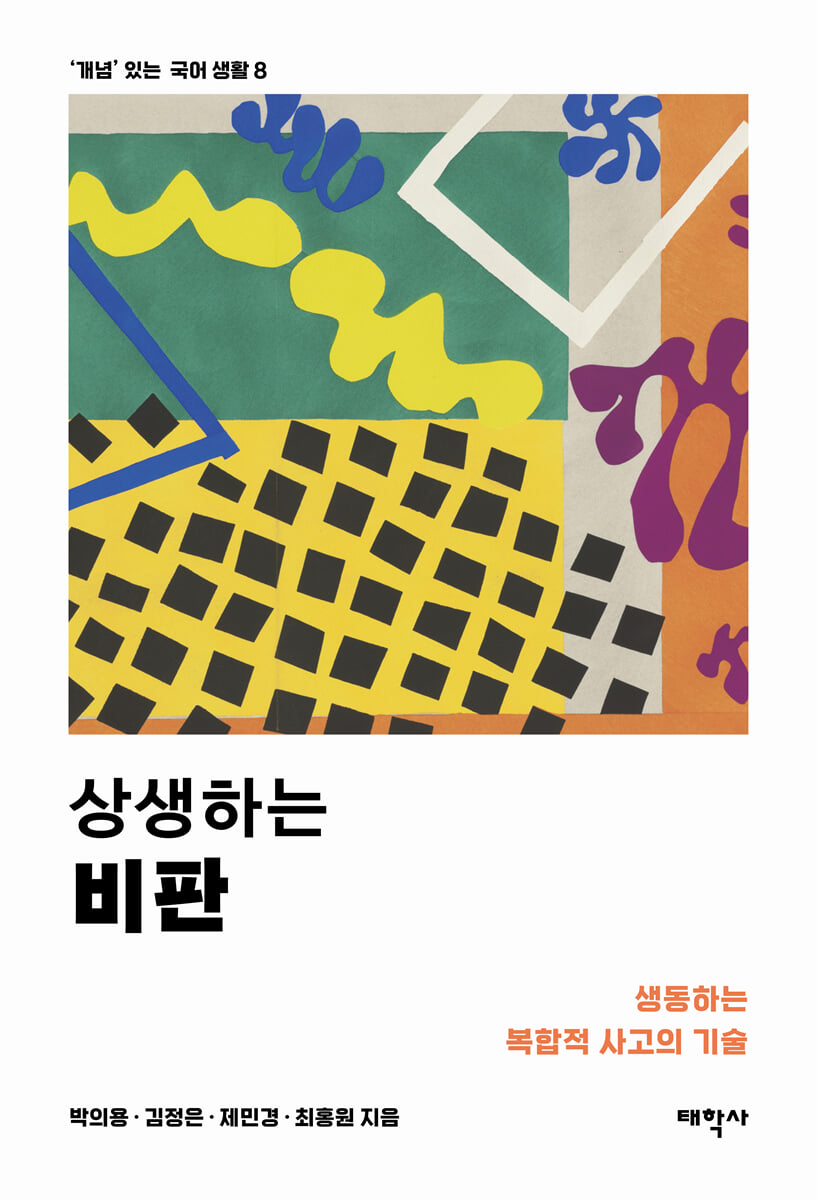
Symbiotic criticism
 |
Description
Book Introduction
A Teacher's Reference Book that Can Be Applied Immediately to Real-World Classes
A must-read for students that will improve their skills in all subjects, starting with Korean.
A Citizen's Guide to Social Life
The power of positivity and creation, not negativity and destruction,
The art of complex thinking that saves you and me
ㆍWhen criticizing Simcheong's actions, is it enough to just use logic?
ㆍCriticism breeds more criticism and brings about newness?
ㆍWhy are we so sensitive to ‘a single word’?
ㆍIs the object of criticism language or people?
ㆍWhy is distinguishing between facts and opinions a form of criticism?
The importance of 'critical thinking' education is greatly emphasized not only in education in general but also in Korean language education.
This book, "Symbiotic Criticism," was born from the desire to help Korean language education and its effective use in daily life by revisiting the concept of criticism.
Even in this age of data overflow and artificial intelligence doing most of our thinking, 'criticism' and 'critical thinking' remain important.
The ability that students and adults must first develop is not the accumulation and memorization of facts, but rather the critical thinking ability to proactively accept information for a specific purpose.
So then, what exactly is the nature of criticism?
In order for criticism to occur, there must first be a subject to criticize. Once the subject is given, the criticism is carried out by applying certain standards to the content that has been factually understood or supplemented through inference.
When criticism is made, the elements of the subject, purpose, object, and reference of criticism interact and work together.
The results of criticism may vary depending on the nature of the combination.
For this reason, the authors introduce criticism as a 'complex thinking skill' and 'living thinking'.
This book examines how such criticism manifests itself in various contexts of life and explores effective methods of criticism.
At first glance, criticism can seem negative and destructive.
But there is positivity and creativity in it.
By criticizing discrimination, we can expand our community by bringing those who are discriminated against into our society.
Criticism based on universal and inclusive values, consistent and appropriate standards, and a proper attitude of consideration for others can save us and our society.
A must-read for students that will improve their skills in all subjects, starting with Korean.
A Citizen's Guide to Social Life
The power of positivity and creation, not negativity and destruction,
The art of complex thinking that saves you and me
ㆍWhen criticizing Simcheong's actions, is it enough to just use logic?
ㆍCriticism breeds more criticism and brings about newness?
ㆍWhy are we so sensitive to ‘a single word’?
ㆍIs the object of criticism language or people?
ㆍWhy is distinguishing between facts and opinions a form of criticism?
The importance of 'critical thinking' education is greatly emphasized not only in education in general but also in Korean language education.
This book, "Symbiotic Criticism," was born from the desire to help Korean language education and its effective use in daily life by revisiting the concept of criticism.
Even in this age of data overflow and artificial intelligence doing most of our thinking, 'criticism' and 'critical thinking' remain important.
The ability that students and adults must first develop is not the accumulation and memorization of facts, but rather the critical thinking ability to proactively accept information for a specific purpose.
So then, what exactly is the nature of criticism?
In order for criticism to occur, there must first be a subject to criticize. Once the subject is given, the criticism is carried out by applying certain standards to the content that has been factually understood or supplemented through inference.
When criticism is made, the elements of the subject, purpose, object, and reference of criticism interact and work together.
The results of criticism may vary depending on the nature of the combination.
For this reason, the authors introduce criticism as a 'complex thinking skill' and 'living thinking'.
This book examines how such criticism manifests itself in various contexts of life and explores effective methods of criticism.
At first glance, criticism can seem negative and destructive.
But there is positivity and creativity in it.
By criticizing discrimination, we can expand our community by bringing those who are discriminated against into our society.
Criticism based on universal and inclusive values, consistent and appropriate standards, and a proper attitude of consideration for others can save us and our society.
- You can preview some of the book's contents.
Preview
index
A word from the "Conceptual Korean Language Life" project
preface
Class 1.
Why 'criticism'?
You're criticizing me?
Jeong Yak-yong and the Magpie Lord's Life
Criticism to reach the truth
To understand criticism
Class 2.
What is criticism and why is it needed?
The Many Colors of Criticism - What is Criticism?
Criticism and Logic - When criticizing Simcheong's actions, is logic enough? What else should be added?
Criticism and Critique - A historian's character assessment: is it criticism or critique?
Criticism and Creativity - Copernicus's Heliocentric Theory: Criticism Begets More Criticism and Brings Innovation?
Why Criticism Is Necessary? - The Painful Lessons of the Absence and Rejection of Criticism
Class 3.
What and how to criticize?
Why are we so sensitive to 'a single word'?
Is the object of criticism language or people?
Why is distinguishing between fact and opinion a criticism?
How do our society's prejudices appear in the media?
Are 'film criticism' and 'scientific criticism' the same criticism?
Class 4.
What does it take to be good at criticism?
Purpose and criteria of criticism
Validity? Reliability? Fairness? Appropriateness? And an optimized assessment tool.
Companions of Critical Thinking
Criticism that protects individuals, a society that encourages criticism
Note
References
preface
Class 1.
Why 'criticism'?
You're criticizing me?
Jeong Yak-yong and the Magpie Lord's Life
Criticism to reach the truth
To understand criticism
Class 2.
What is criticism and why is it needed?
The Many Colors of Criticism - What is Criticism?
Criticism and Logic - When criticizing Simcheong's actions, is logic enough? What else should be added?
Criticism and Critique - A historian's character assessment: is it criticism or critique?
Criticism and Creativity - Copernicus's Heliocentric Theory: Criticism Begets More Criticism and Brings Innovation?
Why Criticism Is Necessary? - The Painful Lessons of the Absence and Rejection of Criticism
Class 3.
What and how to criticize?
Why are we so sensitive to 'a single word'?
Is the object of criticism language or people?
Why is distinguishing between fact and opinion a criticism?
How do our society's prejudices appear in the media?
Are 'film criticism' and 'scientific criticism' the same criticism?
Class 4.
What does it take to be good at criticism?
Purpose and criteria of criticism
Validity? Reliability? Fairness? Appropriateness? And an optimized assessment tool.
Companions of Critical Thinking
Criticism that protects individuals, a society that encourages criticism
Note
References
Detailed image
Publisher's Review
From 'Understanding Criticism'
'How to criticize well'
Chapter 1 begins with the question, "Why criticize?" and examines why humans instinctively desire praise but fear criticism.
Through the anecdote of Jeong Yak-yong being exiled for telling the truth that was unfavorable to those in power and the example of a person like Magpie Lord who only says good things, it shows the reality that criticism works against those in power.
However, the authors emphasize that criticism is an act of perception aimed at understanding the subject as it is and approaching the truth.
Citing the discussions of Kant and Hegel, he argues that critical thinking from various perspectives, even within the imperfection of language, enables an understanding closer to reality.
Ultimately, criticism is not denial, but a process of reaching the truth, and it reminds us that it is a power that must be cultivated for correct knowledge and growth between the 'world of power' and the 'world of truth.'
Chapter 2 explores the nature and role of criticism specifically, focusing on the question, “What is criticism and why is it necessary?”
Criticism is not simply condemnation; it is a reflective thought process, a cognitive activity of analysis, evaluation, inference, and synthesis, aimed at rationally determining beliefs and actions.
Through the example of "Simcheongjeon," it is emphasized that criticism requires not only logic but also contextual judgment, and it explains that appreciation of literary works also expands into a critical act.
Next, through the etymology of criticism and critique, it explains that the two concepts share a common foundation of 'identification, judgment, and evaluation', and by presenting the relationship between criticism and creativity through Copernicus' heliocentric theory, it shows that a new paradigm originates from criticism.
Finally, he points out the tragedy caused by the absence of criticism through the Bay of Pigs invasion and the Challenger explosion, and reminds us that true criticism is “the courage to say ‘yes!’ when everyone else says no.”
Chapter 3 presents practical examples of criticism in various areas of Korean language education, including vocabulary, grammar, reading, and media.
Critical language sensitivity toward language of discrimination and hatred, critique of the social power contained in honorific expressions in the Korean language, education in critical thinking through the distinction between fact and opinion, a critical understanding of bias in the media, and critiques expressed in film, social science, and natural science are presented.
The authors critique the power and distinction inherent in language through Bourdieu's concept of 'habitus', presenting examples such as the 'stroller' and 'baby carriage' debate, generational differences in perception of gender-based language, and online hate speech.
It also analyzes the social power issues surrounding honorific expressions like “Your Americano is ready,” and reveals that language criticism is in fact social criticism.
Finally, it emphasizes that critical literacy, the ability to distinguish between fact and opinion, and the ability to discern the reliability of information in the age of artificial intelligence, are at the heart of true criticism.
Chapter 4 presents the purpose and criteria of criticism, as well as specific methods for practicing critical thinking, under the question, “What is needed to be good at criticism?”
Criticism is an act of discerning truth and contributing to creative problem-solving. Therefore, its purpose must first be clearly recognized. It explains that law, morality, values, and perspectives serve as the standards for criticism, while validity, reliability, fairness, and appropriateness are universal evaluation criteria.
And they say that assessment tools that utilize these criteria promote systematic thinking and, when combined with factual and inferential thinking, lead to creative thinking.
He also says that criticism is a means of self-protection and growth, and the foundation of social development, and that its power is demonstrated when it is considered for others with an attitude of coexistence rather than condemnation.
The authors emphasize that our society can become more democratic and healthy through institutions and reward systems that encourage critical thinking.
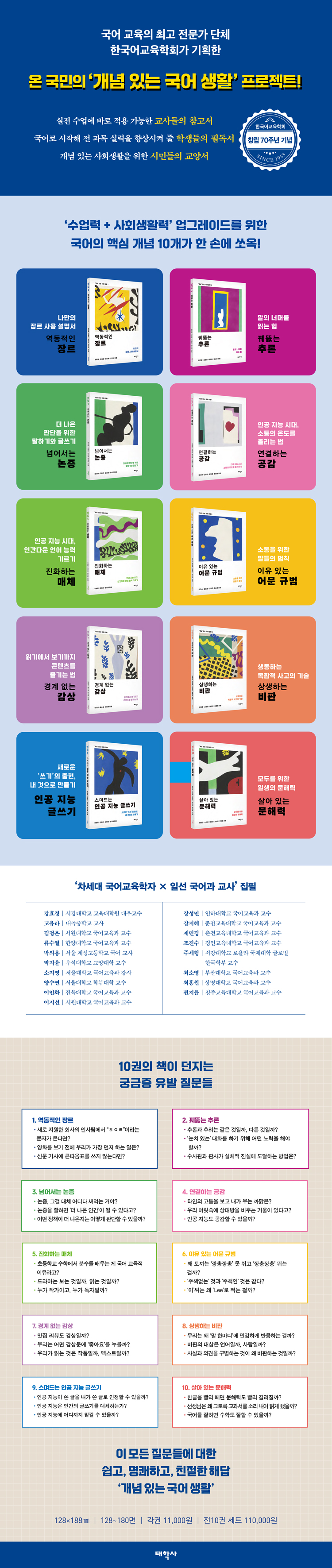
Korean Language Life with 'Concepts' (10 Volumes, Part 1)
"Conceptual Korean Language Life" is a publication by the Korean Language Education Society, Korea's first, best, and largest academic organization. To celebrate its 70th anniversary (launched as the "Korean Language Education Research Society" in 1955), the Society selects and publishes 20 of the most important "concepts" in Korean language education to summarize its academic achievements to date. The publication plan is to begin with the first 10 volumes in 2025, with the remaining 10 volumes to be completed in 2026.
This series was centered around the next generation of Korean language education scholars who will lead the Korean language education field and teachers who are leading the Korean language education field. It was planned with the goal of providing practical help not only to teachers and students in school education, but also to contribute to the language life of ordinary citizens by writing easy-to-understand content on the 'concepts' that are important in Korean language education.
'How to criticize well'
Chapter 1 begins with the question, "Why criticize?" and examines why humans instinctively desire praise but fear criticism.
Through the anecdote of Jeong Yak-yong being exiled for telling the truth that was unfavorable to those in power and the example of a person like Magpie Lord who only says good things, it shows the reality that criticism works against those in power.
However, the authors emphasize that criticism is an act of perception aimed at understanding the subject as it is and approaching the truth.
Citing the discussions of Kant and Hegel, he argues that critical thinking from various perspectives, even within the imperfection of language, enables an understanding closer to reality.
Ultimately, criticism is not denial, but a process of reaching the truth, and it reminds us that it is a power that must be cultivated for correct knowledge and growth between the 'world of power' and the 'world of truth.'
Chapter 2 explores the nature and role of criticism specifically, focusing on the question, “What is criticism and why is it necessary?”
Criticism is not simply condemnation; it is a reflective thought process, a cognitive activity of analysis, evaluation, inference, and synthesis, aimed at rationally determining beliefs and actions.
Through the example of "Simcheongjeon," it is emphasized that criticism requires not only logic but also contextual judgment, and it explains that appreciation of literary works also expands into a critical act.
Next, through the etymology of criticism and critique, it explains that the two concepts share a common foundation of 'identification, judgment, and evaluation', and by presenting the relationship between criticism and creativity through Copernicus' heliocentric theory, it shows that a new paradigm originates from criticism.
Finally, he points out the tragedy caused by the absence of criticism through the Bay of Pigs invasion and the Challenger explosion, and reminds us that true criticism is “the courage to say ‘yes!’ when everyone else says no.”
Chapter 3 presents practical examples of criticism in various areas of Korean language education, including vocabulary, grammar, reading, and media.
Critical language sensitivity toward language of discrimination and hatred, critique of the social power contained in honorific expressions in the Korean language, education in critical thinking through the distinction between fact and opinion, a critical understanding of bias in the media, and critiques expressed in film, social science, and natural science are presented.
The authors critique the power and distinction inherent in language through Bourdieu's concept of 'habitus', presenting examples such as the 'stroller' and 'baby carriage' debate, generational differences in perception of gender-based language, and online hate speech.
It also analyzes the social power issues surrounding honorific expressions like “Your Americano is ready,” and reveals that language criticism is in fact social criticism.
Finally, it emphasizes that critical literacy, the ability to distinguish between fact and opinion, and the ability to discern the reliability of information in the age of artificial intelligence, are at the heart of true criticism.
Chapter 4 presents the purpose and criteria of criticism, as well as specific methods for practicing critical thinking, under the question, “What is needed to be good at criticism?”
Criticism is an act of discerning truth and contributing to creative problem-solving. Therefore, its purpose must first be clearly recognized. It explains that law, morality, values, and perspectives serve as the standards for criticism, while validity, reliability, fairness, and appropriateness are universal evaluation criteria.
And they say that assessment tools that utilize these criteria promote systematic thinking and, when combined with factual and inferential thinking, lead to creative thinking.
He also says that criticism is a means of self-protection and growth, and the foundation of social development, and that its power is demonstrated when it is considered for others with an attitude of coexistence rather than condemnation.
The authors emphasize that our society can become more democratic and healthy through institutions and reward systems that encourage critical thinking.
Korean Language Life with 'Concepts' (10 Volumes, Part 1)
"Conceptual Korean Language Life" is a publication by the Korean Language Education Society, Korea's first, best, and largest academic organization. To celebrate its 70th anniversary (launched as the "Korean Language Education Research Society" in 1955), the Society selects and publishes 20 of the most important "concepts" in Korean language education to summarize its academic achievements to date. The publication plan is to begin with the first 10 volumes in 2025, with the remaining 10 volumes to be completed in 2026.
This series was centered around the next generation of Korean language education scholars who will lead the Korean language education field and teachers who are leading the Korean language education field. It was planned with the goal of providing practical help not only to teachers and students in school education, but also to contribute to the language life of ordinary citizens by writing easy-to-understand content on the 'concepts' that are important in Korean language education.
GOODS SPECIFICS
- Date of issue: October 18, 2025
- Page count, weight, size: 160 pages | 128*188*20mm
- ISBN13: 9791168103856
- ISBN10: 1168103851
You may also like
카테고리
korean


korean

![GQ KOREA Mark (Monthly): December [2025]](http://librairie.coreenne.fr/cdn/shop/files/8ef265dbbfbf186523ed75ba7319009d.jpg?v=1765340328&width=3840)


