

dynamic genre
 |
Description
Book Introduction
A Teacher's Reference Book that Can Be Applied Immediately to Real-World Classes
A must-read for students that will improve their skills in all subjects, starting with Korean.
A Citizen's Guide to Social Life
If you know the 'genre', you can see it too,
Everything you experience is different!
What if you receive a text message saying “ㅎㅇㅌ” from the HR department of the company you’re newly applying to?
What is the first thing we do before watching a movie?
Why are the same expressions read with different meanings?
?What if you don't use quotation marks in newspaper articles?
What does it mean to be good at a genre?
The ‘genre’ we learned in Korean class.
What use is knowing genre in life? The "genre" we learned in school was the standard by which literary works were classified and categorized.
It was a strange and difficult word like lyricism, narrative, drama, or teaching, and rather than something to be understood and acquired like hyangga, gyeonggijega, sijo, or gasa, it was something to be memorized.
Is it really important or necessary to live by knowing about a 'genre' that exists as such an uncomfortable memory?
But as the title of this book, “Dynamic Genres,” suggests, genres are more than we know.
There is nothing in our language life that is not a genre.
It has already entered deeply into our daily lives, so what we encounter every day is genre, and genre is present in every linguistic expression we see before our eyes.
Genres exist and function in short advertisements, social media, and even in the medication instructions and precautions on medicine packets.
Genre is a ‘form of life’ and a ‘framework for social action.’
A genre is a set of social behaviors that are typified and established as customs in repetitive situations.
This book examines what genres we encounter in the context of language, society, and works, and how they function.
It also reveals that these genres are closely connected to our lives, transcending language, society, and works.
Our language life always takes place within certain expectations and predictions.
That's why knowing the genre is no different from knowing when, where, why, and how to act.
So the authors say, “Knowing the genre not only helps you improve your language skills, but it can also change what you see and experience.”
A must-read for students that will improve their skills in all subjects, starting with Korean.
A Citizen's Guide to Social Life
If you know the 'genre', you can see it too,
Everything you experience is different!
What if you receive a text message saying “ㅎㅇㅌ” from the HR department of the company you’re newly applying to?
What is the first thing we do before watching a movie?
Why are the same expressions read with different meanings?
?What if you don't use quotation marks in newspaper articles?
What does it mean to be good at a genre?
The ‘genre’ we learned in Korean class.
What use is knowing genre in life? The "genre" we learned in school was the standard by which literary works were classified and categorized.
It was a strange and difficult word like lyricism, narrative, drama, or teaching, and rather than something to be understood and acquired like hyangga, gyeonggijega, sijo, or gasa, it was something to be memorized.
Is it really important or necessary to live by knowing about a 'genre' that exists as such an uncomfortable memory?
But as the title of this book, “Dynamic Genres,” suggests, genres are more than we know.
There is nothing in our language life that is not a genre.
It has already entered deeply into our daily lives, so what we encounter every day is genre, and genre is present in every linguistic expression we see before our eyes.
Genres exist and function in short advertisements, social media, and even in the medication instructions and precautions on medicine packets.
Genre is a ‘form of life’ and a ‘framework for social action.’
A genre is a set of social behaviors that are typified and established as customs in repetitive situations.
This book examines what genres we encounter in the context of language, society, and works, and how they function.
It also reveals that these genres are closely connected to our lives, transcending language, society, and works.
Our language life always takes place within certain expectations and predictions.
That's why knowing the genre is no different from knowing when, where, why, and how to act.
So the authors say, “Knowing the genre not only helps you improve your language skills, but it can also change what you see and experience.”
- You can preview some of the book's contents.
Preview
index
A word from the 'Conceptual Korean Language Life' project
preface
Class 1.
Before using - Why is it important to know the genre?
Why We Focus on Genre
The Beginning of Successful Communication in the Right Situation
What if you get a text message saying “ㅎㅇㅌ” from the HR department of the company you’re applying to?
What's the first thing we do before watching a movie?
Why do the same expressions have different meanings?
How would you define the genre in one word?
Is Kim Dong-hwan's "Night at the Border" a poem?
Will the genre evolve?
Class 2.
How Genres Work - How Do They Connect to Our Lives?
How language meets genre - do grammatical choices vary across genres?
Why soccer broadcasts use short, simple sentences
The text in the board game manual is special.
What if you don't use quotation marks in newspaper articles?
How does society interact with genre? What does it mean to do a genre well?
What does it mean for us to 'do' a genre?
Genre is a social chain reaction
How to 'do' a genre well
How does a work meet its genre? Does knowing the genre change the fun and excitement?
Genre, a passage to encounter works
Where should the “Bongsan Talchum” be?
There's a hidden genre in "My Mangmaega" too.
The power of a genre that transcends time and space: "Your Silence," a remake of "Je Mang Mae Ga."
Class 3.
Things to keep in mind when using genres - Can I become a genre 'user' too?
Does the genre feel different depending on the language choice?
Between subjectivity and objectivity, between spoken and written language
The relationship between genre and language
In this rapidly changing era, what will genres look like?
Could this also be poetry?
Challenges to the genre and the evolving genre
How to Be a Good Genre User
Going beyond genres
Becoming the subject of genre usage
Note
References
preface
Class 1.
Before using - Why is it important to know the genre?
Why We Focus on Genre
The Beginning of Successful Communication in the Right Situation
What if you get a text message saying “ㅎㅇㅌ” from the HR department of the company you’re applying to?
What's the first thing we do before watching a movie?
Why do the same expressions have different meanings?
How would you define the genre in one word?
Is Kim Dong-hwan's "Night at the Border" a poem?
Will the genre evolve?
Class 2.
How Genres Work - How Do They Connect to Our Lives?
How language meets genre - do grammatical choices vary across genres?
Why soccer broadcasts use short, simple sentences
The text in the board game manual is special.
What if you don't use quotation marks in newspaper articles?
How does society interact with genre? What does it mean to do a genre well?
What does it mean for us to 'do' a genre?
Genre is a social chain reaction
How to 'do' a genre well
How does a work meet its genre? Does knowing the genre change the fun and excitement?
Genre, a passage to encounter works
Where should the “Bongsan Talchum” be?
There's a hidden genre in "My Mangmaega" too.
The power of a genre that transcends time and space: "Your Silence," a remake of "Je Mang Mae Ga."
Class 3.
Things to keep in mind when using genres - Can I become a genre 'user' too?
Does the genre feel different depending on the language choice?
Between subjectivity and objectivity, between spoken and written language
The relationship between genre and language
In this rapidly changing era, what will genres look like?
Could this also be poetry?
Challenges to the genre and the evolving genre
How to Be a Good Genre User
Going beyond genres
Becoming the subject of genre usage
Note
References
Detailed image
Publisher's Review
From 'Why is genre important?'
Up to 'Things to keep in mind when using genres'
Chapter 1 explains why we need to pay attention to genre now, and then explains, using specific examples, that knowing genre and acting accordingly is the beginning of successful communication appropriate to the situation.
The authors explain that a genre is “a phenomenon in which the linguistic responses of a language community are similar in repetitive similar situations, and thus people come to expect a certain linguistic response in a particular situation.”
Furthermore, it explains that genres are not fixed forms but rather dynamic, and that they are fused, transformed, created anew, and sometimes even disappear by members of society.
Chapter 2 explains how language, society, and works interact with genre.
First, we explain the short, simple sentences used in soccer broadcasts, the unique sentences in board game instructions, and the use of quotation marks in newspaper articles, emphasizing that grammatical choices vary depending on the genre, and that understanding the relationship between genre and language requires being able to analyze genre.
Next, the authors explain the context in which sentences of various genres are created through the format of invitations, petitions on the presidential office's national petition bulletin board, people's 'one-line movie reviews' posted on the Internet, and product descriptions from sellers on social media. The authors say that the way to 'do' a genre well is to analyze, criticize, and transform the genre to see what kind of social image or ideology it reflects.
Lastly, the true value of "Bongsan Talchum," which we learned as a text in Korean class, can only be appreciated when approached as a genre of mask dance that combines mask, dance, music, and audience. Furthermore, the author's sadness, fear, and sense of impermanence can only be fully felt when appreciating "Jemangmaega," which is a three-part structure of a ten-verse hyangga.
Genre also explains how literature is created by moving across time and space, and between works.
Chapter 3 explains how the genre feel changes depending on the choice of language through sentences used in local government promotional materials, and examines what genre looks like in a rapidly changing era through the poetry of Oh Gyu-won and Hwang Ji-woo. Through this, the authors emphasize that genre is not fixed, but constantly changing and evolving.
This constant change and evolution of the genre can be seen in things like the use of internet memes in dissertations or the groundbreaking promotional phrases used on local festival posters that capture the public's attention. The authors emphasize that to 'do' a genre well, it is essential to go beyond having an awareness of the genre and to have the ability to respond creatively and actively to the genre.
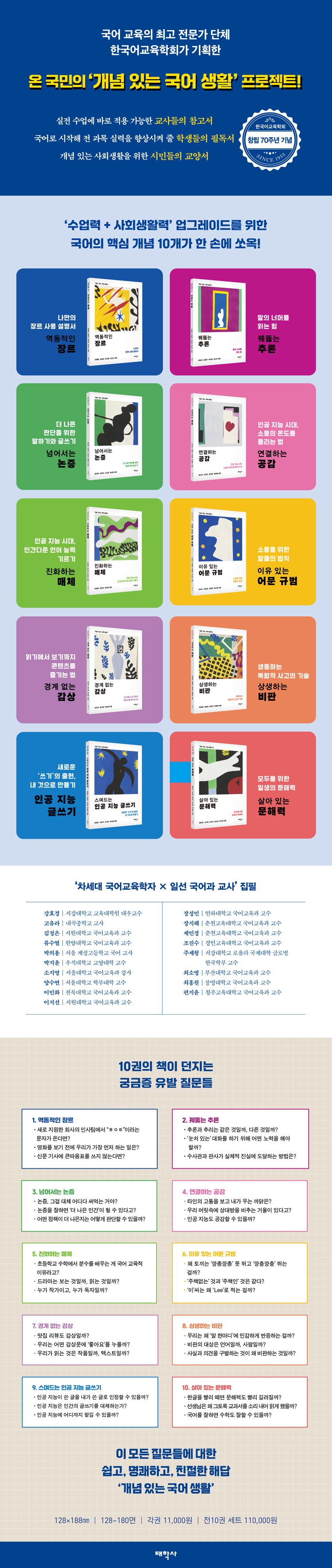
Korean Language Life with 'Concepts' (10 Volumes, Part 1)
"Conceptual Korean Language Life" is a publication by the Korean Language Education Society, Korea's first, best, and largest academic organization. To celebrate its 70th anniversary (launched as the "Korean Language Education Research Society" in 1955), the Society selects and publishes 20 of the most important "concepts" in Korean language education to summarize its academic achievements to date. The publication plan is to begin with the first 10 volumes in 2025, with the remaining 10 volumes to be completed in 2026.
This series was centered around the next generation of Korean language education scholars who will lead the Korean language education field and teachers who are leading the Korean language education field. It was planned with the goal of providing practical help not only to teachers and students in school education, but also to contribute to the language life of ordinary citizens by writing easy-to-understand content on the 'concepts' that are important in Korean language education.
Up to 'Things to keep in mind when using genres'
Chapter 1 explains why we need to pay attention to genre now, and then explains, using specific examples, that knowing genre and acting accordingly is the beginning of successful communication appropriate to the situation.
The authors explain that a genre is “a phenomenon in which the linguistic responses of a language community are similar in repetitive similar situations, and thus people come to expect a certain linguistic response in a particular situation.”
Furthermore, it explains that genres are not fixed forms but rather dynamic, and that they are fused, transformed, created anew, and sometimes even disappear by members of society.
Chapter 2 explains how language, society, and works interact with genre.
First, we explain the short, simple sentences used in soccer broadcasts, the unique sentences in board game instructions, and the use of quotation marks in newspaper articles, emphasizing that grammatical choices vary depending on the genre, and that understanding the relationship between genre and language requires being able to analyze genre.
Next, the authors explain the context in which sentences of various genres are created through the format of invitations, petitions on the presidential office's national petition bulletin board, people's 'one-line movie reviews' posted on the Internet, and product descriptions from sellers on social media. The authors say that the way to 'do' a genre well is to analyze, criticize, and transform the genre to see what kind of social image or ideology it reflects.
Lastly, the true value of "Bongsan Talchum," which we learned as a text in Korean class, can only be appreciated when approached as a genre of mask dance that combines mask, dance, music, and audience. Furthermore, the author's sadness, fear, and sense of impermanence can only be fully felt when appreciating "Jemangmaega," which is a three-part structure of a ten-verse hyangga.
Genre also explains how literature is created by moving across time and space, and between works.
Chapter 3 explains how the genre feel changes depending on the choice of language through sentences used in local government promotional materials, and examines what genre looks like in a rapidly changing era through the poetry of Oh Gyu-won and Hwang Ji-woo. Through this, the authors emphasize that genre is not fixed, but constantly changing and evolving.
This constant change and evolution of the genre can be seen in things like the use of internet memes in dissertations or the groundbreaking promotional phrases used on local festival posters that capture the public's attention. The authors emphasize that to 'do' a genre well, it is essential to go beyond having an awareness of the genre and to have the ability to respond creatively and actively to the genre.
Korean Language Life with 'Concepts' (10 Volumes, Part 1)
"Conceptual Korean Language Life" is a publication by the Korean Language Education Society, Korea's first, best, and largest academic organization. To celebrate its 70th anniversary (launched as the "Korean Language Education Research Society" in 1955), the Society selects and publishes 20 of the most important "concepts" in Korean language education to summarize its academic achievements to date. The publication plan is to begin with the first 10 volumes in 2025, with the remaining 10 volumes to be completed in 2026.
This series was centered around the next generation of Korean language education scholars who will lead the Korean language education field and teachers who are leading the Korean language education field. It was planned with the goal of providing practical help not only to teachers and students in school education, but also to contribute to the language life of ordinary citizens by writing easy-to-understand content on the 'concepts' that are important in Korean language education.
GOODS SPECIFICS
- Date of issue: October 18, 2025
- Page count, weight, size: 136 pages | 128*188mm
- ISBN13: 9791168103801
- ISBN10: 1168103800
You may also like
카테고리
korean


korean

![GQ KOREA Mark (Monthly): December [2025]](http://librairie.coreenne.fr/cdn/shop/files/8ef265dbbfbf186523ed75ba7319009d.jpg?v=1765340328&width=3840)


