

Our children's daily conversations, learned step by step
 |
Description
Book Introduction
Speech therapy experts share tips for everyday speaking practice for your child!
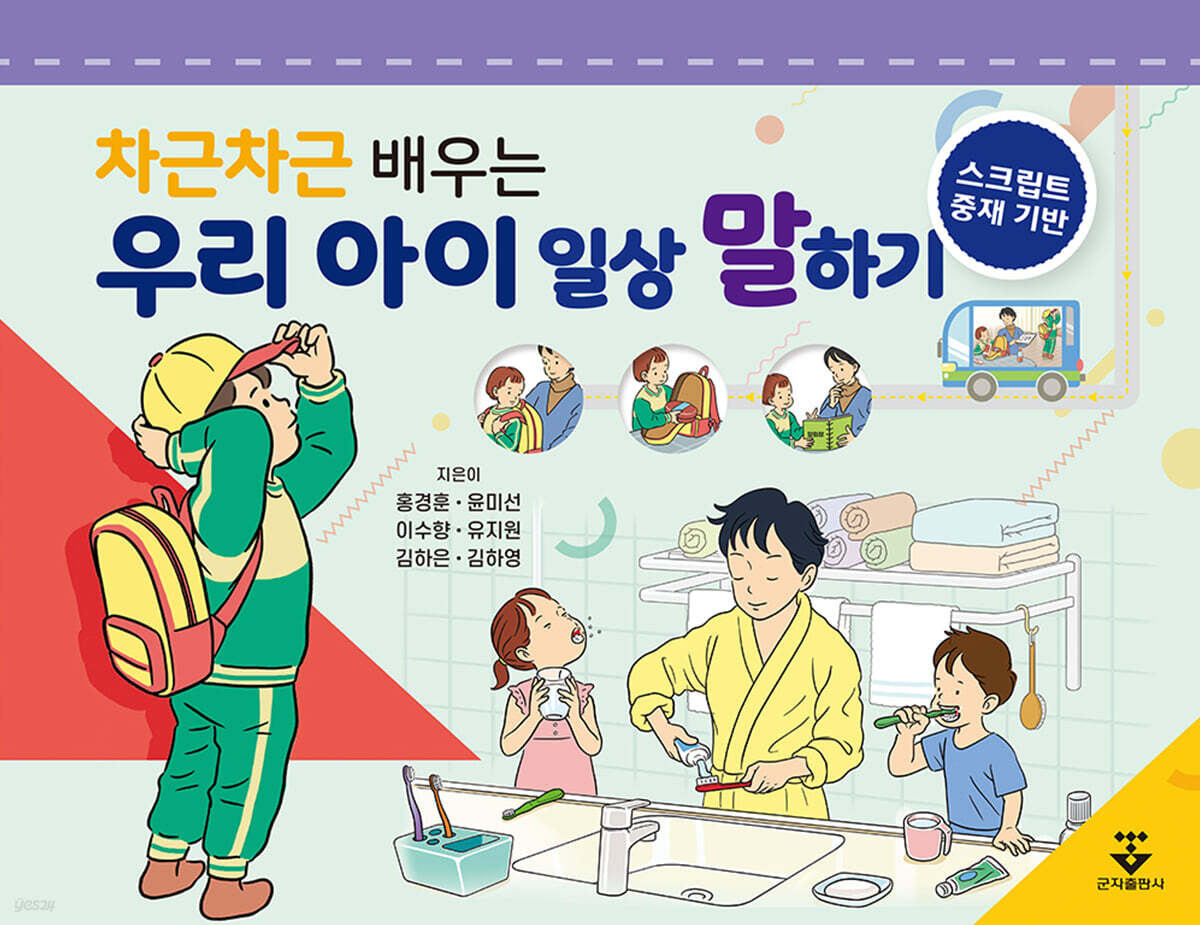
"My Child's Daily Speech: Learning Step by Step" is a book written by speech therapists who have compiled the essential steps for each common situation, the main procedures suggested in the kindergarten curriculum, consultations with daycare centers, kindergarten teachers, and speech therapists, and online research to ensure that it includes the essential procedures that children aged 3 to 6 should acquire.
All scripts are divided into nine levels according to the target language form, and the target language form is presented in four levels: one-word sentences, two-word sentences, multi-word sentences including particles, and conversational form.
A script is defined as a knowledge structure, a mental representation, of a sequence of events that unfold sequentially in a specific situation or context, which can improve a child's everyday language.
The structure of a script that helps children understand has wholeness, coherence, continuity, and causality.
For example, in the case of washing one's face, each sub-action (soaping, rinsing, etc.) is sequentially connected to one another, has a causal relationship, and creates an interconnected whole (washing one's face).
Additionally, scripts contain components such as actors, actions, and props.
In the case of a widely cited restaurant script, there are actors such as people eating and waiters, actions the actors perform such as ordering, eating, and bringing, and props such as menus and tables.
Research has shown that scripts, which are well-organized scripts based on experiences about events, promote language development in young children. In addition, in interactions with their mothers, children increase their vocabulary, verb use, and MLU in familiar event contexts compared to when they do not.
Check out how your child's language skills improve every day with "My Child's Daily Speaking: Learning Step by Step"!
"My Child's Daily Speech: Learning Step by Step" is a book written by speech therapists who have compiled the essential steps for each common situation, the main procedures suggested in the kindergarten curriculum, consultations with daycare centers, kindergarten teachers, and speech therapists, and online research to ensure that it includes the essential procedures that children aged 3 to 6 should acquire.
All scripts are divided into nine levels according to the target language form, and the target language form is presented in four levels: one-word sentences, two-word sentences, multi-word sentences including particles, and conversational form.
A script is defined as a knowledge structure, a mental representation, of a sequence of events that unfold sequentially in a specific situation or context, which can improve a child's everyday language.
The structure of a script that helps children understand has wholeness, coherence, continuity, and causality.
For example, in the case of washing one's face, each sub-action (soaping, rinsing, etc.) is sequentially connected to one another, has a causal relationship, and creates an interconnected whole (washing one's face).
Additionally, scripts contain components such as actors, actions, and props.
In the case of a widely cited restaurant script, there are actors such as people eating and waiters, actions the actors perform such as ordering, eating, and bringing, and props such as menus and tables.
Research has shown that scripts, which are well-organized scripts based on experiences about events, promote language development in young children. In addition, in interactions with their mothers, children increase their vocabulary, verb use, and MLU in familiar event contexts compared to when they do not.
Check out how your child's language skills improve every day with "My Child's Daily Speaking: Learning Step by Step"!
index
I.
family life
3~4 years old
- Eating 2
- Drinking milk 6
- Eat cereal 10
- Brushing teeth 14
- Wash your hair 1 8
- Dressing (Winter) 22
- Pooping 26
5~6 years old
- Take medicine 30
- Bathing 34
- Cleaning the room 38
- Order pizza delivery 42
- Washing the dishes 46
- Using the microwave 50
- Using the washing machine 54
II.
Education and social life
3~4 years old
- Going to school by bus 60
- Getting to school by car (arrival) 64
- Going to school after the picnic 68
- Preparing for a Picnic 72
- Daycare nap 76
- Eating snacks at daycare 80
- Daycare Book Reading 84
- Paper cutting and pasting 88
- Paint Stamping 92
- Playing in the sand 96
- Birthday Party 100
5~6 years old
- Eating Kindergarten Snacks 104
- Eating a picnic lunch 108
- Making a Sandwich 112
- Coloring with watercolors 116
- Clay Making 120
- Playing the xylophone 124
- Play Kitchen with Friends 128
- Going down the slide with friends 132
- Planting Seeds 136
III.
Leisure culture and community life
3~4 years old
- Get an injection 142
- Using a public restroom 146
- Using the elevator 150
- Buy bread 154
- Buy ice cream 158
- Decorating a Christmas Tree 162
5~6 years old
- Buy a hamburger 166
- Using the vending machine 170
- Using a restaurant water purifier 174
- Bus Ride 178
- Cycling 182
- Playground Swing Ride 186
- Crossing the crosswalk 190
- Using the Library 194
- Using the restaurant 198
- Using the swimming pool 202
family life
3~4 years old
- Eating 2
- Drinking milk 6
- Eat cereal 10
- Brushing teeth 14
- Wash your hair 1 8
- Dressing (Winter) 22
- Pooping 26
5~6 years old
- Take medicine 30
- Bathing 34
- Cleaning the room 38
- Order pizza delivery 42
- Washing the dishes 46
- Using the microwave 50
- Using the washing machine 54
II.
Education and social life
3~4 years old
- Going to school by bus 60
- Getting to school by car (arrival) 64
- Going to school after the picnic 68
- Preparing for a Picnic 72
- Daycare nap 76
- Eating snacks at daycare 80
- Daycare Book Reading 84
- Paper cutting and pasting 88
- Paint Stamping 92
- Playing in the sand 96
- Birthday Party 100
5~6 years old
- Eating Kindergarten Snacks 104
- Eating a picnic lunch 108
- Making a Sandwich 112
- Coloring with watercolors 116
- Clay Making 120
- Playing the xylophone 124
- Play Kitchen with Friends 128
- Going down the slide with friends 132
- Planting Seeds 136
III.
Leisure culture and community life
3~4 years old
- Get an injection 142
- Using a public restroom 146
- Using the elevator 150
- Buy bread 154
- Buy ice cream 158
- Decorating a Christmas Tree 162
5~6 years old
- Buy a hamburger 166
- Using the vending machine 170
- Using a restaurant water purifier 174
- Bus Ride 178
- Cycling 182
- Playground Swing Ride 186
- Crossing the crosswalk 190
- Using the Library 194
- Using the restaurant 198
- Using the swimming pool 202
Detailed image

GOODS SPECIFICS
- Date of issue: February 16, 2023
- Format: Springbook book binding method guide
- Page count, weight, size: 220 pages | 275*212*20mm
- ISBN13: 9791159559518
- ISBN10: 1159559511
You may also like
카테고리
korean


korean

![ELLE 엘르 스페셜 에디션 A형 : 12월 [2025]](http://librairie.coreenne.fr/cdn/shop/files/b8e27a3de6c9538896439686c6b0e8fb.jpg?v=1766436872&width=3840)


