

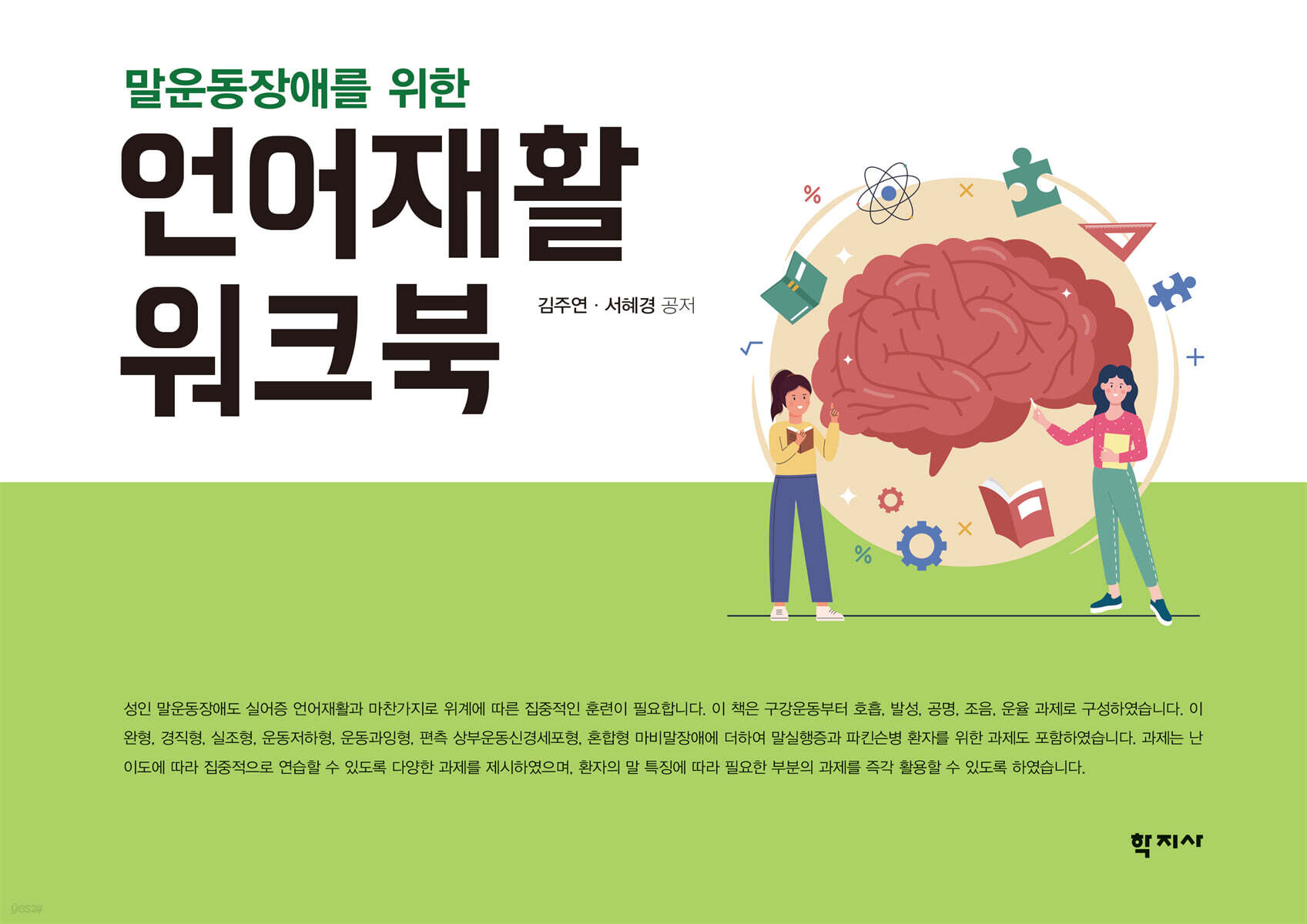
Language Rehabilitation Workbook for Speech Disorders
 |
Description
Book Introduction
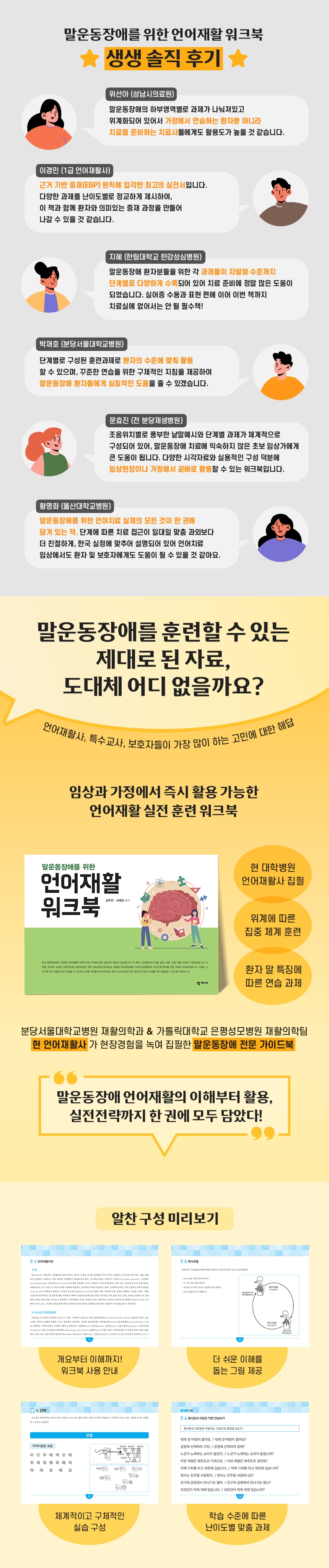
The 『Language Rehabilitation Workbook for Speech Disorders』 is composed of tasks ranging from oral movements to breathing, vocalization, resonance, articulation, and prosody.
In addition to flaccid, spastic, ataxic, hypokinetic, hyperkinetic, unilateral upper motor neuron, and mixed dysarthria, tasks for patients with apraxia of speech and Parkinson's disease were also included.
The tasks were presented in a variety of ways to allow for intensive practice according to difficulty, and the tasks could be immediately utilized as needed based on the patient's speech characteristics.
I hope this workbook will encourage continued practice at home.
In addition to flaccid, spastic, ataxic, hypokinetic, hyperkinetic, unilateral upper motor neuron, and mixed dysarthria, tasks for patients with apraxia of speech and Parkinson's disease were also included.
The tasks were presented in a variety of ways to allow for intensive practice according to difficulty, and the tasks could be immediately utilized as needed based on the patient's speech characteristics.
I hope this workbook will encourage continued practice at home.
index
preface
Chapter 1: Guide to Using the Workbook
1.
What is language rehabilitation?
2.
Workbook Overview and Use
3.
Understanding the Workbook Assignments
Chapter 2 Oral Motor Exercises
1.
Nonverbal movement
2.
oral language movement
Chapter 3: Respiration
1.
caution
2.
posture
3.
inspiration
4.
curiosity
5.
abdominal breathing
6.
Support for oral breathing
7.
Increase the number of syllables per breath
Chapter 4 Phonation
1.
Initiation of speech
2.
Maintaining vocalization
3.
robbery
4.
Sound
Chapter 5: Resonance
1.
Overconsumption arbitration
2.
Hyperbaric intervention
Chapter 6 Articulation
1.
word
2.
sentence
3.
Parnassus
4.
Spontaneous combustion
Chapter 7 Prosody
1.
Speech rate control
2.
Practicing declarative and interrogative intonation
3.
Practice your script
Chapter 8: Treatment of Apraxia of Speech
1.
Contrastive stress training
2.
8-Step Task Continuum Approach
3.
Speech Production Therapy
4.
Expanding phonetic and syllable structures
5.
Words that increase the length of the stimulus word
6.
nine
7.
sentence
Chapter 9: Introduction to Lee Silverman Voice Treatment (LSVT)
References
Chapter 1: Guide to Using the Workbook
1.
What is language rehabilitation?
2.
Workbook Overview and Use
3.
Understanding the Workbook Assignments
Chapter 2 Oral Motor Exercises
1.
Nonverbal movement
2.
oral language movement
Chapter 3: Respiration
1.
caution
2.
posture
3.
inspiration
4.
curiosity
5.
abdominal breathing
6.
Support for oral breathing
7.
Increase the number of syllables per breath
Chapter 4 Phonation
1.
Initiation of speech
2.
Maintaining vocalization
3.
robbery
4.
Sound
Chapter 5: Resonance
1.
Overconsumption arbitration
2.
Hyperbaric intervention
Chapter 6 Articulation
1.
word
2.
sentence
3.
Parnassus
4.
Spontaneous combustion
Chapter 7 Prosody
1.
Speech rate control
2.
Practicing declarative and interrogative intonation
3.
Practice your script
Chapter 8: Treatment of Apraxia of Speech
1.
Contrastive stress training
2.
8-Step Task Continuum Approach
3.
Speech Production Therapy
4.
Expanding phonetic and syllable structures
5.
Words that increase the length of the stimulus word
6.
nine
7.
sentence
Chapter 9: Introduction to Lee Silverman Voice Treatment (LSVT)
References
Detailed image
GOODS SPECIFICS
- Date of issue: April 25, 2025
- Format: Paperback book binding method guide
- Page count, weight, size: 272 pages | 297*210*16mm
- ISBN13: 9788999734021
You may also like
카테고리
korean


korean

![ELLE 엘르 스페셜 에디션 A형 : 12월 [2025]](http://librairie.coreenne.fr/cdn/shop/files/b8e27a3de6c9538896439686c6b0e8fb.jpg?v=1766436872&width=3840)


