

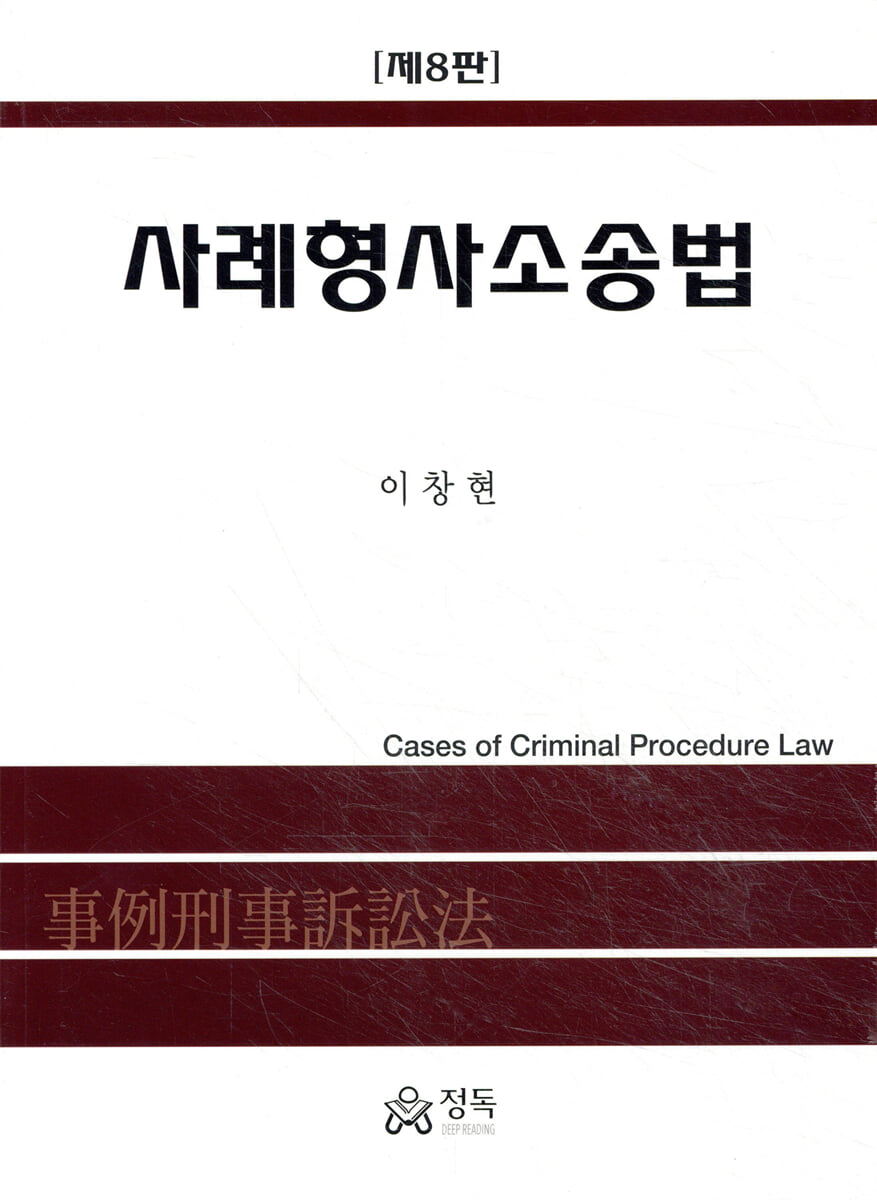
Criminal Procedure Act
 |
Description
Book Introduction
The important aspects of the 8th edition of the Criminal Procedure Act are summarized as follows.
First, we have made every effort to ensure that the case studies for the 15th Bar Examination in 2026 reflect all content in the criminal procedure field, while also summarizing or adjusting some overlapping cases to similar cases to avoid significantly increasing the overall volume.
Second, we have compiled all questions from the 14th Bar Examination and the three mock exams administered in 2024, as well as important case law and Constitutional Court decisions up to January 2025.
Thirdly, we have added issues that have not yet been tested and were not covered in the 7th edition, and have further supplemented them so that in urgent cases, a final summary can be made using only the criminal procedure law.
First, we have made every effort to ensure that the case studies for the 15th Bar Examination in 2026 reflect all content in the criminal procedure field, while also summarizing or adjusting some overlapping cases to similar cases to avoid significantly increasing the overall volume.
Second, we have compiled all questions from the 14th Bar Examination and the three mock exams administered in 2024, as well as important case law and Constitutional Court decisions up to January 2025.
Thirdly, we have added issues that have not yet been tested and were not covered in the 7th edition, and have further supplemented them so that in urgent cases, a final summary can be made using only the criminal procedure law.
index
[Case 1] Whether a member of the National Assembly has immunity and acts incidental to his or her duties
[Case 2] Jurisdiction over related cases and the jurisdiction of military courts
[Case 3] Measures for conducting a joint trial in cases where the legality of jurisdiction and subject matter jurisdiction differ
[Case 4] Court of jurisdiction for a case requesting a merger of land jurisdictions
[Case 5] Whether or not there is a violation of jurisdiction and whether the case should be transferred ex officio
[Case 6] Court action when the prosecutor requests a change in the indictment to a case under the jurisdiction of the collegiate panel in an appeal trial
[Case 7] Causes of Disqualification and Recusal and Whether a Summary Order Requires a Pretrial Trial
[Case 8] Participation in the appeal trial and grounds for disqualification of the judge in charge of preserving evidence during the investigation stage and the judge who conducted the evidence investigation as a trustee judge in the first trial
[Case 9] Whether the participation of the judge who requested the investigation as the chairman of the National Election Commission in the appeal trial constitutes a ground for appeal
[Case 10] Whether the reasons for avoidance and the requirements for a summary dismissal decision are met
[Case 11] Legality of a decision to dismiss a case without suspending proceedings in response to a motion for recusal
[Case 12] The status of the prosecution as a sole authority and the principle of unity of the prosecution
[Case 13] Whether the system of recusal and avoidance of prosecutors is recognized
[Case 14] Identity fraud, identification of the defendant, and actions taken by the prosecutor and court
[Case 15] Prosecutor's actions when the defendant's name is confirmed to have been forged during the trial
[Case 16] Court actions in accordance with false appearance, identification of defendant, and trial procedures
[Case 17] Whether the subject of the right to remain silent is notified and the evidentiary value of a statement prepared without notification of the right to remain silent
[Case 18] Cases not subject to notification of right to remain silent
[Case 19] The Legitimacy of the Right to Remain Unconvinced and the First-instance Court's Sentencing
[Case 20] Illegality of the Request and Decision to Appoint a Public Defender
[Case 21] Whether the defense attorney's right to visitation and communication was violated and the objection to the violation
[Case 22] The legality of the prosecutor's prohibition of contact and traffic, its remedies, and the evidentiary value of the suspect's interrogation record.
[Case 23] Violation of the suspect's right to participate in questioning and the defense attorney's argument
[Case 24] Violation of the Defense Attorney's Right to Participate in the Suspect's Interrogation and the Evidence Capacity of the Suspect's Interrogation Record
[Case 25] Establishment of litigation and remediation of defects
[Case 26] Validity of a lawsuit filed due to error
[Case 27] Whether or not the appointment of a lawyer is supplementary
[Case 28] Whether defects in the filing of a complaint can be corrected through recognition of the additional complaint and amendment of the indictment
[Case 29] Conflict due to lack of conditions for litigation: Violation of the limitation period for filing a complaint for a crime of private prosecution and a final judgment
[Case 30] The prosecutor's right to interrogate a suspect in person to examine the legality of an emergency arrest and the prosecutor's actions when the suspect refuses to be interrogated by the police.
[Case 31] Whether or not entrapment investigations are legal and the court's judgment on illegal entrapment investigations
[Case 32] Ex officio investigation matters and representation of adult guardians in litigation
[Case 33] The nature of the legal representative's right to file a complaint and the method of filing a complaint.
[Case 34] Method of filing a complaint, cancellation of complaint, and compliance with the complaint period
[Case 35] Period for filing a complaint and legality of the complaint in a relative complaint case
[Case 36] Whether the kinship etiquette applies to violations of the Special Act and what to do when a complaint is withdrawn
[Case 37] The effect of cases where the intention not to punish a crime without intent is expressed in the appeal trial and cases where the indictment is changed to a crime without intent
[Case 38] The Right to Withdraw a Complaint and the Inseparable Principle of Complaint in Relative Complaint Crimes
[Case 39] The Inseparable Principle of Complaint in Relative Complaint Crimes 2
[Case 40] The necessity of filing a complaint against a person punished under the principle of inseparability of complaints and the dual punishment provision in cases of private complaint crimes.
[Case 41] Whether the principle of indivisibility of prosecution applies to crimes not punishable by a complaint without a complaint
[Case 42] Withdrawal of complaint by legal representative for a crime indicted based on the victim's complaint
[Case 43] The principle of inseparability of prosecution in relative crimes and the permissibility of waiving the right to sue
[Case 44] Whether the principle of subjective inseparability applies to accusations, and the effect of non-prosecution decisions and accusations
[Case 45] Legality of random searches
[Case 46] Methods and procedures for random inspections
[Case 47] The legality of questioning and searching personal belongings during a random search and the evidentiary value of items seized during the process.
[Case 48] The legality of voluntary accompaniment and detention in a protective shelter
[Case 49] The legality of voluntary accompaniment and the evidentiary value of statements written by suspects during police investigations
[Case 50] Cases where the legality of voluntary accompaniment is recognized
[Case 51] Legitimacy of Consent Verification
[Case 52] Legality of Photography
[Case 53] The legality of compulsory arrest and interrogation of a suspect who fails to appear
[Case 54] Initiation of arrest proceedings without presentation of arrest warrant and execution of arrest on other charges
[Case 55] Cases where the requirements for emergency arrest are recognized
[Case 56] Cases where the requirements for emergency arrest are not recognized
[Case 57] The legality of emergency arrest of a person who voluntarily appeared at a police station.
[Case 58] The legality of pre-indictment investigation and emergency arrest for a crime involving a complaint
[Case 59] The legality of emergency arrest and the defense attorney's legal response before applying for an arrest warrant.
[Case 60] The legality of arbitrary accompaniment and emergency arrest
[Case 61] Whether a suspect who was released after an emergency arrest can be arrested again
[Case 62] The Meaning of a Criminal Caught in the Act and the Requirements for Emergency Arrest
[Case 63] The legality of random searches and methods of arrest
[Case 64] Clarity of the crime as a requirement for arrest in the act
[Case 65] The necessity of arrest as a prerequisite for investigation of a crime involving a complaint and arrest of a criminal caught in the act
[Case 66] Requirements and Procedures for Arresting a Criminal in the Act
[Case 67] Prosecutor's Actions on Arrest Warrant Applications and Judicial Police Officer's Actions on Arrest Warrant Rejection
[Case 68] Procedures from requesting an arrest warrant to issuing it and its execution
[Case 69] How to appeal a decision to reject an arrest warrant
[Case 70] Issuance of an arrest warrant for a person released after an emergency arrest.
[Case 71] Whether it is illegal for a court to issue an arrest warrant without a prior hearing
[Case 72] Calculation method for suspect detention period and exclusion of detention period
[Case 73] Legality of Issuing an Arrest Warrant for the Defendant by the Appellate Court After the Verdict Is Pronounced
[Case 74] Legality of Separate Detention
[Case 75] How a suspect under arrest is released during the investigation phase
[Case 76] Possibility of prosecutorial appeal when a suspect is released during the detention review process
[Case 77] Conditional release upon payment of bail during the investigation phase
[Case 78] Appeal against a decision to grant bail and a decision to forfeit the bail deposit after a decision to cancel bail
[Case 79] Appeal against the decision to cancel bail in the second trial and the effect of the stay of execution
[Case 80] How a Prosecutor Appeals a Decision to Suspend Execution of Detention
[Case 81] Evidence of Recordings Found on a Cell Phone
[Case 82] Legality of the seizure of wallets and other items unrelated to the arrest of a drunk driving offender
[Case 83] Legality in Search and Seizure Procedures 1
[Case 84] Legality in Search and Seizure Procedures 2
[Case 85] Legality of Electronic Information Seizure and Search 1
[Case 86] Guaranteeing the right to participate in the search phase after the information storage media is removed from the investigative agency.
[Case 87] Legality of Electronic Information Seizure and Search 2
[Case 88] Case where a video file found on a mobile phone was copied to a CD and a separate recording file of suspicion was discovered.
[Case 89] When the seized person waives ownership or right to claim return of seized goods and obligation to return
[Case 90] Arrest in the Act: The Legality of Consent for Blood Collection from a Person with Incompetent Medical Capacity
[Case 91] Obtaining evidence through forced blood sampling, etc.
[Case 92] Legality of Forced Blood Collection
[Case 93] Legality of Forced Urine Collection
[Case 94] Searching for a Suspect for Arrest and Urgency 1
[Case 95] Searching for a Suspect for Arrest and Urgency 2
[Case 96] Legality of seizure after arrest under arrest warrant
[Case 97] The legality of arrests in the act and the evidentiary value of seized materials
[Case 98] Whether 'search and seizure at the scene of arrest' is an exception to the warrant principle
[Case 99] Requirements for arrest of a criminal in the act and emergency arrest, search and seizure after emergency arrest, continued seizure, and subsequent search and seizure warrants
[Case 100] Legality of Emergency Seizure of Credit Cards
[Case 101] Evidence of seized items seized and searched without a warrant after an emergency arrest
[Case 102] Evidence of the Blue Tape, Seizure Report, and Photos Seized and Searched After an Emergency Arrest
[Case 103] The Legality of Emergency Arrests and Seizure of Bankbooks and Philopon
[Case 104] Exceptions to search and seizure and urgent measures after emergency arrest and their evidentiary capacity
[Case 105] Exceptions to measures necessary for the execution of search and seizure and measures necessary for urgent action
[Case 106] Evidence of Information Stored in Seized Deposit Books and Laptop Computers
[Case 107] Evidence of weapons seized after emergency arrest
[Case 108] Legality of Seizure of Memory Cards
[Case 109] Legality of Arrest and Vehicle Verification
[Case 110] Whether the seizure of the scene of arrest, crime scene, or remains falls under the exception to the warrant principle
[Case 111] Relevance to the Right to Participate in the Seizure and Search of Oil Remains and Posthumous Warrants
[Case 112] Whether seizure at the scene of arrest or crime and seizure of voluntary submission correspond to this
[Case 113] Evidence of a kitchen knife voluntarily submitted by an arrested person
[Case 114] Legality of the seizure and evidentiary value of arbitrarily submitted memoranda
[Case 115] Legality of Seizure of Randomly Submitted Materials and Consent to Evidence
[Case 116] Scope of guaranteed participation rights in cases where there is a suspect other than the voluntary submitter
[Case 117] Various methods of seizure after emergency arrest
[Case 118] Wiretapping and Entrusted Execution in Communication Restriction Measures
[Case 119] Request for Witness Examination and Request for Evidence Preservation: Measures Prosecutors Can Take to Secure Statements from Witnesses
[Case 120] Prosecution Appeal and Request for Reconsideration: Plaintiff's Appeal to the Decision Not to Indict
[Case 121] Application of special provisions to prisoners in filing financial applications and appeal against decision to reject financial application
[Case 122] Effect of a decision to file a public prosecution for a financial application that violates legal procedures
[Case 123] Suspect's Appeal to Suspension of Indictment
[Case 124] Whether a defendant who has been indicted and detained for further investigation into an accomplice relationship can be questioned in a location other than the courtroom
[Case 125] Whether the investigation of the defendant after the filing of a public indictment is legal and admissible as evidence
[Case 126] Search and seizure as compulsory investigation after filing of public prosecution and evidentiary capacity
[Case 127] Whether the filing of a public prosecution exceeded the prosecutor's discretion and whether it was an abuse of prosecutorial power
[Case 128] Court's Decision on Discriminatory Prosecution
[Case 129] Court's Decision on Filing a Public Prosecution in an Omission Case
[Case 130] Method of filing a complaint and completion of the facts of the complaint
[Case 131] Effect of Faulty Indictment and Filing of Indictment
[Case 132] Preliminary and optional descriptions in the indictment
[Case 133] Legality of preliminary description of facts of indictment and not guilty verdict for surrounding description
[Case 134] Japanese indictment and criminal record
[Case 135] The Effects of Violation of the Japanese Rule of the Indictment and Whether It Can Be Remedied
[Case 136] Expiration date of the statute of limitations for murder and property damage
[Case 137] Starting Point of the Statute of Limitations and Suspension of the Statute of Limitations 1
[Case 138] Starting Point of the Statute of Limitations and Suspension of the Statute of Limitations 2
[Case 139] Exceptions to the statute of limitations for filing a public prosecution against one of the accomplices when the accomplice is in a counteroffensive relationship
[Case 140] Scope of effect of suspension of statute of limitations
[Case 141] Whether the statute of limitations is suspended in the case of a statute of limitations for a lawsuit
[Case 142] The statute of limitations period when the indictment is amended and whether the statute of limitations is suspended due to a decision to restore an accomplice's right to a formal trial.
[Case 143] Legality of Filing a Public Prosecution for Part of a Crime
[Case 144] Legality of filing a public prosecution for a portion of a crime for which the period for filing a complaint has expired
[Case 145] Whether the change in the indictment and the facts of the indictment are identical
[Case 146] Whether the change in the indictment and the facts of the indictment are identical
[Case 147] Prosecution measures when the identity of the facts in the indictment is not recognized
[Case 148] Amendment of the indictment or additional prosecution as a measure to punish additional crimes after filing a public prosecution 1
[Case 149] Amendment of the indictment or additional prosecution as a measure to punish additional crimes after filing a public prosecution 2
[Case 150] Court Action on Request for Amendment of Indictment
[Case 151] Whether or not it is necessary to amend the indictment 1
[Case 152] Whether or not it is necessary to amend the indictment 2
[Case 153] Recognition of reduced facts by the court's authority without changing the indictment
[Case 154] The Court's Obligation to Recognize Reduced Facts in the Indictment
[Case 155] Indicted for habitual extortion, but court action determined that the offense was not habitual
[Case 156] Duty to notify defendants, etc. during indictment amendment procedures
[Case 157] Whether the court's request for amendment of the indictment is mandatory
[Case 158] Prosecutor's and court's actions when a case indicted for special theft is found to be a crime of possession of stolen goods during trial.
[Case 159] Court action taken after determining that a person was indicted for extortion and that the offense was habitual
[Case 160] Whether the court's request for amendment of the indictment is mandatory and the subject of the judgment
[Case 161] Court's Request for Amendment of Indictment, Identity of Indictment Facts, and Possibility of Reindictment
[Case 162] The obligation of the court to request amendment of the indictment in an appeal trial and whether a guilty verdict can be rendered on the reduced facts without amending the indictment.
[Case 163] The possibility of a guilty verdict of only assault for assault resulting in bodily harm in an appeal trial and the judgment in the case where the complaint for assault was withdrawn
[Case 164] The Court's Obligation to Recognize the Facts of the Case and the Legitimacy of an Acquittal
[Case 165] The court's request for amendment of the indictment and the obligation to acknowledge the reduced facts
[Case 166] The possibility and obligation of the court's ex officio recognition
[Case 167] Restrictions on re-indictment after a decision to dismiss a public prosecution has been finalized due to cancellation of the public prosecution
[Case 168] Prosecutor's refusal to submit documents or to allow review or designation of a lawyer
[Case 169] Whether the right to inspect and copy investigative documents is recognized during the detention review process
[Case 170] Prosecutor's refusal to disclose evidence, appeals, and court action
[Case 171] Disclosure of evidence and inspection/copying of documents in ongoing litigation
[Case 172] Request for Restoration of Appeal Rights and Retrial Due to Illegal Public Notice
[Case 173] Appeal procedure in case where a guilty verdict confirmed in the first trial is a crime not punishable by a motion for summary judgment
[Case 174] Appeal against a final guilty verdict due to the defendant's failure to appear in the appeal trial
[Case 175] The effect of a trial conducted without the presence of a lawyer in a case requiring legal representation and the actions of the appellate court
[Case 176] Restrictions on the Defendant's Right to Question the Attorney and the Court's Change of Sentencing Date
[Case 177] Appeal against the decision to reject the claim of entrapment investigation and the request for witness
[Case 178] Witness qualifications of accomplices and non-accomplice co-defendants
[Case 179] Court Decision on the Witness Qualification of an Accomplice and Co-Defendant and the Prosecutor's Request for Witness
[Case 180] Whether or not an accomplice and co-defendant are qualified as witnesses and have the right to refuse to testify
[Case 181] Possibility of Exercising the Right to Refuse to Testify
[Case 182] Admissibility of testimony without notice of right to refuse to testify
[Case 183] Failure to notify the right to refuse to testify and whether perjury is established
[Case 184] Requirements for the testimony made after the defendant was removed to be recognized as evidence
[Case 185] Witness Examination Methods When Face-to-Face Testimony of the Defendant is Difficult
[Case 186] The qualification of a co-defendant as a witness, the defendant's temporary withdrawal and right to participate in witness examination, and substantive defense in cases requiring legal representation.
[Case 187] Requirements for the commencement of summary trial proceedings and the application of the principle of reinforcing confessions
[Case 188] Rigorous Proof and Free Proof
[Case 189] Burden of Proof and Method of Proving the Voluntaryness of a Confession
[Case 190] Burden of Proof and Method of Proof for an Alibi
[Case 191] Burden of proof and method of proof regarding grounds for excluding illegality of defamation
[Case 192] Whether the notebook seized at the scene of arrest is admissible as evidence
[Case 193] Search and seizure as compulsory investigation and evidentiary capacity after several trial dates have been held
[Case 194] Search and seizure under a warrant without a judge's stamp and admissibility of evidence
[Case 195] Search and seizure without notice to public defender and admissibility of evidence
[Case 196] Case 1 where an exception to the theory of negligence by a single person is recognized
[Case 197] Case 2 where an exception to the theory of negligence by a single person is recognized
[Case 198] Case 1 where the exception to the theory of negligence of a single person is not recognized
[Case 199] Case 2 where the evidentiary capacity of a statement prepared in violation of the right to remain silent and the exception to the theory of negligence by the sole witness are not recognized
[Case 200] Requirements for recognizing an exception to the theory of negligence of a single person: When resubmitted after return
[Case 201] Admissibility of evidence in cases where the defendant consents to the use of evidence in the suspect interrogation record containing the confiscated goods and confession made during an illegal arrest
[Case 202] The legality of searches, the legality of seizures preceding arrests, and measures taken with respect to seized items.
[Case 203] Legality of finding photos of crimes committed against other victims on the suspect's cell phone voluntarily submitted by the victim
[Case 204] Admissibility of Evidence Illegally Collected by a Private Person
[Case 205] Admissibility of Evidence Documents Illegally Collected by a Private Person
[Case 206] The evidentiary value of illegally collected evidence and the seizure of voluntary submissions
[Case 207] Illegal wiretapping of conversations between others and its evidentiary value
[Case 208] Whether it corresponds to a conversation between others and the evidentiary value of illegally collected evidence
[Case 209] Evidence of Secretly Recorded Recording Media
[Case 210] Grounds for denying the evidentiary value of a CD
[Case 211] Evidence of Trial Records from Other Cases
[Case 212] Violation of the Defendant's Right to Participate in the Suspect's Questioning and Evidence Capacity
[Case 213] How to challenge the evidentiary value of a suspect interrogation record prepared by a judicial police officer, and the evidentiary value of a statement and statement record that contradicts the contents of the testimony.
[Case 214] The evidentiary value of police and prosecutor-written suspect interrogation records related to the exclusionary rule
[Case 215] The Rule of Exclusion of Confessions in Prosecutor-Prepared Suspect Interrogation Records and the Admissibility of an Accomplice's Legal Confession as Evidence
[Case 216] Evidence of Recording Files
[Case 217] The Legality of Cell Phone Seizure and the Evidence of Recording Files
[Case 218] Requirements for the evidentiary value of suspect interrogation records, statement records, and self-incrimination statements, criminal identification procedures, and probative value
[Case 219] The legality of the defendant's investigation after the filing of the indictment and the evidentiary value of the records
[Case 220] Evidential Admissibility of Suspect Interrogation Reports and Statements Prepared by Judicial Police Officers
[Case 221] Whether the suspect's interrogation record is admissible as evidence as a statement.
[Case 222] Evidence Admissibility of Suspect Interrogation Reports Prepared by Judicial Police Officers Regarding Accomplices
[Case 223] Evidence Admissibility of Suspect Interrogation Records Prepared by Judicial Police Officers and Prosecutors Regarding Accomplices
[Case 224] Whether the whereabouts of a person are unknown or the person resides abroad and whether the person is admissible as evidence under Article 314 of the Criminal Procedure Act
[Case 225] Whether refusal to testify falls under the "other similar reasons" stipulated in Article 314 of the Criminal Procedure Act
[Case 226] The legality of search and seizure after emergency arrest and the evidentiary value of police-written suspect interrogation records.
[Case 227] Whether the statement prepared by the prosecution was prepared in accordance with the 'proper procedure and method'
[Case 228] Requirements for Recognizing the Admissibility of a Statement of Claims Based on Video Recordings
[Case 229] How to Recognize the Substantial Authenticity of a Statement of a Witness Prepared by an Inspector
[Case 230] The evidentiary value of a statement that contradicts the testimony and additional testimony
[Case 231] The evidentiary value of a statement that contradicts the contents of the testimony, a suspect interrogation record, and additional testimony
[Case 232] Evidential Admissibility of Testimony and Witness Statements
[Case 233] Admissibility of a statement prepared in advance before testifying after filing a complaint
[Case 234] The legality of an emergency search after an emergency arrest, the requirements for recognizing illegally collected evidence and consent to evidence, and the evidentiary value of a diary
[Case 235] Evidential Admissibility of Verification Reports and On-Site Investigation Reports
[Case 236] The evidentiary value of the confession statement and reenactment photo recorded in the verification report
[Case 237] The evidentiary value of the crime scene photos, crime reenactment photos, and victim statements attached to the verification report
[Case 238] The evidentiary value of the recording tape containing the witness's statement and the verification report containing the witness' statement.
[Case 239] Requirements for the evidentiary capacity of a statement and whether it corresponds to a document that is naturally recognized as having evidentiary capacity.
[Case 240] Whether the record of the interrogation of a suspect before arrest is admissible as evidence
[Case 241] Admissibility of expert testimony containing the statement of a co-defendant
[Case 242] Admissibility of evidence when a witness's testimony includes a portion of an expert statement containing the statement of a co-defendant
[Case 243] Admissibility of the evidentiary value of the suspect interrogation record prepared by a judicial police officer regarding co-defendants, etc., the evidentiary value of the suspect interrogation record and testimony based on the testimony of the judicial police officer who investigated, and the evidentiary value of the statement of a witness
[Case 244] Legality of Blood Collection and Admissibility of Statements and Prosecutor's Testimony
[Case 245] The evidentiary value of the suspect interrogation record prepared by the prosecutor and the prosecutor's testimony
[Case 246] The evidentiary value of the statement of the witness prepared by the prosecutor and the testimony of the investigating police officer
[Case 247] Admissibility of the witness statement regarding a 4-year-old child
[Case 248] Admissibility of Re-examined Evidence 1: Application of Article 316, Paragraph 1 of the Criminal Procedure Act
[Case 249] Admissibility of Re-examined Evidence 2: Application of Article 316, Paragraph 2 of the Criminal Procedure Act
[Case 250] Evidential ability of expert evidence 3: Record containing the statement of a witness including the statement of one of the co-defendants
[Case 251] Admissibility of the statement of victim A and the statement of psychiatrist B, a second expert witness
[Case 252] The evidentiary capacity of the re-examined evidence, which is a statement written by D after hearing C's statement.
[Case 253] Admissibility of the re-examined evidence, which is a record containing M's statement
[Case 254] The evidentiary value of the records and expert statements containing the suspect interrogation records, court statements, and expert statements prepared by the investigative agency regarding the accomplice
[Case 255] Evidential Admissibility of Expert Statements and Records Containing Expert Statements
[Case 256] The Admissibility of Re-Expert Evidence and Re-Re-Expert Evidence
[Case 257] The evidentiary value of photographs as copies
[Case 258] Evidence of Photographs and Work Logs as Copies
[Case 259] The evidentiary value of a USB file containing a copy of a crime scene recorded on CCTV
[Case 260] The evidentiary value of a CD containing a copy of a crime scene recorded on CCTV
[Case 261] Admissibility of Evidence Submitted to the Inspectorate
[Case 262] Evidence of recorded video stored on a USB
[Case 263] Evidence of Recorded Cell Phone Statements 1
[Case 264] Evidence of Recorded Cell Phone Statements 2
[Case 265] The evidentiary value of expert statements containing the defendant's statements and recorded tapes containing the defendant's statements.
[Case 266] The evidentiary value of each suspect interrogation record prepared by a judicial police officer and a prosecutor, P's testimony and statement to A, and the video recorded on a cell phone
[Case 267] Whether video recordings are admissible as independent evidence
[Case 268] Evidential Admissibility of Scanned and Document Files as Electronic Records
[Case 269] Evidence of Email Printouts and Investment Fund Attraction Agreements
[Case 270] Evidential Admissibility of Documents Printed from Digital Storage Media
[Case 271] The evidentiary power and probative value of lie detector test results
[Case 272] Requirements for granting evidentiary value to memoranda, tape recordings of phone conversations, and photographs of cell phone messages, and evidentiary value of confessions made to police and prosecutors
[Case 273] Admissibility of evidence in a tape recording of a conversation between three parties, a statement written by the suspect at the police station, and a second statement from a person who has already testified
[Case 274] Admissibility of video recordings of witness statements, testimony of prosecutors, and court statements of co-defendants who are accomplices
[Case 275] Requirements for Recognizing the Admissibility of Prosecutor's Statement of Confession by Promise and Co-Defendant
[Case 276] Whether or not consent is given to evidence regarding an object, when withdrawal of consent is permitted, and the attorney's consent to evidence
[Case 277] The Defendant's Withdrawal and the Issue of Consent to Evidence
[Case 278] Whether or not the evidentiary capacity of re-examined evidence is recognized and when consent to evidence is withdrawn in the second trial
[Case 279] The evidentiary value of witness statements and the criminal identification process
[Case 280] Recognition of the evidentiary value of the confession made by a co-defendant and accomplice in the public trial
[Case 281] Whether an accomplice can be convicted based solely on the statutory confession of one accomplice
[Case 282] Defendant's confession in public trial and confession outside public trial under the principle of corroboration of confession
[Case 283] Whether the statement that the defendant admitted to the crime is independent evidence and the rule of corroboration of confession
[Case 284] Whether the contents of a notebook written continuously and mechanically and confessed outside of the courtroom are independent evidence
[Case 285] Whether an accomplice's confession in court requires supporting evidence and whether an accomplice's confession can serve as supporting evidence for the defendant's confession.
[Case 286] Possibility of a guilty verdict when only one accomplice confesses in court and there is no other evidence
[Case 287] In a case where only one of the accomplices confesses in court and there is testimony that the confessing accomplice admitted to the crime, the evidentiary value of that testimony and the possibility of a guilty verdict
[Case 288] Whether a guilty verdict is possible based on evidence such as a request for emotional assessment report
[Case 289] The qualification of a co-defendant who is not an accomplice to be a witness and the evidentiary value of his or her legal statement
[Case 290] Whether the item is subject to voluntary submission and eyewitness statements in the 'Circumstances of Seizure' section
[Case 291] The evidentiary capacity of a statement and the scope of corroborating evidence under the principle of corroborating confessions.
[Case 292] Exclusive Probative Power of Trial Records and Court Actions
[Case 293] Whether the defendant's statement is included in the impeachment case and whether video recordings can be used as impeachment evidence
[Case 294] Subjects of Impeachment and Scope of Impeachment Evidence
[Case 295] Whether the subject of impeachment and illegally collected evidence can be used as impeachment evidence
[Case 296] A suspect interrogation record prepared by a judicial police officer to challenge the probative value of B's testimony.
[Case 297] Possibility of Using a Suspect Interrogation Record that Contradicts the Principle of Parties as Impeachment Evidence
[Case 298] The end point of sentencing and the limits to which a sentence can be changed
[Case 299] Statement of the Reasons for a Guilty Verdict and the Legal Binding Power of Sentencing Guidelines
[Case 300] Permissibility of Optional Description of Criminal Facts
[Case 301] Whether the statement of the reason for excluding the elements of the crime is included in the statement of the facts that constitute the crime under the law and the extent of the judgment
[Case 302] Whether the claim of self-surrender, which is a ground for arbitrary reduction of sentence, is included in the statement of facts that are grounds for the legal increase or reduction of sentence
[Case 303] Judgment on the Claims of the Litigants
[Case 304] Court decision in a case where the defendant is found not guilty on the charges but is found guilty if the charges are changed, but the change is not made
[Case 305] Whether or not it applies when the punishment is abolished due to a revision or amendment of the law after the crime
[Case 306] Whether to recognize the identity of the double indictment and the facts of the indictment
[Case 307] Court Action on Double Indictment for Comprehensive Crimes
[Case 308] The Effect of Absence of Double Judgment and the Identity of the Facts in the Indictment
[Case 309] Whether the objective scope of the res judicata and the identity of the facts in the indictment are recognized
[Case 310] Cases where the final judgment is for a crime of basic elements other than habitual offenders and the power of res judicata
[Case 311] Cases where a final judgment is made in the case of a habitual offender and the force of res judicata
[Case 312] Case where there are two crimes and habitual offenders for which a final judgment is a basic element and the power of res judicata
[Case 313] Prosecutor's Interest in Appeal
[Case 314] Whether an appeal is permitted if the defendant is dissatisfied with the reasons for the not guilty verdict
[Case 315] Court action when the defendant appeals the dismissal of the indictment
[Case 316] Defense counsel's withdrawal of appeal and defendant's consent
[Case 317] Appeal and Appeal Trial Subject to Partial Appeal of Comprehensive Crime
[Case 318] Scope of appeal and measures taken in some appeal cases
[Case 319] Whether to allow some appeals and the scope of the appeal review
[Case 320] Scope of the appeal and the remand court's actions in the case of partial appeals
[Case 321] The scope of the appeal trial and sentencing in cases where the part of the case where only the prosecutor appealed was overturned and remanded, and the scope of the remand in cases where only the prosecutor's appeal is justified after both parties appealed
[Case 322] Scope of judgment following change in judgment of prisoner in appeal
[Case 323] Suspended Sentence and the Principle of Prohibition of Unfavorable Changes
[Case 324] Principle of Prohibition of Unfavorable Changes in Merger Cases
[Case 325] Principle of Prohibition of Unfavorable Changes in Cases of Reduction of Fines and Extension of Period of Detention in a Workhouse
[Case 326] Principle of Prohibition of Unfavorable Changes in Cases of Changing Irregular Forms to Regular Forms
[Case 327] Binding Force of a Rescission Judgment
[Case 328] Request to Change Indictment to a Collaborative Case in an Appeal and Court Action
[Case 329] Whether assault resulting in death can be recognized as assault without changing the indictment in the appeal trial and the effect of withdrawal of the complaint in the appeal trial
[Case 330] When the appellate court makes a decision before the deadline for submitting the appeal statement has elapsed.
[Case 331] Effect of Abstract Description in Appeal Statement
[Case 332] Court action when a public defender fails to submit a statement of appeal within the submission period
[Case 333] Court Action on the Effect of Withdrawal of Appeal and Failure to Submit a Statement of Reasons for Appeal by a Public Defender
[Case 334] Necessity of Notification of Receipt of Litigation Records in Cases Where Private Counsel is Appointed During the Period for Public Defenders to Submit Statement of Reasons for Appeal
[Case 335] Principles and Exceptions to the Reversal of a Judgment in Appeal
[Case 336] Legality of the Appellate Court's Decision
[Case 337] Whether or not it corresponds to the grounds for a decision to dismiss an appeal
[Case 338] Application of the Legal Principle Regarding Limitations on Grounds for Appeal
[Case 339] Scope of effect when an appeal is filed against a leap of faith
[Case 340] Retrial request for a final and conclusive guilty verdict with special pardon and the contents of the verdict in the retrial proceedings
[Case 341] Novelty of Evidence as a Reason for Retrial
[Case 342] Relief measures for falsely accused persons whose judgments have been finalized and the possibility of prosecution of the real perpetrator
[Case 343] Contradictory Verdicts and Retrials for Accomplices
[Case 344] Reasons for Retrial, Scope of Retrial, and Cancellation of Public Prosecution in Retrial Procedures
[Case 345] The Principle of Prohibition of Unfavorable Changes and Emergency Appeals
[Case 346] The Prosecutor General's Actions on Final Judgments of Violation of Law and the Effect of the Judgment
[Case 347] Emergency relief procedures in cases where a deceased defendant is found guilty
[Case 348] Prohibition of Upward Sentence Increase in Cases Requesting Formal Trial
[Case 349] Trial in a case where the defendant failed to appear twice in a formal trial request case
[Case 350] Application of the principle of reinforcement of confession in summary orders, grounds for disqualification, and prohibition of upward severance of sentence
[Case 351] Formal trial and amendment of indictment, comprehensive crime and additional indictment
[Case 352] Prohibition on Amending the Indictment and Upgrading the Sentence in a Formal Trial
[Case 353] The legality of the court's decision to refer a case to a citizen participation trial and the court's response to the prosecutor's appeal.
[Case 354] Court Decision on Application for Citizen Participation Trial
[Case 355] The Defendant's Application Deadline for a Citizens' Participation Trial, and the Unfairness of the Appeal Trial Based on the Trial-Centric Principle and the Principle of Substantive Direct Examination
[Case 2] Jurisdiction over related cases and the jurisdiction of military courts
[Case 3] Measures for conducting a joint trial in cases where the legality of jurisdiction and subject matter jurisdiction differ
[Case 4] Court of jurisdiction for a case requesting a merger of land jurisdictions
[Case 5] Whether or not there is a violation of jurisdiction and whether the case should be transferred ex officio
[Case 6] Court action when the prosecutor requests a change in the indictment to a case under the jurisdiction of the collegiate panel in an appeal trial
[Case 7] Causes of Disqualification and Recusal and Whether a Summary Order Requires a Pretrial Trial
[Case 8] Participation in the appeal trial and grounds for disqualification of the judge in charge of preserving evidence during the investigation stage and the judge who conducted the evidence investigation as a trustee judge in the first trial
[Case 9] Whether the participation of the judge who requested the investigation as the chairman of the National Election Commission in the appeal trial constitutes a ground for appeal
[Case 10] Whether the reasons for avoidance and the requirements for a summary dismissal decision are met
[Case 11] Legality of a decision to dismiss a case without suspending proceedings in response to a motion for recusal
[Case 12] The status of the prosecution as a sole authority and the principle of unity of the prosecution
[Case 13] Whether the system of recusal and avoidance of prosecutors is recognized
[Case 14] Identity fraud, identification of the defendant, and actions taken by the prosecutor and court
[Case 15] Prosecutor's actions when the defendant's name is confirmed to have been forged during the trial
[Case 16] Court actions in accordance with false appearance, identification of defendant, and trial procedures
[Case 17] Whether the subject of the right to remain silent is notified and the evidentiary value of a statement prepared without notification of the right to remain silent
[Case 18] Cases not subject to notification of right to remain silent
[Case 19] The Legitimacy of the Right to Remain Unconvinced and the First-instance Court's Sentencing
[Case 20] Illegality of the Request and Decision to Appoint a Public Defender
[Case 21] Whether the defense attorney's right to visitation and communication was violated and the objection to the violation
[Case 22] The legality of the prosecutor's prohibition of contact and traffic, its remedies, and the evidentiary value of the suspect's interrogation record.
[Case 23] Violation of the suspect's right to participate in questioning and the defense attorney's argument
[Case 24] Violation of the Defense Attorney's Right to Participate in the Suspect's Interrogation and the Evidence Capacity of the Suspect's Interrogation Record
[Case 25] Establishment of litigation and remediation of defects
[Case 26] Validity of a lawsuit filed due to error
[Case 27] Whether or not the appointment of a lawyer is supplementary
[Case 28] Whether defects in the filing of a complaint can be corrected through recognition of the additional complaint and amendment of the indictment
[Case 29] Conflict due to lack of conditions for litigation: Violation of the limitation period for filing a complaint for a crime of private prosecution and a final judgment
[Case 30] The prosecutor's right to interrogate a suspect in person to examine the legality of an emergency arrest and the prosecutor's actions when the suspect refuses to be interrogated by the police.
[Case 31] Whether or not entrapment investigations are legal and the court's judgment on illegal entrapment investigations
[Case 32] Ex officio investigation matters and representation of adult guardians in litigation
[Case 33] The nature of the legal representative's right to file a complaint and the method of filing a complaint.
[Case 34] Method of filing a complaint, cancellation of complaint, and compliance with the complaint period
[Case 35] Period for filing a complaint and legality of the complaint in a relative complaint case
[Case 36] Whether the kinship etiquette applies to violations of the Special Act and what to do when a complaint is withdrawn
[Case 37] The effect of cases where the intention not to punish a crime without intent is expressed in the appeal trial and cases where the indictment is changed to a crime without intent
[Case 38] The Right to Withdraw a Complaint and the Inseparable Principle of Complaint in Relative Complaint Crimes
[Case 39] The Inseparable Principle of Complaint in Relative Complaint Crimes 2
[Case 40] The necessity of filing a complaint against a person punished under the principle of inseparability of complaints and the dual punishment provision in cases of private complaint crimes.
[Case 41] Whether the principle of indivisibility of prosecution applies to crimes not punishable by a complaint without a complaint
[Case 42] Withdrawal of complaint by legal representative for a crime indicted based on the victim's complaint
[Case 43] The principle of inseparability of prosecution in relative crimes and the permissibility of waiving the right to sue
[Case 44] Whether the principle of subjective inseparability applies to accusations, and the effect of non-prosecution decisions and accusations
[Case 45] Legality of random searches
[Case 46] Methods and procedures for random inspections
[Case 47] The legality of questioning and searching personal belongings during a random search and the evidentiary value of items seized during the process.
[Case 48] The legality of voluntary accompaniment and detention in a protective shelter
[Case 49] The legality of voluntary accompaniment and the evidentiary value of statements written by suspects during police investigations
[Case 50] Cases where the legality of voluntary accompaniment is recognized
[Case 51] Legitimacy of Consent Verification
[Case 52] Legality of Photography
[Case 53] The legality of compulsory arrest and interrogation of a suspect who fails to appear
[Case 54] Initiation of arrest proceedings without presentation of arrest warrant and execution of arrest on other charges
[Case 55] Cases where the requirements for emergency arrest are recognized
[Case 56] Cases where the requirements for emergency arrest are not recognized
[Case 57] The legality of emergency arrest of a person who voluntarily appeared at a police station.
[Case 58] The legality of pre-indictment investigation and emergency arrest for a crime involving a complaint
[Case 59] The legality of emergency arrest and the defense attorney's legal response before applying for an arrest warrant.
[Case 60] The legality of arbitrary accompaniment and emergency arrest
[Case 61] Whether a suspect who was released after an emergency arrest can be arrested again
[Case 62] The Meaning of a Criminal Caught in the Act and the Requirements for Emergency Arrest
[Case 63] The legality of random searches and methods of arrest
[Case 64] Clarity of the crime as a requirement for arrest in the act
[Case 65] The necessity of arrest as a prerequisite for investigation of a crime involving a complaint and arrest of a criminal caught in the act
[Case 66] Requirements and Procedures for Arresting a Criminal in the Act
[Case 67] Prosecutor's Actions on Arrest Warrant Applications and Judicial Police Officer's Actions on Arrest Warrant Rejection
[Case 68] Procedures from requesting an arrest warrant to issuing it and its execution
[Case 69] How to appeal a decision to reject an arrest warrant
[Case 70] Issuance of an arrest warrant for a person released after an emergency arrest.
[Case 71] Whether it is illegal for a court to issue an arrest warrant without a prior hearing
[Case 72] Calculation method for suspect detention period and exclusion of detention period
[Case 73] Legality of Issuing an Arrest Warrant for the Defendant by the Appellate Court After the Verdict Is Pronounced
[Case 74] Legality of Separate Detention
[Case 75] How a suspect under arrest is released during the investigation phase
[Case 76] Possibility of prosecutorial appeal when a suspect is released during the detention review process
[Case 77] Conditional release upon payment of bail during the investigation phase
[Case 78] Appeal against a decision to grant bail and a decision to forfeit the bail deposit after a decision to cancel bail
[Case 79] Appeal against the decision to cancel bail in the second trial and the effect of the stay of execution
[Case 80] How a Prosecutor Appeals a Decision to Suspend Execution of Detention
[Case 81] Evidence of Recordings Found on a Cell Phone
[Case 82] Legality of the seizure of wallets and other items unrelated to the arrest of a drunk driving offender
[Case 83] Legality in Search and Seizure Procedures 1
[Case 84] Legality in Search and Seizure Procedures 2
[Case 85] Legality of Electronic Information Seizure and Search 1
[Case 86] Guaranteeing the right to participate in the search phase after the information storage media is removed from the investigative agency.
[Case 87] Legality of Electronic Information Seizure and Search 2
[Case 88] Case where a video file found on a mobile phone was copied to a CD and a separate recording file of suspicion was discovered.
[Case 89] When the seized person waives ownership or right to claim return of seized goods and obligation to return
[Case 90] Arrest in the Act: The Legality of Consent for Blood Collection from a Person with Incompetent Medical Capacity
[Case 91] Obtaining evidence through forced blood sampling, etc.
[Case 92] Legality of Forced Blood Collection
[Case 93] Legality of Forced Urine Collection
[Case 94] Searching for a Suspect for Arrest and Urgency 1
[Case 95] Searching for a Suspect for Arrest and Urgency 2
[Case 96] Legality of seizure after arrest under arrest warrant
[Case 97] The legality of arrests in the act and the evidentiary value of seized materials
[Case 98] Whether 'search and seizure at the scene of arrest' is an exception to the warrant principle
[Case 99] Requirements for arrest of a criminal in the act and emergency arrest, search and seizure after emergency arrest, continued seizure, and subsequent search and seizure warrants
[Case 100] Legality of Emergency Seizure of Credit Cards
[Case 101] Evidence of seized items seized and searched without a warrant after an emergency arrest
[Case 102] Evidence of the Blue Tape, Seizure Report, and Photos Seized and Searched After an Emergency Arrest
[Case 103] The Legality of Emergency Arrests and Seizure of Bankbooks and Philopon
[Case 104] Exceptions to search and seizure and urgent measures after emergency arrest and their evidentiary capacity
[Case 105] Exceptions to measures necessary for the execution of search and seizure and measures necessary for urgent action
[Case 106] Evidence of Information Stored in Seized Deposit Books and Laptop Computers
[Case 107] Evidence of weapons seized after emergency arrest
[Case 108] Legality of Seizure of Memory Cards
[Case 109] Legality of Arrest and Vehicle Verification
[Case 110] Whether the seizure of the scene of arrest, crime scene, or remains falls under the exception to the warrant principle
[Case 111] Relevance to the Right to Participate in the Seizure and Search of Oil Remains and Posthumous Warrants
[Case 112] Whether seizure at the scene of arrest or crime and seizure of voluntary submission correspond to this
[Case 113] Evidence of a kitchen knife voluntarily submitted by an arrested person
[Case 114] Legality of the seizure and evidentiary value of arbitrarily submitted memoranda
[Case 115] Legality of Seizure of Randomly Submitted Materials and Consent to Evidence
[Case 116] Scope of guaranteed participation rights in cases where there is a suspect other than the voluntary submitter
[Case 117] Various methods of seizure after emergency arrest
[Case 118] Wiretapping and Entrusted Execution in Communication Restriction Measures
[Case 119] Request for Witness Examination and Request for Evidence Preservation: Measures Prosecutors Can Take to Secure Statements from Witnesses
[Case 120] Prosecution Appeal and Request for Reconsideration: Plaintiff's Appeal to the Decision Not to Indict
[Case 121] Application of special provisions to prisoners in filing financial applications and appeal against decision to reject financial application
[Case 122] Effect of a decision to file a public prosecution for a financial application that violates legal procedures
[Case 123] Suspect's Appeal to Suspension of Indictment
[Case 124] Whether a defendant who has been indicted and detained for further investigation into an accomplice relationship can be questioned in a location other than the courtroom
[Case 125] Whether the investigation of the defendant after the filing of a public indictment is legal and admissible as evidence
[Case 126] Search and seizure as compulsory investigation after filing of public prosecution and evidentiary capacity
[Case 127] Whether the filing of a public prosecution exceeded the prosecutor's discretion and whether it was an abuse of prosecutorial power
[Case 128] Court's Decision on Discriminatory Prosecution
[Case 129] Court's Decision on Filing a Public Prosecution in an Omission Case
[Case 130] Method of filing a complaint and completion of the facts of the complaint
[Case 131] Effect of Faulty Indictment and Filing of Indictment
[Case 132] Preliminary and optional descriptions in the indictment
[Case 133] Legality of preliminary description of facts of indictment and not guilty verdict for surrounding description
[Case 134] Japanese indictment and criminal record
[Case 135] The Effects of Violation of the Japanese Rule of the Indictment and Whether It Can Be Remedied
[Case 136] Expiration date of the statute of limitations for murder and property damage
[Case 137] Starting Point of the Statute of Limitations and Suspension of the Statute of Limitations 1
[Case 138] Starting Point of the Statute of Limitations and Suspension of the Statute of Limitations 2
[Case 139] Exceptions to the statute of limitations for filing a public prosecution against one of the accomplices when the accomplice is in a counteroffensive relationship
[Case 140] Scope of effect of suspension of statute of limitations
[Case 141] Whether the statute of limitations is suspended in the case of a statute of limitations for a lawsuit
[Case 142] The statute of limitations period when the indictment is amended and whether the statute of limitations is suspended due to a decision to restore an accomplice's right to a formal trial.
[Case 143] Legality of Filing a Public Prosecution for Part of a Crime
[Case 144] Legality of filing a public prosecution for a portion of a crime for which the period for filing a complaint has expired
[Case 145] Whether the change in the indictment and the facts of the indictment are identical
[Case 146] Whether the change in the indictment and the facts of the indictment are identical
[Case 147] Prosecution measures when the identity of the facts in the indictment is not recognized
[Case 148] Amendment of the indictment or additional prosecution as a measure to punish additional crimes after filing a public prosecution 1
[Case 149] Amendment of the indictment or additional prosecution as a measure to punish additional crimes after filing a public prosecution 2
[Case 150] Court Action on Request for Amendment of Indictment
[Case 151] Whether or not it is necessary to amend the indictment 1
[Case 152] Whether or not it is necessary to amend the indictment 2
[Case 153] Recognition of reduced facts by the court's authority without changing the indictment
[Case 154] The Court's Obligation to Recognize Reduced Facts in the Indictment
[Case 155] Indicted for habitual extortion, but court action determined that the offense was not habitual
[Case 156] Duty to notify defendants, etc. during indictment amendment procedures
[Case 157] Whether the court's request for amendment of the indictment is mandatory
[Case 158] Prosecutor's and court's actions when a case indicted for special theft is found to be a crime of possession of stolen goods during trial.
[Case 159] Court action taken after determining that a person was indicted for extortion and that the offense was habitual
[Case 160] Whether the court's request for amendment of the indictment is mandatory and the subject of the judgment
[Case 161] Court's Request for Amendment of Indictment, Identity of Indictment Facts, and Possibility of Reindictment
[Case 162] The obligation of the court to request amendment of the indictment in an appeal trial and whether a guilty verdict can be rendered on the reduced facts without amending the indictment.
[Case 163] The possibility of a guilty verdict of only assault for assault resulting in bodily harm in an appeal trial and the judgment in the case where the complaint for assault was withdrawn
[Case 164] The Court's Obligation to Recognize the Facts of the Case and the Legitimacy of an Acquittal
[Case 165] The court's request for amendment of the indictment and the obligation to acknowledge the reduced facts
[Case 166] The possibility and obligation of the court's ex officio recognition
[Case 167] Restrictions on re-indictment after a decision to dismiss a public prosecution has been finalized due to cancellation of the public prosecution
[Case 168] Prosecutor's refusal to submit documents or to allow review or designation of a lawyer
[Case 169] Whether the right to inspect and copy investigative documents is recognized during the detention review process
[Case 170] Prosecutor's refusal to disclose evidence, appeals, and court action
[Case 171] Disclosure of evidence and inspection/copying of documents in ongoing litigation
[Case 172] Request for Restoration of Appeal Rights and Retrial Due to Illegal Public Notice
[Case 173] Appeal procedure in case where a guilty verdict confirmed in the first trial is a crime not punishable by a motion for summary judgment
[Case 174] Appeal against a final guilty verdict due to the defendant's failure to appear in the appeal trial
[Case 175] The effect of a trial conducted without the presence of a lawyer in a case requiring legal representation and the actions of the appellate court
[Case 176] Restrictions on the Defendant's Right to Question the Attorney and the Court's Change of Sentencing Date
[Case 177] Appeal against the decision to reject the claim of entrapment investigation and the request for witness
[Case 178] Witness qualifications of accomplices and non-accomplice co-defendants
[Case 179] Court Decision on the Witness Qualification of an Accomplice and Co-Defendant and the Prosecutor's Request for Witness
[Case 180] Whether or not an accomplice and co-defendant are qualified as witnesses and have the right to refuse to testify
[Case 181] Possibility of Exercising the Right to Refuse to Testify
[Case 182] Admissibility of testimony without notice of right to refuse to testify
[Case 183] Failure to notify the right to refuse to testify and whether perjury is established
[Case 184] Requirements for the testimony made after the defendant was removed to be recognized as evidence
[Case 185] Witness Examination Methods When Face-to-Face Testimony of the Defendant is Difficult
[Case 186] The qualification of a co-defendant as a witness, the defendant's temporary withdrawal and right to participate in witness examination, and substantive defense in cases requiring legal representation.
[Case 187] Requirements for the commencement of summary trial proceedings and the application of the principle of reinforcing confessions
[Case 188] Rigorous Proof and Free Proof
[Case 189] Burden of Proof and Method of Proving the Voluntaryness of a Confession
[Case 190] Burden of Proof and Method of Proof for an Alibi
[Case 191] Burden of proof and method of proof regarding grounds for excluding illegality of defamation
[Case 192] Whether the notebook seized at the scene of arrest is admissible as evidence
[Case 193] Search and seizure as compulsory investigation and evidentiary capacity after several trial dates have been held
[Case 194] Search and seizure under a warrant without a judge's stamp and admissibility of evidence
[Case 195] Search and seizure without notice to public defender and admissibility of evidence
[Case 196] Case 1 where an exception to the theory of negligence by a single person is recognized
[Case 197] Case 2 where an exception to the theory of negligence by a single person is recognized
[Case 198] Case 1 where the exception to the theory of negligence of a single person is not recognized
[Case 199] Case 2 where the evidentiary capacity of a statement prepared in violation of the right to remain silent and the exception to the theory of negligence by the sole witness are not recognized
[Case 200] Requirements for recognizing an exception to the theory of negligence of a single person: When resubmitted after return
[Case 201] Admissibility of evidence in cases where the defendant consents to the use of evidence in the suspect interrogation record containing the confiscated goods and confession made during an illegal arrest
[Case 202] The legality of searches, the legality of seizures preceding arrests, and measures taken with respect to seized items.
[Case 203] Legality of finding photos of crimes committed against other victims on the suspect's cell phone voluntarily submitted by the victim
[Case 204] Admissibility of Evidence Illegally Collected by a Private Person
[Case 205] Admissibility of Evidence Documents Illegally Collected by a Private Person
[Case 206] The evidentiary value of illegally collected evidence and the seizure of voluntary submissions
[Case 207] Illegal wiretapping of conversations between others and its evidentiary value
[Case 208] Whether it corresponds to a conversation between others and the evidentiary value of illegally collected evidence
[Case 209] Evidence of Secretly Recorded Recording Media
[Case 210] Grounds for denying the evidentiary value of a CD
[Case 211] Evidence of Trial Records from Other Cases
[Case 212] Violation of the Defendant's Right to Participate in the Suspect's Questioning and Evidence Capacity
[Case 213] How to challenge the evidentiary value of a suspect interrogation record prepared by a judicial police officer, and the evidentiary value of a statement and statement record that contradicts the contents of the testimony.
[Case 214] The evidentiary value of police and prosecutor-written suspect interrogation records related to the exclusionary rule
[Case 215] The Rule of Exclusion of Confessions in Prosecutor-Prepared Suspect Interrogation Records and the Admissibility of an Accomplice's Legal Confession as Evidence
[Case 216] Evidence of Recording Files
[Case 217] The Legality of Cell Phone Seizure and the Evidence of Recording Files
[Case 218] Requirements for the evidentiary value of suspect interrogation records, statement records, and self-incrimination statements, criminal identification procedures, and probative value
[Case 219] The legality of the defendant's investigation after the filing of the indictment and the evidentiary value of the records
[Case 220] Evidential Admissibility of Suspect Interrogation Reports and Statements Prepared by Judicial Police Officers
[Case 221] Whether the suspect's interrogation record is admissible as evidence as a statement.
[Case 222] Evidence Admissibility of Suspect Interrogation Reports Prepared by Judicial Police Officers Regarding Accomplices
[Case 223] Evidence Admissibility of Suspect Interrogation Records Prepared by Judicial Police Officers and Prosecutors Regarding Accomplices
[Case 224] Whether the whereabouts of a person are unknown or the person resides abroad and whether the person is admissible as evidence under Article 314 of the Criminal Procedure Act
[Case 225] Whether refusal to testify falls under the "other similar reasons" stipulated in Article 314 of the Criminal Procedure Act
[Case 226] The legality of search and seizure after emergency arrest and the evidentiary value of police-written suspect interrogation records.
[Case 227] Whether the statement prepared by the prosecution was prepared in accordance with the 'proper procedure and method'
[Case 228] Requirements for Recognizing the Admissibility of a Statement of Claims Based on Video Recordings
[Case 229] How to Recognize the Substantial Authenticity of a Statement of a Witness Prepared by an Inspector
[Case 230] The evidentiary value of a statement that contradicts the testimony and additional testimony
[Case 231] The evidentiary value of a statement that contradicts the contents of the testimony, a suspect interrogation record, and additional testimony
[Case 232] Evidential Admissibility of Testimony and Witness Statements
[Case 233] Admissibility of a statement prepared in advance before testifying after filing a complaint
[Case 234] The legality of an emergency search after an emergency arrest, the requirements for recognizing illegally collected evidence and consent to evidence, and the evidentiary value of a diary
[Case 235] Evidential Admissibility of Verification Reports and On-Site Investigation Reports
[Case 236] The evidentiary value of the confession statement and reenactment photo recorded in the verification report
[Case 237] The evidentiary value of the crime scene photos, crime reenactment photos, and victim statements attached to the verification report
[Case 238] The evidentiary value of the recording tape containing the witness's statement and the verification report containing the witness' statement.
[Case 239] Requirements for the evidentiary capacity of a statement and whether it corresponds to a document that is naturally recognized as having evidentiary capacity.
[Case 240] Whether the record of the interrogation of a suspect before arrest is admissible as evidence
[Case 241] Admissibility of expert testimony containing the statement of a co-defendant
[Case 242] Admissibility of evidence when a witness's testimony includes a portion of an expert statement containing the statement of a co-defendant
[Case 243] Admissibility of the evidentiary value of the suspect interrogation record prepared by a judicial police officer regarding co-defendants, etc., the evidentiary value of the suspect interrogation record and testimony based on the testimony of the judicial police officer who investigated, and the evidentiary value of the statement of a witness
[Case 244] Legality of Blood Collection and Admissibility of Statements and Prosecutor's Testimony
[Case 245] The evidentiary value of the suspect interrogation record prepared by the prosecutor and the prosecutor's testimony
[Case 246] The evidentiary value of the statement of the witness prepared by the prosecutor and the testimony of the investigating police officer
[Case 247] Admissibility of the witness statement regarding a 4-year-old child
[Case 248] Admissibility of Re-examined Evidence 1: Application of Article 316, Paragraph 1 of the Criminal Procedure Act
[Case 249] Admissibility of Re-examined Evidence 2: Application of Article 316, Paragraph 2 of the Criminal Procedure Act
[Case 250] Evidential ability of expert evidence 3: Record containing the statement of a witness including the statement of one of the co-defendants
[Case 251] Admissibility of the statement of victim A and the statement of psychiatrist B, a second expert witness
[Case 252] The evidentiary capacity of the re-examined evidence, which is a statement written by D after hearing C's statement.
[Case 253] Admissibility of the re-examined evidence, which is a record containing M's statement
[Case 254] The evidentiary value of the records and expert statements containing the suspect interrogation records, court statements, and expert statements prepared by the investigative agency regarding the accomplice
[Case 255] Evidential Admissibility of Expert Statements and Records Containing Expert Statements
[Case 256] The Admissibility of Re-Expert Evidence and Re-Re-Expert Evidence
[Case 257] The evidentiary value of photographs as copies
[Case 258] Evidence of Photographs and Work Logs as Copies
[Case 259] The evidentiary value of a USB file containing a copy of a crime scene recorded on CCTV
[Case 260] The evidentiary value of a CD containing a copy of a crime scene recorded on CCTV
[Case 261] Admissibility of Evidence Submitted to the Inspectorate
[Case 262] Evidence of recorded video stored on a USB
[Case 263] Evidence of Recorded Cell Phone Statements 1
[Case 264] Evidence of Recorded Cell Phone Statements 2
[Case 265] The evidentiary value of expert statements containing the defendant's statements and recorded tapes containing the defendant's statements.
[Case 266] The evidentiary value of each suspect interrogation record prepared by a judicial police officer and a prosecutor, P's testimony and statement to A, and the video recorded on a cell phone
[Case 267] Whether video recordings are admissible as independent evidence
[Case 268] Evidential Admissibility of Scanned and Document Files as Electronic Records
[Case 269] Evidence of Email Printouts and Investment Fund Attraction Agreements
[Case 270] Evidential Admissibility of Documents Printed from Digital Storage Media
[Case 271] The evidentiary power and probative value of lie detector test results
[Case 272] Requirements for granting evidentiary value to memoranda, tape recordings of phone conversations, and photographs of cell phone messages, and evidentiary value of confessions made to police and prosecutors
[Case 273] Admissibility of evidence in a tape recording of a conversation between three parties, a statement written by the suspect at the police station, and a second statement from a person who has already testified
[Case 274] Admissibility of video recordings of witness statements, testimony of prosecutors, and court statements of co-defendants who are accomplices
[Case 275] Requirements for Recognizing the Admissibility of Prosecutor's Statement of Confession by Promise and Co-Defendant
[Case 276] Whether or not consent is given to evidence regarding an object, when withdrawal of consent is permitted, and the attorney's consent to evidence
[Case 277] The Defendant's Withdrawal and the Issue of Consent to Evidence
[Case 278] Whether or not the evidentiary capacity of re-examined evidence is recognized and when consent to evidence is withdrawn in the second trial
[Case 279] The evidentiary value of witness statements and the criminal identification process
[Case 280] Recognition of the evidentiary value of the confession made by a co-defendant and accomplice in the public trial
[Case 281] Whether an accomplice can be convicted based solely on the statutory confession of one accomplice
[Case 282] Defendant's confession in public trial and confession outside public trial under the principle of corroboration of confession
[Case 283] Whether the statement that the defendant admitted to the crime is independent evidence and the rule of corroboration of confession
[Case 284] Whether the contents of a notebook written continuously and mechanically and confessed outside of the courtroom are independent evidence
[Case 285] Whether an accomplice's confession in court requires supporting evidence and whether an accomplice's confession can serve as supporting evidence for the defendant's confession.
[Case 286] Possibility of a guilty verdict when only one accomplice confesses in court and there is no other evidence
[Case 287] In a case where only one of the accomplices confesses in court and there is testimony that the confessing accomplice admitted to the crime, the evidentiary value of that testimony and the possibility of a guilty verdict
[Case 288] Whether a guilty verdict is possible based on evidence such as a request for emotional assessment report
[Case 289] The qualification of a co-defendant who is not an accomplice to be a witness and the evidentiary value of his or her legal statement
[Case 290] Whether the item is subject to voluntary submission and eyewitness statements in the 'Circumstances of Seizure' section
[Case 291] The evidentiary capacity of a statement and the scope of corroborating evidence under the principle of corroborating confessions.
[Case 292] Exclusive Probative Power of Trial Records and Court Actions
[Case 293] Whether the defendant's statement is included in the impeachment case and whether video recordings can be used as impeachment evidence
[Case 294] Subjects of Impeachment and Scope of Impeachment Evidence
[Case 295] Whether the subject of impeachment and illegally collected evidence can be used as impeachment evidence
[Case 296] A suspect interrogation record prepared by a judicial police officer to challenge the probative value of B's testimony.
[Case 297] Possibility of Using a Suspect Interrogation Record that Contradicts the Principle of Parties as Impeachment Evidence
[Case 298] The end point of sentencing and the limits to which a sentence can be changed
[Case 299] Statement of the Reasons for a Guilty Verdict and the Legal Binding Power of Sentencing Guidelines
[Case 300] Permissibility of Optional Description of Criminal Facts
[Case 301] Whether the statement of the reason for excluding the elements of the crime is included in the statement of the facts that constitute the crime under the law and the extent of the judgment
[Case 302] Whether the claim of self-surrender, which is a ground for arbitrary reduction of sentence, is included in the statement of facts that are grounds for the legal increase or reduction of sentence
[Case 303] Judgment on the Claims of the Litigants
[Case 304] Court decision in a case where the defendant is found not guilty on the charges but is found guilty if the charges are changed, but the change is not made
[Case 305] Whether or not it applies when the punishment is abolished due to a revision or amendment of the law after the crime
[Case 306] Whether to recognize the identity of the double indictment and the facts of the indictment
[Case 307] Court Action on Double Indictment for Comprehensive Crimes
[Case 308] The Effect of Absence of Double Judgment and the Identity of the Facts in the Indictment
[Case 309] Whether the objective scope of the res judicata and the identity of the facts in the indictment are recognized
[Case 310] Cases where the final judgment is for a crime of basic elements other than habitual offenders and the power of res judicata
[Case 311] Cases where a final judgment is made in the case of a habitual offender and the force of res judicata
[Case 312] Case where there are two crimes and habitual offenders for which a final judgment is a basic element and the power of res judicata
[Case 313] Prosecutor's Interest in Appeal
[Case 314] Whether an appeal is permitted if the defendant is dissatisfied with the reasons for the not guilty verdict
[Case 315] Court action when the defendant appeals the dismissal of the indictment
[Case 316] Defense counsel's withdrawal of appeal and defendant's consent
[Case 317] Appeal and Appeal Trial Subject to Partial Appeal of Comprehensive Crime
[Case 318] Scope of appeal and measures taken in some appeal cases
[Case 319] Whether to allow some appeals and the scope of the appeal review
[Case 320] Scope of the appeal and the remand court's actions in the case of partial appeals
[Case 321] The scope of the appeal trial and sentencing in cases where the part of the case where only the prosecutor appealed was overturned and remanded, and the scope of the remand in cases where only the prosecutor's appeal is justified after both parties appealed
[Case 322] Scope of judgment following change in judgment of prisoner in appeal
[Case 323] Suspended Sentence and the Principle of Prohibition of Unfavorable Changes
[Case 324] Principle of Prohibition of Unfavorable Changes in Merger Cases
[Case 325] Principle of Prohibition of Unfavorable Changes in Cases of Reduction of Fines and Extension of Period of Detention in a Workhouse
[Case 326] Principle of Prohibition of Unfavorable Changes in Cases of Changing Irregular Forms to Regular Forms
[Case 327] Binding Force of a Rescission Judgment
[Case 328] Request to Change Indictment to a Collaborative Case in an Appeal and Court Action
[Case 329] Whether assault resulting in death can be recognized as assault without changing the indictment in the appeal trial and the effect of withdrawal of the complaint in the appeal trial
[Case 330] When the appellate court makes a decision before the deadline for submitting the appeal statement has elapsed.
[Case 331] Effect of Abstract Description in Appeal Statement
[Case 332] Court action when a public defender fails to submit a statement of appeal within the submission period
[Case 333] Court Action on the Effect of Withdrawal of Appeal and Failure to Submit a Statement of Reasons for Appeal by a Public Defender
[Case 334] Necessity of Notification of Receipt of Litigation Records in Cases Where Private Counsel is Appointed During the Period for Public Defenders to Submit Statement of Reasons for Appeal
[Case 335] Principles and Exceptions to the Reversal of a Judgment in Appeal
[Case 336] Legality of the Appellate Court's Decision
[Case 337] Whether or not it corresponds to the grounds for a decision to dismiss an appeal
[Case 338] Application of the Legal Principle Regarding Limitations on Grounds for Appeal
[Case 339] Scope of effect when an appeal is filed against a leap of faith
[Case 340] Retrial request for a final and conclusive guilty verdict with special pardon and the contents of the verdict in the retrial proceedings
[Case 341] Novelty of Evidence as a Reason for Retrial
[Case 342] Relief measures for falsely accused persons whose judgments have been finalized and the possibility of prosecution of the real perpetrator
[Case 343] Contradictory Verdicts and Retrials for Accomplices
[Case 344] Reasons for Retrial, Scope of Retrial, and Cancellation of Public Prosecution in Retrial Procedures
[Case 345] The Principle of Prohibition of Unfavorable Changes and Emergency Appeals
[Case 346] The Prosecutor General's Actions on Final Judgments of Violation of Law and the Effect of the Judgment
[Case 347] Emergency relief procedures in cases where a deceased defendant is found guilty
[Case 348] Prohibition of Upward Sentence Increase in Cases Requesting Formal Trial
[Case 349] Trial in a case where the defendant failed to appear twice in a formal trial request case
[Case 350] Application of the principle of reinforcement of confession in summary orders, grounds for disqualification, and prohibition of upward severance of sentence
[Case 351] Formal trial and amendment of indictment, comprehensive crime and additional indictment
[Case 352] Prohibition on Amending the Indictment and Upgrading the Sentence in a Formal Trial
[Case 353] The legality of the court's decision to refer a case to a citizen participation trial and the court's response to the prosecutor's appeal.
[Case 354] Court Decision on Application for Citizen Participation Trial
[Case 355] The Defendant's Application Deadline for a Citizens' Participation Trial, and the Unfairness of the Appeal Trial Based on the Trial-Centric Principle and the Principle of Substantive Direct Examination
Detailed image
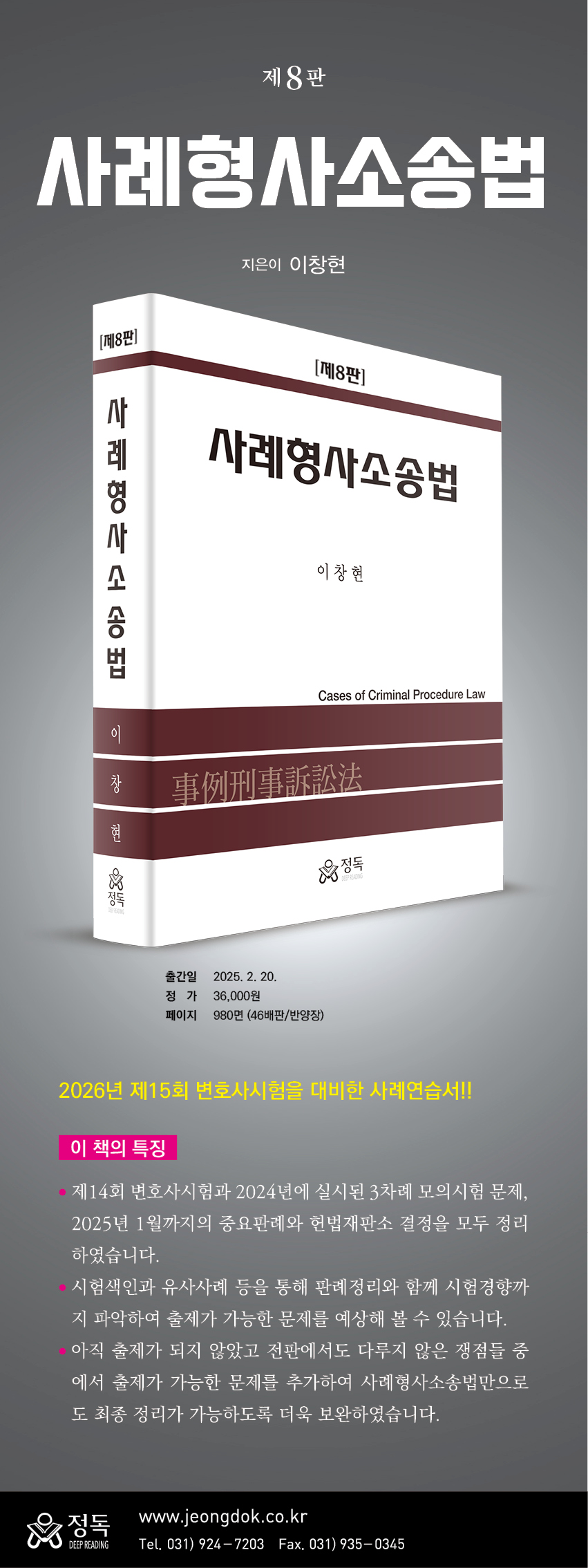
Publisher's Review
preface
Due to the recent state of martial law, investigations and trials of the incumbent president on charges of sedition, impeachment trials, and investigations and trials of the leader of the main opposition party, investigations and criminal trials have become very familiar to many citizens, and it seems that even criminal procedure law education is being provided naturally through the media.
As the CBT method has become established for case-based and written exams in the bar exam, the speed of answering has greatly increased without worrying about handwriting, and as many corrections are possible, even in midterms and final exams at law schools, so the answer sheets are often very rich in content and have excellent sentence structure, so the gap in ability among test takers is expected to widen further.
The 14th Bar Examination, held in January 2025, also revealed that the questions were similar to those from the previous mock exams or were based on recent case law. It is expected that questions will continue to be asked in a similar direction in the future.
The Criminal Procedure Act was created as a tool to help students thoroughly master the content of criminal procedure law through textbooks, and then to develop case-solving skills while reviewing past exam questions and potential exam questions. We will continue to strive toward this goal in the future.
The key features of the 8th edition of the Criminal Procedure Act are summarized below.
First, we have made every effort to ensure that the case studies prepared for the 15th Bar Examination in 2026 reflect all content in the criminal procedure field, while also summarizing or adjusting some overlapping cases to similar cases to minimize the overall volume.
Second, we've compiled questions from the 14th Bar Examination and three mock exams administered in 2024, as well as important case law and Constitutional Court decisions up to January 2025.
By analyzing the exam index and similar cases, you can understand the exam trends and case law and predict the questions that may appear on the exam.
Thirdly, we have added questions that could be included among the issues that have not yet been included in the exam and were not covered in the 7th edition, and have further supplemented them so that, in urgent cases, a final summary can be made using only the criminal procedure law.
I feel a great sense of joy and satisfaction in publishing the 8th edition of the Case Criminal Procedure Act, which has received so much positive feedback and love from readers.
This publication was made possible by the encouragement and support of Jeongdok's President Kim Jung-yong, Director Sim Seong-bo, and Manager Kim In-sook. We will continue to strive to provide even greater assistance to diligent law students.
February 2025
In the law school laboratory of Hankuk University of Foreign Studies
Lee Chang-hyeon
Due to the recent state of martial law, investigations and trials of the incumbent president on charges of sedition, impeachment trials, and investigations and trials of the leader of the main opposition party, investigations and criminal trials have become very familiar to many citizens, and it seems that even criminal procedure law education is being provided naturally through the media.
As the CBT method has become established for case-based and written exams in the bar exam, the speed of answering has greatly increased without worrying about handwriting, and as many corrections are possible, even in midterms and final exams at law schools, so the answer sheets are often very rich in content and have excellent sentence structure, so the gap in ability among test takers is expected to widen further.
The 14th Bar Examination, held in January 2025, also revealed that the questions were similar to those from the previous mock exams or were based on recent case law. It is expected that questions will continue to be asked in a similar direction in the future.
The Criminal Procedure Act was created as a tool to help students thoroughly master the content of criminal procedure law through textbooks, and then to develop case-solving skills while reviewing past exam questions and potential exam questions. We will continue to strive toward this goal in the future.
The key features of the 8th edition of the Criminal Procedure Act are summarized below.
First, we have made every effort to ensure that the case studies prepared for the 15th Bar Examination in 2026 reflect all content in the criminal procedure field, while also summarizing or adjusting some overlapping cases to similar cases to minimize the overall volume.
Second, we've compiled questions from the 14th Bar Examination and three mock exams administered in 2024, as well as important case law and Constitutional Court decisions up to January 2025.
By analyzing the exam index and similar cases, you can understand the exam trends and case law and predict the questions that may appear on the exam.
Thirdly, we have added questions that could be included among the issues that have not yet been included in the exam and were not covered in the 7th edition, and have further supplemented them so that, in urgent cases, a final summary can be made using only the criminal procedure law.
I feel a great sense of joy and satisfaction in publishing the 8th edition of the Case Criminal Procedure Act, which has received so much positive feedback and love from readers.
This publication was made possible by the encouragement and support of Jeongdok's President Kim Jung-yong, Director Sim Seong-bo, and Manager Kim In-sook. We will continue to strive to provide even greater assistance to diligent law students.
February 2025
In the law school laboratory of Hankuk University of Foreign Studies
Lee Chang-hyeon
GOODS SPECIFICS
- Date of issue: February 20, 2025
- Format: Paperback book binding method guide
- Page count, weight, size: 980 pages | 188*257*40mm
- ISBN13: 9791168583337
- ISBN10: 1168583330
You may also like
카테고리
korean


korean

![GQ KOREA Mark (Monthly): December [2025]](http://librairie.coreenne.fr/cdn/shop/files/8ef265dbbfbf186523ed75ba7319009d.jpg?v=1765340328&width=3840)


