

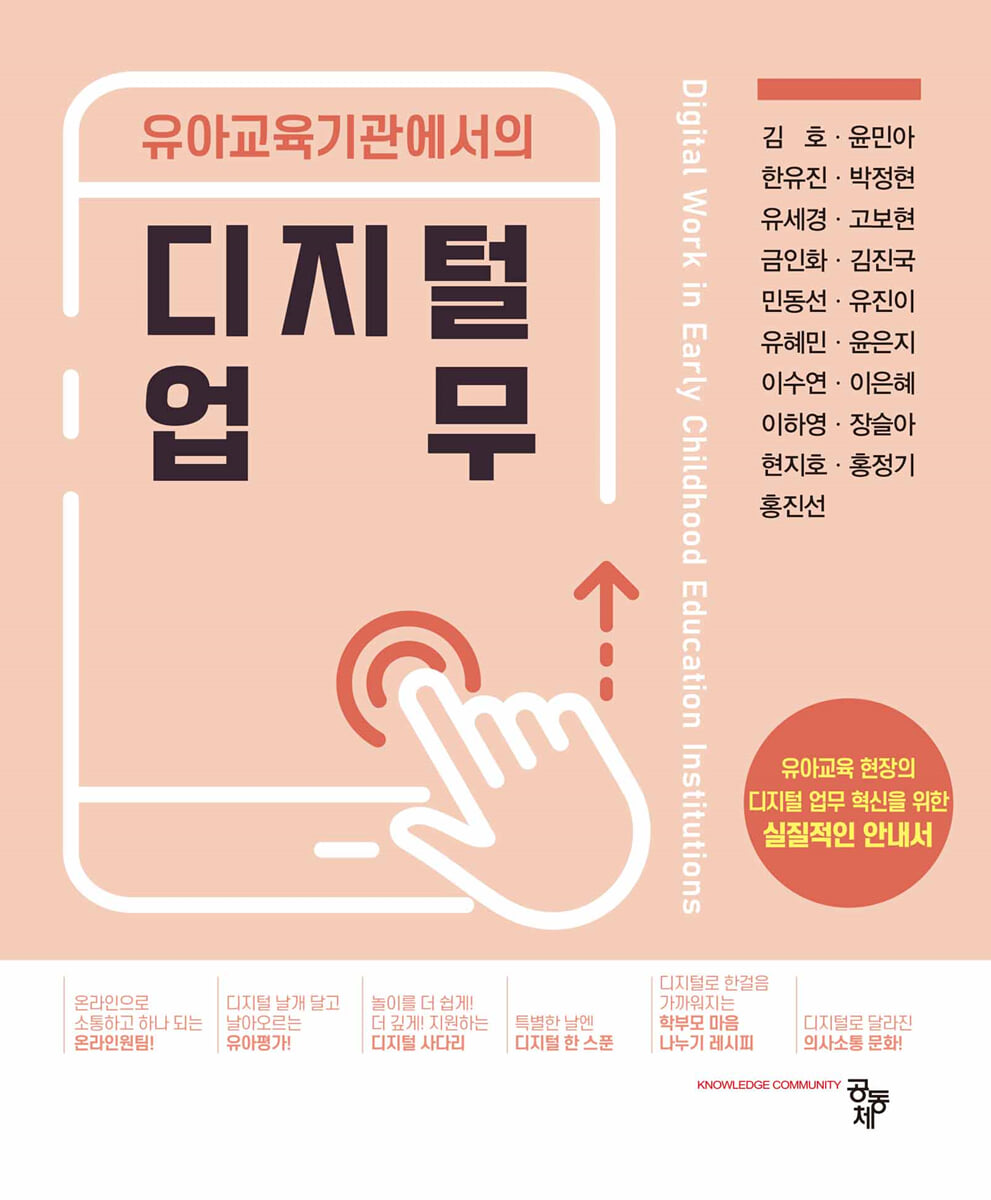
Digital Work in Early Childhood Education
 |
Description
Book Introduction
The rapid development of digital technology is constantly changing the way we work.
As working from home and remote collaboration become more common, a new term called "digital nomad" has gained attention.
Flexible working methods that are not restricted by time or place are no longer an option but a necessity.
The wave of digital transformation is sweeping through the early childhood education field as well.
Therefore, improving the digital work skills of early childhood teachers has become an important task.
Equipping early childhood teachers with digital skills has educational benefits in various aspects.
This book is a practical guide to digital innovation in early childhood education.
As working from home and remote collaboration become more common, a new term called "digital nomad" has gained attention.
Flexible working methods that are not restricted by time or place are no longer an option but a necessity.
The wave of digital transformation is sweeping through the early childhood education field as well.
Therefore, improving the digital work skills of early childhood teachers has become an important task.
Equipping early childhood teachers with digital skills has educational benefits in various aspects.
This book is a practical guide to digital innovation in early childhood education.
index
Part 1 Theory
Chapter 1: Living as a Preschool Teacher in the Digital Age 20
1.
Digital Competencies for Early Childhood Teachers in the Post-Digital Era 20
2.
Digital Work for Early Childhood Teachers 27
Chapter 2: Becoming Digital Citizens for Early Childhood Teachers (52)
1.
Digital Citizen 52
2.
Leveraging Artificial Intelligence (AI) 68
Part 2: The Real Story
Chapter 1: Online One Team: Communicating and Becoming One Online! 76
01 Creating an Online Team with Google Workspace 78
Starting with Online One-Team Collaboration and Cloud Sharing 79
Starting an Online One Team with Google Workspace 81
02 Work Diet with Online Documents 106
Speed Up Your Work with Excel for the Web 107
117: A work notebook in your hand, accessible anytime, anywhere
03 Easily manage your budget with a spreadsheet 130
Numbers, don't calculate, just input them 131
Chapter 2: Soaring with Digital Wings: Early Childhood Assessment! 150
01 A Look Inside Play Using Digital Tools 152
View play traces at a glance with the Idrowmind app 153
Capture Your Toddler's Play with a Print Camera 157
Take a peek at vivid play scenes with Naver Clova Notes 162
02 Waking Up Dormant Records with Digital Tools 168
Organizing and Categorizing Data Collected with Evernote 169
Making the Most of Our Class's Play Records with Notion 174
03 Writing a Child Development Report with the Help of Digital Tools 188
Writing a Child Development Report with the Help of Conversational Artificial Intelligence (AI) 189
Writing a Child Development Report with the Help of Artificial Intelligence (AI) Tools 193
Chapter 3: Play Easier! Play Deeper! Digital Ladder 202
01 Expanding Play Digitally 204
Add immersion to toddler play with Zoom! 205
Enhance your imagination with Imaginary Soundscapes 209
02 Adding Vitality to Educational Materials Using Digital 216
Bring your child's artwork to life with animated drawings! 217
Add immersion to your classes with Studio DID! 226
03 Digital Play Environments that Expand Play 234
Drawing Picasso's Dreams with Digital Drawing 235
Become an all-rounder with QR codes! 239
Chapter 4: A Digital Spoon for Special Days 244
01 Starting the event, easily collecting various information 246
Easily Collect Information from Your Child with Google Forms 247
Pre-visit the field trip site with Naver Map 252
02 Planning a Digital Educational Event 258
Improving Event Efficiency with Canva 259
Create engaging, engaging classes with Kahoot Quizzes 264
03 Sharing Memories and Sharing 268
Create prop-free event photos using the Snow app 269
Easily create graduation videos with Brew's automatic subtitle feature 272
Chapter 5: Recipe for Sharing Parents' Hearts, One Step Closer to Digital Connections 280
01 Fast and Convenient Home Communication 282
Communicating Smartly Through KakaoTalk Channels 283
Convenient communication through Naver Band 287
Have fun communicating with Quiz & 292
Opening a Virtual Exhibition with Artsteps 296
02 Parent Consultation with Digital Assistant 302
Understanding Your Child's Mind with Google Forms 303
Systematically Preparing Parent-Teacher Consultations with Google Forms and Google Calendar 309
Non-face-to-face counseling, like face-to-face counseling, Zoom video counseling 315
Writing a Counseling Journal Using Digital Tools 318
03 Promoting Early Childhood Education Institutions That Transcend Time and Space 322
Creating a Promotional Brochure with Book Creator 323
Creating a Virtual Space for Our Early Childhood Education Institution with Cospace 328
332 Using the Platform to Publish Promotional Materials for Early Childhood Education Institutions
Chapter 6: Communication Culture Transformed by Digital Transformation! 336
01 Meetings Transformed Digitally 338
Reviewing Current Meetings for Smarter Meetings 339
Running Smart Meetings Digitally 340
02 Digitally Transformed Curriculum Planning and Evaluation 352
Planning Course Operations on an Online Whiteboard 353
Evaluating Course Operations on Online Collaboration Platforms 362
Appendix: You are Nice! 370: Systematic and Transparent Management of Academic and Administrative Work
01 A Look at Yua Nice's Work Structure 372
02 A Look at the Key Functions of 'Teaching Affairs' 376
Kindergarten Information 377
Curriculum 379
Academic record 381
Life Record Book 386
· References 390
Chapter 1: Living as a Preschool Teacher in the Digital Age 20
1.
Digital Competencies for Early Childhood Teachers in the Post-Digital Era 20
2.
Digital Work for Early Childhood Teachers 27
Chapter 2: Becoming Digital Citizens for Early Childhood Teachers (52)
1.
Digital Citizen 52
2.
Leveraging Artificial Intelligence (AI) 68
Part 2: The Real Story
Chapter 1: Online One Team: Communicating and Becoming One Online! 76
01 Creating an Online Team with Google Workspace 78
Starting with Online One-Team Collaboration and Cloud Sharing 79
Starting an Online One Team with Google Workspace 81
02 Work Diet with Online Documents 106
Speed Up Your Work with Excel for the Web 107
117: A work notebook in your hand, accessible anytime, anywhere
03 Easily manage your budget with a spreadsheet 130
Numbers, don't calculate, just input them 131
Chapter 2: Soaring with Digital Wings: Early Childhood Assessment! 150
01 A Look Inside Play Using Digital Tools 152
View play traces at a glance with the Idrowmind app 153
Capture Your Toddler's Play with a Print Camera 157
Take a peek at vivid play scenes with Naver Clova Notes 162
02 Waking Up Dormant Records with Digital Tools 168
Organizing and Categorizing Data Collected with Evernote 169
Making the Most of Our Class's Play Records with Notion 174
03 Writing a Child Development Report with the Help of Digital Tools 188
Writing a Child Development Report with the Help of Conversational Artificial Intelligence (AI) 189
Writing a Child Development Report with the Help of Artificial Intelligence (AI) Tools 193
Chapter 3: Play Easier! Play Deeper! Digital Ladder 202
01 Expanding Play Digitally 204
Add immersion to toddler play with Zoom! 205
Enhance your imagination with Imaginary Soundscapes 209
02 Adding Vitality to Educational Materials Using Digital 216
Bring your child's artwork to life with animated drawings! 217
Add immersion to your classes with Studio DID! 226
03 Digital Play Environments that Expand Play 234
Drawing Picasso's Dreams with Digital Drawing 235
Become an all-rounder with QR codes! 239
Chapter 4: A Digital Spoon for Special Days 244
01 Starting the event, easily collecting various information 246
Easily Collect Information from Your Child with Google Forms 247
Pre-visit the field trip site with Naver Map 252
02 Planning a Digital Educational Event 258
Improving Event Efficiency with Canva 259
Create engaging, engaging classes with Kahoot Quizzes 264
03 Sharing Memories and Sharing 268
Create prop-free event photos using the Snow app 269
Easily create graduation videos with Brew's automatic subtitle feature 272
Chapter 5: Recipe for Sharing Parents' Hearts, One Step Closer to Digital Connections 280
01 Fast and Convenient Home Communication 282
Communicating Smartly Through KakaoTalk Channels 283
Convenient communication through Naver Band 287
Have fun communicating with Quiz & 292
Opening a Virtual Exhibition with Artsteps 296
02 Parent Consultation with Digital Assistant 302
Understanding Your Child's Mind with Google Forms 303
Systematically Preparing Parent-Teacher Consultations with Google Forms and Google Calendar 309
Non-face-to-face counseling, like face-to-face counseling, Zoom video counseling 315
Writing a Counseling Journal Using Digital Tools 318
03 Promoting Early Childhood Education Institutions That Transcend Time and Space 322
Creating a Promotional Brochure with Book Creator 323
Creating a Virtual Space for Our Early Childhood Education Institution with Cospace 328
332 Using the Platform to Publish Promotional Materials for Early Childhood Education Institutions
Chapter 6: Communication Culture Transformed by Digital Transformation! 336
01 Meetings Transformed Digitally 338
Reviewing Current Meetings for Smarter Meetings 339
Running Smart Meetings Digitally 340
02 Digitally Transformed Curriculum Planning and Evaluation 352
Planning Course Operations on an Online Whiteboard 353
Evaluating Course Operations on Online Collaboration Platforms 362
Appendix: You are Nice! 370: Systematic and Transparent Management of Academic and Administrative Work
01 A Look at Yua Nice's Work Structure 372
02 A Look at the Key Functions of 'Teaching Affairs' 376
Kindergarten Information 377
Curriculum 379
Academic record 381
Life Record Book 386
· References 390
Publisher's Review
The rapid advancement of digital technology is constantly changing the way we work.
As working from home and remote collaboration become more common, a new term called "digital nomad" has gained attention.
Flexible working practices, independent of time and location, are no longer an option but a necessity.
The wave of digital transformation is sweeping through early childhood education as well.
Therefore, improving the digital work skills of early childhood teachers has become an important task.
Equipping early childhood educators with digital skills has educational benefits in many ways.
First, it can improve the quality of education.
Observing and recording play using digital tools allows us to understand and broadly support young children's growth and learning.
Additionally, the creation and use of digital-based teaching and learning materials can provide young children with richer and more meaningful learning experiences.
Second, it can improve work efficiency.
Digitizing administrative tasks, such as online document management and academic calendar management using real-time platforms, reduces teachers' workload and allows them to use their time more efficiently.
This, in turn, frees up teachers to devote more time and energy to interactions with children and educational activities.
Third, it can strengthen communication with the educational community.
Communication with parents, collaboration among faculty and staff, and sharing educational information through digital platforms enable the formation of a closer and more meaningful educational community.
This can contribute to creating a collaborative educational environment for the holistic development of young children.
Fourth, it can strengthen your capabilities as a digital citizen.
As members of a digital society, early childhood educators must understand and practice critical analysis of information, ethical use, and personal information protection.
These skills are also essential for fostering good digital citizenship in young children.
Finally, it can strengthen our ability to adapt to future education. Advances in new technologies like AI and big data will bring about continuous change in the field of education.
Improving the digital capabilities of early childhood educators can help them proactively respond to these changes and build a foundation for leading future education.
In conclusion, the digital work skills of early childhood teachers are crucial for improving the quality of early childhood education, enhancing teachers' professionalism, and fostering a democratic culture in the educational community. Therefore, they should be recognized as a key task for realizing a brighter future for education.
This book is a practical guide to digital innovation in early childhood education.
As working from home and remote collaboration become more common, a new term called "digital nomad" has gained attention.
Flexible working practices, independent of time and location, are no longer an option but a necessity.
The wave of digital transformation is sweeping through early childhood education as well.
Therefore, improving the digital work skills of early childhood teachers has become an important task.
Equipping early childhood educators with digital skills has educational benefits in many ways.
First, it can improve the quality of education.
Observing and recording play using digital tools allows us to understand and broadly support young children's growth and learning.
Additionally, the creation and use of digital-based teaching and learning materials can provide young children with richer and more meaningful learning experiences.
Second, it can improve work efficiency.
Digitizing administrative tasks, such as online document management and academic calendar management using real-time platforms, reduces teachers' workload and allows them to use their time more efficiently.
This, in turn, frees up teachers to devote more time and energy to interactions with children and educational activities.
Third, it can strengthen communication with the educational community.
Communication with parents, collaboration among faculty and staff, and sharing educational information through digital platforms enable the formation of a closer and more meaningful educational community.
This can contribute to creating a collaborative educational environment for the holistic development of young children.
Fourth, it can strengthen your capabilities as a digital citizen.
As members of a digital society, early childhood educators must understand and practice critical analysis of information, ethical use, and personal information protection.
These skills are also essential for fostering good digital citizenship in young children.
Finally, it can strengthen our ability to adapt to future education. Advances in new technologies like AI and big data will bring about continuous change in the field of education.
Improving the digital capabilities of early childhood educators can help them proactively respond to these changes and build a foundation for leading future education.
In conclusion, the digital work skills of early childhood teachers are crucial for improving the quality of early childhood education, enhancing teachers' professionalism, and fostering a democratic culture in the educational community. Therefore, they should be recognized as a key task for realizing a brighter future for education.
This book is a practical guide to digital innovation in early childhood education.
GOODS SPECIFICS
- Date of issue: December 31, 2024
- Page count, weight, size: 400 pages | 190*230*30mm
- ISBN13: 9791167255662
- ISBN10: 1167255666
You may also like
카테고리
korean


korean

![GQ KOREA Mark (Monthly): December [2025]](http://librairie.coreenne.fr/cdn/shop/files/8ef265dbbfbf186523ed75ba7319009d.jpg?v=1765340328&width=3840)


