

Computer Architecture
 |
Description
Book Introduction
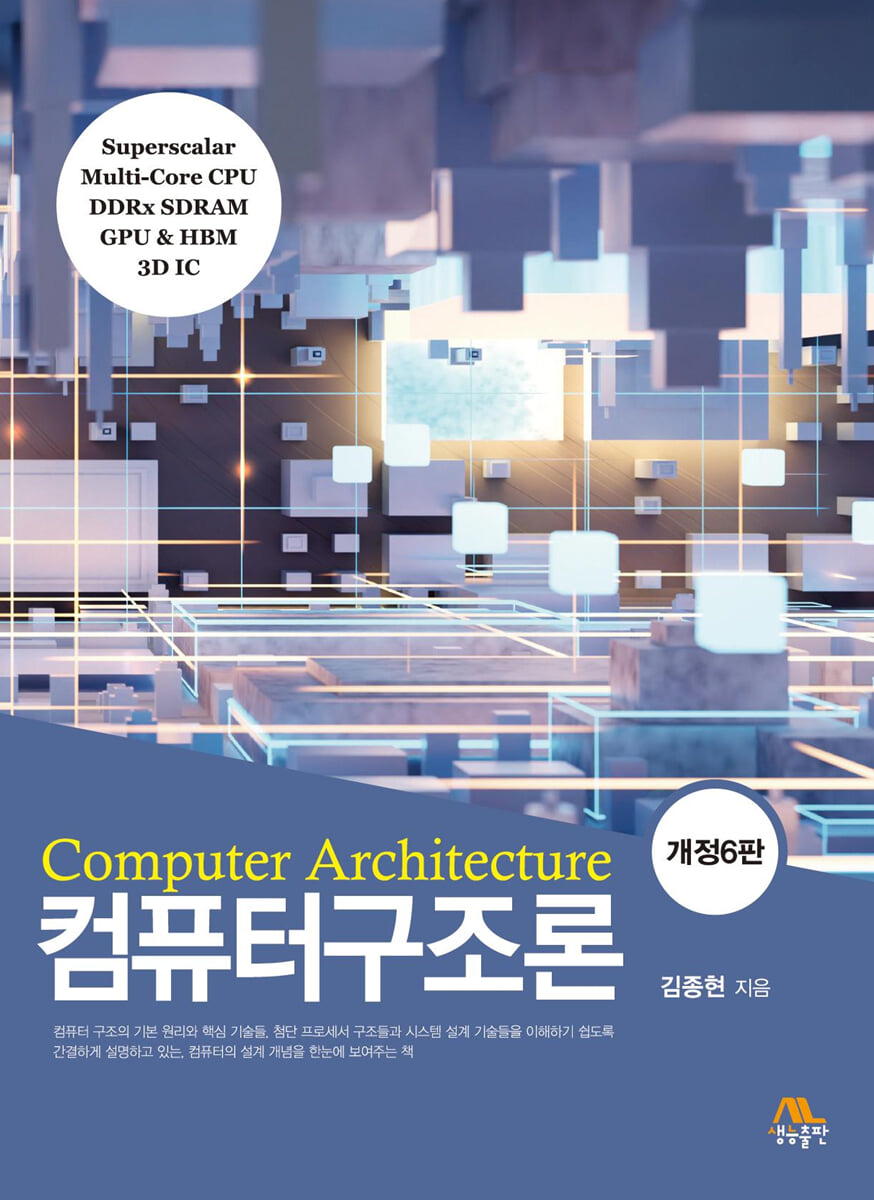
"Computer Architecture" broadly explains the basic principles and core technologies of computer hardware, and also comprehensively introduces the latest computer technologies, including multi-core processor architectures widely used to improve computer performance, main memory technologies such as DDR SDRAM and HBM, and various auxiliary storage devices including 3D NAND flash and SSD.
Therefore, if you faithfully study the contents of this book, you will be able to easily understand the design concepts of almost all computer systems, from mobile PCs to supercomputers.
Additionally, by extracting and explaining only the important content that must be known in this field, the volume was adjusted so that it is not difficult to study up to the last chapter in one semester.
The level of this book is suitable for use as a textbook for computer architecture courses in computer-related departments and electronic engineering departments at universities and technical colleges, and it will also serve as a reference book that will directly help researchers at research institutes or companies developing computer systems.
Therefore, if you faithfully study the contents of this book, you will be able to easily understand the design concepts of almost all computer systems, from mobile PCs to supercomputers.
Additionally, by extracting and explaining only the important content that must be known in this field, the volume was adjusted so that it is not difficult to study up to the last chapter in one semester.
The level of this book is suitable for use as a textbook for computer architecture courses in computer-related departments and electronic engineering departments at universities and technical colleges, and it will also serve as a reference book that will directly help researchers at research institutes or companies developing computer systems.
index
CHAPTER 01 Computer System Overview
1.1 Basic structure of a computer
1.2 Representation and storage of information
1.3 System Configuration
1.3.1 Connection between CPU and memory device
1.3.2 Connection of CPU and I/O devices
1.3.3 Configuration of the entire system
1.4 The evolution of computer architecture
1.4.1 Structure of early computers
1.4.2 Development History of Major Computer Components
1.4.3 Classification and Development Trends of Computer Systems
Basic problem
Practice problems
CHAPTER 02 CPU Structure and Function
2.1 Basic structure of the CPU
2.2 Executing commands
2.2.1 Withdrawal Cycle
2.2.2 Execution Cycle
2.2.3 Interrupt Cycle
2.2.4 Indirect Cycle
2.3 Command Pipelining
2.3.1 Two-Stage Command Pipeline
2.3.2 4-Stage Command Pipeline
2.3.3 Superscalar
2.3.4 Dynamic Execution
2.3.5 Dual-Core and Multi-Core
2.4 Instruction Set
2.4.1 Types of operations
2.4.2 Command Format
2.4.3 Addressing Method
2.4.4 Instruction formats of actual commercial processors
Basic problem
Practice problems
CHAPTER 03 Computer Arithmetic and Logic Operations
3.1 Components of ALU
3.2 Representation of integers
3.2.1 Encoding-size representation
3.2.2 Conservative expression
3.2.3 Sign-bit extension
3.3 Logical operations
3.4 Shift Operations
3.5 Arithmetic operations on integers
3.5.1 Addition
3.5.2 Subtraction
3.5.3 Multiplication
3.5.4 Division
3.6 Representation of floating-point numbers
3.7 Floating-Point Arithmetic Operations
3.7.1 Addition and Subtraction
3.7.2 Multiplication and Division
Basic problem
Practice problems
CHAPTER 04 CONTROL UNIT
4.1 Functions of the control unit
4.2 Structure of the control unit
4.3 Microinstruction Format
4.4 Microprogramming
4.4.1 Withdrawal Cycle Routine
4.4.2 Indirect Cycle Routine
4.4.3 Execution Cycle Routine
4.5 Sequential control of microprograms
Basic problem
Practice problems
CHAPTER 05 Memory Device
5.1 Classification and characteristics of memory devices
5.2 Hierarchical memory system
5.2.1 Necessity and Effect
5.2.2 Memory Hierarchy
5.3 Semiconductor memory devices
5.3.1 RAM
5.3.2 ROM
5.4 Design of the memory module
5.5 Cache Memory
5.5.1 Cache Capacity
5.5.2 Withdrawal Method
5.5.3 Thought style
5.5.4 Replacement Algorithm
5.5.5 Writing Policy
5.5.6 Multiple Caches
5.6 DDR SDRAM
5.6.1 SDRAM
5.6.2 DDR SDRAM
5.6.3 Memory Rank
5.7 Next-generation non-volatile memory devices
5.7.1 PRAM
5.7.2 FRAM
5.7.3 MRAM
Basic problem
Practice problems
CHAPTER 06 Auxiliary Storage Devices
6.1 Hard Disk
6.1.1 Disk Structure
6.1.2 Disk Access Time
6.2 RAID
6.2.1 Background of RAID Emergence
6.2.2 Types of RAID
6.3 Flash Memory and SSDs
6.3.1 Flash Memory
6.3.2 SSD
Basic problem
Practice problems
CHAPTER 07 SYSTEM BUS, I/O, AND INTERRUPT
7.1 System Bus
7.1.1 System Bus Organization
7.1.2 Basic operation of the system bus
7.2 Bus Arbitration
7.2.1 Parallel Arbitration Method
7.2.2 Serial Arbitration Method
7.2.3 Polling method
7.3 Connecting I/O Devices
7.3.1 I/O Control
7.3.2 I/O Addressing
7.4 I/O using interrupts
7.4.1 Multiple interrupt method
7.4.2 Daisy-chain method
7.4.3 Software polling method
7.5 I/O using DMA
Basic problem
Practice problems
CHAPTER 08 High-Performance Computer System Architecture
8.1 Concept and necessity of parallel processing
8.2 Unit of parallel processing
8.3 Classification of Parallel Computers
8.3.1 Flynn's classification
8.3.2 Classification by memory access model
8.3.3 Classification by system configuration method
8.4 Multiprocessor System Architecture
8.4.1 Shared-Memory System Architecture
8.4.2 Distributed-Memory System Architecture
8.4.3 Cache Coherence Protocol
8.5 GPU and HBM
8.5.1 Overview of Artificial Intelligence Using Deep Learning Techniques
8.5.2 Graphics Processing Unit (GPU)
8.5.3 High Bandwidth Memory (HBM)
Basic problem
Practice problems
Appendix A Optical Storage Devices
Appendix B Computer Clustering
References
1.1 Basic structure of a computer
1.2 Representation and storage of information
1.3 System Configuration
1.3.1 Connection between CPU and memory device
1.3.2 Connection of CPU and I/O devices
1.3.3 Configuration of the entire system
1.4 The evolution of computer architecture
1.4.1 Structure of early computers
1.4.2 Development History of Major Computer Components
1.4.3 Classification and Development Trends of Computer Systems
Basic problem
Practice problems
CHAPTER 02 CPU Structure and Function
2.1 Basic structure of the CPU
2.2 Executing commands
2.2.1 Withdrawal Cycle
2.2.2 Execution Cycle
2.2.3 Interrupt Cycle
2.2.4 Indirect Cycle
2.3 Command Pipelining
2.3.1 Two-Stage Command Pipeline
2.3.2 4-Stage Command Pipeline
2.3.3 Superscalar
2.3.4 Dynamic Execution
2.3.5 Dual-Core and Multi-Core
2.4 Instruction Set
2.4.1 Types of operations
2.4.2 Command Format
2.4.3 Addressing Method
2.4.4 Instruction formats of actual commercial processors
Basic problem
Practice problems
CHAPTER 03 Computer Arithmetic and Logic Operations
3.1 Components of ALU
3.2 Representation of integers
3.2.1 Encoding-size representation
3.2.2 Conservative expression
3.2.3 Sign-bit extension
3.3 Logical operations
3.4 Shift Operations
3.5 Arithmetic operations on integers
3.5.1 Addition
3.5.2 Subtraction
3.5.3 Multiplication
3.5.4 Division
3.6 Representation of floating-point numbers
3.7 Floating-Point Arithmetic Operations
3.7.1 Addition and Subtraction
3.7.2 Multiplication and Division
Basic problem
Practice problems
CHAPTER 04 CONTROL UNIT
4.1 Functions of the control unit
4.2 Structure of the control unit
4.3 Microinstruction Format
4.4 Microprogramming
4.4.1 Withdrawal Cycle Routine
4.4.2 Indirect Cycle Routine
4.4.3 Execution Cycle Routine
4.5 Sequential control of microprograms
Basic problem
Practice problems
CHAPTER 05 Memory Device
5.1 Classification and characteristics of memory devices
5.2 Hierarchical memory system
5.2.1 Necessity and Effect
5.2.2 Memory Hierarchy
5.3 Semiconductor memory devices
5.3.1 RAM
5.3.2 ROM
5.4 Design of the memory module
5.5 Cache Memory
5.5.1 Cache Capacity
5.5.2 Withdrawal Method
5.5.3 Thought style
5.5.4 Replacement Algorithm
5.5.5 Writing Policy
5.5.6 Multiple Caches
5.6 DDR SDRAM
5.6.1 SDRAM
5.6.2 DDR SDRAM
5.6.3 Memory Rank
5.7 Next-generation non-volatile memory devices
5.7.1 PRAM
5.7.2 FRAM
5.7.3 MRAM
Basic problem
Practice problems
CHAPTER 06 Auxiliary Storage Devices
6.1 Hard Disk
6.1.1 Disk Structure
6.1.2 Disk Access Time
6.2 RAID
6.2.1 Background of RAID Emergence
6.2.2 Types of RAID
6.3 Flash Memory and SSDs
6.3.1 Flash Memory
6.3.2 SSD
Basic problem
Practice problems
CHAPTER 07 SYSTEM BUS, I/O, AND INTERRUPT
7.1 System Bus
7.1.1 System Bus Organization
7.1.2 Basic operation of the system bus
7.2 Bus Arbitration
7.2.1 Parallel Arbitration Method
7.2.2 Serial Arbitration Method
7.2.3 Polling method
7.3 Connecting I/O Devices
7.3.1 I/O Control
7.3.2 I/O Addressing
7.4 I/O using interrupts
7.4.1 Multiple interrupt method
7.4.2 Daisy-chain method
7.4.3 Software polling method
7.5 I/O using DMA
Basic problem
Practice problems
CHAPTER 08 High-Performance Computer System Architecture
8.1 Concept and necessity of parallel processing
8.2 Unit of parallel processing
8.3 Classification of Parallel Computers
8.3.1 Flynn's classification
8.3.2 Classification by memory access model
8.3.3 Classification by system configuration method
8.4 Multiprocessor System Architecture
8.4.1 Shared-Memory System Architecture
8.4.2 Distributed-Memory System Architecture
8.4.3 Cache Coherence Protocol
8.5 GPU and HBM
8.5.1 Overview of Artificial Intelligence Using Deep Learning Techniques
8.5.2 Graphics Processing Unit (GPU)
8.5.3 High Bandwidth Memory (HBM)
Basic problem
Practice problems
Appendix A Optical Storage Devices
Appendix B Computer Clustering
References
Publisher's Review
Emerging technologies driving innovative change in various sectors of modern society, such as artificial intelligence (AI), the Internet of Things (IoT), cloud computing, and intelligent robots, are all rooted in IT technologies, which rely on computers and information and communications networks. Among these IT technologies, computer hardware, along with system software, is a fundamental component of the computer system infrastructure.
Therefore, Computer Architecture, a subject that studies the operating principles and design methods of computer hardware, is included as a mandatory course in the curriculum of almost all computer-related educational institutions.
However, computer architecture is evolving in a more specialized and optimized direction to meet the ultra-high-speed computation and large-scale data processing capabilities required by the AI field.
In other words, the computer architecture of the AI era is moving away from the existing CPU-centered structure and toward integrating various hardware accelerators (GPUs, TPUs, etc.) and high-bandwidth memory (HBM) to maximize the efficiency of parallel processing and data movement.
Therefore, computer architecture has become essential knowledge to understand and improve the overall performance of a system, transcending the boundaries between hardware and software.
This book broadly explains the basic principles and core technologies of computer hardware in response to such changes, and also comprehensively introduces the latest computer technologies, including the multi-core processor architecture widely used to improve computer performance, main memory technologies such as DDR SDRAM and HBM, and various auxiliary storage devices including 3D NAND flash and SSD.
Therefore, if you faithfully study the contents of this book, you will be able to easily understand the design concepts of almost all computer systems, from mobile PCs to supercomputers.
Additionally, by extracting and explaining only the important content that must be known in this field, the volume was adjusted so that it is not difficult to study up to the last chapter in one semester.
The level of this book is suitable for use as a textbook for computer architecture courses in computer-related departments and electronic engineering departments at universities and technical colleges, and it will also serve as a reference book that will directly help researchers at research institutes or companies developing computer systems.
Contents of this book
Chapter 1: Computer System Overview: Analyzes the basic structure and operating principles of a computer, and provides a general explanation of how to configure the entire computer system, including the CPU, memory devices, and I/O devices.
After briefly examining the development of computer architecture, we analyze recent development trends in various computer categories, from small mobile computers to supercomputers.
Chapter 2 CPU Structure and Function: Describes in detail the internal structure of the CPU, instruction execution process, and pipelining technology.
We will also analyze in detail the design concepts of superscalar and multi-core processors, which are cutting-edge structures for increasing the CPU's program processing speed, and the resulting speed improvements, and examine the principles of dynamic execution techniques and the hardware structures for them.
Finally, we describe the components and design methods of the instruction set, including an analysis of the instruction characteristics of RISC processors.
Chapter 3 Computer Arithmetic and Logic Operations: Examines the internal structure of the ALU, a computer arithmetic and logic operation unit.
After studying the principles of logical operations, we will explain how to express integers and floating-point numbers and arithmetic operations.
Chapter 4 Control Unit: Analyzes the internal structure and operating principles of the control unit, a major component of the CPU, and explains how to design an instruction set using microprogramming techniques.
Chapter 5 Memory: Understand the memory system as a whole by analyzing the memory hierarchy.
Then, we will look at the internal structure of semiconductor memory devices and explain how to design memory modules using them.
And then, after studying the structure and design principles of cache memory to supplement the speed of the main memory.
We also analyze the concept of DDR SDRAM and memory rank, which are technologies for improving memory bandwidth.
Finally, we will briefly look at the principles of next-generation semiconductor memory devices: PRAM, FRAM, and MRAM.
Chapter 6: Auxiliary Storage Devices: Examines the structure and operating principles of hard disks, and analyzes the design concepts and structure of RAID, a disk array designed to increase capacity and reliability.
And, we will explain in detail the internal structure and operating principles of flash memory and SSD, which are widely used as auxiliary storage devices recently.
In particular, we will analyze the structure of 3D NAND flash in depth and examine various technologies for improving the performance of SSDs using them.
Chapter 7 System Bus, I/O, and Interrupts: This chapter analyzes the configuration and arbitration method of the system bus, which is a channel for exchanging information between computer components, and explains the connection method of I/O devices, the interrupt mechanism, and the operating principles of DMA.
Chapter 8: High-Performance Computer System Architecture: Explains the concept of parallel processing, a key technology for improving computer system performance, and introduces various system structures and interconnection networks used in parallel computer systems.
And we analyze the MESI protocol used to maintain cache coherence in server-level multiprocessor system implementation.
We also explain the GPU (Graphic Processing Unit) and the CUDA programming model, which are widely used to improve numerical calculation speed in almost all computer systems, including recent supercomputers.
Finally, we will take a closer look at high-bandwidth memory (HBM) technology for accelerating various AI application processing, including large language models (LLMs).
[Appendix A] Optical Storage Devices: Describes the principles, performance, and characteristics of optical storage devices such as CD-ROMs, DVDs, and Blu-ray Discs (BDs), which are useful as multi-purpose auxiliary storage devices.
[Appendix B] Computer Clustering: This paper analyzes the principles of computer clustering, the most widely used system integration technology for configuring server-level systems and supercomputers.
Therefore, Computer Architecture, a subject that studies the operating principles and design methods of computer hardware, is included as a mandatory course in the curriculum of almost all computer-related educational institutions.
However, computer architecture is evolving in a more specialized and optimized direction to meet the ultra-high-speed computation and large-scale data processing capabilities required by the AI field.
In other words, the computer architecture of the AI era is moving away from the existing CPU-centered structure and toward integrating various hardware accelerators (GPUs, TPUs, etc.) and high-bandwidth memory (HBM) to maximize the efficiency of parallel processing and data movement.
Therefore, computer architecture has become essential knowledge to understand and improve the overall performance of a system, transcending the boundaries between hardware and software.
This book broadly explains the basic principles and core technologies of computer hardware in response to such changes, and also comprehensively introduces the latest computer technologies, including the multi-core processor architecture widely used to improve computer performance, main memory technologies such as DDR SDRAM and HBM, and various auxiliary storage devices including 3D NAND flash and SSD.
Therefore, if you faithfully study the contents of this book, you will be able to easily understand the design concepts of almost all computer systems, from mobile PCs to supercomputers.
Additionally, by extracting and explaining only the important content that must be known in this field, the volume was adjusted so that it is not difficult to study up to the last chapter in one semester.
The level of this book is suitable for use as a textbook for computer architecture courses in computer-related departments and electronic engineering departments at universities and technical colleges, and it will also serve as a reference book that will directly help researchers at research institutes or companies developing computer systems.
Contents of this book
Chapter 1: Computer System Overview: Analyzes the basic structure and operating principles of a computer, and provides a general explanation of how to configure the entire computer system, including the CPU, memory devices, and I/O devices.
After briefly examining the development of computer architecture, we analyze recent development trends in various computer categories, from small mobile computers to supercomputers.
Chapter 2 CPU Structure and Function: Describes in detail the internal structure of the CPU, instruction execution process, and pipelining technology.
We will also analyze in detail the design concepts of superscalar and multi-core processors, which are cutting-edge structures for increasing the CPU's program processing speed, and the resulting speed improvements, and examine the principles of dynamic execution techniques and the hardware structures for them.
Finally, we describe the components and design methods of the instruction set, including an analysis of the instruction characteristics of RISC processors.
Chapter 3 Computer Arithmetic and Logic Operations: Examines the internal structure of the ALU, a computer arithmetic and logic operation unit.
After studying the principles of logical operations, we will explain how to express integers and floating-point numbers and arithmetic operations.
Chapter 4 Control Unit: Analyzes the internal structure and operating principles of the control unit, a major component of the CPU, and explains how to design an instruction set using microprogramming techniques.
Chapter 5 Memory: Understand the memory system as a whole by analyzing the memory hierarchy.
Then, we will look at the internal structure of semiconductor memory devices and explain how to design memory modules using them.
And then, after studying the structure and design principles of cache memory to supplement the speed of the main memory.
We also analyze the concept of DDR SDRAM and memory rank, which are technologies for improving memory bandwidth.
Finally, we will briefly look at the principles of next-generation semiconductor memory devices: PRAM, FRAM, and MRAM.
Chapter 6: Auxiliary Storage Devices: Examines the structure and operating principles of hard disks, and analyzes the design concepts and structure of RAID, a disk array designed to increase capacity and reliability.
And, we will explain in detail the internal structure and operating principles of flash memory and SSD, which are widely used as auxiliary storage devices recently.
In particular, we will analyze the structure of 3D NAND flash in depth and examine various technologies for improving the performance of SSDs using them.
Chapter 7 System Bus, I/O, and Interrupts: This chapter analyzes the configuration and arbitration method of the system bus, which is a channel for exchanging information between computer components, and explains the connection method of I/O devices, the interrupt mechanism, and the operating principles of DMA.
Chapter 8: High-Performance Computer System Architecture: Explains the concept of parallel processing, a key technology for improving computer system performance, and introduces various system structures and interconnection networks used in parallel computer systems.
And we analyze the MESI protocol used to maintain cache coherence in server-level multiprocessor system implementation.
We also explain the GPU (Graphic Processing Unit) and the CUDA programming model, which are widely used to improve numerical calculation speed in almost all computer systems, including recent supercomputers.
Finally, we will take a closer look at high-bandwidth memory (HBM) technology for accelerating various AI application processing, including large language models (LLMs).
[Appendix A] Optical Storage Devices: Describes the principles, performance, and characteristics of optical storage devices such as CD-ROMs, DVDs, and Blu-ray Discs (BDs), which are useful as multi-purpose auxiliary storage devices.
[Appendix B] Computer Clustering: This paper analyzes the principles of computer clustering, the most widely used system integration technology for configuring server-level systems and supercomputers.
GOODS SPECIFICS
- Date of issue: December 13, 2024
- Page count, weight, size: 564 pages | 190*260*35mm
- ISBN13: 9791192932941
- ISBN10: 1192932943
You may also like
카테고리
korean


korean

![GQ KOREA Mark (Monthly): December [2025]](http://librairie.coreenne.fr/cdn/shop/files/8ef265dbbfbf186523ed75ba7319009d.jpg?v=1765340328&width=3840)


