

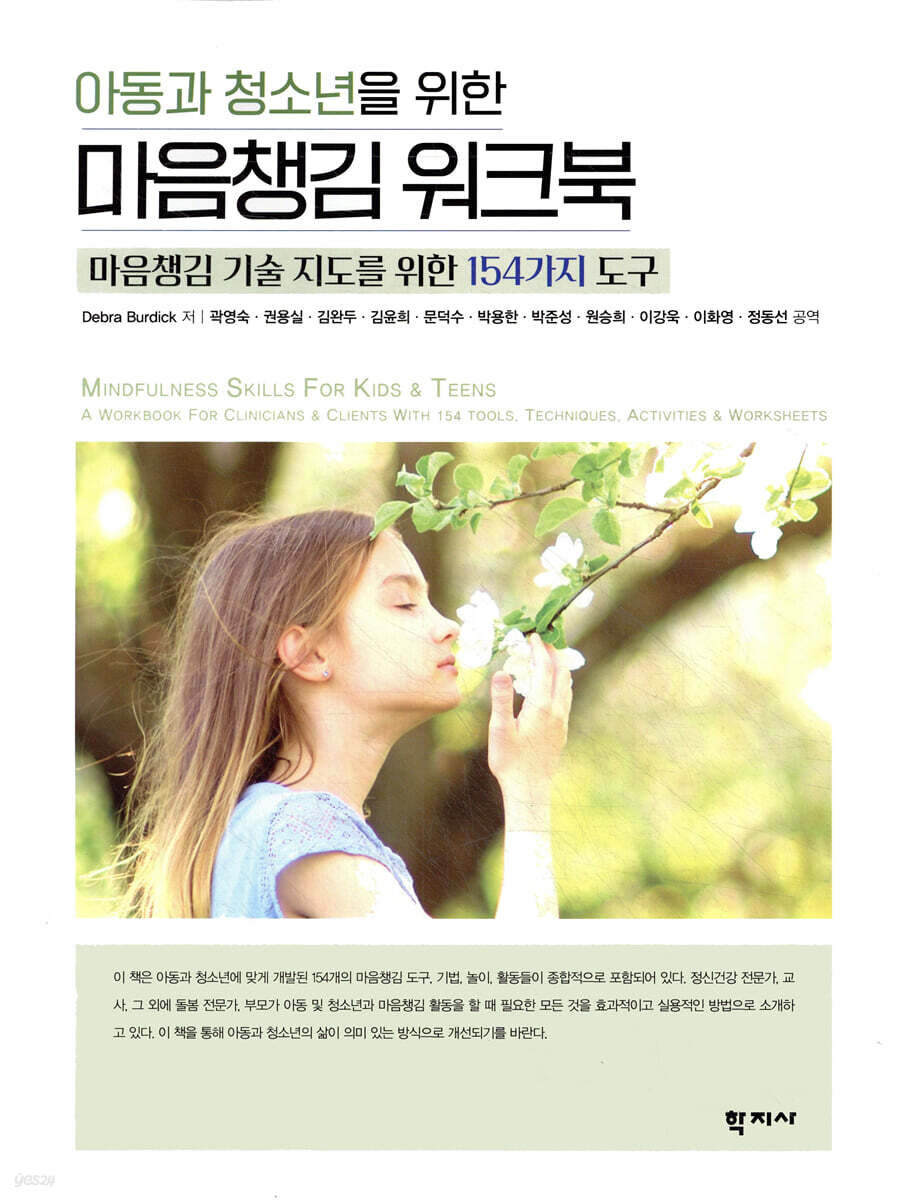
Mindfulness Workbook for Children and Youth
 |
Description
Book Introduction
It is important to know techniques to appropriately manage emotions with children and adolescents.
Because overcoming adversity, big and small, before becoming an adult helps improve one's life in meaningful ways.
However, careful attention is needed when applying mindfulness techniques designed for adults to children and adolescents.
For this reason, more specific guidelines and approaches are needed for professionals who help children and adolescents develop proper mindfulness.
A workbook has been published that addresses these approaches and helps children and adolescents incorporate appropriate mindfulness practices into their daily lives.
This clinically applicable workbook was developed by a team of six psychiatrists, five child psychiatrists, and two meditation experts.
Translated based on solid expertise, this book first introduces the essential fundamental knowledge, perspectives, and practical approaches for understanding children and adolescents.
Then, it presents 154 different mindfulness tools in detail.
Going beyond the existing mindfulness books that simply contain theory, research, and a few examples of mindfulness techniques, this book comprehensively covers mindfulness techniques, skills, games, and activities developed specifically for children and adolescents.
This book, which serves as a mindfulness prescription, offers approaches, tools, activities, and techniques suitable for a variety of mental health issues and conditions, including sleep and pain, and can be applied in a variety of settings.
Furthermore, because it is comprised of easy-to-apply techniques, techniques, games, and activities, you can enjoy using these techniques at home and enhance the healing effects of mindfulness.
We hope this workbook will be a valuable resource for anyone considering systematically helping children and adolescents.
Because overcoming adversity, big and small, before becoming an adult helps improve one's life in meaningful ways.
However, careful attention is needed when applying mindfulness techniques designed for adults to children and adolescents.
For this reason, more specific guidelines and approaches are needed for professionals who help children and adolescents develop proper mindfulness.
A workbook has been published that addresses these approaches and helps children and adolescents incorporate appropriate mindfulness practices into their daily lives.
This clinically applicable workbook was developed by a team of six psychiatrists, five child psychiatrists, and two meditation experts.
Translated based on solid expertise, this book first introduces the essential fundamental knowledge, perspectives, and practical approaches for understanding children and adolescents.
Then, it presents 154 different mindfulness tools in detail.
Going beyond the existing mindfulness books that simply contain theory, research, and a few examples of mindfulness techniques, this book comprehensively covers mindfulness techniques, skills, games, and activities developed specifically for children and adolescents.
This book, which serves as a mindfulness prescription, offers approaches, tools, activities, and techniques suitable for a variety of mental health issues and conditions, including sleep and pain, and can be applied in a variety of settings.
Furthermore, because it is comprised of easy-to-apply techniques, techniques, games, and activities, you can enjoy using these techniques at home and enhance the healing effects of mindfulness.
We hope this workbook will be a valuable resource for anyone considering systematically helping children and adolescents.
index
Translator's Preface
Part 1 Introduction
Chapter 1 Introduction
Tools for Integrating Mindfulness into Part 2 Training
Chapter 2: Customized Mindfulness Tools
Tool 2-1 Involving Parents in Training
Tool 2-2 Considering Age, Development, and Cognitive Level
Tool 2-3: Applying Adult Mindfulness Skills to Children
Tool 2-4: Creating Mindfulness Skills Appropriate for Teens
Tool 2-5: Noticing the Whole Child, Including Body, Mind, and Heart
Tool 2-6: Organizing a Mindfulness Session
Chapter 3: Tools to Explain What Mindfulness Is
Explaining the definition of mindfulness
Tool 3-1 Defining Mindfulness
Tool 3-2 Busy Mind vs. Calm Mind
Tool 3-3: Making a Mindful Glitter Water Bottle
Tool 3-4: Clapping to the rhythm to demonstrate mindfulness
Core Tools
Tool 3-5 Goal Setting
Tool 3-6: Using the Mindfulness Bell
Tool 3-7 Strengthening Awareness
Tool 3-8 Controlling Attention (Focus)
Tool 3-9: Strengthening Self-Regulation (Using Words and Colors as Body-Mind Signals)
Tool 3-10: Recording Your Mindfulness Awareness
The Neurobiology of Mindfulness
Tool 3-11 Understanding What Neuroplasticity Is and Why It's Important to Us
Tool 3-12: Understanding the Role of the Prefrontal Cortex
Tool 3-13: Understanding the Role of the Amygdala
Tool 3-14 Passing the Beads
Tool 3-15: Understanding the Role of the Insula
Tool 3-16 Feeling the Pulse
Tool 3-17: Logging Your Safety Assistant and Leader
An easy way to understand the brain's anatomy
Tool 3-18 Brain Hand Model
Tool 3-19 Nerve-Hand-Elbow Model
Tool 3-20 Brain Structure
Tools to explain research
Tool 3-21 Explaining Mindfulness Research to Parents, Children, and Adolescents
Tool 3-22: Reviewing the Benefits of Mindfulness Research for Clients
Tool 3-23: Journaling about why mindfulness helps you
Chapter 4: Tools for Increasing Mindfulness Practice at Home
Tool 4-1 Find a comfortable position
Tool 4-2 Finding Effective Time
Tool 4-3: Finding a Place for Core Mindfulness Training
Tool 4-4: Incorporating Mindfulness into Daily Life
Tools 4-5 Involving Parents
Journaling about your plan to use mindfulness tools 4-6
Chapter 5: Tools for Teaching the Basics of Mindfulness
Basic Course of Mindfulness
Tool 5-1: Notice, Accept, Ignore, and Undo
Training with clients
Tool 5-2 Find opportunities to introduce concepts in sessions
Tool 5-3: Try Mindfulness Tool Training
The process that happens to the client
Tool 5-4 Find out what happened during or after training
Tool 5-5: Dealing with Situations Where Clients Don't Train
How to identify and overcome obstacles and resistance
Tool 5-6 Recognizing Common Obstacles
Tool 5-7: Resolving Client Refusal
Tool 5-8 Journaling About Rejection and Overcoming It
Tools to engage clients in mindfulness
Tool 5-9: Finding Out What Your Client Thinks About Mindfulness
Tool 5-10: Telling Your Client What Mindfulness Practices They're Already Doing
Tool 5-11 How to Start Small and Where the Client Is
Tools 5-12: Choosing the Best Mindfulness Tool for Your Client
Tool 5-13 Explaining Mindfulness to Help Youth
Tool 5-14 Getting Parental Support
How to connect the effects of specific tools to the client's condition
Tool 5-15: Connecting Client Conditions to Benefits
Tool 5-16: Journaling about how mindfulness can help your client
Part 3: Tools for Teaching Specific Mindfulness Skills
Chapter 6 Mindfulness of Breathing
Tool 6-1 How to Breathe
Tool 6-2 How to breathe (smell the flowers)
Tool 6-3 How to Exhale (Blowing Bubbles, Toilet Paper, Pinwheels, Balloons, Candles)
Tool 6-4 Basic Relaxation Breathing
Tool 6-5 How to Practice Abdominal Breathing
Tool 6-6 Three Tips for Abdominal Breathing
Tool 6-7 Try breathing quickly and then slowly
Tool 6-8 Core Training
Tool 6-9: Core abdominal breathing exercise with an animal doll or smartphone placed on the stomach
Tool 6-10 Count your breaths by counting from 1 to 4 as one unit.
Tool 6-11: Breathing Mindfulness Journaling
Chapter 7: Awareness of the Present Moment
Mindfulness with your surroundings
Tool 7-1 Mindfulness of Your Surroundings (Indoors)
Tool 7-2 Mindfulness in Nature (Outdoors)
Awareness of things
Tool 7-3: Examine Any Object with a Beginner's Mind
Tool 7-4 Water Cup Observation Game
Open focus
Tool 7-5 Feeling the Space Between
journal
Tool 7-6: Journal about how being aware of this present moment changes your day.
Chapter 8: Mindful Listening
Tool 8-1 Listen to the bell
Tool 8-2 Listen to the sounds in the room
Tool 8-3 Dance until the music stops
Tool 8-4 Listen to the Sound of the Sea
Tool 8-5 Listen to the sound of music
Tool 8-6 Playing the Drums Together
Listen to the Tool 8-7 Relay Game
View Chapter 9 Mindfulness
Tool 9-1 Recognizing Objects
Tool 9-2 Remembering Objects
Tool 9-3 Describe or Draw
Tool 9-4 Hello, I'm watching you!
Tool 9-5 Simon said
Chapter 10: Mindful Eating
Tool 10-1 Gustatory Mindfulness Tester
Tool 10-2: Taste Mindfulness Connection Game
Tool 10-3 Mindful Eating
Chapter 11: Mindfulness of the Sense of Smell
Tool 11-1 Imagine the smell
Tool 11-2 Guess the Name of the Smell
Tool 11-3: Experience Different Types of Smells
Chapter 12: Mindfulness of Contact
Tool 12-1 Ice Sculpting Game
Tool 12-2 Texture Feeling Game
Tool 12-3 What is this game?
Tool 12-4 Object Guessing Game
Chapter 13: Mindfulness of Movement
Tool 13-1 Mindful Walking
Tool 13-2 Movement Mindfulness
Tool 13-3 Dancing
Tool 13-4 Shouting
Tool 13-5: Keeping a Movement Mindfulness Journal
Chapter 14: Mindfulness of Thought
Tool 14-1 Floating in the Pool
Tool 14-2 Writing on an Erasable Whiteboard
Tool 14-3 Interrupting Thoughts
Tool 14-4 Channel Change
Tool 14-5: Changing Automatic Negative Thoughts
Tool 14-6 Past, Present, and Future Games
Tool 14-7 Meditation for Concentration
Tool 14-8 Mindfulness Journaling
Chapter 15: Mindfulness of Emotions
Tool 15-1: Becoming Aware of the Various Emotional Processes
Tool 15-2 Emotional Mindfulness Meditation
Tool 15-3 'I feel...' Game
Tool 15-4 Naming Emotions
Tool 15-5 Core Warmth
Tool 15-6: Emotional Mindfulness Journaling
Chapter 16: Mindfulness of the Body
Tool 16-1 Progressive Muscle Relaxation
Tool 16-2 Relaxation Response
Tool 16-3 Body Exploration
Tool 16-4 Listening to My Body
Tool 16-5 Feeling the Snow as It Falls
Tool 16-6 Body Sense Game
Tool 16-7 Chip Balancing Game
Tool 16-8 Health Memory
Tool 16-9: Writing a Body Awareness Journal
Chapter 17: Relationship Mindfulness
Tool 17-1 Mindful Greeting
Tool 17-2 Relationships
Tool 17-3 Relationship Mindfulness for Children
Tool 17-4 Relationship Mindfulness for Teens
Chapter 18: Mindfulness of Work
Tool 18-1 Mindfulness in Daily Life
Tool 18-2 Mindfulness Homework
Tool 18-3: Journaling to Improve Mindfulness
Chapter 19: Loving-Kindness Mindfulness
Tool 19-1 Compassion for Self and Others
Tool 19-2 Kind Acts
Chapter 20: Mindfulness of Intention
Tool 20-1: Exploring True Intentions
Tool 20-2 Meditation
Chapter 21: Intuitive Mindfulness (Older Children and Adolescents)
Tool 21-1: Synchronizing
Tool 21-2 Intuitive Mindfulness Meditation
Tool 21-3: Writing an Intuition Mindfulness Journal
Part 4: Tools for Using Mindfulness for Specific Mental Health Issues
Chapter 22 Mood Disorders
melancholy
Tool 22-1: Become Free from Depression in This Moment
Tool 22-2 Finding Thoughts That Make You Feel Good
unrest
Tool 22-3 Reducing and Eliminating Anxiety
Tool 22-4 Channel Change
panic attack
Tool 22-5 Stopping and Preventing Panic Attacks
Post-traumatic stress disorder (PTSD)
Tool 22-6 Reducing PTSD Symptoms
Contact Tool 22-7
Obsessive-compulsive disorder
Tool 22-8: Becoming More Aware of Obsessions
Tool 22-9 Reducing Obsessions and Compulsions
Chapter 23 Attention Deficit Hyperactivity Disorder (ADHD)
Tool 23-1: Developing Concentration
Tool 23-2 Reduce Hyperactivity
Chapter 24 Chronic Pain, Medical Conditions, and Sleep Disorders
chronic pain
Tool 24-1 Managing Pain
Tool 24-2 Treating Pain
chronic medical conditions
Tool 24-3 Remembering Health
sleep disorders
Tool 24-4 Sleeping Tonight
Chapter 25: Stress and Anger
stress
Tool 25-1 Reducing Stress Responses
anger
Tool 25-2 Sending Out Rage
Tool 25-3 Don't get too angry
Chapter 26 Autism Spectrum Disorder
Tool 26-1: Reduce Aggression
Tool 26-2 Coping with Sensory Overload
Part 5 Tools for Tracking Progress
Chapter 27: Tracking Progress
Tool 27-1 Setting Treatment Goals
Tool 27-2 Tracking Symptoms
References
Part 1 Introduction
Chapter 1 Introduction
Tools for Integrating Mindfulness into Part 2 Training
Chapter 2: Customized Mindfulness Tools
Tool 2-1 Involving Parents in Training
Tool 2-2 Considering Age, Development, and Cognitive Level
Tool 2-3: Applying Adult Mindfulness Skills to Children
Tool 2-4: Creating Mindfulness Skills Appropriate for Teens
Tool 2-5: Noticing the Whole Child, Including Body, Mind, and Heart
Tool 2-6: Organizing a Mindfulness Session
Chapter 3: Tools to Explain What Mindfulness Is
Explaining the definition of mindfulness
Tool 3-1 Defining Mindfulness
Tool 3-2 Busy Mind vs. Calm Mind
Tool 3-3: Making a Mindful Glitter Water Bottle
Tool 3-4: Clapping to the rhythm to demonstrate mindfulness
Core Tools
Tool 3-5 Goal Setting
Tool 3-6: Using the Mindfulness Bell
Tool 3-7 Strengthening Awareness
Tool 3-8 Controlling Attention (Focus)
Tool 3-9: Strengthening Self-Regulation (Using Words and Colors as Body-Mind Signals)
Tool 3-10: Recording Your Mindfulness Awareness
The Neurobiology of Mindfulness
Tool 3-11 Understanding What Neuroplasticity Is and Why It's Important to Us
Tool 3-12: Understanding the Role of the Prefrontal Cortex
Tool 3-13: Understanding the Role of the Amygdala
Tool 3-14 Passing the Beads
Tool 3-15: Understanding the Role of the Insula
Tool 3-16 Feeling the Pulse
Tool 3-17: Logging Your Safety Assistant and Leader
An easy way to understand the brain's anatomy
Tool 3-18 Brain Hand Model
Tool 3-19 Nerve-Hand-Elbow Model
Tool 3-20 Brain Structure
Tools to explain research
Tool 3-21 Explaining Mindfulness Research to Parents, Children, and Adolescents
Tool 3-22: Reviewing the Benefits of Mindfulness Research for Clients
Tool 3-23: Journaling about why mindfulness helps you
Chapter 4: Tools for Increasing Mindfulness Practice at Home
Tool 4-1 Find a comfortable position
Tool 4-2 Finding Effective Time
Tool 4-3: Finding a Place for Core Mindfulness Training
Tool 4-4: Incorporating Mindfulness into Daily Life
Tools 4-5 Involving Parents
Journaling about your plan to use mindfulness tools 4-6
Chapter 5: Tools for Teaching the Basics of Mindfulness
Basic Course of Mindfulness
Tool 5-1: Notice, Accept, Ignore, and Undo
Training with clients
Tool 5-2 Find opportunities to introduce concepts in sessions
Tool 5-3: Try Mindfulness Tool Training
The process that happens to the client
Tool 5-4 Find out what happened during or after training
Tool 5-5: Dealing with Situations Where Clients Don't Train
How to identify and overcome obstacles and resistance
Tool 5-6 Recognizing Common Obstacles
Tool 5-7: Resolving Client Refusal
Tool 5-8 Journaling About Rejection and Overcoming It
Tools to engage clients in mindfulness
Tool 5-9: Finding Out What Your Client Thinks About Mindfulness
Tool 5-10: Telling Your Client What Mindfulness Practices They're Already Doing
Tool 5-11 How to Start Small and Where the Client Is
Tools 5-12: Choosing the Best Mindfulness Tool for Your Client
Tool 5-13 Explaining Mindfulness to Help Youth
Tool 5-14 Getting Parental Support
How to connect the effects of specific tools to the client's condition
Tool 5-15: Connecting Client Conditions to Benefits
Tool 5-16: Journaling about how mindfulness can help your client
Part 3: Tools for Teaching Specific Mindfulness Skills
Chapter 6 Mindfulness of Breathing
Tool 6-1 How to Breathe
Tool 6-2 How to breathe (smell the flowers)
Tool 6-3 How to Exhale (Blowing Bubbles, Toilet Paper, Pinwheels, Balloons, Candles)
Tool 6-4 Basic Relaxation Breathing
Tool 6-5 How to Practice Abdominal Breathing
Tool 6-6 Three Tips for Abdominal Breathing
Tool 6-7 Try breathing quickly and then slowly
Tool 6-8 Core Training
Tool 6-9: Core abdominal breathing exercise with an animal doll or smartphone placed on the stomach
Tool 6-10 Count your breaths by counting from 1 to 4 as one unit.
Tool 6-11: Breathing Mindfulness Journaling
Chapter 7: Awareness of the Present Moment
Mindfulness with your surroundings
Tool 7-1 Mindfulness of Your Surroundings (Indoors)
Tool 7-2 Mindfulness in Nature (Outdoors)
Awareness of things
Tool 7-3: Examine Any Object with a Beginner's Mind
Tool 7-4 Water Cup Observation Game
Open focus
Tool 7-5 Feeling the Space Between
journal
Tool 7-6: Journal about how being aware of this present moment changes your day.
Chapter 8: Mindful Listening
Tool 8-1 Listen to the bell
Tool 8-2 Listen to the sounds in the room
Tool 8-3 Dance until the music stops
Tool 8-4 Listen to the Sound of the Sea
Tool 8-5 Listen to the sound of music
Tool 8-6 Playing the Drums Together
Listen to the Tool 8-7 Relay Game
View Chapter 9 Mindfulness
Tool 9-1 Recognizing Objects
Tool 9-2 Remembering Objects
Tool 9-3 Describe or Draw
Tool 9-4 Hello, I'm watching you!
Tool 9-5 Simon said
Chapter 10: Mindful Eating
Tool 10-1 Gustatory Mindfulness Tester
Tool 10-2: Taste Mindfulness Connection Game
Tool 10-3 Mindful Eating
Chapter 11: Mindfulness of the Sense of Smell
Tool 11-1 Imagine the smell
Tool 11-2 Guess the Name of the Smell
Tool 11-3: Experience Different Types of Smells
Chapter 12: Mindfulness of Contact
Tool 12-1 Ice Sculpting Game
Tool 12-2 Texture Feeling Game
Tool 12-3 What is this game?
Tool 12-4 Object Guessing Game
Chapter 13: Mindfulness of Movement
Tool 13-1 Mindful Walking
Tool 13-2 Movement Mindfulness
Tool 13-3 Dancing
Tool 13-4 Shouting
Tool 13-5: Keeping a Movement Mindfulness Journal
Chapter 14: Mindfulness of Thought
Tool 14-1 Floating in the Pool
Tool 14-2 Writing on an Erasable Whiteboard
Tool 14-3 Interrupting Thoughts
Tool 14-4 Channel Change
Tool 14-5: Changing Automatic Negative Thoughts
Tool 14-6 Past, Present, and Future Games
Tool 14-7 Meditation for Concentration
Tool 14-8 Mindfulness Journaling
Chapter 15: Mindfulness of Emotions
Tool 15-1: Becoming Aware of the Various Emotional Processes
Tool 15-2 Emotional Mindfulness Meditation
Tool 15-3 'I feel...' Game
Tool 15-4 Naming Emotions
Tool 15-5 Core Warmth
Tool 15-6: Emotional Mindfulness Journaling
Chapter 16: Mindfulness of the Body
Tool 16-1 Progressive Muscle Relaxation
Tool 16-2 Relaxation Response
Tool 16-3 Body Exploration
Tool 16-4 Listening to My Body
Tool 16-5 Feeling the Snow as It Falls
Tool 16-6 Body Sense Game
Tool 16-7 Chip Balancing Game
Tool 16-8 Health Memory
Tool 16-9: Writing a Body Awareness Journal
Chapter 17: Relationship Mindfulness
Tool 17-1 Mindful Greeting
Tool 17-2 Relationships
Tool 17-3 Relationship Mindfulness for Children
Tool 17-4 Relationship Mindfulness for Teens
Chapter 18: Mindfulness of Work
Tool 18-1 Mindfulness in Daily Life
Tool 18-2 Mindfulness Homework
Tool 18-3: Journaling to Improve Mindfulness
Chapter 19: Loving-Kindness Mindfulness
Tool 19-1 Compassion for Self and Others
Tool 19-2 Kind Acts
Chapter 20: Mindfulness of Intention
Tool 20-1: Exploring True Intentions
Tool 20-2 Meditation
Chapter 21: Intuitive Mindfulness (Older Children and Adolescents)
Tool 21-1: Synchronizing
Tool 21-2 Intuitive Mindfulness Meditation
Tool 21-3: Writing an Intuition Mindfulness Journal
Part 4: Tools for Using Mindfulness for Specific Mental Health Issues
Chapter 22 Mood Disorders
melancholy
Tool 22-1: Become Free from Depression in This Moment
Tool 22-2 Finding Thoughts That Make You Feel Good
unrest
Tool 22-3 Reducing and Eliminating Anxiety
Tool 22-4 Channel Change
panic attack
Tool 22-5 Stopping and Preventing Panic Attacks
Post-traumatic stress disorder (PTSD)
Tool 22-6 Reducing PTSD Symptoms
Contact Tool 22-7
Obsessive-compulsive disorder
Tool 22-8: Becoming More Aware of Obsessions
Tool 22-9 Reducing Obsessions and Compulsions
Chapter 23 Attention Deficit Hyperactivity Disorder (ADHD)
Tool 23-1: Developing Concentration
Tool 23-2 Reduce Hyperactivity
Chapter 24 Chronic Pain, Medical Conditions, and Sleep Disorders
chronic pain
Tool 24-1 Managing Pain
Tool 24-2 Treating Pain
chronic medical conditions
Tool 24-3 Remembering Health
sleep disorders
Tool 24-4 Sleeping Tonight
Chapter 25: Stress and Anger
stress
Tool 25-1 Reducing Stress Responses
anger
Tool 25-2 Sending Out Rage
Tool 25-3 Don't get too angry
Chapter 26 Autism Spectrum Disorder
Tool 26-1: Reduce Aggression
Tool 26-2 Coping with Sensory Overload
Part 5 Tools for Tracking Progress
Chapter 27: Tracking Progress
Tool 27-1 Setting Treatment Goals
Tool 27-2 Tracking Symptoms
References
GOODS SPECIFICS
- Date of issue: September 30, 2024
- Format: Paperback book binding method guide
- Page count, weight, size: 424 pages | 210*280*18mm
- ISBN13: 9788999732256
You may also like
카테고리
korean


korean

![GQ KOREA Mark (Monthly): December [2025]](http://librairie.coreenne.fr/cdn/shop/files/8ef265dbbfbf186523ed75ba7319009d.jpg?v=1765340328&width=3840)


