

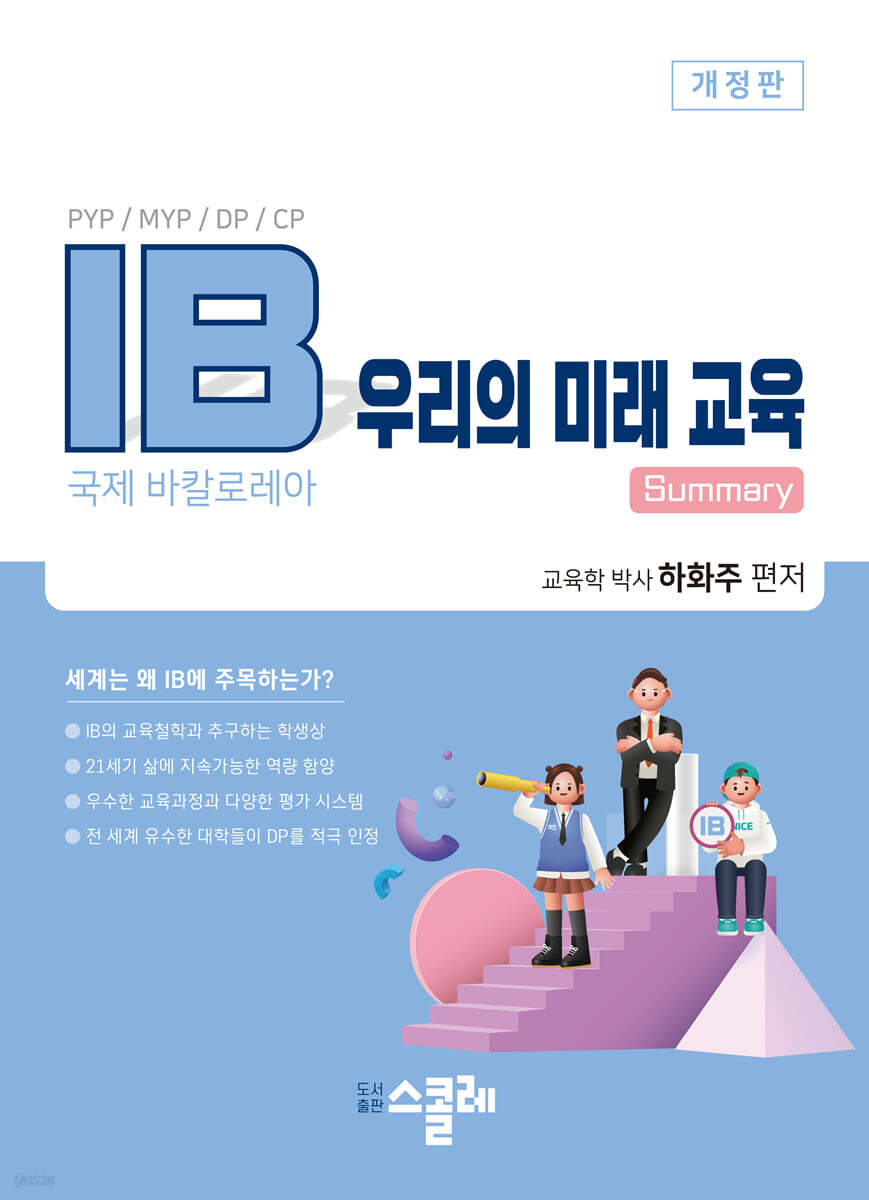
IB Our Future Education
 |
Description
index
PART 1 IB: A Paradigm for Future Education 11
Lecture 1: Why is the world paying attention to IB? 12
1. Institutions that provide IB education and their functions 12
2. History of IB Education and International Standard Education Program 14
3.
Why is the world paying attention to IB? 15
4.
The Growth and Current Status of IB Education Worldwide 20
5. Introduction of the IB Korean Program 22
6.
The spread of the IB education program in Korea 23
Lecture 2: IB's Educational Philosophy and the Student I Want 24
1. What it means to “have an IB education” 24
2. IB Educational Goals and Philosophy 25
3. IB's Mission Statement 26
4. IB Goals and Student Vision 26
5. Intellectual Honesty in IB Education 28
6. Comparison of the educational goals and ideal talents of the IB and domestic curricula 29
PART 2 Overview of the PYP (Primay Years Program), the International Standard Education Program for Kindergarten and Elementary Schools 31
Lesson 3: PYP Fundamentals and Curriculum Framework 32
1. Basic understanding of PYP 32
2. PYP Educational Philosophy and Philosophy 33
3. PYP Curriculum Framework 34
4. Essential Elements for PYP Operation 36
5. The Meaning of the Five PYP Elements 41
Lesson 4: Core to the PYP Curriculum: Transdisciplinary Topics and Subjects 42
1. PYP Curriculum Philosophy 42
2. PYP Curriculum Model 42
3.
Knowledge: Application of Transdisciplinary Themes 43
4.
Knowledge: PYP Six Subjects 46
Lesson 5: PYP Curriculum Design and Implementation 50
1. 3 Dimensions of the PYP Curriculum 50
2. Core of the PYP Documented Curriculum: POI & UOI 50
3.
Overview of the Core POIs and UOIs of the Documented Curriculum 51
4.
Element 53 of the Unit of Inquiry (UOI)
5.
53 Things to Consider When Creating a Documented Curriculum (POI&UOI)
6. PYP Curriculum Document (POI) Example 54
7. Teaching and Learning Methods for the PYP Curriculum 58
8. Assessment in PYP Education 59
9. PYP Exhibition (Academic Presentation) 59
10. 10 Benefits of PYP Education 61
11. Current Status of PYP Education in Korea (Daegu Office of Education Case) 62
PART 3 Overview of the Middle Years Program (MYP) 63
Lesson 6: MYP Basic Concepts and Curriculum Framework 64
1. Basic Understanding of MYP 64
2. Key Features of the MYP Program Operation 66
3. Understanding the MYP Education Program Model 67
4. Educational Objectives and Emphasis of MYP Curriculum 69
5.
Community Project/Personal Project 73
Lesson 7: Core Elements of the MYP Curriculum Framework 74
1. Characteristics of the MYP Curriculum Framework 74
2. Foundation of the MYP Curriculum: Concept 75
3.
Key Concepts and Related Concepts 77
4. The MYP Curriculum and Foundations of Teaching and Learning: Global Context 79
5. MYP Teaching Approach: ATT (Approaches to Teaching) 80
6. MYP Learning Approach: ATL (Approaches to Learning) 81
Lesson 8: Understanding IB MYP Course Design and Assessment Methods 00
1. MYP Unit Plan Form and Step 82
2. Create and implement MYP unit plan 85
3. Understanding the MYP Assessment Method 89
4. MYP and the 2015 Revised Curriculum 92
PART 4 Overview of the Diploma Program (DP) for High Schools with International Standards 93
Lecture 9: DP Basic Concepts and Curriculum Framework 94
1. Basic Understanding of the IB Diploma Program (DP) 94
2. Structure of the IB DP (Diploma Program) Model 99
3. IBDP Curriculum Structure 100
4. IBDP Subject Completion System 100
5. IBDP subject completion hours 100
6. IBDP Subject-Specific Electives 101
7. IBDP Dual Language Program: DLDP (Dual Language Diploma Program) 102
Lesson 10: Overview of the IBDP Core Requirements 103
1.
Overview of the Theory of Knowledge (TOK) 104
2.
Overview of the Extended Essay (EE) 108
3. CAS (Creativity, Activism, Service) Overview 109
Lesson 11: Overview of the IBDP Assessment System 111
1.
Diploma Program Evaluation Features 111
2.
Diploma Program Evaluation Policy 111
3.
Calculating the Diploma Program Evaluation Score 111
4.
Internal and External Evaluation Methods of the Diploma Program 112
5. Detailed External Assessment Methods for IBDP Subjects 112
6.
Knowledge Theory and Essay Grading Method 113
7. IBDP Internal and External Assessment Grading Coordination System 113
8. IB Diploma Requirements 115
9. IBDP External Assessment (Example) 116
10. IBDP Pass Rate and Average Score: 118
Lecture 12: IBDP Curriculum Design and Evaluation - Focusing on Group 1 Areas 119
1.
Overview of Group 1 Subjects 119
2.
121 Major Reinforcement of the Curriculum for Group 1 Subjects
3.
Group 1 Korean Literature Curriculum Design (Example) 122
4.
Group 1 Korean Literature Evaluation Overview 123
5.
Group 1 Korean Literature Evaluation Questions (Example) 126
6. The Implications of the IBDP Program for Korean Education 126
PART 5: An Overview of the Career Program (CP), an Alternative for Simultaneous Preparation for College and Employment 127
Lecture 13: Understanding the Background, History, and Curriculum Structure of the IBCP (128)
1. Background of the Introduction of IBCP 128
2. History of IBCP 128
3. Basic Understanding of IBCP 129
4.
Pavement to Employment 130
5. IBCP Curriculum Structure 131
6. IBCP's Realistic Challenges 135
PART 6 Comparison and Acceptance of the Korean Curriculum and the IB Program 137
Lecture 14: The IB Curriculum and the 2015 Revised Curriculum 138
1.
The Basis and Educational Issues of Introducing the IB Program into the Korean Curriculum 138
2. Comparison of the educational goals, ideal students, and core competencies of the IB and national curriculums 139
3.
Comparison of the Structure of Curriculum Structures 140
4.
The Relationship Between the Domestic High School Curriculum and the IBDP Subject Structure 141
5.
Comparison of Class Hour Management Methods 142
6.
Comparing Extracurricular Activities: Creative Experiential Activities and IB's CAS 143
7.
Comprehensive Comparison of the 2015 Revised Curriculum and the IBDP 144
8.
IBDP Acceptance Framework 145 in the 2015 Revised Curriculum
9. IBDP Curriculum Subject Organization Example 145
10. IBDP Curriculum NEIS Registration Example 147
11. Accepting the IBDP assessment into NEIS 148
12. IBDP and University Entrance Exams 150
Lecture 15: IB Program Comparison and Implementation Procedures 151
1. Summary and Comparison of IB Programs 151
2. Procedures for Becoming an IB-Certified School 154
3. Step-by-step tasks to become an IB-accredited school 157
4. Essential Considerations for Introducing the IB Program 158
5.
The Role of IB Schools and IB Headquarters in Quality Assurance 158
PART 7 Conclusion: A Shift in Perception 161
1.
A Shift in Perception 1 162
2.
A Shift in Perception 2 162
3.
A Shift in Perception 3 163
4.
A Shift in Perception 4 163
· References 164
· Web-based search resources 169
Lecture 1: Why is the world paying attention to IB? 12
1. Institutions that provide IB education and their functions 12
2. History of IB Education and International Standard Education Program 14
3.
Why is the world paying attention to IB? 15
4.
The Growth and Current Status of IB Education Worldwide 20
5. Introduction of the IB Korean Program 22
6.
The spread of the IB education program in Korea 23
Lecture 2: IB's Educational Philosophy and the Student I Want 24
1. What it means to “have an IB education” 24
2. IB Educational Goals and Philosophy 25
3. IB's Mission Statement 26
4. IB Goals and Student Vision 26
5. Intellectual Honesty in IB Education 28
6. Comparison of the educational goals and ideal talents of the IB and domestic curricula 29
PART 2 Overview of the PYP (Primay Years Program), the International Standard Education Program for Kindergarten and Elementary Schools 31
Lesson 3: PYP Fundamentals and Curriculum Framework 32
1. Basic understanding of PYP 32
2. PYP Educational Philosophy and Philosophy 33
3. PYP Curriculum Framework 34
4. Essential Elements for PYP Operation 36
5. The Meaning of the Five PYP Elements 41
Lesson 4: Core to the PYP Curriculum: Transdisciplinary Topics and Subjects 42
1. PYP Curriculum Philosophy 42
2. PYP Curriculum Model 42
3.
Knowledge: Application of Transdisciplinary Themes 43
4.
Knowledge: PYP Six Subjects 46
Lesson 5: PYP Curriculum Design and Implementation 50
1. 3 Dimensions of the PYP Curriculum 50
2. Core of the PYP Documented Curriculum: POI & UOI 50
3.
Overview of the Core POIs and UOIs of the Documented Curriculum 51
4.
Element 53 of the Unit of Inquiry (UOI)
5.
53 Things to Consider When Creating a Documented Curriculum (POI&UOI)
6. PYP Curriculum Document (POI) Example 54
7. Teaching and Learning Methods for the PYP Curriculum 58
8. Assessment in PYP Education 59
9. PYP Exhibition (Academic Presentation) 59
10. 10 Benefits of PYP Education 61
11. Current Status of PYP Education in Korea (Daegu Office of Education Case) 62
PART 3 Overview of the Middle Years Program (MYP) 63
Lesson 6: MYP Basic Concepts and Curriculum Framework 64
1. Basic Understanding of MYP 64
2. Key Features of the MYP Program Operation 66
3. Understanding the MYP Education Program Model 67
4. Educational Objectives and Emphasis of MYP Curriculum 69
5.
Community Project/Personal Project 73
Lesson 7: Core Elements of the MYP Curriculum Framework 74
1. Characteristics of the MYP Curriculum Framework 74
2. Foundation of the MYP Curriculum: Concept 75
3.
Key Concepts and Related Concepts 77
4. The MYP Curriculum and Foundations of Teaching and Learning: Global Context 79
5. MYP Teaching Approach: ATT (Approaches to Teaching) 80
6. MYP Learning Approach: ATL (Approaches to Learning) 81
Lesson 8: Understanding IB MYP Course Design and Assessment Methods 00
1. MYP Unit Plan Form and Step 82
2. Create and implement MYP unit plan 85
3. Understanding the MYP Assessment Method 89
4. MYP and the 2015 Revised Curriculum 92
PART 4 Overview of the Diploma Program (DP) for High Schools with International Standards 93
Lecture 9: DP Basic Concepts and Curriculum Framework 94
1. Basic Understanding of the IB Diploma Program (DP) 94
2. Structure of the IB DP (Diploma Program) Model 99
3. IBDP Curriculum Structure 100
4. IBDP Subject Completion System 100
5. IBDP subject completion hours 100
6. IBDP Subject-Specific Electives 101
7. IBDP Dual Language Program: DLDP (Dual Language Diploma Program) 102
Lesson 10: Overview of the IBDP Core Requirements 103
1.
Overview of the Theory of Knowledge (TOK) 104
2.
Overview of the Extended Essay (EE) 108
3. CAS (Creativity, Activism, Service) Overview 109
Lesson 11: Overview of the IBDP Assessment System 111
1.
Diploma Program Evaluation Features 111
2.
Diploma Program Evaluation Policy 111
3.
Calculating the Diploma Program Evaluation Score 111
4.
Internal and External Evaluation Methods of the Diploma Program 112
5. Detailed External Assessment Methods for IBDP Subjects 112
6.
Knowledge Theory and Essay Grading Method 113
7. IBDP Internal and External Assessment Grading Coordination System 113
8. IB Diploma Requirements 115
9. IBDP External Assessment (Example) 116
10. IBDP Pass Rate and Average Score: 118
Lecture 12: IBDP Curriculum Design and Evaluation - Focusing on Group 1 Areas 119
1.
Overview of Group 1 Subjects 119
2.
121 Major Reinforcement of the Curriculum for Group 1 Subjects
3.
Group 1 Korean Literature Curriculum Design (Example) 122
4.
Group 1 Korean Literature Evaluation Overview 123
5.
Group 1 Korean Literature Evaluation Questions (Example) 126
6. The Implications of the IBDP Program for Korean Education 126
PART 5: An Overview of the Career Program (CP), an Alternative for Simultaneous Preparation for College and Employment 127
Lecture 13: Understanding the Background, History, and Curriculum Structure of the IBCP (128)
1. Background of the Introduction of IBCP 128
2. History of IBCP 128
3. Basic Understanding of IBCP 129
4.
Pavement to Employment 130
5. IBCP Curriculum Structure 131
6. IBCP's Realistic Challenges 135
PART 6 Comparison and Acceptance of the Korean Curriculum and the IB Program 137
Lecture 14: The IB Curriculum and the 2015 Revised Curriculum 138
1.
The Basis and Educational Issues of Introducing the IB Program into the Korean Curriculum 138
2. Comparison of the educational goals, ideal students, and core competencies of the IB and national curriculums 139
3.
Comparison of the Structure of Curriculum Structures 140
4.
The Relationship Between the Domestic High School Curriculum and the IBDP Subject Structure 141
5.
Comparison of Class Hour Management Methods 142
6.
Comparing Extracurricular Activities: Creative Experiential Activities and IB's CAS 143
7.
Comprehensive Comparison of the 2015 Revised Curriculum and the IBDP 144
8.
IBDP Acceptance Framework 145 in the 2015 Revised Curriculum
9. IBDP Curriculum Subject Organization Example 145
10. IBDP Curriculum NEIS Registration Example 147
11. Accepting the IBDP assessment into NEIS 148
12. IBDP and University Entrance Exams 150
Lecture 15: IB Program Comparison and Implementation Procedures 151
1. Summary and Comparison of IB Programs 151
2. Procedures for Becoming an IB-Certified School 154
3. Step-by-step tasks to become an IB-accredited school 157
4. Essential Considerations for Introducing the IB Program 158
5.
The Role of IB Schools and IB Headquarters in Quality Assurance 158
PART 7 Conclusion: A Shift in Perception 161
1.
A Shift in Perception 1 162
2.
A Shift in Perception 2 162
3.
A Shift in Perception 3 163
4.
A Shift in Perception 4 163
· References 164
· Web-based search resources 169
GOODS SPECIFICS
- Date of issue: June 10, 2024
- Page count, weight, size: 172 pages | 190*260*20mm
- ISBN13: 9791198104175
- ISBN10: 1198104171
You may also like
카테고리
korean


korean

![ELLE 엘르 스페셜 에디션 A형 : 12월 [2025]](http://librairie.coreenne.fr/cdn/shop/files/b8e27a3de6c9538896439686c6b0e8fb.jpg?v=1766436872&width=3840)


