

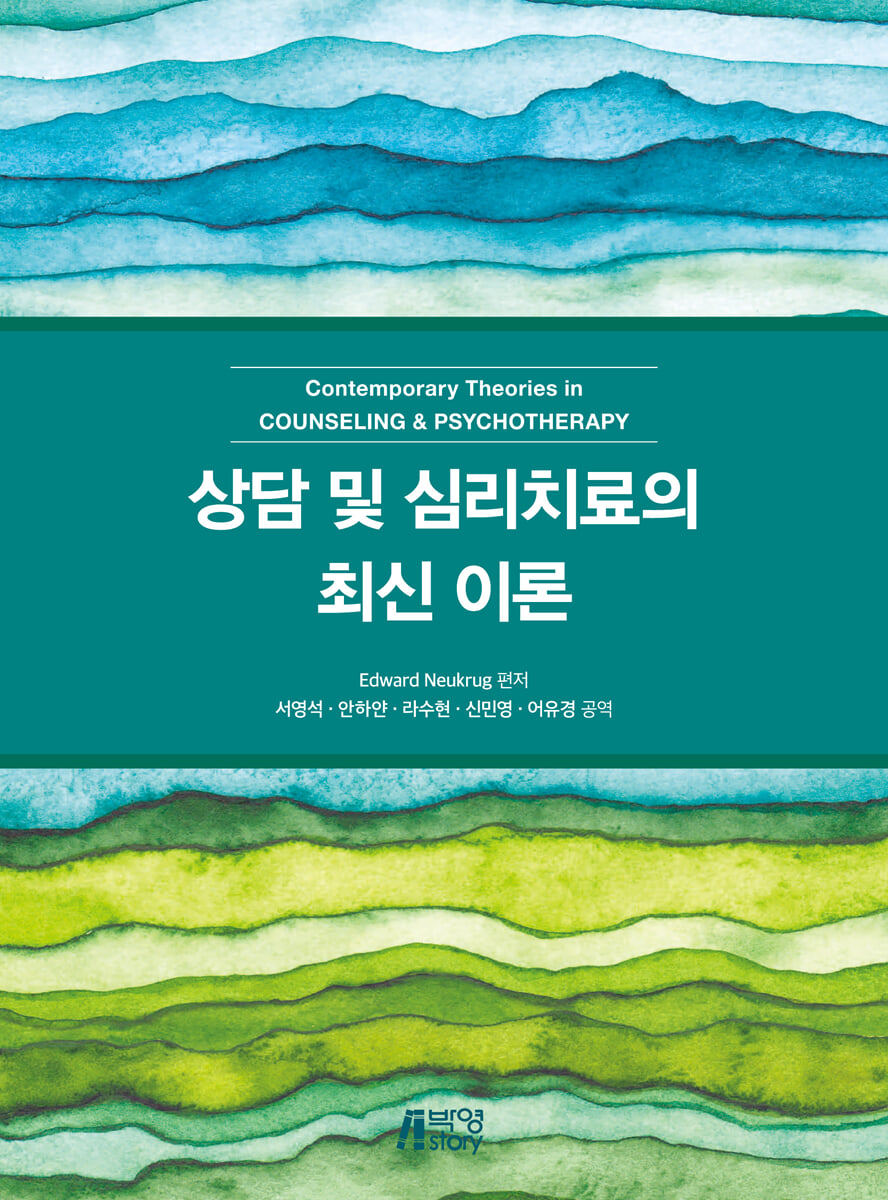
Latest theories in counseling and psychotherapy
 |
Description
Book Introduction
I am very pleased to announce the publication of the first edition of 'Current Theories in Counseling and Psychotherapy'.
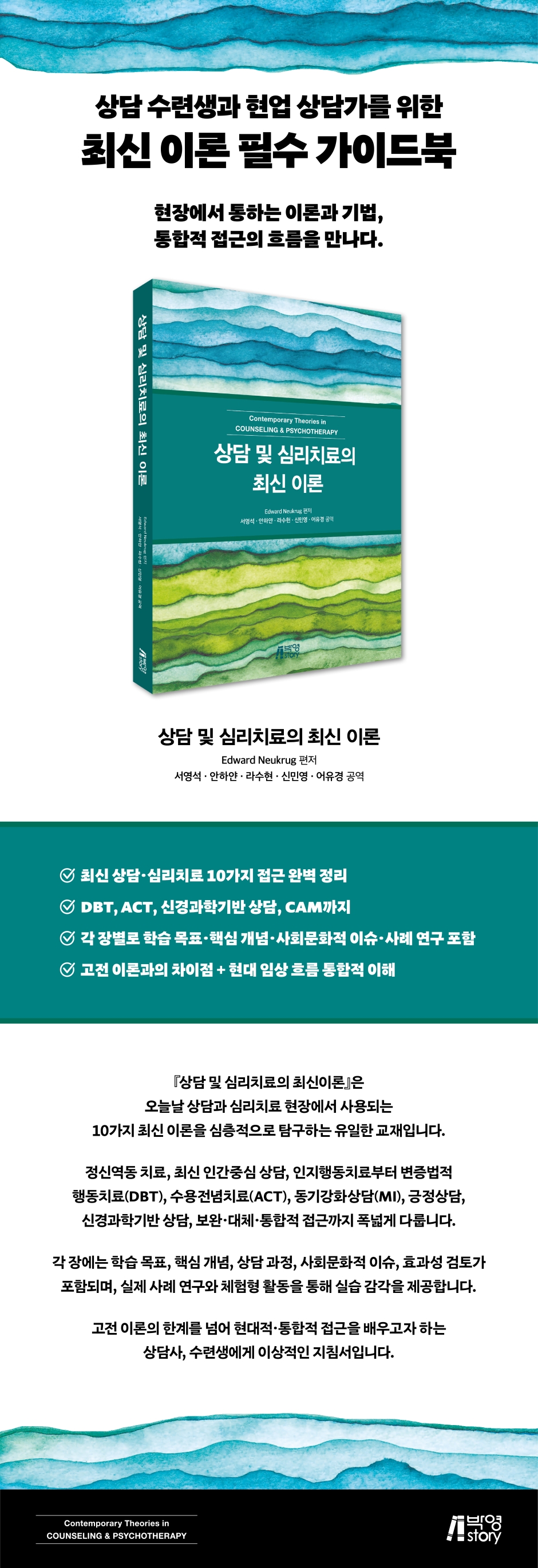
This book may be the first and only textbook to cover the latest theories used by clinicians today.
People in training usually learn classical theories, but rarely do they learn the theories that clinicians use in their work today.
This textbook thoroughly covers the following theories:
This book may be the first and only textbook to cover the latest theories used by clinicians today.
People in training usually learn classical theories, but rarely do they learn the theories that clinicians use in their work today.
This textbook thoroughly covers the following theories:
index
Table of Contents
Author's Preface ⅹ
Translator's Preface ⅹⅵ
1 Contemporary Psychodynamic Therapy 1
2 Contemporary Person-Centered Counseling 39
3 Cognitive Behavior Therapy (CBT) 78
4 Integrative Postmodern Therapy Using Narrative, Solution-Focused, and Relational Cultural Approaches 123
5 Dialectical Behavior Therapy (DBT) 159
6 Acceptance and Commitment Therapy, ACT 209
7 Motivational Interviewing, MI 250
8 Positive Counseling 293
9 Neuroscience-Based Counseling_Neurocounseling 331
10 Complementary, Alternative, and Integrative Modalities 373
Appendix 1: The Miller Family 411
Search 417
Editor's Note 418
About the Author 420
Table of Contents
1 Contemporary Psychodynamic Therapy 1
Ed Neukrug and Kevin C.
Snow
A Brief History of Modern Psychodynamic Therapy 2
Perspectives on Human Nature 5
Core Concept 7
The Conscious and Unconscious Mind 7
Drive and Instinct 8
Defense Mechanism 8
Transference and Countertransference 11
Early Attachment and Relationship Patterns 13
Lifelong Influences 14
Technique 17
Conduct a thorough evaluation 18
Creating an Atmosphere of Trust 20
Use of Questions 20
Free Association 21
Resistance Analysis 21
Dream Analysis 22
Transition Analysis 23
Countertransference exploration 24
Other Techniques 26
Counseling Process 27
Sociocultural Issue 29
Effect 30
Summary 31
Keywords and names 33
Case Study: Angela's Experience with Modern Psychodynamic Therapy 34
37 Questions to Consider
2 Contemporary Person-Centered Counseling 39
Ed Neukrug and Amber Pope
A History of Modern Human-Centered Counseling 40
Views on Human Nature 42
Core Concept 44
Realization tendency 44
Conditions of Value 45
Inconsistent, inauthentic self 46
Symptom 46 as a message to yourself
Unsolved Problem 48
Phenomenology 48
Making Meaning 49
Choice 50
Universal Desires, Repressed Desires 50
Universal Needs 50
Repressed Desire 51
Technique 51
Respect and Respect 51
Normalizing without Pathologizing 52
Acceptance 52
Sympathy 53
56 Creative and New Empathic Responses
Authenticity 58
Question Usage 59
Using the Language of 'Now' 61
Empty Chair Technique 62
Confirm your selection and set your goals 63
Giving Advice, Speaking Your Mind 64
Other techniques 65
Counseling Process 65
First counseling session 65
Early part of the consultation 65
Counseling Part 66
Second half of the consultation 66
Sociocultural Issues 67
Effect 68
Summary 69
Key words and names 72
Case Study: Markus's Experience with Modern Person-Centered Counseling 73
76 Questions to Consider
3 Cognitive Behavior Therapy (CBT) 78
Ed Neukug
A Brief History of Cognitive Behavioral Therapy 79
Views on Human Nature 81
Core Concept 82
Cognitive Model 83
Cognitive Conceptualization 91
Technique 92
Core Technique 92
Commonly Used Technique 98
Counseling Process 103
Reception and Evaluation 103
First Session 105
Second and subsequent sessions 107
End 108
Sociocultural Issues 109
Effect 112
Summary 114
Keywords and names 116
Case Study: Ann Sees a Cognitive Behavioral Therapist 117
121 Questions to Consider
4 Integrative Postmodern Therapy Using Narrative, Solution-Focused, and Relational Cultural Approaches 123
Ed Neukrug
A Brief History of Integrative Postmodern Therapy 124
Views on Human Nature 126
Core Concept 129
Postmodernism 130
Poststructuralism 130
Social Constructivism 132
Power 133
Depathologization 133
From Thin to Thick Description 134
Mutually Encouraging, Empathetic, and Empowering Relationships 135
Rework 136
Technique 136
Showing respectful curiosity and awe while being mysterious 136
Conveying Acceptance, Authenticity, and Empathy 137
Scaling 137
Using Questions 138
Externalizing the Problem 141
Analyzing the Counselor-Client Power Difference 142
Encouraging Discussion of Oppression and Alienation 142
Self-Reflection Exercise 143
Assignment 146
Counseling Process 146
Sociocultural Issues 148
Effect 149
Summary 151
Keywords and names 154
Case Study: Markus's IPMT Therapist 154
157 Questions to Consider
5 Dialectical Behavior Therapy (DBT) 159
Francisca Rivas, Ne'Shaun J.
Borden, Johana Rocha, and Kyulee Park
A Brief History of Dialectical Behavior Therapy 160
Views on Human Nature 163
Core Concept 164
Borderline Personality Disorder (BPD) 164
Biosocial Theory 165
Emotional dysregulation and emotional regulation 166
Dialectical Philosophy 167
Activism 170
Zen Buddhism and Mindfulness 171
Seven Basic Assumptions of DBT 172
Technique 172
Pre-treatment stage 173
Stages I-IV in Individual Therapy 174
Group Skills Training 185
Collaboration Team Meeting 193
Intersession Coaching 194
Technique Summary 194
Counseling Process 196
Sociocultural Issues 197
Effect 198
Summary 200
Keywords and names 203
Case Study: Jake's Experience with a DBT Therapist 203
207 Questions to Consider
6 Acceptance and Commitment Therapy (ACT) 209
John C.
Wren, Robert R.
Armbruster, and Abie Tremblay
A Brief History of Acceptance and Commitment Therapy 210
Views on Human Nature 212
Core Concept 214
Relationship Framework Theory 214
Human suffering stems from the nature of language 216
Psychological Rigidity 217
Psychological Flexibility 221
Technique 226
Compassion, acceptance, respect, and empathy 226
Promoting cooperative and equitable relationships 227
Troop Listening 227
Obtaining prior consent and setting goals 228
Psychoeducation 228
Using Parables, Metaphors, Stories, Paradoxes, and Mindfulness 228
Exercise 231, highlighting the six core processes of the hexagonal model.
Counseling Process 237
Sociocultural Issues 239
Effect 240
Summary 241
Keywords and names 243
Case Study: Jake's Acceptance and Commitment Therapist 244
248 Questions to Consider
7 Motivational Interviewing (MI) 250
Tony Dice, Betsy Zimmerman, and Rawn Boulden
A Brief History of Motivational Interviewing 251
Views on Human Nature 255
Core Concept 256
Motive 256
MI Spirit 257
Ambivalent Feelings 260
Change Dialogue 262
Avoiding Confrontation 262
FRAMES 263
Technique 264
Assessing the Importance, Confidence, and Readiness for Change 264
OARS 265
Listening and Empathy 269
Creating Dissonance 270
Leading a Change Dialogue 271
Listening to the Maintenance Dialogue (Rolling with Resistance) 277
Providing Information and Advice 279
Setting Goals 280
Counseling Process 280
Building Relationships 281
Focus 281
Trigger 282
Planning 283
Sociocultural Issues 283
Effect 284
Summary 285
Keywords and names 287
Case Study: ROB's Motivational Counselor 288
Questions to Consider 292
8 Positive Counseling 293
Kira Mari Candelieri Marcari, Kathleen Brown, and Clara Adkins
A Brief History of Positive Counseling 294
Views on Human Nature 298
Core Concept 299
Maintaining Psychological Well-Being 300
Default Setting 300 Towards Negativity
Strengths Theory 301
Expanded-Construct Theory of Positive Emotions 302
PERMA Model 302
Technique 306
Hello, Rate 306
Identifying the Good 310
Boosting Positive Emotions 310
Mindfulness 311
Strengths-Based Training 312
Gratitude Training 315
Hope and Optimism Training 316
Other Positive Psychotherapy Interventions 317
Counseling Process 317
Wellness Treatment 318
Positive Counseling as a Distinctive Approach 319
Socio-cultural Issues 320
Effect 321
Summary 322
Keywords and names 325
Case Study: Jake's Experience with Neuroscience-Based Counseling 326
Questions to Consider 329
9 Neuroscience-Based Counseling (Neurocounseling) 331
Carlos Zalaquette and Lauren Parker
A Brief History of Neuroscience-Based Counseling 332
Views on Human Nature 335
Core Concept 337
Neuroplasticity 337
Neurogenesis 338
Attention, Awareness, and Focus 338
The Limbic System and Emotions 338
Changes in brain function across the lifespan 340
Empathy and Mirror Neurons 341
The Relationship Between Neural Networks and Detailed Technologies 342
EEG 342
Health, Positivity, and Neuroplasticity 344
Self-regulation 344
Technique 345
Neuroeducation 345
Lifestyle Assessment 346
Biofeedback and Self-Regulation Techniques 352
Neurofeedback 355
Neuroscience Knowledge-Based Therapy 356
Counseling Process 361
Sociocultural Issues 361
Effect 362
Trauma 362
Substance Use Disorder 363
Attention-Deficit/Hyperactivity Disorder 364
Anxiety and Depression 364
Other Issues 365
Summary 365
Keywords and names 367
Case Study: Angela's Experience with Modern Psychodynamic Therapy 368
371 Questions to Consider
10 Complementary, Alternative, and Integrative Modalities 373
Kevin C.
Snow and Christine Ciecierski Berger
A Brief History of Complementary, Alternative, and Integrative Approaches 374
Views on Human Nature 377
Core Concepts 381
Holistic Care 381
Complementary, Alternative, and Integrative Health 382
Natural Products, Mind and Body Work, and Other Complementary Health Techniques 383
Popular Complementary, Alternative, and Integrative Health Techniques 383
Ethical Considerations and Best Practices 384
Technique 386
Natural Products 387
Body and Mind Work 388
Other Complementary Health Approaches 393
Final Thoughts 394
Counseling Process 394
Integrating Non-Mainstream Techniques 395
Complementary Therapies Using Non-Mainstream Techniques 397
Alternative Therapies in Non-Mainstream Practice 397
Sociocultural Issues 398
Effect 399
Summary 401
Keywords and names 403
Case Study: Applying CAM to Lillian 404
Questions to Consider 408
Appendix 1: The Miller Family 411
Pedigree and Nuclear Family Characteristics 416
Search 417
Author's Preface ⅹ
Translator's Preface ⅹⅵ
1 Contemporary Psychodynamic Therapy 1
2 Contemporary Person-Centered Counseling 39
3 Cognitive Behavior Therapy (CBT) 78
4 Integrative Postmodern Therapy Using Narrative, Solution-Focused, and Relational Cultural Approaches 123
5 Dialectical Behavior Therapy (DBT) 159
6 Acceptance and Commitment Therapy, ACT 209
7 Motivational Interviewing, MI 250
8 Positive Counseling 293
9 Neuroscience-Based Counseling_Neurocounseling 331
10 Complementary, Alternative, and Integrative Modalities 373
Appendix 1: The Miller Family 411
Search 417
Editor's Note 418
About the Author 420
Table of Contents
1 Contemporary Psychodynamic Therapy 1
Ed Neukrug and Kevin C.
Snow
A Brief History of Modern Psychodynamic Therapy 2
Perspectives on Human Nature 5
Core Concept 7
The Conscious and Unconscious Mind 7
Drive and Instinct 8
Defense Mechanism 8
Transference and Countertransference 11
Early Attachment and Relationship Patterns 13
Lifelong Influences 14
Technique 17
Conduct a thorough evaluation 18
Creating an Atmosphere of Trust 20
Use of Questions 20
Free Association 21
Resistance Analysis 21
Dream Analysis 22
Transition Analysis 23
Countertransference exploration 24
Other Techniques 26
Counseling Process 27
Sociocultural Issue 29
Effect 30
Summary 31
Keywords and names 33
Case Study: Angela's Experience with Modern Psychodynamic Therapy 34
37 Questions to Consider
2 Contemporary Person-Centered Counseling 39
Ed Neukrug and Amber Pope
A History of Modern Human-Centered Counseling 40
Views on Human Nature 42
Core Concept 44
Realization tendency 44
Conditions of Value 45
Inconsistent, inauthentic self 46
Symptom 46 as a message to yourself
Unsolved Problem 48
Phenomenology 48
Making Meaning 49
Choice 50
Universal Desires, Repressed Desires 50
Universal Needs 50
Repressed Desire 51
Technique 51
Respect and Respect 51
Normalizing without Pathologizing 52
Acceptance 52
Sympathy 53
56 Creative and New Empathic Responses
Authenticity 58
Question Usage 59
Using the Language of 'Now' 61
Empty Chair Technique 62
Confirm your selection and set your goals 63
Giving Advice, Speaking Your Mind 64
Other techniques 65
Counseling Process 65
First counseling session 65
Early part of the consultation 65
Counseling Part 66
Second half of the consultation 66
Sociocultural Issues 67
Effect 68
Summary 69
Key words and names 72
Case Study: Markus's Experience with Modern Person-Centered Counseling 73
76 Questions to Consider
3 Cognitive Behavior Therapy (CBT) 78
Ed Neukug
A Brief History of Cognitive Behavioral Therapy 79
Views on Human Nature 81
Core Concept 82
Cognitive Model 83
Cognitive Conceptualization 91
Technique 92
Core Technique 92
Commonly Used Technique 98
Counseling Process 103
Reception and Evaluation 103
First Session 105
Second and subsequent sessions 107
End 108
Sociocultural Issues 109
Effect 112
Summary 114
Keywords and names 116
Case Study: Ann Sees a Cognitive Behavioral Therapist 117
121 Questions to Consider
4 Integrative Postmodern Therapy Using Narrative, Solution-Focused, and Relational Cultural Approaches 123
Ed Neukrug
A Brief History of Integrative Postmodern Therapy 124
Views on Human Nature 126
Core Concept 129
Postmodernism 130
Poststructuralism 130
Social Constructivism 132
Power 133
Depathologization 133
From Thin to Thick Description 134
Mutually Encouraging, Empathetic, and Empowering Relationships 135
Rework 136
Technique 136
Showing respectful curiosity and awe while being mysterious 136
Conveying Acceptance, Authenticity, and Empathy 137
Scaling 137
Using Questions 138
Externalizing the Problem 141
Analyzing the Counselor-Client Power Difference 142
Encouraging Discussion of Oppression and Alienation 142
Self-Reflection Exercise 143
Assignment 146
Counseling Process 146
Sociocultural Issues 148
Effect 149
Summary 151
Keywords and names 154
Case Study: Markus's IPMT Therapist 154
157 Questions to Consider
5 Dialectical Behavior Therapy (DBT) 159
Francisca Rivas, Ne'Shaun J.
Borden, Johana Rocha, and Kyulee Park
A Brief History of Dialectical Behavior Therapy 160
Views on Human Nature 163
Core Concept 164
Borderline Personality Disorder (BPD) 164
Biosocial Theory 165
Emotional dysregulation and emotional regulation 166
Dialectical Philosophy 167
Activism 170
Zen Buddhism and Mindfulness 171
Seven Basic Assumptions of DBT 172
Technique 172
Pre-treatment stage 173
Stages I-IV in Individual Therapy 174
Group Skills Training 185
Collaboration Team Meeting 193
Intersession Coaching 194
Technique Summary 194
Counseling Process 196
Sociocultural Issues 197
Effect 198
Summary 200
Keywords and names 203
Case Study: Jake's Experience with a DBT Therapist 203
207 Questions to Consider
6 Acceptance and Commitment Therapy (ACT) 209
John C.
Wren, Robert R.
Armbruster, and Abie Tremblay
A Brief History of Acceptance and Commitment Therapy 210
Views on Human Nature 212
Core Concept 214
Relationship Framework Theory 214
Human suffering stems from the nature of language 216
Psychological Rigidity 217
Psychological Flexibility 221
Technique 226
Compassion, acceptance, respect, and empathy 226
Promoting cooperative and equitable relationships 227
Troop Listening 227
Obtaining prior consent and setting goals 228
Psychoeducation 228
Using Parables, Metaphors, Stories, Paradoxes, and Mindfulness 228
Exercise 231, highlighting the six core processes of the hexagonal model.
Counseling Process 237
Sociocultural Issues 239
Effect 240
Summary 241
Keywords and names 243
Case Study: Jake's Acceptance and Commitment Therapist 244
248 Questions to Consider
7 Motivational Interviewing (MI) 250
Tony Dice, Betsy Zimmerman, and Rawn Boulden
A Brief History of Motivational Interviewing 251
Views on Human Nature 255
Core Concept 256
Motive 256
MI Spirit 257
Ambivalent Feelings 260
Change Dialogue 262
Avoiding Confrontation 262
FRAMES 263
Technique 264
Assessing the Importance, Confidence, and Readiness for Change 264
OARS 265
Listening and Empathy 269
Creating Dissonance 270
Leading a Change Dialogue 271
Listening to the Maintenance Dialogue (Rolling with Resistance) 277
Providing Information and Advice 279
Setting Goals 280
Counseling Process 280
Building Relationships 281
Focus 281
Trigger 282
Planning 283
Sociocultural Issues 283
Effect 284
Summary 285
Keywords and names 287
Case Study: ROB's Motivational Counselor 288
Questions to Consider 292
8 Positive Counseling 293
Kira Mari Candelieri Marcari, Kathleen Brown, and Clara Adkins
A Brief History of Positive Counseling 294
Views on Human Nature 298
Core Concept 299
Maintaining Psychological Well-Being 300
Default Setting 300 Towards Negativity
Strengths Theory 301
Expanded-Construct Theory of Positive Emotions 302
PERMA Model 302
Technique 306
Hello, Rate 306
Identifying the Good 310
Boosting Positive Emotions 310
Mindfulness 311
Strengths-Based Training 312
Gratitude Training 315
Hope and Optimism Training 316
Other Positive Psychotherapy Interventions 317
Counseling Process 317
Wellness Treatment 318
Positive Counseling as a Distinctive Approach 319
Socio-cultural Issues 320
Effect 321
Summary 322
Keywords and names 325
Case Study: Jake's Experience with Neuroscience-Based Counseling 326
Questions to Consider 329
9 Neuroscience-Based Counseling (Neurocounseling) 331
Carlos Zalaquette and Lauren Parker
A Brief History of Neuroscience-Based Counseling 332
Views on Human Nature 335
Core Concept 337
Neuroplasticity 337
Neurogenesis 338
Attention, Awareness, and Focus 338
The Limbic System and Emotions 338
Changes in brain function across the lifespan 340
Empathy and Mirror Neurons 341
The Relationship Between Neural Networks and Detailed Technologies 342
EEG 342
Health, Positivity, and Neuroplasticity 344
Self-regulation 344
Technique 345
Neuroeducation 345
Lifestyle Assessment 346
Biofeedback and Self-Regulation Techniques 352
Neurofeedback 355
Neuroscience Knowledge-Based Therapy 356
Counseling Process 361
Sociocultural Issues 361
Effect 362
Trauma 362
Substance Use Disorder 363
Attention-Deficit/Hyperactivity Disorder 364
Anxiety and Depression 364
Other Issues 365
Summary 365
Keywords and names 367
Case Study: Angela's Experience with Modern Psychodynamic Therapy 368
371 Questions to Consider
10 Complementary, Alternative, and Integrative Modalities 373
Kevin C.
Snow and Christine Ciecierski Berger
A Brief History of Complementary, Alternative, and Integrative Approaches 374
Views on Human Nature 377
Core Concepts 381
Holistic Care 381
Complementary, Alternative, and Integrative Health 382
Natural Products, Mind and Body Work, and Other Complementary Health Techniques 383
Popular Complementary, Alternative, and Integrative Health Techniques 383
Ethical Considerations and Best Practices 384
Technique 386
Natural Products 387
Body and Mind Work 388
Other Complementary Health Approaches 393
Final Thoughts 394
Counseling Process 394
Integrating Non-Mainstream Techniques 395
Complementary Therapies Using Non-Mainstream Techniques 397
Alternative Therapies in Non-Mainstream Practice 397
Sociocultural Issues 398
Effect 399
Summary 401
Keywords and names 403
Case Study: Applying CAM to Lillian 404
Questions to Consider 408
Appendix 1: The Miller Family 411
Pedigree and Nuclear Family Characteristics 416
Search 417
Detailed image
Publisher's Review
◆ Latest psychodynamic therapy
◆ Latest human-centered counseling
◆ Cognitive behavioral therapy
◆ Integrative Postmodern Therapy
Dialectical Behavior Therapy
Acceptance and Commitment Therapy
◆ Motivational Counseling
◆ Positive Counseling
◆ Neuroscience-based counseling
◆ Complementary, alternative, and integrated approaches
Each chapter contains the following:
Learning objectives, a brief history of the theory, perspectives on human nature, core concepts, common techniques, the counseling process, sociocultural issues, the effectiveness of the theory, keywords and biographies, and a case study of the Miller family.
A description of the Miller family is provided in Appendix 1, and it is recommended that you read about this family before reading the case studies presented at the end of each chapter.
In the field of psychotherapy, there are counselors and psychotherapists who follow the classical pure approach and apply one of the following theories in their practice.
Psychoanalysis, analytical psychology, Adlerian counseling, person-centered counseling, existential therapy, Gestalt therapy, behavioral therapy, cognitive behavioral therapy, rational emotive behavior therapy, reality therapy, narrative therapy, solution-focused counseling, relational-cultural counseling.
In fact, all of these theories are described in detail in the textbook I wrote, "Counseling Theory and Practice."
However, most counselors and psychotherapists today do not work with just one theory, but rather integrate these theories or use more recent popular approaches.
This textbook focuses on these approaches.
Below, we briefly describe ten approaches.
Chapter 1: Modern Psychodynamic Therapy
Many counselors and psychotherapists today practice using an integrative approach to psychodynamic therapy.
While moving away from Freudian determinism, they adhere to general concepts of psychoanalysis, such as focusing on the unconscious and attachment to early primary caregivers, and dealing with resistance, transference, and countertransference.
However, they acknowledge the influence of the environment and developmental changes, and believe that people are much more adaptable to their environment than Freud thought.
They also view the relationship between counselor and client as much more open and fluid than the cold and indifferent therapeutic relationship of psychoanalysis.
This chapter will outline how psychodynamic therapy is practiced today.
Chapter 2: Modern Human-Centered Counseling
Modern person-centered counseling incorporates concepts from both classical person-centered counseling and classical existential therapy, but also integrates and expands them.
For example, although classic techniques such as acceptance, empathy, and authenticity are used, many techniques that are not often seen in classic client-centered counseling or existential therapy are used, such as clarifying, tentative/preferred goals, solution-focused questions, affirmation and encouragement, using “now” language, the empty chair technique, identifying choices and setting goals, giving advice, and talking through the counselor’s thoughts.
Chapter 3: Cognitive Behavioral Therapy
Although in some ways a classic approach, this chapter is included in the textbook because cognitive behavioral therapy remains one of the most popular approaches.
In this chapter, we will explain the origins of the theory and explain its core concepts such as core beliefs, intermediate beliefs, cognitive distortions, and automatic thoughts.
This chapter will also introduce various techniques and, as in other chapters, will present case studies to illustrate how the theory is applied.
Chapter 4: Integrative Postmodern Therapy: Narrative, Solution-Focused, and Relational-Cultural Approaches
Many counselors today use narrative therapy, solution-focused brief therapy, or relational-cultural therapy, approaches that are discussed in detail in Counseling Theory and Practice.
However, many counselors incorporate key concepts and techniques derived from these postmodern approaches into their own unique approaches.
The integrated approach outlined in this chapter will address key concepts such as postmodernism, poststructuralism, social constructivism, analyzing power, depathologization, explanations that grow from thin to thick, mutually reinforcing, empathic, and empowering relationships, and reauthorization.
We will examine key techniques that touch on these key concepts and borrow from the three approaches.
Chapter 5: Dialectical Behavior Therapy
One of the more popular approaches today is dialectical behavior therapy (DBT), which is rarely taught in undergraduate or graduate schools.
Initially focused primarily on people with borderline personality disorder, it has expanded to treat people with related disorders.
This treatment focuses on helping clients regulate their emotions through psychoeducation and various behavioral and Eastern techniques (e.g., mindfulness).
We encourage individual counseling, intensive group work, and telephone coaching when necessary.
Chapter 6: Acceptance and Commitment Therapy
This approach is based on relational frame theory (RFT), which explains how language develops and how our framework for viewing the world develops.
This approach assumes that we tend to develop psychological rigidity. According to RFT, because our way of viewing the world has evolved over many years, changing this requires accepting ourselves and developing a new prism or framework.
Therefore, the goal of this approach is to develop psychological flexibility, which is the ability to live in the present moment, accept one's current state, and act in ways that are consistent with one's chosen values, using a variety of techniques.
This chapter will describe many techniques for developing psychological flexibility.
Chapter 7: Motivational Interviewing
Motivational interviewing (MI) has been used primarily for people with addiction disorders, but has expanded to be used independently or as a complementary treatment for many mental health problems.
This approach is based on existential-humanistic, postmodern, cognitive-behavioral approaches and includes key concepts such as MI (compassion, collaboration, acceptance, triggering), understanding ambivalence, encouraging change dialogue, confrontation avoidance, and FRAMES (feedback, responsibility, advice, menu of options, empathy, self-efficacy).
This chapter will cover techniques for gently encouraging client change while forming a therapeutic alliance.
Chapter 8: Positive Counseling
This approach is based on identifying strengths and positive traits, logical positivism, anti-determinism, intentionality, and a strength-building approach.
This approach can be used as a stand-alone counseling approach for clients who do not struggle with serious pathology.
However, this approach can be used complementarily with almost any counseling approach.
How to do this specifically will be explained in this chapter.
Key techniques include well-being assessments, identifying successes, increasing positivity, mindfulness, strengths-based training, gratitude training, hope and optimism training, and other positive psychotherapy interventions.
Chapter 9: Neuroscience-Based Counseling
Neurocounseling is an emerging field that explores how the brain responds to toxins and stress and the positive interventions that can enhance brain function.
As a structural biology approach grounded in health, strengths, and development, neuroscience-based counseling posits that certain techniques can increase neuroplasticity—the brain's ability to expand old neural networks and grow new ones.
Key techniques and approaches that appear to facilitate this process include neuroeducation, lifestyle assessment, biofeedback and self-regulation techniques (diaphragmatic breathing, mindfulness, technological approaches to biofeedback), neurofeedback, prolonged exposure therapy, and neuroscience-based techniques such as eye movement desensitization and reprocessing (EMDR).
Chapter 10: Complementary, Alternative, and Integrative Approaches
Complementary, alternative, and integrative approaches (CAM) are a more recent addition to counseling and psychotherapy, but they have their roots in some of the oldest known traditions.
These approaches are based on Eastern techniques and theories with a history of thousands of years, and are used to complement, replace, or integrate with existing ones.
Techniques briefly reviewed in this chapter include natural herbal products, vitamins and minerals, probiotics, yoga, chiropractic and osteopathic manipulation, meditation and mindfulness, acupuncture, relaxation techniques, tai chi and qigong, hypnotherapy, other mind-body techniques, and complementary health approaches such as Ayurvedic medicine, traditional Chinese medicine, homeopathy, and naturopathy.
We will present several examples of how these techniques can be integrated within a single session and used to support counseling sessions.
How to use the textbook
For instructors, the chapters in this textbook may be combined with those in the companion textbook, Counseling Theory and Practice.
A case study of the Miller family is presented at the end of each chapter in both textbooks, and questions about the case studies are also included.
Counseling Theory and Practice includes videos demonstrating how to implement each theory.
This textbook contains videos demonstrating the theory in each of the first four chapters.
For students, each chapter will provide interesting case studies and experiential exercises.
It will be helpful to read the content and cases in each chapter and answer questions about the cases.
It would also be good to actively participate in the suggested experiential activities, as they are interesting and fun and will help you learn the theory.
As you read through the different theories, think about which one you find most appealing, reflect on how your own views of human nature are similar to theirs, and consider how the various theories included in this textbook differ and are similar to one another.
If you're interested, you might want to take a survey to assess which of the classic theories in Counseling Theory and Practice best aligns with your view of human nature.
The survey can be taken at www.odu.edu/~eneukrug.
There's a site called "Great Theories of the 20th Century," where you can find caricatures of 17 famous therapists talking about their theories.
Private
Many people contributed to the publication of this book.
First, I would like to express my gratitude to the authors who spent a lot of time writing each chapter.
Their names are listed in each chapter, and their biographies can be found at the end of the textbook.
We also thank Dr. Rosanne Nunnery of Cappella University for reviewing and providing feedback on the chapter on dialectical behavior therapy.
Dr. Traci Richards of Old Dominion University reviewed the Acceptance and Commitment Therapy chapter and provided valuable feedback that helped strengthen the content.
We would like to thank Joshua Abraham for his assistance with neuroscience-based counseling.
Finally, I would like to thank the counseling graduate students at Old Dominion University for their help in verifying supplementary material in the textbook.
Their names are as follows:
Ashley Casey, Nessalyn Dearce, Alexandra Johnston, Olivia M.
Lewis.
Many people at Cognella Academic Press also worked hard to publish this book.
Thanks to production editor Abbey Hastings, cover designer Emely Villavicencio, copy editor Henry Fuentes, and senior project editor Amy Smith.
As always, a special thanks to my esteemed Vice President, Kassie Graves, who encouraged me to do my best.
Translator's Preface
Seo Young-seok
It was a new and meaningful attempt in many ways.
As someone who majored in counseling, this was my first time translating a textbook on counseling and psychotherapy theory, and it was also my first time working with clinical psychologists.
I learned a lot while translating the textbook.
We confirmed that the early theories developed in the West influenced and fused with each other, and that traditional Eastern techniques and concepts were incorporated into counseling and psychotherapy theories.
So, there was no hesitation in including the term 'latest' in the title.
Chapter 10, which made me somewhat hesitant! I was hesitant to translate Chapter 10, which contained content that might be unfamiliar to counselors (complementary, alternative, and integrated approaches). However, I decided to include it in the translation, judging it to be a current trend.
I would like to express my gratitude to the professors who maintained their meticulousness, thoroughness, and kindness throughout the initial translation, cross-review, and numerous subsequent revisions.
I would also like to express my gratitude to Park Young Story's CEO, Noh Hyun, for allowing the publication of the translation and for his unwavering support.
Not white
What the authors of this book and the translators of this book have in common is that they are ‘young’ and ‘diverse.’
The young scholars who participated were indeed young, and the first author and first translator were also very young in their willingness to work with them.
The authors and translators have diverse backgrounds, and this book, like us, introduces a variety of interesting, cutting-edge theories.
This process, in which counseling and clinical work worked together as one while demonstrating their unique expertise, gave me a strange sense of joy even amid the hardship of translating the book.
The translators all said that the more they read the book, the more they liked it, and that this made them want to translate it better.
I hope that the translators' sincerity will touch the hearts of those who encounter this book.
I think the times we spent brainstorming and thinking about how to translate each term into Korean will remain as precious memories for a long time.
I would like to express my gratitude to the professors, confessing that just meeting these congenial colleagues with whom I will dream together in the future feels like a dream come true.
Ra Su-hyeon
I started reading it for translation, but it was also a learning and enjoyable task for me.
Personally, it had been quite a while since I read a basic book on counseling and psychotherapy theory when I was a student, and it contained not only the development of classical theories but also new counseling and psychotherapy theories, including truly 'up-to-date' theories.
It was a great pleasure to be able to take on the part of Chapter 1, Modern Psychodynamic Therapy, which is my main interest in theory, and Chapter 4, Integrative Postmodern Therapy, once again reminded me of the awareness that clients' problems can be defined by society.
I was excited to find a good book and introduce it to my students, but at the same time, I was cautious about not letting my inexperience interfere with the delivery of the content.
It seems that all the professors who participated in this translation had the same thoughts.
Their meticulousness and thoughtfulness have served as a great example.
I would like to take this opportunity to express my deepest gratitude.
Shin Min-young
Around the time I was commissioned to translate this book, I took the time out of my neuropsychology class to explain to my students about the brains of depressed people.
That day, I realized that the sparkling, curious eyes of students could transform academic conference terms like "frontal lobe" and "limbic system" into captivating narratives, like pop song lyrics.
Students studying counseling psychology have been deeply questioning the "usefulness" of this class all semester.
"What on earth is the brain used for?" The students' discontented questions, tired of all the technical terms, turned into questions like, "Well, why do counselors need knowledge about the brain?"
In my search for answers, I became fascinated by the theory of neurocounseling, and I tried to spread the word about it through various channels, such as classes and workshops.
Among the many textbooks that have covered theories of counseling and psychotherapy, there have been few that explore the workings of the human mind in novel ways, such as neuroscience-based counseling or complementary, alternative, and integrative approaches.
In that sense, it would not be an exaggeration to say that this textbook, translated through collaboration between counseling psychologists and clinical psychologists, contains cutting-edge theory.
Eo Yu-gyeong
While studying and teaching psychology, I thought that the most important thing was being able to connect theory to practice.
When I first encountered this book, my heart raced because I thought it was a very appropriate book that fit my thoughts.
The more I read, the more I felt happy thinking, 'This is a good book,' and the more I translated it into Korean, the more I felt a sense of responsibility, hoping that 'this book will be helpful to many people.'
I would like to thank Professor Seo Young-seok for giving us the opportunity to work with him, and Professor Ahn Ha-yan for meticulously caring for the translators throughout the translation process.
I would also like to thank Professors Shin Min-young and Ra Su-hyeon, who, despite their characteristic meticulousness and clarity, never forgot their warmth.
The translators collaborated and encouraged each other, making good use of each other's different characteristics, and worked together throughout the translation process.
I am fortunate to have been a part of this process.
There is a Latin saying, 'Every book has its own destiny (Habent sua fata libelli)'.
I sincerely hope that this book will fulfill its mission according to its destiny.
◆ Latest human-centered counseling
◆ Cognitive behavioral therapy
◆ Integrative Postmodern Therapy
Dialectical Behavior Therapy
Acceptance and Commitment Therapy
◆ Motivational Counseling
◆ Positive Counseling
◆ Neuroscience-based counseling
◆ Complementary, alternative, and integrated approaches
Each chapter contains the following:
Learning objectives, a brief history of the theory, perspectives on human nature, core concepts, common techniques, the counseling process, sociocultural issues, the effectiveness of the theory, keywords and biographies, and a case study of the Miller family.
A description of the Miller family is provided in Appendix 1, and it is recommended that you read about this family before reading the case studies presented at the end of each chapter.
In the field of psychotherapy, there are counselors and psychotherapists who follow the classical pure approach and apply one of the following theories in their practice.
Psychoanalysis, analytical psychology, Adlerian counseling, person-centered counseling, existential therapy, Gestalt therapy, behavioral therapy, cognitive behavioral therapy, rational emotive behavior therapy, reality therapy, narrative therapy, solution-focused counseling, relational-cultural counseling.
In fact, all of these theories are described in detail in the textbook I wrote, "Counseling Theory and Practice."
However, most counselors and psychotherapists today do not work with just one theory, but rather integrate these theories or use more recent popular approaches.
This textbook focuses on these approaches.
Below, we briefly describe ten approaches.
Chapter 1: Modern Psychodynamic Therapy
Many counselors and psychotherapists today practice using an integrative approach to psychodynamic therapy.
While moving away from Freudian determinism, they adhere to general concepts of psychoanalysis, such as focusing on the unconscious and attachment to early primary caregivers, and dealing with resistance, transference, and countertransference.
However, they acknowledge the influence of the environment and developmental changes, and believe that people are much more adaptable to their environment than Freud thought.
They also view the relationship between counselor and client as much more open and fluid than the cold and indifferent therapeutic relationship of psychoanalysis.
This chapter will outline how psychodynamic therapy is practiced today.
Chapter 2: Modern Human-Centered Counseling
Modern person-centered counseling incorporates concepts from both classical person-centered counseling and classical existential therapy, but also integrates and expands them.
For example, although classic techniques such as acceptance, empathy, and authenticity are used, many techniques that are not often seen in classic client-centered counseling or existential therapy are used, such as clarifying, tentative/preferred goals, solution-focused questions, affirmation and encouragement, using “now” language, the empty chair technique, identifying choices and setting goals, giving advice, and talking through the counselor’s thoughts.
Chapter 3: Cognitive Behavioral Therapy
Although in some ways a classic approach, this chapter is included in the textbook because cognitive behavioral therapy remains one of the most popular approaches.
In this chapter, we will explain the origins of the theory and explain its core concepts such as core beliefs, intermediate beliefs, cognitive distortions, and automatic thoughts.
This chapter will also introduce various techniques and, as in other chapters, will present case studies to illustrate how the theory is applied.
Chapter 4: Integrative Postmodern Therapy: Narrative, Solution-Focused, and Relational-Cultural Approaches
Many counselors today use narrative therapy, solution-focused brief therapy, or relational-cultural therapy, approaches that are discussed in detail in Counseling Theory and Practice.
However, many counselors incorporate key concepts and techniques derived from these postmodern approaches into their own unique approaches.
The integrated approach outlined in this chapter will address key concepts such as postmodernism, poststructuralism, social constructivism, analyzing power, depathologization, explanations that grow from thin to thick, mutually reinforcing, empathic, and empowering relationships, and reauthorization.
We will examine key techniques that touch on these key concepts and borrow from the three approaches.
Chapter 5: Dialectical Behavior Therapy
One of the more popular approaches today is dialectical behavior therapy (DBT), which is rarely taught in undergraduate or graduate schools.
Initially focused primarily on people with borderline personality disorder, it has expanded to treat people with related disorders.
This treatment focuses on helping clients regulate their emotions through psychoeducation and various behavioral and Eastern techniques (e.g., mindfulness).
We encourage individual counseling, intensive group work, and telephone coaching when necessary.
Chapter 6: Acceptance and Commitment Therapy
This approach is based on relational frame theory (RFT), which explains how language develops and how our framework for viewing the world develops.
This approach assumes that we tend to develop psychological rigidity. According to RFT, because our way of viewing the world has evolved over many years, changing this requires accepting ourselves and developing a new prism or framework.
Therefore, the goal of this approach is to develop psychological flexibility, which is the ability to live in the present moment, accept one's current state, and act in ways that are consistent with one's chosen values, using a variety of techniques.
This chapter will describe many techniques for developing psychological flexibility.
Chapter 7: Motivational Interviewing
Motivational interviewing (MI) has been used primarily for people with addiction disorders, but has expanded to be used independently or as a complementary treatment for many mental health problems.
This approach is based on existential-humanistic, postmodern, cognitive-behavioral approaches and includes key concepts such as MI (compassion, collaboration, acceptance, triggering), understanding ambivalence, encouraging change dialogue, confrontation avoidance, and FRAMES (feedback, responsibility, advice, menu of options, empathy, self-efficacy).
This chapter will cover techniques for gently encouraging client change while forming a therapeutic alliance.
Chapter 8: Positive Counseling
This approach is based on identifying strengths and positive traits, logical positivism, anti-determinism, intentionality, and a strength-building approach.
This approach can be used as a stand-alone counseling approach for clients who do not struggle with serious pathology.
However, this approach can be used complementarily with almost any counseling approach.
How to do this specifically will be explained in this chapter.
Key techniques include well-being assessments, identifying successes, increasing positivity, mindfulness, strengths-based training, gratitude training, hope and optimism training, and other positive psychotherapy interventions.
Chapter 9: Neuroscience-Based Counseling
Neurocounseling is an emerging field that explores how the brain responds to toxins and stress and the positive interventions that can enhance brain function.
As a structural biology approach grounded in health, strengths, and development, neuroscience-based counseling posits that certain techniques can increase neuroplasticity—the brain's ability to expand old neural networks and grow new ones.
Key techniques and approaches that appear to facilitate this process include neuroeducation, lifestyle assessment, biofeedback and self-regulation techniques (diaphragmatic breathing, mindfulness, technological approaches to biofeedback), neurofeedback, prolonged exposure therapy, and neuroscience-based techniques such as eye movement desensitization and reprocessing (EMDR).
Chapter 10: Complementary, Alternative, and Integrative Approaches
Complementary, alternative, and integrative approaches (CAM) are a more recent addition to counseling and psychotherapy, but they have their roots in some of the oldest known traditions.
These approaches are based on Eastern techniques and theories with a history of thousands of years, and are used to complement, replace, or integrate with existing ones.
Techniques briefly reviewed in this chapter include natural herbal products, vitamins and minerals, probiotics, yoga, chiropractic and osteopathic manipulation, meditation and mindfulness, acupuncture, relaxation techniques, tai chi and qigong, hypnotherapy, other mind-body techniques, and complementary health approaches such as Ayurvedic medicine, traditional Chinese medicine, homeopathy, and naturopathy.
We will present several examples of how these techniques can be integrated within a single session and used to support counseling sessions.
How to use the textbook
For instructors, the chapters in this textbook may be combined with those in the companion textbook, Counseling Theory and Practice.
A case study of the Miller family is presented at the end of each chapter in both textbooks, and questions about the case studies are also included.
Counseling Theory and Practice includes videos demonstrating how to implement each theory.
This textbook contains videos demonstrating the theory in each of the first four chapters.
For students, each chapter will provide interesting case studies and experiential exercises.
It will be helpful to read the content and cases in each chapter and answer questions about the cases.
It would also be good to actively participate in the suggested experiential activities, as they are interesting and fun and will help you learn the theory.
As you read through the different theories, think about which one you find most appealing, reflect on how your own views of human nature are similar to theirs, and consider how the various theories included in this textbook differ and are similar to one another.
If you're interested, you might want to take a survey to assess which of the classic theories in Counseling Theory and Practice best aligns with your view of human nature.
The survey can be taken at www.odu.edu/~eneukrug.
There's a site called "Great Theories of the 20th Century," where you can find caricatures of 17 famous therapists talking about their theories.
Private
Many people contributed to the publication of this book.
First, I would like to express my gratitude to the authors who spent a lot of time writing each chapter.
Their names are listed in each chapter, and their biographies can be found at the end of the textbook.
We also thank Dr. Rosanne Nunnery of Cappella University for reviewing and providing feedback on the chapter on dialectical behavior therapy.
Dr. Traci Richards of Old Dominion University reviewed the Acceptance and Commitment Therapy chapter and provided valuable feedback that helped strengthen the content.
We would like to thank Joshua Abraham for his assistance with neuroscience-based counseling.
Finally, I would like to thank the counseling graduate students at Old Dominion University for their help in verifying supplementary material in the textbook.
Their names are as follows:
Ashley Casey, Nessalyn Dearce, Alexandra Johnston, Olivia M.
Lewis.
Many people at Cognella Academic Press also worked hard to publish this book.
Thanks to production editor Abbey Hastings, cover designer Emely Villavicencio, copy editor Henry Fuentes, and senior project editor Amy Smith.
As always, a special thanks to my esteemed Vice President, Kassie Graves, who encouraged me to do my best.
Translator's Preface
Seo Young-seok
It was a new and meaningful attempt in many ways.
As someone who majored in counseling, this was my first time translating a textbook on counseling and psychotherapy theory, and it was also my first time working with clinical psychologists.
I learned a lot while translating the textbook.
We confirmed that the early theories developed in the West influenced and fused with each other, and that traditional Eastern techniques and concepts were incorporated into counseling and psychotherapy theories.
So, there was no hesitation in including the term 'latest' in the title.
Chapter 10, which made me somewhat hesitant! I was hesitant to translate Chapter 10, which contained content that might be unfamiliar to counselors (complementary, alternative, and integrated approaches). However, I decided to include it in the translation, judging it to be a current trend.
I would like to express my gratitude to the professors who maintained their meticulousness, thoroughness, and kindness throughout the initial translation, cross-review, and numerous subsequent revisions.
I would also like to express my gratitude to Park Young Story's CEO, Noh Hyun, for allowing the publication of the translation and for his unwavering support.
Not white
What the authors of this book and the translators of this book have in common is that they are ‘young’ and ‘diverse.’
The young scholars who participated were indeed young, and the first author and first translator were also very young in their willingness to work with them.
The authors and translators have diverse backgrounds, and this book, like us, introduces a variety of interesting, cutting-edge theories.
This process, in which counseling and clinical work worked together as one while demonstrating their unique expertise, gave me a strange sense of joy even amid the hardship of translating the book.
The translators all said that the more they read the book, the more they liked it, and that this made them want to translate it better.
I hope that the translators' sincerity will touch the hearts of those who encounter this book.
I think the times we spent brainstorming and thinking about how to translate each term into Korean will remain as precious memories for a long time.
I would like to express my gratitude to the professors, confessing that just meeting these congenial colleagues with whom I will dream together in the future feels like a dream come true.
Ra Su-hyeon
I started reading it for translation, but it was also a learning and enjoyable task for me.
Personally, it had been quite a while since I read a basic book on counseling and psychotherapy theory when I was a student, and it contained not only the development of classical theories but also new counseling and psychotherapy theories, including truly 'up-to-date' theories.
It was a great pleasure to be able to take on the part of Chapter 1, Modern Psychodynamic Therapy, which is my main interest in theory, and Chapter 4, Integrative Postmodern Therapy, once again reminded me of the awareness that clients' problems can be defined by society.
I was excited to find a good book and introduce it to my students, but at the same time, I was cautious about not letting my inexperience interfere with the delivery of the content.
It seems that all the professors who participated in this translation had the same thoughts.
Their meticulousness and thoughtfulness have served as a great example.
I would like to take this opportunity to express my deepest gratitude.
Shin Min-young
Around the time I was commissioned to translate this book, I took the time out of my neuropsychology class to explain to my students about the brains of depressed people.
That day, I realized that the sparkling, curious eyes of students could transform academic conference terms like "frontal lobe" and "limbic system" into captivating narratives, like pop song lyrics.
Students studying counseling psychology have been deeply questioning the "usefulness" of this class all semester.
"What on earth is the brain used for?" The students' discontented questions, tired of all the technical terms, turned into questions like, "Well, why do counselors need knowledge about the brain?"
In my search for answers, I became fascinated by the theory of neurocounseling, and I tried to spread the word about it through various channels, such as classes and workshops.
Among the many textbooks that have covered theories of counseling and psychotherapy, there have been few that explore the workings of the human mind in novel ways, such as neuroscience-based counseling or complementary, alternative, and integrative approaches.
In that sense, it would not be an exaggeration to say that this textbook, translated through collaboration between counseling psychologists and clinical psychologists, contains cutting-edge theory.
Eo Yu-gyeong
While studying and teaching psychology, I thought that the most important thing was being able to connect theory to practice.
When I first encountered this book, my heart raced because I thought it was a very appropriate book that fit my thoughts.
The more I read, the more I felt happy thinking, 'This is a good book,' and the more I translated it into Korean, the more I felt a sense of responsibility, hoping that 'this book will be helpful to many people.'
I would like to thank Professor Seo Young-seok for giving us the opportunity to work with him, and Professor Ahn Ha-yan for meticulously caring for the translators throughout the translation process.
I would also like to thank Professors Shin Min-young and Ra Su-hyeon, who, despite their characteristic meticulousness and clarity, never forgot their warmth.
The translators collaborated and encouraged each other, making good use of each other's different characteristics, and worked together throughout the translation process.
I am fortunate to have been a part of this process.
There is a Latin saying, 'Every book has its own destiny (Habent sua fata libelli)'.
I sincerely hope that this book will fulfill its mission according to its destiny.
GOODS SPECIFICS
- Date of issue: March 30, 2024
- Page count, weight, size: 456 pages | 188*257*30mm
- ISBN13: 9791165194413
- ISBN10: 1165194414
You may also like
카테고리
korean


korean

![GQ KOREA Mark (Monthly): December [2025]](http://librairie.coreenne.fr/cdn/shop/files/8ef265dbbfbf186523ed75ba7319009d.jpg?v=1765340328&width=3840)


