

Artificial Intelligence Mathematics with Python
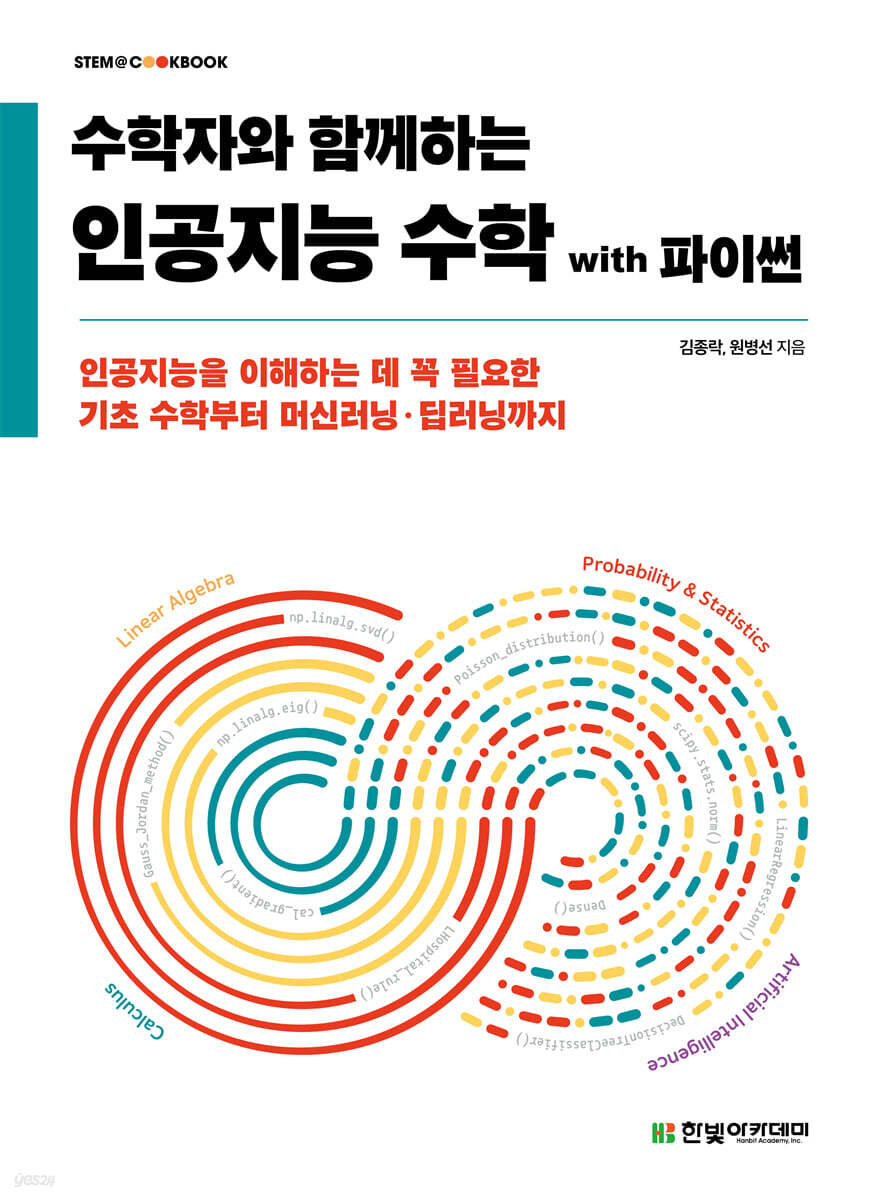 |
Description
Book Introduction
Understanding artificial intelligence through the connection between mathematics, machine learning, and deep learning!
To properly understand and utilize artificial intelligence technology, it is essential to understand the mathematical principles and algorithms that serve as its theoretical foundation.
This book is organized with a friendly commentary by a mathematician, covering everything from the mathematical concepts essential to artificial intelligence to machine learning and deep learning.
We lay the mathematical foundation for artificial intelligence with essential topics such as linear algebra, differential and integral calculus, and probability and statistics, and mathematically analyze the key concepts of machine learning and deep learning, which are fields of artificial intelligence research.
By implementing mathematical theory and the basic algorithms of machine learning and deep learning in Python code, you can more easily approach the core of artificial intelligence.
If you want to know what mathematics is needed for artificial intelligence and how mathematics is applied to artificial intelligence, start with this book!
To properly understand and utilize artificial intelligence technology, it is essential to understand the mathematical principles and algorithms that serve as its theoretical foundation.
This book is organized with a friendly commentary by a mathematician, covering everything from the mathematical concepts essential to artificial intelligence to machine learning and deep learning.
We lay the mathematical foundation for artificial intelligence with essential topics such as linear algebra, differential and integral calculus, and probability and statistics, and mathematically analyze the key concepts of machine learning and deep learning, which are fields of artificial intelligence research.
By implementing mathematical theory and the basic algorithms of machine learning and deep learning in Python code, you can more easily approach the core of artificial intelligence.
If you want to know what mathematics is needed for artificial intelligence and how mathematics is applied to artificial intelligence, start with this book!
- You can preview some of the book's contents.
Preview
index
PART 01 Linear Algebra and Artificial Intelligence
Chapter 1: Systems of Linear Equations and Matrices
1.1 Systems of linear equations
1.2 Definition of a matrix
1.3 Matrix Operations
1.4 Relationship between matrices and simultaneous linear equations
Practice problems
Programming practice
Chapter 2 Gauss-Jordan Elimination and Various Matrices
2.1 Gauss-Jordan elimination
2.2 Inverse matrix
2.3 Various matrices
Practice problems
Programming practice
Chapter 3 Vector Spaces and Inner Products
3.1 Vectors and Vector Spaces
3.2 Dot product of vectors
3.3 Differentiation of vectors
Practice problems
Programming practice
Chapter 4: Linear Transformations and Rank Theorem
4.1 Linear transformation
4.2 Rank Summary
Practice problems
Programming practice
Chapter 5: Eigenvalues and the Cayley-Hamilton Theorem
5.1 Eigenvalues and Eigenvectors
5.2 Cayley-Hamilton theorem
Practice problems
Programming practice
Chapter 6 Matrix Decomposition
6.1 LU decomposition
6.2 Singular value decomposition
Practice problems
Programming practice
PART 02 Calculus and Artificial Intelligence
Chapter 7 Differentiation
7.1 Differentiation and Derivatives
7.2 Higher-order derivatives
7.3 Differentiation of composite functions
7.4 Mean Value Theorem and L'Hopital's Rule
7.5 Applications of Differentiation
Practice problems
Programming practice
Chapter 8 Integration
8.1 Indefinite integrals
8.2 Substitution and Partial Integration
8.3 Definite integrals
8.4 Applications of Integration
Practice problems
Programming practice
Chapter 9 Partial Differentiation and Gradient Descent
9.1 Partial Differentiation
9.2 Gradient descent
Practice problems
Programming practice
PART 03 Probability, Statistics, and Artificial Intelligence
Chapter 10 Probability and Probability Distributions
10.1 Conditional probability and Bayes' theorem
10.2 Discrete probability distributions
10.3 Continuous probability distribution
Practice problems
Programming practice
Chapter 11: Correlation Analysis and Regression Analysis
11.1 Correlation Analysis
11.2 Regression Analysis
Practice problems
Programming practice
PART 04: Connections with Machine Learning and Deep Learning
Chapter 12 Machine Learning
12.1 Introduction to Machine Learning
12.2 Classification Algorithm
12.3 Regression Analysis Algorithm
12.4 Clustering and Principal Component Analysis
Practice problems
Programming practice
Chapter 13 Deep Learning
13.1 Perceptron
13.2 Convolutional Neural Networks
13.3 Recurrent Neural Networks
Practice problems
Programming practice
References
Search
Chapter 1: Systems of Linear Equations and Matrices
1.1 Systems of linear equations
1.2 Definition of a matrix
1.3 Matrix Operations
1.4 Relationship between matrices and simultaneous linear equations
Practice problems
Programming practice
Chapter 2 Gauss-Jordan Elimination and Various Matrices
2.1 Gauss-Jordan elimination
2.2 Inverse matrix
2.3 Various matrices
Practice problems
Programming practice
Chapter 3 Vector Spaces and Inner Products
3.1 Vectors and Vector Spaces
3.2 Dot product of vectors
3.3 Differentiation of vectors
Practice problems
Programming practice
Chapter 4: Linear Transformations and Rank Theorem
4.1 Linear transformation
4.2 Rank Summary
Practice problems
Programming practice
Chapter 5: Eigenvalues and the Cayley-Hamilton Theorem
5.1 Eigenvalues and Eigenvectors
5.2 Cayley-Hamilton theorem
Practice problems
Programming practice
Chapter 6 Matrix Decomposition
6.1 LU decomposition
6.2 Singular value decomposition
Practice problems
Programming practice
PART 02 Calculus and Artificial Intelligence
Chapter 7 Differentiation
7.1 Differentiation and Derivatives
7.2 Higher-order derivatives
7.3 Differentiation of composite functions
7.4 Mean Value Theorem and L'Hopital's Rule
7.5 Applications of Differentiation
Practice problems
Programming practice
Chapter 8 Integration
8.1 Indefinite integrals
8.2 Substitution and Partial Integration
8.3 Definite integrals
8.4 Applications of Integration
Practice problems
Programming practice
Chapter 9 Partial Differentiation and Gradient Descent
9.1 Partial Differentiation
9.2 Gradient descent
Practice problems
Programming practice
PART 03 Probability, Statistics, and Artificial Intelligence
Chapter 10 Probability and Probability Distributions
10.1 Conditional probability and Bayes' theorem
10.2 Discrete probability distributions
10.3 Continuous probability distribution
Practice problems
Programming practice
Chapter 11: Correlation Analysis and Regression Analysis
11.1 Correlation Analysis
11.2 Regression Analysis
Practice problems
Programming practice
PART 04: Connections with Machine Learning and Deep Learning
Chapter 12 Machine Learning
12.1 Introduction to Machine Learning
12.2 Classification Algorithm
12.3 Regression Analysis Algorithm
12.4 Clustering and Principal Component Analysis
Practice problems
Programming practice
Chapter 13 Deep Learning
13.1 Perceptron
13.2 Convolutional Neural Networks
13.3 Recurrent Neural Networks
Practice problems
Programming practice
References
Search
Detailed image

Publisher's Review
From basic mathematics essential to understanding artificial intelligence
A book that will help you understand machine learning and deep learning.
This book links the mathematical theories essential for a thorough understanding of artificial intelligence technology with the key concepts of machine learning and deep learning.
This book covers the essential mathematical topics required to fully understand machine learning and deep learning: linear algebra, differential and integral calculus, and probability and statistics.
The author, a mathematician and leading expert in artificial intelligence, provides helpful explanations to help you clearly understand complex mathematical and artificial intelligence theories. By implementing various examples and programming exercises directly in Python code, you can cultivate your coding and problem-solving skills.
A book that will help you understand machine learning and deep learning.
This book links the mathematical theories essential for a thorough understanding of artificial intelligence technology with the key concepts of machine learning and deep learning.
This book covers the essential mathematical topics required to fully understand machine learning and deep learning: linear algebra, differential and integral calculus, and probability and statistics.
The author, a mathematician and leading expert in artificial intelligence, provides helpful explanations to help you clearly understand complex mathematical and artificial intelligence theories. By implementing various examples and programming exercises directly in Python code, you can cultivate your coding and problem-solving skills.
GOODS SPECIFICS
- Date of issue: January 29, 2024
- Page count, weight, size: 492 pages | 188*257*19mm
- ISBN13: 9791156640165
You may also like
카테고리
korean


korean

![GQ KOREA Mark (Monthly): December [2025]](http://librairie.coreenne.fr/cdn/shop/files/8ef265dbbfbf186523ed75ba7319009d.jpg?v=1765340328&width=3840)


