

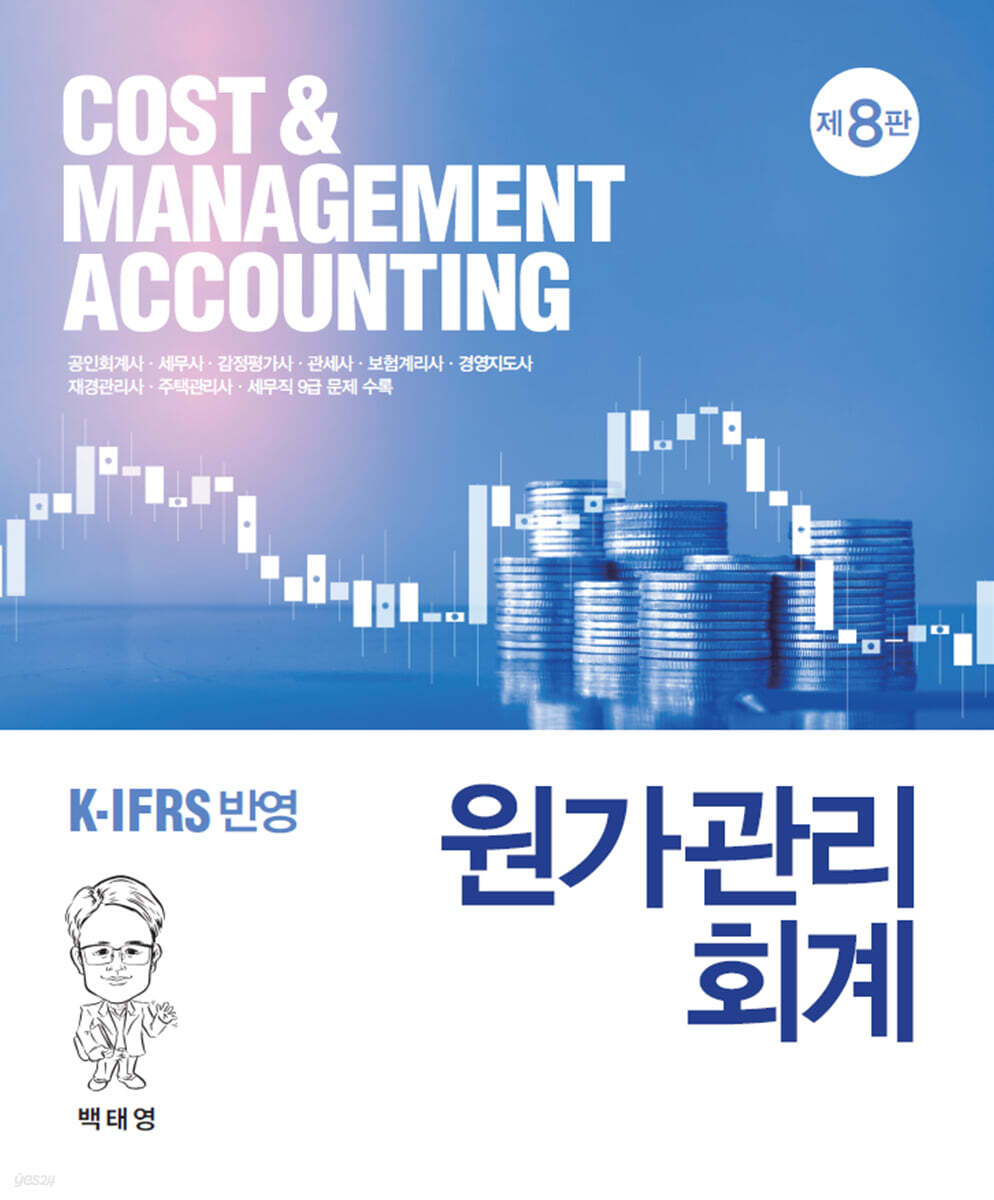
Cost Management Accounting
 |
Description
Book Introduction
To facilitate better learning, the 8th edition has been significantly updated with recent past exam questions and has paid special attention to providing solutions.
There may be multiple solutions to a single problem, but some solutions on the market are often unnecessarily complex, time-consuming, and difficult to understand.
We have tried to provide explanations that are as simple and easy to understand as possible.
There may be multiple solutions to a single problem, but some solutions on the market are often unnecessarily complex, time-consuming, and difficult to understand.
We have tried to provide explanations that are as simple and easy to understand as possible.
- You can preview some of the book's contents.
Preview
index
Ⅰ Basic Concepts of Cost Management Accounting
1.
What is cost management accounting?
What is management accounting?
Who Needs Cost Management Accounting Knowledge?
What is the difference between management accounting and financial accounting?
Are cost accounting and management accounting really different?
What other business fields are related to cost management accounting?
2.
Cost Concept: What is cost and what types are there?
What is cost?
Distinguish between manufacturing costs and selling, administrative, and general expenses.
What is the difference between product cost and period cost?
Understand the flow of manufacturing costs with the manufacturing cost statement.
Distinguish between direct and indirect costs
Distinguish between variable and fixed costs
Find relevant costs needed for decision making
Ⅱ Cost calculation of products and services
3.
Individual Costing: Allocation of Manufacturing Indirect Costs
▶Individual cost calculation
Cost calculation is done for each individual task.
Individual cost calculation is done using the work cost table.
How is the manufacturing overhead cost allocation rate determined?
▶Actual cost calculation
In actual cost accounting, actual costs flow in.
Actual cost calculation uses the actual manufacturing overhead cost allocation rate.
Actual cost calculation must wait until the end of the period.
▶Normal cost calculation
It's convenient to use the expected distribution rate
The difference between normal manufacturing overhead costs and actual manufacturing overhead costs is adjusted in cost of sales, etc.
▶Examples and Service Industry Cost Calculation
Comprehensive example of manufacturing cost flow for individual cost calculation
Individual cost calculation for service industries
4.
Comprehensive costing: Cost allocation between finished goods and work-in-process
The unit costs of products (finished goods) and work-in-progress (unfinished goods) are different.
Use the cost per unit of finished goods conversion quantity.
If the direct material cost and processing cost are different in terms of completion, the finished product conversion amount is calculated separately.
Weighted average method: Calculate cost by adding the basic materials cost and the current period cost.
First-in, first-out (FIFO) and last-in, first-out (LIFO) methods: Calculate costs by separating the initial cost of materials in process and the current period's cost.
Profit figures and corporate tax vary depending on the cost accounting (inventory asset valuation) method.
First-in, first-out method: Calculate the current unit cost by calculating only the current period's work volume.
Products produced through multiple processes are cost-calculated by process.
Combine individual costing and comprehensive costing
5.
Combined Costing: Cost Allocation Between Joint Products
What is joint cost?
Are joint costs different from common costs?
The combined cost can be divided among the products based on quantity.
The combined cost can be divided by reflecting the sales value of the joint product.
The combined cost can be divided by taking additional processing into account.
The gross profit margin for each product can be made the same.
Is it beneficial to do additional processing?
Performance is evaluated based on net realizable value.
Accounting for by-products and waste
6.
Cost calculation by division: Aggregate costs by division.
Calculate costs by division of the organization
The support sector supports the production sector.
There are three ways to allocate support department costs to production departments.
The simplest method is to directly allocate the support department's costs to the production department - the direct allocation method.
The most accurate method is to reciprocally allocate the cost of support to each department - the reciprocal allocation method.
Is it worth the complex reciprocal distribution?
There is a method of allocating support department costs in stages - the step-by-step allocation method.
Is the step-by-step distribution method useful?
Variable and fixed costs can be allocated separately - double allocation ratio
Calculate product cost from cost by sector
Cost calculation by sector in the service industry
7.
Activity-based costing: Accurately aggregate costs by activity.
Production automation, product diversification, and increased competition necessitate activity-based costing.
Aggregate costs by activity
Allocate activity costs using cost drivers
Calculate the cost of each product using activity costs.
Activity-based costing and sector-based costing differ in two ways.
There are activity costs that are not proportional to production volume - the hierarchy of activity costs.
Activity-based costing is also applied to sales management expenses.
Activity-based costing also applies to the service industry.
Reduce costs by reducing non-value-added activities.
Is Activity-Based Costing Worth Adopting?
What must be done to successfully implement activity-based costing?
Activity-based costing isn't perfect.
Activity-based costing can be difficult to implement.
Time-driven activity-based costing is an alternative.
Time-driven activity-based costing uses processing capacity cost rates and usage.
Ⅲ Estimation and Analysis of Costs and Profits
8.
Cost volatility and cost estimation: How do we estimate cost behavior?
Understand variable costs, fixed costs, and mixed costs.
Mixed costing is useful for cost estimation within a relevant range.
Staircase costs are related to facility expansion.
Estimating next year's costs using this year's costs - Accounting Method
Estimating next year's cost using data from the past two years - high-low method
Estimating next year's costs using data from the past several years - regression analysis
There are some things to keep in mind when estimating future costs using past data.
Estimating future costs without past data - Engineering analysis method
[Appendix A] Estimating Costs with Excel
[Appendix B] Learning Effects
9.
Variable costing: Fixed manufacturing costs are treated as period costs.
Is direct material cost a variable cost?
Is direct labor cost a variable cost?
Are manufacturing overhead costs variable costs?
Which is better, variable costs or fixed costs?
Variable costing that treats fixed manufacturing costs as period costs
What is a contribution income statement?
Why are operating profits under variable costing and full costing different?
What are the advantages of variable costing?
What is variable costing?
Why are operating profits under variable costing and ultra-variable costing different?
Hypervariable costing promotes inventory reduction efforts.
10.
Cost-Operation-Profit Analysis: Understanding the Relationship Between Production and Sales Volume, Cost of Sales, and Profit
What is the relationship between production and sales volume, cost of goods sold, and profit?
What is the break-even point and contribution margin?
How do you find the break-even point?
How much do you need to sell to reach your target profit?
How sensitive are profits to changes in sales volume? - The leverage effect
Measure the profit-increasing effect of cost reduction
What happens if you pay corporate tax?
What are the assumptions of the basic cost-volume-profit model?
What is the break-even point if there is a step cost?
Full cost accounting and cost-operating-profit analysis
Cost-Operation-Profit Analysis is also used in the service industry.
11.
Comprehensive Budget: Establishing a Budget to Prepare for the Future
Future planning comes with a budget
Why do we need a budget?
Establish sales and financial budgets
Establish sales and production budgets
Establish a manufacturing cost budget
Set a cost of sales budget
Establish a sales management expense budget
Estimate operating profit
Set up a cash budget
Do a budget simulation
Who should prepare the budget?
When preparing a budget, use incremental budgeting and zero-based budgeting.
Use both periodic and continuing budgets together.
[Appendix] Capital Budget
12.
Variance Analysis and Standard Costing: Why Do Expectations and Results Differ?
Compare plans and performance
Why are actual costs different from expected costs? - Cost Variance Analysis
Use a variable budget
Why do direct material cost variances occur? - Quantity variances and price variances
Why do direct labor cost variances arise? - Quantity variances and wage rate variances
Why do variable manufacturing overhead cost variances occur?
Why do fixed manufacturing overhead cost variances occur?
Easily calculate costs using standard costs - Standard Costing
When calculating standard cost, there is a difference in the operating rate of fixed manufacturing indirect costs.
Understand manufacturing cost flow and reconciliation in standard costing.
Analyze the difference in the sales department - sales operation difference
What additional differences should be investigated?
Performance appraisals based on differences have a two-sided effect on human behavior.
Ⅳ Decision-making and performance evaluation
13.
Decision-making and related costs: pricing, product mix, outsourcing, product additions/discontinuations.
How much should I price the product?
There is a way to set prices based on cost.
Set prices considering the impact of sales volume.
Shutting down the business is also an option.
How much discount can you give on the price?
Stopping production of loss-making products could result in greater losses.
Sales of multiple products may influence each other.
Which product should be produced and sold more when there are limited resources?
Reduce costs by outsourcing
Increase profitability through additional product processing.
14.
Strategic Cost Management: Using Quality Cost, Constraints Theory, and Cost Planning
Strategic cost management
▶Inventory-related cost analysis
Why is inventory necessary?
Determine the optimal inventory level to reduce inventory-related costs - the economic order quantity (EOQ) model.
Just-in-time purchasing system
Just-in-time production system
Costs and Benefits of Just-in-Time Procurement/Production Systems
▶Quality Cost Calculation for Quality Management
What is quality?
What is quality cost?
Perfection is the best
How do you measure the cost of quality?
▶Analyzing the Effectiveness of Speed Management
Quick customer response is our competitive edge.
▶Constraint Theory and Decision Making
Identify and expand bottlenecks to increase profitability.
Increasing the processing capacity of bottleneck processes directly leads to profits.
▶Product Life Cycle Costing
Costs before and after production are also important.
Most costs are determined before production.
▶Cost planning and target cost
Cost planning is done during the planning/development/design stages of new products.
Target cost, standard cost, and Kaizen cost are different.
15.
Uncertainty and Decision Making: Making Decisions Understanding Uncertainty
How can we cope with an uncertain future?
Analyze the situation
Express future uncertainty as a probability
Maximize expected profits
Even the best decisions can end up being wrong.
Get information to increase your profits
How do you represent predictions with incomplete information?
Even incomplete information has value.
Consider the risks
Do you like or hate risk?
Express your attitude toward risk with utility
Maximize expected utility
16.
Performance Evaluation: Responsibility Accounting, Economic Value Added, and Balanced Scorecards are used.
General Considerations for Responsibility Accounting and Performance Evaluation
Evaluate each department based on its responsibilities and authority - responsibility accounting
Controllability is not perfect
Which is better, relative evaluation or absolute evaluation?
The goal is difficult but achievable
Should all evaluation indicators be quantified?
Utilize performance evaluation results
▶Investment Performance Evaluation Index
Investment performance is evaluated by rate of return - return on investment
Breaking Down Investment Returns - DuPont Analysis
Beware of the dysfunction of evaluation based on investment returns.
Residual profit is profit after taking into account all costs of capital.
What is economic added value?
How do you get invested capital?
Find the cost of capital
▶Balanced Scorecard
Financial and non-financial performance indicators are used complementarily.
The balanced scorecard is evaluated from four perspectives.
Causal relationships from learning and growth to internal processes, customer satisfaction, and financial performance.
Translate your strategy into performance indicators
17.
Internal replacement price: Uses the internal transaction system.
Why is internal replacement pricing necessary?
Why is internal replacement pricing important?
Align departmental and company-wide goals with internal replacement pricing.
The role of internal replacement prices to prevent internal replacement is also necessary.
There is an internal replacement price that always matches the target in all production levels.
How would in-house substitution differ if parts could be purchased externally?
The external market price of the internal substitute is the optimal internal substitute price.
Determine the in-house replacement price based on cost.
Consider the opportunity cost of the supply sector.
It is also possible to determine the internal replacement price through double pricing or negotiation.
International transfer pricing is a matter of tax savings.
□ Cost accounting guidelines
□ Search
1.
What is cost management accounting?
What is management accounting?
Who Needs Cost Management Accounting Knowledge?
What is the difference between management accounting and financial accounting?
Are cost accounting and management accounting really different?
What other business fields are related to cost management accounting?
2.
Cost Concept: What is cost and what types are there?
What is cost?
Distinguish between manufacturing costs and selling, administrative, and general expenses.
What is the difference between product cost and period cost?
Understand the flow of manufacturing costs with the manufacturing cost statement.
Distinguish between direct and indirect costs
Distinguish between variable and fixed costs
Find relevant costs needed for decision making
Ⅱ Cost calculation of products and services
3.
Individual Costing: Allocation of Manufacturing Indirect Costs
▶Individual cost calculation
Cost calculation is done for each individual task.
Individual cost calculation is done using the work cost table.
How is the manufacturing overhead cost allocation rate determined?
▶Actual cost calculation
In actual cost accounting, actual costs flow in.
Actual cost calculation uses the actual manufacturing overhead cost allocation rate.
Actual cost calculation must wait until the end of the period.
▶Normal cost calculation
It's convenient to use the expected distribution rate
The difference between normal manufacturing overhead costs and actual manufacturing overhead costs is adjusted in cost of sales, etc.
▶Examples and Service Industry Cost Calculation
Comprehensive example of manufacturing cost flow for individual cost calculation
Individual cost calculation for service industries
4.
Comprehensive costing: Cost allocation between finished goods and work-in-process
The unit costs of products (finished goods) and work-in-progress (unfinished goods) are different.
Use the cost per unit of finished goods conversion quantity.
If the direct material cost and processing cost are different in terms of completion, the finished product conversion amount is calculated separately.
Weighted average method: Calculate cost by adding the basic materials cost and the current period cost.
First-in, first-out (FIFO) and last-in, first-out (LIFO) methods: Calculate costs by separating the initial cost of materials in process and the current period's cost.
Profit figures and corporate tax vary depending on the cost accounting (inventory asset valuation) method.
First-in, first-out method: Calculate the current unit cost by calculating only the current period's work volume.
Products produced through multiple processes are cost-calculated by process.
Combine individual costing and comprehensive costing
5.
Combined Costing: Cost Allocation Between Joint Products
What is joint cost?
Are joint costs different from common costs?
The combined cost can be divided among the products based on quantity.
The combined cost can be divided by reflecting the sales value of the joint product.
The combined cost can be divided by taking additional processing into account.
The gross profit margin for each product can be made the same.
Is it beneficial to do additional processing?
Performance is evaluated based on net realizable value.
Accounting for by-products and waste
6.
Cost calculation by division: Aggregate costs by division.
Calculate costs by division of the organization
The support sector supports the production sector.
There are three ways to allocate support department costs to production departments.
The simplest method is to directly allocate the support department's costs to the production department - the direct allocation method.
The most accurate method is to reciprocally allocate the cost of support to each department - the reciprocal allocation method.
Is it worth the complex reciprocal distribution?
There is a method of allocating support department costs in stages - the step-by-step allocation method.
Is the step-by-step distribution method useful?
Variable and fixed costs can be allocated separately - double allocation ratio
Calculate product cost from cost by sector
Cost calculation by sector in the service industry
7.
Activity-based costing: Accurately aggregate costs by activity.
Production automation, product diversification, and increased competition necessitate activity-based costing.
Aggregate costs by activity
Allocate activity costs using cost drivers
Calculate the cost of each product using activity costs.
Activity-based costing and sector-based costing differ in two ways.
There are activity costs that are not proportional to production volume - the hierarchy of activity costs.
Activity-based costing is also applied to sales management expenses.
Activity-based costing also applies to the service industry.
Reduce costs by reducing non-value-added activities.
Is Activity-Based Costing Worth Adopting?
What must be done to successfully implement activity-based costing?
Activity-based costing isn't perfect.
Activity-based costing can be difficult to implement.
Time-driven activity-based costing is an alternative.
Time-driven activity-based costing uses processing capacity cost rates and usage.
Ⅲ Estimation and Analysis of Costs and Profits
8.
Cost volatility and cost estimation: How do we estimate cost behavior?
Understand variable costs, fixed costs, and mixed costs.
Mixed costing is useful for cost estimation within a relevant range.
Staircase costs are related to facility expansion.
Estimating next year's costs using this year's costs - Accounting Method
Estimating next year's cost using data from the past two years - high-low method
Estimating next year's costs using data from the past several years - regression analysis
There are some things to keep in mind when estimating future costs using past data.
Estimating future costs without past data - Engineering analysis method
[Appendix A] Estimating Costs with Excel
[Appendix B] Learning Effects
9.
Variable costing: Fixed manufacturing costs are treated as period costs.
Is direct material cost a variable cost?
Is direct labor cost a variable cost?
Are manufacturing overhead costs variable costs?
Which is better, variable costs or fixed costs?
Variable costing that treats fixed manufacturing costs as period costs
What is a contribution income statement?
Why are operating profits under variable costing and full costing different?
What are the advantages of variable costing?
What is variable costing?
Why are operating profits under variable costing and ultra-variable costing different?
Hypervariable costing promotes inventory reduction efforts.
10.
Cost-Operation-Profit Analysis: Understanding the Relationship Between Production and Sales Volume, Cost of Sales, and Profit
What is the relationship between production and sales volume, cost of goods sold, and profit?
What is the break-even point and contribution margin?
How do you find the break-even point?
How much do you need to sell to reach your target profit?
How sensitive are profits to changes in sales volume? - The leverage effect
Measure the profit-increasing effect of cost reduction
What happens if you pay corporate tax?
What are the assumptions of the basic cost-volume-profit model?
What is the break-even point if there is a step cost?
Full cost accounting and cost-operating-profit analysis
Cost-Operation-Profit Analysis is also used in the service industry.
11.
Comprehensive Budget: Establishing a Budget to Prepare for the Future
Future planning comes with a budget
Why do we need a budget?
Establish sales and financial budgets
Establish sales and production budgets
Establish a manufacturing cost budget
Set a cost of sales budget
Establish a sales management expense budget
Estimate operating profit
Set up a cash budget
Do a budget simulation
Who should prepare the budget?
When preparing a budget, use incremental budgeting and zero-based budgeting.
Use both periodic and continuing budgets together.
[Appendix] Capital Budget
12.
Variance Analysis and Standard Costing: Why Do Expectations and Results Differ?
Compare plans and performance
Why are actual costs different from expected costs? - Cost Variance Analysis
Use a variable budget
Why do direct material cost variances occur? - Quantity variances and price variances
Why do direct labor cost variances arise? - Quantity variances and wage rate variances
Why do variable manufacturing overhead cost variances occur?
Why do fixed manufacturing overhead cost variances occur?
Easily calculate costs using standard costs - Standard Costing
When calculating standard cost, there is a difference in the operating rate of fixed manufacturing indirect costs.
Understand manufacturing cost flow and reconciliation in standard costing.
Analyze the difference in the sales department - sales operation difference
What additional differences should be investigated?
Performance appraisals based on differences have a two-sided effect on human behavior.
Ⅳ Decision-making and performance evaluation
13.
Decision-making and related costs: pricing, product mix, outsourcing, product additions/discontinuations.
How much should I price the product?
There is a way to set prices based on cost.
Set prices considering the impact of sales volume.
Shutting down the business is also an option.
How much discount can you give on the price?
Stopping production of loss-making products could result in greater losses.
Sales of multiple products may influence each other.
Which product should be produced and sold more when there are limited resources?
Reduce costs by outsourcing
Increase profitability through additional product processing.
14.
Strategic Cost Management: Using Quality Cost, Constraints Theory, and Cost Planning
Strategic cost management
▶Inventory-related cost analysis
Why is inventory necessary?
Determine the optimal inventory level to reduce inventory-related costs - the economic order quantity (EOQ) model.
Just-in-time purchasing system
Just-in-time production system
Costs and Benefits of Just-in-Time Procurement/Production Systems
▶Quality Cost Calculation for Quality Management
What is quality?
What is quality cost?
Perfection is the best
How do you measure the cost of quality?
▶Analyzing the Effectiveness of Speed Management
Quick customer response is our competitive edge.
▶Constraint Theory and Decision Making
Identify and expand bottlenecks to increase profitability.
Increasing the processing capacity of bottleneck processes directly leads to profits.
▶Product Life Cycle Costing
Costs before and after production are also important.
Most costs are determined before production.
▶Cost planning and target cost
Cost planning is done during the planning/development/design stages of new products.
Target cost, standard cost, and Kaizen cost are different.
15.
Uncertainty and Decision Making: Making Decisions Understanding Uncertainty
How can we cope with an uncertain future?
Analyze the situation
Express future uncertainty as a probability
Maximize expected profits
Even the best decisions can end up being wrong.
Get information to increase your profits
How do you represent predictions with incomplete information?
Even incomplete information has value.
Consider the risks
Do you like or hate risk?
Express your attitude toward risk with utility
Maximize expected utility
16.
Performance Evaluation: Responsibility Accounting, Economic Value Added, and Balanced Scorecards are used.
General Considerations for Responsibility Accounting and Performance Evaluation
Evaluate each department based on its responsibilities and authority - responsibility accounting
Controllability is not perfect
Which is better, relative evaluation or absolute evaluation?
The goal is difficult but achievable
Should all evaluation indicators be quantified?
Utilize performance evaluation results
▶Investment Performance Evaluation Index
Investment performance is evaluated by rate of return - return on investment
Breaking Down Investment Returns - DuPont Analysis
Beware of the dysfunction of evaluation based on investment returns.
Residual profit is profit after taking into account all costs of capital.
What is economic added value?
How do you get invested capital?
Find the cost of capital
▶Balanced Scorecard
Financial and non-financial performance indicators are used complementarily.
The balanced scorecard is evaluated from four perspectives.
Causal relationships from learning and growth to internal processes, customer satisfaction, and financial performance.
Translate your strategy into performance indicators
17.
Internal replacement price: Uses the internal transaction system.
Why is internal replacement pricing necessary?
Why is internal replacement pricing important?
Align departmental and company-wide goals with internal replacement pricing.
The role of internal replacement prices to prevent internal replacement is also necessary.
There is an internal replacement price that always matches the target in all production levels.
How would in-house substitution differ if parts could be purchased externally?
The external market price of the internal substitute is the optimal internal substitute price.
Determine the in-house replacement price based on cost.
Consider the opportunity cost of the supply sector.
It is also possible to determine the internal replacement price through double pricing or negotiation.
International transfer pricing is a matter of tax savings.
□ Cost accounting guidelines
□ Search
Detailed image

Publisher's Review
This book features:
1.
Includes recent questions and answers used in various qualification exams: Certified Public Accountant, Certified Tax Accountant, Certified Real Estate Appraiser, Certified Customs Broker, Certified Insurance Accountant, Certified Management Consultant, Certified Financial Manager, Certified Housing Manager, and Level 9 Tax Accountant.
2.
Various articles and cases: Contains various articles and cases to help you understand the textbook contents.
3.
Various tables, graphs, and figures for understanding: Various tables, graphs, and figures are provided to help you understand cost management accounting more easily.
4.
Discussion questions, summaries, and appendices to aid learning: We provide 'discussion questions' with case studies to aid in studying cost management accounting, and 'summaries' to conclude each chapter.
?5.
Related Video Introductions on YouTube: We've diversified our content by introducing related videos on YouTube.
1.
Includes recent questions and answers used in various qualification exams: Certified Public Accountant, Certified Tax Accountant, Certified Real Estate Appraiser, Certified Customs Broker, Certified Insurance Accountant, Certified Management Consultant, Certified Financial Manager, Certified Housing Manager, and Level 9 Tax Accountant.
2.
Various articles and cases: Contains various articles and cases to help you understand the textbook contents.
3.
Various tables, graphs, and figures for understanding: Various tables, graphs, and figures are provided to help you understand cost management accounting more easily.
4.
Discussion questions, summaries, and appendices to aid learning: We provide 'discussion questions' with case studies to aid in studying cost management accounting, and 'summaries' to conclude each chapter.
?5.
Related Video Introductions on YouTube: We've diversified our content by introducing related videos on YouTube.
GOODS SPECIFICS
- Date of issue: January 24, 2024
- Page count, weight, size: 704 pages | 210*254*40mm
- ISBN13: 9788955018516
- ISBN10: 8955018517
You may also like
카테고리
korean


korean

![GQ KOREA Mark (Monthly): December [2025]](http://librairie.coreenne.fr/cdn/shop/files/8ef265dbbfbf186523ed75ba7319009d.jpg?v=1765340328&width=3840)


