

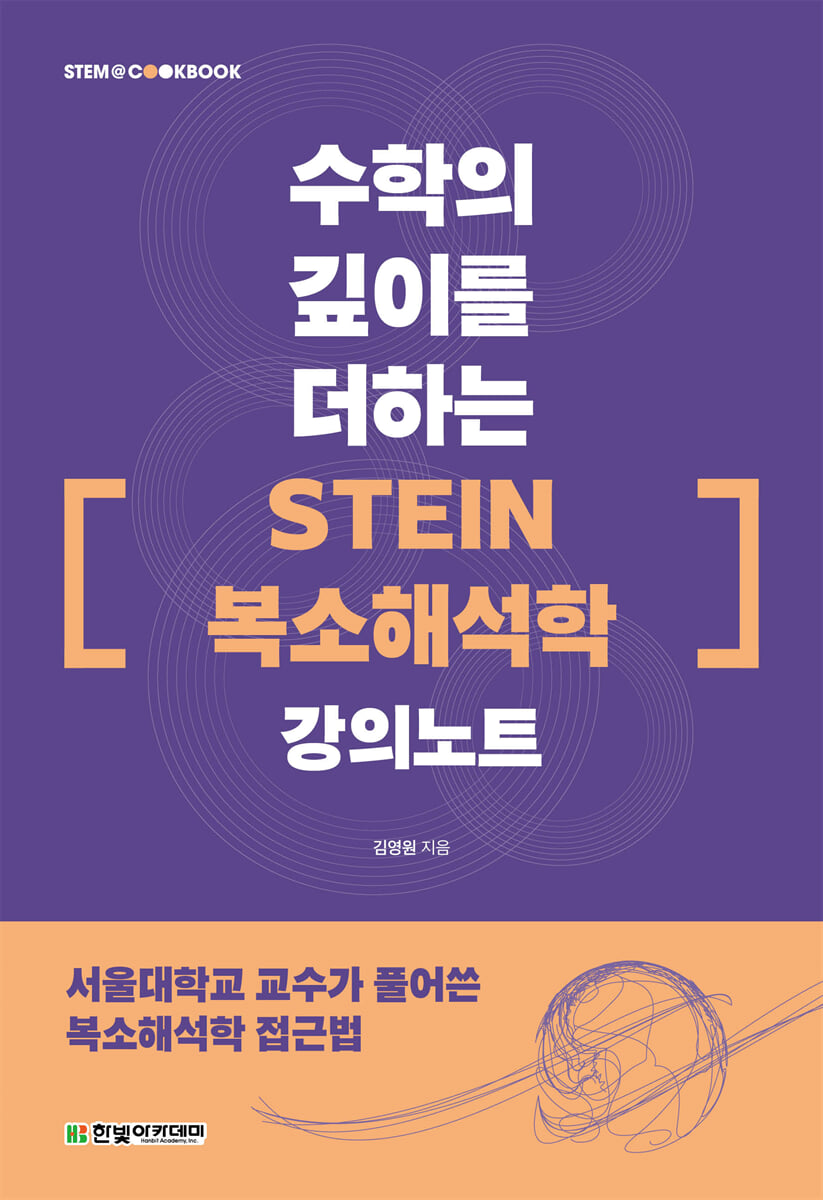
Lecture Notes for "STEIN Complex Analysis," Deepening Mathematics
 |
Description
Book Introduction
A study guide detailing 『STEIN Complex Analysis』
The author, who reviewed the translation of 『STEIN Complex Analysis』 and has long taught complex analysis at Seoul National University, has compiled his complex analysis learning know-how into a single volume exclusively for 『STEIN Complex Analysis』 readers.
You can gain a deeper understanding of the original text through carefully selected articles on over 40 topics.
The author, who reviewed the translation of 『STEIN Complex Analysis』 and has long taught complex analysis at Seoul National University, has compiled his complex analysis learning know-how into a single volume exclusively for 『STEIN Complex Analysis』 readers.
You can gain a deeper understanding of the original text through carefully selected articles on over 40 topics.
index
Chapter 1.
Foundations of Complex Analysis
1-A.
Relationship between complex differentiability and real two-variable differentiability
1-B.
Sufficient condition for real variable mapping to be differentiable
1-C.
Integral of complex-valued functions of real variables
1-D.
Chapter 1 Practice Problem 5: Solving and Reading
Chapter 2.
Cauchy's theorem and its applications
2-A.
Chapter 2 Summary 2.1 Reading the Explanation
2-B.
Solving the integral calculation in Chapter 2, Section 3
2-C.
Proof and generalization of Chapter 2 Summary 4.1
2-D.
Generalization of Theorem 4.1 using Corollary 4.2
2-E.
Chapter 2 Summary 4.4 Reading the Explanation
2-F.
Proof and application examples of the identity theorem
Chapter 3.
Glassy functions and logarithmic functions
3-A.
Use of a keyhole or similar toy path
3-B.
The relationship between isolated singularities and Laurent series
3-C.
Unraveling the Luche theorem
3-D.
Continuous transformation, solving the condition that the given area is simply connected
3-E.
Winding number and declination principle
Chapter 4.
Fourier transform
4-A.
Unpacking the function set F
4-B.
Convergence of singular integrals and comparative tests
4-C.
Chapter 4: Proof of Theorem 2.2 and Theorem 2.4
4-D.
Chapter 4: Proof of Summary 3.4
Chapter 5.
Fully solved function
5-A.
Chapter 5 Summary 1.1 Generalization
5-B.
Function to count the number of zeros
5-C.
Chapter 5 Summary 2.1 Reading the Explanation
5-D.
Chapter 5: Detailed proof of Propositions 3.1 and 3.2
5-E.
Chapter 5, Section 3.2, Explanation
5-F.
Solving the Hadamard Factorization Theorem
Chapter 6.
Gamma and zeta functions
6-A.
Analytical extension of the gamma function
6-B.
Increasing exponent of some preprocessing functions
6-C.
Chapter 6: Detailed proof of Propositions 2.5 and 2.7
6-D.
Singular integral whose limit is given by the gamma function
Chapter 7.
Zeta function and prime number theorem
7-A.
Chapter 7: Detailed proof of Proposition 1.6
7-B.
Chapter 7: Related Proposition 2.1
7-C.
Absolutely converging double series
Chapter 8.
Conformal mapping
8-A.
Montel's theorem
8-B.
Properties of continuous functions related to the proof of Chapter 8, Theorem 4.2
8-C.
The behavior of the conformal homeomorphism on the boundary of the domain, related to the proof of Chapter 8, Theorem 4.2
8-D.
Direction of the boundary
8-E.
Change in direction along the boundary of the polygonal area
Chapter 9.
Introduction to Elliptic Functions
9-A.
Chapter 9 Proof of Lemma 1.5
Chapter 10.
Applications of theta function
10-A.
The group whose members are linear fractions
10-B.
Proof of Chapter 10 Summary 3.4
Foundations of Complex Analysis
1-A.
Relationship between complex differentiability and real two-variable differentiability
1-B.
Sufficient condition for real variable mapping to be differentiable
1-C.
Integral of complex-valued functions of real variables
1-D.
Chapter 1 Practice Problem 5: Solving and Reading
Chapter 2.
Cauchy's theorem and its applications
2-A.
Chapter 2 Summary 2.1 Reading the Explanation
2-B.
Solving the integral calculation in Chapter 2, Section 3
2-C.
Proof and generalization of Chapter 2 Summary 4.1
2-D.
Generalization of Theorem 4.1 using Corollary 4.2
2-E.
Chapter 2 Summary 4.4 Reading the Explanation
2-F.
Proof and application examples of the identity theorem
Chapter 3.
Glassy functions and logarithmic functions
3-A.
Use of a keyhole or similar toy path
3-B.
The relationship between isolated singularities and Laurent series
3-C.
Unraveling the Luche theorem
3-D.
Continuous transformation, solving the condition that the given area is simply connected
3-E.
Winding number and declination principle
Chapter 4.
Fourier transform
4-A.
Unpacking the function set F
4-B.
Convergence of singular integrals and comparative tests
4-C.
Chapter 4: Proof of Theorem 2.2 and Theorem 2.4
4-D.
Chapter 4: Proof of Summary 3.4
Chapter 5.
Fully solved function
5-A.
Chapter 5 Summary 1.1 Generalization
5-B.
Function to count the number of zeros
5-C.
Chapter 5 Summary 2.1 Reading the Explanation
5-D.
Chapter 5: Detailed proof of Propositions 3.1 and 3.2
5-E.
Chapter 5, Section 3.2, Explanation
5-F.
Solving the Hadamard Factorization Theorem
Chapter 6.
Gamma and zeta functions
6-A.
Analytical extension of the gamma function
6-B.
Increasing exponent of some preprocessing functions
6-C.
Chapter 6: Detailed proof of Propositions 2.5 and 2.7
6-D.
Singular integral whose limit is given by the gamma function
Chapter 7.
Zeta function and prime number theorem
7-A.
Chapter 7: Detailed proof of Proposition 1.6
7-B.
Chapter 7: Related Proposition 2.1
7-C.
Absolutely converging double series
Chapter 8.
Conformal mapping
8-A.
Montel's theorem
8-B.
Properties of continuous functions related to the proof of Chapter 8, Theorem 4.2
8-C.
The behavior of the conformal homeomorphism on the boundary of the domain, related to the proof of Chapter 8, Theorem 4.2
8-D.
Direction of the boundary
8-E.
Change in direction along the boundary of the polygonal area
Chapter 9.
Introduction to Elliptic Functions
9-A.
Chapter 9 Proof of Lemma 1.5
Chapter 10.
Applications of theta function
10-A.
The group whose members are linear fractions
10-B.
Proof of Chapter 10 Summary 3.4
Publisher's Review
A book that makes 『STEIN Complex Analysis』 shine even brighter
The author, Professor Emeritus Kim Young-won, has been teaching complex analysis for a long time and has been teaching Elias M.
I used Stein's "Complex Analysis" as a textbook and reviewed the manuscript of its translation, "STEIN Complex Analysis."
However, I felt that there was a need for resources to help me properly understand this book.
Because the translation aims to accurately convey the intent of the original work, we have compiled together texts that will help you understand the details into a new book.
I hope that through this book, you will gain a deeper understanding of 『STEIN Complex Analysis』 and further enjoy the joy of studying mathematics.
The author, Professor Emeritus Kim Young-won, has been teaching complex analysis for a long time and has been teaching Elias M.
I used Stein's "Complex Analysis" as a textbook and reviewed the manuscript of its translation, "STEIN Complex Analysis."
However, I felt that there was a need for resources to help me properly understand this book.
Because the translation aims to accurately convey the intent of the original work, we have compiled together texts that will help you understand the details into a new book.
I hope that through this book, you will gain a deeper understanding of 『STEIN Complex Analysis』 and further enjoy the joy of studying mathematics.
GOODS SPECIFICS
- Date of issue: November 20, 2023
- Page count, weight, size: 200 pages | 153*223*11mm
- ISBN13: 9791156646730
You may also like
카테고리
korean


korean

![ELLE 엘르 스페셜 에디션 A형 : 12월 [2025]](http://librairie.coreenne.fr/cdn/shop/files/b8e27a3de6c9538896439686c6b0e8fb.jpg?v=1766436872&width=3840)


