

sociology
 |
Description
Book Introduction
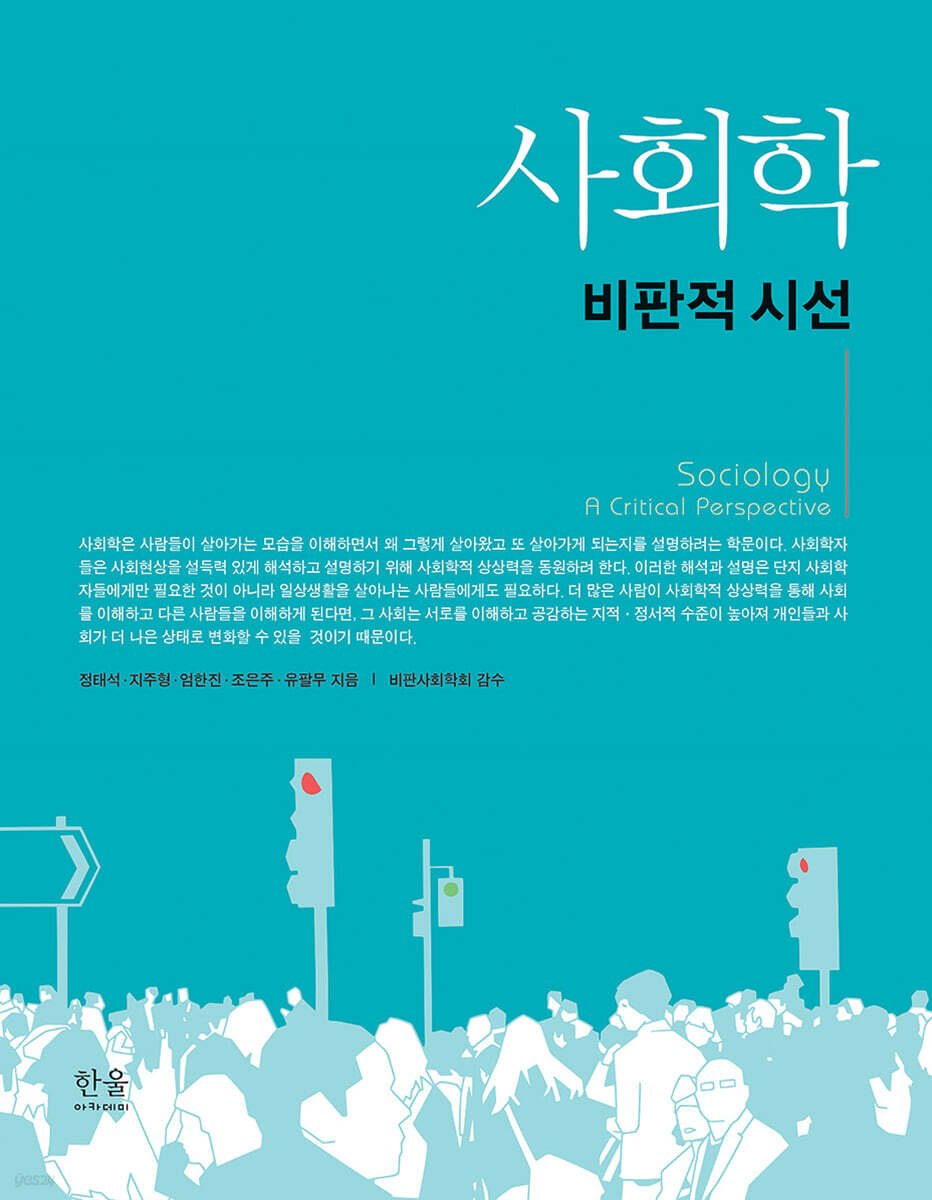
The best-selling introductory sociology textbook, "Sociology"
Following 『Sociology: Critical Reading of Society』
New edition of "Sociology: A Critical Perspective" to be published in 2023!
This book is a new edition of the introductory sociology textbook that has been consistently loved, following the 2004 publication of 『Sociology』 and the 2012 revised edition of 『Sociology: Critical Reading of Society』.
This book, designed to make sociology accessible to everyone, from undergraduates to the general public, in an easy and engaging way, introduces various issues and phenomena to systematically and structurally understand social realities and people's lives, which are difficult to understand on an individual level.
The newly published 『Sociology: A Critical Perspective』 has slightly changed the structure compared to the previous edition, clarified the content, and included new content that helps understand recent social changes.
Through this book, readers will become familiar with the fundamental concepts and issues of sociology, and gain a broader understanding of the daily lives and culture of today's people, the core systems of capitalism and democracy in modern society, the increasingly complex social problems and movements, and the rapidly changing world and the latest issues in sociology.
Following 『Sociology: Critical Reading of Society』
New edition of "Sociology: A Critical Perspective" to be published in 2023!
This book is a new edition of the introductory sociology textbook that has been consistently loved, following the 2004 publication of 『Sociology』 and the 2012 revised edition of 『Sociology: Critical Reading of Society』.
This book, designed to make sociology accessible to everyone, from undergraduates to the general public, in an easy and engaging way, introduces various issues and phenomena to systematically and structurally understand social realities and people's lives, which are difficult to understand on an individual level.
The newly published 『Sociology: A Critical Perspective』 has slightly changed the structure compared to the previous edition, clarified the content, and included new content that helps understand recent social changes.
Through this book, readers will become familiar with the fundamental concepts and issues of sociology, and gain a broader understanding of the daily lives and culture of today's people, the core systems of capitalism and democracy in modern society, the increasingly complex social problems and movements, and the rapidly changing world and the latest issues in sociology.
index
Part 1: Problems and Basic Concepts of Sociology
01 Sociological Interests and Sociological Imagination
02 Formation and Development of Sociology
03 Social Structure and Social Change
Part 2 Culture and Daily Life
04 Socialization and Interaction
05 Social Groups and Social Organizations
06 Popular Culture and Daily Life
07 Gender, Sexuality, and Family
Part 3: Capitalism and Politics
08 Principles and Historical Changes of Capitalism
09 The World of Work and Labor
10 Social Inequality and Class and Stratification
11 State, Civil Society, and Democracy
Part 4 Social Issues and Social Movements
12 Deviant Behavior and Crime
13 Population, Cities, Regions
14 Social Welfare and Quality of Life
15 Collective Action and Social Movements
Part 5: The Changing World and Everyday Life
16 Media and Knowledge Information
17 Globalization and Identity
18 Science, Technology, Risk, and Environment
01 Sociological Interests and Sociological Imagination
02 Formation and Development of Sociology
03 Social Structure and Social Change
Part 2 Culture and Daily Life
04 Socialization and Interaction
05 Social Groups and Social Organizations
06 Popular Culture and Daily Life
07 Gender, Sexuality, and Family
Part 3: Capitalism and Politics
08 Principles and Historical Changes of Capitalism
09 The World of Work and Labor
10 Social Inequality and Class and Stratification
11 State, Civil Society, and Democracy
Part 4 Social Issues and Social Movements
12 Deviant Behavior and Crime
13 Population, Cities, Regions
14 Social Welfare and Quality of Life
15 Collective Action and Social Movements
Part 5: The Changing World and Everyday Life
16 Media and Knowledge Information
17 Globalization and Identity
18 Science, Technology, Risk, and Environment
Into the book
Sociological imagination can be said to be a social scientific thought process that utilizes various cognitive methods, and Mills believed that distinguishing between 'personal problems regarding living conditions' and 'public problems regarding social structure' is a basic tool of sociological imagination.
In other words, 'sociological imagination' is recognizing that things we consider personal problems in everyday life are related to changes in social structure and finding these connections in various environments and conditions.
---From “01 Sociological Interests and Sociological Imagination” on page 29
From a Marxist perspective, the process of socialization is also a process of conflict and struggle for ideological domination.
French Marxist philosopher Louis Althusser also developed Marx's theory of ideology from this perspective.
Unlike Marx, who largely limited ideology to the 'ideological' and 'conscious' in contrast to the material, Althusser emphasized that ideology exists through concrete material devices and practices.
Accordingly, he believed that the state plays a crucial role in maintaining capitalist social relations, and that state power is exercised through 'repressive state apparatuses' such as the police and the military, but also through ideological institutions such as schools and the media.
In a capitalist society, the state functions as a representative of the capitalist class and serves the interests of the capitalist class that possesses material power (capital). Althusser defines institutions that produce ideology, such as schools, churches, the press, and mass media, as "ideological state apparatuses" because they exist in civil society but actually contribute to the exercise of state power.
---From “Page 147, 04 Socialization and Interaction”
Patriarchy has reinforced attitudes of rejection and discrimination against marginalized groups that deviate from heterosexuality, such as sexual minorities such as homosexuals, while exclusively enforcing rigid, male-centered gender norms.
And the logic of patriarchal gender division of labor limited women's opportunities to express their individuality.
Furthermore, this logic of gender division of labor has become a force that suppresses diversity in both men and women by making 'unmanly men' as well as 'unfeminine women' the target of criticism.
Resistance against this patriarchal system began to spread socially through the women's suffrage movement in the late 19th century.
Since then, the women's movement has developed into a women's liberation movement demanding equal social opportunities and legal rights in the early 20th century, leading to the expansion of gender equality. Efforts to liberate women have continued steadily, including the formation of global women's solidarity.
---From “07 Gender, Sexuality, and Family” on page 249
However, since Marx believed that class is fundamentally based on economic inequality and is the basis for political and cultural inequality, his class theory can be seen as an economic-centered theory of inequality.
In contrast, Weber treats class as one of the various dimensions of inequality—class, status, and faction—and thus his class theory occupies a section within the theory of pluralistic inequality.
Moreover, since Weber views power as the most fundamental dimension of the phenomenon of inequality, his theory can be called a 'power-centered theory of pluralistic inequality.'
Weber's theory, which emphasized the plurality of inequalities, provided the foundation for modern class theory.
---From “10 Social Inequality and Class/Strategy” on page 371
In Korea, the prosecution, which monopolizes the right to indict and investigate, has been interfering in politics by indicting and investigating reform-minded bureaucrats and politicians on charges of corruption and bribery, thereby weakening political trust and restricting political activities. This, too, can be said to be a form of the "judicialization of politics."
In this process, the political influence of the investigative agencies and the judiciary increases as independent investigative agencies and conservative media combine, and if this weakens the legitimacy of political rivals, the possibility of a conservative right-wing party taking power also increases.
A significant example is the 2022 South Korean presidential election in which Yoon Seok-yeol, a former prosecutor, ran as a candidate for the conservative People Power Party and was elected president.
And the conservative ruling powers that rely on the judiciary tend to regress to authoritarian rule.
---From “11 States, Civil Society, and Democracy” on page 426
First, as the wealthy and real estate capitalists own areas with improved location conditions due to urban development, and various investments are concentrated in these areas, social inequality is emerging in urban spaces.
In particular, redevelopment leads to the displacement of existing land users, and new development also increases the pressure to evict surrounding areas.
This gentrification has recently occurred in commercial districts, even at the house and building level.
Conflicts between building owners and tenants arise when there is a change in ownership or when there is an attempt to evict existing residential/commercial tenants due to reconstruction or remodeling.
In this case, the conflict becomes more intense because the tenant loses the key money, which is a unique practice in Korean commercial leases.
As these conflicts intensified socially, such as the dispute between a takeout drawing cafe in Hannam-dong, Seoul, and its new building owner, singer Psy, became a major issue, the 「Commercial Building Lease Protection Act」 was revised in 2015 to guarantee tenants the right to request a lease term, contract renewal, and preferential payment rights.
---From “13 Population, Cities, and Regions” on page 501
Even in the 21st century, oppressive and authoritarian rule by military dictatorships or socialist regimes persists in some countries and regions.
In 2019, Hong Kong, a special administrative region of China, witnessed a pro-democracy movement against the political interference of the Chinese socialist regime.
The Chinese government's attempts to limit Hong Kong's autonomy were thwarted by strong resistance from Hong Kong citizens, but conflict and tensions persist.
In Myanmar, the military seized power through a coup, rejecting the results of the 2020 democratic elections. They are violently suppressing and killing citizens who are protesting and demanding the restoration of democracy.
Meanwhile, in the Islamic Republic of Iran, the death of a young woman who was arrested by police for not wearing the hijab under the Islamist authoritarian regime sparked a youth uprising demanding freedom and human rights, and the pro-democracy movement demanding de-Islamization and democracy is spreading across all generations.
---From “15 Collective Action and Social Movements” on page 586
The development of the Internet has greatly increased the importance of accessibility, and the normalization of access in cyberspace brings tremendous opportunities to capital and businesses.
In the Internet age, cyberspace has brought about the expansion of commerce through Internet shopping and cyber advertising.
Internet sites are filled with provocative phrases, photos, and videos designed to stimulate the desire to buy or to encourage viewing of advertisements.
Wherever there is a lot of traffic, there are always advertisements, and advertising fees are paid for these.
Therefore, 'influencers' who attract people by providing unique and interesting information or current and meaningful information are active on various Internet sites and social media, and companies are trying to increase the effectiveness of their advertising by utilizing them in their advertising.
Sales and advertising sites collect personal information such as email addresses and phone numbers to secure repeat customers, but this process can lead to damage due to the leak of personal information.
In other words, 'sociological imagination' is recognizing that things we consider personal problems in everyday life are related to changes in social structure and finding these connections in various environments and conditions.
---From “01 Sociological Interests and Sociological Imagination” on page 29
From a Marxist perspective, the process of socialization is also a process of conflict and struggle for ideological domination.
French Marxist philosopher Louis Althusser also developed Marx's theory of ideology from this perspective.
Unlike Marx, who largely limited ideology to the 'ideological' and 'conscious' in contrast to the material, Althusser emphasized that ideology exists through concrete material devices and practices.
Accordingly, he believed that the state plays a crucial role in maintaining capitalist social relations, and that state power is exercised through 'repressive state apparatuses' such as the police and the military, but also through ideological institutions such as schools and the media.
In a capitalist society, the state functions as a representative of the capitalist class and serves the interests of the capitalist class that possesses material power (capital). Althusser defines institutions that produce ideology, such as schools, churches, the press, and mass media, as "ideological state apparatuses" because they exist in civil society but actually contribute to the exercise of state power.
---From “Page 147, 04 Socialization and Interaction”
Patriarchy has reinforced attitudes of rejection and discrimination against marginalized groups that deviate from heterosexuality, such as sexual minorities such as homosexuals, while exclusively enforcing rigid, male-centered gender norms.
And the logic of patriarchal gender division of labor limited women's opportunities to express their individuality.
Furthermore, this logic of gender division of labor has become a force that suppresses diversity in both men and women by making 'unmanly men' as well as 'unfeminine women' the target of criticism.
Resistance against this patriarchal system began to spread socially through the women's suffrage movement in the late 19th century.
Since then, the women's movement has developed into a women's liberation movement demanding equal social opportunities and legal rights in the early 20th century, leading to the expansion of gender equality. Efforts to liberate women have continued steadily, including the formation of global women's solidarity.
---From “07 Gender, Sexuality, and Family” on page 249
However, since Marx believed that class is fundamentally based on economic inequality and is the basis for political and cultural inequality, his class theory can be seen as an economic-centered theory of inequality.
In contrast, Weber treats class as one of the various dimensions of inequality—class, status, and faction—and thus his class theory occupies a section within the theory of pluralistic inequality.
Moreover, since Weber views power as the most fundamental dimension of the phenomenon of inequality, his theory can be called a 'power-centered theory of pluralistic inequality.'
Weber's theory, which emphasized the plurality of inequalities, provided the foundation for modern class theory.
---From “10 Social Inequality and Class/Strategy” on page 371
In Korea, the prosecution, which monopolizes the right to indict and investigate, has been interfering in politics by indicting and investigating reform-minded bureaucrats and politicians on charges of corruption and bribery, thereby weakening political trust and restricting political activities. This, too, can be said to be a form of the "judicialization of politics."
In this process, the political influence of the investigative agencies and the judiciary increases as independent investigative agencies and conservative media combine, and if this weakens the legitimacy of political rivals, the possibility of a conservative right-wing party taking power also increases.
A significant example is the 2022 South Korean presidential election in which Yoon Seok-yeol, a former prosecutor, ran as a candidate for the conservative People Power Party and was elected president.
And the conservative ruling powers that rely on the judiciary tend to regress to authoritarian rule.
---From “11 States, Civil Society, and Democracy” on page 426
First, as the wealthy and real estate capitalists own areas with improved location conditions due to urban development, and various investments are concentrated in these areas, social inequality is emerging in urban spaces.
In particular, redevelopment leads to the displacement of existing land users, and new development also increases the pressure to evict surrounding areas.
This gentrification has recently occurred in commercial districts, even at the house and building level.
Conflicts between building owners and tenants arise when there is a change in ownership or when there is an attempt to evict existing residential/commercial tenants due to reconstruction or remodeling.
In this case, the conflict becomes more intense because the tenant loses the key money, which is a unique practice in Korean commercial leases.
As these conflicts intensified socially, such as the dispute between a takeout drawing cafe in Hannam-dong, Seoul, and its new building owner, singer Psy, became a major issue, the 「Commercial Building Lease Protection Act」 was revised in 2015 to guarantee tenants the right to request a lease term, contract renewal, and preferential payment rights.
---From “13 Population, Cities, and Regions” on page 501
Even in the 21st century, oppressive and authoritarian rule by military dictatorships or socialist regimes persists in some countries and regions.
In 2019, Hong Kong, a special administrative region of China, witnessed a pro-democracy movement against the political interference of the Chinese socialist regime.
The Chinese government's attempts to limit Hong Kong's autonomy were thwarted by strong resistance from Hong Kong citizens, but conflict and tensions persist.
In Myanmar, the military seized power through a coup, rejecting the results of the 2020 democratic elections. They are violently suppressing and killing citizens who are protesting and demanding the restoration of democracy.
Meanwhile, in the Islamic Republic of Iran, the death of a young woman who was arrested by police for not wearing the hijab under the Islamist authoritarian regime sparked a youth uprising demanding freedom and human rights, and the pro-democracy movement demanding de-Islamization and democracy is spreading across all generations.
---From “15 Collective Action and Social Movements” on page 586
The development of the Internet has greatly increased the importance of accessibility, and the normalization of access in cyberspace brings tremendous opportunities to capital and businesses.
In the Internet age, cyberspace has brought about the expansion of commerce through Internet shopping and cyber advertising.
Internet sites are filled with provocative phrases, photos, and videos designed to stimulate the desire to buy or to encourage viewing of advertisements.
Wherever there is a lot of traffic, there are always advertisements, and advertising fees are paid for these.
Therefore, 'influencers' who attract people by providing unique and interesting information or current and meaningful information are active on various Internet sites and social media, and companies are trying to increase the effectiveness of their advertising by utilizing them in their advertising.
Sales and advertising sites collect personal information such as email addresses and phone numbers to secure repeat customers, but this process can lead to damage due to the leak of personal information.
---From “16 Media and Knowledge Information” on page 622
GOODS SPECIFICS
- Date of issue: March 10, 2023
- Page count, weight, size: 768 pages | 1,274g | 173*224*31mm
- ISBN13: 9788946074293
- ISBN10: 8946074299
You may also like
카테고리
korean


korean

![ELLE 엘르 스페셜 에디션 A형 : 12월 [2025]](http://librairie.coreenne.fr/cdn/shop/files/b8e27a3de6c9538896439686c6b0e8fb.jpg?v=1766436872&width=3840)


